June 8, 2022

Five days in June


Today marks the 54th anniversary of the funeral of Robert F. Kennedy. I'm currently reading a book about his presidential campaign—totally coincidental, I might add; I don't have enough foresight to plan this kind of thing—and not long ago finished one examining the evidence against Sirhan. So, what with the occasional flashbacks I've been seeing pop up in the last few days, it's difficult not to have it on the mind, especially if you remember the moment. Here's something I wrote several years ago about those times, lightly edited for improvement. It still holds up pretty well, if I do say so myself.

It was the middle of the night when Robert F. Kennedy was shot following his victory in the California primary—arguably the biggest American news event ever to occur during the overnight hours. Kennedy gave his victory speech at a quarter past midnight Pacific time—3:15 a.m. on the East Coast—and in those wee hours of the early morning, many people would get their first news of the shooting not from television, but from radio.* In the days before 24/7 television, it's not hard to imagine people lying in bed with the radio on, unable to sleep, listening to a late-night music program when the news broke, and thereafter continuing to lay there in the stillness of the dark, listening to disembodied voices describing what had happened in far-away Los Angeles. 

*According to a contemporary poll, 56% first received the news on radio. And most people didn't even find out until they'd gotten up that morning; less than 20% had heard the news by 5:00 a.m. ET. By 7:00 a.m., however, 15.9% of all homes with television were watching; on a usual morning, the figure was 1.6%

In Minneapolis, Franklin Hobbs was hosting his popular overnight music program "Hobbs House" on clear channel WCCO-AM, and he presented wire-service reports until CBS came on the air with network coverage.* One thing that stands out from these contemporary bulletins is how fresh in the memory the assassination of JFK still was—RFK is often referred to as "the brother of assassinated President John Kennedy." One report talked of Kennedy's eyes being "open but unseeing," and Hobbes, perhaps trying to keep listeners from panicking, cautions that this might be an "overly-dramatic" report.

*Those early reports had Kennedy being shot in the hip; I've never been sure if someone originally misunderstood "head" as "hip," or if they confused the wounds with those of one of the other bystanders who'd been shot.

I've referred in the past to television as being the most intimate form of communications, but radio can be even more intimate, more one-on-one, especially at nighttime. Television reporters talk at you, their words providing a backdrop to the dominant pictures, while radio reporters talk to you, and the effect can be far more intimate.* And so, lacking the images that television could provide, radio reporters were forced to paint word pictures for their listeners, and these disembodied voices, speaking in that lonely darkness of Wednesday morning, create an unreal, almost surrealistic atmosphere. 

*As any baseball fan can tell you.

Imagine listening to the reports as you lay in bed during those small hours, your bedside alarm clock silently glowing. Perhaps you were agitated, you had to get up and walk around, slipping on your robe, trying to comprehend this latest horror in a year of increasing horrors—as you looked out your window, was the neighborhood shrouded in blackness, with only the radio voices breaking the dead night? Did you lay there, unwilling or perhaps even afraid to turn on the lights, preferring the shelter of the night, your agony a silent and solitary one? Or did lights begin to snap on in houses up and down the block as the news spread, and did you perhaps call a friend or family member yourself, compelled to share your agitation with others? 

, .
l  l  l

The television networks scrambled to get back on the air. Tabulation of the vote had been miserably slow, in spite of—or perhaps, as Howard K. Smith noted wryly, because of—new automated voting equipment. Therefore, coverage had already stretched more than two hours beyond the planned cutoff by the time Kennedy came down to the ballroom of the Ambassador Hotel to claim victory. He then left the stage, cutting through the pantry behind the ballroom, headed for a press conference that was never held.

By this time, according to Broadcasting magazine, CBS had already ended their coverage, and in New York ,anchor Joseph Benti was across the street at a bar, unwinding a bit after the long broadcast. As news spread, he raced back to the studio and went on the air with the bulletin. At NBC, the only one of the three networks to be broadcasting from Los Angeles, Frank McGee, having received unconfirmed reports in his earpiece, vamped for a few minutes, keeping the studio coverage live until the report could be confirmed. ABC, the only network yet to project Kennedy as the winner, was in the process of signing off in favor of Joey Bishop's show; the credits were actually rolling when the first report came in, and after a couple of "please stand by" announcements, Howard K. Smith returned with the news.

WPIX in New York broadcast the single word "Shame" for over
two hours Wednesday morning as RFK underwent surgery.
Kennedy underwent surgery early that Wednesday morning; expected to last less than an hour, it instead ran for almost four. The networks maintained continuous coverage throughout the morning; in ABC's case, devoting Dick Cavett's morning talk show to commercial-free discussion of the breaking story. (See here and here.)

Kennedy clung to life for over 24 hours, and his passing, like the shooting itself, came in the middle of the night. Throughout Wednesday afternoon and evening, networks provided periodic medical bulletins and special reports, otherwise maintaining a semblance of their regular programming, albeit with subtle changes: ABC cancelled a planned repeat of the murder mystery Laura (featuring Lee Radziwill, Jackie Kennedy's sister). Wednesday's Joey Bishop Show was expanded to two hours, commercial free, and included an interview with Andrew West of Mutual Broadcasting, who had been only feet away from Kennedy when the shots were fired, resulting in a memorable radio broadcast.

Kennedy died just after 4:30 a.m. Eastern time Thursday morning. and the networks remained on the air until noon, returning later in the afternoon for the departure of the plane returning his body to New York. CBS preempted its primetime schedule for continuous coverage, while ABC and NBC presented special broadcasts following an abbreviated schedule. ABC substituted episodes of less violent episodes of The Avengers and The Flying Nun,* and Johnny Carson devoted that night's entire Tonight Show to the assassination. Meanwhile, on NET, Fred Rogers presented the first primetime episode of Mister Rogers' Neighborhood to help parents talk about the assassination with their children.

*The Flying Nun too violent? Oh, yes; that night's storyline involved Sr. Bertrille finding herself in the middle of a mob hit.

Kennedy's body lay in state in St. Patrick's Cathedral in New York throughout Friday. The funeral Mass was held there on Saturday, and then the body was taken by funeral train to Washington, D.C. where he was buried next to his brother on Saturday night.

l  l  l

YouTube is loaded with television coverage of John F. Kennedy's assassination, and there's a good chunk of broadcast material from Robert F. Kennedy's as well, including the initial broadcasts from all three networks. When hard news wasn't being rehashed, discussion turned to the issues of violence in American (in general) and gun control (in particular), not only on programs like The Dick Cavett Show, but from news commentators as well. If you want proof, look no further than Frank Reynolds and his impassioned commentary on gun control during ABC's Wednesday morning coverage.

These television broadcasts are all fascinating, as they would be to someone who runs a blog called It's About TV!, but it's the radio coverage I want to return to. I began by discussing how the news spread on radio, and thanks to this amazing collection of radio broadcasts we can hear how the coverage proceeds throughout the early morning hours on Wednesday, to the announcement of Kennedy's death Thursday, and the funeral and burial on Saturday. Particularly interesting is Arthur Godfrey's shrewd commentary on his CBS morning show Thursday. Amid the calls for restrictions on guns and other liberties, Godfrey says, people will say that "there ought to be a law." But, he continues, "We can only hope and pray that reason will continue to prevail...the danger at hand, it seems to me, is that men of questionable purpose will find an excuse in what's happened to alter our system, to use our emotional state as a cover for rushing through some repressive laws that purport to cure the ills of society. In my view it's not a time for hysterical action or pejorative oratory." Godfrey was a master of communication, it's true, but even so it's difficult to imagine that a television commentator (other than, perhaps, Ronald Reagan), could make the same connection to an audience.

In much the same way, radio coverage of Saturday's funeral and burial provides a dimension different from that of television. Without the fillers that TV pictures provide, the announcers were forced to describe the unfolding events, and during the many times when nothing at all was happening, their commentary provided nothing so much as an insight into their own hearts. During the funeral, covered on CBS radio by Douglas Edwards and Maury Robinson, the men struggle with the unfamiliar "new" liturgy of the Catholic Church (a hybrid between the old Latin Tridentine rite and the soon-to-be-revealed Vatican II Novus Ordo), all the while explaining the significance of the words and gestures occurring in front of them.

Images of Saturday (upper): Ted Kennedy eulogizes his brother; Leonard Bernstein conducts the New York Philharmonic in the Adagietto from Mahler's Seventh; (lower) a passenger train coming from the other direction kills two in New Jersey; RFK is laid to rest hours behind schedule. 

Without the pictures, the listener is forced to remember not the sights, but the sounds, of those events: the quivering voice of Edward Kennedy eulogizing his brother; the mournful strains of Mahler's Adagietto accompanying the procession of Kennedy youngsters as they brought the Communion offerings to the altar, the smooth, sad voice of Andy Williams singing "The Battle Hymn of the Republic" as the pallbearers prepare to remove the casket from the Cathedral. Amazingly, near the end of Kennedy's funeral, a news update informs us that James Earl Ray, accused of assassinating Martin Luther King a mere two months before, had been apprehended in London. News, like death, takes no holiday.

The funeral train taking Kennedy's body from New York to Washington was both a tribute and, in some respects, a fiasco. Two people were killed in Elizabeth, New Jersey by an express train travelling in the opposite direction, and after that the Penn Central shut down northbound rail traffic. The funeral train was almost five hours late in arriving in Washington, travelling slowly to afford the crowds, estimated at perhaps two million people, a better chance to view it. It had been expected that the burial would occur in late afternoon or early evening, and Major League Baseball had rescheduled the day's games to the evening, to start after the ceremony. Instead, the first pitches were thrown as the train continued its slow progress; the actual burial didn't occur until after 10:00 p.m. Eastern. On television the remote images showed the train pulling into Washington's Union Station; on radio, one hears only the lonely ringing of the train's bell. As the motorcade processes down Constitution Avenue to Arlington, a radio reporter apologizes for not being able to provide better coverage, but the darkness combined with the leafy canopy formed by the trees lining the street served to obscure her view. George Herman, anchoring CBS' radio coverage, mentions the Kennedy people asking CBS to pass along a request to those lining the funeral route and listening to transistor radios that they light a match as the cortege passes by.

l  l  l

I was eight years old in 1968, and I have more of a personal memory of Robert Kennedy's death than that of John's. I watched the coverage the day through, not really understanding or appreciating what I was saying. I was upset that the baseball game had been preempted, and as the day and night wore on I hung in there, waiting for the Bedtime Nooz, Channel 4's late-Saturday night satiric comedy news show. When it did air, as the hour approached midnight, it was done straight, without humor. Again, I was disappointed.

Watching and listening to the events from that week (covered in fascinating detail in this issue of Broadcasting) has provided an opportunity to reflect on everything that happened, and how it was broadcast. Nineteen sixty-eight had already been an eventful, grim year: the Tet Offensive, Eugene McCarthy's challenge to President Johnson and LBJ's subsequent decision not to seek reelection, the assassination of Martin Luther King, race riots, war protests, and now this. Still to come was the tumultuous Democratic convention in Chicago and the election; one of the few bright spots was Apollo 8's memorable Christmas Eve trip around the moon.

As such, I think the American people were a more cynical lot, numbed somewhat to the events that seemed to cascade, one after another, throughout the year. Whereas JFK's assassination was truly shocking, if not incomprehensible, by June of 1968 the assassination of Robert Kennedy was all-too believable. And perhaps that's what made it such a deeply sad event for so many, for without the anesthesia of shock to cushion the blow, the emotions that had been rubbed raw were there for the taking. It was so stunning, so unexpected, so quick. I may not have been aligned with John and Robert Kennedy on most issues, but I admired their style, the words they used, way they connected with the people. And the events of that week in June were heartbreaking on so many levels: the political, the personal, the familial. 

That night, in recounting the "stunning tragedy" of Robert F. Kennedy, ABC's Keith McBee reviewed the "unique, painful events" of Saturday, June 8, 1968. Those two descriptions combined the best of the elements we've discussed, picture and sound. It was, indeed, a unique, painful, and tragic week. TV  

June 6, 2022

What's on TV? Monday, June 10, 1969


Last week, we were in Houston; this week's issue travels north to Dallas. Same state, 11 years apart. Don't know if we've had that kind of yin and yang before. Anyway, here are a couple of things to note: The Red Skelton Hour features Red's famous rendition of the Pledge of Allegiance, being rebroadcast due to "enthusiastic viewer response." (See what TV used to be like before the advent of the VCR?) You can see that original broadcast here, in its original broadcast of January 14, 1969. Meanwhile, on NBC's Monday Night at the Movies, Bobby Darin stars in Gunfight in Abilene, a movie for which he also wrote the score. I can't deny that I'm impressed. How do you feel about the rest of today's lineup?

June 4, 2022

This week in TV Guide: June 7, 1969


As you have undoubtedly noticed over these many years, I don't always feature the cover story first, and sometimes I don't even write about it at all. It depends on my fickle nature, the barometric pressure, and other mysteries of life. Sometimes, however, the cover gets in your face, so to speak, and forces itself on you whether you like it or not. This is one of those instances. You'd be asking about it anyway, so here it is.

Dancing is a big deal on television of the 1960s. Most variety shows have their own dance troupes, prominently featured in the opening credits (The June Taylor Dancers!)*, singers employ them to enliven a static stage, and shows like Hulabaloo thrive on them. And one of the busiest dancers out there is Debbie Macomber—so busy, apparently, she can't even stand still for the cover. She was a regular on The Jerry Lewis Show, good enough that she was actually put under contract, a rarety in the business. She would have been on Turn-On, had ABC not turned it off. She played a dancing version of Holly Golightly in a musical version of Breakfast at Tiffanys that was so bad it closed before it opened. She almost got into the movie Cabaret, but "they gave the part to some buxom, sexy dame." 

*Or the Juul Haalmeyer Dancers, if you prefer.

You know you wanted this picture
Dancing is a way for her to reach out and touch people, to "make everyone feel they are dancing." It also fills an emptiness in her life; her father is dead, her mother is all the family she has, and she "has no boyfriends—only male friends who are dancers." (They probably wouldn't be any help in the boyfriend market, anyway.) Dancing is her life. She loves "the show-business atmosphere, the drive, the competition"; Jerry Lewis is "the greatest man I ever worked for," and is into astrology, meditation and the metaphysical, numerology, and the psychic world. And even though dancers, she says, "work the hardest and are paid the least," she stays with it because it is her future. 

What is the future for Debbie Macomber? Her IMDb bio is virtually non-existent; her last listed credit is the aforementioned Turn-On. There is, as it turns out, a fairly prominent Debbie Macomber, but unless I'm very mistaken, the well-known and best-selling romance novelist is not the same as the not-quite famous dancer. After all, the author Debbie Macomber has a net worth of about $10 million, and as we know, dancers aren't paid that much.

l  l  l

Throughout the 60s and early 70s, TV Guide's weekly reviews were written by the witty and acerbic Cleveland Amory. Whenever we get the chance, we'll look at Cleve's latest take on the shows of the era. 

The Hollywood Squares, Cleveland Amory writes, is really "several games in one." That is, I think, overcomplicating the matter. In fact, I'm not even sure it's a game at all, not in the competitive way we think of it. Sure, there are winners and losers, and anyone who wins five consecutive times also wins a new car; even if you don't get the car, there's money to be won—not enough to retire on, perhaps, but you could at least relax with a nice dinner.

Amory finds that part of the show a little complicated, though, and wisely skips over it in favor of what The Hollywood Squares is really all about: Peter Marshall feeding questions to celebrities, who respond with a variety of jokes, one-liners and double-entendres. The same thing could probably be accomplished sitting on the couch with Johnny on The Tonight Show. But would it be as much fun?

Cleve doesn't dwell on that question, and it's really a pointless one, just as it was trying to figure out whether or not You Bet Your Life was anything other than a vehicle for Groucho. And as far as I know, he's not on the Squares, but Vincent Price is, and he is Amory's favorite among those panelists who are "primarily good jokesters rather than good guessers." Close behind Price is Paul Lynde, whose answers are part of television lore. "Paul," Peter Marshall asks, "what should you call half a pair of pants?" "Indecent," Lynde replies. Marshall calls The Hollywood Squares "the wildest show in the world." "It isn't all that," Amory says, "but it's a lot more for your money than most game shows, and these days that's something"

l  l  l

Outwardly, there's nothing in Arnold Hano's profile of David Hartman that suggests someday he'll be the extremely popular, outrageously successful host of ABC's morning news program Good Morning America. Oh, the article covers the usual terrain; how he majored in economics at Duke University, did a tour in the Air Force, paid his dues as a struggling actor for several years, and finally made it as a regular on The Virginian before he was plucked from the West to become a doctor as part of NBC's upcoming series The Bold Ones. 

When you look at it that way, there's nothing to distinguish David Hartman from any other up-and-coming television star of the era. But, as is so often the case when one looks at things retrospectively, the signs not only are there, they're obvious. I mean, read the following paragraph: "Such is the buoyant view of life of David Hartman. Call it the power of positive delusion. He kids himself into thinking that not only does every cloud have a silver lining, but the cloud itself is beautiful." Doesn't that perfectly describe a morning show host? Frank Price of Universal says of him, "He's so nice, it's scary." Hano describes him as "the nicest young man since Jimmy Stewart wrestled evil on the floor of Congress one score and nine years ago" Older woman want to mother him, younger women want to date him. He blushes when a girlfriend asks him to kiss her over the phone. 

Hartman grew up in a caring home; "This open-handed, warm, loving treatment has left its mark. 'I'm not a closed person,' says David Hartman. 'I like to express myself. American men are too often afraid to feel, to emote It's a pity. The foreign male is not afraid. He's not even afraid to kiss another man. If I like something, I'm effusive." I'm left wondering why it took another six-and-a-half years for a network to put him on in the morning. I mean, this guy has it all.

And in case you're wondering, I'm not doing a hit piece on him. I liked him on Good Morning America; I liked him when he'd appear with Jerry Lewis on the Labor Day telethons. I liked him in The Bold Ones. (Lucas Tanner, not so much.) But the next time a network wants to write a job desciption for a morning show host, all they need to do is read this article.

l  l  l

Whenever we enter the summer season, I'm always left with one thought: among the reruns that dominate the airwaves, will I find anything interesting? Now, your idea of what's interesting may be different from mine, but as I've pointed out before, I'm the one sitting behind the keyboard, so I get to choose. And what have I chosen this week?

Well, arguably the biggest show of the week is the 21st annual Emmy Awards (Sunday, 9:00 p.m. CT, CBS), hosted by Bill Cosby at the Santa Monica Civic Auditorium, and Merv Griffin at Carnegie Hall in New York. You can see by the close up that the folks who owned this TV Guide were keeping score at home, which is a detail I really appreciate; it feels like I'm holding a piece of history you can date all the way back to the broadcast. (The winners are circled.)


A couple of interesting tidbits; first, according to the always-reliable Wikipedia, NET Playhouse's win as Outstanding Drama Series was the first ever win in a major category by a show from outside the big three networks. Second, in an effort to prevent the same performers and programs from winning each year, all shows that had aired more than two seasons were ineligible. Intriguing idea, s'il vous plaît? (Another interesting item: the show is scheduled for a 90-minute running time. Right.)

Arguably, the biggest sports event of the week is on ABC's Wide World of Sports: highlights of the Indianapolis 500 (Saturday, 4:00 p.m.), held Friday, May 30. It's a historic race, as the great Mario Andretti wins his one and only Indy 500. This was always one of the highlights of the Wide World year, given that same-day taped coverage won't begin for another two years, and live coverage doesn't start until 1986. If you want to see it as it happens, you've got two choices: pay to go see the closed-circuit broadcast in a local theater, or listen to the live broadcast on the radio. (To this day, true fans like yours truly watch the race with the sound muted and listen on the radio.) 

That's not the only sports headliner, though; at the same time on CBS, Majestic Prince goes for the Triple Crown at the Belmont Stakes, trying to be the first to claim the Crown since Citation in 1948. Alas, it's not to be, as the Prince finishes second to Arts and Letters, the second-place finisher in the Derby and Preakness.

And speaking of sports, this note from The Doan Report, that old favorites such as Laugh-In and Lucy have a new kind of competition on the way: ABC has agreed to telecast 13 consecutive weeks of prime-time football next season from the newly merged National and American Football Leagues. "Each game will run close to midnight or after in the East." It's a prime-time breakthrough for pro sports; the deal is "for a 'minimum' of three years." Fifty-three years later, it's still going.

l  l  l

Earlier in this issue, you read Cleveland Amory's review of The Hollywood Squares, and a few weeks ago, I wrote about a profile of Peter Marshall. Well, there's no reason not to keep; a good thing going, so we'll start with Saturday morning's Storybook Squares (11:00 a.m., NBC), in which our favorite celebrities play nursery rhyme and other children's characters. Remember that? Cliff Arquette played himself, or rather Charley Weaver, just as he did on the regular version, but otherwise you have Abby Dalton playing Little Miss Muffet, Nanette Fabray as The Old Woman Who Lived in a Shoe, Stu Gilliam as Merlin the Wizard, Carolyn Jones as Morticia Addams (natch), and others. In case you're curious how that worked, you can see an episode here from February 22, 1969, and since this week's show is a rerun, it might very well be this one.

Also on Saturday: it was a couple of weeks ago that I wrote about the "wedding of the year" on Mister Peepers, and mentioned other big TV weddings, but here's one I neglected: Max and Agent 99 on Get Smart (7:00 p.m., NBC). I really did think that killed the show, but then what do I know? Best to opt for the debut of The Johnny Cash Show, the summer replacement for The Hollywood Palace (8:30 p.m., ABC). On this premiere show, Johnny's guests are Bob Dylan, Joni Mitchell, Doug Kershaw, and Fannie Flagg. His regulars are June Carter and the Carter Family, Carl Perkins, the Statler Brothers, and the Tennessee Three. Not bad, not bad.

Leaving aside the Emmys, the most interesting thing about Sunday might be that tonight's Smothers Brothers Show (8:00 p.m.) is the last show of the series, CBS's patience having finally run out. Beginning next week, Hee Haw, a country variety show, debuts in this time spot. Including its 23 seasons in first-run syndication, the Kornfield Kounty rubes stick around until 1993. Of personal interest, The Frank McGee Report (4:30 p.m., NBC) covers the Minneapolis mayoralty race, between conservative independent Charles Stenvig, running on a law-and-order platform, and liberal Republican Joe Angotti. I remember this election well; we had a Stenvig sign on our lawn, and he would win the first of his three terms as mayor, before being defeated by Democrat Al Hofstede. To date, Stenvig is the last non-Democrat mayor of Minneapolis, and that may explain a lot.

On Monday, Steed and Mrs. Peel go up against "The Fear Merchants." No, it's not those people from the National Institutes of Health; it's the latest plot by a megalomaniac businessman to conquer the world, in The Avengers (6:30 p.m., ABC). After that, it's the local debut of The Allen Ludden Show (9:30 p.m., KDTV); the password is "variety," with his guests Ken Berry, Harvey Korman, and Gerri Granger.

Talk about a man who can do it all: Yves Montand hosts a one-man variety hour on this rerun of NET Festival (Tuesday, 8:00, NET), which features him singing in French, dancing with the Dirk Sanders Ballet, and performing classic Nichols and May skits with the recorded voice of his wife, actress Simone Signoret.

Wednesday
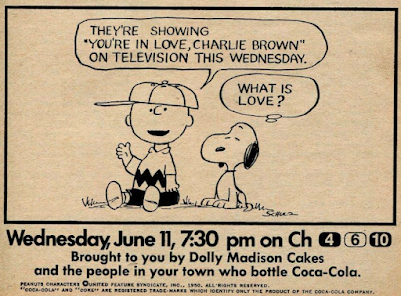
, and another one of those Charlie Brown specials that didn't really catch on, not like Christmas and the Pumpkin: You're in Love, Charlie Brown (7:30 p.m., CBS). This is, according to the always-reliable Wikipedia, notable in that it is the first television appearance of Peppermint Patty, who would eventually come to take over a good part of the storytelling in the strip. This Peanuts cartoon aired six times on the network. That's followed by a repeat doubleheader from Hooterville: at 8:00 p.m. on CBS, The Beverly Hillbillies head there to celebrate Thanksgiving with those folks from Petticoat Junction and Green Acres; next, Petticoat Junction's Uncle Joe crosses over to Green Acres as part of Hooterville's centennial celebration. If only they could have done a Petticoat Junction episode with someone from one of the other two shows—but no, it's time for Hawaii Five-O next, and there's no crossover from anything there.

A couple of great variety show lineups stand out on Thursday; This is Tom Jones (8:00 p.m., ABC) features Mama Cass Elliot, the Dave Clark Five, George Carlin, and Spanish singer Massiel; The Dean Martin Show (9:00 p.m., NBC) welcomes Lena Horne, Sid Caesar, Victor Borge, and the comic Times Square Two.

A couple of weeks ago, I mentioned one of my new favorites, Judd, for the Defense; on Friday, it's a case that even Perry Mason never had to deal with: "Judd probes the family crisis of a widow whose daughter murdered her husband, killed herself, but spared their child. Appointed guardian, Judd must decide what's best for the infant: the unstable home of close relatives or an institution." The top-flight guest cast includes Margaret Leighton, Brian Bedford, Penny Fuller, Carrie Snodgress, and Dabbs Greer.

l  l  l

Finally, a little something for when company drops by:


As always, if anyone tries this, let us know how it is. TV  

June 3, 2022

Around the dial


At Comfort TV, David is continuing a very interesting series he started recently, to watch at least one episode of every prime-time network series to air in the 1970s. This week, he's up to Tuesdays in 1970. How many of them do you remember?

The Horn Session returns to the wacky world of F Troop, as Hal reviews the episode "Spy, Counterspy, Counter Counterspy," from the show's first season. With Pat Harrington, Jr. and Abbe Lane as guest stars, it's as wacky as you'd expect.

At Cult TV Blog, John continues his look into the alternative explanation behind The Prisoner. "The Prisoner in the Asylum" has been a very provocative series, and as I've mentioned before, I'm looking forward to watching the series again, only this time from the standpoint of his scenario.

At The Classic Film Connection, Jillian reviews the TCM documentary on Dean Martin, Dean Martin: King of Cool. Personally, I'd give that title to Steve McQueen, but as I mentioned here, Deano was always cool, and Jillian's analysis is terrific.

Rick is back at Classic Film & TV Cafe with another edition of the Movie-TV Connection Game, and as usual I'll warn you to refrain from checking the comments before you've given your own answers. These are always a lot of fun!

At A Shroud of Thoughts, Terence remembers the late Bo Hopkins, the latest TV and movie star to pass on, who died last week, aged 84. In addition to the many movies in which he appeared, he was also a familiar face on television throughout his career, including a regular role in Dynasty. 

At The Hits Just Keep on Comin', JB takes one of his periodic looks back at a date in living history; this time, it's June 1, 1982. You know, I'm surprised at how much of this I remember, and how long ago it seems. I think it's called getting old. TV  

June 1, 2022

Over the Transom: Mannix Hires a Secretary


It's time once again for another edition "Over the Transom," the occasional feature by Stephen Taylor which debuted here last month. This month, Stephen takes a look at the actress who played such a pivotal role in the success of one of my favorite detective series.

by Stephen Taylor


It was 1968, and Mannix had been renewed for a second season. But CBS was dissatisfied, and so was producer Bruce Geller. For the series to succeed, Joe Mannix would need to work on his own, and get away from the constraints of Intertect, the corporate detective agency. At Intertect, he worked on a very short leash, constantly needing to report his whereabouts, file reports and keep an expense account. This stifled what could be done with the character, and Geller, at the urging of Lucille Ball, opened the second season with Mannix setting up his own agency. Given the nature of his work, he knew he’d be in and out of the office. He needed a secretary, someone to hold down the fort and answer phone calls and do research and keep the books. The secretary would end up doing far more than that, but that’s how her duties were described to Ms. Peggy Fair when Mannix hired her as his secretary.

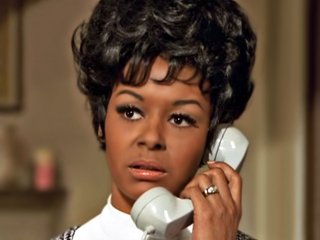
Peggy Fair was portrayed by Gail Fisher. Fisher was from New Jersey, and after winning multiple beauty contests began to model. She also gained some formal training as an actress working with Lee Strasberg and Elia Kazan. She had the chops, and she was ready to go to Hollywood. The only problem was whether she’d be able to find work. Fisher was black at a time when blacks were few and far between in television and the movies. The doors were beginning to open, but so very slowly. She arrived in Hollywood at about the same time that Nat King Cole had his groundbreaking variety show canceled by NBC due to an inability to find national sponsorship. Times were tough for black actors, but this began to come to an end in the early ’60’s when blacks actors and actresses began to land guest star spots on various television shows. The Fugitive was an early example, with Ruby Dee and James Edwards guesting in the first season in 1963. Bill Cosby became the first black actor to have a continuing role in a series with I, Spy in 1965. Both Cicely Tyson and Nichelle Nichols had regular roles in a drama, with East Side/West Side and Star Trek respectively, so Fisher was the third actress to share this distinction. In my opinion she was the first black actress to be given anything to do as a character.

As a secretary, Peggy Fair was everything a good secretary needed to be. They weren’t referred to as administrative assistants back then; they were called secretaries, and they did many things for their boss not listed in the ad posted in the newspaper. Peggy Fair was no exception. She was a single mother, a widow with a child to raise. Her late husband was an LAPD cop killed in the line of duty. (The circumstances of his death would be examined in an episode called “Medal for a Hero” in the third season). She answered the ad and was a perfect fit. She was tactful, accomplished at every sort of office work, knew how to screen visitors and do collections and so much more. The more included fixing Mannix sandwiches, coffee and the occasional meal. To run down obscure facts using someone named "Vivian" at the LAPD. To be waiting at the foot of the bed every time Mannix woke up in a hospital room. To make his bail. To place Art Malcolm on the alert. To cheerfully (most of the time) answer her telephone at 2 AM when Mannix needed some bit of information. To appeal to his sense of fair play and justice in talking him into taking some dog of a case that involves some relative/friend of hers with no money to pay, and to shame him when he wasn’t meeting her expectations. And to be a sounding board when Mannix was puzzled, and to make suggestions that often provided Mannix with some burst of insight. And to just be a secretary, and a friend and a confidant and a shoulder to cry on and a smile first thing in the morning on a rainy California Monday. And in 1968 being a secretary included making a nice ham sandwich for your boss, and having him ask you to "put a little more mustard on that, honey.."

Peggy Fair was also easy on the eyes, which led to speculation that she more than a professional relationship with Joe Mannix. No. While Mike Connors and Gail Fisher had great chemistry working together, there was never any sort of romance between the two. There couldn’t be. Peggy Fair was not going to get involved with a man who did the same sort of work as her late husband. The stress of being married to a cop wasn’t going to be any different than a relationship with a private detective. The hours, the worry, the constant terror of bad news; she’d been down that road before and wanted no part of that again, thank you very much. Mannix, for his part, played the field and enjoyed himself immensely. He never married, had no children, and was interested in neither. And a relationship would have destroyed the great chemistry these two had, one with the other. With the constant worry over his safety, the balance between the two characters would have shifted in a way that was detrimental to the series. The show would have jumped the shark years before Fonzie. And as a practical matter, the CBS Television Network just wasn’t going to allow an interracial romance. So it never happened. I think the series was better off without it. Her relationship toward Mannix was maternal mixed with friendship; he gave her someone to take care of and worry over. Mannix saw her as a friend, and would do anything to protect her and keep her from harm. In fact, he did this several times, as Peggy had a tendency to get kidnapped on a routine basis. He counted on Peggy to have his back, and she never let him down.

Several TV series back then experimented with racially charged language in their early seasons; Adam-12 and Sanford and Son come to mind immediately. It didn’t last long, and it didn’t occur at all on Mannix. Even the bad guys treated Peggy with respect, although one thug did refer to her as a “blackbird”. Mannix put the issue of racism front and center early on in an episode in the second season, “Last Rites for Miss Emma”. Peggy is attracted to a man (Robert Hooks) who tried to break up a robbery. Mannix begins to investigate, and finds the man may not be the hero he’s portrayed to be. When Mannix points this out to Peggy, she refuses to believe him and calls him a racist. Mannix had a way of grabbing people by their arm or shoulder to emphasize a point, and he grabs Peggy now and just stares at her without speaking; his look tells her that she knows better and that she better stop being foolish right away. Peggy finally breaks eye contact and, weeping, apologizes.

Peggy really shone in the fourth season episode “The World Between”. While in the hospital recovering from a gunshot wound (remember, she worked for Joe Mannix) she falls in love with an African prince (Hari Rhodes), and he with her. They begin planning a future, but he learns that he’s terminally ill. He decides to return to his homeland, and trying to keep Peggy from being hurt, breaks off the romance. This episode was all about Peggy; it only took Mannix about 10 minutes to figure out who was trying to kill the Prince and to break up the conspiracy, and the rest of the episode was given over to their romance. This episode, one of the best in the series, certainly features one of the best endings; Peggy is at her desk, as chipper as always. Mannix passes by and stops. He hesitates, not really knowing what to say. He finally asks her if she’s okay; she smiles and assures him that she’ll be just fine. Satisfied, Mannix walks into his office. Peggy then turns toward the camera; her face crumples and tears begin to run down her face.

Fisher never did much after Mannix. She had some legal issues later in the ’70’s involving drugs and long-distance telephone fraud, and there were rumors of drug abuse for many years after Mannix. She didn’t participate in the crossover episode of Diagnosis: Murder in 1997, and by the time she died in 2000 she had fallen so far off the face of the earth that it took nearly three months for word of her death to leak out to the general public. TV