February 6, 2015

Hitchcock, Sherlock, tough guys and TV Guides - they're all Around the Dial!

Limited time for me to look around the blogosphere this week, but that doesn't mean there's a limit to the interesting things out there.

"Isabel" is the latest episode of The Alfred Hitchcock Hour to receive the "Hitchcock Project" treatment from Jack Seabrook at bare-bones e-zine.  I'm never sure how much of the synopsis I should read when I haven't seen the episode yet - but as far as I've gotten, this one sounds very good.

At Classic Film and TV Cafe, Rick gives us the five toughest tough guys of the '70s.*  You know it's a tough decade when John Wayne only ends up in third place.  But you oughta see the two ahead of him!  Not sure about number five, but I wouldn't want to argue about it...

*I know they're all movie stars, but interestingly enough four of the five starred in their own television series at one time or another.

Cult TV Blog has some second thoughts on the British series Sherlock, with Oscar nominee Benedict Cumberbatch as the famed sleuth.  I'm glad he's warming to it; I was very skeptical of it myself until I saw the first episode, but if you're willing to view Sherlock Holmes through the lens of Doctor Who, I'd say you'll love it.

It's F Troop Friday at The HORN Section.  I've mentioned in the past that I watched F Troop when I was of age; even had one of the TV tie-in books, as I recall.  The show was worth it for Larry Storch alone, and he shines in this wild episode that includes a guest appearance from General Grant himself.  I think this one was on MeTV not that many months ago.

At Comfort TV, David takes a look at The Price is Right, and makes some very perceptive comments on the importance of the relationship between a show and its viewers.  His look back brings back memories for me, not only of Price but all the daytime game shows from that era.  And I love his comment that Dian Parkinson "was Cinemax before that was even a word."*  Well played, sir!

*He also mentioned that no one ever wore a bikini better; as I recall, she "unwore" it pretty well also.

Another week, another TV Guide review at Television Obscurities.  The issue of January 30, 1965 includes yet another plea by former FCC Chair Newton Minow to improve TV, a profile of Inger Stevens, a new William Shatner series, and more.  I really enjoy reading these recaps, particularly when it's an issue like this, one that I don't have.  But even when they're ones I do have, Robert always has a perspective that adds to my appreciation of the issue.

Sorry to link and run, but we'll be back tomorrow, right? TV  

February 4, 2015

The crime drama as metaphor

KEVIN WHATELY (LEFT) AND LAURENCE FOX SOLVE ANOTHER MURDER IN A SCENE FROM INSPECTOR LEWIS (PBS) 
You've probably heard the one about how Cabot Cove, home of Murder, She Wrote's Jessica Fletcher, actually has a higher per-capita murder rate than any other city in the country, or how NCIS's naval murder victims would actually be safer serving in Iraq or Afghanistan than they are stateside.  Added to that is the college town of Oxford in England, home to the Brit dramas Inspector Morse and its sequel, Inspector Lewis.  If the actual murder rate there was anything like what it is on television (and keep in mind there's rarely just a single murder in those episodes; there are usually two or three per story), it would be the most dangerous place in Europe.  But while watching an old episode of Inspector Lewis last week, I came on a theory that suggests there's another way we could view this series, and perhaps others like it.

I say perhaps, because the Morse/Lewis franchise has an elegance about it that is quite unlike any of the procedurals on American television.  It's not just the English atmosphere, although I'll grant you it's a bit different from the mean streets of New York; it's everything from the penetrating music to the essentially tragic nature of its crimes to the quite dignity in which the protagonists go about solving yet another murder.  These are not the arrogant bullies of Law & Order, nor the quirkbots of NCIS, the glib romantics of Castle, the gimmicks of the USA Network's crime fighters, nor any of the rest.  No, they may have the world-weariness of other homicide detectives, but it's combined with a sense that there's still a job that needs to be done, justice that needs to be administered in order to maintain the essential balance of the universe, and the novel idea that civilians are neither automatically the enemy nor automatically guilty.  Solving the crime comes not with a push or two of a computer keyboard, but only after a lot of hard work, conjecture, investigation, and a pinch or two of luck.

It's with this sense of elegant literateness, then, that I propose this theory.  It came about during the latest academic fraud-turned-murder story ("The Lions of Nemea"), and though this time the academic fraud was not also the killer, it did prompt the missus to remark that it's always the same.  "There's just as much dishonesty in academia as there is in politics," she said.  "It always comes back to that, one way or another."  I thought on that for a moment, and then the theory came to me.

"You know," I said, "that explains it.  We're not meant to view Oxford as the murder capital of England.  It's a metaphor for the corruption that's inherent in academic life everywhere."  I spent a while longer mulling this over (after the killer was captured and the final credits had rolled, of course), smoothing out the rough edges, and it still seems plausible.

It's essential, in a series about homicide detectives, that there be a homicide in each episode.*  Unless you're developing an anthology series, you're going to have the same team of investigators each week.  Given the nature of police jurisdiction, it's likely that each case is going to take place in the same approximate geographical area.  So far, so good - I've succeeded only in describing just about every police show ever.

*Unless it's a serial like Broadchurch, which gives us a whole season to think about one.

But, given the aforementioned elegance and intelligent composition of Morse and Lewis*, it doesn't seem far-fetched to add the next layer, that of metaphor.  Specifically to Lewis, there's the suggestion that all institutions of higher learning are corrupt; the only difference being the corruption that becomes public versus that which remains private.  In other words, could you point to any university in the world that as being completely immune from it?  To the extent that crime outside of the university setting occurs in Lewis, the same holds - the crimes of a corrupt institution, whatever it might be, will eventually seep out into the greater community.  Therefore, it's only logical to assume that institutional corruption will in time taint everything into which it comes in contact.

*For my money, Inspector Lewis is the best, and most compelling, crime drama on television, in case I haven't made myself clear.  Right now, though, that's relevant only in the sense that the quality of the series provokes such theorizing.

Further, I'd contend that what we're talking about isn't cynicism, but something quite different. In looking at Oxford as a metaphor, the real point is that while geography changes, while accents and scenic views and all the rest can vary from place to place, what doesn't change is human nature.  Or, more specifically, the corruption of human nature through Original Sin.  No matter how pastoral or how grimy the neighborhood, there's always the fallen nature of man to contend with.  It's what makes good people do bad things, what makes an honest academician fudge the results of a scientific study, what makes a desperate soul see murder as the only way out.  You could do a crime series set in Washington, D.C. and see the government as having much the same effect.*

*I realize this comes close to describing NCIS, with the government and/or the military-industrial complex acting as the corrupting influence, but in this case I think the cynicism would outweigh the metaphor.  Their crimes are less tragic and more evil.

I don't think most of the shows on TV nowadays, either the ones I mentioned earlier, or any of the others, would give this much thought.  It would be implicit that people do bad things, else there'd be no need for the police - but beyond that, I think they're primarily concerned with meeting their annual quota of episodes.  Lewis is as well, but the nature of the stories - what I called the tragedy at the heart of them - suggests more depth, at the very least a subconscious awareness of the situation.  Lewis' superior is surnamed Innocent; could there be any more of a metaphorical name for a chief inspector than that?

The one possible exception to this, the American series that might have understood this, is Murder, She Wrote.  Now, that was a fun series, with a very likable lead (Angela Lansbury) and plots that were entertaining, if not grand mysteries.  But, viewed in the great American tradition of stories about small tows such as Peyton Place, there's at least the possibility that Murder, She Wrote presents us with a look at the seething passions that live just below the surface of small town life.*  Cabot Cove, Maine is no more dangerous than any small town; it's simply a stand-in for all small towns.  They may look tranquil on the outside, but once you've entered the town limits, you see the underbelly for what it is - that is, pretty much like any place where a handful of people try to live under the same community roof.  Watching the show as if it were Anytown, U.S.A. means you don't have to suspend your disbelief quite as much, although there is the question as to just how one person, a grandmotherly type at that, can leave such a wide swath of death in her wake, unless she was a serial killer herself.

*As a movie poster or the back cover of a paperback book might put it.

You can give this as much or as little thought as you want, but to me the most important thing is that shows like Inspector Morse and Inspector Lewis or, for that matter, another British police drama called Foyle's War, can cause that kind of contemplation.  At heart there is always a sadness about crime, a sense that when an injustice is committed, the world weeps just a little bit.  Using a crime drama as a metaphor for a fallen world may seem a little extreme, but the show that can even cause one to consider it is the show well worth watching.

February 2, 2015

What's on TV? February 6, 1968

It's back to my old home turf in the Twin Cities for this week's listing, which comes from Tuesday, February 6.  Among other things, it's opening day for the Winter Olympics, but don't think that means there isn't a lot of other interesting stuff on the tube today, including an interview with a future president.  Let's check it out.

January 31, 2015

This week in TV Guide: February 3, 1968

This week the big TV event is the opening of the 10th Winter Olympics from Grenoble, France, and ABC is all over it.  The network promises “a 27-hour Olympic orgy” with at least one prime-hour a night, a 15-minute nightly wrapup, and daytime weekend coverage.  Included will be unprecedented live coverage, via Early Bird satellite, of the Opening Ceremonies at 7:45am CT on Tuesday morning.

The U.S. is hoping to make a better showing in this Games than in 1964, when speed-skater Terry McDermott was the lone American gold medalist  (with the U.S. taking home a paltry six medals in total), but the only American with a real chance for the gold is figure skater Peggy Fleming.  Nonetheless, ABC plans to cover all the angles, with a 250-man staff using 40 color cameras to bring the pictures back home.  Roone Arledge wants the games to be more than just a technical marvel, though: “Figuring out where the drama will be and shooting it – that’s more important than technical wizardry.”  In other words, the thrill of victory and the agony of defeat – or, as Jim McKay would say many times over the years, “up close and personal” – that’s the ABC way.

ALL: HADLEY TV GUIDE COLLECTION
Twenty-seven hours doesn't seem much of a broadcast “orgy,” does it?  By the time of the 1984 Summer Games in Los Angeles, the TV schedule had expanded dramatically, to take advantage of the favorable time-zone (and to help pay for the enormous amount ABC was shelling out to win the rights).  This kind of saturation coverage has remained the rule since, to the point that new sports are added, it would seem, simply to give the broadcasters more to show. Now, when you add up all the different platforms used to broadcast the Olympics, you've got more than 27 hours of coverage a day.


And so, when one looks at the Close-Up that accompanied ABC’s coverage of the first week of the Games, it’s kind of nice to see how simple things are, how naïve.  The 1968 Winter Olympics were not free from controversy, but they were still a sporting event to be covered, not a made-for-TV spectacle that saturates everything in sight.  What a concept.

***
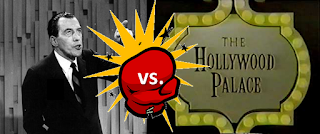
During the 60s, the Ed Sullivan Show and The Hollywood Palace were the premiere variety shows on television. Whenever they appear in TV Guide together, we'll match them up and see who has the best lineup..

Palace: Host Phil Silvers introduces singers Connie Stevens, Jack Jones and Polly Bergen; comedian Henny Youngman; the Waraku Trio, Japanese pantomimists; and the rocking James Brown Revue.

Sullivan:  Scheduled guests: singer-actress Michele Lee; comedians Jackie Vernon, Stiller and Meara, Morecambe and Wise, and Stu Gilliam; dancer Peter Gennaro; and acrobats Gill and Freddie Lavedo.

Neither show overwhelms this week, and that's why I'm giving the slight nod to the Palace.  Phil Silvers is very funny, Jack Jones is very smooth, and Henny Youngman can be very funny, particularly in small doses.  On the other hand, while I love Jackie Vernon as the voice of Frosty the Snowman it's almost impossible to watch his stand-up without thinking of it, and I've never been a big fan of Stiller and Meara.  Maybe next week will be better.

***

Well.  It seems as if just a couple of weeks ago I was writing about Ben Gazzara, noting that the article in question was a pretty snark-free one.  I also mentioned that there was one from a year later that portrayed him "in a slightly less flattering light."  That would be this issue, and the article is by Edith Efron, who follows Gazzara around for the day on his press junket through New York.  And the one question that confronts Gazzara no matter where he goes, no matter who he speaks to: when are you going to die?

It's not as serious as it sounds, nor is it as existential as all that.  It refers to Paul Bryan, the character Gazzara plays in Run For Your Life, who at the outset of the series is given no more than eighteen months to live.  The series is now in its third season; hence the questions.  At first Gazzara is all bonhomme and laughter, reminding the interviewer that "Little Orphan Annie never grows up," lauding the writers for keeping the series' quality high, the usual dog-and-pony act.  But as the day wears on, Gazzara's defenses begin to drop.  A one-minute plug on Hugh Downs' Concentration is followed by a radio interview with Ed Joyce, then an appearance on NBC with Lee Leonard, a talk with Art Fleming on NBC Radio's Monitor, an interview with Bob Stewart, a pre-Tonight show prep with Carson's staffers.  And, bit by bit, the weariness and frustration that Gazzara has with series television begins to show.

To Joyce, who quotes the well-known director Elia Kazan as calling Gazzara "one of the three most brilliant actors working in the English language," he admits that "This kind of work doesn't tap all the muscles," and that an actor's career doesn't always go the way they'd want.  "The plays don't keep coming, the films are fewer and farther between.  An actor has to work."  This will be his last series, he promises, but "I'm coming out of this one with loot."  As the day progresses the bonhomme dries up, the answers become rote and mechanical, the eyes deaden.  By the time he gets to Stewart's, all his defenses are down.  Asked to complete the sentence "Doing a regular series is like ______," Gazzara replies, "Being in purgatory."  Between interviews, he will tell Efron that the problem is "that there's so little opportunity for complex acting" in Run For Your Life.  "It's scripts, it's directors.  I'm becoming interested in movies.  Something is happening in European films.  They're nonobjective, bu they're personal.   They're not the creation of a bunch of bureaucracies."

The process of selling yourself is often a distasteful one for celebrities.  It's the very thing that Sammy Davis Jr. found so difficult to stomach when his variety show started, and his failure to do it at the beginning, when it most mattered, was one of the many reasons for its downfall.  Gazzara understands the necessity of turning himself into a "zoological creature" putting himself on display for tourists.  When he sits down with Efron for the last time, after the Carson pre-interview, she says of the drained Gazzara that "It would be an act of cruelty to conduct an interview."  All she can ask him, with a wry sympathy, is "When are you going to die?" to which he says, with an exhausted smile, "You know, Little Orphan Annie . . . she never grows up," after which he finishes the last of his drink with a gulp.

***

Care for a quick look through the week?

On Saturday, ABC's Wide World of Sports presents a heavyweight semifinal bout, with Jerry Quarry taking on Thad Spencer in Oakland.  The winner will face Jimmy Ellis for the title vacated after Muhammad Ali was stripped of it for refusing military induction.  Quarry will win the fight, Ellis will later take the title, and he in turn will lose to Joe Frazier down the line.  But all that is another story.

Sunday afternoon features another of Leonard Bernstein's "Young People's Concerts" on CBS, this time an all-Beethoven program.  It's up against NBC's coverage of the final round of the Bob Hope Desert Classic from Palm Springs, California, which will be won by the great Arnold Palmer.  ABC has a preview of the coming Winter Olympics.

Monday, singer/actor/activist Harry Belafonte starts a one-week stint as guest host on the Tonight Show, with a star-studded lineup featuring Senator Robert Kennedy and his wife Ethel, Bill Cosby, Lena Horne, and actress Melina Mercouri and her husband, movie producer Jules Dassinn.  A great lineup, but wait until we get until Thursday.

In addition to the opening of the Olympics Tuesday morning, Mike Douglas' show, which airs at 4pm CT on Channel 4, has a star guest of its own in former Vice President and current presidential candidate Richard M. Nixon.  And NBC's I Dream of Jeannie gives us a thorny problem:  Jeannie's locked in a safe, which has an explosive mechanism that will go off unless a demolitions expert can disarm it.  Making things more difficult, the man who opens the safe will become Jeannie's new master.  How does it end?  Tune in next week and see if Larry Hagman's still in the credits.

On Wednesday, it's another of Fred Astaire's acclaimed specials, with his partner Barrie Chase and a bevy of artists promoting "today's sound" - Simon and Garfunkel, Sergio Mendes and Brasil '66, the Young-Holt Trio and the Gordian Knot.  I think I'll stick to Fred's specials from the early '60s - that is, unless "The Sounds of Silence" describe the noise Simon and Garfunkel make.  This isn't a train wreck, it's more like one of those 500-car pileups.

You remember I mentioned Thursday night's Tonight Show lineup?  Tonight Belafonte's guests are Dr. Martin Luther King Jr., Paul Newman and comedian Nipsey Russell.  And herein lies a difference between late-night talk shows of the past and present.  Belafonte had an incredible guest lineup that week - I haven't even mentioned Sidney Poitier, Robert Goulet, Aretha Franklin or Dionne Warwick.  One of Belafonte's guests is a Nobel Prize winner, the other is a candidate for president of the Unite States.  Can you imagine Kimmel or Fallon with that kind of a lineup?   Or that two of the biggest headliners would be dead less than five months later?

NET has another of its unusual dramas on Friday.  Entitled "The Successor," the British play "focuses on the deliberations of a convention [in other words, conclave] of Catholic cardinals as they elect a new pope.  The cast contains characters such as the Cardinals of Palermo, Boston and Paris, plus some generically named prelates.  I wish I could find something more about it, but I cant.  This is the year Pope Paul VI releases his encyclical Humanae Vitae, after which many in the media probably wished the Church was meeting to select a new pope.

There are other things on this week - come back on Monday and see which day I chose.

***

Finally, this week's TV Teletype gives us a preview of coming attractions.  Sheldon Leonard, the producer of I Spy, has acquired rights to James Thurber's works with the intent of making an hour-long series for the 1968-69 season.  That turns out to be My World and Welcome to It, which stars William Windom.  It actually premieres on NBC in 1969 and runs only 30 minutes, but though it's cancelled after a single season it's still fondly remembered by many classic TV fans.

ABC has plans for a new daytime chat-and-info show called This Morning, a 90-minute daily show that premieres next month.  It's hosted by Dick Cavett, and will run in daytime for less than a year before shifting to prime time, and then to the late-night slot to replace Joey Bishop.

And then there's the one that got away, the one we would have liked to see.  It's a pilot called City Beneath the Sea, and if all goes well for producer Irwin Allen, it will become part of the prime time schedule.  "It's about a futuristic city under the ocean," writes Joseph Finnigan, who ads that "Maybe [Allen'll] cast Lloyd Bridges as mayor."  Sadly, the movie never turns into a regular series, and we're forced to conclude that Finnigan is right.  Imagine Lloyd Bridges as mayor, with Richard Basehart and David Hedison as head of the city's defense system?  It's a sure-fire idea, that is. TV  

January 30, 2015

A deal for our readers, classic movies, tragic anniversaries, and Happy Birthday Dorothy Malone!

DOROTHY MALONE AND JOHN IRELAND IN A SCENE FROM THE FAST AND THE FURIOUS  
As is (too) often the case, it's time for me to play catch-up.  I've got announcements, emails from readers, requests for information, and more.  Let's get right to it, shall we?

A new benefit for our readers.  I've recently become acquainted with The Movie and Music Network, a website that offers streaming movies and music.  The good folks at MMN asked me to take a look around at the site, which offers all kinds of classic movies, foreign flicks, silent films, and more.  Best of all for us classic TV fans, there's a network devoted to our genre as well, with some very worthwhile shows for you to check out.

And now here's the good news.  A month’s subscription of unlimited streaming is ordinarily $5.99, but the Network has graciously offered my readers half-off of your first month.  To take advantage, just email Sonia at sonia@movieandmusicnetwork.com with the promo code “MITCHELL” to take advantage of this offer.

I'll be checking in from time to time with news on programs you might want to investigate, and why.  And speaking of which...

Happy Birthday Dorothy Malone & John Ireland!  Today's the 90th birthday of Dorothy Malone, and the 101st birthday of John Ireland.  Malone is, of course, known to classic TV fans for Peyton Place, and classic movie fans with a sharp eye and memory will remember her from her brief but memorable appearance in The Big Sleep.  In both of those roles, as well as so many through her career, she had a presence and appearance that caused you to turn your head and look - and remember.  Quite by accident, I read that she lives right here in Dallas, and with a little research - sure enough, she's right here in the phone book.  As a matter of fact, we've driven past where she lives without even knowing it!  It has been suggested that I should call her up and ask for an interview, but bold as I may be, I don't think I've got the guts to do it out of the blue.  Question of the day: am I a coward?

John Ireland's career was mostly in the movies, but he was no stranger to television either, with a raft of guest roles in series such as Bonanza, Thriller and Riverboat, and starred for two years in the British series The Cheaters.  (I wonder if Cult TV Blog knows about this?.  He also played a pivotal, Oscar-nominated role in the great political movie All the King's Men.  (I wrote about the Pulitzer Prize-winning book here.)

As luck would have it, you can catch both of these stars in Movie and Music Network's movie of the day, The Fast and the Furious.  No, not the franchise of films that seem to be in the theaters all the time, but the original, filmed in 1955.  It's a terrific noir thriller, and it's directed by Roger Corman - I mean, how much better can it get?  Not surprisingly, it's not nearly as frenetic as the remake (which, in fact, it only vaguely resembles), and seeing as how it's noir, you know that Malone's character is not as simple as first appears.  This movie also has a twist at the end that, I think, is somewhat surprising for the usually fatalistic noir genre - but why listen to me when you can check it out for yourself here.  And please do so - I don't think you'll be disappointed once you've visited MMN.

Calling Mike Dolan.  Mary Jo Schwartzhoff writes, "Hi, I have a question. I'm trying to figure out about what time I was born by what TV shows my sister remembers being on. Do you have the TV line up for Chicago for September 20, 1964?"   This sounds like a call for you, Michael.  Can you provide us with the information?

Remembering Apollo 1.  January 27 was the anniversary of the 1967 flash fire that claimed the lives of the three astronauts scheduled to fly the first manned Apollo mission - Gus Grissom, Ed White and Roger Chaffee.*  My friend Marc Ryan sends along this clip from NBC of his father Bill anchoring a special report on the disaster.  He also writes, "You'll notice a funny edit after about 90 seconds. He is ad-libbing the rest of the way."  I remember when this happened; I was only six at the time, but for a kid who'd watched as many space launches as he could, it was - as I said to Marc - a hell of a shock.

*And January 28 was the anniversary of the Challenger explosion.  A somber week for the American space program.

And finally...  If you're out there Jeff Alexander, some time back you asked me for some information, and I've been woefully, woefully slow in getting it to you.  And when I did send it, the email bounced back.  If you see this and still need the information, send me your new email address, and I'll get it to you!

That's it for today - see you tomorrow!