The Fugitive was the big story when we looked at this issue back in 2013; back then, the focus was on star David Janssen, but in this encore look I think it'd be appropriate to recall the series itself, and its position in the cultural history of America.
It’s often been assumed that the series was based on the true-life story of Dr. Sam Sheppard, who in 1954 was convicted of the murder of his wife, and wasn’t cleared of the crime until 1966. It’s a claim that’s always been denied by the show’s creator, Roy Huggins, who said he was actually inspired by Victor Hugo’s novel
Les Misérables. Maybe that’s the case, maybe he was simply trying to avoid any entanglements with the Sheppard family. The idea of a doctor murdering his wife isn’t exactly uncommon, after all – I personally knew one who faced such an accusation myself – so we’ll probably never really know how the show got its start, not that it matters in the long run.
As I wrote a few years ago, it’s a delicious irony that Susan Hayes, the “other woman” mentioned as a possible motive in the Sheppard murder, wound up being married to a music editor who worked on – you guessed it –
The Fugitive. It’s true that you just can’t make this kind of stuff up.
Leaving aside the inspiration for
The Fugitive, I’ve mentioned in the past that the concept of the series was controversial to begin with; a number of people, including some executives at ABC, were uncomfortable with the idea of basing a weekly series around the premise that the American criminal justice system had successfully convicted an innocent man who, but for the intervention of Fate, would have been executed. That ultimately fell by the wayside in the critical and popular acclaim that greeted the series, but it’s an interesting point to ponder nonetheless. The show ended in September 1967, a time in which the counterculture was already well under way. As far as I can remember, the idea of Richard Kimble as a persecuted folk hero, along the lines of someone like Reuben “Hurricane” Carter, about whom songs were written and movies were made, was never broached, although we do understand that there is a strong if small claque of people familiar with the case who strongly believe in Kimble’s innocence.
Suppose, however, that
The Fugitive had continued for a couple more seasons, or at least through the year 1968. Would it have become a different series then, one in which Kimble becomes a full-fledged symbol of oppression by “The Man,” someone unjustly persecuted by the same establishment currently conducting the war in Vietnam? Would he have been embraced by the counterculture and put into some kind of underground railway that would have enabled him to more safely travel across the country while still continuing his search for the one-armed man? And how would Kimble himself have reacted to this? From Janssen’s portrayal, he appears to be a quiet, conservative man by nature, not given to drawing attention to himself even when he’s not on the run for his life. My suspicion is that he would have been quite uncomfortable with being embraced as a symbol; it was much more important to him that people believe in his innocence, hence his determination to track down his wife’s real killer rather than simply disappearing in, say, Argentina or Brazil, where he could live without Lieutenant Gerard breathing down his neck, but by the same token would have given up his best chance to clear his name and reputation.

Regardless, it would have been interesting had
The Fugitive been confronted with such a choice: to follow the course of the folk-hero Kimble (perhaps even becoming part of the counterculture himself as he came to view its inhabitants as misunderstood misfits, not unlike himself), or to continue the series as was, pretending that this segment of America didn’t exist. The challenge for Quinn Martin would have been that
The Fugitive took place not in an isolation booth, where reality seldom intervened, but out there in that great, sprawling America. Although the show’s production didn’t travel the land as did Route 66’s, it was nonetheless a travelogue of sorts, and it would have been difficult to pretend that a culture that had even infiltrated such an icon of middlebrow America as Ed Sullivan would never come into contact with a man on the run from the police.
I make no pretense to having the right answers, of course, but you must have some thoughts you’d like to share, right?
◊ ◊ ◊
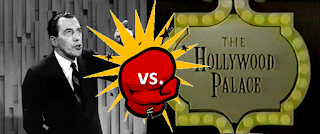 During the 60s, the
 Ed Sullivan Show
and The Hollywood
Palace
were the premiere variety shows on television. Whenever they appear
in TV Guide together, we'll match them up and see who has the best
lineup..
Ed Sullivan: Scheduled guests include singer Ella Fitzgerald; Duke Ellington and his band; singer Rita Pavone; singer-dancer Roy Castle; comics Stiller and Meara; the two Carmenas, balancers; and comedian John Byner.
Hollywood Palace: Host Eddie Fisher welcomes actress-vocalist Connie Stevens, comedian Jack Carter, the Marquis Chimps, the Arirang Korean ballet troupe, comedy pantomimist Ben Wrigley and the Kuban Cossacks, dance team.
This contest was pretty much over at the start. With Ella and Duke headlining the Sullivan show,
Palace was going to have to come up with something big to top it. Eddie Fisher, Connie Stevens and Jack Carter are OK, but the royalty that the
Palace needed was already spoken for. Crown
Sullivan as winner for the week.
◊ ◊ ◊
Some interesting articles this week, the best of which is a story on The Three Stooges, who are going strong as ever since their fueled-by-TV comeback. The emotional peak is a moving story about a 12-year-old girl being treated for emotional troubles. The girl spoke and wrote only in numbers, and when she became angry she "cried out numbers ending in 4." The stunned doctors eventually discovered that the numbers she used corresponded to the numbers on Three Stooges trading cards. The cards depicted "moods of violence" that the troubled girl herself was unable to articulate without the emotional release offered by the Stooges; in recounting the story, Moe Howard tears up.
It's interesting to note that although the Stooges (which at this point consist of Moe, Larry Fine, and "Curley Joe" DeRita) don't receive any financial compensation for their old movies, but the features and personal appearances sparked by the renewed interest in the movies more than make up the difference. Ah, the Stooges - loved 'em as a kid, love' em just as much now.
Let's see - there's also an article about CBS's series
The Nurses, which has just been retooled with the addition of a couple of doctors; it's now called
The Doctors and the Nurses. The nurses (Shirl Conway and Zina Bethune) are now supporting players to the doctors (Joe Campanella and Michael Tolan). According to producer Herb Brodkin, the move was made to improve ratings and dramatic potential: since nurses can't diagnose patients, there just weren't enough stories to carry the show. Says Brodkin, "Part of the problem was that, in making things happen in a story, nurses are handholders."
There's also Malcolm Muggeridge's article on how
The Beverly Hillbillies explains your salvation; that was such an intriguing story,
I wrote an entire piece about it.
◊ ◊ ◊
How about some sports?
It's March, so you'd be well within your rights to wonder where March Madness is. But, as we've pointed out many a time in the past, things were much different back then. There's a grand total of
one college basketball game, and that is the result of the Big Ten* Game of the Week (WCCO, Saturday at 3:30 p.m. CT) pitting Minnesota against Michigan. If you're looking for conference tournaments, the ACC is the only major conference to have one, and you're not going to find that on Minneapolis television. Nor the NCAA tournament, for that matter; it doesn't make its network debut until 1969, and the term "March Madness" doesn't come along until Brent Musburger coins it in 1974.
*
Back when the Big Ten actually had ten teams. Yeah, that was a long
time ago.
If you insist on sports, though, there's the
Pro Bowlers Tour at 2:30 p.m. Saturday afternoon on ABC, followed by
Wide World of Sports (figure skating and ski jumping). On Sunday, it's the latest renewal of the epic rivalry between the Philadelphia 76ers and Boston Celtics on ABC's Game of the Week Sunday afternoon, followed on WCCO by the final round of the Pensacola Open golf tournament,
And if that isn't enough for you, check out the Sports Awards on Wednesday night - you can read about it below.
◊ ◊ ◊
It's only been 20 years since the end of World War II, and the impact of that war endures in American culture - and the week's programming.
It starts on
Saturday with "Battleground." acclaimed as one of the most realistic war movies of the time (and winner of two Academy Awards) on NBC's
Saturday Night at the Movies, starring Van Jonson, John Hodiak and Ricardo Montalban, and reaches a peak with the 1962 epic "Judgment at Nurenberg" on ABC's
Sunday Night Movie, featuring a dynamic, Oscar-winning performance by Maximillian Schell as defense attorney for four Germans accused of war crimes. Spencer Tracy, Burt Lancaster, Judy Garland, Richard Widmark, Marlene Dietrich, and Montgomery Clift round out the cast.
On
Monday Jerry Lewis does a rare dramatic turn on
Ben Casey, as well as directing the episode, "A Little Fun to Match the Sorrow." Lewis plays a resident hoping to move into neurosurgery, but his clownish antics clash with the humorless personality of Casey. A better choice might be
The Alfred Hitchcock Hour on NBC, a story of a mechanic scheming to get into show business, starring James Farentino, Vera Miles, and John Carradine.
NBC presents a news special
Tuesday night entitled "The Pope and the Vatican," covering the concluding days of the Second Vatican Council and the radical changes (termed
aggiornamento, or "bringing up to date") coming to the Catholic Church. Compared to the turmoil sweeping the Church today,
aggiornamento seems like a walk in the park.
The most notable event to air on
Wednesday: the "first annual" Grand Award of Sport, airing at 8:30 p.m. on ABC, presented live from the New York World's Fair, and hosted by Bing and Kathryn Crosby. The format: "Panels of outstanding sportsmen have selected 20 winners" from a list of 83 nominees representing "the world's top athletes". The nominees included football stars Jim Brown and Johnny Unitas, boxer Cassius Clay, baseball's Sandy Koufax, basketball greats Wilt Chamberlain and Oscar Robertson, and hockey stars Bobby Hull and Gordie Howe. At the show's end, one of these winners will be chosen to receive the "Grand Award," presented by former astronaut John Glenn. I can't find another listing for the "Grand Award of Sport"; it's my guess that it was either replaced or folded into the
Victor Awards, which began (coincidentally?) the very next year, 1966.
The World War II theme continues
Thursday night with a pair of programs: first, NBC's
Kraft Suspense Theatre (9:00 p.m.) presents Barry Sullivan and Glenn Corbett in a drama about an OSS major and his inexperienced demolitions man who threatens to jeopardize the mission. If that isn't enough history for you, take a break for the local news and then come back for the KMSP 10:30 movie,
The Diary of Anne Frank with Millie Perkins and Joseph Schildkraut. By the end of the week, we should all be reminded about the horrors of war.
 |
| SOURCE: HADLEY TV GUIDE COLLECTION |
Finally,
Friday offers as the most interesting item not a program, but an ad: for McDonald's
new "main dish," the Filet-O'-Fish. (Well, it
is Lent.) I've often thought that if it was invented today, it probably would have been called the McFish. In other news, the syndicated
Have Gun - Will Travel (7:30 p.m., Channel 11) gives us a wonderful image: Paladin (Richard Boone) as the bodyguard to Oscar Wilde. And later on Channel 11, James Garner stars in yet another World War II adventure,
Darby's Rangers. I expect it's not
quite as grim as some of the other offerings this week.
◊ ◊ ◊
Speaking of which, we'll finish up by coming full circle from
Nuremberg to the note in TV Teletype that on April 11 the ABC program
Discovery '65 will be telecasting David Amram's Holocaust opera
The Final Ingredient, commissioned by the network and based on the teleplay by Golden Age writer Reginald Rose. "Set in the Bergen-Belsen concentration camp,
The Final Ingredient relates the story of a group of inmates who attempt to hold a secret Passover Seder inside the camp, and their quest for the final ingredient, which lies just outside the camp walls." Interesting, as
this article points out, that ABC conceived of this as a "Passover Opera" that might be presented annually - almost a Jewish counterpart to Menotti's Christmas opera
Amahl and the Night Visitors. But it didn't become an annual broadcast - at least, as far as I know. It's
available for viewing at the Paley Center - might have to check this out someday.
TV


