January 16, 2023

What's on TV? Monday, January 15, 1968


Ah yes, the return of Arnold Zenker! We last saw him filling in for Walter Cronkite on the CBS Evening News, and now he's a co-anchor on the WBZ news; it's always fun to see a familiar name. And speaking of familiar names, last week we saw the New England edition of TV Guide, and now we've skipped ahead one week and ten years, to the Eastern New England edition. The Boston stations are still around, but Maine is nowhere to be found, replaced by a variety of Eastern locations; compare the differences. Oh, and did you notice Issues and Answers at 1:00 a.m. on WNAC, right after The Joey Bishop Show? Perfect time for it, if you ask me!

January 14, 2023

This week in TV Guide: January 13, 1968


Sometimes it seems I just can't help repeating myself. I repeat: sometimes it seems I just can't help repeating myself. I don't really mean to do that; at the very least, I'd like you all to think I have more than just a handful of points that I recycle over and over. But, as I've said many times before (see!), plus ça change, plus c'est la même chose; the more things change, the more they stay the same. Case in point this week is the sporting event of the week, the "second annual Super Bowl" pitting the AFL champion Oakland Raiders against the NFL (and defending Super Bowl champion) Green Bay Packers (Sunday, 3:00 p.m., ET, CBS). You may notice three things right off: the game's already being referred to as the Super Bowl even though that isn't its official designation; it hasn't yet become so affected that it uses Roman numerals ("second annual"); and it's being played in the daytime rather than primetime. It isn't even the last sporting event of the day; the Bing Crosby National Pro-Am Golf Classic airs at 6:00 p.m. on ABC, with defending champion Jack Nicklaus, Bob Hope, Dean Martin, Andy Williams, Phil Harris, and the host. 

There's something else you'll notice: the game's being played on January 14. By contrast (and this is where I repeatedly get repetitive), this year's playoffs don't even start until January 14. Of course, there are only eight playoff teams between the two leagues in 1968, whereas there are 14 in the playoffs today. Still, at least until the last couple of decades, football has at least made a pretense of trying to end its regular season in the same calendar year as which it started. But I suppose if the World Series can end a few days after Halloween, the Super Bowl can be played a couple of days before Valentine's Day.

Anyway, the real question, as Melvin Durslag points out in his feature story, is: what if the AFL should win? This is the eighth season of the rival league, and the second time their champ has played the champ of the NFL. The AFL has shown progress during those eight years, but how much? "That is," he says, "we know for a certainty the National League is stronger, but we aren't sure by how much." The NFL champion Packers, considered by many to be the greatest professional football team in history, are coming off their third consecutive NFL title, and fifth in the last seven years; last year they defeated Kansas City 35-10 to win the inaugural Super Bowl. Their opponents this year, the Raiders, finished the regular season 13-1 and defeated the Houston Oilers 40-7. They're viewed by some as perhaps the finest team the AFL has ever produced. 

And if the stakes are high for the players, they're even higher for the two networks covering the leagues, CBS (the NFL) and NBC (the AFL). Last year, when the two networks televised the Super Bowl simultaneously, CBS spent more to promote the game than any other program they'd ever televised. "Our cash outlay alone ran more than $100,000," says one executive, "and very possibly we gave away a million dollars' worth of time." During the course of the regular season, CBS pays upward of $22,000,000 to the NFL, which it recoups with commercial times of up to $70,000 a minute. Would advertisers, Durslag wonders, still be willing to pay that amount should the AFL prove itself an equal rival? "Like the league it backs, NBC has the sweet irresponsibility of everything to gain with scafrcely a thing to lose."

Last year's game, played in Los Angeles, was blacked out on both networks; this year it moves to Miami, a much smaller market, which should help CBS out ratings-wise. The Packers win their second consecutive Super Bowl, defeating Oakland 33-14. However, that question about what happens if the AFL wins—they won't be asking that much longer.

l  l  l

During the 60s, the Ed Sullivan Show and The Hollywood Palace were the premiere variety shows on television. Whenever they appear in TV Guide together, we'll match them up and see who has the best lineup.

Sullivan: Scheduled guests: Duke Ellington; actress-singer Tammy Grimes; singers Buddy Greco, and the rock 'n' rolling Vanilla Fudge; comedians Flip Wilson, and Davis and Reese; magician Silvan; and baton twirler Diane Shelton.

Palace: Joining Bing Crosby to open the series' fifth year are Peggy Lee, Milton Berle, Jimmy Durante, Lawrence Welk, Phil Harris, Roosevelt Grier and the Los Angeles Rams' Fearsome Foresome, and the acrobatic Solokhins of the Moscow Circus. Cameras recall past Palace guests, including Louis Armstrong, Fred Astaire, Jack Benny, Nat King Cole, Bette Davis, Ella Fitzgerald, Judy Garland, Buster Keaton, Bert Lahr, Ethel Merman, George Burns, Gloria Swanson and Ed Wynn.

The big news is that The Hollywood Palace is back on Saturday nights where it belongs, and hopefully the person who decided to move it to another night is back where they belong—in another job. You can't really say much more about the anniversary show than the lineup above, and ordinarily that would be more than enough to win. I have to admit, though, that one of my favorite Sullivan clips comes from this show: Vanilla Fudge singing "Keep Me Hangin' On." Go figure. Oh yes, there's Duke Ellington too; what a delightful mess of a mix. For sentiment's sake, this week is a Push.

l  l  l

Throughout the 60s and early 70s, TV Guide's weekly reviews were written by the witty and acerbic Cleveland Amory. Whenever we get the chance, we'll look at Cleve's latest take on the shows of the era. 

"In the general category of adventure shows," Cleveland Amory says, "there are only three in the A class—I Spy, Mission: Impossible and Ironside." There are several in the B category though, including one of the season's new offerings: Mannix, the detective series starring Mike Connors and Joseph Campanella. I might quibble a bit with Cleve putting Mannix in the "adventure" category; it's a private-eye series, which just happens to have a lot of action. I can't argue with his conclusion, however, which is that Mannix is one of the best of the Bs.

I've read comments over the years from fans of the show who point out a warmth and humanity in Connors' depiction of Joe Mannix, and I think Amory picks up on that fairly quickly; he acknowledges that there is too much violence in the show (a non-uncommon Amory argument), and too many melodramatic chases, but the violence "seems more excusable than in most shows," and as for the chases, "these too are by no means so melodramatic that you don't care. You do care—even when, as in one recent episode, you felt that even Mannix himself didn't think he had a chance." That's a shrewd point, and I think it goes a long way toward explaining the series' longevity (it will run for eight seasons, and leaves only because of a dispute over reruns shown on other networks). We do care about Mannix, and one reason is that he seems to care about his clients, enough so that he'll go where angels fear to tread, but bad guys hang out far too often. 

Mannix has many things going for him, including a sense of humor, and in this first season, where he works essentially as an employee of private-detective firm Intertect (run by Campanella), he shows a rebellious streak that will serve him well when he strikes out on his own next season, assisted by the capable Peggy Fair. But one thing that never leaves him is a sense of justice, as Amory points out in an episode about police corruption. " 'Since when,' one policeman asks Mannix, 'did some of the guys in your line of work start worrying about being legal?' Replies Mannix grimly, 'Since some of the guys in your line of work stopped worrying about it.' " We could use a man like Joe Mannix again, couldn't we?

l  l  l
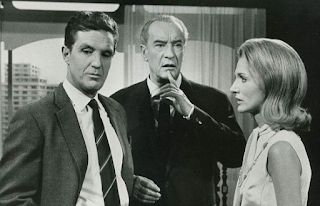
Robert Stack, George Sanders, Lee Bouvier 
There have been, as we know, many bad decisions made in the history of television. Many, many bad decisions, if we're being perfectly honest about it. (And they weren't all made by the person who moved Hollywood Palace to Mondays.) One of those lesser decisions, to be charitable, belongs to David Susskind, who was inspired by Truman Capote to produce a remake of the 1944 film classic Laura as a vehicle for Capote's friend, Princess Lee Radziwill. (Susskind and Capote discussed several options before deciding on Laura.) If you look at the cast of this production, though (Wednesday, 9:00 p.m., ABC), you won't see Radziwill's name anywhere; instead, you'll see that Laura is played by Lee Bouvier. Now, Lee Radziwill is a real princess (her husband is Prince Stanisław Albrecht Radziwiłł), but her maiden name is Bouvier—as in Jacqueline Bouvier, her older sister, whom you might recognize by her married name, Jacqueline Kennedy. See how it all adds up?

Anyway, we can be brief about this. Laura, the 1944 version, is, as I said, a classic, nominated for five Oscars, with a memorable theme song. Laura, the 1968 version, is terrible. Robert Stack, in the role played so well by Dana Andrews in the original, would later write that "the production resembled a junior high school effort." One critic called it the "worst drama" of the season, adding that Radziwill was "unbelievably bad." (In other words, she's no Gene Tierney, Laura circa 1944.) It having been made unavailable for preview, all Judith Crist can do is marvel "at the courage of those involved in attempting to surpass that 1944 film triumph." George Sanders, Arlene Francis, and Farley Granger round out the cast. 

There are a couple of ironic footnotes to the story: although Laura is scheduled for January 17, with a prominent Close-Up in TV Guide, it winds up being pushed to January 24 due to President Johnson's State of the Union address. And a repeat broadcast in June 1968 is postponed due to the assassination of Lee Radziwill's brother-in-law, Robert F. Kennedy. Perhaps they should have left well-enough alone.

l  l  l

Let's see, what else have we got going for us this week? On Monday, "The Seven Wonders of the World Affair" is the last show of the series for The Man from U.N.C.L.E. (8:00 p.m., NBC). Debuting next week in this time slot: Rowan and Martin's Laugh-In. Tuesday is a rerun of last February's fairy-tale favorite Jack and the Beanstalk (8:00 p.m., NBC), with Gene Kelly producing, directing, and starring as Jeremy, the peddler who sells the magic beans to our sucker—er hero, Jack. The special combines live action and animation; Bobby Riha is Jack, and in a wonderful piece of casting, Ted Cassidy is the voice of the giant. Tuesday is also the night for the adventures of Alexander Mundy, aka Robert Wagner, in ABC's new series It Takes a Thief (8:30 p.m.), which debuted only last week.

Wednesday night, President Johnson gives the State of the Union (9:00 p.m., all networks), and you'll be glad to know that while "our country is challenged, at home and abroad," the United States and her people "have the strength to meet our every challenge," as well as "the will to meet the trials these times impose." Free elections have been held in Vietnam, and "the enemy has been defeated in battle after battle." (Apparently someone forgot to tell the North Vietnamese the importance of this.) LBJ is also committed to using our abundance so that everyone can eventually share in it. In conclusion, this is the State of the Union: "seeking, building, tested many times in this past year—and always equal to the test."

Thursday night, Batman (7:30 p.m., ABC) features what many fans consider the worst episode of the show's three-season run, "Nora Clavicle and the Ladies' Crime Club," in which Commissioner Gordon, Chief O'Hara, and the whole police force are fired and replaced with women. Barbara Rush is wasted as Nora Clavicle, a woman's rights activist, and even I cringe from the sexism when I watch it. Better to watch Elizabeth Montgomery in a dual role of Samantha and Serena on Bewitched (8:30 p.m., ABC) or The Dean Martin Show (10:00 p.m., NBC), with guests George Burns, Eddie Albert, Florence Henderson and Janie Gee. On Friday, Lorne Greene narrates David L. Wolper's documentary World of Horses (7:30 p.m, NBC), which pre-empts Tarzan, and I'm not sure how you feel about that if you were a fan of Ron Ely, but I guess it's just fine with me. 

l  l  l

I was mentioning to someone the other day that I'd counted ten Perry Como Christmas shows on YouTube, all from different years. Now, you might not think it was necessary for me to throw that last part in, but if so, you don't remember the days of Bob Hope, back when he had two Christmas shows each year.

For 25 years now, beginning in 1941, Hope has travelled around the world entertaining American troops wherever they might be stationed, including Tunisia, the South Pacific, Korea, Greenland, Berlin, and (since 1964) Southeast Asia. He'd do his regular studio Christmas special, which aired in December, and then he and his troupe (always including beautiful female stars; this year including Raquel Welch, Barbara McNair, and Miss World) would be off to wherever the action was, the results of which would turn up on television sometime in January. We're in such a hurry to take down Christmas tree nowadays, but back when I was growing up, it wasn't Christmas, or New Year's, or the bowl games, that signified the end of the holiday season—it was Bob Hope's show from Vietnam.


This week Hope shares some of his memories with Leslie Raddatz as a preliminary to The Bob Hope Vietnam Christmas Show (Thursday, 8:30 p.m., NBC). He's entertained audiences of 50,000 in Marseilles, France, and eight at an impromptu refueling stop in Alaska. The first year he went to Vietnam there was a bullet hole in his plane; last year, captured Vietcong documents showed that he and his troupe had missed a planned bombing of their hotel by 10 minutes. In Korea he passed a child's body in the road ("He had just been shot"); two weeks later he saw pictures of where his stage had been, burning after an air raid. "In '44," he tells Raddatz, "we played before 15,000 Marines on an island in the South Pacific. We knew that they were invasion troops and that half of them would never come back. Later we found out that 60 percent of them were knocked off."

Hope figures he's traveled about 6,000,000 miles in all these years, and he's received more than 700 awards and citations, including a tribute from President Truman that had been signed by 1,000,000 GIs. "It's a lot of work," he acknowledges, "from the time you wake up in the morning until you go to bed at night, you never have a minute. But it's a very exciting, gratifying thing, and I wouldn't have it any other way."

l  l  l

MST3K alert: Creature from the Black Lagoon (1954). "In an Amazon lagoon, a scaly amphibious Gill-Man is captivated by the girl on scientific expedition. Richard Carlson, Julia [sic] Adams." (Friday, 1:30 a.m., WNAC). This never made it to the Satellite of Love, but the first sequel, Revenge of the Creature (1955) did, with John Agar, Lori Nelson, and John Bromfield. And, of course, Ricou Browning as the Creature. TV  

January 13, 2023

Around the dial


I'm not sure; that character on the small screen looks a little like Paul Brinegar, Wishbone on Rawhide, but someone more familiar with the Western genre might be able to tell for sure. It could be someone from a series like Death Valley Days, or it could be some made-up scruffy character. That's one of the great things about these old photos; you never know what you'll find.

For example, at bare-bones e-zine, we're off on a new Hitchcock Project, as Jack introduces us to Leigh Brackett's first Hitchcock script, "Death of a Cop," from 1963. It's a tense crime drama starring one of the great stars of the crime genre, Victor Jory, along with Peter Brown and Richard Jaeckel.

At Cult TV Blog, John turns once again to The Prisoner, with an intriguing idea for watching the series. Patrick McGoohan had apparently originally intended it to run as a series of 90-minute films, and John sets out to watch them this way, beginning with the final two episodes of McGoohan's Danger Man. Can't wait to try this out myself.

Some Polish American Guy, aka my friend Dan Budnik, is back with a new series on his podcast, Eventually Supertrain: Lucan, the 1977-78 drama. His co-host is Made for TV Mayhem's Amanda Reyes, so be sure to check out the link for where you can listen.

At Comfort TV, David takes a look back at the cop buddy series Starsky and Hutch. This is another series I admit to never having seen, although my defense is that I was living in the World's Worst Town™ for most of its run, making it unavailable to me. Granted, I haven't sought it out since, but if you're a fan, you'll want to see what David has to say.

Television's New Frontier: The 1960s returns with the 1962 episodes of The Real McCoys, the final season of the successful, long-running series, and how it copes with the absence of actress Kathy Nolan. who left the series after the fifth season.

At A Shroud of Thoughts, Terence shares his entry in the "What a Character! Blogathon," a look at the career of Jack Carson, a wonderful character actor who moved between movies, radio and television. Even if you don't recognize the name, you'll recognize him when you see or hear him.

The Outer Limits is a series I've always enjoyed since I saw it in reruns shortly after it went off of first-run on ABC (with the proviso that some episodes are better than others), and Cult TV Lounge reviews three episodes from the first season; "They're not among the best episodes but even lesser episodes of this series are pretty good and pretty interesting." TV  

January 11, 2023

When sports becomes news


by Mitchell Hadley and Marc Ryan

Many of you probably witnessed the horror scene in Cincinnati on January 2, when Buffalo Bills player Damar Hamlin suffered a cardiac arrest during the game and had his heartbeat revived on the field. My suspicion is that most people watching feared Hamlin was dead, which wasn't far from the truth; at the very least, he was taken to the hospital in grave condition, with little reason to feel particularly optimistic about his chances. (Remarkably, earlier today—just over a week later—he was released from the hospital.)

Today, we've got a unique joint byline on the coverage of this breaking news event. My friend, former journalist Marc Ryan, was watching the game live and saw it unfold as it happened. I didn't have the game on but saw the breaking news online and switched over immediately. In discussing the story afterwards, we found that we had independently had similar thoughts about how ESPN covered the story: where it got things right, and where the coverage was lacking. Most important, perhaps, was ESPN's inability, intentional or not, to place the unfolding story in a historical context. We decided that you might find our observations and conclusions informative, for the intent is to provide constructive advice for the future, rather than to simply offer criticism. 

So here you go.

l  l  l

It is the obligation and responsibility of the host team of an NFL game to have an Emergency Action Plan, a plan that has the endorsement of the league and the Players Association and has been approved by medical emergency experts. Further, that host team must provide two life support ambulances and coordinate with a Level 1 trauma center should the absolute worst happen. 

On Monday night, the absolute worst happened. Cincinnati was ready, ESPN was not.

Based on our experiences, not only television news but as a television historian who's reviewed decades of breaking news stories, we recognize the importance of institutional memory; that is, being able to put a story into historical context and perspective. When Marc worked at ESPN and SportsChannel, there was a time or two when expertise on goaltending, differences in college football and NFL rules, or the infield fly rule didn’t matter. It was time to think outside of sports. 

One such instance was in 1985, when over a dozen players testified in court about drug use in Major League Baseball. Collectively, this was called “The Pittsburgh Drug Trials.” In addition to arranging for personnel/equipment/facilities for live reports, it was necessary to find the right people to interview about why this was taking place in Pittsburgh, was this a city or state or federal case. Admittedly, this was scheduled, there was time to make calls and gather information and contacts.

A sports journalist must also be prepared for an instance when a game might turn into a news event. An extreme but perfect example was the Loma Prieta earthquake—in plain English, that’s the earthquake that struck during ABC’s pregame show for Game 3 of the 1989 World Series in San Francisco. Al Michaels provided his audience with great reporting, levelheaded delivery, and outstanding practical knowledge. Earlier in his career, he was an announcer for the Giants for three years; when a crisis hit, he provided insight as only a resident could. 

In our opinion, the overriding impression coming from ESPN's coverage of the Hamlin story is that of a network whose on-air talent lacked the necessary information, the historical precedent, to provide the viewer with the information required to give a complete picture of the story. And whether through attrition in the form of layoffs or simply a lack of knowledge, there was nobody talking in their earpieces, providing them with that information.

In the immediate aftermath of the incident, as the severity of Hamlin's situation became evident, play-by-play announcer Joe Buck and analyst Troy Aikman repeated that this was an unprecedented circumstance. Those assertions were, in fact, in error. When ESPN cut away from Cincinnati to return to the set, Suzy Kolber, Adam Schefter and Booger McFarland expressed concern and relayed the gravity of the moment. As did Buck and Aikman, the studio hosts spoke as if this was a first-ever event during an NFL game. While they talked, both of us thought back to a day in 1971; for us, the Damar Hamlin crisis had the feel of déjà vu.

On October 24, 1971, Chuck Hughes, a reserve receiver for the Detroit Lions, collapsed and died in the waning minutes of the game against the Chicago Bears. The game was broadcast regionally (the national game for CBS that Sunday was 5-0 Washington at 4-1 Kansas City) and, as you would guess, fewer cameras were used on NFL telecasts back then; highlight shows were later in the week and produced by NFL Films. (Yahoo! posted an excellent recap of that story late that January 2.)

Both of us have the advantage of being old (Marc was 13 when it happened, Mitchell was 11), so this isn't our first rodeo. For days after Hughes's death, the story was on the 6 o'clock news and ran in the daily newspapers; more than a week later, it was in Sports Illustrated. The sports media landscape was nowhere near as pervasive as it is today, but there was ample coverage for the time.

l  l  l

With the Hughes precedent in mind, are you telling us that in 35 years of televising NFL games, ESPN has never considered such a situation? There should be an internally generated handbook in every football show studio, TV truck, and broadcast booth for the situation that everyone hopes, just as with that familiar wall fixture "Break Glass in Case of Emergency," no one ever needs. It is what the on-air talent needs to rely on when a sporting event turns into a breaking news story.

There have been similar occurrences in other sports, most recently the collapse of soccer player Christian Eriksen in 2021; he also required heart resuscitation on the field, while players from both teams wept on the sidelines. It was, for those of us who saw it, eerily similar to what happened to Damar Hamlin. (Eriksen is back playing today; we can hope that the same for Hamlin.) Such a handbook would be useful for what to do if there's a Marc Bouniconti/Dennis Byrd/Mike Utley or Chuck Hughes situation.

It's understandable that an organization as image conscious as the NFL (because, let's be honest, when it comes to televising the NFL, it's the league that calls the shots) would be hesitant to call viewers' attention to a similar situation that resulted in the death or paralysis of a player. And yet, treating this as a news story requires background and perspective. In the moments after President Kennedy was shot, when it was not yet known that the wounds were fatal, the delicacy of the situation did not stop broadcasters from reminding viewers and listeners that three past presidents of the United States had been assassinated. This wasn't some kind of sensationalist speculation; it was history. 

Where was that historical perspective on Monday night? Kolber vowed she and her studio mates would not speculate, which is appropriate; it's bad enough when doctors speculate on the medical condition of people who aren't their patients, let alone sportscasters. But that's the point: the job of a journalist is to know their beat, and the Hughes precedent certainly falls under the category of the football reporter's beat. Meanwhile, McFarland thoughtfully promised ESPN would think of something to televise if the game wasn’t resumed. Neither Kolber nor McFarland can be blamed for being shaken, but they offered little more than "this is tragic, back after commercial." Kolber and Shefter are ESPN’s most touted experts. Shefter could have been taken off camera and used his contacts for information, not guessing.

As the minutes stretched into hours, there was also a disturbing lack of information, leaving viewers to expect the worst. Naturally, social media was inundated with rumor. However, it was also filled with prayers and good wishes from friends, fellow players, and total strangers. Additionally, there was an update—the first of any kind—from Jordon Rooney, Hamlin's business manager and friend. While his identity needed to be confirmed (it was, fairly quickly), this didn't make it to ESPN's coverage. Was nobody monitoring social media?

ESPN has an extensive roster of former players and coaches for ersatz comedy bits on Sunday pregame shows; they could have reached out, either on the phone or Skype. Not to speculate, but Rex Ryan can speak to what a coach does, Dan Orlovsky can speak to how players react. And once the NFL announced the game would not be resumed, ex-player Ryan Clark and Scott Van Pelt took over, each handling the story with respect and without speculation. They covered it, for the most part, as what it was: a news story. But with commercials.

Our last observation concerns multiple breaks where commercials ran from industrial products from General Electric, fast food spots, NFL playoff games on ESPN and regrettably, tone deaf ads for gambling options and NFL announcements of caution to gamble wisely. TV Newsroom 101 is elementary: if a jet aircraft goes down, pull all airliner ads.

With the worst possible scenario playing out on the field and in the hospital, the sensitivity that ESPN showed by not speculating on Hamlin's condition could have been extended to commercial content. Again, the commercials were probably meant for insertion in the game itself. But, as we've said, this was no longer a game, but a news event. If ESPN is serious about being the worldwide leader, it could do to establish best practices for what happens when a sporting event becomes a news story. Before the next time it happens. TV  


Marc Ryan is a former Assignment Producer working at CNN, WPIX, ESPN, SportsChannel and West Virginia Public Television, and retired Adjunct Professor at Keene State College, where he taught classes in Mass Communication, Sports Media and Communications. He is also the author of three books, including Three Shots were fired: JFK’s Assassination and TV’s First Global Story and From Berlin to Beijing and London: A look at TV and the Olympics. My interviews with him can be found here and here.

January 9, 2023

What's on TV? Tuesday, January 7, 1958


Three late-night movies stand out among today's programming. The Petrified Forest (WBZ) and King Kong (WJAR) are two classics that people might have stayed up late to watch. The third one is more unusual, however: Whispering Ghosts (WGAN), a 1942 mystery that stars Milton Berle. Berle had already made a name for himself on radio, although his radio fame would grow as the 1940s progressed, leading to his transition into television. His TV star is already dimming by 1958 (although he remains a big name in the clubs); this is an interesting opportunity to see him before his rise, but after his fall. This week's listings come from the New England edition.