August 18, 2023

Around the dial


The picture above was taken in a department store on October 22, 1962, during President Kennedy's Cuban Missile Crisis speech. There's a shared sense about it, the feeling that people are going through this together. Nowadays, would people be glued to their phones, each lost in their own little world while the big one stands on the brink? Somehow, I think I prefer the old way.

On a lighter note, those sets are handsome pieces of furniture, aren't they? At the Broadcast Archives, here's a  1960s ad for a 21-inch color set; could very well be one that's displayed on the floor there. Today's big screens are great, but I miss those old consoles.

At Comfort TV, David has some random observations about classic TV that are sure to ring a bell with many of us. Some of them are quite shrewd (#6, for instance), while with others you'll nod your head and think, "Yeah, now that you mention it, he's right." Great stuff.

The actress Sharon Farrell died this past May, although it was not announced until last week. Hers was a familiar name and face to anyone watching teleivsion in the 1960s and '70s, and Terence pays tribute to her career in this piece at A Shroud of Thoughts.

John continues his provocative look at the relationshilp between The X-Files and the American Dream with a look at several more episodes that provide commentary on, if you will, the difference between the dream and the reality of America. Always food for thought.

Back when times were simpler, one of TV's favorite questions was whether or not Mister Ed was actually a zebra. At Drunk TV, Paul goes back to those simple times, with a look at the show's third season: still funny, but how long can this premise go on?

At The View from the Junkyard, Roger takes a look at "No Time to Die," an unconventional (and perhaps underappreciated) episode of Columbo, one that is a complete departure from the standard Columbo format. Did it work? You be the judge, but Roger has some interestng thoughts.

Finally, a quick note from Jodie at Garroway at Large: Peace, her biography of Dave Garroway is now available at Amazon in both hardcover and paperback, so if you haven't purchased your copy yet, here's another option. Now you have no excuses! TV  

August 16, 2023

The live Top Ten


Time flies. It was ten years ago that I prepared my Top Ten list that's been residing over there on the sidebar. Most of those shows had been part of my informal top ten, the one I kept in my head, for years, and given my disinclination to watch contemporary television, there was no particular reason to think those choices would be changing any time soon. 

Recently, though, I've been thinking. (Granted, that's often cause for alarm among you readers, but it's a habit I've had trouble breaking.) Ten years is a long time, and while it’s true the classic era of television (which encompasses most of the shows on that list) is long since over, that doesn’t mean I’m done discovering classics that are new to me; indeed, thanks to the wonders of YouTube and the Internet Archive, I probably have more access to unseen shows from the 1950s through the 1970s than ever before. And so it sees to me that it’s about time for a reappraisal—or perhaps, using today's industry lingo, I should call it a "reboot."

This first list is one made up of shows that have been my favorites over the last year or so. Think of it as a "live" list—in other words, (spoiler alert!) while The Prisoner will always be one of my all-timers, it's been a few years since I've watched it. Therefore, it wouldn't make a list of current favorites. Conversely, there are shows that I really enjoy right now, but when they're stacked up against the rest, they might fall just outside the top ten. That's not a knock on them; it just shows how tough it is to crack that list. Later on in the year, I'll be introducing an all-new all-time Top Ten. I wouldn't expect too many changes if I were you, but it will definitely have some additions, not to mention revised comments on some of the shows that remain. 

Having already gone on altogether too long, I'll now get to the point with two legal dramas that rise to the top of the list: Judd, for the Defense and Sam Benedict. I reviewed Sam Benedict just a couple of weeks ago, while I shared my feelings for Judd last year. Each of them represent a welcome break from the formulaic Perry Mason; while Mason is still a favorite, the Perry/Della/Paul triangle gets old after a time, while Hamilton Burger's incompetence remains beyond comprehension. Both Judd and Benedict give us what is probably a more realistic look at the high-octane life of a big-time trial lawyer. It's also quite a different view of the legal system, though; for example, in one case Sam gets his client acquitted, but we never find out who actually did commit the crime. That's not Sam's job, though; he was hired to ensure justice for his client, and that's what he did. 

Both men share a passion for that concept, justice, which causes them to occasionally take cases against their better judgment, representing unpopular causes or defending people they don't like—but, as Clinton Judd reminds us, everyone is entitled to a fair trial, even those with whom you might not agree, and what's popular is not always what's right. (By the way, it's also nice to see clients who behave like real people, with well thought-out backstories, rather than the cartoonish caricatures that too often comprise the Mason universe.) Our heroes aren't assured of winning, either; a couple of Judd's cases go to the jury without us ever finding out the verdict, while one of Benedict's clients turns out to be guilty, and another is only saved from a long prison term by a plea deal that Sam arranges for him. We may not be used to seeing that, but it's a fact of life, and in these stories the casees were just background; there was something much more fundamental at stake, which is what the stories were actually about. These shows have hard edges and deal with hard issues, and they've both earned top places on this list.  

Also on the list, and this won't come as any surprise to longtime readers, is Mystery Science Theater 3000. As many times as I've seen some of these movies, there's invariably a riff or two that I hadn't caught before, or one that just hits me the right way; along with the original British version of Top Gear, it's one of the few shows that actually makes me laugh out loud. I've gained a real appreciation for the various casts that appeared on the show over the years, particularly the dry wit of Mike Nelson, the voice talents of Trace Beaulieu, and the offbeat riffs from J. Elvis Weinstein, who started on the show when MST3K was just a local program in the Twin Cities, and stayed for the first year of its national run. (I remember seeing the very first MST3K, a double-feature that aired on a Thanksgiving evening, and was a fan from the start.) I also learned how a bad serial like Radar Men from the Moon can be that entertaining.

There are a couple of war dramas on the list as well. I took on Garrison's Gorillas here, and followed it up with the show that succeeded it on our schedule, Combat! Garrison's Gorillas is action-adventure at its finest, with a very good ensemble cast (as opposed to, say, The Rat Patrol) and entertaining stories; at the same time, it never forgets (nor lets you forget) that war is no game, and it's fought for the highest possible stakes. That's a message that's driven home relentlessly in Combat!, which is not only perhaps the best war drama ever seen on television, but one of its best dramas period. Its well-drawn characters and literate plots give us a graphic look at the horrors of war; it makes those of us who never fought profoundly grateful for our good fortune, and even more appreciative of those who have. If you're not anti-war after watching Combat!, you haven't been paying attention.

The British police series Maigret, starring Rupert Davies, got my treatment here, and my enjoyment of it continues to increase each week. Davies's portrayal of the famous French detective is spot-on, capturing the world-weariness and hard edge of the character perfectly, while also portraying his warmth and good humor, seen both with his wife and his colleagues. Maigret is shrewd, intuitative, and, in contrast to most American police dramas, demonstrates both respect and empathy for many of the accused that he investigates, including some that he arrests; "Some people criticize me for being too sympathetic," he comments in one episode. American detectives would probably accuse him of being soft; they fail to understand what humanity is all about, primarily because they've already lost their own.

The Twilight Zone is already on the Top Ten list, but it's been many years since I've given the series a proper look, and my new BluRay set has been the perfect excuse to start watching it again from the very beginning, with spotless and uncut episodes. It's provided me with a reminder of how brilliant the show's first season is; I wonder what people thought back in 1959 when they were seeing these episodes for the first time? We can look it up, of course; there's been a plethoria of material written about the show. Still, it's interesting to see how well those first season episodes reflect the tenor of the times: several early stories depicting military themes (how many men back then would have found these settings familiar; after all, it was what they'd experienced), while others involve man's quest for space, or just a general unease with the modern world. Add to that a layer of the unexplainable, and it's hard to top.

My relationship with Twin Peaks remains an ambiguous one, in light of a brilliant premiere episode, a solid first season, and a disastrous second one. I'm in the midst of watching Twin Peaks: The Return right now (six episodes in), and I'll write it up when it's over. But right now I'm at a point where each week's episode is highly anticipated, if for no other reason than to see if things begin to make sense. Bit by bit some pieces of the story come together each week, but there's a long way to go. Still, when you're dealing with David Lynch, you either trust him or you don't, and The Return has still paid off in a way that season two never quite managed. Besides, remember how I said this was a live list? Well, I look forward to it each week, and if that doesn't earn a show a spot on the list, what does? We'll see if it's still there the next time we try this little experiment.

Hawaiian Eye
is probably the third-best of the WB detective dramas, behind 77 Sunset Strip and the underrated Bourbon Street Beat, and the quality of episodes varies wildly, but in a TV diet that, at the moment, is a very intense one, it's the kind of show that you can relax and watch, knowing you don't have to listen carefully for the smallest verbal clue, react to the injustice you see on the screen, or wince once again at man's inhumanity to man. You just watch it and accept it for what it is, and believe me, there's a lot to be said for that. I first wrote about it here, and since then Grant Williams has joined the cast; he doesn't really add anything to the show, but he doesn't hurt it either. Otherwise, the only changes I'd make to what I said then are that I've come to enjoy Anthony Eisley much more—I might have mischaracterized him as being stiff back then, and he's grown on me since; I'll miss him when he leaves the show for the final season—and Connie Stevens is starting to get on my nerves. Her Cricket Blake character keeps complaining that she's not treated like a grown-up, but for my money she doesn't give us any reason to think otherwise. Hopefully, as it is with so many immature people, it's just a phase.

Finally, I wrote about Burke's Law just recently; there's a reason why we're watching the series again from the very start. It's as charming now as it was the first time, and with the passage of time there's still some mystery as to whodunnit; what more can you ask for in an encore showing? It's the perfect Saturday-night compliment to a movie from the Criterion Channel that's often intensity ramped up to eleven on the dial. (Have you ever watched Japanese noir? Try it sometime.)

As I mentioned, I'll have a complete revised Top Ten later in the year, but looking at it in real time has been an interesting exercise. Maybe we'll do it again sometime. TV  

August 14, 2023

What's on TV? Thursday, August 18, 1966


That article about game shows that we were looking at on Saturday got me thinking about the daytime network schedules in general. You'll notice that NBC has the most game shows, CBS the fewest. Perhaps not surprisingly, NBC also has fewer soap operas than the other two, a number that got smaller during the summer when Chain Letter and Showdown replaced Morning Star and Paradise Bay, respectively. What the Peacock Network doesn't have is a block of primetime reruns, unlike CBS and ABC, which each have two-hour blocks. ABC generally starts their daytime schedule later than the other two by at least an hour, but they also run later in the afternoon, with Where the Action Is. It's quite different from today's network schedules, but I'll leave that to you as to whether or not that's a good thing. The listings come from Northern California.

August 12, 2023

This week in TV Guide: August 13, 1966


Edith Efron leads off the week with one of television's truly existential questions: what do game shows prove? In the summer of 1966, game shows comprise 32 of the 110 weekly hours of network daytime programming. As Efron notes, with a brief break for lunch, "it is possible to watch. 13 game shows in a row from 10 a.m. to 4:30 p.m.—two on CBS, three on ABC; and eight on NBC." While they might not be as popular as soap operas, they attract a weekly audience of about 45 million, and since children are in school, these shows are designed for and watched by adults. What does it all mean?

The games themselves, Efron says, are not stupid. "Even the much-lamented Supermarket Sweep, which has been written off by casual observers as a graceless plundering of supermarket shelves, actually requires detailed knowledge of market prices plus the ability to make arithmetical calculations, involving fractions, at high speed." Network executives and hosts agree that the basic appeal of the shows is intellectual; The Match Game's Gene Rayburn says that "TV games are popular because they test people’s ability to think under stress. This has always interested people. Human beings have a survival need to keep their wits strong and alert." Allen Ludden, host of Password, adds that "It’s not accidental that Password, which is primarily dependent on deductive reasoning, is one of the most popular game shows on the air. Logical reasoning is very attractive to people." And Ed Vane, director of daytime programming at ABC, says that "The only game shows which succed are those which stimulate the viewer intellectually." 

Perhaps surprisingly, those from the world of academics agree with this analysis. Detroit psychologist Roger Callahan, ex-president of the Michigan Society of School Psychologists, tells Efron that "The appeal of the game shows is the same as the appeal of all quizzes and parlor games—they give people an opportunity to exercise their minds." This is seconded by professor Herbert Hyman, head of Columbia University’s graduate department of sociology, who says that the popularity of game shows derives from such factors as "traditional American pleasure in a contest" and the "intellectual pleasure of play," and Boston psychologist Barbara Klein says "The appeal of the game shows is obviously intellectual." Greed is not generally seen as an attraction; Klein and Callahan call the hypothesis of collective vicarious greed "absurd," and "irationally unfounded." 

Specialists in game shows—the creators, the hosts—are adamant that the success of the genre indicates people want smart television, and that networks underestimate the intelligence of their daytime audiences. "[Viewers are] hungry for the sight of brightness on the air," according to Bob Stewart, one of the creators of Password and To Tell the Truth.. "They’re starving for intelligent programming," adds Ludden. This is not, however, a view shared by network executives, who insist that more "mentally demanding" shows won't be successful. NBC's Larry White says "Most of the daytime viewers are women. They’re working during these hours—washing dishes, making the beds, answering the doorbell, taking care of the babies. They don’t have the time or inclination to watch more demanding shows." (Or fashion shows? You'll read about that shortly.) News-and-talk shows such as Calendar with Harry Reasoner, or Mike Wallace's morning news, "were calmly ignored by most of the daytime audience." "It’s hard enough to get an audience for intellectual shows at night,” says White. "Look at CBS Reports, look at East Side/West Side. If you put an intellectual show on in the daytime, you'd get zero ratings."

Ludden, for one, isn't buying it. "The networks simply don’t understand the difference between native intelligence and public-affairs stuffiness. The viewers are not academic squares, but that doesn’t mean they have 12-year-old minds." The psychologists agree. "Too often," Callahan says, "what passes for intellectual programming on the networks isn’t intellectual at all. Too often, it consists of dull, unresolved drama; dull, unresolved discussions; and dull, unresolved public-affairs shows, to which the only appropriate response is—so what? Such shows are mentally frustrating. Most viewers reject them day and night—and rightly so. To judge people as intellectually deficient because they repudiate such shows is absurd."

Where does this leave us? Efron notes that "native intelligence in the mass audience is rarely mentioned in all the brouhaha about TV programming," and that it is this native intelligence, not formal education, that comprises the audience. But network executives admit no study has ever been conducted on "the number of brains—the number of just plain bright people in both the day and the nighttime audiences." Personally, I agree with this totally; intellectuals, or pretentious executives, often confuse education with intelligence, and almost never consider common sense. After all, all those letters that follow someone's name makes them part of an elite minority, and to admit that this doesn't necessarily make them smart means they aren't special anymore, either.

The networks, Efron says, need to understand that "there are many millions of modestly schooled adults in this country who have good minds, and who would actively welcome more intelligent programming." To recognize "the existence of multimillions of intelligent 'common' men and women could have a profoundly salutary effect on U.S. television."

l  l  l

That's no cavalry corporal on the cover, that's Larry Storch! And, with all due respect to Forrest Tucker, I think it's safe to say that without Storch, there would be no F Troop. In this week's episode he plays multiple roles, including the notorious bandid El Diablo, Grandma Agarn, Gaylord Agarn and Carmen Agarnado. But, says Michael Fessier Jr., the zany comedian you see on screen is, when the cameras stop rolling, "melancholy and detached, light years in his thoughts from the frantic activity surrounding him."

"Nothing’s easy for me," he says. "I'm always in a quandary over things." With a half smile, he adds, "I guess it’s my dark Russian soul." He broods about "ultimate meanings and truths," from Vietnam and underpriviledged children to "the well-being of every living creature." Not surprisingly, he's a product of the Depression, a boy who hated school and, one suspects, became an impressionist and jokester to stay away from the classroom. He "stumbled" into radio acting after WWII, impressing with his ability to mimic voices, and moved into some TV and film roles; his friends feel that it's his "unaggressive nature" that's kept him from going further. "[H]e deprecates himself," says one friend, Tony Curtis. "He’s afraid to assert himself. He doesn’t want to offend anybody. But underneath he’s fully aware of his talent."

In fact, it is Curtis, along with Storch's wife Norma, who deserve credit for keeping Storch's career alive. Norma, who used to manage him, got his career going after it appeared dead in the water, while Curtis got Storch a part in the movie Who Was That Lady I Saw You With? (Storch had played the role on Broadway); they've appeared in three more movies since, but Curtis says it's due to talent. "Larry's a very terrific actor." 

In addition to many television appearances, Storch will return to the stage after F Troop ends, and remains popular throughout a career that runs well into the 21st Century. He was a frequent guest at the Mid Atlantic Nostalgia Convention, where I saw him the last time I was there; his autograph prices were more reasonable than anyone else's, and I'm sorry I didn't take advantage of it at the time. He died last year, at the age of 99—still wearing the corporal's hat to the end.

l  l  l

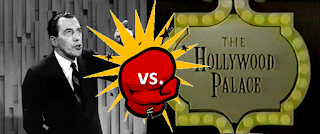
During the 60s, the Ed Sullivan Show and The Hollywood Palace were the premiere variety shows on television. Whenever they appear in TV Guide together, we'll match them up and see who has the best lineup.

Sullivan: Ed’s guests include Jimmy Durante, opera singers Franco Corelli and Dorothy Kirsten, British singer Petula Clark, comic Myron Cohen and Britain's rocking Animals. Also on hand are contortionist Gitta Morelly, balancer José Cole, dancers Lawrence and Carroll, and Durante’s partner, singer Sonny King. Durante and King perform excerpts from their night-club act. 

Palace: Host Victor Borge introduces singer Jane Powell, choreographer-dancer Peter Gennaro, comic professor Irwin Corey, the musical Kim Sisters and Kim Brothers, and Irish trapeze artist Gala Shawn. Victor offers his routine about phonetic punctuation. 

A pair of reruns this week offer us a pair of good lineups. Victor Borge's phonetic punctuation is funny no matter how many times over how many years you see it, and Jane Powell and Peter Gennaro are great guests. On the other hand, Ed's got Jimmy Durante and Myron Cohen, both of whom are funnier (IMHO) than Irwin Corey; the great stars Franco Corelli and Dorothy Kirsten are more than a match for the Kim Sisters and kim Brothers, and the Animals can take care of the rest. This week Sullivan takes the prize.

l  l  l

If you've been following along with this series of Northern California issues I've been looking at this year, you might recognize KLOC, the independent station in Modesto. Channel 19 has been missing from earlier 1960s issues, but this week it makes its debut, premiering at 7:00 p.m. on Monday, broadcasting "approximately 50 hours [weekly], seven days a week.*" Welcome aboard!

*During the day, the station would simulcast the programming from sister radio station KLOC, including cameras showing the radio station's on-air talent. Now we know where ESPN got the idea! (Yes, I know Arthur Godfrey used to simulcast his show, but this is different.

With the exception of the one month that the United Network was in existence, KLOC remains an independent station until 1972, when it becomes an affiliate of Univision. As KUVS, it continues to broadcast to this day.

l  l  l

Sunday is probably the most interesting night of this television week, one filled (as you might expect) with repeats. We begin at Tanglewood, located in Lennox, Massachusetts, the long-time summer home of the Boston Symphony Orchestra. (My wife used to be a regular visitor there each summer until I rescued her from the wilds of Maine.) On Sunday, NBC spends "An Afternoon at Tanglewood" (2:30 p.m. PT). a live concert with the BSO and conductor Erich Leinsdorf, featuring solo performances by 20-year-old pianist Misha Dichter and 19-year-old violinist Masuko Ushioda, both of whom go on to distinguished careers. During the intermission, host Edwin Newman interviews Leinsdorf and the two soloists. As I've mentioned many times before, this is the kind of thing networks used to show before Sundays became dominated by sports. 

If sports is your thing, though, there's the final round of the Thunderbird Classic golf tournament, from Clifton, New Jersey. (2:00 p.m., ABC) It's an important tournament; previous winners include major champions Jack Nicklaus, Arnold Plamer, Gene Littler, and Billy Casper. However, it's rookie Bob Murphy who comes out on top, firing a final-round 68 to win by three shots and take home the first price money of $30,000.

Ah, but what if your interest lies with unsold pilots? Don't worry; we've got you covered as well, with the debut of Preview Tonight (8:00 p.m., ABC), a five-week series of such shows. First up is Pursue and Destroy, a WWII drama starring Van Williams as the commander of a submarine in the days following the attack on Pearl Harbor. It has a very good supporting cast, including Dame Edith Evans, Jessica Walter, and Henry Wilcoxon; I wonder why it didn't get picked up? You can check it out here and see what you think. And Van Williams makes out just fine; instead of fighting the Japanese, he'll battle criminals as The Green Hornet.

Speaking of fighting crime, we can't really leave Sunday without mentioning "The Case of the Twice-Told Twist," tonight's episode of Perry Mason (9:00 p.m., CBS). It's the only color episode of the show's nine-season run, and had the show returned for a tenth season this is how it would have looked. I think I prefer it in black-and-white.

On Monday night, NET presents GI Joe (8:30 p.m.), a documentary following high-school senior Michael J. Frame, who's just been drafted into the Army. The cameras take us through his last days at school, a farewell date, and his swearing-in at an Army induction center. I always wonder, whenever I see a program from this era that features a serviceman, what winds up happening to him. Did he make it through basic training, and was he shipped off to Vietnam? I didn't find his name listed among those on the Wall, so that's encouraging; a quick Google doesn't turn up anything connecting anyone by this name to this documentary, which you might have expected in an obituary, and that's also encouraging. A "Michael J. Frame" does show up in another obituary, as the son-in-law of a woman who'd recently passed, so that's a possibility; if he was drafted in 1966, he was probably born around 1948, so he might still be alive. If anyone has more information, please let me know.

Tuesday afternoon features a rare daytime network special, The World of Fashion and Beauty: Italy (1:00 p.m., ABC), a fashion show highlighting the collections of Italy's top designers, with commentary by designer Lore Caulfield. I suppose it's on in the afternoon because, you know, women are the ones watching daytime TV, and that's what they'd be interested in, not "intellectually demanding shows." In the evening, NBC takes us to a different world, to The Angry Voices of Watts (7:30 p.m.), as author Budd Schulberg introduces us to a Watts writers' workshop, where the residents give voice to what it's like living in the infamous ghetto.

I don't know how many of you are familiar with Blue Light, a one-season (17 episodes) WWII espionage drama starring Robert Goulet as David March, an American journalist who's supposedly defected to the Nazis but is actually a double-agent for the U.S. This week's rerun (Wednesday, 8:30 p.m., ABC) presents one of those infinite-regression situations, as the Nazis ask March to pose as an American spy to get the goods on a Nazi admiral suspected of being involved in a plot against Hitler. In other words, he's an American spy posing as a German spy posing as an American spy, investigating a German who may be working for the good guys. This is either brilliant or totally confusing, and perhaps both.

On Thursday, NET's cultural program U.S.A. presents "Art as Religion" (10:00 p.m.), with author Tom Wolfe offering a commentary on U.S. culture. Wolfe's most recent book is The Kandy-Kolored Tangerine-Flake Streamline Baby, and throughout his career he'll be known for casting a sharp, jaundiced eye toward what he saw as pretentiousness in politics, art, architecture, and celebrity. Wolfe has always been a favorite of mine; his opinions are always well worth listening to.

The longer I'm at this gig, the more I realize how little I really know. On Friday, KLOC finishes a week-long (well, four days*, since they debuted on Monday) debut of country-western variety shows in the 6:30 p.m. timeslot: Ernest Tubb on Tuesday, Bill Anderson on Wednesday, Billy Grammer on Thursday, and, today, Midwestern Hayride. Now, I remember seeing Bill Anderson's show back in the days of the World's Worst Town™, but I had no idea it stretched all the way back to the 1960s, and I didn't know anything about these other shows, either. I guess they didn't air in Minneapolis.

*The following Monday saw the premiere of The Porter Wagoner Show, which began in 1960 and aired until 1981, a total of 686 episodes. Those of you of the male persuasion may recall that Dolly Parton was a regular on this show in later years.

l  l  l

MST3K alert: The Sword and the Dragon
(Russian; 1960) A legendary Russian hero sets out to rescue his wife. Boris Andreyev, Andrei Abrikosov. (Sunday, 5:00 p.m., KGO) This issue has plenty of MST3K wannabees (Queen of Outer Space, with Zsa Zsa Gabor and Eric Fleming), but we'll stick with the real thing. The movie itself is nothing to write home about, but the interstitials include what is probably the greatest-ever Ingmar Bergman joke. Granted, that may not be a huge category, but even so, it's a classic. TV  

August 11, 2023

Around the dial


Frank Gabrielson's second and final Alfred Hitchcock Presents script is Jack's subject at bare-bones e-zine. The 1958 episode "The Foghorn" is a superior adaptation of a powerful short story, and as always Jack gives us a good look at the process of adaptation.

 Continuing his consideration of The X-Files and the American Dream, John's latest at Cult TV Blog looks at the show's third season; in particular, I'm interested in the show's link to Operation Paperclip, the real-life operation of U.S. intelligence to integrate Nazi scientists into the American space program. No easy answers here.

I remember the Saturday morning kids' show Land of the Lost; it's from the World's Worst Town era, so if I was watching TV at all, that's what would have been on. I don't want to talk about it much more, because I'm afraid the theme song will start running through my head, but it's the topic of discussion at The View from the Junkyard.

At A Shroud of Thoughts, Terence has a few suggestions for streaming services. Streamers are struggling lately; we've cancelled most of our services over the last year, leaving only the F1 channel and the Criterion Channel (we get a lot of use out of them). Perhaps more people would stick with them if they took Terence's advice. And stopped raising their prices.

Babyboomers.com has an interesting but fairly superficial article on how classic TV influenced modern college culture. I think it could do with a lot more in-depth consideration (this could have been an AI-authored article), but I think it's spot-on in the discussion "Classic Television as an Educational Tool." I've been advocating this for years.

Speaking of which, one of the nice things about retirement is the ability to travel without regard to time off from work, etc.,  so we're driving out to the Mid-Atlantic Nostalgia Convention this year! It's the first time we've gone in a few years, and we could use some fun. I'm not making a presentation this time, we're just spectators. Are any of you planning to attend? If so, let me know and we'll plan to meet up! TV