August 13, 2021

Around the dial


For my money, Friday has always been the best day of the week. I'll grant you that the best 24 consecutive hours are those from midnight Friday to midnight Saturday, but there's a satisfaction in reaching the end of the work week, and surrendering myself to a fine night of TV viewing. But there's another reason for enjoying Fridays, and that's our trip around the classic TV dial, and some most excellent blogs.

Let's start at bare•bones e-zine, where Jack wraps up his review of the William Link and Richard Levinson Hitchcock scripts with the ninth-season "Nothing Ever Happens in Linvale," with Fess Parker, Gary Merrill and Phyllis Thaxter. I think it would have been kind of fun if it had starred Joanna Linville, but I wasn't there for the casting.

I'm no longer at a point where I need to feel any older than I am, but David's latest at Comfort TV has succeeded in reminding me anyway: Marcia Brady is 65. Or at least Maureen McCormick is, and so a happy birthday to someone who, from all accounts, is as nice a person as she appeared to be on TV.

At Cult TV, John worries that he's straying too far from the subject, which happens to be the Doctor Who episode "Fury From the Deep," starring Patrick Troughton, but in actuality it's a very interesting discussion on the topic of reconstructed Doctor Who videos. You might think this is a little too "inside baseball" unless you've collected telesnaps and grey market videos, but I loved it.

You've all heard the jokes about reading Playboy for the stories, but back in the day the magazine, like so many of the era, had an excellent reputation for publishing short fiction from some of the best (or soon-to-be best) writers around. At The Twilight Zone Vortex, Jordan looks at the magazine's contributions by TZ writers, including Ray Bradbury and Charles Beaumont. 

Staying in the genre, Shadow & Substance has a writeup of Rod Serling's Night Gallery story "The House," a nasty little story starring Joanna Pettet and directed by John Astin. Night Gallery was, I thought, always a bit uneven in quality (even without the Sixth Sense episodes thrown in), but this is certainly in the upper percentile.

At Inner Toob, it's a look at the various crossover stars and historical figures from the WB western series Bronco that link the show to other WB series. (You can choose to believe me or not when I say that we were just talking about Bronco at dinner last night, for no particular reason. The clincher that caused me to add this piece is the 1960 Maverick episode "Hadley's Hunters," and trust me: you don't want to run into them.

It seems that every time I head over to A Shroud of Thoughts, Terence is penning another obituaries of a star who has passed, and this week there are three: Pat Hitchcock, Markie Post, and Jane Withers. Godspeed to them all.

Television's New Frontier: The 1960s returns with a trip to 1962 and The Donna Reed Show. The year saw the end of the show's fourth season and the start of the fifth, and as Reed began to tire from the 39-episode grind, the focal point, more and more, became Paul Petersen. That's not all there is to the show, of course, with storylines and guest stars aplenty.

Now, if all this has added to your enjoyment of the best day of the week, I'm pleased to have helped out. But stay tuned for tomorrow; there's even more to come. TV  

August 11, 2021

The Descent into Hell: "The Children's Story. . . but not just for children" (1982)


The teacher was afraid," the story begins. "And the children were afraid. All except Johnny. He watched the classroom door with hate. He felt the hatred deep within his stomach. It gave him strength. 

"It was two minutes to nine." 

This, in its entirety, is the first page of James Clavell's "The Children's Story," first published in Ladies' Home Journal in October, 1963, and made into a half-hour drama, written and directed by Clavell himself and telecast on February 18, 1982 (in most markets) on the syndicated Mobil Showcase Network. It remains, to this day, one of the most subversive television shows ever aired, a deceptively simple story that tackles indoctrination, brainwashing, and what could be called a unique form of child abuse. It's perhaps the most disturbing program I've ever seen.

t t t

Mobil Showcase was a kind of commercial companion to PBS's Masterpiece Theatre, which Mobil had underwritten for years. Its first presentation was a sensation: the 12-part British miniseries Edward the King, hosted by newsman Robert McNeil, which ran on Wednesday nights in 1975 on an ad-hoc lineup of nearly 50 stations around the country, including 27 network affiliates. It was a huge success, not only for the stations airing it but for Mobil, which had the opportunity to air its commercials during the program, rather than being limited to brief mentions at the beginning and end of Masterpiece Theatre. (After all, the goodwill from underwriting programs on public broadcasting only goes so far.)

Showcase
 returned in early 1977 with another success, the ten-part BBC documentary series Ten Who Dared, narrated by Anthony Quinn (David Attenborough had been the voice of the British airing), featuring great explorers who had trekked around the world to previously unexplored areas. Today they might be convicted of cultural appropriation by the students of "The Children's Story," but in 1977 the series outdrew several network shows (including The Waltons) during its run. In 1979, the series struck gold yet again with Edward & Mrs. Simpson, the story of the ill-fated romance between Edward VIII and Wallis Simpson.

In early 1983, Mobil Showcase returned with Charles Dickens' sprawling story, The Life and Adventures of Nicholas Nickleby, in a triumphant nine-hour saga spread over four consecutive nights.* Nickleby, which had been the smash hit of Broadway the year before, had been turned down by all three networks; Mobil reportedly bought it for $1.1 million and spent another $3 million to distribute it over its ad hoc network, which was down one station after CBS pressured its Flint, Michigan, affiliate, not to carry it. In 1984, it was an acclaimed production of King Lear, featuring Laurence Olivier in the title role (Olivier would win a Best Actor Emmy for this, his last Shakespearian performance), and an all-star supporting cast including Colin Blakely, John Hurt, Diana Rigg and Leo McKern. 

*Mobil limited commercials to 21 minutes for the entire nine hours, promising "no hard-sell or advocacy advertising this time."

I hadn't really thought about this until now, but it's quite possible that Mobil Showcase was the premier prestige dramatic show on commercial television during its run. It reminds me of what the Hallmark Hall of Fame used to be.

t t t

The story opens in "A Neighborhood Schoolroom." It takes place at an indeterminate time in the very near future; we're only told that "THEY have just conquered us."  

Old Miss Warden (Mildred Natwick) sits at her desk, playing nervously with her fingers; her students, each of them about seven years old, can feel the tension in the air. In front of her is an official document, which she reads to them: "All current teachers will turn over their classes to new teachers." She is afraid, they are all afraid, except for Johnny, who defiantly repeats the words his father told him: "We're scared too much. We're dead even though we're alive. We are not to ever be afraid." 

The clock turns over to 9:00, the door opens and the New Teacher (Michaela Ross) enters. She is young, attractive, dressed in olive green. With a smile, she greets the children, and she gently tells Miss Warden that "You're to go to the principal's office," As the old woman tearfully looks back at her students before the door closes, some of them are crying. The New Teacher greets each one of them by name, and they are surprised; their old teacher sometimes forgot their names. But then, the New Teacher tells them, you sit in the same desks every day; she just memorized the list. "I had to work three whole days just to remember all your names." It's very lazy for a teacher to not know who's here and who isn't, she continues. 

Without formality, without even being aware of it, their education has begun.

"How do you start school?" she asks the children. "What do you do to begin?" A student tells her they say the Pledge of Allegiance. What does it mean? she asks them. None of them know; neither their teachers nor their parents ever explained it to them. "I don't think that was very good not to explain. You can always ask me anything—that's what a real teacher should do." She then tells them that allegiance means to pledge loyalty to "a king or president or leader or to your government." But you can’t pledge allegiance to a flag—"that's like saying the flag is more important than a person.” 

The flag is very pretty, though, she says. “I wish I could have a piece of it.” Removing it from the pole, she tells the students that if the flag is that important, “we should all have a piece of it.” She finds a pair of scissors in Miss Worden’s desk, and allows a thrilled Leslie to cut the first piece, since it’s her birthday. (And they’re so thrilled that she knows things like birthdays.) They all line up excitedly around the teacher’s desk to get a piece of the flag. But what to do with the bare flagpole? One student, giggling, suggests they throw it out the window—is he serious, or just wondering how far they can go, how outrageous is too outrageous. But the New Teacher tells them that “if that’s what you want to do, you can do it.” The students gleefully follow through. The time is 9:12.

*Clavell would make the point that an actual flag was not used in the filming of this scene.

The New Teacher then plays a kind of Ask Me Anything, and one student asks why Miss Warden was crying. She was probably tired and needed a rest, the Teacher replies. “She’s going to have a long rest. We think the teachers should be young. I’m 23.” Another asks her “Is the war over?” “Yes. Isn’t that wonderful?” she replies. “Now all of your daddies will be home soon.” “Did we win or did we lose?” “We—that’s you and I and all of us—we won. We’re all one world now.” 

Johnny, who’s been silent through most of this, finally speaks up. “Where’s my dad?” he cries. “What have you done to my dad?” The children look expectantly toward the New Teacher. Will she be able to answer? She walks toward Johnny, sits on the edge of a desk next to him, rests her hand on his arm gently, explains that his dad had to go back to school. “He had some strange thoughts, and he wanted other grown-ups to believe them. It’s not right for others to believe wrong thoughts. Is it?” She tells them, for example, that whenever their parents don’t have time to talk to them, that’s a wrong thought. And that’s what they do all the time. "Perhaps my mom should go back to school," one student says. "Perhaps she should," another agrees. "There’s a good boy," the New Teacher says.

And now there’s another surprise: all the students will be staying at the school overnight. "We have a lovely room and bed and there’s lots of food and we’ll all tell stories and have such a lovely time." And they can stay up until 8:30—what an adventure! "But first we have to say our prayers," one little girl reminds her. 

"Let's all pray for candy."
What shall we pray for? the New Teacher asks. “I know. Let’s pray for candy.” And so they all pray, the Teacher as well as the students, with their eyes closed and their hands together. But when they open their eyes, there is no candy. How can that be? After all, if we pray to God, He’ll answer our prayers. Isn’t that true? “I prayed for a puppy,” one boy says, “but never got one.” Maybe we need to try harder, the Teacher says. “Perhaps we’re using the wrong name. Instead of God, let’s say Our Leader. Let’s pray to Our Leader for candy.” As the children kneel, with their eyes closed tightly, she removes some candy (Hershey’s Kisses, I’d say) from her satchel. The children are amazed when they open their eyes and see it in her hand. “I’m going to pray to Our Leader every time,” one says. Only Johnny sees her. “You put them there. I saw you!” he shouts.

Surprisingly, the New Teacher agrees with Johnny.” She tells the children that she did it to show them that it doesn’t matter who you pray to. “To God or anyone. Even Our Leader. No one will ever give you anything. Only another human being.” God didn’t give you the puppy you wanted, “but if you work hard, I will.” The children are excited. “Only I or someone like me can give you things.” 

And because Johnny was especially clever, she says that he should be made monitor for the whole week. He beams with pride as the children applaud. “Teacher’s right, you know,” he says to the boy sitting next to him, who replies “I’m going to work hard to not have wrong thoughts.” “Me too,” Johnny says. “Not like dad.”

The New Teacher looks out the window, surrounded by some of her students. "It’s a fine, fine land. A land to breath in," she says, more to herself than to her students, as she puts her arms around them. "And you know, all over our new world, everyone’s being taught, just like I’m teaching you. Each according to his age group, each according to his need.”

The time is 9:23. 

t t t

By the time "The Children's Story" was adapted for TV, James Clavell was a household name. He'd authored four best-selling novels (King Rat, Tai-Pan, Shōgun and Noble House), written screenplays for several movies (including The Great Escape and The Fly), and directed several others (including the Sidney Poitier smash To Sir, With Love, which he also wrote.) The 1980 television version of Shōgun, running for 12 hours over five nights, was one of the biggest hits in TV history, the biggest that NBC had ever had. With those credentials, anything by Clavell was sure to attract attention.

Compared to the books that made him famous, "The Children's Story" represents something of a change of pace. As opposed to epic sagas set in faraway exotic locales, this story is brief (only about 4,300 words, or 85 pages), takes place in an intimate, almost claustrophic setting, and deals overtly with contemporary politics. 

The story's genesis was a conversation Clavell had with his six-year-old daughter Michaela, who'd proudly told him that she had learned the Pledge of Allegiance in school. What most struck him was that, while she'd memorized it completely, she had "no idea what many of the words meant." Clavell, talking with "people of every age" about the Pledge, found that "[i]n every case . . . not one teacher, ever—or anyone—had ever explained the words to any one of them. Everyone just had to learn it to say it." It was then, he wrote, that "I realized how completely vulnerable my child's mind was—any mind for that matter—under controlled circumstances.

The subtitle of "The Children's Story," both in print and on TV: "But not just for children."

Oh, and that young actress playing the New Teacher? Her professional name was Michaela Ross; her real name is Michaela Clavell. The same Michaela who started the whole thing in the first place.

t t t

"And fear not them which kill the body but are not able to kill the soul," Jesus tells His disciples according to the evangelist Matthew, “but rather fear him which is able to destroy both soul and body in hell.” Indeed, in the Middle Ages it was not uncommon for heretics to be burned at the stake. We can question the extremity of such action, but what cannot be questioned is the seriousness with which people regarded the state of the soul, the inner workings of man. 

For Christians of the era, to mislead people about the spiritual truth was, in a sense, a form of brainwashing, an indoctrination into falsehoods that threatened not the physical lives of those individuals, but their spiritual lives. Should one die while under the control of such false beliefs, their soul could very well wind up in hell, a fate far more disastrous than anything that could happen to them through torture or killing.

As such, to manipulate the young, while in their most vulnerable intellectual stage of life, comes in for particularly severe judgment. I referred to this earlier as a unique form of child abuse; Christ Himself warns of the consequences: “If anyone causes one of these little ones who believe in Me to stumble, it would be better for him to have a large millstone hung around his neck and to be drowned in the depths of the sea.”

Lesson: what you believe in, what you are taught, matters.

t t t

If "The Children's Story" was a departure from Clavell's typical fare, it was also different from other Mobil Showcase presentations. Not only was it a stand-alone, single-night production (rather than the multi-part miniseries that had been the series' trademark), its running time was only 30 minutes. In addition, unlike previous programs in the series, it was presented without commercial interruption, "because of the unusual nature and importance of the program." It was appropriate, given that the story unfolds in real time.
 
     The edition in my library
When Mobil Showcase host Peter Ustinov appeared on camera to introduce the program, which he hoped viewers would find "as chilling and as thought-provoking as we do," he did so not from an elaborate set or a comfortable chair, but from a library, surrounded by some of the most dangerous elements known to mankind: books. His singularly disturbing introduction, running barely a minute, concludes with a question as prescient today as it was 40 years ago. "We take so much for granted in this wonderful world of ours," he said. "Free speech, freedom to question, to choose what we read, where our children go to school, where we live, what we say, what we think. All our glorious inalienable rights. So solid, so permanent. But are they?"

Reaction to "The Children's Story" was predictable. Janet Maslin, writing for the liberal New York Times, described it as "a half-hour alarmist fable that has a numbing obviousness, and plenty of other objectionable aspects," and compared it to "the cold-war hysteria of Rod Serling's ''The Twilight Zone'' without any of the ingenuity." Gene Triplett, writing in conservative Oklahoma for The Oklahoman, saw it differently, calling it "a riveting and thought-provoking half-hour of television viewing," and praised Ross's "effective portrayal of the soothing, manipulative instructor [through which] we are given a disturbing demonstration in how charm and fallacious logic can seduce and subvert young minds." The Christian Science Monitor's Arthur Unger described it as a "unique horror show" and added that "This slight but important half-hour in class is a shocking lesson about the sometimes forgotten power over our children which we delegate to our schools."

Perhaps Janet Maslin right. The one thing you can depend on when it comes to evil is that it does exactly what it tells you it's going to do. If that makes it "numbingly obvious," so be it.

t t t

In Cultish: The Language of Fanaticism, by the writer and linguist Amanda Montell, the author examines how words can be manipulated to build a sense of community, enforce collective values, and even shut down the debate. I'm not necessarily applying the message of that book here, but: notice the phrases that the New Teacher uses, always insinuating the children into an exclusive club of knowledge, one that only the privileged are part of. "We know, you and I," she says, "you and I and all of us." Our new world," she says. "I can learn from you, as you can learn from me," she says. 

Arthur Unger, in that Christian Science Monitor review, called "The Children's Story" "an unnerving lesson in the danger of the hidden message."

If this isn't the language of exclusivity, if it doesn't operate in the same manner as the cult, how else should we describe it?

t t t

So there we have it. What do we make of it?

Well, it's a very unhappy ending, isn't it? Reminiscent of 1984, the first entry of this series, when, at the very end, it is said of Winston Smith, "He loved Big Brother." That's called "one of the most heartbreaking lines in literature," and for good reason.

From here on it, of course, you’re under no obligation to read my thoughts on the subject. For that matter, you don’t have to read anything I write, here or anywhere else. And if you’re concerned about being offended, you can stop here and go no further; at the very least, you'll have come away with some interesting notes about television history. Please know that I'm not here to offend anyone, but that doesn't mean I'm going to hold back either. Consider yourself warned.

In watching "The Children's Story" today, you might think to yourself that this isn't a cautionary tale so much as it is a documentary. However, Clavell's warning about the future, which appears so prescient in so many ways, got one detail wrong: the Marxist infiltration of our education system didn't require a war being lost or a nation being conquered; the abandonment of our children to this singular form of indoctrination happened without a shot being fired. 

You might also think the children in this story are very stupid, that all you have to do is say their name or know their birthday or give them a piece of candy, and they’ll do anything you want. I don’t know that I’d call them stupid, though—I’d call them human. We’re all vulnerable to flattery, to bribery, to being made to feel important. It’s like wearing a badge, or a medal.  It shows everyone else that I’m special. I’m more special than you. Now, we're all special in the eyes of God. But, I forgot—there’s no God either, is there? After all, if He were there, He’d answer your prayers, wouldn’t He?  Praying to God or anyone for something is a waste of time, the New Teacher tells her students. You can pray if you want to, if it makes you feel better, but it won’t do any good. Your parents want you to, "but we know, you and I, that it means nothing. That’s our secret."

We're told how it's so very important that we protect people from wrong thoughts, from fake news, from “misinformation” and “harmful content.” Those quotes are from Facebook’s “Community Standards and Protections Policy,” by the way. Other forms of social media have similar policies, and most companies have diversity policies with similar language. And if you violate those policies, you’re subject to some kind of sensitivity training. It’s just like going back to school. And who decides what makes thoughts strange and content harmful? The people who make the policy, of course. As the New Teacher tells Johnny, “It’s right to show grown-ups right thoughts when they’re wrong." Kind of like the Hitler Youth.

So, what were those wrong thoughts? "Just some grown up thoughts that are old fashioned. We’re going to learn all about them in class. Then we can share knowledge so I can learn from you as you can learn from me." Ah, yes, those old fashioned thoughts are so gauche, aren’t they? Ideas like religion, patriotism, and Father Knows Best, American history and the Founding Founders. Acts like questioning the "experts" when it comes to the Wuhan virus, or insisting that you have the right not to be injected with an experimental, morally illicit drug against your will. They're just in the way, you know, preventing us from getting where we need to be. Anyway, "It’s not right for others to believe wrong thoughts. Is it?"

This is the world in which we live today, the world we’ve been living in for some time now, and if you think this isn't already happening, no matter where you live, you haven't been paying attention. From Common Core to Critical Race Theory, public schools in America—and many private ones as well, including schools professing to be Christian—have become nothing more than indoctrination centers for the government, repositories of hate and division, of propagandizing and conditioning; institutions committed to undermining the authority of parents, the values of society, the traditions of a nation, and where even silence can be seen as dissent from this new Creed, the Creed of, as the New Teacher put it, “our new world.”  

A world where history is what we say it is.

A world where the only thing that matters is what happens today.

A world founded on slavery, on bigotry, where our homeland was never great, or perhaps even good. 

A world where error has no rights and wrong thoughts must be punished, where a supposedly free citizen must have the proper papers to avoid being branded as a dissident, where there are no such things as second chances, where doubt can never be allowed, even for a moment, to darken the precepts of the new morality.

In such a world, who can you trust? Not history. Not God. Certainly not what you thought you knew, or what your parents or grandparents taught you. They’re prisoners of the old way of thinking. They’re trapped by wrong ideas.

No, the only thing that matters is having right thoughts. The thoughts that you learn in your government school. That’s what it is, you know, so we might as well call it that, the unholy alliance between the state and the education establishment. 

"Freedom, however you conceive it, is such a fragile possession," Peter Ustinov says at the end of "The Children's Story." "It has to be worked at to be protected. So all of us have a part in
this story. What’s the value of your child’s mind? Or your right to question?"

Yes, this children's story is not just for children.  TV  

August 9, 2021

What's on TV? Tuesday, August 10, 1965


All this week on NBC's You Don't Say!, it's the battle of the doctors, as Dr. Joyce Brothers takes on Dr. Frank Baxter. Who is Dr. Frank Baxter? Well, in 1965 you would have recognized him. According to the always-reliable Wikipedia, "Baxter is best remembered for his appearances from 1956–1962 as 'Dr. Research' in The Bell Laboratory Science Series of television specials. These films became a staple in American classrooms from the 1960s through the 1980s. The Bell series combined scientific footage, live actors and animation to convey scientific concepts and history in a lively, entertaining way; and the bald, bespectacled and affable Baxter served as narrator, lecturer and host. These films made Baxter (who was not a scientist) something of a scientific icon among baby boomers. 

"Several of Baxter's science films have been released on DVD. Baxter also appeared (as himself) in a prologue to the 1956 film The Mole People, in which he gave a brief history of theories of life beneath the surface of the earth. 

"In 1966, Baxter hosted a popular TV series called The Four Winds to Adventure, featuring filmmakers exploring little-known areas of the world, whether across continents, oceans, or local people and animals in a particular region."

And now you know the rest of the story. Let's go to the Minnesota State Edition.

August 7, 2021

This week in TV Guide: August 7, 1965

Xou all know about my affection for Gene Barry's detective series Burke's Law. (If you don't, you haven't been reading very closely.) It was a stylish mix of humor and police drama, all done with tongue-in-cheek and twinkle-in-eye. But Burke's Law, as we know it, is now done. Starting this fall, the show's jumping on the secret agent bandwagon popularized by The Man From U.N.C.L.E. Amos Burke, Secret Agent retains Barry's suave style (and Rolls Royce) amidst a bevy of beauties, but the supporting cast that did so much to make Burke fun—Gary Conway, Regis Toomey, Leon Lontac and Eileen O'Neill—is long gone, never to be seen again.* And Amos Burke, Secret Agent will be gone before long itself; the reboot lasts a mere 17 episodes before the series bites the dust.

*Except for a cameo appearance by O'Neill as one of Burke's "secret agent" operatives. Though she doesn't play the Sergeant Ames character, I think it's significant that she's one of the few female operatives working with Burke in the new series who doesn't get killed.

According to the article by Peter Bogdanovich (!), network executives feel the Burke's Law format was getting stale, "running 'out of gas'." And despite the protestations of Tom McDermott, president of Four Star Productions that Amos Burke will not be a carbon copy of U.N.C.L.E.—"The last time I saw U.N.C.L.E., they looked like they were doing Burke's Law"—there's no doubt that the spy spoof has played a big role in the retool of Burke. It's a James Bond world now, and we're all just living in it.

Barry himself professes to be excited about the new format. "We made TV history," he says of the cameo-laden, sly humor of Burke, "and now the time is ripe to enlarge the format of the show." And to its credit, Amos Burke doesn't try to deny its past. As the season progresses, there are several references to Burke's previous career as the head of the L.A. homicide department, and Burke continues to drive his Rolls. In fact, Barry's sophistication, which everyone agrees was the major selling point of Burke, should have been tailor-made for a globe-trotting secret agent. But without the supporting cast of the previous two years, the spark just isn't there anymore. The shows are pleasant, but nowhere near as entertaining. Which once again proves that if it ain't broke, don't fix it.

Besides Amos Burke, Secret Agent, the 1965-66 television season also sees the premieres of I Spy, The Wild Wild West, and Get Smart. They all go on to longer, more successful runs than Amos Burke. And when Gene Barry reprises the role of Amos Burke in 1994, it will be under the moniker of Burke's Law. As it should be.

t t t

During the 60s, the Ed Sullivan Show and The Hollywood Palace were the premiere variety shows on television. Whenever they appear in TV Guide together, we'll match them up and see who has the best lineup..

Palace: Host Steve Lawrence inroduces Mickey Rooney and Bobby Van in a spoof of the movie "Bridge on the River Kwai"; operatic soprano Jean Fenn; the Backporch Majority, folk singers; choreographer-dancer Jack Cole; comic Gene Baylos; plate spinners Alberta and Rosita; the Gimma Brothers, novelty act; and 4-year-old drummer Poogie Bell.

Sullivan: Ed welcomes Steve Lawrence, Victor Borge, the rock 'n' rolling Dave Clark Five, comics Rowan and Martin, the Israeli Ballet, puppet Topo Gigio, the tap dancing Mattison Trio and John, a balancer.

As I typed these listings, I was thinking to myself that I really wanted go go with Palace this week because I like Steve Lawrence, but beyond Rooney and Van the lineup's pretty weak.  And then I come over to Sullivan and who do I see?  Steve Lawrence! As far as I remember, this is the first time we've had an act appear on both Palace and Sullivan the same week. Of course, it helps when both shows are in reruns. But Ed has more than Steve—try the very funny Borge, the occasionally funny Rowan and Martin, and the stylish Dave Clark Five. And if that isn't enough, you've got a puppet and a ballet company! No more calls, ladies and gentlemen, we have a winner—Sullivan takes it in a song.

t t t

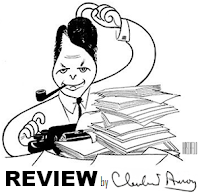
Throughout the 60s and early 70s, TV Guide's weekly reviews were written by the witty and acerbic Cleveland Amory. Whenever we get the chance, we'll look at Cleve's latest take on the shows of the era. 

Before Daniel Boone was a big man, before Mr. Smith went to Washington, before Davy Crockett was king of the wild frontier, there was Fess Parker. And, according to Cleveland Amory, this is where the problem starts.

Don't get me wrong; like Amory, I like Fess Parker, both personally and as an actor. If he has not always been a great actor, or even a very good one, he has been a pleasant one, which can get you a long way with viewers, But, quite frankly, in this first season of Daniel Boone, Parker has a lot to fess up to. (Don't blame Amory; that one belongs to me.) Cleve has only two things to say about Parker's acting: "(1) He can keep up with the dialog. (2) He can out-act the Indians." When it comes to the acting, though, you can't blame Parker entirely: "[T]he only possible explanation for the dialog in this show is that it was written by writers who live in canyons—the echo techique whereby every question is asked and then reasked, answered and then reanswered." And over and over. As for the Indians, "they are fascinting in their inepitude. They play almost every scene as if someone had just told them they were not going to be paid after all." So bad are the actors playing the good guys, "one way we have found to enjoy it is to root for the bad guys, who are, at least sometimes, good actors." 

Believe me, I tried to find something good about Daniel Boone in this review, but the best I could do was an episode called "The Sisters O'Hannrahan," and, says Amory, that was good "if for no other reason because it at least had an idea for a plot." I can't really speak to the series myself; it was not a show I had any real interest in watching when I was growing up. I do know that Daniel Boone ran for six seasons and continues to be popular today. I also know that many series take awhile to get going, and the latter episodes bear only a passing resemblance to the initial ones. And finally, I know that Cleveland Amory doesn't always get it right; he is, after all, a curmudgeon. But if you enjoy someone who obviously takes great pleasure in the use of words, then this column, if not this show, is for you.

t t t

Football? This early in August? Of course. The sporting landscape changes dramatically this week, with our usual summer fare of baseball, golf and bowling being joined on Sunday by the return of the American Football League as the Buffalo Bills and Boston Patriots face off in a pre-season tilt from Boston (1:00 p..m. CT, NBC). This is the first year of the AFL's new television contract with the network, which will give the AFL the necessary finances to launch the bidding war that ultimately results in the league's merger with the NFL.

Not to be outdone, CBS presents an NFL game opposite the AFL, but we're really talking apples and oranges here. The CBS offering (1:00 p.m.) is the Baltimore Colts inter-squad game, taped the previous night. The focus is on Baltimore's preparation for the regular season, in which they'll be out to avenge their 24-0 loss to the Cleveland Browns in the previous year's NFL championship game. In fact, it's Cleveland, not Baltimore, that makes it back to the title game, where they're waxed by my favorite team of the era, the Green Bay Packers, 23-12. Better that you should tune in a day earlier and catch their broadcast of the Washington Redskins and Philadelphia Eagles from Hershey, PA. (1:00 p.m., CBS)

t t t

Kellam de Forest is my kind of guy. His research company regularly vetts scripts for accuracy and liability, and is on call to answer questions that producers and scriptwriters might have about, say, how to peel a pearl (The Richard Boone Show) or what day December 30, 2022 falls on (The Twilight Zone). And while some of these items may seem like they're not such a big dea—after all, anyone with an internet connection can tell you that 12/30/22 is a Thursday—others can be very important, not only for the show's accuracy, but its financial well-being.

For one thing, de Forest conducts a vigorous background check into character names that appear in scripts. This service would have been particularly advantageous had the producers of Dr. Kildare taken advantage of it. They're currently in the midst of a $5 million lawsuit because of a recent episode in which a fictional doctor stands accused of covering up a medical mistake that resulted in the death of a young child. Seems that there's a real doctor out there with the same last name, who didn't take kindly to having that name besmirched, whether the TV doc was fictional or not. Sending the script de Forest's way could have saved the producers a lot of grief, for a fraction of the cost.

De Forest and his staff
I first read about de Forest many years ago, in Marc Scott Zicree's Twilight Zone Companion, in which de Forest applied his trade to the 1963 episode "In Praise of Pip." Rod Serling's original script contained a reference to American military action in Laos, with Jack Klugman's son Pip dying in a place where "There isn't even a war there," but de Forest pointed out that the Geneva Treaty on the neutrality of Laos stipulated the removal of all foreign troops from the country. "The implication that the U.S. has troops fighting in Laos (even in The Twilight Zone) could be an embarrassment and might cause repercussions.," de Forest noted. "U.S. Special Forces are fighting ('in an advisory capacity') in South Vietnam. Suggest South Vietnam." That wasn't his only suggestion for the script. A line from Klugman states, "There isn't even a war there," but, wrote de Forest, "In South Vietnam it is common knowledge that there is a Civil War, but U.S. troops are not supposed to be fighting there. Suggest 'There isn't even supposed to be a war there.'"

It's a fascinating line of work, at least to me. De Forest sits in his office, surrounded by a library of over 5,000 books "run[ning] the gamut from "The History of Orgies" to Dr. Spock's 'Common Sense Book of Baby and Child Care.'" A script comes in, from an episode of Profiles in Courage set in the late 1800's. Among 54 research points, de Forest issues recommendations regarding the phrases "Little old bird dog, that's me" ("the term 'bird dog,' referring to one who hunts and finds objects, didn't come into use until circa 1930") and "to take in a water cooler around the bend in the corridor" ("the modern cooler was invented about 1910, though there were can-top coolers earlier"). Another Profiles script called for a scene of "great shouting and commotion" at the 1924 Democratic National Convention.  De Forest, on his own, added "The 'official' record indicates specific cries of 'soak it to them, boys, soak it to them.'"

In years to come, de Forest would continue to prove his worth to various producers, often through his name-checking. For instance, Archie Bunker was originally named "Wally" Bunker, until de Forest discovered there was already a "Wally Bunker" living in Queens. Wally quickly became Archie—the name Norman Lear wanted in the first place. Very cool, don't you think? He also did key research and technical advise for the original Star Trek; he was responsible for the stardate format by suggesting that the writers use the Julilan rather than the Gregorian calendar. (It would "not only be more precise, but more futuristic.") Kellam de Forest died in January of this year, at age 94, supposedly of Wuhan.

I don't have a Kellam de Forest Research Services at hand for my use, although the resources of the internet probably provide me with more data than de Forest could have dreamt of. It's knowing how to use the research that counts. And when it comes to storytelling, it's the details—putting a war in South Vietnam instead of Laos, or taking care to avoid historical anachronisms—that can make all the difference. 

t t t

Some quick programming hits for the week:


Saturday, as we noted, is the return of exhibition football on CBS. That night, Al Hirt, summer replacement for Jackie Gleason (and beneficiary of a feature article elsewhere in this issue), features a pretty good middlebrow lineup, with satirist Stan Freberg (one of the funniest men in radio or television), Met Opera soprano Anna Moffo , ballet dancers Edward Villella and Patricia McBride, pop singer Dionne Warwick, rockers Chad and Jeremy, harpist Robert Maxwell and jazz pianist Willie Smith. (6:30 p.m., CBS) And then, of course, there's Al's trumpet. Pretty good lineup; to be honest, it might top Ed and Palace this week.

Sunday is public affairs day, starting with Lamp Unto My Feet (9:00 a.m., CBS). This week's topic is "Reunification of Mankind," featuring historians Arnold Toynbee and William McNeil, and the question is "Can religion help man adjust to rapid and profound social, political and technological change?" I cannot possibly imagine a more prescient topic today, given that we live in a world of profound social, political and technological change that's pretty much rendered our society a shambles, precisely because of a decline (for whatever reasons) in religious belief. This is just what Toynbee's concerned with, given his view of religion as "a powervul force in shaping man's responses to human and environmental changes." 

Later, the public affairs program ABC Scope commemorates the 20th anniversary of the bombing of Hiroshima. (Noon, ABC) We hear about this on an almost annual basis around this time of year, but in 1965 it was still pretty fresh in people's minds. Correspondent Lou Cioffi (incorrectly identified as Gioffi in this issue) reports on how the city has changed since then; I wonder how much discussion concerned the use of the bomb in the first place? I'm always interested in intense conversations about this today, conducted mostly by people who weren't alive then and have little feeling for the context and climate in which the decision was made.

Monday's rerun of Andy Williams (8:00 p.m., NBC) features an odd pairing of guests: Roy Rogers and Dale Evans, and Jonathan Winters. "In a circus spot, Roy demonstrates his marksmanship and Jonathan portrays a lion tamer." On the other hand, The Man From U.N.C.L.E. (7:00 p.m., NBC), which is coming to camp mode by this time, has a story about "a strange disease [that] killed the entire population of a small English coastal village—by afflicting the inhabitants with old age." With a couple of tweaks, that could almost be The Andromeda Strain, couldn't it?

We're seeing the summer season wind down, and with it the shows that won't be returning in the fall. NBC has a pair on TuesdayMoment of Fear (7:30 p.m.), which is showing an episode that originally came from G.E. Theater in 1959, and Cloak of Mystery (8:00 p.m.), which shows a failed pilot episode. Hullabaloo, also on NBC, will be back next summer, but it ends this year's run with a show hosted by Frankie Avalon, with Barbara McNair, Joanie Sommers, the Supremes, Peter and Gordon, the Byrds, and Sam the Sham and the Pharaohs. (9:00 p.m.)

Wednesday: It's Our Private World, the first prime-time program spun off from a daytime soap, in this case As the World Turns. (You'll remember Cleveland Amory reviewing this a few issues ago.) It airs twice weekly, on Wednesdays and Fridays (at 8:30 and 8:00 p.m., respectively), and stars the legendary soap actress Eileen Fulton in her ATWT role of Lisa Miller Hughes. It would have been interesting had this show taken, to have a bifurcated story universe running in both daytime and nightime; that is, even though the shows (and storylines) are separate, the participants inhabit the same universe. Alas, the show, which started in May, only makes it through to September and the beginning of the fall season.

On Thursday, the Minnesota Twins and New York Yankees wrap up a series at Yankee Stadium (7:00 p.m., WTCN, KCMT, WDSM, KROC). It's an informal changing of the guard; the Twins, who were mostly miserable as the Washington Senators, are headed for the American League pennant in 1965, as part of a run that includes a second-place finish in 1967 and West Division titles in 1969 and 1970. For the Yankees, on the other hand, it's the Twilight of the Gods: American League champions for the last five years and 22 of the last 29, the Yanks are headed for a sixth-place finish in 1965, followed by a total collapse into the cellar in 1966. They won't make it back to the World Series for another decade.


Finally, what would Friday be without a beauty pageant, or "Beauty Spectacular," as the listings put it? It's the 14th annual International Beauty Pageant, live from Long Beach, California. (9:00 p.m., NBC) John Forsythe is the host, with an all-star panel (well, kind of) of judges including actress Virginia Mayo, pin-up illustrator Alberto Vargas, and Tom Kelley, the fashion photographer, who took a very famous photo of Marilyn Monroe against a red background which we probably, ah, shouldn't link to here.

Interestingly enough, this lesser-known pageant is still around (although last year's pageant was cancelled due to Wuhan), and is one of the few that doesn't judge solely on looks. Its "contestants are expected to serve as 'Ambassadors of Peace and Beauty', demonstrating tenderness, benevolence, friendship, beauty, intelligence, ability to take action, and, most importantly, a great international sensibility. The ultimate goal of the Miss International beauty pageant is to promote world peace, goodwill, and understanding."

In other words, just like this blog, right? TV  

August 6, 2021

Around the dial


Wou might recall that a couple of months ago, we looked at a TV Guide cover story on Gail Davis, star of the syndicated Western series Annie Oakley. This week, I received a very nice email from Windham Taylor and Brian Miller at the website Ammo.com, on an article they'd published (by Molly Carter) on the real Annie Oakley, America's most iconic woman sharpshooter. Would I be interested in the article? You bet I would, and I'm happy to share it here today. It's in the best tradition of the "Background" feature that TV Guide used to run, an article that would tell the story behind an upcoming movie or special. I appreciate getting links like this, and if any of you have similar things you'd like to share, please let me know!

My Twitter friend Herbie Pilato has a terrific article at the Television Academy website—you know, the people who do the Emmys—on the 50th anniversary of the Sonny and Cher Comedy Hour. Fifty years, which would make me, let's see—too old. Whether or not you were a fan of the duo, you'll be a fan of the article.   

At The Ringer, Alison Herman examines one of the many ways that streaming television has changed the very product it provides: all the conventions that governed classic TV, from the length of the show to the length of the season, are now up for grabs, with the result being what she calls "form confusion": "an exciting array of possibilities that also leaves room for error."

On a philosophical note, at The American SpectatorLou Aguilar has an interesting—and provocative—article on how today's television is redefining masculinity. TV has the power to shape perception and behavior, of course; otherwise, advertisers would be throwing their money away. There's a reason why some people prefer classic television, back when things were black-and-white—so to speak.

In a somewhat similiar vein, at Comfort TV, David says television should always have a Superman. A simple, declarative statement, but I think it goes beyond Superman the character, to Superman the iconic hero. There's some thought that in these days when Marvel seems to dominate all forms of entertainment, the antihero's time is over, and the age of the hero is back. We could use some.

Week in and week out, one of my favorite stops on the trip around the dial is at bare•bones e-zine, especially when it's time for one of Jack's Hitchcock Project entries. For those of you scoring at home, or even if you're alone, here is a complete index to all the episodes covered so far. The closer he gets to the end, the closer we are to seeing that much-needed book!

Speaking of recaps, you won't want to miss Joanna's recap of this year's Christmas in July feature at Christmas TV History. Considering the hot, dry summer we've been experiencing here in Minnsota, it's kind of nice to think about Christmas in July. Come December, though, we might already be sick of the snow.

At The Horn Section, Hal stops by F Troop long enough to ask the question, "What Are You Doing After the Massacre?"  It's a delightful second-season episode featuring the great Phil Harris guesting as the 147-year-old Chieftan Flaming Arrow, aiming to get the entire United States back, one parcel of land at a time. 

One of the more popular memes out there asks you to tell people your age without using numbers. For me—well, I'm old enough to remember when MTV ran nothing but music videos. (Even typing that sentence has aged me.) At A Shroud of Thought, Terence takes a look back at the history of the groundbreaking network on the occasion of its 40th anniversary.

Finally, at Eventually Supertrain, I'm back to talk about the Search episode "The Gold Machine" with Dan; stick around as Dan discusses Planet of the Apes with Amy The Conqueror, and chats about Kolchak with Tim. Some people ask why I so often promote my own links at the bottom of the page, and the truth is it's because I have every confidence in you, my loyal readers, that you'll read to the very end, right? Right? TV