Showing posts with label 1968. Show all posts

February 7, 2026

This week in TV Guide: February 8, 1969


For media analysts, the 1968 Democratic Convention is the gift that keeps on giving. I know a lot of you are probably tired of me writing about it as often as I do, but I don't generally go looking for it; it comes to me. And TV Guide has written about it at least as often as everyone else. It is, in fact, a seminal event when it comes to looking at how the news media presented events, how it became a participant in those events, and the public's perception of those events.

In this first of a four-part series, Neil Hickey looks at the decisive questions raised by last year's convention: "How well did the networks discharge their responsibilities? Was coverage slanted? Were viewers fully and fairly informed? Did many of them deliberately refuse to believe their eyes?" The issue, Hickey says, "appears destined neither to die nor fade away, but to linger in some morose corner of the public mind for generations to come."  The answer will influence the future course of television news coverage."  

What is truly remarkable about this preamble to the series is how these questions about the media are not only still being asked today but also appear to arise with greater frequency, greater intensity, and greater scope. If news coverage of the convention raised eyebrows back then—if viewers truly were shocked by what had hitherto been, in Hickey's words, a "20-year romance which television has enjoyed with American families" that had achieved iconic status with the coverage of President Kennedy's assassination—then today, many of these accusations are simply assumed as a given by most viewers, who would claim that the media doesn't even make a token effort to hide their bias. 

Coverage of the convention—it's estimated that almost 90 percent of American households were tuned in to the events, and 92 percent of all television homes in the free world—makes this kind of discussion inevitable, one supposes. In an era when you still had to make an effort to write a letter—unlike today's social media instant-reaction environment—the three networks and the Federal Communications Commission were flooded with "tens of thousands of letters" complaining about the media's coverage. Among those complaints were that coverage was biased against President Johnson and Vice President Humphrey; that news footage focused on violent acts by the police against the protestorss "but never the provocation which led up to it"; that reports and anchors "engaged in too much editorializing (at the expense of straight news) without labeling it as such"; and that newsmen "were too generous and affectionate in their coverage of the hippies, Yippies and radical leftists who had come to Chicago with the announced purpose of disrupting the convention and creating havoc in the streets." One of the specific allegations was that the media inflated the number of protestors; in the weeks leading up to the convention, the news floated estimates of between 100,000 and one million, but "the best estimates now indicate that the demonstrators’ recruitment was an almost total flop, and that no more than 5000 of them came to the city from points outside Illinois."

And look at some of these comments: Columnist Jenkin Lloyd Jones wrote: "It should now be obvious that television, as it is now used, is the enemy, not the servant, of the political convention. It has become so, not out of malice, but because TV is a medium that prefers drama to uplift, and where both are present it will go for drama every time." Sen. Everett Dirksen (R-lll.), called it "an outrage against the democratic process" and "a clear and outrageous attempt at editorializing and bias." You can read variations of this quote pretty much any time you want today. 

In an extraordinary series of reports by Drew Pearson and Jack Anderson, the columnists claimed that a House Commerce Committe study confirmed that "some of the networks deliberately went out to slant the news; that TV directors purposefully photographed Vice President Humphrey and Mayor Daley in unflattering poses, even resorting to distorting the TV color; that speeches favorable to the Johnson regime were forsaken repeatedly by the cameras to focus on some dissident eager for publicity," and that the networks, "perhaps in their eagerness to generate high ratings for TV sponsors, encouraged dissidents to make inflammatory statements and helped to stir up controversies." This was far from a universal opinion, mind you; even some of the papers that ran the columns by Pearson and Anderson felt compelled to offer disclaimers about the content; the New York Post wrote that "The notion that the labors of conscientious TV men under fire were exploited in a network plot to discredit the Democrats is absurd." 

Since there are three other installments in the series, I haven't done an in-depth presentation of everything involved in Hickey's investigation; instead, I've pulled some quotes that point to the disturbing similarities between the era I'm writing about and that in which we live today. Perhaps someday I'll write about the entire series. But for now, I just want to look at this as, if you will, one of those "canary in the coal mine" moments, that also proves how the more things change, the more they stay the same. With only a little tweaking, most of what we see here could have been written today.

What I find interesting is that you'll often read comments, mostly by people lamenting the state of today's news coverage, pointing to the "classic" era of television news, the days of Cronkite, Huntley and Brinkley, and others, when the news was "fair and objective," as opposed to today's slanted opinions and outright bias. In fact, the argument we're having today is nothing new. It may have intensified, it may be more available to more people, making them more aware of the controversy. But to suggest that everything was fine and dandy back in "the good old days" is simply not true, and the borderline-obsessive coverage of Chicago proves that.

This all happened nearly sixty years ago; most Americans of today weren't born then, and many of those who were alive don't have a clear memory of it anymore. I do remember it well; I remember what a terrible time it was for everyone. If we look back on these as the "good old days," how much worse does that mean things are in our modern age? One of the most disturbing quotes I found in this article comes from columnist Max Lerner, who talked of "a kind of 'social dynamite' in the spreading suspicion among both liberals and conservatives that the wells of communication in the U.S. are poisoned." Can there be any better description of the state of America today? 

l  l  l

During the 60s, the Ed Sullivan Show and The Hollywood Palace were the premier variety shows on television. Whenever they appear in TV Guide together, we'll match them up and see who has the best lineup.

Sullivan: Tentatively scheduled guests: Leslie Uggams; comic Bill Dana; singer Roslyn Kind, Barbra Streisand’s half-sister; Joan Rivers; Barbara Eden of I Dream of Jeannie; Peter Gennaro; and the acrobatic Schaller Brothers. (If there were any changes, they're not reflected in the episode guide.)

Palace: Robert Goulet’s guests: the Mills Brothers; Kay Thompson; singer Dusty Springfield; comics Hendra and Ullett, and Jack Wakefield; and Nina Logatsheva, low-wire ballerina from the Moscow State Circus.

You want singers? Sullivan has Leslie Uggams and Roslyn Kind; the Palace is hosted by a singer, Robert Goulet, and has the Mills Brothers, Kay Thompson, and Dusty Springfield. You want comics? Sullivan has Bill Dana and Joan Rivers, the Palace has Hendra and Ullet and Jack Wakefield. Sullivan has acrobats, the Palace has a low-wire ballerina. So what does all this prove? Well, the Mills Brothers are unbeatable, Dusty Springfield (singing "Son of a Preacher Man") is undeniable, and Mr. G himself is as smooth as they come. This week, Palace wins with a song in its heart.

l  l  l

From 1963 to 1976, TV Guide's weekly reviews were written by the witty and acerbic Cleveland Amory. Whenever they appear, we'll look at Cleve's latest take on the shows of the era.
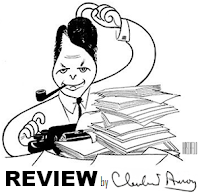
Back in the day, you often heard it said that "there outta be a law." And Cleveland Amory has an idea for a perfect law: television should be prohibited from "laying its blood-stained hands on the classics—particularly on children’s classics." That includes NBC's new series, The New Adventures of Huckleberry Finn. "And make no mistake —which you already have if you've sat through an episode—this particular series is not content to murder just one classic." 

I think it's pretty clear where we're going from here, but it's our good fortune that our Cleve is leading the way, for the more he piles it on, the more entertaining he gets. Borrowing from Johnny Mercer's lyrics to Moon River, "Your Huckleberry friend who is waiting round the bend is only the take-off point here. Each program moves on from there to fire at will on "Don Quixote," "The Arabian Nights," "Gulliver's Travels," etc., etc.—until you end with a full-scale massacre. Watch it and we guarantee that your Huckleberry friend won’t have to wait at all. You too will be around the bend." (I don't normally quote at such length, but, unlike the series itself, this was simply too good to pass up.) You see, one of the conceits of this series is that episodes often involve Mark Twain's favorite characters in fanciful adventures that take place between the covers of other classics: "Huck of La Mancha," for example, in which Huck, Tom, and Becky find themselves rescuing Don Quixote and Sancho from Don Jose D'Indio, who is none other than—of course—Injun Joe. You might think that, well, at least this episode has good source material to work with; however, "it was really shocking to find that there was, in the concept and rendition of the character of Don Quixote, not one single whit of pathos, understanding or even point." Another episode takes our trio to the stories of the Arabian Knights: Ali Baba, Scheherazade, Sinbad. It takes them, and does nothing to them. In other words, the show is so much a product of today's values—"the self-centered, self-serving world the modern child today faces"—that it makes no attempt to present the values and morals that were integral parts of the original stories.

If you've never seen the show before (consider yourself fortunate), it blends live action and animation, not unlike Song of the South, although to much worse effect. In fact, Amory says, the animated characters are generally better actors. Of them, the best is Ted Cassidy, who voices Injun Joe. He appears in the prologue as a live character, then morphs into the animated villain of the story. Smart thinking, Lurch. Amory concludes at the beginning, with a look at that prologue. Speaking of Injun Joe, Huck says, "I had a funny feeling that we'd see him again." Says Cleve, "We had a feeling too—but it wasn’t funny."

l  l  l

It is hard to imagine that there was a time, as late as 1969, when people had not heard of Stella Stevens. I say this not just as a normal, red-blooded American male with an appreciation for such things, but as a student of pop culture. She appeared with Elvis in Girls, Girls, Girls. She appeared with Jerry Lewis in The Nutty Professor. She appeared with Dean Martin in The Silencers. She appeared with Rosalind Russell in Where Angels Go, Trouble Follows. She appeared with a smile and nothing else as the January 1960 centerfold in Playboy. I rest my case.

And yet, as Joe McGinniss* writes this week, that's exactly where we are. "Stella Stevens has not really failed. It’s just that she has not succeeded," McGinniss writes. "She has worked hard at her career since moving West from Memphis in 1958. She has made lots and lots of movies. She has done some very good television work. Yet nobody knows who she is." You'll forgive me if I have trouble believing this, and yet, there it is. She is, by all accounts, "warm and sincere," besides which, as we've mentioned, she's a knockout. But she's "too versatile," the knock is, moving from comedy to drama, from the big screen to television, never quite landing the part that would make her a star. 

*The same Joe McGinniss who would later write non-fiction books such as The Selling of the President and Fatal Vision

She's overcome a lot to make it this far, including a marriage at age 15, a son (Andrew Stevens, who would go on to become an actor in his own right) at 16, a divorce at 17. And her career is far from being what one would consider a failure. She has, McGinniss says, "adjusted to worse things. She will be able to proceed quite nicely through her 30's without being on the covers of magazines." And she believes the best is still to come. "I feel like my career is just beginning,” she says. "I've put in my apprenticeship. Now people are finally beginning to realize that I’m serious and I'm good." A lot of people say that she's very good, "a genuine comedienne who can handle straight roles, too." 

You can only remember so many names, though, and there are a lot of them out there. They're getting younger all the time, too (Stella is all of 29, virtually over the hill), and her chances of hitting the jackpot diminish. And yet, all these years later, the name "Stella Stevens" has yet to be forgotten. She appeared on television almost constantly, appeared as a regular in Flamingo Road and Santa Barbara, and remained active up to 2010. As a 2012 article noted, she was, in the 1960s, "one of the most photographed women in the world." Apparently, some people had heard of her. Of her layouts in Playboy (three in all), she said, "If you've got ten million people seeing you in a layout like that ... and half of them remember the name 'Stella Stevens', they'll buy tickets for your movies."

Joe McGinniss was a very good writer, but maybe he didn't know everything. Otherwise, all I can say is that it's a sad commentary on American manhood.

l  l  l

Here's a movie that definitely should have made it to Mystery Science Theater 3000: Billy the Kid vs. Dracula (Saturday, 9:00 a.m. PT, KTVU). I suppose it had something to do with rights, but listen to the description: "Billy discovers that his fiancee's uncle is a vampire." And it features John Carradine! What more can anyone ask for?

Sunday
's highlight is the special Man and His Universe (7:00 p.m., ABC), a look at space exploration, specifically last December's flight of Apollo 8. "As earth's unrolled stunning blue-and-white carpet is_ across the screen, viewers hear from Apollo 8 heroes Frank Borman and James A. Lovell Jr.; Col. Edwin Aldrin Jr., named to this summer’s scheduled Apollo 11 moon-landing team; and Dr. Harrison H. (Jack) Schmitt, who plans to make geological studies on the moon." George C. Scott narrates the hour, which I really would like to have seen. I think the Paley Center has a copy of it; it might as well be on the moon. That's one of three specials that make Sunday night special, including a presentation of A Midsummer Night's Dream (9:00 p.m., CBS) by the Royal Shakespeare Company, with a cast including David Warner, Diana Rigg, Helen Mirren, Judi Dench, Ian Holm, and Ian Richardson. And NBC presents a rerun of last year's Fred Astaire special (10:00 p.m.), with Barrie Chase, Simon and Garfunkel, Sergio Mendes and Brasil '66, the Young-Holt Trio, Neal Hefti's orchestra and the Gordian Knot.

Twenty-four years before Schindler's List, Monday's installment of the ABC Evening News with Frank Reynolds (5:30 or 6:00 p.m. depending on the market) features a special report on Oskar Schindler: "Although he was a Nazi, Schindler saved 1300 Jews by having them transferred from death camps to his factory, and later gave them weapons so they could overcome Gestapo guards and escape to freedom." You don't often see a special report on the evening news that's featured in TV Guide, but as I recall, this is something that ABC did from time to time to try and boost their news by giving it a different feel. In primetime, Ella Fitzgerald is joined by Duke Ellington for an hour of music (7:30 p.m., KOVR), Davy Jones guests on a Valentine's celebration on Rowan & Martin's Laugh-In (8:00 p.m., NBC), and Carol Burnett is joined by a stellar lineup including Lucille Ball, Eddie Albert, and Nancy Wilson (10:00 p.m., CBS)

Speaking of guest stars, Jimmy Stewart makes a cameo appearance on Julia (Tuesday, 8:30 p.m., NBC), while James Earl Jones (currently starring in the Broadway production of "The Great White Hope") stars on N.Y.P.D. (9:30 p.m., ABC), a really fine half-hour police drama. And on The Tonight Show (11:30 p.m., NBC), Johnny's scheduled guests are Jack Benny, choreographer George Ballanchine (perhaps the premier classical choreographer of the time), ballet dancers Suzanne Farrell and Arthur Mitchell, and author and Discovery host Frank Buxton.

Wednesday 
is Lincoln's Birthday, which used to be a fairly big deal, at least back when I was in school, and Aaron Copland conducts the National Symphony in a Lincoln Day concert (8:30 p.m., NET), including one of Copland's most famous works, "Lincoln Portrait," narrated by Coretta Scott King, MLK's widow. Meantime, NBC repeats last year's highly acclaimed special with Herb Alpert and the Tijuana Brass (9:00 p.m.). The most interesting item on Tuesday, though, is what we didn't see: the never-aired second episode of ABC's infamous disaster Turn-On (scheduled for 8:30 p.m.), which would have featured as hosts Robert Culp and his wife, France Nuyen. 

As a sign of the times, I'm intrigued by this episode of I Dream of Jeannie (Thursday, 7:00 p.m., KHSL), in which Jeannie, in an attempt to free Tony from house fix-up projects, redoes the house into a mansion sold for $60,000 to a NASA VIP. Now, the idea of a $60,000 "mansion" intrigued me; I'm not sure you can buy a mobile home for $60,000 anymore, so I decided to see what that $60,000 house would be worth today. The answer? Approximately $558,831.03, an increase of 831.39 percent. Does that qualify as a mansion under today's home prices? Given that the median U.S. home price hovers around $400,000–$450,000, and that "luxury" homes start at about $1.3 million, Zillow estimates that a mansion would run around $1.4 million; in Miami, the price would be closer to $2 million. For $560,000, you would get a home classified as "nice" or upper-middle-class in many places; to call it a "mansion" would probably be treated with skepticism. (In case you're wondering, in 1969 a mansion would have run over $100,000.) Thus endeth our economics lesson for today.

Davy Jones, who was on Laugh-In on Monday night, is one of the guest stars on This is Tom Jones (Friday, 7:30 p.m., ABC), along with Nancy Wilson, who was on The Carol Burnett Show on Monday night, Rich Litte, Mireille Mathieu, and Herman's Hermits, who weren't on anything else this week. On The Name of the Game (8:30 p.m., NBC), Robert Goulet and his then-wife Carol Lawrence star as Tony Franciosa's investigative reporter looks into the case of a famous doctor (Goulet) who's "an absolute whiz at hospital fund-raising—but totally incompetent as a surgeon." In the late-night movie slot, check out The Outrage (11:30 p.m., KOVR), an Old West version of Rashomon starring Paul Newman as a bandit executed for murder, even though nobody knows for certain what the facts were. Claire Bloom, Laurence Harvey, Edward G. Robinson, and Howard Da Silva fill out a tremendous supporting cast, as well as William Shatner as a preacher—made to order for the Shat's overacting. 

l  l  l

Finally, as a dedicated MST3K fan, I can't ignore Robert de Roos's feature story on Peter Graves, who appeared on Beginning of the End, It Conquered the World, and Parts: The Clonus Horror, as well as the Rifftrax feature Killers from Space. Graves is now starring in Mission: Impossible, but according to de Roos, he still can't escape the shadow of big brother James Arness. 

"I don’t know why Peter wants to be a star so badly," says George Santoro, a producer at Universal. "He's already recognized by more people than most stars."  Graves insists that this doesn't bother him, although he does admit that he wishes he came across as a star whose fans hold him in awe, rather than those who come up to him and treat him like a long-lost friend. Some think it has to do with the squeaky wheel getting the attention; producer Norman Macdonnell says, "You never hear much about Pete." Others, including Graves, say that his television work has effectively kept him from making the movies that could elevate his profile. 

This could be changing, though. CBS vice president Perry Lafferty says of Graves that "The quiet strength of this man has contributed to the smash hit of Mission: Impossible." It could have been awkward stepping into the lead that had originally been held by Steven Hill, but "there was never a hint
of trouble. I can think of a half dozen other leading men who would have been bitterly resented by the cast. I just wish I had 15 more like him." (This jibes with other descriptions from costars and crew who speak highly of Graves' professionalism and quiet sense of humor.) Graves himself says, "Some bloom early, and some take a little longer. I have a deep sense that I am ready for the big push." Indeed, Peter Graves becomes the face of M:I, notwithstanding the show's gradual decline in the years after Barbara Bain and Martin Landau left the show. Perhaps his greatest hit comes in his deadpan role as Captain Oveur in Airplane. Like Stella Stevens, maybe it just took a little patience. TV


If you enjoy the content here and want to support my broader creative work, please consider buying me a Diet Coke at my Ko-fi page. Thank you!

August 24, 2024

This week in TV Guide: August 24, 1968


This week we've got a miniseries filled with just about everything television has to offer, a star-studded event featuring high drama and low comedy, tragedy and pathos, suspense, violence, and even theater of the absurd. It runs for four consecutive nights, Monday through Thursday, and it's while two networks will be showing it unabridged, a third plans to present a condensed, Cliff's Notes version. It's the water-cooler show of the year, guaranteed to leave viewers shocked and breathless. 

Welcome to Chicago, and the 1968 Democratic National Convention.

l  l  l

It's not as if the chaos of the convention just snuck up on people. You can see it right there in the full-page add for KCRA's convention coverage; referring to the location of the convention, at the International Amphitheatre near the Union Stock Yards, the headline shouts, "Tempest Near the Stockyards," with the body of the ad containing either a promise or a warning: "The Democrats are facing what may be the stormiest convention fight of the century." 

We probably don't need to rehash it all: police on the convention floor; reporters being assulted; delegates taken into custody; a telecommunications strike that hampered media efforts to provide coverage of protests devolving into riots in Grant Park; contentious debates about delegate selection and the Vietnam War plank in the party platform; and more. Media coverage of the convention, and the public's response to that coverage, would be hashed and rehashed in TV Guide (and other publications) in the ensuing weeks and months, and continues to be analyzed to this day. But why wait for that? There's already a lot of second-guessing regarding network coverage of last month's Republican Convention, if the Letters section is any indication.

NBC was the big winner in the ratings race, and so it's no surprise that many of the letters, both positive and negative, refer to the Peacock Network's coverage in Miami Beach. Jean Ward of Kimberton, Pennsylvania, chastises NBC as "saboteurs for the Democratic Party," and says their editorial remarks, "presented as news, were highly improper and, to me, highly objectionable." Tim Johnson, writing from Los Angeles, and D. Sherwood, of Allentown, Pennsylvania, both single out Sander Vanocur; the former calls his reporting "sophomoric cynicism," and the latter found him "highly biased and generally unprofessional." Mr. Johnson adds that, thanks to Vanocur, "I have discovered what a truly remarkable reporting team the CBS Network has." [Nonetheless, I always enjoyed Sander Vanocur myself.] Not everyone was so negative, however; Helene Shalotsky of Parsippany, New Jersey, praises coverage that "vividly uncovered to the American people the hoopla and ludicrous expenditure involved in selecting a Presidential candidate," and James Kusiak, of Wildwood, New Jersey, thanks the networks "for their devoted service to the nation in their coverage of issues as important as the respective conventions."

And then there's ABC, which eschewed the traditional gavel-to-gavel convention coverage in Miami Beach (and the estimated $5 million that CBS and NBC each spent) in favor of a 90-minute nightly summary of each night's session at less than half the cost, while still retaining much of their nightly entertainment revenue. Pam Hornung, of St. Louis, found that this suited her just fine, writing that "I have never enjoyed a convention more or felt more well-informed as to what had happened during the day." Mrs. Cal Heathman, from Champaign, Illinois, extends "My compliments to ABC News. They needed only an hour and a half to tell us what had happened at the Republican Convention; it took CBS and NBC all evening long." She also takes a moment to mention "Gore Vidal and William F. Buckley [who] added a great deal of interest and, in most cases, understanding."

Buckley on the left, Vidal on the right: 
the only time you'd identify them that way.
For coverage of both the Republican and Democratic conventions, ABC signed Buckley and Vidal to provide their own take on things, from, respectively, the conservative and liberal points of view. Their contentious clashes became so famous that, years later, they would become the subject of a documentary. The highlight of their interactions (or lowlight, if you prefer) unquestionably comes on Wednesday, August 28, an infamous night that saw Hubert Humphrey's nomination for president, interspersed with tape-delayed coverage of the clashes between police and protestors in Grant Park. 

Anchorman Howard K. Smith, referring to a clip they had just viewed, had suggested that the raising of the Vietcong flag by antiwar protestors, an act which triggered a violent response from police, could be considered akin to raising a Nazi flag during World War II; Buckley nodded his agreement with Smith. Addressing Buckley, Vidal replied that "As far as I’m concerned, the only sort of pro- or crypto-Nazi I can think of is yourself. Failing that, I will only say that if we can’t have the right of assembly –" at which point Buckley interrupted, "Now listen, you queer—stop calling me a crypto-Nazi or I’ll sock you in your goddamn face and you’ll stay plastered!" A decade later, New York magazine would rank the debates as one of the greatest moments in the history of television to date, right up there with the moon landing and the Beatles on The Ed Sullivan Show; august company indeed. 

That's all in the future, though. For the present, the Doan Report wonders if ABC's limited coverage may be the wave of the future. Looking back to last month, Doan notes that, on average, "nearly 13 million Americans" chose ABC's alternative programming (including reruns of The Rat Patrol and The Flying Nun and an old Jerry Lews movie) instead of watching convention coverage on NBC and CBS. Were they, Doan wonders, "mostly distinterested Democrats? Or were they, regardless of political persuasion, simply switched off by the tedium of 90 percent of the Miami Beach proceedings?" Even worse was the possibility that "a great swatch of the public" has become "so disenchanted with the Old Politics . . .that many people are permanently turned-off to this sort of televised razzmatazz?" The Democrats are taking last-minute steps to streamline some of their proceedings in hopes viewers will find it all less boring; ironically, "TV’s millions may be switching en masse to CBS and NBC if trouble breaks out outside Chicago’s International Amphitheatre. Huge protest demonstrations are in the making." In Miami, NBC and ABC were the clear ratings winners, with CBS finishing in third place for the first time in history. What Chicago has in store, nobody knows for sure. 

l  l  l

It may be an odd thing to say, given how countercultural 1968 was, but there's a certain innocence to it all at the same time, particularly the idea that a political party was willing to debate important issues and air out its differences right there in front of everyone on live television. You look at those poor suckers on the convention floor, thinking that what they're doing really makes a difference, and yet somewhere in the back of your mind you envy their naïvety, their commitment to something that matters. You look at the motto emblazoned in the convention hall, "Promises Made, Promises Kept," and you wonder how anyone could ever believe such hoke, let alone something like, "Make America Great Again." It may have been the worst of times, but there was somethiung eminently human about it all, something that we've lost in the deIt cades since. 

The Democrats didn't plan it that way, but it happened nonetheless, and the idea that anything like it could happen again today is laughable. As we read a couple of weeks ago, by 1980 conventions were being scripted down to the minute, and today they scan more like cheap infomercials, except those infomercials usually have more substance to them. It's hard to shake the feeling sometimes that we're all just going through the motions, playing the roles that have been assigned to us, while we wait to see what happens next. We wait, and we wonder.
 
l  l  l

That innocence isn't on display only in the convention hall. You can see it on the Elysian fields of Williamsport, Pennsylvania, where the championship game of the Little League World Series is being contested Saturday afternoon on ABC's Wide World of Sports (5:00 p.m., tape-delayed). It used to be that the only other time you'd see a Little League game was if you walked down to a local playground, and in that way it's more of a slice of Americana, something you'd see in a picture book along with parades and church socials, than an actual sporting event. Today, the entire tournament is televised; even the regional rounds wind up on ESPN (in primetime, no less!), and Little League baseball seems more of a commodity, another source of programming for a machine. Even the between-innings segments featured in 1968, with all-stars Carl Yastrzemski, Sam McDowell, and Dave Giusti offering "tips for the youngsters," would seem corny today; the only tips they're interested in are the best home run celebrations for the cameras. 

Apropos of a convention week, some of the best alternative programming comes from exhibition football, where the hitting is only slightly harder than it is in Chicago. On Saturday, two of the oldest and fiercest rivals in the AFL, the Oakland Raiders and Kansas City Chiefs, face off in KC (5:30 p.m., KNEW), while the teams in the last two NFL championship games, the Green Bay Packers and Dallas Cowboys, go at it in Big D (6:30 p.m., CBS). The AFL season begins in earnest on September 6, the NFL follows suit on September 15.

Even non-political programming has its tangentially-political side; on Sunday morning, Discovery '68, which Cleveland Amory praised last week, presents a poignant rerun from last November featuring the late Robert F. Kennedy in a program that explores ways to preserve and enjoy "The Vanishing Wilderness." (11:30 a.m.) Among a montage of Americans enjoying hiking, fishing, and camping, Kennedy and his family are seen shooting the rapids on the Colorado River, and RFK later discusses government projects designed to protect these areas. It is an interesting choice by the netw, Aork to replay this particular episode on the eve of the Democratic Convention (just as it was to telecast it last November, a year out from the election); although Discovery is primarily a children's show, I'd imagine this one might have produced a tear or two from grown-up viewers. 

Also on Sunday, Glen Campbell's summer replacement series airs its final episode. (Don't worry; thanks to the dispute between CBS and the Smothers Brothers, he'll be back soon enough.) For the finale (9:00 p.m., CBS), Glen presents a country-music concert with Johnny Cash and the Tennessee Three, the Stoneman Family, and regulars Leigh French and John Hartford; Pat Paulsen features in his mock-presidential campaign, advocating for increased gun-control laws. 

Monday illustrates the challenges faced by West Coast stations when it comes to covering live events. CBS and NBC both begin their live, gavel-to-gavel convention coverage at 4:30 p.m.; if things go as planned (which they never do), their affiliates should have an hour or two to fill before their late local news (and, in the case of NBC, The Tonight Show, with Bob Newhart as guest host for the week). It's pretty much business as usual for ABC, though, with the Chuck Connors series Cowboy in Africa (7:30 p.m., The Rat Patrol (8:30 p.m.), and Howard Duff and Dennis Cole in Felony Squad (9:00 p.m.), followed by their nightly convention wrap-up at 9:30 p.m. (about three hours after its live broadcast).

On Tuesday, ABC continues its counter-programming offensive with Garrison's Gorillas (7:30 p.m., although with all the explosions and whatnot, viewers might have been forgiven for thinking the network was interrupting things for live footage from downtown Chicago), followed by It Takes a Thief, with guest star Susan Saint James. Tonight the convention runs late, ending after 10:00 p.m. in the West, so weary viewers might have opted for a special Merv Griffin broadcast from the streets of Harlem, in support of New York's "Give a Damn" program to benefit ghetto youth (8:30 p.m., Channel 36). Following opening remarks from NYC's mayor John Lindsay, Merv presents performances by James Brown, Joe Tex, Gladys Knight and the Pips, Spanky and Our Gang, Willie Tyler and Lester, the Pied Piper Drummers and Dancers (doing a tribal dance), and a fashion show of African-style clothes. There are also appearances by former heavyweight champion Muhammad Ali and actor Burt Lancaster, who grew up in the neighborhood. 

Wednesday, ABC's alternate reality reaches its peak, when the network puts Elvis up against the politicians; Blue Hawaii (7:30 p.m.) is, says Judith Crist, "bearable to the non-[Elvis] fans as well," with "pretty views of Hawaii, has the usual quota of pretty girls on hand, has a couple of tidy tunes in its repertoire and even has Angela Lansbury to brighten the screen as Elvis's mother." Of course, Angela Lansbury also played the evil mother in The Manchurian Candidate, one of the great political thrillers of all time, so she's got you covered either way. Keep in mind, though, that the presidential balloting takes place on Wednesday, which also features rough stuff inside the convention hall and rioting outside it, so the network may have decided to go live earlier in the night.

If ABC continues its minimalist convention coverage, its Thursday night lineup is made up of comedies (make of that what you will): The Second Hundred Years (7:30 p.m.), The Flying Nun (8:00 p.m.), Bewitched (8:30 p.m.), and That Girl (9:00 p.m.) However, Channel 2 has Portrait: James Mason (9:00 p.m.), which includes clips from The Seventh Veil, Odd Man Out, I Met a Murderer, A Star Is Born, and Georgy Girl; his career is discussed by those who have worked with him, including Stephen Boyd, Sue Lyon, Omar Sharif and director Sidney Lumet. Following that, NET Playhouse (10:00 p.m.) presents an adaptation of Georges Simenon's "The Suspect," a dark, non-Maigret story of terrorism and revolutionary fervor.

We're finally back to normal on Friday, and tonight's choice is the very funny Star Trek episode "A Piece of the Action" (8:30 p.m., NBC), featuring Kirk and Spock as a couple of Chicagoland gangsters, and introducing to the world the game whose rules never end, Fizbin. And this leads us to the week's unbylined cover story, a profile of DeForest Kelley, the erstwhile Dr. Bones McCoy. Kelley comes across, to me at least, as a man of contradictions: a minister's son who eschews religion in favor of the New Age-y Science of Mind; a quiet, droll man who nonetheless has become something of a "teen-age sex symbol," serenated by Sunset Strip hippies who offer him love beads; one of the three stars of a successful TV series who still has to "fight for everything I've gotten at Star Trek, from a parking space at the studio to an unshared dressing room," and once found himself left out of an episode entirely. 

He's immensely popular with the crew and his fellow actors; "De really cares about people," says Leonard Nimoy, who also calls him "truly the most human of all the actors I've ever known," while William Shatner cites "a simple, unassuming niceness about this man that's rare in any business." He doesn't deny the disappointments of his career, the stardom that seemed close but always remained just out of reach, but of course he attains an immortality that few actors ever reach. And not only that—earlier this year he found himself, for the first time, part of a TV Guide crossword puzzle, which hs wife clipped out and framed. "It's not an Oscar or an Emmy," he says, "but to an actor it's something."

l  l  l

It was just a couple of weeks ago that we were discussing, in this very space, how frequently TV Guide looks at children's programming. And so what do we have this week? Another article on children's programming! And, somewhat appropriately, this, too, has a tangental relationship to the week's festivities in Chicago, as Dr. Joyce Brothers asks the question: "Are the seeds of violence nurtured through the public's airwaves?" 

She starts out with a sobering statistic: "Without changing the dial, a child of our electronic age can watch some 50 near or actual violent 'deaths' on his television set in a day’s time." He's also going to spend as many hours in front of the TV over the course of a year as they do in front of a schoolteacher. No wonder that mothers "worry more about the effect of tele-violence on their children's souls than they do abou tthe effect of television on their eyes and posture." And, "in the wake of Sen. Robert Kennedy's assassination, everybody has been worrying with them."

Following Kennedy's assassination, there was a wave of self-censorship on television, with networks pulling the more violent episodes of various series (only to air them later, after things had died down), but Dr. Brothers is skeptical of such moves, viewing them more as a quest to find a scapegoat. "History,' she quotes William James, "is a bath of blood. To hunt a neighboring tribe, kill the males, loot the village and possess the females was the most profitable, as well as the most exciting, way of living."

Not surprisingly, there's no real consensus on the topic among those who study such things. "There are as many opinions as there are experts," says Brothers, "and their disagreement is often as violent as our television fare. Not all the opinions are based on facts, for there are very few of these. Research on television’s influence on our lives has barely begun. And many of the findings are contradictory." 

For example, one expert says there's no such thing as something too violent for kids, that violent television serves the same purpose as Grimm's Fairy Tales; "Children still need these hair-raising stories that end happily if they are not to be terrified by their own unresolved and frightening fantasies." Another replies that television is "a school for violence that most of our children attend regularly," and that kids wind up learning that "violence is the great adventure and the sure solution, and he who is best at it wins. We are training not only a peace corps but also a violence corps." 

Brothers cites the results of a questionnaire completed by over 300 psychiatrists at a recent American Psychiatric Association meeting; 30 percent beleved fictional violence (TV shows, movies, comic books) teaches actual violence to children, while 24 percent believe it helps dissipate aggression. "The rest were undecided." Studies run on children produce results that differ dramatically. 

If there's any clarity at all, it might come from a Stanford University study that found that "children are less affected by the violence they witness on their TV screens than they are by their parents’ attitudes toward violence." In other words, happy children with loving parents tend to focus more on the struggle between good and evil, between hero and villain, while those who have been neglected, mistreated, or underprivileged often bring their existing frustrations to their viewing, where what they see on TV adds fuel to the fire. 

Marshall McLuhan, one of the most influential of media watchers, offers some interesting observations of his own. According to McLuhan, children actually look at the faces of actors much more than they do the weapons or the action. What they really fear, he says, is the unknown. Children (and most adults) don't watch Westerns or detective stories for their violent content; rather, it's "for the pleasure of participating in the solution of a crime or in building a frontier town." Violence in that detective show or Western is familiar to them, and less upsetting than stories like 1984 or Jane Eyre. Which, to me, suggests that something like, say, the Three Stooges, or the Road Runner cartoons, is so formulaic, so predictable, that the violent content would have little effect on children watching them. 

Perhaps most interesting, and most sobering, is a finding that juvenile viewers are far more disturbed by verbal aggression on TV than by physical violence. "They were least upset by shooting, more upset by knives and most upset 'when grownups are angry with one another and shout.'" And maybe that's the lesson we take from all this: that what's important is not what children see on television, but what they see in their own households, from their own parents. Television, Joyce Brothers says, is not a chief motivating force; rather, it's "a mirror in which we see the reflections of ourselves and the world in which we live." And changing the mirror image doesn't change the world. 

l  l  l

I think we could all do with something a little lighthearted to round things out, and that comes to us courtesy of Joseph Finnigan's article on those "long-gone TV luminaries" who've found their fame—and fortune—working in Europe. Stars like George Nader, Ty Hardin, Edd Byrnes, Ray Danton, and others, who may have disappeared from American televisions but now grace the marquees of foreign theaters. 

    George Nader, king of the
    sauerkraut spy circuit.
Their role model, of course, is Clint Eastwood, who headed to Italy after the cancellation of Rawhide to make a spaghetti-Western called A Fistfull of Dollars. Two more movies followed—For a Few Dollars More and The Good, the Bad, and the Ugly—and Eastwood emerged a bona fide movie star, one whose fame and acclaim have grown exponentially larger in the decades since this issue of TV Guide was published. George Nader, who starred in the forgettable single-season series Shannon among other series, is no Clint Eastwood. However, he's the star of a series of secret-agent movies in Germany, where he's now a celebrity. "I make my living in Europe now," he tells Finnigan. Even after years in Hollywood, "I hadn't had any offers." But now, "I look at my counterparts in Hollywood and they’re playing guest roles. In my pictures, I’m the leading man."*

*He also starred, with Richard Kiel in a sci-fi flick called The Human Duplicators, which aired on MST3K. Maybe we'll see that here someday.

Edd Byrnes, who captured the hearts and minds of viewers as Kookie on 77 Sunset Strip, travelled to Europe to keep things rolling after they stopped on the Strip. He calls Europe "a gold mine, It bought me a Rolls-Royce, a big house in Hollywood—and I still keep my apartment in Rome." He cautions though, that in the shady world of European movie-making, it's best to get paid up-front, "before yu shoot the last week of the picture." He was paid $100,000 for one Western; the going rate for most Hollywood Ã©migrés is about $25,000 per picture.

Adam West is another veteran of the spaghetti-Western circuit, declaiming there after the end of the Robert Taylor series The Detectives, in which he played one of the titular characters. "I was offered five more pictures over there," he says, "but I didn't want to get involved in Italian film. Then Batman came along." He, too, says there are drawbacks to working in Italy or Spain. "We filmed our picture in the desert outside of Almeria, Spain, where Lawrence of Arabia was made. It was so hot that after a few hours your horse would lie down and roll over in slow motion." European actors, reluctant to be upstaged by the big American star, didn't pull their punches, either. "Ali of those villains wanted to be the hero, wouldn’t settle for being the bad guy," he recalls, remembering one who "put his spur through my left shin in a fight one day."

The American expats acknowledge that their European stardom might not be quite the same as if it were Hollywood. But, as one Hollywood agent puts it, "they can make three or four pictures a year abroad at $25,000 a shot. In what other industry can a guy make $100,000 a year and still be called a failure?" And, as George Nader said, be called the star of the movie?

l  l  l

MST3K alert: Invasion of the Neptune Men
(Japanese; 1962) A group of youngsters have difficulty convincing anyone they were attacked by a spaceship. Shinichi Chiba, Kappel Matsumoto. (Friday, 9:00 p.m., KEMO in San Francisco) There are really only two recommendations for this movie: a very early appearance by famed Japanese martial arts actor Sonny Chiba; and the return of Phantom of Krankor (Bill Corbett), the villain of a similar (and much better) MST3K flick, Prince of Space. For the SOL crew, it's a rare bright spot in one of the worst movies they've had to endure. TV  

June 15, 2022

What's old is new again

The other night we were watching a YouTube video of ABC's 1968 summer schedule, with the openings to all of their shows, and a programming grid at the end. You know the kind, right? We'd seen this one before, as we have with most of them; it's the type of video that's easy to have on in the background, without having to concentrate too much or take your eyes off what else you might be doing. Like having dessert, for instance, which just happens to be what we were doing at the time.

At some point in the proceedings, though, my wife turned to me and said, "Look at how many of these shows we've got. We've seen most of them!" I started thinking about that, not only the ones we've got on DVD, but those we've started watching on various YouTube channels. It occurs to me that the 1968 season must be close to the tipping point at which a majority of TV series still exist, either on DVD, the gray market, or through YouTube. It would certainly be a contender for the 1960s season having the most shows; the Golden Age of DVD releases was very kind to this era. (Going to all-color programming didn't hurt, either.)

I'm also intrigued by how many of those series are from ABC. I'm sure if we were looking at an NBC or CBS video, we'd find the same thing. But you wouldn't necessarily think that so many of these shows from the perennial third-place network still exist. Or maybe you would; someone—it might have been a comment someone left here—once mentioned that because ABC had nothing to lose, they took more chances creating new and different shows than did the other two networks. True, that includes shows like The Dating Game and The Newlywed Game, but as we all know, different does not necessarily equate to better.

At any rate, I've taken a screenshot of the schedule from the end of the video (don't worry; you'll get to see the video)—look at how many of these shows we could be watching right now:


In our own DVD collection, we've got The FBI, The Rat Patrol, N.Y.P.D., The Avengers, Man in a Suitcase, and The Guns of Will Sonnett. Voyage to the Bottom of the Sea, The Big Valley, It Takes a Thief, The Invaders, The Flying Nun, Bewitched, That Girl, and at least some of Peyton Place have gotten commercial releases. The complete (or nearly complete) Garrison's Gorillas, Judd, for the Defense and Felony Squad are on YouTube, along with nearly 150 episodes of The Lawrence Welk Show (plus those you can catch on PBS), at least 75 episodes of The Hollywood Palace, 16 (at least) out of 26 episodes of The Second Hundred Years, and a few from Cowboy in Africa, the Newlywed and Dating Games. You can even find an episode of Dream House! And I suspect many of the movies that aired on Sunday and Wednesday nights, as well as on Off to See the Wizard, are available. (We've watched nine of them on a regular basis.) 

All in all, I figure there are 17 series (out of 25, not including the movie shows) that are complete or nearly so, plus four that have a high number of episodes available. Only the three game shows and Cowboy in Africa are significantly less than complete. No matter how you look at it, that's a pretty high percentage, especially when you're talking about shows that were on 54 years ago. In fact, you've got an excellent chance of being able to reproduce any given week from this schedule in its entirety. That is impressive. And since 1968 is a year of particular interest for me, you can see why I appreciate this.

Here's the video in question; undoubtedly, I'll do the same with CBS and NBC someday.


TV  

June 8, 2022

Five days in June


Today marks the 54th anniversary of the funeral of Robert F. Kennedy. I'm currently reading a book about his presidential campaign—totally coincidental, I might add; I don't have enough foresight to plan this kind of thing—and not long ago finished one examining the evidence against Sirhan. So, what with the occasional flashbacks I've been seeing pop up in the last few days, it's difficult not to have it on the mind, especially if you remember the moment. Here's something I wrote several years ago about those times, lightly edited for improvement. It still holds up pretty well, if I do say so myself.

It was the middle of the night when Robert F. Kennedy was shot following his victory in the California primary—arguably the biggest American news event ever to occur during the overnight hours. Kennedy gave his victory speech at a quarter past midnight Pacific time—3:15 a.m. on the East Coast—and in those wee hours of the early morning, many people would get their first news of the shooting not from television, but from radio.* In the days before 24/7 television, it's not hard to imagine people lying in bed with the radio on, unable to sleep, listening to a late-night music program when the news broke, and thereafter continuing to lay there in the stillness of the dark, listening to disembodied voices describing what had happened in far-away Los Angeles. 

*According to a contemporary poll, 56% first received the news on radio. And most people didn't even find out until they'd gotten up that morning; less than 20% had heard the news by 5:00 a.m. ET. By 7:00 a.m., however, 15.9% of all homes with television were watching; on a usual morning, the figure was 1.6%

In Minneapolis, Franklin Hobbs was hosting his popular overnight music program "Hobbs House" on clear channel WCCO-AM, and he presented wire-service reports until CBS came on the air with network coverage.* One thing that stands out from these contemporary bulletins is how fresh in the memory the assassination of JFK still was—RFK is often referred to as "the brother of assassinated President John Kennedy." One report talked of Kennedy's eyes being "open but unseeing," and Hobbes, perhaps trying to keep listeners from panicking, cautions that this might be an "overly-dramatic" report.

*Those early reports had Kennedy being shot in the hip; I've never been sure if someone originally misunderstood "head" as "hip," or if they confused the wounds with those of one of the other bystanders who'd been shot.

I've referred in the past to television as being the most intimate form of communications, but radio can be even more intimate, more one-on-one, especially at nighttime. Television reporters talk at you, their words providing a backdrop to the dominant pictures, while radio reporters talk to you, and the effect can be far more intimate.* And so, lacking the images that television could provide, radio reporters were forced to paint word pictures for their listeners, and these disembodied voices, speaking in that lonely darkness of Wednesday morning, create an unreal, almost surrealistic atmosphere. 

*As any baseball fan can tell you.

Imagine listening to the reports as you lay in bed during those small hours, your bedside alarm clock silently glowing. Perhaps you were agitated, you had to get up and walk around, slipping on your robe, trying to comprehend this latest horror in a year of increasing horrors—as you looked out your window, was the neighborhood shrouded in blackness, with only the radio voices breaking the dead night? Did you lay there, unwilling or perhaps even afraid to turn on the lights, preferring the shelter of the night, your agony a silent and solitary one? Or did lights begin to snap on in houses up and down the block as the news spread, and did you perhaps call a friend or family member yourself, compelled to share your agitation with others? 

, .
l  l  l

The television networks scrambled to get back on the air. Tabulation of the vote had been miserably slow, in spite of—or perhaps, as Howard K. Smith noted wryly, because of—new automated voting equipment. Therefore, coverage had already stretched more than two hours beyond the planned cutoff by the time Kennedy came down to the ballroom of the Ambassador Hotel to claim victory. He then left the stage, cutting through the pantry behind the ballroom, headed for a press conference that was never held.

By this time, according to Broadcasting magazine, CBS had already ended their coverage, and in New York ,anchor Joseph Benti was across the street at a bar, unwinding a bit after the long broadcast. As news spread, he raced back to the studio and went on the air with the bulletin. At NBC, the only one of the three networks to be broadcasting from Los Angeles, Frank McGee, having received unconfirmed reports in his earpiece, vamped for a few minutes, keeping the studio coverage live until the report could be confirmed. ABC, the only network yet to project Kennedy as the winner, was in the process of signing off in favor of Joey Bishop's show; the credits were actually rolling when the first report came in, and after a couple of "please stand by" announcements, Howard K. Smith returned with the news.

WPIX in New York broadcast the single word "Shame" for over
two hours Wednesday morning as RFK underwent surgery.
Kennedy underwent surgery early that Wednesday morning; expected to last less than an hour, it instead ran for almost four. The networks maintained continuous coverage throughout the morning; in ABC's case, devoting Dick Cavett's morning talk show to commercial-free discussion of the breaking story. (See here and here.)

Kennedy clung to life for over 24 hours, and his passing, like the shooting itself, came in the middle of the night. Throughout Wednesday afternoon and evening, networks provided periodic medical bulletins and special reports, otherwise maintaining a semblance of their regular programming, albeit with subtle changes: ABC cancelled a planned repeat of the murder mystery Laura (featuring Lee Radziwill, Jackie Kennedy's sister). Wednesday's Joey Bishop Show was expanded to two hours, commercial free, and included an interview with Andrew West of Mutual Broadcasting, who had been only feet away from Kennedy when the shots were fired, resulting in a memorable radio broadcast.

Kennedy died just after 4:30 a.m. Eastern time Thursday morning. and the networks remained on the air until noon, returning later in the afternoon for the departure of the plane returning his body to New York. CBS preempted its primetime schedule for continuous coverage, while ABC and NBC presented special broadcasts following an abbreviated schedule. ABC substituted episodes of less violent episodes of The Avengers and The Flying Nun,* and Johnny Carson devoted that night's entire Tonight Show to the assassination. Meanwhile, on NET, Fred Rogers presented the first primetime episode of Mister Rogers' Neighborhood to help parents talk about the assassination with their children.

*The Flying Nun too violent? Oh, yes; that night's storyline involved Sr. Bertrille finding herself in the middle of a mob hit.

Kennedy's body lay in state in St. Patrick's Cathedral in New York throughout Friday. The funeral Mass was held there on Saturday, and then the body was taken by funeral train to Washington, D.C. where he was buried next to his brother on Saturday night.

l  l  l

YouTube is loaded with television coverage of John F. Kennedy's assassination, and there's a good chunk of broadcast material from Robert F. Kennedy's as well, including the initial broadcasts from all three networks. When hard news wasn't being rehashed, discussion turned to the issues of violence in American (in general) and gun control (in particular), not only on programs like The Dick Cavett Show, but from news commentators as well. If you want proof, look no further than Frank Reynolds and his impassioned commentary on gun control during ABC's Wednesday morning coverage.

These television broadcasts are all fascinating, as they would be to someone who runs a blog called It's About TV!, but it's the radio coverage I want to return to. I began by discussing how the news spread on radio, and thanks to this amazing collection of radio broadcasts we can hear how the coverage proceeds throughout the early morning hours on Wednesday, to the announcement of Kennedy's death Thursday, and the funeral and burial on Saturday. Particularly interesting is Arthur Godfrey's shrewd commentary on his CBS morning show Thursday. Amid the calls for restrictions on guns and other liberties, Godfrey says, people will say that "there ought to be a law." But, he continues, "We can only hope and pray that reason will continue to prevail...the danger at hand, it seems to me, is that men of questionable purpose will find an excuse in what's happened to alter our system, to use our emotional state as a cover for rushing through some repressive laws that purport to cure the ills of society. In my view it's not a time for hysterical action or pejorative oratory." Godfrey was a master of communication, it's true, but even so it's difficult to imagine that a television commentator (other than, perhaps, Ronald Reagan), could make the same connection to an audience.

In much the same way, radio coverage of Saturday's funeral and burial provides a dimension different from that of television. Without the fillers that TV pictures provide, the announcers were forced to describe the unfolding events, and during the many times when nothing at all was happening, their commentary provided nothing so much as an insight into their own hearts. During the funeral, covered on CBS radio by Douglas Edwards and Maury Robinson, the men struggle with the unfamiliar "new" liturgy of the Catholic Church (a hybrid between the old Latin Tridentine rite and the soon-to-be-revealed Vatican II Novus Ordo), all the while explaining the significance of the words and gestures occurring in front of them.

Images of Saturday (upper): Ted Kennedy eulogizes his brother; Leonard Bernstein conducts the New York Philharmonic in the Adagietto from Mahler's Seventh; (lower) a passenger train coming from the other direction kills two in New Jersey; RFK is laid to rest hours behind schedule. 

Without the pictures, the listener is forced to remember not the sights, but the sounds, of those events: the quivering voice of Edward Kennedy eulogizing his brother; the mournful strains of Mahler's Adagietto accompanying the procession of Kennedy youngsters as they brought the Communion offerings to the altar, the smooth, sad voice of Andy Williams singing "The Battle Hymn of the Republic" as the pallbearers prepare to remove the casket from the Cathedral. Amazingly, near the end of Kennedy's funeral, a news update informs us that James Earl Ray, accused of assassinating Martin Luther King a mere two months before, had been apprehended in London. News, like death, takes no holiday.

The funeral train taking Kennedy's body from New York to Washington was both a tribute and, in some respects, a fiasco. Two people were killed in Elizabeth, New Jersey by an express train travelling in the opposite direction, and after that the Penn Central shut down northbound rail traffic. The funeral train was almost five hours late in arriving in Washington, travelling slowly to afford the crowds, estimated at perhaps two million people, a better chance to view it. It had been expected that the burial would occur in late afternoon or early evening, and Major League Baseball had rescheduled the day's games to the evening, to start after the ceremony. Instead, the first pitches were thrown as the train continued its slow progress; the actual burial didn't occur until after 10:00 p.m. Eastern. On television the remote images showed the train pulling into Washington's Union Station; on radio, one hears only the lonely ringing of the train's bell. As the motorcade processes down Constitution Avenue to Arlington, a radio reporter apologizes for not being able to provide better coverage, but the darkness combined with the leafy canopy formed by the trees lining the street served to obscure her view. George Herman, anchoring CBS' radio coverage, mentions the Kennedy people asking CBS to pass along a request to those lining the funeral route and listening to transistor radios that they light a match as the cortege passes by.

l  l  l

I was eight years old in 1968, and I have more of a personal memory of Robert Kennedy's death than that of John's. I watched the coverage the day through, not really understanding or appreciating what I was saying. I was upset that the baseball game had been preempted, and as the day and night wore on I hung in there, waiting for the Bedtime Nooz, Channel 4's late-Saturday night satiric comedy news show. When it did air, as the hour approached midnight, it was done straight, without humor. Again, I was disappointed.

Watching and listening to the events from that week (covered in fascinating detail in this issue of Broadcasting) has provided an opportunity to reflect on everything that happened, and how it was broadcast. Nineteen sixty-eight had already been an eventful, grim year: the Tet Offensive, Eugene McCarthy's challenge to President Johnson and LBJ's subsequent decision not to seek reelection, the assassination of Martin Luther King, race riots, war protests, and now this. Still to come was the tumultuous Democratic convention in Chicago and the election; one of the few bright spots was Apollo 8's memorable Christmas Eve trip around the moon.

As such, I think the American people were a more cynical lot, numbed somewhat to the events that seemed to cascade, one after another, throughout the year. Whereas JFK's assassination was truly shocking, if not incomprehensible, by June of 1968 the assassination of Robert Kennedy was all-too believable. And perhaps that's what made it such a deeply sad event for so many, for without the anesthesia of shock to cushion the blow, the emotions that had been rubbed raw were there for the taking. It was so stunning, so unexpected, so quick. I may not have been aligned with John and Robert Kennedy on most issues, but I admired their style, the words they used, way they connected with the people. And the events of that week in June were heartbreaking on so many levels: the political, the personal, the familial. 

That night, in recounting the "stunning tragedy" of Robert F. Kennedy, ABC's Keith McBee reviewed the "unique, painful events" of Saturday, June 8, 1968. Those two descriptions combined the best of the elements we've discussed, picture and sound. It was, indeed, a unique, painful, and tragic week. TV