Showing posts with label Academy Awards. Show all posts

April 11, 2026

This week in TV Guide: April 12, 1969


W
hat's with the talk about the Academy Awards, you're thinking. Weren't they on TV last month? Why is TV Guide bringing it up now, in the middle of April?

Well, that's the way it used to be, back in the days when the only significant movie awards show besides the Oscars was the Golden Globes, and those were confined to an hour-long broadcast on The Andy Williams Show. Back then, the Oscarcast was held in early April, usually on a Monday night, and it was the only awards show for most people. Now, it's just one of many, and soon it won't even be on commercial TV, just YouTube.

Dwight Whitney's take on the Oscars concerns the revamping of the show, under the direction of famed Broadway choreographer Gower Champion. It's been an uphill climb for Champion, who's had to deal with the conservative Board of Governors of the Motion Picture Academy, a group that has "always considered jazzing up Oscar tantamount to jazzing up the Lord’s Prayer." For them, the the one and only important thing about the show is "The Walk," that "interminable walk to the podium" taken by the winners. As producer and former Academy president Arthur Freed says, "It's the World Series. I don't care what you say, it's who's going to win the ball game. The drama is The Walk." William Dozier dryly notes that "The big question is, does the winner kiss his wife or his girl friend when he hears the thrilling news?"Joe Pasternak, producer of three of the most recent Oscarcasts, predicts that "Gower will regret the day he took it on. They will stop him from having a great show. They control the costs."

Nonetheless, after taking five months to consider the Academy's offer, Chamption decided to take on the challenge. And take it on he has. Bob Hope has been replaced as host (Hope said, "Thank God," when Champion boached the subject with him), to be replaced by ten "Friends of Oscar*" who will share the emcee duties. The venue has changed, from the Santa Monica Civic Auditorium to the Dorothy Chandler Pavilion in Los Angeles, and the look will be entirely different; "The customary white-fluted columns and classical-garden settings would give way to elaborate rear-projection effects, slides, clips, silhouettes, mirrors, multiple images on  multiple screens and sets that fly apart and change their conformation at will." 

*Ingrid Bergman, Diahann Carroll, Tony Curtis (replacing Warren Beatty), Jane Fonda, Burt Lancaster, Walter Matthau, Sidney Poitier, Frank Sinatra, Barbra Streisand, and Natalie Wood.

And that's not all. The dress code has been relaxed, with black tie replacing white tie and tails. Champion even proposes getting rid of the bleachers outside the auditorium, where the fans gather to watch the stars walk down the red carpet, but that was going too far in the eyes of many, and Champion eventually relented.

Whitney expresses an appropriate level of skepticism regarding Champion's plans. After all, the Academy Awards are now "an electronic monster which no one seems able to control on any level." (Boy, some things really don't change.) But, in the end, the broadcast comes off pretty well. It's one of the longer broadcasts in recent years, checking in at what now would be considered a svelte two hours and 33 minutes, but it brings in good ratings, along with some surprise winners, and Champion is accorded a standing ovation when he arrives at the after-broadcast party. As stagnant and dull as recent broadcasts have been, it's a pity we don't have another Gower Champion waiting somewhere in the wings. And let's be honest: none of the recent hosts have been any "friends of Oscar."

l  l  l

From 1963 to 1976, TV Guide's weekly reviews were written by the witty and acerbic Cleveland Amory. Whenever they appear, we'll look at Cleve's latest take on the shows of the era.

Many of us may have been tempted, over the past few years, to ask the question, "What's It All About, World?" (The answer is not "Alfie.") This week, Cleveland Amory asks the same question, but without the existential angst that the question merits today. It is, instead, ABC's "Second Season" variety show, hosted by Dean Jones, which Cleve describes as "a kind of Thinking Man's Laugh-In." (A low hurdle to clear, perhaps, but still...) 

Most of us are familiar with Jones from his many appearances in Walt Disney movies over the years, and he gives us a different host than we've become used to, "both charmingly different and genuinely diffident—and that, these days, is difficult." He's also backed by a cast of regulars including comedian Scoey Mitchell, singer Gerri Granger, news commentator Alex Dreier, and the comedy team of Jenna McMahon and Dick Clair. The show has boasted an impressive guest lineup as well, with the Smothers Brothers, Martin Landau and Barbara Bain, Carl Reiner, Barbara Feldon, Alice Ghostley, and Art Carney. Skits tend to be geared toward current events, and they don't shy away from controversial issues in their comedy bits. (Amory notes that previous topics have included overpopulation, obscene children’s books, the "obsolescence" of husbands, and exclusive country clubs taking on minority members. This suggests that Laugh-In isn't the only apt comparison; one might also suggest that the network learned its lessons after the fiasco of Turn On.)

Unfortunately for those who like What's It All About, World?, it's on ABC. And ABC, as Cleve says, has employed a unique strategy toward their second season, which appears to have been, "put out a whole barrage of new midseason shows, then decided to take them—literally before anyone even knew they were on—off." The network, he says, used ratings as an excuse, but "It would have taken a pretty nimble Nielsener just to keep these shows straight, let alone rate them." Before too long, What's It All About, World? becomes The Dean Jones Variety Hour, and after a total of thirteen weeks, it takes on a title that's all too common to ABC series of the day: cancelled.

l  l  l

No "Sullivan vs. The Palace" this week, even though we're in the right era for it.  And for once, it's not a preemption of
The Hollywood Palace that causes it. No, it's Ed who's preempted this week, in favor of Dick Van Dyke's variety special, Dick Van Dyle and the Other Woman, billed as "a program of music, dance and comedy," featuring the "other woman"Mary Tyler Moore, the two of them together again after the success of their famed sitcom. (Sunday, 8:00 p.m., CBS) THe special is co-produced by Bill Persky and Sam Denoff, the same pair that used to do the series. Says the preview, "The two stars and the two producers hope to produce again the chemistry that once resulted in television success for them." Did they succeed? Well, you don't think I'd ask that question unless you were able to check it out for yourself and draw your own conclusions.

And that's not the only special on Sunday evening. NBC, wisely, scheduled a Dinah Shore special to follow Dick Van Dyke, rather than go head-to-head (9:00 p.m.). Will wonders never cease? It's called "Like Hep," and features an all-star lineup of guests: Lucille Ball, Dan Rowan and Dick Martin, and Diana Ross; and cameos from Tom and Dick Smothers, Lorne Greene, Greg Morris, Victor Buono, and Elisha Cook Jr. You can also see this special and decide, as I often say, who's better, who's best.

But in case you were curious, Saturday night's Palace (9:30 p.m., ABC) is hosted by Diahann Carroll, with her guests, Richard Harris; Mort Sahl, the Checkmates, Ltd., and her young co-stars from Julia, Marc Copage and Michael Link. And yes, this episode exists as well. Can't beat YouTube, can you?

l  l  l

It's a new era for Major League Baseball, with the two leagues expanding to twelve teams each, the creation of two divisions in each league, and the advent of playoffs between the division winners prior to the World Series. Some would argue that the game hasn't been the same since. (I'd say that it still had a few decades to go before "baseball" evolved into a completely different sport, but the point is well-taken.) The changes are immediately apparent in the season premiere of NBC's Game of the Week, with the San Francisco Giants taking on the expansion San Diego Padres (Saturday, noon PT)—or, depending on where you're located, the game between the Boston Red Sox and Cleveland Indians. 

Sunday continues the sports spectacular, with the final round of the Masters golf tournament (1:00 p.m., CBS). Among the star-studded field, it's unheralded George Archer who comes away with the famed green jacket, finishing one stroke ahead of Billy Casper, George Knudson, and Tom Weiskopf to win his only major championship. And in honor of baseball's opening, CBS reruns one of the oldest, yet least remembered, of the Peanuts specials, Charle Brown's All-Stars. (7:30 p.m., CBS). The special, which premiered in 1966, was an annual feature on CBS until 1972, and made its last appearance on the network in 1982. There was a big promo effort for the cartoon when it first came out; I remember the baseball caps with the "Charlie Brown's All-Stars" logo on the front, and there was a book version of the special (differing slightly from the televised version). In the story, a company offers to sponsor Charlie Brown's team and provide them with real uniforms, but there's a catch: no girls and no dogs allowed on the team. Charlie Brown refuses the offer and then tells the team about it (without telling them why he turned the sponsor down). Predictably, they heap abuse on him until Linus and Schroeder step up to defend Charlie Brown, berating the girls for attacking him. The idea of making females the heavies, along with the dated concept of girls not playing baseball, probably accounts for its disappearance from the rotation.

In addition to the Academy Awards, the Monkees return to the airwaves Monday night in "a superpsychedelic hour" with the Brian Auger Trinity, featuring Julie Driscoll; Fats Domino; Jerry Lee Lewis; Little Richard; the Clara Ward Singers; the Buddy Miles Express; We Three; and Paul Arnold and the Moo. The special isn't named, but it's the infamous 33⅓ Revolutions Per Monkee (8:00 p.m., NBC), which, according to the always-reliable Wikipedia, was "chaotic, both on-screen and off-screen," and which Mike Nesmith described as the television version of their equally infamous movie Head.  The network was said to have been so disappointed by the result that it scheduled the West Coast telecast opposite ABC's live broadcast of the Oscars. (It was seen two hours before the Oscars in most areas.) It would be the final time the Monkees performed as a quartet until 1986. There's also a Carol Channing special (9:00 p.m., ABC, time approximate), which follows the Oscars on the West Coast but was seen prior to the show everywhere else; Danny Thomas and Carol Burnett are Miss Channing's guests.

Tuesday features a repeat of the TV-movie Prescription: Murder (9:00 p.m., NBC), with Gene Barry, whom we loved as a millionaire cop in Burke's Law, playing a doctor who's killed his wife and plans to run off with his mistress. The only problem is when he runs into a particularly dogged detective who won't give up. He's played by Peter Falk and his name is Columbo. It would be wrong to call this a pilot in the strictest sense; another Columbo telemovie will follow, this one with Lee Grant, and the decision to turn it into a series is technically because of that movie. But all the goods are here already, as is the pleasure in watching it unfold. Interestingly enough, Judith Crist wasn't all that thrilled with it, calling it "one of last season’s tailored-for-television contrivances that proves that a pedestrian but tidy one-hour melodrama can’t be stretched into a two-hour movie without stultifying all concerned. Peter Falk, as a persistent cop, is the major, but intermittent, relief." She's right about one thing: Columbo, as a series, was almost always better at the 90-minute length than when stretched into two hours.

Wednesday sees the Beverly Hillbillies, accompanied by Drysdale and Miss Hathaway, heading to London for four episodes, starting this week (9:00 p.m., CBS). This was a popular trope back in the day; stars from Lucille Ball to Danny Thomas to Jack Benny would do episodes from London; Jack Paar did a week's worth of shows from there, as did Today. I wonder, though, given what London has become over the last few years, if it would be quite as popular a location shoot today? Meanwhile, Oliver and Lisa chaperone Arnold the Pig to Hollywood, a much safer (in some ways) location, in the second of a two-part story that sees the pig in the running to appear in a movie. I didn't realize Babe was a remake... (9:30 p.m., CBS)

Thursday, Bob Hope make his final appearance of the season (8:30 p.m., NBC), with an eclectic cast that includes Patti Page, Jack Nicklaus, Sergio Mendes and Brasil ‘66, and Bob‘s newest leading ladies: Jane Wyman, Maureen Arthur, and Tina Louise. The telemovie feature is entitled U.M.C., which stands for University Medical Center and is the pilot for a new fall series. (9:00 p.m., CBS) The movie stars Richard Bradford as Dr. Joe Gannon, with James Daly as his colleague and mentor, Dr. Paul Lochner. Daly, father of future TV-star Tyne Daly, stays with the project when it becomes a series, but Bradford, whom we recognize from the British import Man With a Suitcase, is replaced by Chad Everett when the series, now called Medical Center, makes its debut in September of 1969. The movie wasn't available for preview, but Judith Crist praises the cast, which features Edward G. Robinson, Kevin McCarthy, Maurice Evans, J.D. Cannon, William Windom, and Kim Stanley.

Usually, when a television series appears in a movie slot, it's because the producers took two or more episodes and combined them into a feature-length presentation, but such does not appear to be the case on Friday, when Roger Moore returns as Simon Templar, aka The Saint, in a regular one-hour story in which our hero carries out the last wishes of a notorious gangster: stage a gold robbery that will implicate his four greatest enemies. (10:00 p.m., NBC). Given that reruns of The Saint appear in this timeslot for the next several weeks, I suspect this was nothing more than a typo. It only appears on the San Francisco affiliate, KRON, though; KCRA, the Sacramento NBC affiliate, has Playboy After Dark (10:00 p.m.), with Bill Cosby, Don Rickles, attorney Melvin Belli, Doug McClure, Robert Fuller, the Checkmates, Ltd., and Kelley Garrett.

l  l  l

By the way, do you find yourselves wondering if any of those shows would have been worth watching? Well, if it were up to Dr. Frank Stanton, you'd have a little more information to go by when making your viewing decisions. In The Doan Report, Richard K. Doan reports that Stanton, the president of CBS, is advocating giving TV critics a chance to review shows before they're broadcast, ostensibly to warn of content that might seem "too risque or violent for younger audiences."  The other networks, NBC and ABC, are aghast at the idea; "Stanton is way out on a limb," one rival says "What are sponsors and their agencies going to say the first time the critics blast a CBS show before anybody else has seen it?"

Many think Stanton is overreacting to the latest Congressional push against TV violence, and with talk of a ratings system continuing to grow, it may be that Stanton is proposing advance screenings as an alternative. But when a CBS spokesman is asked when the previewing will start, he says not before next fall. And as for NBC and ABC, "the betting was it'll never happen."

In this case, I think we can say "never" didn't last quite as long as those networks might have thought. With a few exceptions, most shows have been made available for preview for quite some time now; even in the case of streaming series, critics (and other influencers) are often given the first three or four episodes in order to prime the pumps, so to speak. And it really is difficult to remember a time when this wasn't the case; after all, without previews from the critics, how else would we know what to watch?

l  l  l

I've written about Garry Moore many times in the past, as well as devoted a full episode of the "American TV History" episode to talking about him. And there's a good reason why. At one time, Garry Moore had logged more hours in front of a television camera than anyone in history. In 1963 he was the highest paid entertainer on television, making $43,000 a week, and at the time of Paul Wilkes's article this week, he's still pulling in about $200,000 a year, for doing nothing.

And therein lies the rub. In a 1966 TV Guide profile, Moore talked about wanting to do something "new and different" from his variety and game show host duties. Three years later, we get a closer look at the fall of Moore's career. He's bored, to be blunt about it. He's still under contact to CBS, and despite that huge salary he's getting, CBS doesn't have (or doesn't want to have) anything for him to do. Although he insists there are joys in his life (even though he doesn't name them), he laments that "I don't want a leftover life to lead." But the fan mail has disappeared, he's seldom recognized anymore when he walks down the street, and the man who once had a radio show and two television series now has more time on his hands than he can count.

It's really a rather sad article. Although he's only 54, he's aged dramatically in the two-plus years since his last CBS show went off the air; one executive says he looks closer to 70. Moore wants to work, but nobody's interested in him; they tell him he appeals to the wrong demographic. He'd like to do something substantial, "like CBS Reports," but the network doesn't mingle its news and entertainment divisions, and while he's under contract to CBS he's prohibited from appearing on other networks without their permission. He's about to start a stint as host of the syndicated To Tell the Truth, which he'll stay with until 1977, and he's making guest appearances on shows like The Carol Burnett Show, but it's just not the same thing. He says he's not bitter, just that "I'd like to be used somehow."

Garry Moore was a unique figure in television. He wasn't a singer, although he could sing, and wasn't an actor, although he could act). Mostly, he played himself, on his variety show as well as his long run hosting I've Got a Secret, and he did it better than anyone else. He was friendly and avuncular, and he put viewers at ease as they watched him, making them feel like his friends.  But as we know, the times are changing; CBS isn't far away from the "Rural Purge," and the people who have grown old with television are now seen as being too old for television.  As the song at the end of Wilkes's article puts it, "oh, how the years have flown."

l  l  l

An interesting editorial on the front page makes a humorous point about how the years have flown: the editors declaim the state of modern language, and the new catch phrases that dominate: "hang-up," "blow your mind," "generation gap," "tell it like it is," and more.  "Are you up-tight about the language of the acid heads, the teeny-boppers and the flower children?" they ask. "Would you, in short, think it groovy if the English language were discovered to be alive and well and living in the United Statesits old turf?"

Humorous, as I say, but making a point. "We are brought to a state of nausea whenever we hear or read one of these banal or crude or cloddish substitutes for thinking that are so horribly ubiquitous these days in broadcasting and in print." I wonder if you couldn't make the same sort of statement today? We don't write or even think in words so much anymoreit's more likely the strange pig-Latin language of texting, with its abbreviations, concepts, half-thoughts, and emojis. Such is the life of a post-literate society, though. And it has consequences, which we see play out today with ever-increasing frequency: "people talking about commitment and value judgments" which they use as weapons against those who have the temerity to disagree with them.

Although we're all about television here, we're also about language, especially the written word. I find there's a great deal of eloquence in writing about TV, even though I may only capture a fraction of its potential. Television, and its history, has painted a vast panoply of imagery over the years, which words are uniquely suited to describe. It's ironic, in that television is mostly a visual medium, one that's been blamed by many for leading to the death of the written word. And yet millions of words have been, and continue to be, written about it, words oftentimes more powerful than those images they describe. And as long as I'm writing about it, I intend to keep looking for the beauty in those words, as well as the pictures which accompany them.

l  l  l

MST3K alert: Agent for H.A.R.M. 
(English; 1966) Tale of a creeping blob from outer space that transforms human flesh into fungus. Mark Richman, Wendell Corey, Carl Esmond. (Saturday, 11:30 p.m., KPIX in San Francisco) Peter Mark Richman, Wendell Corey: what are you doing here? H.A.R.M. was, apparently, initially supposed to serve as a pilot for a new series, but wound up in theatrical release instead. My favorite review comes from The New York Times, which called it an "anemic James Bond imitation." I don't believe this is currently part of the MST3K episodes that run on TV; all-in-all, probably a good thing. TV


If you enjoy the content here and want to support my broader creative work, please consider making a donation at my Ko-fi page. Any amount you contribute helps me continue writing, researching, and sharing these articles and projects. Thank you!

December 19, 2025

Around the dial


It's kind of sobering to sit here, with the anticipation for Christmas rising, and realize that a week from now, the big day will have come and gone (though the Christmas season will continue throughout the 12 days). Have no fear, though; there's still plenty to read about in the meantime. It's a light week, as weeks go (I can't understand why anyone would be busy with anything else. . .) but, as always, the quality is high.

At RealWeegieMidget, Gill commemorates the 100th anniversary of Richard Burton's birth by looking at three of his movies with wife Elizabeth Taylor, including the made-for-TV movies Divorce His/Divorce Hers. This was quite the coup for ABC's Movie of the Week when it was announced, to significant fanfare.

John's official Cult TV Blog Christmas post is here, as he focuses on the BBC children's anthology series Shadows, and the episode "The Waiting Room," which may be a ghost story, or it may be a time-slip story; either way, it's a perfect ghost story for Christmas.

At Mavis Movie Madness!, Paul continues the Christmas theme with a look at 1980's Yogi's First Christmas, which brings everyone's favorite bear together with many other Hanna-Barbera characters for a Yuletide story that's still plenty pleasing to watch.

Rick celebrates the end of the year with his annual review of his most-read posts of the year at Classic Film & TV Cafe. It's hard to limit them to ten, because Rick offers some of the most thoughtful and informative (not to mention fun) posts about classic movies and television.

I know that YouTube has something for everyone, but I'd never known there was a channel devoted to "Sandwiches of History." Well, I know now, thanks to Bob Sassone, who challenged the channel to try a sandwich made by one of our favorite TV dads, Ward Cleaver at Leave It to Beaver.

At Comfort TV, David honors the most recent losses in the world of classic TV in a year that's seen far too many of them. Fortunately, Terence balances this out at A Shroud of Thoughts with a tribute to Dick Van Dyke, who hit the century mark this week.

Finally, you've probably read about the Academy Awards moving to YouTube in 2029. There are a lot of jokes going around about this, so it's futile for me to even try and add to it, but it demonstrates in a pretty dramatic way how far out of the public consciousness the Oscars have fallen. Yes, I know streaming is the future, and the future is increasingly now, but still, considering the memorable moments the show has been responsible for in the past, it's kind of sad to see how unimportant it has become to television—or, for that matter, how unimportant movie theaters have become. But today's movies are, for the most part, so far out of mainstream interest that one can hardly be surprised. This isn't all bad news, however; perhaps now there can be an Oscarcast without Jimmy Kimmel as host. And that would be further proof, if we needed it, that God exists and wants us to be happy. TV


If you enjoy the content here and want to support my broader creative work, please consider making a donation at my Ko-fi page. Any amount you contribute helps me continue writing, researching, and sharing these articles and projects. Thank you!

March 5, 2025

And the loser is. . . the viewers


I hadn't planned on writing about the Academy Awards show I didn't watch on Sunday night; for one thing, I haven't seen an Oscarcast in probably twenty years, I don't like Conan O'Brien, I hadn't heard of any of the nominated movies nor most of the nominated performers (although I did my due dilligence and looked most of them up, so I knew what was what), I knew the nominated songs would be bad, they'd leave deserving people out of the In Memorium segment, and they'd tell too many political jokes that would just make me too angry to go to sleep afterward, and when all was said and done I'd have lost three hours that I'd never get back.

As I say, I hadn't planned on writing any of this. But (much to my surprise) the response I got to my essay last week on TV shows I don't watch received such positive feedback that it seemed maybe going negative two weeks in a row might work. So here we are. 

I think I've mentioned here before that I used to be a big fan of the Oscars. Over the years, I'd spend hours in the library going through back issues of TV Guide to look at the full-page close-ups with pictures of the nominees, I had my copy of Wiley and Bona's Inside Oscar book, and watched old clips of the show on YouTube. (One of the great favors the Academy has done, for both movie buffs and television historians, is upload hours of footage from those old shows, where we can not only appreciate the winners from years past, we can also study how the networks used to broadcast the show.) It was full of movie stars, it was glamorous, it was special. 

All that's changed, which is one reason I don't watch the Oscars anymore. Even last year, when I actually had a rooting interest in the winners (having seen two of the Best Picture nominees), I didn't bother. There was, therefore, no reason to even consider tuning in this year, but from what I understand, I wouldn't have been a bit surprised by what happened (although I didn't expect that Adrien Brody's acceptance speech would run almost as long as The Brutalist, the movie for which he won). Otherwise, it would seem to have been just as much of a turn-off as I'd have expected.

I don't know if the Oscars can be saved, and to be honest, I'm not sure that it's worth trying to figure out. The movie industry as a whole is on life support, and before too long we're going to have to try and figure out just what qualifies as a "movie," and whether or not it even has to appear in a theater in order to qualify for an Oscar. For all we know, we may see a day when the Motion Picture Academy and the Television Academy come up with some kind of hybrid definition that allows studios to produce movies that go directly to streaming but still count as far as the Academy Awards is concerned.*

*My point here is that the made-for-TV movie, in its heyday, was its own type of movie, a distinct genre from the movie that appears in a theater: its structure was constructed to allow for commercials, the subject matter was creative and frequently provocative, the casting frequently came from the television industry itself, and the storytelling was direct. Clint Eastwood's latest movie, Juror #2, was originally scheduled to go direct to streaming; would anyone really consider that a made-for-TV movie in the traditional sense?

Having said all that, if the Academy insists on continuing with the Oscars, I could make a few suggestions for how to come up with a better television presentation. (The most obvious — make and nominate better and more popular movies — is beyond my reach, but that doesn't mean there aren't still things that could be done.)

In no particular order:
  • Hire Ricky Gervais as the emcee, and provide him with a copy of the Epstein guest list, if it hasn't already been released. Even I would tune in to see that.
  • If you're going to insist on having talk-show hosts as emcees, put them in their natural environment. Sit them behind a desk, have the presenters join them, and when the winners are introduced, have them come sit on the couch.
  • Speaking of the winners, limit their acceptance speeches to 30 seconds, after which the emcee says, "We'll be right back." It shouldn't take any longer for someone to say "Thank You," and if they want to talk longer, refer them to a Toastmasters meeting.
  • Limit the red carpet segment to five minutes, tops. There aren't enough actual movie stars to justify wasting more time than that.
  • Eliminate all the production numbers (if they still have them) and special tributes. All it does is remind viewers of how good the movies used to be, and how bad they are today.
  • I understand that the Best Song nominees weren't performed this year. That might have been a bit radical; just have the movie's director cut a music video of the song and show that. (You remember music videos, don't you?)
  • Get rid of the "In Memorium" segment and just show the most recent "TCM Remembers" instead. Don't be afraid to admit that those doing it now are in way over their heads.
  • Set a goal of a running time of 90 minutes and no more. The awards show should not last longer than the average movie, and certainly not longer than Ben-Hur.
The chances of having any of these suggetions accepted by the Academy are probably, to use a movie title, less than zero. But it's long past time for us to realize that the Academy Awards is no longer a show that's broadcast on TV; it's a TV show, pure and simple, and it ought to look and sound like one. And if that's beyond the ability of the industry, then maybe it's time to just call the whole thing off. TV  

April 13, 2024

This week in TV Guide: April 16, 1966


I can appreciate that some of you are, by now, tired of the continuous references to Vietnam in the TV Guides of this era. If, like me, you lived through that time, you might well prefer not going through it again; on the other hand, if you're too young to remember all that, you might not care about what seems to you like ancient history. 

Nevertheless, the fact that Vietnam is written about so frequently in a television magazine shows how thoroughly it dominated the culture in the second half of the 1960s. Such is the case once again this week, in "A Remarkable Letter from Vietnam,"* written by Jesse Zousmer, ABC's vice president and director of TV news and a veteran newsman, shortly before he and his wife were killed in a plane crash near Tokyo. 

*Which, I should add, has absolutely nothing to do with the pictures of the three beauties from Petticoat Junction that grace the cover.

The letter was written to Elmer Lower, president of ABC News, in an attempt to explain, to him and all ABC staffers concerned, about the problems encountered in covering this war. "It is," he says, "like trying to cover our South in revolt on a bicycle with one correspondent." It is, he continues, being 13 miles from the biggest battle of the day "and not [hearing] a word of it, even though I talked to such as Westmoreland, Kinnard, the 7th commander, Col. Moore and more damn [Public Information Officers] than you could smile at." His point: "They didn’t know either."

You'd better be ready to find your own way around, too. "It is just frequently not possible to get from one base to another. If we score a big victory, the Army will lay on planes for all who want to go. But generally you are on your own. You just show up at the airport and check in." You pack the night before, "the shaving mirror and the anti-insect stuff, the extra everythings, the toilet paper and the candy, the extra towel for around the neck to absorb sweat and keep the sand from settling on your collar and giving you a rash." It's unspeakably hot, especially when the sun comes up; "When it gets noonish, run for the shade." And it's important to stay in constant shape—it's the only way to keep up, and you must keep up.

      Jesse Zousmer
Just as the jeep was the mode of transportation in previous wars, in Vietnam it's the helicopter. "And each time you ride, a gunner sits half out the left and right sides, peering for action. We saw no bullets and heard none. But these kids don’t kid around." The choppers take off and land 24 hours a day, every day. "There are so many you can't ever count what you can see at one time." They take you to a bombed-out jungle—"We are Americans. Where there are jungles, we tear them down. Where there are forests, we level them. Where there are mountains, we cut roads through them. Where there are bomb-blasted tree stumps, we use them as foundations for our construction." One sniper can threaten the whole area; "If he fires one bullet at us, we respond with an arsenal of howitzers and mortars and all those ugly things that have big numbers followed by mm... like 105 mm and 155 mm etc." And there's one motto: "Kill the VC's." [Viet Cong]

The correspondents sleep 15 to a tent with no pillows, no blankets. Cooking is done inside on Coleman stoves; the tent's flaps are down to keep the blackout. "It’s a night of racking coughing, and some guys dreaming out loud." Then, there are the pounding sounds of the heavy guns and the ever-present helicopters. "Let the VC’s fire a gun . . one of our birds someplace up there sees it, and for fun or fear he calls in artillery corrections, etc. God, how the hell the VC’s must feel . . . how hopeless against our power .. . what they must consider our waste ... if they had any comprehension of our costs." (Yeah, probably felt hopeless all the way to victory, right?)  

Zousmer has great admiration for the correspondents reporting from Vietnam, particularly the cameramen lugging their heavy equipment everywhere. "Our guys are superb," he says. "Smiling, helpful, hep, quick, brave." That's nothing compared to what he feels for the soldiers there, though; "veteran soldiers, all kids, all in different kinds of the same clothes, each carrying a different weapon, or a different piece of gear." 

All in all, Zousmer's depiction of covering the war is a depressing one, and that's just for the press; it must have been multiple times worse for the soldiers themselves—miserable conditions in the middle of nowhere, out of contact, not sure why they're there, with even their leaders not sure what's going on. As many have written, before and since, it was a war unlike anything we were used to, and one can only think that the troops showed great courage in the face of it. It's too bad that courage proved to be in a wasted effort.

l  l  l

During the 60s, the Ed Sullivan Show and The Hollywood Palace were the premiere variety shows on television. Whenever they appear in TV Guide together, we'll match them up and see who has the best lineup.

Sullivan: Ed's scheduled guests: Jimmy Durante; singer Petula Clark; the rock 'n' rolling Animals; opera singers Franco Corelli and Dorothy Kirsten; comic Myron Cohen; Gita Morelly, contortionist; and, in a taped segment, the Swingle Singers, who use jazz rhythms in performing classical music.

Palace: Singer Tony Martin and dancer Cyd Charisse (Mrs. Martin) introduce actor Cesar Romero, who appears in the sketch "At Home with the Martins"; singer Vikki Carr; the comedy team of Rowan and Martin; comedian Norm Crosby; juggler Bobby Winters; and the acrobatic Suns Family. 

Tough call this week. I like a lot of Ed's lineup, from Durante to a really good lineup of singers (including Petula Clark, who's identified in the listing as "Pet" Clark), and Myron Cohen, who generally has a very funny routine. On the other hand, I also like Rowan and Martin, and Norm Crosby (although I know some people don't like his schtick), and I'd enjoy seeing the skit with Cesar Romero and the Martins. And if Cyd Charisse dances, well, that's a bonus. So what would you do? As Crow T. Robot would say, "If you're past midfield, go for it. Or just punt." That's what I'm going to do—punt. This week is a Push.

l  l  l

Throughout the 60s and early 70s, TV Guide's weekly reviews were written by the witty and acerbic Cleveland Amory. Whenever we get the chance, we'll look at Cleve's latest take on the shows of the era. 

The Wild' Wild West is, Cleveland Amory says, for those who appreciate the good old days, the "post-Civil War times when men were men and women were women and there weren't any teen-agers at all." And while the show's two stars, Robert Conrad and Ross Martin, are pretty good, what's really wild about it are the gadgets. I mean, who among us wouldn't want our man cave to be a pool hall with one ball that turns into a smoke bomb, and two cues that turn into, respectively, a rapier and a gun? Or to walk around with a pistol in the heel of our shoes, bullets in the belt buckle, and secret pockets with keys to open every door? Says Cleve, "The only thing lacking to make a real vacation of it was credit cards."

Of course it requires a certain suspension of disbelief—what action series, then or now, doesn't?—it's also true that the action keeps you on your toes enough that you won't have time to notice it. And, after all, why should we be in any doubt about a plot to assassinate a Supreme Court justice masterminded by a master puppeteer operating a world of steam-filled puppets under the sea, assisted by a beautiful girl puppet who turns out to be a real woman? Or an episode starring Nehemiah Persofff, who turns out to be Victor Buono in disguise? Admit it: considering the headlines we're subjected to every day in the news, does this really seem to be that implausible? It makes a hell of a lot more sense than anything I've read online lately.

What's most implausible, Amory says, is the title. Originally it was to be called The Wild West, but "some genius upstairs had the wild idea of calling it The Wild, Wild West." Which was pretty stupid, since the hero's name is West and it is a Western. It should have been called The Wild West West. But who, I ask you, would believe a series with a title like that?

l  l  l

The entertainment highlight of the week is the 38th Academy Awards, hosted once again by Bob Hope, and broadcast for the first time in color! (Monday, 7:00 p.m. PT, ABC) George Christy, in this week's cover story, makes a compelling case for the idea that the best show actually happens off camera. (Considering what the Oscarcast has become over the last few years, one would hope this is still the case.) Take 1961, for example, when Mitzi Gaynor, scheduled to interview the winners, was left waiting because Best Actress winner Elizabeth Taylor had passed out in the ladies' room. "Poor Mitzi was left on camera with egg on her face," says producer-director Dick Dunlap, doing this year's show for the sixth time; "Nobody bothered to say much to her; all the action was backstage" with people, including the other winners, off looking for Liz.

Costume consultant Edith Head, an eight-time Oscar winner for costume design, announces the red carpet arrival on television and radio, and always checks the stars' gowns at the Sunday afternoon dress rehearsal. But it seems as if some of the stars are determined to defy her; "Come evening, when the show is in progress, Edith, looking at her notes, announces, 'Here comes Judy Garland in black velvet'—only Judy has switched at the last minute to red silk, and when Edith looks up, she feels like a goon," Dunlap recounts grimly. 

No article on off-camera drama would be complete without recounting the 1963 Oscars, and the clash between Joan Crawford and Bette Davis. Both women, who had co-starred in Whatever Happened to Baby Jane, were scheduled presenters; in addition, Davis had been nominated for Best Actress for the movie, while Crawford (who had not been nominated) had agreed to accept for Anne Bancroft—nominated for The Miracle Worker—should she win. "There are only two large dressing rooms backstage," Dunlap explains. "Sinatra [that year's host] was automatically assigned one, and who do you think took over the other? Joan, of course, who moved right in with two Pepsi-Cola coolers, a portable bar stocked with champagne and booze, and a buffet table." Dunlap arranged for Davis to use Sinatra's dressing room to wait in, and as Maximillian Schell began to read the names of the nominees, the drama rose to peak pitch, leaving Dunlap with a decision to make. "[T]here is a desperation between actresses to win. [Bette would have been the first three-time Best Actress winner.] And Joan was not even a nominee, but if Anne Bancroft won, she would save face and dazzle the audience. For a second, I debated: Should I show the scene to the viewers? I decided I couldn’t—it would have been cruel."

In the end, Schell ripped open the envelope—and announced Anne Bancroft's name. "Joan instantly stood erect—shoulders back, neck straight, head up. She stamped out her cigaret butt, grabbed the hand of the stage manager, who blurted afterward that she 'practically broke all my fingers with her strength.' Then she soared calmly on-stage with that incomparable Crawford composure. Backstage, Bette bit her cigaret and seemed to stop breathing. Joan was out there; suddenly it was her night." Now, how could anything on-screen hope to compete with that?

As far as this year's broadcast is concerned, it's become fashionable for nominees to be no-shows, so only two of the Best Actor nominees are present: Lee Marvin for Cat Ballou, and Rod Steiger, for The Pawnbroker. Either would be worthy winners, but it's Marvin who takes home the prize. He joins Julie Christie, who wins Best Actress for Darling, and Robert Wise, Best Director for the year's Best Picture, The Sound of Music

l  l  l

Sometimes we run into one of those "where are they now" moments, when we read about someone who was supposed to become the Next Big Thing but instead turned out to be someone we've never heard of, who has an IMDb listing of one or two lines. It happens in the sports world as well as the entertainment business, as we see in the ABC News documentary The Big Guy (Saturday, 10:30 p.m., KOVR in Sacramento), a profile of heavyweight boxer Jim Beattie. The show covers Beattie's preparation for an upcoming fight against journeyman Dick Wipperman at Madison Square Garden in New York.  Beattie, who weighs in at 6' 9" and 240, is touted as a future contender for the heavyweight crown, but the fight against Wipperman, who comes in with 26 wins in 30 fights, is a major step up. 

In the fight, Wipperman gives Beattie a tough battle before Beattie scores a TKO in the seventh round. Beattie's rise in the rankings finally comes to an end in 1968 when he's knocked out by heavyweight contender Buster Mathis; after losing his following fight, he steps away from the sport. Although he makes a comeback in 1976, fighting on local cards in his hometown of St. Paul, Minnesota, he retires for good in 1979 with a career record 0f 40-10, never really fulfilling that early promise. His closest whiff of the crown coming in the 1970 James Earl Jones movie The Great White Hope, where Beattie plays "the Kid"—as you can find in IMDb. 

l  l  l

Elsewhere in sports, Saturday is the season debut of the baseball Game of the Week (11:00 a.m., NBC), with the New York Yankees taking on the Baltimore Orioles, led by their newest addition, former National League MVP Frank Robinson. In October, the Orioles will win the World Series, while Robinson wins the Triple Crown and American League MVP. Meanwhile, on Sunday it's the first game of the NBA Finals (11:00 a.m., ABC), as the defending champion Boston Celtics host the Los Angeles Lakers. It's the tenth consecutive appearance in the finals for the Celtics, seeking their eighth straight title; although the Lakers win game one in overtime, 133-129, the Celtics come out on top in a thrilling seven-game series.

Monday
sees the debut of The John Bartholomew Tucker Show (weekdays, 3:30 p.m., KPIX in San Francisco). Tucker comes from radio, where he worked for WJZ in Baltimore, hosts this live "variety show for happy people," with former Miss Minnesota Sharon Carnes and the Ralph Sharon Trio; guest on this opening show is Jimmy Dean. By the way, for those of you who remember NBC's radio program Monitor, Tucker was one of the final two communicators with the show when it ended in 1975.

Fred Astaire concludes a rare dramatic television role on Dr. Kildare (Tuesday, 8:30 p.m., NBC), in the conclusion of a four-part story, in which he plays pool shark Joe Quinlan, reunited with his seriously ill daughter, a nun (Laura Devon). By this time Kildare is a half-hour series, broadcast twice weekly, so the story isn't really as long as it might seem; it's really a two-hour story spread out over four episodes. In tonight's final episode, Quinlin—himself suffering from a heart ailment—insists on leaving the hospital to play in a big-stakes tournament, with plenty of stress.

Wednesday, Danny Thomas returns with another in his series of variety specials, a spoof of the Bing Crosby-Bob Hope "Road" movies (9:00 p.m., NBC). It all begins on The Today Show, where Crosby tells Hugh Downs that he doesn't want Hope as his co-star in his latest movie, The Road to Lebanon. Danny Thomas would be perfect," Crosby says. "He's younger, fresher, and Lebanese." Claudine Auger, the Bond Girl in Thunderball, rounds out the cast (no pun intended). 

Horrors! The Howells find out from a radio broadcast that they're not legally married, in a traumatic Gilligan's Island (Thursday, 8:00 p.m., CBS). Without looking this episode up, I'm willing to bet that the solution to this awkward situation is to have the Skipper marry them, since we all know that ship's captains are authorized to perform marriages, right? Wrong! According to the always-reliable Wikipedia (which I verified by watching an episode of Perry Mason), a ship's captain does not have the legal right to officiate a wedding at sea, unless he's either a judge, a justice of the peace, a minister, or a Notary Public. (Hey—you could have been married by me back in the day!) Now, it is true that most Princess Cruise captains have Bermuda licenses to perform weddings, so you can get married on certain Princess ships. But you have to go to a judge and swear that everything in the documentation is accurate. There are various theories as to how the trope came into being, but it's not worth going into now; if you're planning to get married at sea in the near future, I'll leave it to you to check things out beforehand.

On Friday, it's the fourth and final movie in the series of UN dramas shown on ABC over the last three years, The Poppy is Also a Flower (7:30 p.m.). The series, which I wrote about here, dramatizes (or propagandizes, depending on your point of view) the vital role played in the world by the UN—in this case, the fight against the international drug trade. Like the others, tonight's movie is sponsored by Xerox and presented without commercial interruption, and features a true all-star cast from top to bottom: directed by three-time James Bond director Terence Young, based on a story idea by Ian Fleming, introduced by Princess Grace of Monaco, and starring (among others) E.G. Marshall, Trevor Howard, Angie Dickinson, Yul Brynner, Rita Hayworth, Marcello Mastroianni, Omar Sharif, Barry Sullivan, and Eli Wallach. It makes my fingers hurt just to list them all.

Also on Friday, it's the final episode of Sammy Davis Jr., ill-fated variety show (8:30 p.m., NBC). I wrote about some of the show's challenges here; although Davis would buckle down in an effort to right the ship, it came too late to save it from the chopping block. Tonight's show is, quite possibly, the best of the series: a one-man show starring Sammy, which you can see here.

l  l  l

MST3K alert: The Amazing Colossal Man
(1957) After being burned in a plutonium explosion, an Army colonel starts growing at the rate of 10 feet per day. Glenn Langan, Cathy Downs. (Wednesday, 5:00 p.m., KGO in San Francisco) Unfortunately, since the rights to use the movie expired, you can no longer see the MST3K version, except on YouTube. However, you can still catch the unwanted, unasked-for sequel, War of the Colossal Beast, with a completely different cast. Take it from me: if you've seen one colossal man, you've seen them all. TV  

March 26, 2022

This week in TV Guide: March 26, 1955


I know we've been spending quite a bit of time in the 1950s lately, but I'm going to stick with it for one more issue, because I'm a sucker for what the Academy Awards used to be.

The Oscars are yet another topic you've heard me complain about ad infinitum, so if you're sick and tired of it, feel free to skip this portion and go to the next section. The reason I'm even bringing it up now is because the Oscars seem every year to move farther and farther away from what they used to be. I mean, ask yourself—how many of you are planning to watch tomorrow night's show? How many of you have been to more than two of the Best Picture nominees? How many of the acting nominees have you seen in more than one or two movies? How many of you have heard of all three of this year's hosts? How many of you consider the Dolby Theater glamourous?

Now, there are probably a few of you out there, cinephiles perhaps, who can give a positive answer to most of those questions. But here's my next question: how many of the people who watched the 1955 Academy Awards broadcast considered themselves cinephiles, and how many were simply fans of the movies?

Let's look at the list of nominees for Wednesday night's program (9:30 p.m. CT, NBC). First, there's the time itself—7:30 p.m. in Hollywood, which gives the whole thing the air of a movie premiere, with spotlights and screaming crowds flanking the red carpet as the stars stride into the Pantages Theater, one of Hollywood's storied locations. This year's ceremony begins at 5:00 p.m., which means the stars don't come out at night—they appear in the middle of the afternoon. Anyone can tell you that a full moon visible during the day isn't nearly as awe-inspiring as it is in the dark of night.

Then you have the nominees, both the actors and the movies themselves: Humphrey Bogart, Marlon Brando, Bing Crosby, James Mason, Dorothy Dandridge, Judy Garland, Audrey Hepburn, Grace Kelly, Jane Wyman, Eva Marie Saint, Nina Foch, Claire Trevor, Lee J. Cobb, Karl Malden, Rod Steiger. You probably recognize most of these names, if not all of them. Even a lesser-known actor, such as Best Actor nominee Dan O'Herlihy, gains credence by his very inclusion with grand names. (The Oscars were always good at that, and finding those nominees is one way of introducing yourself to very good performances in very good movies.) And the movies themselves: The Caine Mutiny, The Country Girl, On the Waterfront, Seven Brides for Seven Brothers, A Star is Born, Three Coins in the Fountain, The High and the Mighty. It's a great night for the movies—and maybe that's another thing: the Academy seems more interested today in films than in movies.

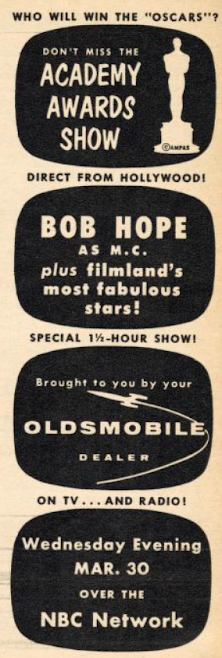
There's only one host in 1955, and there could only be one host: Bob Hope, Who else could it be? And he was charged with keeping the show moving; the listings give the running length at "About 2 hours." (The ad on the left even suggests 90 minutes!) The last time a normal ceremony was held, back in 2020, the running time was three hours and thirty-six minutes; previous ceremonies had been known to eclipse four hours, filled with clips that remind you how much better the movies used to be.

Don't misunderstand me: I love going to the movies, and there are still very good movies being made, movies that feature very good actors. Denzel Washington, for example, is an excellent actor, and I hope he wins tomorrow night. I'll admit that I've not seen a movie starring Nicole Kidman, but the same goes for her. (I read Billy Bathgate though, if that counts for anything.) Some of this year's nominated actors are probably better than some of the actors nominated in 1955. The point is, a great actor isn't necessarily a movie star. Right?

The Academy Awards are all about movies, and they're all about glamour. They're missing too much of the former, and too much of the latter, and that's why I miss what they used to be. 

l  l  l

Oh, one more thing about Wednesday's show—the nominated songs and their singers. Dean Martin sings "Three Coins in the Fountain" from the movie of the same name; Johnny Desmond does "The High and the Mighty" from that movie; Rosemary Clooney performs "The Man Who Got Away" from A Star is Born, Danny Thomas sings "Count Your Blessings" from White Christmas, and Tony Martin does "Hold My Hand" from Susan Slept Here. Not a bad lineup of songs or singers, is it?

l  l  l

The weekend highlight is the color extravaganza Entertainment 1955 (Sunday, 6:30 p.m., NBC), a 90-minute spectacular to celebrate the dedication of NBC's new Burbank color studios (made so famous in later years by Johnny Carson). It's a showcase of how television can cover "the lively arts," with Helen Hayes presenting the Tony award for Best Play; Dinah Shore in the studio, singing "Whatever Lola Wants"; Leontyne Price recreating her recent NBC Opera Theatre appearance as Tosca; comedy from Buddy Hackett, Pat Carroll, and Tom Holmore; Sue Carson doing a nightclub act, and host Fred Allen performing some of radio's greatest moments. NBC executives Pat Weaver and Robert Sarnoff, make a special appearance. 

Sunday's a pretty good night on the tube; on Toast of the Town, Ed Sullivan welcomes Rodgers and Hammerstein as they commemorate the 12th anniversary of their celebrated musical Oklahoma! (7:00 p.m., CBS) That's followed at 8:00 p.m. by General Electric Theater, as host Ronald Reagan introduces Henry Fonda as the young Emmett Kelly in "Clown," based on Kelly's autobiography.

Speaking of the circus, John Daly takes us behind the scenes at Madison Square Garden in New York City as Ringling Bros.—Barnum & Bailey prepares to kick off the 85th edition of "The Greatest Show on Earth." (Tuesday, 7:00 p.m., NBC) About half of the hour-long program focuses on the actual acts, while the other half consists of Daly's co-host, John Ringling North, leading viewers on a tour of what makes the Circus tick. The broadcast, which will utilize 12 live cameras at various points in the Garden, required the approval of Cecil B. DeMille, who, as a result of producing the Oscar-winning movie version The Greatest Show on Earth, had veto control over any television broadcast of the Circus. This year's broadcast is something of an experiment; if it proves to be an effective commercial for the Circus, the cameras will be back next year.

Next on Tuesday's agenda is March of Medicine (8:30 p.m., NBC), a special that provides us with some historical perspective. Entitled "Ten Years After Hiroshima," it's a report on the effect of atomic radiation on the survivors after "the first atomic weapon ever used in war." There's also a look at the U.S. Atomic Bomb Casualty Commission, and the work being done by research labs in Boston and Chicago. To me, at least, this is a show that gives one pause; it's not even ten years since Hiroshima, and this isn't some distant memory—almost everyone reading this issue was alive when the bomb was dropped, and the research is based not on theoretical experiments, but on the actual survivors of the blast.

We'll round off the week with Person to Person (Friday, 9:30 p.m., CBS), and tonight Ed Murrow's lead guest is none other than Marlon Brando, who on Wednesday won Best Actor at the Oscars for his performance in On the Waterfront. Ed didn't know for certain that he'd have an Oscar winner as a guest, obviously, but I think he had a better than 20 percent chance of being right. According to the description, Brando plans to "show off his seashell and book collections and his observatory, from which he can see the Pacific, almost all of Los Angeles and the Sierra Nevadas." I can't remember if this show was live or not; I think not, but in any event I wonder if anything changed based on Brando's win.

l  l  l

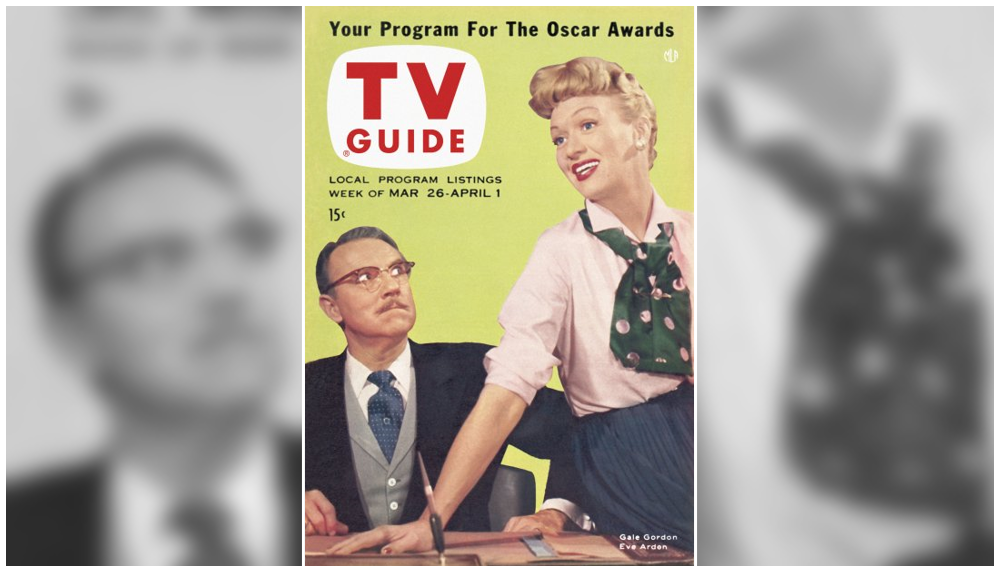
On the cover this week is one of television's favorite second bananas, Gale Gordon. To a later generation, he would be known as the long-suffering Mr. Mooney, one of the many roles he played as the longtime foil of Lucille Ball, but his appearance in this week's issue is as the long-suffering Mr. Conklin, the principal and foil to Eve Arden in both the radio and television versions of Our Miss Brooks.

In real life, Gordon is anything but the "bellowing" Conklin. He's a pipe-smoker, plumber, carpenter, fruit grower, oil painter, playwright, and gun collector; in addition, he's "one of the few actors in history to appear in a radio dramatic role without saying a word," having played the footsteps of the Unknown Soldier. Somehow, that seems perfect for a man who is about as unassuming as Hollywood stars get. 

Gordon seems to have played just about everyone, mostly on radio (including Lucy's boss on My Favorite Husband), and has worked with just about everyone (including Mary Pickford and John Barrymore, who said he had the best diction of anyone "on the stage, radio or screen." He's played  Mayor LaTrivia on Fibber McGee and Molly, Inspector Lestrade on Sherlock Holmes (with Basil Rathbone), and in a radio episode of Gangbusters, he played not only the killer, but the cop who arrested him, and the siren that belonged to the cop's car. 

Gordon has a rich career, even appearing in Lucy's final TV series, Life With Lucy. You might even say that it was a career to shout about.

l  l  l

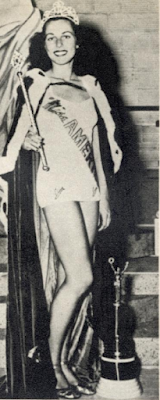
Perhaps the most famous Miss America in history, Bess Myerson has parlayed her crown into regular appearances on television, and it's no wonder. A striking 5-foot-10 in her stocking feet*, Bess has "moved from bathing suits to mink," and it seems that she's thoroughly enjoying it. Last year, she pulled in $125,000 as "The Lady in Mink" on the giveaway show The Big Payoff, while also pitching products on three major networks, and finding a regular place on various panel shows (she would be a regular on I've Got a Secret from 1958 to 1967). 

*And, the article is quick to mention in the way of the times, her "classical dimensions" of 36-26-36.

It's a very interesting article, as much for what it doesn't say as for what it does. It's been ten years since she became the first (and, to date, only) Jewish Miss America, and while the article makes note on her musical performance at the pageant (an accomplished musician, she wowed the judges with excerpts from Grieg's Piano Concerto), there's no mention of how three of the pageant's five sponsors refused to have her represent their companies as Miss America. (Obviously, television sponsors were far less concerned about her religion.) Much is made of her marriage to Allan Wayne, which produced Barra; there's no indication of the domestic violence that would result in divorce in 1957. 

And, of course, still ahead lies her time as head of New York City's Department of Consumer Affairs in 1969; her involvement in big-time Democratic politics, including Ed Koch's successful campaign for mayor, and her own unsuccessful run for the U.S. Senate in 1980; and her involvement in a scandal involving her relationship with a married man, her friendship with the judge hearing her paramour's divorce case (and employment of the judge's daughter), and subsequent trial for conspiracy, mail fraud, obstruction of justice, and using interstate facilities to violate state bribery laws (she was eventually acquitted). Ah well, he that is without sin. . .

As starlets go, Bess Myerson is already more successful than most—really, she's already a star—and anyone who's watched her in the old kinescopes of I've Got a Secret that used to run on GSN will remember her as charming, witty, urbane, and still beautiful. Whenever I see her in one of those old reruns, I still prefer to remember that, and ignore the messy stuff. I think she's entitled to that, don't you?

l  l  l

And just a reminder that if you like what you've seen, there's plenty more where that came from.
 

  TV