Showing posts with label Bing Crosby. Show all posts

December 14, 2024

This week in TV Guide: December 14, 1963


We all know how the minefield that is television is littered with the bodies of various flops, bombs, disasters, and other fiascos. Their tombstones are inscribed with various synonyms for failure: Turn-On. The Tammy Grimes Show. Flesh and Blood. Now it's time to add to that dubious pantheon one of the most infamous of them all: The Jerry Lewis Show. And it falls to Richard Gehman to write the obituary, even though the body, while moribund, is still breathing.

The Jerry Lewis Show was the result of a bidding war among all three networks, and came on the heels of some very well-received specials over the years, as well as a successful stint as guest host on The Tonight Show in that interim period between the departure of Jack Paar and the arrival of Johnny Carson. As befits the stature of one of the biggest stars in the business, The Jerry Lewis Show was big: two hours long, telecast live each Saturday, from the newly-renamed and refurbished Jerry Lewis Theater (at a cost of $1,000,000). ABC was spending, chairman Leonard Goldenson said, "more money than we own" on the show. And people were excited; "Everybody's rooting for Lewis," said Jack Elliott, music director for the Edie Adams show. "Everybody wants him to make it."

But now, only seven weeks into its run, the show is in Big Trouble, with a captial T that, if it doesn't rhyme with R, can best be summarized with the word ratings. It has fallen into third place for the night, trailing both NBC's Saturday Night at the Movies and CBS's venerable Western duo of Have Gun, Will Travel and Gunsmoke. The critics are using harsh words to describe the show's star: "egocentric" and "boor." ABC's president, Tom Moore, will only say that "We are committed to The Jerry Lewis Show for 40 weeks." The whispering in the industry is that "Jerry Lewis, LIVE from Hollywood, soon would be DEAD from Hollywood." And the question that everyone's asking: what happened?

According to Gehman, the problems are varied, but insiders point to one overriding conern: nobody really knew what Lewis wanted out of the show, what his vision was. It was as if he was completely detached from the project: unavailable for consultation with the network on guest stars, working on the script for his next movie instead of damage control on the show, opening for a week in Las Vegas in November. The problem, says Gehman, isn't confusion as much as it is a "complete lack of communication." 

Opening night didn't help. Lewis was nervous—"terribly nervous"—and things were only made worse when the huge screen above the stage stopped working, which meant most of the people in the theater couldn't see him. Cameramen lost communications with the control room. The red lights on the cameras went off, meaning nobody on stage knew which one to face. Commercials came and went without warning, or at the wrong time. Lewis, "a fearfully nervous persormer [whose] apparent ego masks a frightened and inescure little boy," hates surprises, and opening night was filled with them. He looked awkward, and the audience didn't understand some of his comments. Things went downhill from there. (You can see the opening to that show here.)

Gehman had been given unusual access to Lewis; the next year, he would write a biography of Lewis, That Kid, that, some said, caused Lewis to regret having given him that access. When it came to the show, however, Gehman found it difficult to get him to talk about things. He was more interested in talking metaphysically about God ("I think He sits up there in a big chair going har-har-har at all of us. I think He looks like Kriss Kringle. And I think He's makin' all of us do all this as a kind of audition.") and shrugs off press criticism ("The minute the critics are for me, I know I'm in trouble."). 

Which leaves it up to Gehman to analyze the failure, the first one that Lewis has had since a brief radio venture with Dean Martin that was almost immediately followed up by a successful turn into television. Lewis, Gehman says, is "a man whose deepest basic motivion—he once said to me—is fear." It may be, Gehman thinks, that "hurt and fear" have kept him detached. It may be that we was so cocky he didn't take into account how difficult two hours of live television each week could be, that he just had to "show up." It could be that, like his friend Frank Sinatra with his own ill-fated ABC series a few years ago, he had contempt for the television audience. All anyone knows is that when his press agent, Jack Keller, asked if there was anything he could do for Jerry, Lewis replied "Yeah—get me off this show."

It is, Gehman says in conclusion, as if Jerry Lewis was still auditioning, that, as he put it, God was going har-har-har while Lewis ran around frantically "and mainly running away." 

l  l  l

From 1963 to 1976, TV Guide's weekly reviews were written by the witty and acerbic Cleveland Amory. Whenever they appear, we'll look at Cleve's latest take on the shows of the era

I tried watching a couple of episodes of East Side/West Side a few years ago. Well, actually, I did watch a couple of episodes; I tried to like it, but I don't know that East Side/West Side is the kind of show that one actually likes, but the lack of a likeable character, combined with an excessive preachiness, meant I turned it off before it could turn me on. The fact that I tried it out, though, meant I fulfilled the obligation set out by Cleveland Amory in this week's review.

To be fair, Cleve had a few nits to pick as well, chief among them that East Side/West Side can be a little, well, humorless. The show is "a pretty depressing concept for evening 'entertainment' to begin with," perhaps "a bit seamier, it seems to us, than it has to be." A show like this doesn't have to have humor, but "more of a light touch would, if nothing else, help to illumine the dark spots." In crafting the role of welfare worker Neil Brock, played by George C. Scott, the producers "have failed to create a character with whom we can identify", and that goes as well for his two colleagues, played by Elizabeth Wilson and Cicely Tyson. There's also the fact that much of the dialog falls into the "unreal" department, which isn't the best thing for a series that promotes its realism.

All that said, Amory praises East Side/West Side as "undoubtedly the boldest, bravest and most original new series now on your screen this new season." CBS deserves credit for actually putting it on the air. And "you owe it to your conscience not only to see it but also to see that it stays on." At least I met Cleve halfway. 

l  l  l

This week is a kind of limbo for Christmas programming—the quiet before the storm, as it were. We're in the time before the barage of animated Christmas specials that come early in the month (Mr. Magoo's Christmas Carol premiered in 1962), and the variety shows and weekly sitcoms that air special Christmas episodes are just beginning to run theirs. (More of them will be on next week.)

With that said, two of the best-known and best-loved sitcom Christmas episodes air this week. On Tuesday, The Jack Benny Program (9:30 p.m., CBS) presents the famous 1960 episode "Jack Goes Christmas Shopping," featuring a performance by Mel Blanc that will crack you up, as it does Jack. On Wednesday, it's "The Alan Brady Show Presents," on The Dick Van Dyke Show (9:30 p.m., CBS), with Dick, Laura, Buddy, Sally, Mel, and Ritchie performing their hearts out. No Christmas viewing schedule is complete without either of these. And Saturday's Lawrence Welk Show (8:30 p.m., ABC) celebrates a holiday show with the Osmond Brothers.

Sunday's always a good time for holiday programs, and this Sunday is no exception, starting with CBS's religious program Look Up and Live (10:30 a.m.), which focuses on "Three Views of Christmas," including songs and spirituals appropriate to Advent. We continue at WNAC in Boston, with the second half of the noon double feature, Remember the Night, with Barbara Stanwick as a shoplifter remanded to the custody of the prosecuting attorney (Fred MacMurray) over the Christmas holiday. (Only in the movies, right?) That finishes in time for you to switch over to the Hallmark Hall of Fame's Christmas presentation, "A Cry of Angels" (4:00 p.m., NBC), the story of Handel and how he came to write "Messiah." Walter Slezak plays the troubled composer, who faces mounting debt, dwindling audience interest, and crippled pain in his hands, as well as the emnity of the Prince of Wales (Hurt Hatfield); Maureen O'Hara costars as Susanna Cibber, the singer who assisted in the efforts to get "Messiah" published. Lassie (7:00 p.m., CBS) presents the first of a two-part Christmas story, in which Timmy and Lassie bring home an elderly toy mender for Christmas. And over on ABC, The Ernie Ford Show (Monday-Friday, noon), Ernie sings at least one Christmas hymn each day.

Locally, WMUR in Manchester airs a charming little program Monday through Friday at 7:00 p.m. called Santa Claus, with the studio transformed into Santa's Workshop at the North Pole, and Santa (kids' show host "Uncle" Gus Bernier" reading letters from kids. You can see a clip from that here. On Thursday, WBZ offers a Boston Christmastime tradition, the play Black Nativity (7:30 p.m.), by American poet Langston Hughes, set to traditional Chrismas carols sung in gospel style; Hughes himself provides the narration. At 8:00 p.m. the same night, WGBH has Dylan Thomas's prose poem A Child's Christmas in Wales, recited by Thomas, against the backdrop of photographs of Thomas's homeland. If you have to choose, I'd choose Black Nativity simply on the grounds that WGBH will probably repeat A Child's Christmas sometime in the next couple of weeks.

l  l  l

There's plenty more to look forward to this week. Saturday is the final day of the regular season in college football, with Alabama taking on Miami at the Orange Bowl (1:30 p.m. ET, NBC). If you're like me, you might have wondered that the regular season extended so deep into December, until you see the notation "Postponed from last week." The accordian effect of November 22 really does have a long reach, doesn't it? 

On Sunday afternoon, NBC Children's Theatre (3:00 p.m.) presents a kind of alternative to CBS's Young People's Concerts, as conductor Igor Buketoff and the NBC Orchestra demonstrate the range and variety of sounds made by a symphony orchestra. And who wouldn't want to see the conclusion of Pollyanna on Disney's Wonderful World of Color (7:30 p.m., NBC), with the delightful ◀ Hayley Mills, Jane Wyman, and Karl Malden. 

If you wake up early enough on Monday, you'll catch an interesting lineup on Today (7:00 a.m., NBC), with the focus on "second-generation actors" James Mitchum and Peter Fonda. One of them becomes a big star, one of them doesn't (but he's still more successful than I'd ever be). And if you can stay awake long enough, Sing Along with Mitch (10:00 p.m., NBC) has a tribute to World War II and the London Blitz, with Leslie Uggams, Bob McGrath, Deirdre Damon and Sandy Stewart joining in. 

The younger set should be excited by Mr. Novak (Tuesday, 7:30 p.m., NBC), with singer Frankie Avalon as special guest star. And we're in for an eclectic evening on The Bell Telephone Hour (10:00 p.m., NBC), with Steve Lawrence and Eydie Gormé, plus opera great Birgit Nilsson, pianist Lorin Hollander, and dancer Eleanor Powell. Talk about a variety show. 

Wednesday, CBS Reports (7:30 p.m.) features members of President Johnson's cabinet sharing their views on various issues facing the new president, less than one month into his administration. It must still have taken some getting used to seeing the phrase "President Johnson" in print. And on The Danny Kaye Show (10:00 p.m., CBS), the aforementioned Dick Van Dyke is Danny's special guest; among the skits, Dick plays a best man trying to talk Danny out of leaving his bride standing at the altar.

On Thursday, Lauren Bacall makes a rare television appearance in Dr. Kildare (8:30 p.m., NBC) as a Pulitzer Prize-winning columnist faced with a serious illness. And on Kraft Suspense Theatre (10:00 p.m., NBC), Mickey Rooney stars in "The Hunt" as a sadistic sheriff who plays a variation of "The Most Dangerous Game" with his prisoners—first he lets them escape, then he tracks them down and kills them. The unfortunate prisoners are James Caan and Bruce Dern.

Friday
gives us a case of what might be called "Dueling Serlings," starting with The Chrysler Theatre presentation of "It's Mental Work" (8:30 p.m., NBC), Rod Serling's adaptation of John O'Hara's short story, starring Lee J. Cobb, Harry Guardino, Gena Rowlands, and Archie Moore. After that, you can flip over to CBS for Serling's Twilight Zone story "Ninety Years Without Slumbering" (9:30 p.m.), starring Ed Wynn. When that's over, you've got a choice: The Jack Paar Program (10:00 p.m., NBC), with Jack's guest, BIshop Fulton J. Sheen; or the Fight of the Week (10:00 p.m., ABC), with welterweight champion Emile Griffith moving up a class to fight Rubin "Hurricane" Carter. Remember Carter's long and ultimately successful fight for justice back in the day? This was when he was simply known as a boxer.

l  l  l

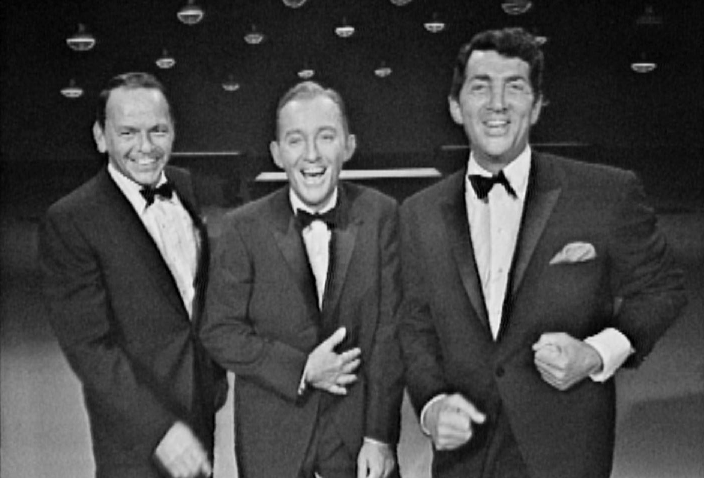
On the cover this week is a program that looks as if it should be one of Bing Crosby's star-studded Christmas specials, but in fact The Bing Crosby Show for Lever Brothers, starring Frank Sinatra, Dean Martin, Bob Hope, Rosemary Clooney, Kathryn Crosby, and Peter Gennaro, isn't scheduled until February 15 of next year.* But these shows have to be shot sometime, and this one has just wrapped production.

*Bing had done Christmas variety specials on ABC in 1961 and 1962; in 1963, he narrated a program called The Promise, made by Father Patrick Peyton's Family Theatre Productions, which told of the events leading up to the birth of Christ. 

Deano welcomes Rosie to the set.     
One of the challenges in putting together an all-star show like this is getting everyone together at the same time, and as fate would have it, Hope is in and out before Sinatra and Martin have even arrived; Bob is suffering from an eye ailment, and left early for treatment. There's only a brief discussion as to whether or not to replace him with another star, and it's decided that they'll tape his segement at a later date and splice it in. Crosby explains to the audience that Hope picked up a slight cold, "and you know at his age, old Skinose has to take care of himself." 

The special represents "Kathy" Crosby's first television appearance with Bing (as well as her first singing appearance on television), and Crosby's pride in his young wife is evident, kissing her as she sits on his lap. Anyone who's ever watched Bing in action knows how smooth, how practiced and at ease, he always appears ("utterly nervless"), and even his wife is moved to comment on it; at one point, while he was out of earshot, she commented to Rosemary Clooney that "I had no idea he was such a pro. If I had known, I'd have married him sooner." 

Incidentelly, when Kathy Crosby was still Kathryn Grant, she appeared in a 1957 science fiction movie called The Night the World Exploded, and that's airing this Friday overnight at 1:00 a.m. on WBZ.

l  l  l

MST3K alert: Lost Continent (1951) A rescue mission discovers a "Lost Continent." Cesar Romero, Hillary Brooke. (Sunday, 9:00 a.m., WGN) This brief description hardly does the movie justice, and editing it down to fit a one-hour Sunday morning timeslot doesn't help things. But without the interstitial MST3K features, you don't have a movie anyway: Crypto-dad Hugh Beaumont as one of the Four Horsemen of the Apocalypse, rock climbing, and Cesar Romero—really, who could ask for anything more? TV  

January 13, 2024

This week in TV Guide: January 11, 1958


There's a part of me that views the headline on this week's cover—"What Time Has Done to Shirley Temple"—in the same light as one of those clickbait headings you see on the sidebar of just about every website around. (Not this one, of course!) It implies ravages of some sort or other, the kind of thing that you'd expect if the headline had asked What Time Has Done to Judy Garland.

But in fact what the last twenty years have done to Shirley Temple is to change her from an adorable curly-haired moppet who just happened to be one of the biggest movie stars in the world and was known as America's Sweetheart, to a beautiful and charming young woman of 29, wife of executive Charles Black and devoted mother of three, and, thanks to her parents putting her money in trust funds, "if she isn't a millionaire in her own right, she's close enough to it to be called one." We should all be so lucky to have time do that to us, and perhaps it has for you, but don't include me in that company.

And so thus contented, Shirley had made no moves to return to the business, despite repeated offers, until Bill Phillipson came long. He's the executive producer for Henry Jaffe Enterprises, and approached her with an idea for an hour-long series of fairy tales, which she would narrate and in which she would occasionally star. "I'm a pushover for fairy tales," she explained. "I've long felt there is a need for more shows that would appeal to the entire family, and certainly this series was designed with just that kind of family appeal in mind. So here I am." 

And here is Shirley Temple's Storybook, which debuts on Sunday night at 8:00 p.m. (ET) on NBC with a live broadcast, in color, of "Beauty and the Beast," starring Claire Bloom as Beauty, Charlton Heston as The Beast, and a supporting cast including E.G. Marshall, June Lockhart, and Barbara Baxley. It confirms Shirley's determination for her series to be "something better than just another batch of children's shows." "They must have quality," she says, and several of them will be in color. "I still can't understand why they don't do them all in color," she says with a touch of the famous Shirley Temple pout. 


Shirley Temple's Storybook
airs on an occasional basis throughout 1958, and then returns as a weekly series in 1960-61; in all, 41 episodes are produced, and many of them are available on YouTube—although, alas, not "Beauty and the Beast." It's a warm family show, with none of the postmodern cynicism that one might see were such a series revived today. And, of course, any episode that gives us a chance to see Shirley acting is a treat. 

So what, if we were to flip ahead another twenty years, would time have done to Shirley Temple Black? Well, by any measure, she has to have had one of the most successful post-acting careers of any child star, including service on the boards of several major corporations (including the Walt Disney Company; what would she think of Disney today?), a lifelong involvement in politics (including an unsuccessful run for Congress), and a diplomatic career that featured serving as U.S. Ambassador to Ghana and U.S. Ambassador to Czechoslovakia, membership on the U.S. delegation to the United Nations, and becoming the first female U.S. Chief of Protocol. 

Throughout it all, she is a shining symbol of the greatness that was Hollywood, lending her name to a famous drink (ginger ale and a splash of grenadine) and her image to a famous doll owned by millions of little girls (including my mother-in-law), and remains a much-loved figure until her death in 2014. If time was good to Shirley Temple, it seems that she was pretty good in return. 

l  l  l

There's a story behind every story. These are just some of them.

The ad says, "If you like the PERRY MASON show, you'll love DICK AND THE DUCHESS, at 8:30 on the same station." The day is Saturday, the network is CBS, and the series is one of the first to be filmed in the United Kingdom for broadcast in America. Dick and the Duchess stars Patrick O'Neal as an insurance investigator, and Hazel Court as his wife, a duchess by birth, who always seems to get involved in his investigations. Years later, sound editor Robert Winter discussed the show's use of a laugh track; the challenge in writing for audiences in two different nations, Winter explained, was determining  "what was or was not funny to a British audience, as well as the important criteria for an American audience for whom it was principally made." Under such circumstances, the laugh track was used to prompt laughter among viewers, especially in situations where the humor (or humour, if you prefer) might not be as obvious. The show runs for 26 episodes, which apparently disproves the adage in the ad, seeing as how Perry Mason still has eight seasons to run.

Sunday
's highlight is half-sporting event, half-entertainment special. Billed as Bing Crosby and His Friends, it's the final round of one of golf's glamor tournaments, the Bing Crosby National Pro-Am, also known as the Crosby Clambake, from one of America's greatest golf courses, Pebble Beach in California (5:30 p.m., CBS). It's the first time the tournament has been broadcast nationally, and as an indication of the event's hybrid status, the emcee is John Daly—no, not the golfer John Daly, the newsman and What's My Line? host John Daly. Bing and his wife Kathryn are hosts, and in addition to coverage of the tournament's final two holes, the broadcast includes highlights of the previous three days, plus songs and sketches from some of Bing's show business buddies, including Bob Hope and Phil Harris. Oh, and let's not forget the golf; Billy Casper takes the first of his two Crosby titles, defeating Dave Marr by four shots and winning $4,000 in the process.

On Monday, it's the debut of the daytime serial Kitty Foyle (2:30 p.m, NBC), which surely must have one of the more distinguished pedigrees of any soap opera. It begins with the 1939 best-seller by Christopher Morley, which tells the story of a white-collar girl who falls in love with a young socialite, and includes such touchy subjects as out-of-wedlock pregnancy and abortion. This was adapted into a 1940 movie (toning down some of the book's racier parts), which won a Best Actress Oscar for Ginger Rogers (and created a fashion trend called the "Kitty Foyle Dress"), and then a 1942-44 radio serialization created by soap opera giant Irna Phillips. In was inevitable that it would eventually make it to television, which it does here, becoming NBC's first half-hour soap. Strangely enough, the TV version of Kitty Foyle doesn't do too well; soap opera historian Ron Lackmann speculates that "perhaps the story was too familiar, or perhaps once the basic story was told, there was nothing else to say about Kitty and her problems." The series ends after only five months. 

Omnibus, usually seen on Sunday afternoon, makes a rare prime-time appearance on Tuesday (8:00 p.m., NBC) in a musical variety hour, "The Suburban Review," with Alistair Cooke welcoming veteran comic Bert Lahr, musical comedy star Pat Stanley, and the young comedy team of Mike Nichols and Elaine May; the show's theme contrasts the suburban life of the 1920s with today's contemporary Suburbia. Lahr, of course, was famous for The Wizard of Oz, as well as his long career in burlesque and vaudeville; meanwhile, Stanley won a Tony for Goldilocks, and co-starred in The Pajama Game. Nichols and May, however, were less-well known nationally, although they were popular in the Village and at New York's famed Blue Angel, and they'd made their television debut with Steve Allen just the previous month. However, the audience for Omnibus is in the tens of millions, and they are given 15 unedited minutes to perform; by Tuesday, Nichols and May are famous. You can see those skits here and here.

Wednesday on Kraft Theatre (9:00 p.m, NBC), Walter Matthau, Nancy Walker, Robert Middleton, Barton MacLane, and Nancy Gates star in "The Code of the Corner," a gritty story of crime on the city streets, written by Jack Klugman. Yes, that Jack Klugman! It's one of two scripts he wrote for Kraft Theatre, the other being "Big Break." Klugman was already an established actor at this point in his career; 12 Angry Men had come out the previous year, so this isn't a case of an actor turning to writing while waiting for his own big break, so to speak. I never knew this before; I guess the old saying is right that you learn something new every day. (Well, of course it's right, otherwise it wouldn't be an old saying—it would be a forgotten saying, which is something completely different.) At any rate, you can watch Klugman talking about acting and writing for Kraft Theatre in this interview for the Television Academy.

On Thursday, it's the premiere of a new adventure series: Sea Hunt, starring Lloyd Bridges as Mike Nelson, ex-Navy frogman turned undersea investigator (7:00 p.m., WHEN in Syracuse). Sea Hunt was created by Ivan Tors; he was unable to sell the series to any of the three networks (Oops!), and so wound up entering into a deal with Ziv Television Productions. According to the always-reliable Wikipedia, "The show attracted half of the viewing audience in 50 major cities and averaged 59 percent of audiences in New York City." The show will run for four successful seasons and 155 episodes, which I suspect any network would have been pleased with. Bridges himself was a natural athlete who took to scuba immediately, and wound up doing all but the most dangerous stunts himself.

Later on Thursday, we have another big-name lineup. This time, it's Playhouse 90 (9:30 p.m., CBS), and the story "The 80 Yard Run," starring Paul Newman and Joanne Woodward, with Darryl Hickman and Robert Simon. It's the story of a former football hero who lost his fortune during the Depression and now faces the prospect of his wife, who works at a fashion magazine, succeeding where he fails. (Can you say A Star is Born?) The teleplay is by David Shaw, based on the 1941 short story by his brother, best-selling author Irwin Shaw, which was published in Esquire. If you're curious, you can read that short story here, and an in-depth analysis of the story's meaning here. I wonder if Playhouse 90 tried to give the story a happy ending?

Friday
night, it's the final holiday special of the Christmas season: Bob Hope's USO tour of the Pacific (8:00 p.m., NBC). Bob's troupe includes Jayne Mansfield, singers Erin O'Brien and Carol Jarvis, Hope regular Jerry Colonna, columnist Hedda Hopper, dancer Arthur Duncan, and Jayne's fiancée, former Mr. Universe Mickey Hargitay (who is no actor, according to TV Guide's Frank DeBlois, who accompanied the crew). The tour covered ten days and 16,000 miles, and included stops in Hawaii, Wake Island, Okinawa, Korea, Tokyo, and Guam. The show rolled into Korea on Christmas Eve, where Hope gave four shows that night, then two more in sub-freezing weather on Christmas Day—just 500 yards from the North Korean border—where 10,000 troops waited four hours in the snow to see him. You can see a clip from it here.

l  l  l

Frank DeBlois is a busy man; not only did he accompany Bob Hope on his tour of the Pacific, he's also taking a look at how the first half of the television season has measured up. More of us are watching TV than ever before, with 41,200,000 homes having at least one television—that's a three percent increase over last year. 

DeBlois reports on some surprises: ABC's Maverick outpointed CBS's Ed Sullivan Show several times during the season while "something called The Real McCoys" bested both Climax! and Dragnet. (Hint to Frank: The Real McCoys, which debuted in 1957, will run for six successful seasons before leaving the airwaves in 1963, only to spend several more years in reruns during the daytime.) Frank Sinatra's return to television, with his eponymous drama/variety show, showed "less than spectacular success." Gunsmoke, now in its third season, appears headed for the number one spot in the ratings. 

In fact, Westerns scored strongly in the first half of the season, despite complaints from critics that there were too many of them on television. In addition to Gunsmoke and Maverick, Wyatt Earp, Cheyenne, Zorro, and Wagon Train were big winners. Singers had it rough; besides Sinatra, shows hosted by Polly Bergen and Gisele MacKenzie (who graces the cover this week) "consistently wooed mediocrity," and even stars such as Dinah Shore, Pat Boone, and Eddie Fisher had their troubles. As far as specials, The Edsel Show, with Sinatra and Bing Crosby, the General Motors anniversary program, NBC's presentation of the opera Dialogues of the Carmelites, and The Prince and the Pauper, being notable successes. 

Comedians seem to be coming back, with Danny Thomas and Jack Paar scoring strongly, along with Bob Hope, Red Skelton, and Jack Benny. Hallmark Hall of Fame continues to be consistently good (as opposed to today's version), and Playhouse 90 appears to be overcoming a weak start. The Eve Arden Show and Leave It to Beaver are among the better sitcoms, while DeBlois finds McCoys and Dick and the Duchess to be middling. CBS lead the way with some fine documentary series, including The Twentieth Century and The Seven Lively Arts, while NBC offered Omnibus and Project 20, and ABC made its mark with Mike Wallace's dominating interviews. 

The point, DeBlois says, is that there's this feeling that television is starting to turn away from "the tired old worn-out formats and cliches" of last year; there's a feeling of revolt, of something new. And it's good to have it back.

l  l  l

Boris Karloff is going through something of a career renaissance, with Frankenstein now thrilling a second generation of Americans through its regular showings on television. The character of Frankenstein's monster is the role with which he's most identified; he revived the character in two sequels, and after than embarked on a series of "mad scientist" movies, which tend to overwhelm the great body of work he's done throughout his career, first in movies and then on television, where he's appeared in "practically every live dramatic show and filmed anthology series that has ever gone on the air." But, unlike some stars who resent the typecasting that can result from such a famous creation, Karloff has nothing but affection for the monster.

"It's a lovely film, a great film, and I'm devoted to the monster," he tells Joe Morhaim. "He's the best friend I ever had. He changed the course of my entire life." It may be natural that he'd feel that way about the role that made him a star, but he has a deeper point he wants to make. "That monster is one of the most sympathetic characters ever created in the world of English letters," he says. "He was a big, lumbering, awkward, inarticulate figure, completely childlike and helpless in spite of his enormous strength. He became savage only when he was frightened and he was frightened only by the ignorance and fear of human beings." 

He believes the world has missed the point of Marry Shelley's story, and quarrels with those who classify Frankenstein as just another horror film. "'Horror' connotes revulsion, disgust, recoil. The object is not to turn your stomach—but merely to make your hair stand on end," he says with some passion. "As a matter of fact, I believe the Frankenstein-type story fills a deep-seated human need. One finds it rooted in the folk literature of every race, even in nursery rhymes and fairy tales." He also doesn't believe children are harmed by such stories. "Young people have much more intelligence than we give them credit for. They have the ability to sort things out and put them in their proper relationships." The fan mail he receives from children, asking for a picture of himself as he is, bears out that "they knew it wasn't true, and they knew I knew it wasn't true. As a rule, they expressed a great compassion for the monster." 

It's true that monster movies can be overcooked, he agrees. "Any story can be done in good or bad taste. The important thing is that the story be interesting and that it is done well." He acknowledges that the two Frankenstein sequels left something to be desired; by the third, the monster had been reduced to "a comic prop." But even though other Frankenstein movies have continued to be made, with other actors in the role, people know who the real monster is. "They would get the pay checks and I would get the fan mail," he says, and you almost wonder if the mail isn't more important to him than the checks. He is an educated, gracious, and charming man, respected and admired by his friends and colleagues, and continues to work steadily, even appearing recently on The Dinah Shore Show. He says he'll not do the monster again; "They would change his character today, and I couldn't bear that. I have too much respect for the old boy." And to think, he's got more than a decade to go, and one of his most famous roles—the voice of The Grinch—ahead of him.

l  l  l

I've been on a lot about stories this week, and it's true that there's a lot of storytelling to be had besides what you see on the screen. We'll finish with the story of Jeanne Carmen, the professional golfer who would be an actress.

She can, according to this brief profile, "hit a golf ball a country mile against the wind or literally off your teeth," and she's been known to parlay her trick shot artistry into several thousand dollars a day, but now she says those days are done. She's no newcomer to the entertainment world; as far back as 1948, she appeared in the chorus line of the aforementioned Bert Lahr's Burlesque, and was in great demand as a model. More recently, she's appeared in the movies (Too Much Too Soon and Born Reckless), and done shows with Bob Hope and George Gobel. As a matter of fact, that picture has the whole story. Just not the most interesting parts.

In addition to her career as a trick-shot artist and Hollywood actress (she even appeared in a Three Stooges short, playing Joe Besser's girlfriend), Jeanne was an "intimate" friend of mobster "Handsome Johnny" Roselli, one-time confederate of Al Capone, who recruited fellow mobsters Sam Giancana and Santo Trafficante Jr. in the CIA attempt to assassinate Fidel Castro, and was thought to have been involved in the assassination of JFK as well. Through Roselli, she became acquainted with Frank Sinatra, who she would see on-and-off over the next few years. (She was also reported to have been involved with Clark Gable and Elvis Presley.) Later, she became a close friend and confidant of Marilyn Monroe; after Monroe's "suicide" (a verdict that Jeanne found dubious), she was warned by Roselli to leave town for her own safety, and lived a quiet and peaceful life thereafter with her third husband, raising three children and never mentioning her past life; she died in December, 2007. She's probably the only person who's been profiled both by The Golf Channel and the E! True Hollywood Story. If you head over to the website dedicated to her life, you can see pictures of her with everyone from Elvis to Donald Trump, and why doesn't that surprise me? And these are just the highlights.

It's quite a remarkable story—but then, so have most of the stories we've read this week. And, when you think about it, almost everyone's life is a remarkable story in one way or another. I may not have had a tenth of the adventures that Jeanne Carmen experienced, and I'm actually glad about that. We may have moved around the country a few times, but at least it hasn't been because someone warned us our lives might be in danger. And I'll be the same is true for you as well. Who knows? Maybe the most exciting lives are better read about than lived. TV  

December 23, 2022

Around the dial


I've used this photo before at this time of the year; it's not me, but it could have been: cat, TV, Christmas cards, presents. What more could you ask for? Anyway, I think it's just a great picture. 

Let's stay on that Christmas theme for a bit, starting with this look at Comet Over Hollywood at 75 years and five versions of Miracle on 34th Street, which includes the rare fifth version that stars Ed Wynn as Kris. I knew about that one, but I'd really like to see it someday.

At The Epoch Times, Jeffrey Tucker writes about the lessons we can learn from Rudolph the Red-Nosed Reindeer. I think there's a temptation to read articles like this tongue-in-cheek, but not this one: his conclusion is very serious, especially considering the times we live in today.

You'll recall that last week I wrote an article on the many things that are wrong with "holiday" movies on networks like Hallmark, Netflix and the like. This week, The Babylon Bee comes up with the natural headline: Hallmark Researchers Close to Developing a Second Movie Plot.

Meanwhile, over at Comfort TV, David looks back at That Girl's first Christmas episode, and how his opinion of it has changed upon second viewing. Sometimes things don't always turn out the way you planned, and that's a rare message for TV at Christmastime.

At Garroway at Large, Jodie reminds us of Dave Garroway's appearance as Santa Claus in the 1954 and 1955 productions of Babes in Toyland, as well as a link to the 1954 broadcast. We watched this last week, and it's absolutely charming; Dave is exactly what you'd expect as Santa. Well worth it!

And Silver Scenes has a look at another Christmas special we've got, although we didn't watch it this year (we like to rotate the Bing Crosby specials, since there are so many of them)—Mary Costa singing the Ukranian Carol on Bing's 1970 show, which also features Robert Goulet, as well as the Crosby clan. 

TV Guides from the mid-70s often referred to Boris Karloff Presents Thriller, which always puzzled me, there being only one version of a show called Thriller that I was aware of, until I learned about the British show of the same name. Today at Cult TV Blog, John talks about that version, and the episode "Kill Two Birds." 

For those of you already looking forward to the New Year's weekend, Shadow & Substance has the lowdown on Syfy's Twilight Zone marathon. It's hard for me to watch the edited versions, especially when I have it on DVD, but if you turn over for a few minutes, you might be there for a couple of hours.

Diane McBain, who was one of the last stars from the golden age of WB detective shows in the late-50s and early-60s, died this week at age 81. She was always enjoyable on these shows; she was criminally underutilized on Surfside 6, but I've complained about that before. I'll be we'll be seeing some tributes to her on the blogosphere over the next couple of weeks.

Finally, congratulations to Aurora on the 11th anniversary of Once Upon a Screen. Here's hoping to many more!

For those of you who may not be checking in here until after the weekend, be safe if you're facing the heavy weather as we are here in Indiana, and my wishes for a very Merry Christmas! TV  

September 7, 2022

That Bing Crosby special: the rest of the story


You might recall a video I shared a couple of weeks ago of a non-holiday Bing Crosby special. (Then again, you might not. I do, though, and that's the important thing.) In discussing that show, which aired on February 15, 1964, I mentioned that guests Frank Sinatra and Dean Martin had originally been scheduled to appear on an earlier Crosby special, but that they'd been "canceled" from the program by the network. I also mentioned that The New York Times probably had some of the details, but that I wasn't in a position to pay to find out. 

Well, the mighty Jodie Peeler, from Garroway at Large, has come to the rescue! She's provided me, and by extension the rest of you, with a couple of articles that give us the lowdown on what actually happened behind the scenes, and it just adds another layer of interest to this program.

The first article, dated October 1, 1963 and written by Val Adams, speculates that the cancelation may have had something to do with music rights, but there was no definite answer. Adams's follow-up article from October 30, however, gives us a far more salacious reason: General Motors, parent company of Pontiac, one of the show's sponsors, objected to Sinatra's appearance because of his possible connections to "underworld leader" Salvatore "Sam" Giancana. Martin then withdrew from the show in sympathy with Sinatra. Since Pontiac is not sponsoring Crosby's February special, Sinatra and Martin will make their appearance then. I've cut and pasted the two stories so they'd fit the space better, but the content remains the same.


You may recognize Sam Giancana's name; besides being a renowned gangster, his mistress, Judith Exner (who was previously married to actor William Campbell, whom you might recognize from a couple of appearances on the original Star Trek), was also reportedly used as a go-between with President John Kennedy, with whom she was also having an affair. Giancana is also a favorite among conspiracy buffs as one of the mobsters involved in the assassination of Kennedy, which occurs less than one month after the appearance of Adams's second article. I tell you, this is another of those gifts that just keeps on giving!

My thanks again to Jodie, for reading my initial piece and responding to my covert cry for help. As Jackie Gleason might have said, It's About TV readers are the greatest readers in the world. TV  

August 24, 2022

The Bing Crosby Show, 1964


Here's something you don't see often: a Bing Crosby special that's not for Christmas. It was aired on CBS February 15, 1964 (preempting The Defenders), but it had actually been recorded nearly a year earlier, in June 1963.* Talk about a star-studded lineup; Bing's guests are Rosemary Clooney, Bob Hope, Frank Sinatra, Dean Martin, Peter Gennaro, and Bing's wife Kathryn. Now that's a special

*And it was recorded at the NBC studios in Burbank. I know that Bing was supposed to be one of the wealthiest entertainers in Hollywood, but I didn't realize he owned all three networks.

One of the interesting sidelights is that this CBS special comes in the midst of Bing's work with ABC. His 1961 and 1962 Christmas specials had been on the network, as had a non-Christmas special in May 1962; his long association with The Hollywood Palace (he hosted it 31 times) began in January 1964 (before the Crosby special on CBS; evidentially Bing's contract with CBS didn't have the same clause as Sammy Davis Jr.'s! But I forgot—Bing owned all the networks), and his weekly series, with Beverly Garland, premiered on ABC in September 1964. 

This was not the first time Crosby had been on CBS, though; he had a history with CBS radio dating back to the late 1940s and had aired a television special on the network on November 7, 1963, so these two programs might have been part of a package. And then there's Bing's production company, fittingly named Bing Crosby Productions, which had programs on both CBS and ABC and was famous for cross-pollinating variety shows with stars from series on opposing networks (e.g. the cast of Hogan's Heroes on The Hollywood Palace).  

Something interesting about that November show; according to several sources, Sinatra and Martin were scheduled to be guests on that special but were bumped to the later one. (It might have had something to do with music rights, I don't know. I could have paid The New York Times to get access to their archive, but that's not in the budget for a starving artist.) At least The Bing Crosby Show is broadcast in time for the opening of the movie that starred Crosby, Sinatra, and Martin: Robin and the 7 Hoods, which opened in June 1964.

Anyway, here it is, from February, 1964: The Bing Crosby Show. See what it's like to watch a Bing Crosby special that doesn't end with "White Christmas."  


TV  


December 12, 2020

This week in TV Guide: December 16, 1972

We've already looked at the story of the Duke and Duchess of Windsor, aka Edward Windsor and Wallis Simpson, when it was a multi-part miniseries in 1980. Time isn't always linear though, as you might have noticed if you've been reading this feature the last few years. Just because 1972 comes before 1980 doesn't mean that we actually get to it first. (I wrote that other piece about the Duke and Duchess at the start of this year, and frankly I'm surprised they're running even that close to each other.) And so we find ourselves making a big deal about The Woman I Love, an hour-long drama airing Sunday at 9:00 p.m. PT on ABC.

This might be the first big American TV drama about the "Love Affair of the Century," and so it's understandable that it would be on this week's cover. That, and also because the couple are being played by Richard Chamberlain and Faye Dunaway, and even though Chamberlain hadn't yet ascended to his Shogun/Thorn Birds-era status as King of the Miniseries, he's still glamorous enough to match wits with Dunaway.

Basil Boothroyd's background story tends to concentrate on the political crisis instigated by Edward's romance with the twice-divorced Wallis; he says that the king "never for a moment considered" the alternative of retaining the throne and giving up "the woman I love," and doesn't consider the post-abdication live of the Duke and Duchess. While religious objection to the marriage is seen today as outdated, especially considering the marital situation of Prince Charles, it was in fact the primary reason for the crisis in the first place; for his part, Edward was, in the eyes of some historians, bluffing with his abdication threat, in a failed power play to retain the throne and marry Wallis. As far as the romance is concerned, I've read accounts on both sides; most historians suggest that the couple remained in love until Edward's death earlier in 1972, but at the same time Edward yearned to live a more meaningful life, one that never came, as the couple became mainstays of café society. It's probably just as well that this story ends where that story begins, for while the political machinations (particularly by Prime Minister Baldwin) are fascinating, they're no match in the end for a royal love story, are they? Just ask the Hallmark Channel.

t  t  t

Throughout the 60s and early 70s, TV Guide's weekly reviews were written by the witty and acerbic Cleveland Amory. Whenever we get the chance, we'll look at Cleve's latest take on the shows of the era. 


We've seen throughout the years that Cleveland Amory has an antipathy toward shows lacking originality. A show that isn't good but at least tries to be different always has it over a show that is neither good nor original. Welcome to Bridget Loves Bernie, the CBS sitcom about the Catholic girl (Bridget, played by Meredith Baxter) married to the Jewish boy (Bernie, also known as David Birney). It is, says Cleve, "pretty awful." In other words, it's not the "Love Affair of the Century."

It's not that the marriage itself doesn't have problems, he says. For one thing, "they're always either talking about [love] or smooching so much they couldn't talk anyway," and I can certainly understand how that might get a little tiresome after, say, half an episode. No, as with many marriages in the real world, the problem here lies with the families of the young marrieds. "There ought to be a law on TV against in-laws on TV who live in," as in the case of Bernie's parents (as well as a maiden uncle) who run a deli right below where the happy couple lives; meanwhile, Bridget's parents (and a brother who's also a priest, making him—what, Father Brother?) may not live with them, but "they're always there, whenever the show needs them—and also when it doesn't." There's always Bernie's friend Otis, "the show's nonresident black," which pretty much means every box of the stereotypical sitcom has been checked.

This show was controversial when it aired in 1972; the idea of interfaith marriage was a much thornier situation than it is today, when pretty much anything goes. Nonetheless, it might have been better had the controversy surrounded the lack of support given to the cast: Birney is a likable Berney, says Amory (I'm surprised he didn't have a name joke there), and as Bridget, Baxter is pretty. The in-laws are pretty good as well, barring Audra Lindley as Bridget's mom, who's a bit much, but she's supposed to be. Where the show falls short is in the plotting, which leads to stories that are, as far as I can tell, dumb more than anything else. There is, for instance, the one where the couple broke their bed. (It's probably better that we're not told how this happened.) Each family, of course, buys them a new bed, and they buy themselves a new bed as well. A water bed, apparently, because it leaked, "just like the plot." And then there's this week's episode, which Cleve fortunately doesn't get to, in which the families quarrel about whether to celebrate Christmas or Hanukkah. He recalls plots like this with "a stabbing pain," and even without watching it, I'm beginning to feel it myself. It's not that there isn't a place for a show like this, he concludes: "what's a nice soap opera like you doing in prime time?" Bridget may love Bernie, and Bernie may love Bridget, but the viewers only loved them 24 episodes worth.

t  t  t

Christmas is just over a week away, so we can't be surprised that holiday programs have their own section in the week's highlights.

On Sunday afternoon, Christmas Is (12:30 p.m. PT, KGO) finds a schoolboy transported to the Nativity, where he encounters innkeeper Hans Conreid. John Huston narrates the documentary Christ is Born (6:00 p.m., KCRA), filmed on location in the Holy Land. Season's Greetings from Mike Douglas (7:30 p.m., KPIX) finds the talk show veteran ringing in the season with Cliff Robertson, Louis Nye, Joan Fontaine, and Marilyn Michaels. The gang at the 4077th celebrates Christmas on M*A*S*H (8:00 p.m., CBS), while KBHK has a Father Knows Best Christmas episode at 9:00 p.m.

Monday, PBS repeats The Plot to Overthrow Christmas (6:00 p.m.) a re-creation of a studio broadcast of Norman Corwin's 1938 verse play about the Devil's plan to kill off Santa. On Bill Cosby's variety show (10:00 p.m., CBS) George Kirby plays the three Ghosts of A Christmas Carol (as Pearl Bailey, Bette Davis, and Flip Wilson's Geraldine), and Bill thinks back to Christmases past. Tuesday, it's Pete Seeger's New England holiday show (6:00 p.m., PBS), with gospel and folk artists including the great Doc Watson. Temperatures Rising has its first (and last) Christmas episode (8:00 p.m., ABC)

Wednesday offers some great choices: The Sonny and Cher Comedy Hour (8:00 p.m., CBS) has a Yule-themed show with guest star William Conrad, who plays Santa, a Christmas Eve bill collector, and a lodge owner where the Bonos vacation for the holidays. Christmas music abounds! At the same time on PBS, it's A New England Christmas, a festive, Currier and Ives-like look at Christmas memories in Maine. Julie Andrews has the Christmas edition of her weekly show at 8:30 on ABC, with James Stewart as the featured guest, plus cameos by Jack Cassidy, Cass Elliot, Joel Grey, Carl Reiner, and Rich Little as Jack Benny playing Scrooge.

Thursday night, PBS has A Joyful Noise (8:00 p.m.), "a holiday package of carols and folk songs" with the Beers Family, Brenda Joyce, and the Sounds of Joy. Later, it's Dean Martin's Christmas show (10:00 p.m., NBC), and Dean is joined by Glenn Ford, Lynn Anderson, and the Golddiggers. On Friday, Lawrence Welk hosts his annual Christmas show (7:00 p.m., syndicated), while KRCR shows The Night the Animals Talked (7:30 p.m.) the story of what happened on a December night 2000 years ago when the animals—well, I guess you can figure that one out for yourselves. The score is by Jule Styne and Sammy Cahn, and although it doesn't figure in this cartoon, one of their best-known songs is "Let It Snow! Let It Snow! Let It Snow!" Yuletide stories pop up on The Little People, where Brian Keith faces being replaced as Santa in the Christmas pageant (8:30 p.m., NBC), and The Partridge Family (8:30 p.m., ABC), as the Partridges are told an Old West Christmas tale by an old prospector (Dean Jagger).

t  t  t

Dwight Whitney has an interesting interview this week with Gary Crosby, son of Bing, semiregular on Adam-12, and feeling "good about myself" for the first time in his life. Now, with no disrespect intended to Gary, he's not what's interesting about this interview; in fact, I'm not quite sure why he's being interviewed, since he's got nothing particularly timely to promote. No, what we're interested in, nearly 50 years hence, is what Gary has to say about his illustrious father.

When asked by Dwight Whitney whether or not he loved his father as he was growing up, Gary replies, "We worshiped him. What he thought was everything. . . Maybe he'd send us to our room for some minor infraction. 'Now you guys stay there for the next two hours,' he'd say. He could leave town and we'd still be sitting in the same position." When asked about Crosby's reputation for being insensitive, even cold, Gary disagrees: "Absolutely wrong. He was tremendously sensitive and he cared deeply. He just had a rough time showing it." He admits that while parts of his childhood did come across like the American Dream, it wasn't always good. "As we grew older, terrific arguments developed over girls, cars, curfews. My rage was constant."

The Crosbys, from 1952: (l-r) Philip, Gary, Bing, Lindsay, Dennis
He does detail difficulties he had with his father, such as the time the elder Crosby sent son Lindsay's Christmas presents back unopened, simply because Lindsay had chosen to spend Christmas with Gary in Las Vegas. "I got madder than Linny did, holding love out on us like that!" Gary says. "And it took a long time to smooth that one out." Eventually it does get smoothed out; Gary says that the love of his wife Barbara is what helped tear down the wall that Gary's built around himself; "She had to teach me to show affection." And his relationship with his father is much better; "I know he loves us. I'll grab him and he'll grab me back. . .Now he can even say, 'You know, Gary, maybe I was a little too strict with you kids.'"

Now, you'll recall that it was Gary who made headlines in 1983 with his book Going My Own Way, in which he accused his father of having abused him when he was a boy. The stain on the elder Crosby's memory is one that's hung around since, although I have to wonder how many of today's generation are even aware of it (or know who Bing Crosby was, for that matter). The accusation was simply taken as fact back then, even though two of Gary's three brothers took issue with it, and Crosby biographer Gary Giddins has said he's never found any evidence to back it up.

Despite the affectionate way in which Gary talks of his father here, it doesn't necessarily contradict that story. Of course, many abused children love their parents deeply, as if they could win their love. Perhaps Gary, as part of his continuing efforts to overcome his alcoholism, had to learn that he wasn't entirely to blame for those conflicts with his father. In later years, Bing would talk about how he had made mistakes with his first family, mistakes that he was determined to rectify after he married Kathryn (his first wife, Dixie, had died of cancer). Anyway, it would have been terribly difficult for Gary to make those accusations while Bing was still alive, although waiting until after Bing's death did make it impossible for his father to respond to them.

Remember how important context is; many disciplinary methods that were that were tried and true back then are unacceptable today, and the stern father of yesteryear is a borderline monster now. Consider also that since this article appeared, Gary divorced not only Barbara, whom he'd given credit for helping him turn his life around, but two subsequent wives. Gary Crosby was, by his own admission, a troubled man, and while it's entirely possible that he was telling the truth in his book, it's equally possible that he exaggerated what had happened (Bing didn't deny his faults), either for effect or because that's what he'd come to believe. I don't pretend to know the truth, but I lean toward the reading that Bing Crosby was, like all of us, human; and Gary Crosby, like all of us, struggled to explain why his life turned out the way it did.

t  t  t

I promised you there was more to the week than just Christmas programming and so there is, beginning on Sunday with the world's greatest ballet dancer, Rudolf Nureyev, joining the National Ballet of Canada in Tchaikovsky's immortal ballet The Sleeping Beauty (7:00 p.m., PBS). It's also the final weekend of the NFL season, which means there's no Monday Night Football; this was done in the early seasons because it was possible one of the teams might have to turn around and play in a playoff game on Saturday. ABC carries forth the spirit, and keeps the time slot warm, with the first college bowl game of the year, the Liberty Bowl (6:00 p.m.), pitting Georgia Tech and Iowa State, with the men from Atlanta winning, 31-30.

Tuesday's ABC Theatre presentation of "If You Give a Dance You Gotta Pay the Band" (8:30 p.m.), a gritty, hard-hitting drama about life in the ghetto, features young Larry Fishburn as one of the stars. At this point, he's only 11 years old, and it's his first screen credit. From 1974 to 1976, he'll play Joshua Hall on One Life to Live; during that run, he makes the movie Cornbread, Earl and Me, billed as Laurence Fishburne III. (The lack of an e at the end of his last name in 1972 is either a typo on TV Guide's part or one of the styling changes in his name.) In 1979, he's one of the crewmembers of the hopeless trip up the river in Apocalypse Now; as time goes on, he's nominated for a Best Actor Oscar for playing Ike Turner in What's Love Got to Do With It, wins a Featured Actor Tony for Two Trains Running and takes home an Emmy for TriBeCa. He's starred in movies like The Matrix and TV series such as CSI, and he continues to have quite a career. I wonder if anyone saw it coming from this 11-year-old in 1972? Also on Tuesday, a whimsical episode of Hawaii Five-O (8:30 p.m., CBS) features Andy Griffith as head of a family of con artists who find themselves in over their heads when one of their victims turns out to be one of the island's leading gangsters. Ol' Barn ain't gonna bail you out of this one, Andy.

On Wednesday, ABC's Movie of the Week (9:30 p.m.) demonstrates everything that's wrong with the post-Vatican II Catholic Church, in The Weekend Nun, a based-on-true-events story of a nun who's also a probation office, and is forced to ask herself where she does the most good: the convent or the mean streets. Now, don't get me wrong; I've got nothing against probation officers, who I'm sure perform an important job for the community, even though I've never had to make use of one myself. The point is that a nun already has a full-time job, or at least she did until the Church tried to become more "relevant" in the modern world. That job was called praying, and it just might be every bit as effective in keeping delinquents out of trouble. And Thursday, Charlton Heston stars as an aging cowboy facing changing times in a hard world in Will Penny (9:00 p.m., CBS), a role that I recall Heston saying was one of the more satisfying of his career.

t  t  t

In the odds and ends department, the Teletype reports that Telly Savalas is joining the list of stars in detective movies with an upcoming CBS TV-movie Cojack, with Jose Ferrer and Marjoe Gortner. When that movie does air, on March 8, 1973, it's with Ned Beatty instead of Ferrer, and the character's name is spelled "Kojack." By the time the series begins that October, it's Kojak, the name that we know and love, baby.

And last but certainly not least, the Teamsters is trying to "polish its image" by sponsoring a CBS special on Christmas night, Opening Night U.S.A., hosted by Ed McMahon. It is, according to the network, the first time a labor union has ever sponsored a prime-time show. Why does the Teamsters—the union headed by Jimmy Hoffa, who's spent the last four years in federal prison and will step down as its president in June—need to polish its image? I think I've asked and answered my own question. The ironic part of this story is that there's a good chance that the strike against CBS by the International Brotherhood of Electrical Workers might still be in progress, with technicians on the picket lines, leaving management to see to it that there is an opening night for Opening Night. Apparently, according to Richard K. Doan, the union isn't bothered by crossing that line. TV