




One of the many drawbacks to the corporate takeover of media is that the ability to work your way up from the sticks to the big city just isn't what it used to be. With the exception of local news, there aren't really many changes for somebody to make it big with a local talk or variety show, or as a radio DJ. (I'm not even sure many DJs exist anymore; ask iHeart.) Anyway, the point is that the Chicago School of Television, as it was known, produced a pretty fair number of celebrities and shows you might have heard of, all with a style that was distinctive, "relaxed, intimate, friendly, natural, subtle," according to Look magazine, but always one in which "[T]he viewer doesn't always know what's going to happen next and next and next." Dave Garroway; Studs Terkel; The Bozo Show; Zoo Parade, with Marlin Perkins; Hawkins Falls, one of television's first soap operas; Ding Dong School; Burr Tillstrom's Kukla, Fran and Ollie; Mike Douglas, who first made an impact on WGN's Hi Ladies. Quite a track record, wouldn't you say?
"Chicago Dateline," the local section of this week's issue, gives us an update on shows that continue the tradition: Mr. Wizard, for instance, with Don Herbert, who still promotes Chicago as a "quality TV stronghold." It's currently seen in 71 cities each week, and Herbert "expects to have 20 more markets on his list by the time he celebrates his third anniversary early this March." In the meantime, Ben Parks, producer of the aforementioned Hawkins Falls, is pushing for NBC to move the soap Three Steps to Heaven from New York (where it's the last Gotham-based soap on the network) to Chicago. The reason: cheaper production costs in Chicago. Who knew that it was a 1950s version of Canada? Don McNeil's Breakfast Club, a Chicago institution, is about to return to ABC, and the originating station, WBKB, plans a "wake-up" music show at 7:00 or 7:30 a.m. And DuMont's Music Show, which originates in Chicago (even though it isn't seen here) may return on the network's local affiliate, WGN.
Network television is often accused of being stagnant, repetitive, boring. I wonder if it would have continued that way if multiple cities had maintained their own TV hubs, developing their own schools of broadcasting.
 Bob Hope has long been his own warm up; "Approximately a minute before airtime, he reads from the script what is allegedly the first joke on the show. He then ceremoniously rips the first page off, crumples it in a ball, throws it on the floor, and kicks it." Hope times things so that the audience is still roaring at the very moment the show starts. The singer Jane Froman plays a part in her warm up as well; while her announcer is chatting with the audience, Jane can be heard singing that night's songs in her dressing room, located very near the stage. And Ed Sullivan reminds his audience members to laugh when the cameras are facing them; "You don't want to disgrace your grandpa back home in the corner saloon. If he sees that you're not smiling, he'll think you're not having a good time."
Oscar winner Ray Milland starred for two seasons in the sitcom Meet Mr. McNutley, another show with its roots on radio. In this case, however, the radio and television versions aired concurrently during the show's first season (Milland starred in both); unusual, perhaps, but not unheard-of, as Dragnet did separate stories on radio and television the first few seasons. I'm sure there are many other examples. At any rate, in Thursday's episode (7:00 p.m., CBS), Ray and his friend Pete (Gordon Jones) are finally letting Ray's wife Peggy (Phyllis Avery) accompany them on their camping trip—as long as she disguises herself as a young boy. Not sure if this should be taken as sexism or science fiction.
 That's not to say that the show is perfect, though; after all this time, it "lacks today the freshness it once had in such great abundance," as well as showing "a tendency to repeat sketches and numbers." It takes more than one great sketch a week to make the viewers feel that the entire show was great, "and it is not every week these days that they are coming up with even one standout." Even with that, Your Show of Shows remains worth the effort to catch, and Caesar and Coca often fly into "sheer comic greatness." Although the material may be harder to come by these days, "there is no one in their field who can touch them."
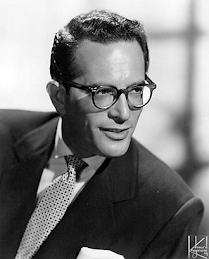 Arthur Godfrey wasn't the start of Robert Q. Lewis's career; he'd been drawn to acting when he was a boy, suffering with asthma that prevented him from more physical activities. He studied dramatics through college at Michigan, and then dropped out to work out at a radio station in Troy, NY. "He knew he would be drafted soon, and wanted to get a start in the business, to have something to return to after the war." He would then circulate through a series of radio gigs until his first television opportunity with Godfrey. Since then, he's worked in summer stock and nightclubs.
l l l
Anyone in entertainment knows the value of a good warm up act. "As a precaution" against cold, unresponsive audiences, the warm up act is there to make sure that, come airtime, "the audience will be giddy enough to laugh at anything."
One of the challenges faced by a warm up act is to make sure he's not funnier than the main event, so Your Show of Shows' Ed Herlihy (you know him for narrating the Kraft recipe commercials of the day), as is the case with other comedy shows, treads the line carefully, reminding the audience to relax, have a good time, even take their shoes off if they feel like it.
And one of the most unique warm ups comes on Bishop Fulton Sheen's Life is Worth Living. One of the show's two announcers, Fred Scott or Bill O'Toole, tells the audience to enjoy themselves, laugh and applaud when they feel like it, and "remember, above all, that it is not in church."
l l l
Is it possible for me to talk about the Hallmark Hall of Fame without going into a tirade about the current version? Why, yes—just watch me! On Sunday (3:00 p.m. CT, NBC), Hall of Fame presents a high-class (and probably live) adaptation of Shakespeare's Richard II, with Maurice Evans as the King, Kent Smith as the conniving Bolingbroke, Sarah Churchill as the Queen, and a pre-Untouchables Bruce Gordon as Mowbray. Hall of Fame is preceded at 2:30 p.m. by a whimsical episode of Kukla, Fran and Ollie involving the Kuklapolitans doing a Shakespearian play ("to set the mood" for Richard II); their problem is that they can't decide which play to adapt!* And on Omnibus (4:00 p.m., CBS), one of the segments features Lew Ayres, starring in a performance excerpted from the French film The Spice of Life.
*Now, that wasn't snarky at all, was it?
As you know, many of television's early stars came from radio, and in turn from vaudeville, and it's interesting to see that reflected in Monday night's episode of Burns & Allen (7:00 p.m., CBS), in which, as part of a typical episode, George and Gracie do "Lamb Chops," the routine that first made them famous. "This act was placed by Joe Laurie, Jr. on his ideal vaudeville bill consisting of the greatest acts in vaudeville history." I think that deserves a look, don't you?
Helen Hayes is billed as "America's Most Distinguished Actress" in the ad for Tuesday's Motorola TV Hour presentation of "Side by Side" (8:30 p.m., ABC), so with a build-up like that, I guess we'd better look at it. It's the story of a successful housewife and mother who's so prominent in civic organizations that she's urged by prominent politicians to run for Congress. A setup like this is ripe for a dramatic story, considering that the 83rd Congress, which sat from 1953-55, had a grand total of 13 women in Congress (five Democrats and eight Republicans, in case you were curious). I wonder how it turns out?
Helen Hayes is billed as "America's Most Distinguished Actress" in the ad for Tuesday's Motorola TV Hour presentation of "Side by Side" (8:30 p.m., ABC), so with a build-up like that, I guess we'd better look at it. It's the story of a successful housewife and mother who's so prominent in civic organizations that she's urged by prominent politicians to run for Congress. A setup like this is ripe for a dramatic story, considering that the 83rd Congress, which sat from 1953-55, had a grand total of 13 women in Congress (five Democrats and eight Republicans, in case you were curious). I wonder how it turns out?
Boxing is still the big sport on television, but of the four televised fights this week, there's only one that's really worthy of attention: Wednesday's world light heavyweight title fight between champion Archie Moore and challenger Joey Maxim, live from Miami Beach. (9:00 p.m., CBS) Moore, one of boxing's all-time greats, held the light heavyweight championship longer than any man, for ten years. (Needless to say, Moore wins this fight, in a 15-round decision.) After his career ends in 1963 (one of his last fights is a loss against young Cassius Clay), he becomes a successful character actor in television and the movies and is prominent in civil rights and youth causes. Quite a legend, he was.
 |
| Sure, I'd believe she's a boy. |
Friday's highlight, as it often is, is probably Edward R. Murrow's Person to Person (9:30 p.m., CBS), with tonight's special guest Eleanor Roosevelt, speaking from her New York apartment. Setting aside political allegiances, has there been any former First Lady who remained as much a part of politics and the world as she did? Jackie Kennedy was always a tabloid sensation, but as far as I know she was never much of a mover in the Democratic Party as Mrs. Roosevelt. She really did carve out quite a life for herself apart from FDR.
On Saturday, Jackie Gleason devotes the entire hour to a Honeymooners sketch in which Ralph and Alice decide to buy a summer cottage. (7:00 p.m., CBS) I wonder how Norton fits into the scene? Later this evening, on The Martha Raye Show (8:00 p.m., NBC; the monthly show that fills in for Your Show of Shows), Martha's got a great guest lineup, with Edward G. Robinson, Cesar Romero, and former boxer Rocky Graziano.
l l l
I mentioned in that last paragraph that Martha Raye replaces Your Show of Shows once a month; well, as it so happens, Your Show of Shows is the show that Dan Jenkins reviews as the "Program of the Week." And it's probably a dead giveaway as to what he thinks of it when he refers to it, in the first sentence, as "The Eighth Wonder of the World, Show Business Division." The revue, starring Sid Caesar, Imogene Coca, Carl Reiner, and Howard Morris, has come to be considered one of the legendary shows of the Golden Age, and the three-times-a-month, 90-minute show should, Jenkins says, "have collapsed of its own weight years ago, but is apparently as durable as Old Man River himself."
The idea that the show is starting to feel its age isn't an illusion on Jenkins's part. The ratings start to slip this season, and NBC will make the decision to split up Caesar and Coca and give each of them their own series. The last episode airs on June 5. Although I think Caesar has more solo success than Coca, neither of them, separate or together, ever reach the heights of Your Show of Shows. But what heights they were.
l l l
Another show Jenkins reviews is The Les Paul and Mary Ford show. It's a brief review, which is appropriate because the show only runs for five minutes. Yes, five minutes—and you thought those 15-minute music programs that take up the other half of the evening news slot were short!
Les Paul, of course, is a genuine legend, "a jazz, country, and blues guitarist, songwriter, luthier, and inventor," as his Wikipedia page describes him, "one of the pioneers of the solid-body electric guitar, and his prototype, called the Log, served as inspiration for the Gibson Les Paul." And what did you do today? Paul is the only person in both the Rock and Roll Hall of Fame and the National Inventors Hall of Fame, two areas that I imagine have a pretty small overlap. His wife Mary (real name: Colleen Summers; the couple were introduced by Gene Autry) served as the vocalist, to great success.
So the show: as Jenkins describes it, "it's over almost as soon as it starts. Paul and his wife get off two quick songs, the sponsor is in for two quick messages and that's it." It's economical, I'll say that; there are other shows out there that would take 15 minutes to get all that in. It has "an easy casualness that belies the careful production" of the show, and Paul's guitar virtuosity, combined with Ford's "full-throated quietness," complement each other perfectly.
The show airs on NBC for a single season, filling in where needed on the schedule, and then goes into syndication until 1960. And that's the real problem, according to Jenkins, since the show has no set schedule: "It's like trying to find a lone daisy in a rose garden." Heck, it isn't that hard—you can see it right here:
l l l
Here's a news bulletin for you: man leaves Arthur Godfrey show on good terms! It's Robert Q. Lewis, the permanent substitute host for Godfrey, who departed the Old Redhead, with his blessings, for his own five-day-a-week CBS show. Lewis, unlike many who've left the Godfrey camp, has good words for his mentor; "I'm very grateful to him for allowing me to grow at the same time he was growing. Anytime he ever wants me for anything, I'll be glad to cooperate."
Godfrey may have allowed Lewis to "grow," but that doesn't mean he didn't water the seeds, as it were. During Godfrey's hip operation last year, he would direct the show from his hospital bed, phoning the control room as he watched the show on TV. Lewis remembers one time when he was struggling for a laugh from the studio audience; the producer passed Lewis a note from a Godfrey phone call. "Bob's trying too hard," it read. "Tell him not to worry."
In addition to hosting his own variety show, Lewis is helming the game show The Name's the Same, and it will be for his participation in game shows, as both host and panelist, that he will be most remembered. He was a Goodson-Todman favorite, appearing more than three dozen times as a panelist on What's My Line?, as well as To Tell the Truth and both versions of The Match Game (and how many people other than Gene Rayburn can say that?) TV


