Showing posts with label Frank Sinatra. Show all posts

November 15, 2025

This week in TV Guide: November 13, 1965


Television is a lot like the weather, don't you think? We're always complaining about it, but never do anything about it. And when someone does try to change it—by improving its quality, for example—people don't watch it, and then go back to complaining. (Which makes it a lot like social media too, come to think of it.) And such is the case, as we find out this week from Dwight Whitney, with a program called, Slattery's People.

Slattery's People, starring Richard Crenna, was one of CBS's prestige dramas, created by James Moser, the man responsible for Medic and Ben Casey. Moser approached the network and its then-president, James Aubrey, with the idea of a show about "a young, Kennedy-like politician, along the lines of Casey, with the capitol dome substituting for the operating room." It had been turned down by ABC, "on the grounds that political shows were never really successful." This apparently acted as something of an aphrodisiac for Aubury, who wanted to show that he "knew better." He bit on Moser's idea. 
 
The problems came early and often, beginning with Aubrey's insistence that the lead role go to Crenna, who until then had been known primarily for two long-running series: Our Miss Brooks, in which he portrayed perennial teenager Walter Denton, and The Real McCoys, in which he played the good-natured Luke McCoy to Walter Brennan's patriarch Amos. Crenna himself had once said that he couldn't "compete with those good-looking former gas-station attendants who become stars overnight," and alarm bells sounded for Moser and the team at Bing Crosby Productions, who preferred someone stronger, more charismatic—someone, in fact, like Vince Edwards, star of Casey. But, as Moser points out, "When the head man wants it that bad—well, you are hardly in a position to argue." 

Almost as soon as the pilot for Slattery was shot, Aubrey began second-guessing himself. He thought the pilot was "great," and liked the idea of a serious dramatic program to counteract the accusations that he was lowering the Tiffany Network's standards, but he also wanted the show to "get out from under the capitol dome more." Says one insider, "It was that well-known Aubrey ambivalence. He wanted it but he didn’t. We didn’t know which side of Aubrey we were fighting, the literary Jim Aubrey or the merely commercial one." Moser, more blunt about it, said "What he was really saying was: Let’s make this into a political adventure show." 

Slattery
debuted that fall to critical praise, but ratings disaster, as it was slaughtered by its opposition: Ben Casey, irony of ironies. There was talk of replacing Crenna with someone stronger; the actor complained that "Everybody was looking for a whipping boy to salve their injured egos. I was a natural selection. I wasn’t ready to buy that." Aubury decided the show needed more women in the supporting cast to make it more "popular," and that Crenna's character needed to be "humanized." It was, according to Whitney, "a kind of Terry and the Politicians." Aubury also moved the show from Mondays to Fridays, where it would go up against The Man from U.N.C.L.E. Everyone, Crenna included, assumed it would be canceled at the end of the season, and it was. A week after that, Aubury was himself canceled by William Paley, and Slattery found itself with a second life, thanks to Michael Dann, the network's VP in charge of programming. Dann put the show back on the fall schedule, declaring to the media that "Although the series has never been in the Top 10, we believe this hour.of meaningful drama has a place on our schedule next fall."

"Back at the studio," Moser had already started a new project. A new producer, Irving Elman, was called in. Slattery began to loosen his tie, both literally and figuratively. He was referred to, for the first time on camera, by his first hame. A love interest was introduced. And, after the second episode of the shows's second season, it was canceled again. The show's ratings were worse than ever (if two episods can be considered statistically significant; "Slattery was not even getting a sampling," and as someone pointed out, if you can't get people to sample a show, you're in big trouble. Slattery's People would be replaced in the timeslot by another struggling drama, Trials of O'Brien, which would meet a similar fate before too long. 

Although praising the show, Dann points out, not unreasonably, that "there are certain minimum requirements. This year Slattery was our lowest-rated drama." "I know what the rules are," Crenna said, looking back at it from the perspective of a man who's been around the business. "During the years we were doing The Real McCoys, we knocked off 19 shows, among them Playhouse 90." That doesn't mean he has to like it, though, or that he thinks it's right. "I don’t ask for any miracles. The real shame is that the medium can’t make room for a Playhouse 90. Just the same I am going to miss Slattery’s People." It is, it would seem, the eternal conundrum: people complain about the lack of quality television, but when you give it to them, they don't watch.

l  l  l

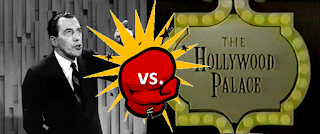
During the 60s, the Ed Sullivan Show and The Hollywood Palace were the premier variety shows on television. Whenever they appear in TV Guide together, we'll match them up and see who has the best lineup..

Sullivan: Ed’s scheduled guests are comics Woody Allen and Bert Lahr; the rock 'n' rolling Dave Clark Five; singer Jerry Vale; the singing Barry Sisters; and the winners of the Harvest Moon Ball dance contest. (Other sources confirm this lineup as listed.)

Palace: The hostess is Judy Garland, who dons her tramp costume for two numbers and recalls songs made famous by singers at the original Palace on Broadway. Also on the bill: singer Vic Damone, dancer Chita Rivera, comedian Gene Baylos, the comedy team of Avery Schreiber and Jack Burns, the acrobatic Lyons Family and the Three Bragazzi, musical clowns from Italy.

There's nothing wrong with Ed's lineup this week; Woody Allen could be very funny as a standup, the Dave Clark Five are at their peak, and Jerry Vale is as smooth as ever. On the other hand, though, you've got Judy Garland hosting the Palace, and she proves she can still put on quite a show when she gets a venue such as this. Chita Rivera is as exciting a dancer as there is around, and there's nothing wrong with Vic Damone's voice, either. This week, Garland takes the Palace over the rainbow for the win.
l  l  l

From 1963 to 1976, TV Guide's weekly reviews were written by the witty and acerbic Cleveland Amory. Whenever they appear, we'll look at Cleve's latest take on the shows of the era

It's difficult to think of Steve Lawrence without also thinking of his wife, Eydie Gorme: they started out together on Steve Allen's Tonight, and "Steve and Eydie" is how we think of them, even though whenever they appeared with Johnny Carson, for example, they famously appeared on separate nights, so that one of them would always be home with their children. And Steve Lawrence did, in fact, build up a considerable list of solo credits, including many appearances on The Carol Burnett Show. You might have forgotten that, for a short time, he was even host of his own weekly variety show, The Steve Lawrence Show, and if you have forgotten such fact, according to Cleveland Amory, it's your loss.

The Lawrence show (at the time, he was considered a protege of Jackie Gleason, whose company produced Lawrence's effort) is by no means perfect. It falls victim to so many of the cliches and unimaginative tropes of so many variety shows of the day: the congratulatory "telegrams" from celebrities that turn out to be extended jokes ("You sang better than I ever did’ and it’s signed ‘Dean .. . and Mrs. Rusk"), the grand entrances of guests such as Lucille Ball (who complained that Lawrence introduced her as "the first lady of TV"; "I’m not. The first lady of television was Milton Berle."), and so on. Cleve cites an example from the show's premiere, when Steve and Lucy rode through Shubert Alley atop an elephant, which at one point chose to dump the pair into the startled arms of spectators. When highlights of the procession made it on air, it was sans such unplanned mishap, "which illustrates not only how little imagination producers of a taped show have when, once in a blue moon, something happens which actually would be interesting, but also how you are being shortchanged by the 'miracle' of tape."

If this sounds harsh, it's only because the show is capable of so much more. Notes Amory, "Mr. Lawrence himself has some strong pluses, not only as a singer but also a host. He doesn’t, like so many other hosts, come on as if he thought he was the greatest man since Adam and he doesn’t try to hit you over the head with (a) his charm (b) his wit or (c) his voice." When he quietly sings songs such as "You'll Never Know" or "I Really Don't Want to Know," "he can be extraordinarily ingratiating." One show, a country-music salute to Nashville, was, as Amory put it, "excellent." It helps make up for the time when Bobby Darin sang "Get Me to the Church on Time" "as if he had just misplaced the tune and lost the address of the lyricist." In all, it seems as if Lawrence, like so many past stars (see: Garland, Judy) was done wrong by his producers and directors; when the show does conclude its run, after 13 weeks, it's with Eydie joining him on stage, and I'll wager the two of them singing was all the show ever needed.

l  l  l

When it was released in 1958, Alfred Hitchcock's Vertigo was considered fun and exciting, but "too long and slow" to ever be considered among the master's best. Today, it's not only ranked as his best, it's considered by most critics to be one of the greatest movies of all time. Personally, I think that's a little much; I mean, it's good, but I never did quite see what all the shouting was about. Nonetheless, it makes its network television debut on NBC's Saturday Night at the Movies (9:00 p.m.), earning the coveted "time extension" slot that permits it to run a half-hour longer than the average Saturday night movie, concluding at 11:30 p.m. And, whether you think it's great or mearly good, it's a pretty nice way to spend a Saturday evening.

On Sunday, Danger Man's John Drake, Patrick McGoohan, stars in part one of a three-part presentation of Walt Disney's charming 1963 story of a girl and her cat, The Three Lives of Thomasina, on The Wonderful World of Color (7:30 p.m., NBC). And for something slightly different, I recommend staying up late to see KHSL's late movie, The Killers (11:15 p.m.), a terrific adaptation of Ernest Hemingway's short story, starring Burt Lancaster, Ava Gardner, and Edmund O'Brien. As you probably know, it was remade in 1964, starring Lee Marvin, Ronald Reagan (his last film role), and Angie Dickinson; I actually prefer the remake, but the original is pretty damn good.

False jeopardy notice: on Monday's episode of Run for Your Life (10:00 p.m., NBC), "Motor trouble forces Paul to stop in Pine Grove, where he gets into a fight with town boss Loomis’s son Neddie—who is later found murdered." As you know, this is one of the TV tropes I absolutely despise, and there are actually two for the price of one in this story: not only is Paul (Ben Gazzara) put in false jeopardy—I mean, you and I both know the star of the show isn't going to be written out by being convicted of murder, so everything that follows depends on how well the search for the real killer goes—it also happens in an unhospitable small town run by a tyrannical local citizen, which, as we all know, is the only kind of small town that exists. You're better off turning to the aforementioned Steve Lawrence Show (10:00 p.m., CBS), with Steve's guests, Trini Lopez, Caterina Valente, and Judi Rolin.

I think Tuesday's episode of Combat! (7:30 p.m., ABC) raises some interesting points we don't often think about in World War II dramas: Saunders' squad replacements include three privates nearing 40: one is homesick for his family, another is a limping veteran, and the third a former politician looking for a resume padder. Saunders is exasperated, as are the other members of the squad, and here's my point: as troops continue to fall and are replaced, there must have come a time when the GIs started to wonder just how many men were left back in the States, and whether or not they might actually be running out of them. It's seen even more strongly a few episodes later, when they encounter German soldiers who are little more than schoolchildren; they are, in fact, all the Germans have left to offer. The whole thing is frightening when you stop to consider it.

Later on Tuesday, a CBS News Special (10:00 p.m.) takes a backstage look at Frank Sinatra, in a special that's created controversy before it's even aired. As Henry Harding reports, Sinatra was displeased with questions about his personal life asked by host Walter Cronkite, questions which Sinatra "politely, but firmly," refused to answer. Shortly thereafter, CBS News received a letter from Sinatra's lawyer "withdrawing permission to use film footage in which he appeared." Says one of his press agents, "Consent was originally granted when Sinatra was led to believe that the program would be a commentary on his career as an entertainer in the same manner in which the network did news specials on the careers of Pablo Casals, Isaac Stern and Marian Anderson." CBS counters that the special is a news presentation, not an entertainment special, and doesn't require any permission to air the footage. The documentary does air, and apparently the aftereffects aren't too lasting; his Emmy-nominated 1969 special runs on CBS. Andy Rooney, by the way, wrote the script for tonight's show.

Bob Hope plays a thinly disguised version of himself in the Chrysler Theatre presentation "Russian Roulette" (Wednesday, 9:00 p.m., NBC). It seems that comedian Les Haines (Hope), on his way to Russia as part of a cultural exchange group, gets mixed up with espionage and a glamorous secret agent, played by Jill St. John. Don Rickles, Victor Buono, Harold J. Stone, and Leon Askin round out a terrific supporting cast; Bing Crosby, alas, is nowhere to be seen. Hope co-authored the story on which the script is based. If you want your totalitarian stories without comedy, tune in for KSHL's late movie (boy, they've got a good lineup this week), the 1956 British adaptation of 1984, starring Michael Redgrave and Edmond O'Brien. (11:30 p.m.)

The circus is coming to town on Thursday, as Ed Wynn and his three granddaughters host a rare performance of the Ringling Bros. and Barnum & Bailey Circus, taped in Seattle. (7:30 p.m., NBC) At 9:00 p.m., it's the excellent crime thriller Experiment in Terror (CBS), starring Glenn Ford, Lee Remick, and Stefanie Powers in the story of a woman being forced by a criminal to embezzle from her bank employer. If she doesn't agree, her sister dies. And in the night's highlight, the Hallmark Hall of Fame is back with Melvyn Douglas and Ed Begley in "Inherit the Wind" (9:30 p.m., NBC) the dramatization of the Scopes monkey trial of 1925. You can insert my obligatory complaint about the diminished quality of Hallmark television presentations here. 

Friday night, it's the return of the marvelous Michael Dunn as Dr. Loveless on The Wild Wild West (7:30 p.m., CBS), and this time he's accompanied by Richard Kiel as Voltaire. It doesn't get much better than that, does it? There's some primetime sports on tap, as KTVU has San Francisco Warriors basketball; tonight, the Warriors, let by Rick Barry and Nate Thurmond, take on Jerry West, Elgin Baylor, and the Los Angeles Lakers, live from Los Angeles. (8:30 p.m.) And much later, on the unfortunate final season of The Farmer's Daughter (9:30 p.m., ABC), Glen and Kate find trouble on their honeymoon when their hotel is besieged by a rock star trying to escape his fans; Judy Carne is among the costars. 

l  l  l

Now, you didn't think we'd forget that Joey Heatherton is on the cover of this week's issue, did you? Of course not; don't be ridiculous. In fact, we'd be rather shirking our duties as a cultural archaeologist to overlook the inside spread, in which we get not only a look at the progress of Joey's career, but at some of the threads she's modeling, courtesy of such designers as Carl, Golo, and Capezio.


Twenty-one-year-old Davenie Johanna Heatherton, the article tells us, is "the archetypal 'pop culture' chickie, and that’s all there is to it: lithe, white-blonde, kinetic, shapely and young—permanently young." As far as being the arbiter of cultural style, "If there’s a rhythm and flavor to these particular years in the United States, she’s in touch with it." She's acted in various television series—Mr. Novak, The Virginian, The Nurses, Breaking Point—but it's the dancing, whether she's doing the Frug, the Watusi, the Jerk, the Chicken, the Pony, the Boston, the Monkey, the Philadelphia—that's what stays in the imagination, long after the other young, blonde actresses have come and gone. "It’s an outlet," she says of pop rock dance. "We’re working out our problems. You get a bad mark in school, you come home, turn on the radio, and let it out."

She was a sensation last summer, when she joined Bob Hope's company touring the Dominican Republic entertaining the troops, and she'll be going with him this December to Vietnam. She still remembers the reaction from those young soldiers: "I just walked out on the stage and they went ape. I wore, you know, a leotard and boots. They were all so googly-eyed. I sang the lines, ‘Im just a little girl who’s looking for a little boy,’ and some of them started running up on the stage. The MP’s had to head them off." Expect a similar reaction in Vietnam.

l  l  l

MST3K alert: It Conquered the World 
(1956) Scientists discover that an outer-space monster has arrived from Venus to destroy Earth. Peter Graves, Lee Van Cleef, Beverly Garland. (Saturday, 5:30 p.m., KCRA) "He learned almost too late that man is a feeling creature. . . and, because of it, the greatest in the universe. He learned too late for himself that men have to find their own way, to make their own mistakes. There can't be any gift of perfection from outside ourselves. And when men seek such perfection. . . they find only death. . . fire. . . loss. . . disillusionment. . .  the end of everything that's gone forward. Men have always sought an end to the toil and misery, but it can't be given, it has to be achieved. There is hope, but it has to come from inside—from man himself." TV


If you enjoy the content here and want to support my broader creative work, please consider making a donation at my Ko-fi page. Any amount you contribute helps me continue writing, researching, and sharing these articles and projects. Thank you!

July 4, 2025

Around the dial


I tried to come up with a picture of George Washington watching television for today, but unfortunately, photography hadn't yet been invented, so we'll go instead with a picture of Sebastian Coe's mother watching her son win the gold medal in the 1500 meters at the 1980 Olympics. This came, by the way, from a 2017 story of how 80 people in Bristol, England, were still watching black and white TV. Among the reasons given were that the license for a black and white TV costs only a third of what one pays to watch TV in color (or, I should say, colour). See, in England, you have to pay a yearly license to watch television at the same time it's being broadcast. This is what subsidizes the BBC, and the current fee is £174.50 for a color license, £58.50 for black and white. It doesn't matter if you watch the BBC or not, or even if you like it; you pay to keep it going. Remember that the next time you're tempted to complain about commercial television. There are, however, no complaints about this week's lineup, however.

Twin Peaks: The Return was one of the most astonishing, confusing, and maddening series to air on television since  The Prisoner, maybe? Apparently, David Lynch wasn't happy with how it was mixed for TV, and so he created one for theaters. Now, it's about to hit the big screen in New York City. I wonder if it will ever make it out here to real America?

My favorite musical of all time is 1776, partially, I suspect, because it has less music in it than almost any musical ever to make it to Broadway. It's the story of the writing of the Declaration of Independence, one of the greatest adventures in human history, and at Captain Video, we see an animated Congress, thanks to a comic book adaptation of the story that captures things quite well.

Returing to British TV, at Cult TV Blog, John writes about "Welcome Home," an episode of the British series Out of the Unknown, that's part mystery, part science fiction. When you get to the heart of the mystery, it proves to be quite intriguing.

At Comfort TV, David takes time to remember some of the major figures who've recently departed, as well as one who, thankfully, is still around: the deaths of Rick Hurst, Lalo Schifrin, Bobby Sherman, and Bill Moyers; and the 100th birthday of June Lockhart. All part of my TV memories, needless to say.

Bob Crane: Life & Legacy is in a reflective mood as well, with June 29 marking the anniversary of Bob Crane's murder, still (and destined to be, apparently) unsolved. Included is a message that serves us well as to how we should view the eternal struggle against the human condition.

At Classic Film & TV Cafe, Rick reviews the two Tony Rome detective movies made by Frank Sinatra. Now, I like Frank, and I like detective movies, so these are both watchable enough, but you get the distinct impression they could have and should have been better.

Paul's latest review at Drunk TV is of season five of Mister Ed, one of those concept sitcoms that managed to transcend the concept and provide entertainment that was genuinely funny on its own. And if that wasn't enough, you get a double dose of Paul this week: at Mavis Movie Madness, he shares his observations on making it all the way through NBC's fabled daytime drama The Doctors, one of those rare soaps that exists virtually in its entirety, except for 290 episodes. That's out of 20 years, folks.

At A Shroud of Thoughts, Terence looks at a landmark 1973 episode of Medical Center, starring Lois Nettleton as a lesbian doctor. It's frank, unspectacular, and one of the first television episodes to present a homosexual character as "a healthy, well-adjusted human being."

At Television Obscurities, Robert celebrates his annual Lost TV Day with links to some fascinating stories about lost episodes, audio recordings, and more. I have a couple of stories regarding lost episodes myself, ones that I encountered while writing Darkness in Primetime, that I'll share here one day. Suffice it to say, once again, that the television industry has been very sloppy in preserving its own history.

And finally, over at Eventually Supertrain, I join Dan for our latest discussion on Garrison's Gorillas. I can personally recommend that, but make sure you make time for Ghosted and Bronk as well.

If you're reading this on Friday and you live in the United States, I hope you're enjoying the Independence Day holiday, and that you don't lose any limbs with your fireworks! If you're reading this over the weekend or next week, I'll assume you survived in one piece. TV  

September 16, 2023

This week in TV Guide: September 17, 1955


Let's start the week off right with a look at two legends and their relationship to TV, beginning with Judy Garland and her television debut on next Saturday's 90-minute Ford Star Jubilee. It will be telecast live and in color (on the East Coast, anyway), with special guest David Wayne, playing the Fred Astaire role in a song from Easter Parade.

Garland is only 33 and without the gaunt look that we'd see a decade later—in fact, don't you think she looks like daughter Liza in the picture on that album cover below? And even though she cancelled the remainder of her national tour in order to do the special, she's nervous all the same. "I’ll probably come out on the stage, take one look at those three-eyed TV monsters and faint dead away," she says. "And then where am I going to find another medium to make my comeback?" 

Still, it's a time of excitement, and she's not going to worry about it. "I’ll just work my head off, get good and sick 30 minutes before air time, and by Sunday morning we’ll know whether or not I’ve laid an egg." The writer is confident that she won't. And I don't think she did, either; included in the show is the only video performance of "Over the Rainbow" while wearing the famous tramp outfit that she so often wore in concert. As a matter of fact, you can see most of the show here and decide for yourself. As I frequently say, we're fortunate we have this much of our television history still intact.

l  l  l

From one legend to another: Frank Sinatra says he has no interest in doing television on a regular basis—it's "too tough," he says—but the networks keep coming after him, and he's not above doing the occasional special, such as this Monday's now-famous Producers' Showcase presentation of Thornton Wilder's "Our Town" (7:00 p.m. CT, NBC) in which Sinatra plays the Stage Manager and introduces the song "Love and Marriage."* The cast includes Paul Newman and Eva Marie Saint, the two teenagers at the heart of the story, plus Shelley Fabares and well-known character actors Paul Hartman, Ernest Truex, Sylvia Field, and Peg Hillias. 

*It's also the first of a long collaboration between songwritesr Sammy Cahn and Jimmy Van Heusen. 

But back to The Chairman; he's happy with "Our Town" ("a great script"), but he says he doesn't have any TV plans for the future. "I like movies better," he tells Dan Jenkins, although he makes fun of an early effort, 1948's The Miracle of the Bells, now popular on The Late, Late Show, in which he plays a priest, "walking through the role with all the grace and animation of a wooden Indian" according to Jenkins ("Pretty awful, wasn't it?" Sinatra acknowledges.) A man can afford to do that when he has an Academy Award on the mantlepiece, which Sinatra won five years later for From Here to Eternity. "Takes a guy that long to learn how to act," he says. "You gotta keep watching all the other guys and pretty soon you absorb enough of it or it just rubs off on you or something. Anyway, you learn." He learns pretty good; later in the year he'll star in The Man with the Golden Arm, for which he'll receive another Oscar nomination the following year. And despite his protestations to the contrary, he's got one more TV series up his sleeve, a 1957 effort for ABC that was to combine dramatic efforts with occasional music specials.

That series fails (as did an earlier CBS effort in 1950), but no matter; he remains a powerhouse in records and movies, and his frequent singing specials are always ratings hits. This must be our lucky week, though; "Our Town" is available on YouTube as well, and you can see it here.

l  l  l

Another week, another story about CBS's struggle to field a competitive morning show to go against Today. It seems as if this has been the case ever since television started, but that's an exaggeration; it's only been several decades. Anyway, we've already seen Walter Cronkite and Jack Paar try, and fail, to make a dent in NBC's dominance of the two-hour timeslot, but according to the New York TV Teletype, the network has a radical new idea: "Bill Leonard, local New York CBS commentator, will do feature stories; Charles Collingwood will continue with the news, and Bob Keeshan, original 'Clarabell' on Howdy Doody, will do a kid show, Captain Kangaroo."

Now, isn't that something? CBS does, in fact, cut The Morning Show down to an hour, and giving the second hour to The Captain. Paar actually stays with the show until the following year, when CBS moves him to a late-morning program of his own. Paar's replaced by Will Rogers, Jr.; that format lasts 14 months before Rogers is replaced in turn by country singer Jimmy Dean; that show runs for 45 minutes, with a 15-minute morning news program leading into Captain Kangaroo; the whole shebang lasts another nine months, after which CBS gives up altogether until The CBS Morning News debuts in 1963.

Meanwhile, Captain Kangaroo continues weekdays until 1982, when it's moved to the weekend in order to make room for an expanded CBS Morning News, hosted by Bill Kurtis and Diane Sawyer, which actually worked for whilebefore failing again. 

l  l  l

Let's stay with the industry news for a bit longer. Dan Jenkins takes a not-so-fond look back at the summer season just ended; "If 'good riddance' is too strong a term, and it probably is, let it be said that it was a 'normal' summer. As such, it in no way measured up to the exciting promises voiced by the networks." Only one program, The $64,000 Question, emerged from the season to become a hit, and while Jenkins questions its cultural value, rest assured that it's going to become a symbol of television culturecough, scandalbefore long. 

Johnny Carson debuted his variety program on CBS*; the "bright young comic" is still in the launching stage, but when he takes off, it'll be quite a flight. Julius La Rosa, standing in for Perry Como, was "pleasant, if not inspiring." His old boss, Arthur Godfrey, turned the reins over to Frankie Laine, "who poses no immediate threat." Many of the "spectaculars" promised for the summer were less than special, including "One Touch of Venus," which I mentioned just a few weeks ago. Jenkins wastes fewer words than I did in describing it; it was "a bore." 

*You can find this on DVD, and while I think the makers would like you to mistake this for The Tonight Show, it's worth it anyway, to see his legendary career in its embryonic stage. 

I don't want to give the impression that everything was bad, though. Jenkins liked Ethel and Albert, the Peg Lynch-created crossover from radio, writing that it was "one of the few intelligently written husband-and-wife situation comedies extant and should be jealously preserved for the benefit of the American sanity." He also liked The Dunninger Show, starring the famed mentalist (you can read about the TV Guide profile here), calling him a pheonmenon, and adding that "there aren't many phenomenons on TV." Then or now, if you ask me. And the anthologies that continued throughout the summer, such as Studio One, were satisfying. 

All in all, says Jenkins, good television "is somewhat akin to the weather. Everybody talks about it, nobody does anything about it—yet occasionally, as though all by itself, along comes that rare day in June. It’s the waiting that can kill you."

l  l  l

John Cameron Swayze, anchor of NBC's Camel News Caravan, is the latest to weigh in on the effect television has on children, and surprise: he believes they'll profit from it. 

While acknowledging that "a few programs are not what they should be," Swayze points out that "our youngsters' TV experiences are in no way limited to specifically designed 'children's programs,' either good or bad; their interest isn't limited to programs tailor-made for their particular age group." Because of its visual impact and sense of immediacy, "televisison has captured the child's imagination and boosted interst in areas of thought and activity often considered outside his own sphere." 

In support of his contention, Swayze points to his own experience with News Caravan; more than 35 percent of the mail he gets is from children between six and 16, a "tremendous response" from a demographic that's not the target market. In one week, he received letters from an entire New Jersey elementary class commenting on world problems; had a letter from a 14-year-old in Arkansas asking about use of the H-bomb for defense; heard from a 15-year-old with her views on the power struggle in the Kremlin; and had a 10-year-old write asking for ideas on the president's foreign policy." Many colleagues, he reports, have received similar kinds of mail from young viewers; among other things, he concludes, "we parents are slow to realize how much youngsters are interested in what’s going on in the world beyond their own particular family and school realm."

The lesson, he says, is that parents should "take advantage of this painless, entertaining 'schoolroom,' i.e., the TV set," and understand that children "are quite capable of interest in good adult programming." It's not enough to make sure they see they monitor children's programs; "a little effort should be put to surveying personally the type and quality of the many TV programs available and scanning daily schedules for shows overlooked that could spark their child’s interest." It might surprise them, as it surprised Swayze, to find out "they have been selling young folks a bit short when it comes to enjoying and profiting from the better type of so-called grown-up TV fare."

l  l  l

We'll wrap things up for the week with a look at more programming highlights, beginning with the debut of Perry Como's one-hour primetime show (Saturday, 7:00 p.m., NBC). Perry's guests are an all-star lineup including Frankie Laine, Rosemary Clooney, Marion Lorne, Leo DeLyon, and Dave Barry. Como had hosted the three-times-weekly Chesterfield Supper Club since 1948, and his hour-long show is an instant hit, becoming the Kraft Music Hall in 1959, and remaining on the air until 1963, when Como decides to cut back to several specials per year.

On Sunday, it's the premiere of Famous Film Festival (6:30 p.m., ABC), notable for being the first primetime movie series on network television, featuring nearly three dozen recent movies from Britain. Tonight's premiere is Carol Reed's grim 1947 thriller Odd Man Out, starring James Mason in one of his greatest performances, supported by Robert Newton and Kathleen Ryan. If you're looking for something a little more lighthearted, Dean Martin and Jerry Lewis are back to kick off the new season of the Colgate Variety Hour. (7:00 p.m., NBC) Included in tonight's features a satire on the recent differences of opinion between the two stars; Less than a year later, the partnership is dissolved. I wonder if the "differences" referred to here are what precipitated the break, or if it's something else. They're going up against Ed Sullivan's Toast of the Town (7:00 p.m., CBS), tonight spotlighting the U.S. Navy's World Wide Talent Contest, with the finalists coming from all over the world. Julius La Rosa and the Marquis Chimps are also part of the fun. 

Besides "Our Town," Monday also features opera star Roberta Peters on Voice of Firestone (7:30 p.m., ABC), where in addition to the classics, she sings pieces by Noel Coward and Richard Rodgers. And later, on WTMJ in Milwaukee, Orson Welles' brings film noir to Shakespeare in his 1948 black-and-white adaptation of Macbeth, with Jeanette Nolan in her film debut as the murderous Lady Macbeth. (Midnight)

A pair of premieres are on tap for Tuesday, starting with Cheyenne (6:30 p.m., ABC), one of the three rotating elements of Warner Brothers Presents, and the only one to survive to a second season. Cheyenne is not only the first hour-long Western, it's the first hour-long show with continuing characters to survive beyond one season. Meantime, at 7:30 p.m. on CBS it's the inaugural episode of You'll Never Get Rich, later to be known as The Phil Silvers Show, starring Silvers in his most famous role as Master Sergeant Ernie Bilko. 

Wednesday
, Arthur Godfrey and Friends begins the night for CBS (7:00 p.m.), which leads us to one of the week's cover stories, part two of Godfrey's feud with the press. The star himself shrugs off any significance to what's written about him; "I learned a long time ago to read as little as possible about myself," he told one interviewer. "First they build you up; then they tear you down." And such is the case with Godfrey; for years he enjoyed laudatory writeups from the press, but the tide began to turn with the firing of Julius La Rosa, when his role suddenly switched "from hero to villain, from crusader to bully." Says Ben Gross of the New York Daily News, "to see the Great Man requires the eating of more humble pie than trying to interview the Queen of England. He is the master of the brush-off, with a generally contemptuous manner toward newspapermen." Godfrey's vow to even the score in his upcoming autobiography doesn't help things any, and despite his best efforts he never regains the popularity he once enjoyed.

Thursday belongs to guest stars, with Nina Foch and Vincent Price starring on Climax! (7:30 p.m., CBS); naturally, Price is the heavy, and meets an untimely ending. Ida Lupino, one of the four stars of Four Star Playhouse, stars in "With All My Heart" (8:30 p.m., CBS), while Brian Donlevy and Bobby Van are the leads in "The Policy of Joe Aladdin" on Ford Theatre (8:30 p.m., NBC) And WTMJ's midnight movie is The Lie, with Lee Bowman as a man who wakes up to find a dead body in his room. How many times has this happened to you?

Throughout the week, the merchants of the modern Park Forest Plaza in Park Forest, Illinois ("60 modern stories! Parking for 3500 cars!") have been celebrating the "Park Forest-TV Guide Jamboree," and Friday features a musical-variety hour with local celebrities, headlined by a non-local celebrity: Sammy Davis Jr., who also crowns the queen of the festival. (3:00 p.m., WGN) In case you were curious, the Park Forest Plaza is no more, but it's not a victim of the recent downturn in retail malls; it came to an end in 1996. Later, on Edward R. Murrow's Person to Person (9:30 p.m., CBS), it's a great doubleheader: first Ed interviews conductor and composer Leonard Bernstein and his wife, Felicia Montealegre; then his guest is Olympic legend Jesse Owens. Not a bad way to end the week, right? TV  

October 12, 2019

This week in TV Guide: October 12, 1974

You are Frank Sinatra, one of—if not the—biggest names in entertainment. You came out of a two-year retirement last year, you've just recently concluded a massive world tour, and on Sunday night ABC is broadcasting a concert you performed just a few nights ago at Madison Square Garden in New York. You are Frank Sinatra, and your opening act tonight is: Sonny Bono.

Well, maybe that's a bit of an exaggeration. Sonny isn't actually in New York City. But The Sonny Comedy Revue (8:00 p.m. PT), his effort to prove that there is indeed life after Cher, kicks off a big night of music for ABC, one that concludes at 10:00 p.m. with Herb Alpert and the Tijuana Brass. And between Sonny and Herb—sounds like a sandwich shop, doesn't it?—is The Main Event. Or rather, SinatraThe Main Event.

It's not just the title that plays off the Garden's storied boxing history; ads portray Sinatra posing like a victorious prize fighter, a towel around his shoulders, hands clasped triumphantly over his head. The stage looks like a boxing ring (minus the ropes), and Sinatra walks through the star-studded crowd to reach it, escorted by his entourage, all to the sounds of Howard Cosell's introduction. We get the message: Sinatra's not just The Chairman, he's the Heavyweight Champion; it's Frank's world, and we just live in it.

It's a great bit of theater, and no wonder—Roone Arledge, ABC's genius master of sports, is producing the special, using 11 cameras "including several hand-held ones" to capture the action. Sinatra sings all his favorites,* backed by Woody Herman and The Young Thundering Herd, and even though he might not be in the best voice on this night, who cares? "The Lady is a Tramp," "My Kind of Town," "I Get a Kick Out of You," "I've Got You Under My Skin," "My Way"—that's what people want to hear.

*Plus a couple of clunkers. "Bad, Bad Leroy Brown"? I mean, it's a great song for Jim Croce, but seriously? Not "New York, New York," thoughit hasn't been written yet.

Oh, and the rest of the night? Well, Sonny's guest stars are Glen Campbell, Twiggy, and The Staple Singers. Herb Alpert has a retooled Tijuana Brass, one that he says is more strongly influenced by jazz. The Muppets are around for some laughs, and Herb's vocalist (and future wife) Lani Hall puts some words to the music. All in all, that's a pretty good night of entertainment.

t  t  t

On weeks when we can, we'll match up two of the biggest rock shows of the '70s, NBC's The Midnight Special and the syndicated Don Kirshner's Rock Concert, and see who's better, who's best.

Kirshner: Bad Company, Rare Earth and Renaissance are guests.

Special: Host Paul Anka welcomes James Brown, Guess Who, Brownesville Station, and the Tymes and Ohio Players soul groups.

This week's Kirshner comes to us Saturday night on KOVR in Sacramento. However, I don't think we have to think about this too much. It's an odd juxtaposition, the two shows this week, especially with Paul Anka, but he's having a career renaissance, so to speak, himself. Add James Brown, and you've got two legends on one stage—and the Guess Who aren't too bad, either. The clock strikes twelve for Kirshner this week; the glass slipper goes to The Midnight Special.

t  t  t

Throughout the 60s and early 70s, TV Guide's weekly reviews were written by the witty and acerbic Cleveland Amory. Whenever we get the chance, we'll look at Cleve's latest take on the series of the era.

That's My Mama,
 one of ABC's new sitcoms, has gotten more than its share of attention since its debut. Part of that is because the network put it on a week ahead of its other shows, hoping it would stand out. Well, it worked, but perhaps not the way the network had hoped. It's gotten some pretty negative reviews, and Cleveland Amory says that's too bad, because it's a pretty good show.

It gives us a new comedy setting, Washington, D.C. (this is, remember, in the pre-C-SPAN days, before we knew just how funny a city Washington, D.C. could be), and producers (Allan Blye and Chris Bearde) who have chosen to handle the typical sitcom situations with "taste and even tact," rather than phony farce. And it has a terrific cast, starting with the titular Mama, Theresa Merritt, who defends her turf admirably. It's just as important, however, for her to have a worthy adversary—the success of shows like these invariably depends on the conflict between parent and child, who bicker all the way through but still love each other—and Clifton Davis, as her son, "not only gives his mother as good as he gets, which is plenty, but, miracle of miracles, she doesn't always kick the extra point. Sometimes he does." Throw in a daughter, played by Lynne Moody, who can hold her own against her mother, her brother, and her husband as well; add in a good supporting cast, and you're ahead of the game.

True, the plots often are nothing to write home about; this is a television series, after all, not a house of miracles. Still, there are enough things that stand out to make That's My Mama worth a second look—even a third.

t  t  t

The World Series begins this weekend, though we don't know who's playing in it since the playoffs ended after press time. (I just looked it up: it's the Oakland A's and Los Angeles Dodgers. Actually, I knew that, but I did look it up just so I could type that last bit honestly.) It's also, if I'm not mistaken, the first all-West Coast series, so the weekend games will all have later start times, since those games are still played in the daytime. Saturday's coverage on NBC starts with a 15-minute pre-game show at 12:30 p.m., while Sunday's game starts at 1:00 pm. In any event, it's all done by the end of the week, with the A's winning their third straight series.

Melvin Durslag, TV Guide's resident sports expert, recently had a conversation with Oakland's owner, the irrepressible (and, some would say, irresponsible) Charles O. Finley. Finley has some, shall we say, interesting ideas about how to make baseball more popular. He suggests making the field more colorful, for example. "We should have the base lines and the bases in bright hues. Who the hell says that white is sacred?" Along those same lines, he'd like to get rid of the white baseball and replace it with an orange one. "Alert Orange," to be precise. He's in favor of a Designated Runner as well as the Designated Hitter. He'd like to see the umpires lose weight and have their own uniforms, instead of the suits that, he says, make them look like "undertakers." And so on.

What would Finley think of baseball today? The game is at a crossroads, with sabermetrics and the increasingly popular theory of "three true outcomes" reducing baseball to a frequently tedious, three-plus hour contest of home runs, walks, and strikeouts. The three-ball walk, which Finley talks about in this article, would certainly be up for discussion. (The automatic intentional walk, which Finley also advocated, has already come to pass.) One of Finley's passions was a pitch clock, forcing the pitcher to throw within 20 seconds; there's been serious talk about this, but it appears that it will be at least 2022 before it's implemented.

And then there's the prime-time World Series game. Finley advocated this long before the the first nighttime Series game was played in 1971, in part because, as Finley said, "Why play some of the games when the kids are in school and the workers are in the factories?" And yet games now run so late into the night (or early morning) that, as one sportswriter put it, an entire generation of school-age kids has grown up never having seen the end of a weeknight Series game. I think Charlie Finley, who for all his eccentricities was essentially a populist, would be horrified at what today's game has done to one of his prize ideas.

What would he do today? I think he might be tempted to sell the team, shake his head, and walk away.

t  t  t

The first ratings results are in, reports Richard K. Doan, and already it's becoming clear which of this year's shows are hits—and which are bombs. In the latter category, ABC's The New Land, Kodiak, The Texas Wheelers, The Night Stalker, and the aforementioned Sonny Comedy Hour are sure losers, as is CBS's Sons and Daughters. Existing series in trouble include The Six Million Dollar Man, Kung Fu, The Odd Couple, and Adam-12. All is not lost, however, for veterans such as All in the Family, Sanford and Son, and M*A*S*H, which have returned to their winning ways, and newcomers Chico and the Man, Little House on the Prairie, Rhoda, That's My Mama, Paul Sand in Friends and Lovers, and The Rockford Files.

So how did it all turn out? The "experts" were wrong about The Six Million Dollar Man, which kept going successfully until 1978; they also missed the boat on Friends and Lovers, which was cancelled after 15 episodes; I think that was a case where the critics were so in thrall to that show that they didn't want to see the evidence that the rest of the country wasn't that crazy about it.

If, as it seems, Sonny can't cut it without Cher, what about the other way around? CBS has already given Cher a guarantee for a series of her own next year, and she'll have a special in February that might give us an idea of just that series might look like. That lasted two seasons, before a reconciliation with Sonny that lasted a further season. And after that? Well, Cher goes on to the movies, and Sonny to a political career that eventually takes him to Congress. Who'd have thunk it?

t  t  t

On Monday, ABC News Closeup takes a look at the dangers of playing high-school football in "Danger in Sports: Paying the Price." (10:00 p.m.) It's a particularly prescient topic in 2019, with the heightened awareness we have of head injuries and their long-term effects on the brain, but even in 1974 there were concerns about tactics such as leading with the head when tackling. In 1974 there were an estimated 800,000 injuries playing football each year; today that figure is 1.2 million. The more things change. . .

The World Series resumes on Tuesday, with weekday games beginning at 5:15 on the West Coast, pretty much taking care of NBC's prime-time lineup for the week. Which is just fine, since the night's highlight is the all-time great crime drama Point Blank (8:00 p.m., KTXL), with Lee Marvin outdoing himself as novelist Richard Stark's antihero Parker (renamed Walker in the movie), and a brilliant supporting cast including Angie Dickinson, Keenan Wynn, Carroll O'Connor, and a host of recognizable character actors. It's one of Marvin's greatest roles; although it's the only time he plays the character, you can't go wrong reading any of Stark's* 24 Parker novels.

*Pen name of the celebrated crime novelist Donald E. Westlake.

Occasionally I'll catch an episode of the long-running (1943-55) OTR drama Nick Carter, Master Detective on the SiriusXM Radio Classics channel, but I wasn't aware until now that a 1972 TV-movie version of Nick existed, with Robert Conrad in the role. Wednesday's CBS Late Movie (11:30 p.m.) presents The Adventures of Nick Carter, with Shelley Winters, Broderick Crawford, and Dean Stockwell as the supporting cast.

A couple of interesting programs on Thursday; first, it's an episode of PBS's outstanding sports documentary The Way it Was, hosted by Curt Gowdy (8:00 p.m.). Each week, The Way it Was focused on a great sports event of the past, combining highlights with a panel discussion featuring some of the surviving participants. Tonight it's the 1952 world middleweight championship bout between Rocky Graziano and Sugar Ray Robinson, and it's a tremendously entertaining half-hour. Later, on ABC's Wide World Special (11:30 p.m.), Dick Cavett does a 90-minute interview with Walter Cronkite from Cronkite's home at Martha's Vineyard. Cavett quotes a critic who once said, "Viewers rarely recall and relish a Cronkite statement. They believe it instead."

On Friday, the NBA kicks off a new season as the Golden State Warriors take on the Los Angeles Lakers (8:00 p.m., (KTVU, KTXL). I know it's hard to believe that the start of the season could be this low-key, but back in the pre-cable days, that's the way it is. (To coin a phrase.) Aside from a couple of special occasions, the NBA won't even have a game of the week on network television until January.

t  t  t

Finally, this week's issue of TV Guide is the first of twelve that will be coming to you over the next year or so courtesy of Alvaro Leos, who graciously loaned these issues to me to use plugging holes in our weekly feature. I'm extremely grateful to him, as well as to all the benefactors who've dipped into their collections over the years to share their knowledge of TV Guide not only with me, but with you, the readers. As always, if you have any issues that you'd like to see on the site, and if you're willing to part company with them for a short time, please drop me an email. Thanks again!

t  t  t

R.I.P., Valerie Harper. TV  


May 11, 2019

This week in TV Guide: May 14, 1966

What better way to kick the week off than with a look at the undisputed heavyweight Chairman of the Board?

Leslie Radditz' article, which accompanies an encore presentation of  Sinatra's acclaimed NBC special A Man and His Music on Sunday (9:00 p.m. CT), looks at Sinatra at 50. In many ways, Radditz notes, Sinatra "seems to be reaching new peaks." He complains about not getting enough sleep, about his current Vegas gig being about two weeks too long, about lousy service in the hotel dining room. But then, when he gets onstage—well, as Radditz says, "the old excitement is there." Comments from women in the audience bear this out: "It's the eyeball-to-eyeball contact that gets me," one says. "I'll bet there isn't a place in that room where you wouldn't feel he was looking at you." Adds another, "His animal attraction is amazing."

Sunday's Sinatra special, which had originally aired the previous November, bears it out. It's just an hour of Frank singing—no skits, no forced banter, just Sinatra, with two of his best collaborators, Gordon Jenkins and Nelson Riddle, providing the orchestral backing. The show's available on DVD, and if you're a Sinatra fan you need to have it. Looking through some of the songs is like reading the notes on a Greatest Hits album: "I've Got You Under My Skin," "I Get a Kick Out of You," "It Was a Very Good Year," "Young at Heart," "Come Fly with Me," "Lady is a Tramp," "You Make Me Feel So Young," "One For My Baby." He closes the show with his longtime theme, "Put Your Dreams Away."  "My Way" and "New York, New York"? He hasn't even recorded those yet. Yes, Frank Sinatra still has some very good years ahead of him.

Here's a sample from A Man and His Music:


t  t  t

No Hollywood Palace this week, preempted by a "Holiday on Ice" show hosted by Milton Berle. However, that doesn't mean we don't have some variety for you. Sullivan himself has a pretty good lineup (7:00 p.m., CBS), headlined by Alan King, Kate Smith, and dancer Peter Gennero. Frank's Rat Pack pal Dean Martin, on NBC Thursday night (9:00 p.m.), has singers Gisele MacKenzie, Tommy Sands and the McGuire Sisters, comedian Jack Carter, and Sherri Lewis and Lamb Chop. Red Skelton's Tuesday show (7:30 p.m., CBS) features Petula Clark, who was so big back in the early '60s that she's on twice this week—she's also a co-headliner on NBC's Best on Record program (Monday, 8:00 p.m., NBC), featuring performances by winners from March's Grammy Awards.

While we're at it, let's take a closer look at that Grammys show. The listing for it reads "The annual Grammy awards are presented," and mentions that Dinah Shore will be giving the Golden Achievement award to Duke Ellington. But we know it isn't the awards show itself—that was on March 15, in New York, Los Angeles, Chicago and Nashville. So what gives?  Well, believe it or not, the Grammy award ceremony wasn't broadcast live on TV until 1971—prior to that, a series of annual specials, called Best on Record, showcased the winners in the major categories, performing their winning tunes. It wasn't about the competition; who knows whether or not they named the losing nominees on the show? It was all about the music. And in that sense, it's no different than the Grammys today. Nobody really turns on the show to see the lame jokes from the presenters, the envelope opened, the four losers on screen while the winner tearfully accepts the award. No—people want the performances, and that's what this show gives them. Maybe they should consider this format every year?

t  t  t

Throughout the 60s and early 70s, TV Guide's weekly reviews were written by the witty and acerbic Cleveland Amory. Whenever we get the chance, we'll look at Cleve's latest take on the series of the era. 

The Avengers, Cleveland Amory writes, "is so British you don't have to be British to understand it—but it helps." Understand? I'm not sure I do, but we'll leave it at that for the time being.

As I recounted a few years ago, it apparently took the British public a while to figure out that The Avengers was a satire, but with the passage of a couple of years, Cleve has no such problem—"Each of the episodes we've seen has involved not only individual satires of the old days, but also general satires of modern life." He at least acknowledges the presence of Patrick Macnee as John Steed (well, after all, he's only the glue that holds the whole series together), but he more than notices Diana Rigg in the unforgettable role of Mrs. Emma Peel, "the swinging girl of today and the forward-looking woman of tomorrow." "Pretty good, what?" says Amory, and adds, "make no mistake, she's both pretty and good."

He goes on to joke about a few more British-type jokes; cucumber sandwiches, "brollys," and "By Jove," but doesn't really say much more about the show. And I suppose that's a good thing—if you've read these capsule summaries over the years, one thing you know is that the more Cleve has to say about your show, the more you'll regret it. Understand?

t  t  t

Keeping on the theme of British television, there's Robert Musel's (yes, this one's for you, Mike Doran!) profile of "the incorruptible" Patrick McGoohan, star of the decidedly more serious Danger Man or, as it's known in these parts, Secret Agent. McGoohan hasn't yet ventured into what will become his most famous role, that of Number Six in The Prisoner, but it's not hard to see the genesis of that show as he riffs on his television philosophy. "Every real hero since Jesus Christ has been moral," he says, a statement that will come as absolutely no surprise to those who've noticed the occasional Messianic parallel in Number Six's actions. He adds that he will not let John Drake, his character in Danger Man (and perhaps alter ego of Number Six?), do anything he would not do himself.

McGoohan's a man who knows what he believes in and isn't afraid to say so.  "When I first started the series," he tells Musel, "they wanted me to carry a gun and have an affair with a different girl in each episode.  I wasn't going to do that. I simply will not appear in anything offensive.  I won't accept bad language or eroticism."  That doesn't mean he's against romance on screen; "Romance is the finest for of entertainment...It's something you create in the mind of the viewer."  Rather, it's his philosophy toward television itself, and its responsibility to the viewer.  "What I object to is promiscuous sex which is anti-romance.  Television is watched by so many people, children and grandmothers among them, that it has a moral obligation to its audience."

McGoohan's a demanding man to work with, but "generally liked by his crew because they recognize him as a professional who could, if he had to, light a set or edit a film or even design a production."  I suspect it also doesn't hurt that he has a clear idea of what he wants in a series.  All in all, we get a picture of a man with an ego, a man with vision and the determination to bring it to fruition, a man with a pure artistic integrity.  It's hard not to respect a man like that.

t  t  t

What else is there to talk about this week?

Well, if you're a sports fan, there's not much to look forward to this week. The Dodgers and Pirates meet in NBC's Saturday Game of the Week (1:00 p.m.), and the Twins take on the Yankees in a local broadcast Friday night at 7:00 p.m. on Channel 11. Otherwise you've got swimming, wrestling, bowling, ice-dancing and hydroplane races to look forward to. Oh, and Sam Snead offers tips on how to avoid sand traps.

Many of the weekly series have started the rerun season, so there's not a lot new there either.  Even the week's biggest show (except for Frank, that is) comes up a cropper. That's the scheduled launch of Gemini IX, which was slated to take off on Tuesday morning as the second-half of a space doubleheader. The day was to begin with the launch of an Atlas-Agena target vehicle at 10:00 a.m., followed at 11:40 a.m. by the Gemini launch. The Gemini, manned by Tom Stafford and Gene Cernan, would then catch up with, rendezvous and dock with the Agena, a crucial component that had to be understood and mastered prior to the forthcoming Apollo flights.

However, as you can see here, the launch of the Agena didn't exactly come off as planned; Mission Control lost contact with the vehicle after the Atlas booster failed, and the Agena plunged into the Atlantic. The Gemini flight was postponed until the following month, when a replacement vehicle was launched. Gemini IX finally took off on June 3, and while it didn't quite come off without a hitch, it was still a success.


t  t  t

Another of the fashion spreads that TV Guide features from time to time, and this week our model is Joan Hackett.  Hackett, a woman of unconventional beauty, has had a pretty good career, winning awards for her work on stage and showing up regularly on a variety of movies and television shows and series.  This article has nothing to do with that, of course; for TV Guide, Hackett makes a perfect model for the English-styled fashions popularized by the ultra-chic New York shop Paraphernalia.


SOURCE: HADLEY TV GUIDE COLLECTION
The store, which opened multiple locations and remained around in one form or another until the late 70s, is quite a story itself.  As for Hackett, her career continues on the upswing, with critical plaudits for the TV adaptation of Mourning Becomes Electra followed by Golden Globe and Oscar nominations for her work in her last movie, Only When I Laugh; in 1983 she will die of ovarian cancer.

t  t  t

That seems like kind of a down note to end on, so let's take a look at a movie that sounds so awful, you have to smile at it.  It's 1958's Attack of the Puppet People, starring two actors who really ought to have known better, John Hoyt (many television shows) and John Agar (Shirley Temple's first husband; how far we've fallen since then, hmm?), and I swear to you that this is the real description of the movie, which airs on Channel 5 at 12:45 a.m. on Saturday night/Sunday morning:  "A toymaker carries his occupation to an extreme.  He shrinks people and locks them in a dollhouse."

Shockingly, the always-reliable Wikipedia says that the movie, which was shot under the working title The Fantastic Puppet People,  "has had a generally poor reception amongst critics."  It was rushed into production to capitalize on the recent popularity of The Incredible Shrinking Man, but something tells me that no amount of time would have helped this flick out.


Perhaps it makes more sense with the Spanish subtitles. But I keep waiting for three silhouettes to appear on the bottom of the screen.

Finally, there's this from Hugh Downs. According to the Doan Report, Hugh was speaking before The Advertising Club of New York last week, and and his comments were, shall we say, less than flattering.

Talking about so-called "high-irritation" commercials—and isn't that all of them nowadays?—Downs says, "Viewers, particularly the younger ones, are insulted by the patronage implicit in this sea of video silliness, and there's mounting evidence that they are rejecting this kind of advertising." One-joke commercials are "repeated to a point of great unfunniness." And to those who counter that, after all, it works, Downs says, "This isn't my point. It may work for a while longer, but while it's working it may be doing heavy harm to the credibility of advertising." Hugh Downs turned 98 earlier this year, and although he said these words over 50 years ago, he could say the same thing todayTV