Showing posts with label Jim McKay. Show all posts

October 15, 2022

This week in TV Guide: October 19, 1951


Sometimes the only way to find out whether or not an idea really works is to just jump right in and try it. For instance, I had a couple of TV Guides to choose from today, issues from the mid-50s; I also had one from the '60s that I'd used eight or so years ago, long enough that it would still be new for many people. Those would have been the safe choices, but, I asked myself, why not live dangerously this week and try something different? (Now, it's true that if this is the best I can do when it comes to living dangerously, it's no wonder why I live such a sedate life. And if you asked yourself that, you'd be right. But maybe that's what it takes to break out of a fog.)

And that's how, with the aid of the Internet Archive, we find ourselves looking at the TV Guide of October 19, 1951. This is a year-and-a-half prior to the national rollout, when TV Guide was limited to New York, New England, and the Washington-Baltimore area, so expect an emphasis on local, rather than national, stories. Since most of the familiar features have yet to appear, I have no idea what we're in for, so we'll just take it as it comes and hope for the best!

l  l  l
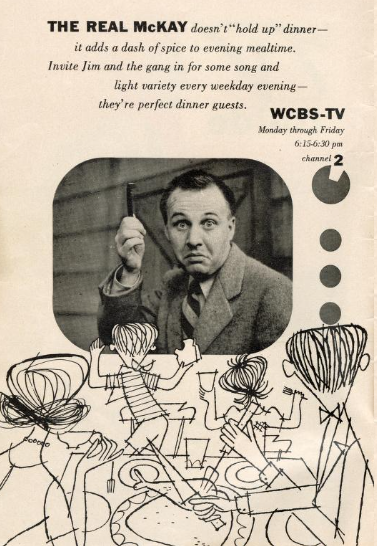
Here's a promising start: an ad on the inside cover (labeled page 2) for Jim McKay's 15-minute WCBS variety series, The Real McKay.

You might know that Jim McKay's real name is Jim McManus; in fact, his son Sean, who is chairman of CBS Sports, uses the family name. And it might have been ABC's Wide World of Sports with Jim McManus, had it not been for this show.* The title is, of course, a pun on "The Real McCoy," and it was to be young McKay's first break in big-time television. He wasn't thrilled to find out that his name would now be McKay; "I liked my own name just as it was," he wrote in his autobiography The Real McKay. "The thought of James K. McManus disappearing into thin air didn't please me at all, and I knew would be even less pleasing to my parents, and to [wife] Margaret, who had easily taken to the liquid sound of my real surname." He quickly realized, however, that there was no sense in jeopardizing his chances, and so, though he wondered "why they didn't just call me Jim McCoy," Jim McKay it was, and would remain, for one of the legendary careers in television.

*Roone Arledge, who produced Wide World, would always refer to McKay as "McManus" over the headset. 

The format of The Real McKay, which McKay helped develop with WCBS's program director, is that of a standard interview/variety program, taking place on a faux living room set designed by McKay's wife, Margaret. For the first program, the producer lined up a couple of singers from the Catskills, one male and one female; McKay would interview them, they would each sing, and then a few months later they'd be brought back to the show to see how their careers were progressing. The female singer was Barbara Cook, who a few years later would co-star on Broadway with Robert Preston in The Music Man, playing Marian the Librarian (the role played by Shirley Jones in the movie version). And the male singer: the man who would go on to marry said Shirley Jones, Jack Cassidy—TV and Broadway star in his own right, and father of Sean and David. And the program director of WCBS, who helped create The Real McKay and get it on the air? His name is Dick Doan—Richard K. Doan, who will later produce "The Doan Report" for TV Guide. Where he doubtless will carry a report on his old colleague, Jim McKay.

l  l  l

Well, that went pretty well, so let's go to page 3, "a terse weekly report" called "Inside TV," which serves as a prototype for the future TV Teletype that we know and love sio well. And among other facts (did you know, for instance, that actress Adelaide Hawley actually played Betty Crocker in a Saturday noon weekly show called Betty Crocker Star Time? And here, you thought she was only a picture on a box.), we learn, in a section called "Program Possibilities," that "Dave Garroway may be emcee of an NBC-TV 7 to 9 a.m.—and we mean a.m.—program to be called The Rise and Shine Revue." That, of course, is The Today Show, which will premiere on the network the following January, and which Garroway will host until 1961.

Joining Garroway on that first Today and remaining on the program until 1967 as co-host, announcer, and occasional foil is Jack Lescoulie. (Garroway was known as "The Master Communicator"; he dubbed Lescoulie "The Saver" for his ability to liven up dull segments.) Lescoulie had previously worked as a game show host, announcer, and producer for WCBS. Among the shows he produced: The Real McKayhe was the producer who chose Barbara Cook and Jack Cassidy as guests for that first program. I tell you, you can't make this stuff up.
 
l  l  l

Let's turn now to the man on the cover, actor Lloyd Nolan. Over a long and successful career, Nolan made a lot of movies and appeared on a lot of TV shows; you might well recognize him most from a series of movies he made featuring private detective Michael Shayne, or from his role as Dr. Chegley in Julia. Shayne is in the past, however, and Julia is in the future; we're concerned with the present, where Nolan is the new star of Martin Kane, Private Eye (he's one of four actors to play the part over the show's five seasons on radio and television).

Among the things we learn about Nolan in this brief profile: he once worked as a stagehand in a theater where one of the ushers was a young woman named Bette Davis; he and his wife introduced square dancing to Hollywood and had a group called the Beverly Hillbillies (what a pity he never did a guest stint on the sitcom); and that his real name, in fact.is Lloyd Nolan. (I know, it would have been great if his real name had been McCoy or something like that, but you can't have everything.) One of his most acclaimed roles is still ahead of him; his stage and television portrayal of Captain Queeg in The Caine Mutiny Court-Martial, which Herman Wouk adapted from his own novel, and for which Nolan wins an Emmy in 1955.

l  l  l

The listings in this issue are very short on details; no Close-Ups, and while there are ads for movies (mostly The Late Show on WCBS, Channel 2), there are also ads for movies in the theater, for horse racing, for restaurants (prime Angus steak dinner for $1.95!), and for companies that sponsor various shows (though not for the shows themselves).

But as different as things may look, there are still programs you're going to recognize. either from having watched them or seen them in pages of future TV Guides:
  • Your Show of Shows (Saturday, 9:00 p.m., NBC)
  • Meet the Press (Sunday, 4:00 p.m., NBC)
  • Toast of the Town, aka The Ed Sullivan Show (Sunday, 8:00 p.m., CBS)
  • Colgate Comedy Hour (Sunday, 8:00 p.m., NBC)
  • Red Skelton (Sunday, 10:00 p.m., NBC)
  • What's My Line? (Sunday, 10:30 p.m., CBS)
  • The Voice of Firestone (Monday, 8:30 p.m., NBC)
  • I Love Lucy (Monday, 9:00 p.m., CBS)
  • Studio One (Monday, 10:00 p.m., CBS)
  • Texaco Star Theater with Milton Berle (Tuesday, 8:00 p.m., NBC)
  • Arthur Godfrey and His Friends (Wednesday, 8:00 p.m., CBS)
  • Suspense (Wednesday, 9:30 p.m., NBC)
  • The Lone Ranger (Thursday, 7:30 p.m., ABC)
  • Burns and Allen (Thursday, 8:00 p.m., CBS)
  • You Bet Your Life (Thursday, 8:00 p.m., NBC)
  • Amos 'n' Andy (Thursday, 8:30 p.m., CBS)
I didn't include a number of less well-known shows that are still among the era's best (Armstrong Circle Theater or Robert Montgomery Presents, for instance), nor did I go into the daytime (Love of Life, Search for Tomorrow) or the pre-primetime (Kukla, Fran and Ollie, The Perry Como Show) schedules. I also left out boxing, which will be a staple on all networks throughout the 1950s. Still, that's pretty good.

Then there are the shows that aren't starting up until later in the season. That movie on Channel 2, for instance, isn't for the Dragnet that we know and love. (Besides, Henry Wilcoxon is no Jack Webb.) But the famed cop series is on the way; Dragnet, with Joe Friday and Frank Smith* patrolling the streets of Los Angeles, makes its television debut on December 16, 1951, alternating every other week with Gangbusters

*Barton Yarborough, who had played Friday's partner Ben Romero on the radio version of Dragnet since 1949, died after two episodes of the television series had been filmed. After a short time working with several other partners, Smith (Ben Alexander) became Friday's partner for the remainder of the series.

By the way, although Jack Webb enjoyed playing the character of Joe Friday on the radio, he was not at all sure that he was the right actor to play him on TV. He was, however, much too closely identified with the role, and the network insisted that he continue. The actor who was Webb's choice to play Friday: Lloyd Nolan, of course.

l  l  l

One more story I wanted to get to, and that's the show advertised on the back cover: New York Close-Up, Monday through Friday at 6:30 p.m. "The program that tells the story of the people who have a story to tell"—don't you appreciate the urgency that conveys? The show is hosted by the inimitable married couple of Tex McCrary and Jinx Falkenburg, and in the day they were a media sensation. "Mr. and Mrs. New York," indeed. They were pioneers in the talk show format, just as Dave Garroway was with Today, and like Garroway they are mostly forgotten today.

Tex McCrary had not only been a correspondent during World War II, he was also a colonel in the Army Air Corps who led the first journalists into Hiroshima after the bomb. Jinx Falkenburg was considered one of the most beautiful women of her time: cover girl, athlete, USO entertainer. That nightgown that Rita Hayworth wore in her famous pinup? That was loaned to her by her friend, Jinx. I imagine it looked just as good on her.

Tex taught Jinx the basics of how to conduct an interview (other protégés of his included Gabe Pressman, Ted Yates, Barbara Walters, and Barry Farber), and she wound up being one of the best in the business. They began a breakfast radio show in 1946, then made the transition to television (while doing two radio shows and a newspaper column). In 1952, they staged a rally in Madison Square Garden that helped convince Dwight Eisenhower to run for president. Tex would move into public relations, where he would work behind the scenes with William Levitt and Thurgood Marshall to make sure Levittown was integrated. Jinx, meanwhile, traveled to the Soviet Union in 1959 to open a model house belonging to one of Tex's clients at a U.S. exhibition—in the kitchen of the model, Nixon and Khrushchev would engage in their "kitchen debate." Accompanying Jinx on that tour was a young researcher who became a well-known columnist and political speechwriter: William Safire. In other words, just ordinary people like you and me. 

It's true that only a handful of people in this world live lives like this—we all know that. And yet, reading through these issues, you're overwhelmed by the extraordinary lives of extraordinary people. It shouldn't make us feel inadequate, because if everyone lived like this, no lives would be extraordinary; they'd all be average. So if you're inclined to feel kind of down after reading this, just remember that you're doing your part to help create extraordinary people.

l  l  l

So that's a look around a 1951 TV Guide. Only 32 pages, including the front and back covers. There are no reviews of programs or movies, no crossword puzzles, and the Letters to the Editor are rather mundane. Yet it's been a fascinating experiment, don't you think? Maybe I'll do it again sometime.

And by the way, this week's MST3K alert: I Accuse My Parents (Sunday, 1:00 p.m., WPIX). Some things never change. TV  

October 31, 2020

This week in TV Guide: November 3, 1973

I had the option this week of several issues having to do with an election or its aftermath, but I think we're going to be getting more of that than we want over the next few days (and longer?), so let's skip ahead a couple of days to early November, and the man who may have "The Best Job in Sports." 

And why not? Jim McKay "travels 250,000 miles a year to the world's most exotic locales and the world's most exciting sports events, and he gets paid a great deal of money to do so." A lifetime "spanning the globe" has covered a lot of big events over the years: the Olympics; the Masters, U.S., and British Opens; the Indianapolis 500, the Grand Prix of Monaco and the 24 Hours of LeMans; the Grey Cup; the World Cup; the Triple Crown; Wimbledon; figure skating; track and field; even the world barrel jumping championship. How's that for starters? 

Jim McKay was one of what I call the "big game" announcers: whenever you heard his voice on television, you knew there was something big going on. Unlike most of the other announcers in that categoryCurt Gowdy, Pat Summerall, Lindsay Nelson, Mike Emerick, for example—Jim McKay wasn't necessarily doing the biggest game— in town, but he had that rare ability to transcend the event he was covering, to make it important because the people participating in it were important. And for McKay, anyone taking part in an athletic event was important. In his charming autobiography The Real McKay, he tells the story of being in Islip, New York covering a demolition derby for Wide World of Sports. Interviewing the winner, McKay was inclined to treat the whole thing as a lark. But it was no lark to the winner, who had just won the demolition derby "world championship" and discussed his strategy as seriously as would any other athlete. McKay learned a valuable lesson that day: "I had committed an unforgivable bit of gaucherie, looking down on this man in a condescending manner during what he considered the greatest moment of his life." From then on, McKay said, he tried to approach all sports "through the eyes of its competitors."

McKay didn't start out in sports, nor did he even start out with the name McKay. His real name was Jim McManus, and he got his television start in Baltimore, as a serious news journalist. He worked with people like Douglas Edwards, interviewed scientists, and covered presidential inaugurations, or at least the parades. When he became host of a daily variety show in Baltimore, he was asked to change his last name so that the show could be called "The Real McKay." He did so, grudgingly, but always thought of himself as McManus and retained the name for the family that played such an important role in his life.  "It vaguely annoys me," he tells interviewer Neil Hickey. "But when you're young and working in Baltimore, you let yourself be talked into a lot of things.

It should be no surprise, then, that McKay proved himself more than equal to the task at his most famous, and most tragic, appearance: covering the massacre of the Israeli athletes at last year's Munich Olympics. It's still fresh in the mind, a year and two months later; "I've never had a reaction to anything I've ever reported that approximates the public response to what we did that day." He won a Peabody and an Emmy for that, to go along with other Emmys and other awards that marked his stellar career. They were all well deserved. 

There's also McKay the family man, who refers to he and his wife Margaret as "a team," and credits that "team" for much of his professional and personal success. He knows that hard work is essential to a successful marriage and family, and believes that a common faith and shared interests have much to do with it. He's proud of his son, Sean McManus, who will eventually become Chairman of CBS Sports, and equally proud of his daughter Mary, a counselor. Of the life he and his wife have shared, he says, "There is little more we could ask for." The miles add up over the years, as they will when you've got a job that spans the globeover three million as of 1973and he's often heard to mumble, "I gotta start figuring out how to stay home a little more, and I don't know how I'm going to do it."

McKay always felt it was a priviledge to have the job he had, to see the places and cover the events to which he was taken on Wide World, but in fact the priviledge was ours as well, to be able to have him take us there. He was one of the last of a (literally) dying breed, the sportscaster who put the game ahead of himself.

t  t  t

Throughout the '60s and early '70s, TV Guide's weekly reviews were written by the witty and acerbic Cleveland Amory. Whenever we get the chance, we'll look at Cleve's latest take on the shows of the day. 

We all know that in the world of television only one thing counts: ratings. And so it doesn't matter what the "extra" is in NBC's new sitcom The Girl with Something Extra is, as long as that extra includes extra viewers. Sally Field was a familiar face on television when this series premiered, but it would be wrong to think of her as a star, or at least a two-time Academy Award-winning star. And it's a good thing, because I'd hate to think that this is the best you could come up with for a star of that magnitude. 

The Girl with Something Extra features Field and John Davidson as a young married couple, with a challenge that most young marrieds don't usually face: Field has ESP, which on the "extra" scale is probably on par with, say, being a witch. And yet TGWSE (if we can call it that) comes and goes quicker than you can wiggle your nose; 22 episodes in all. Cleveland Amory may have identified the problem early on, when he points out that the producers have made the conscious decision to eliminate one of the key plot potentials: the chance that Field could use her supernatural powers for profit on, say, game shows (the emcee has to be thinking of the correct answer while he's reading the question) or the track (she'd know which horses felt like running). Says producer Larry Rosen, "For someone less honest than Sally, ESP could be a powerful tool But for her, as well as her husband, it proves to be more a continuing source of trouble." And that, says Cleve, is "stuffy stuff," as well as gloomy. "If you have a funny gimmick, why not go with it and have fun?"

This isn't to say the show doesn't have promise; Amory finds Field a "cutie pie," as is Davidson, though he could do with a little less of it (I've always just found him smarmy myself), and their co-stars, Jack Sheldon and Zohra Lampert, do everything with what they have. As well, some of the stories are very funny—how, for example, do you buy someone like that a surprise birthday present that's a real surprise? But if the show's going to survive, "it's time for the producers and writers to do something too—only different. ESP isn't after all, a fatal illness. And this show isn't soap opera. You don't turn it on to enjoy the misery. You turn it on, presumably, for the fun." You'd think they would have known that, wouldn't you? 

t  t  t

On occasion, we get to take a simultaneous look at three of the major rock music shows of the pre-MTV era: NBC's
The Midnight Special, ABC's In Concert, and the syndicated Don Kirshner's Rock Concert, Let's look at this week's listings and see who's better, who's best.

Kirshner: Van Morrison and Richie Havens are guests. Songs: "Gloria," "Caravan" (Van Morrison) and "Get it On Down" (Richie Havens).

Special: Jerry Lee Lewis is the host. Guests include he Ike and Tina Turner Revue, blues singer B.B. King, rock groups Flash and Ballin' Jack, pop singer Linda Gail Lewis. 

In Concert: Singer-composer Cat Stevens is the center of this 90-minute tribute to his own works. Linda Ronstadt, Donny Hathaway and Dr. John are also featured performing Cat's compositions.

Note that may interest only me: In the Twin Cities, you could watch these shows back-to-back-to-back without missing a thing. In Concert is at 10:30 p.m. for 90 minutes, followed by The Midnight Special at midnight for 90 minutes, followed by Kirshner on WCCO at 1:45 a.m. for 90 minutes. That's really a heck of a night if you're into that kind of thing. Of course, you'd need to stay up until nearly 3:30 in the morning to see it all; your mileage may vary, of course, but if I could cherry-pick from each, I'd take Van Morrison, Jerry Lee Lewis, Tina Turner, B.B. King, and Dr. John, and I'd have quite a program. You'll notice, though, that most of these acts come from one show, which means that this week, The Midnight Special really is special.

t  t  t

The World Series finished a couple of weeks earlier, and surprise—according to The Doan Report, half of all Americans with their televisions on were watching it. It's the first time three consecutive games have appeared in prime time, which isn't so remkarable now when you consider the first night game in World Series history wasn't until 1971, and the ratings are called unprecedented. MLB would absolutely kill for numbers like that today. (Recent headline: World Series ratings hit record lowagain.) The only show to compete with the Series? The Waltons. Speaking of ratings, it's the time of the year when the networks start to spend more time looking at them, and we can tell which series have now assumed what the sports world calls the hot seat. At CBS, The New Perry Mason and Calucci's Dept. are called "dead ducks," while NBC is trying to "salvage" Lotsa Luck, but hopes are fading for Diana* and Love Story. Meanwhile, ABC's shaky list includes the veteran Partridge Family, as well as The New Temperatures Rising and Toma. In the end, only Toma can be said to have lasted; it was retooled with a new star and turned into Baretta.

*Starring Diana Rigg. Talk about failing to provide a star with the proper vehicle.

There's also speculation about a one-hour network evening newscast. This seems to pop up in TV Guide every few years, and as we know nothing ever comes from it. This time it's CBS, with the idea that they might expand the Cronkite news by adding an extra half-hour. The local stations won't mind, the thought is, because their local programming hasn't been profitable. Of course, this was before the strip programming that dominates the half-hour before prime time: Entertainment Tonight, TMZ, Wheel of Fortune, Jeopardy! and the rest. I'll bet nobody thinks those aren't profitable now.

Speaking of news, ABC has multiple ads in this issue for the ABC Evening News with Howard K. Smith and Harry Reasoner, each one urging us to "Find out why more and more people are watching," presumably by tuning in. Apparently not enough people must have been watching: Smith is demoted to commentary in 1975, and Reasoner will be joined by Barbara Walters a year later.  Reasoner, who hated working with Walters, returns to CBS in 1978.

Sticking with ABC, the Teletype reports that the migration of big-name Hollywood stars to made-for-TV movies continues. Kirk Douglas will star in ABC's telefilm Mousey, about a man who plots to kill his wife, while Bette Davis is on tap for the network's Scream, Pretty Peggy. And Pat Boone bears the burden of a school principal accused of having an affair with a student on Owen Marshall, Counselor at Law. (Maybe it was just a case of April love.) As Joseph Finnigan notes, it seems like it was just yesterday when people were "gushing" about Boone's first screen kiss. 

t  t  t

In some other highlights of the week, The Graduate makes its TV debut on CBS (Thursday, 8:00 p.m. CT), six years after its release. I always feel I have to point this kind of thing out, for the benefit of those who're used to seeing movies almost as soon as they hit the theater, that such was not always the case. Anyway, what's particularly interesting about the timing is that the movie was just re-released in theaters earlier this year, and it packed them in, just as it did in 1967. Judith Crist calls it "the milestone-in-youth-movies hit," and that pretty much sums it up, with brilliant performances by Dustin Hoffman and Anne Bancroft, stylish direction by Mike Nichols, and "a put-it-all-together honey of a score" by Simon and Garfunkel. It comes on right after The Waltons, which is presumably doing even better in the ratings now that it doesn't have to go against the World Series.

For most of my life, WCCO passed up the opportunity to carry CBS's Sunday morning triumverate of Lamp Unto My Feet, Look Up and Live, and Camera Three. (9:00-10:30 a.m.) I've complained about this before, and I probably will again; even though I wouldn't have watched them at that age, I'd probably watch them today, so I'm retroactively offended. This week's Camera Three* has a profile of one of my favorite authors, the unconventional Austrian novelist and playwright Peter Handke. His best-known work is probably The Goalie's Anxiety at the Penalty Kick, later adapted into a movie by Wim Wenders, with whom Handke works several times, most notably on the screenplay for Wings of Desire; in 2019 he's awarded the Nobel Prize in Literature. 

Carroll O'Connor gets a chance to show his acting chops outside of All in the Family in a trio of short dramas about women called Three for the Girls (Monday, 8:30 p.m., CBS). Joining him are Lee Grant, Barbara Sharma and Joan Blondell. It sounds to me a lot like the 1968 British Male of the Species, which I mentioned here

Another show not on in the Twin Cities (at least not in its regularly scheduled timeslot) is Hollywood Television Theatre (Wednesday, 9:00 p.m., PBS). Keir Dullea, Rip Torn, Jack Albertson, Geraldine Page, Hurd Hatfield and Earl Holliman star in "Montserrat," a drama of political terror in Venezuela (so what's new?) adapted by Lillian Hellman. In a special two-hour episode of Ironside (Thursday, 7:00 p.m., NBC) Ironside is off the force and onto skid row after a 10-year-old murder witness is killed while in his custody. Will the chief wind up out of the gutter and back in his wheelchair? Since the description doesn't include "Last show of the series," my answer is "Yes." 

Finally, on Friday, CBS's movie is Sunshine (7:30 p.m.), starring Cliff DeYoung as a young father having to deal with his 20-year-old wife's (Cristina Raines) battle for live against cancer. Judith Crist is of two minds about the two-and-a-half hour (!) movie; the cast is very good, led by DeYoung's "brilliant" performance, and Raines holds her own against a script that requires "constant emoting," but the movie still consists of cliches, gimmicks and endless repetition, and Brenda Vaccaro as "Marcus Welby in drag." Your reaction to the story "depends on how vicarious you like your agony." I'm not of two minds about it; any movie that features a soundtrack by John Denver, including the excreable title song, deserves to go to the bottom of the ocean like the Titanic.

t  t  t

Be honest now—when was the last time you heard about Deirdre Lenihan? She's on the cover, so I should spend a moment on her. Currently, she's one of the stars on NBC's short-lived (14 episodes) series Needles and Pins (Friday, 8:00 p.m.), which also stars Norman Fell, Bernie Kopell and Louis Nye, all of whom had done or would do better work than this.

It's interesting, because Dwight Whitney's article spends several pages on her, while admitting that "[n]o one seems entirely sure who she is. Certainly not her fellow actors. Even the studio press department, usually bullish in these matters, seems to have only the haziest recollection." She worked in Joseph Papp's Shakespeare theater and did some other TV and movie bits, and at the time of this article had a "gentleman friend" named Jimmy Sloyan, a fellow actor. They're not against marriage, just haven't had time yet. They did find time eventually, had two children who've done some acting (Samantha Sloyan and Dan Sloyan), and as far as I know they're still married. But Deirdre Lenihan never did become the Next Big Thing, and it just goes to show that being on the cover of TV Guide isn't always everything it's cracked up to be. Nor, as we often discover, does it need to be. TV  

May 20, 2014

He was the Real McKay, all right

The Real McKay: My Wide World of Sports, by Jim McKay, Plume, 320 pages, available through local and online used booksellers

Jim McKay was from the old school.  He didn’t try to make himself bigger than the events he covered; hell, apart from the introduction he often didn’t even appear on camera.  But when you heard his voice, you knew something important was on – even if it was just a demolition derby in Islip, New Jersey.  Because it was Jim McKay calling it.

I mention the demolition derby because McKay gives it a prominent spot in his autobiography, The Real McKay.  Not so much for anything memorable that might have happened, but because of what it taught him about covering sports.  Interviewing the winner, McKay was inclined to treat the whole thing as a lark. But it was no lark to the winner, who had just won his sport’s "world championship" and discussed his strategy as seriously as would any other athlete. McKay learned a valuable lesson that day: "I had committed an unforgivable bit of gaucherie, looking down on this man in a condescending manner during what he considered the greatest moment of his life." From then on, McKay said, he tried to approach all sports "through the eyes of its competitors."

I might add that, successful as he was in approaching the sports he covered through the eyes of the participants, Jim McKay was equally successful at approaching them through the eyes of the viewers at home.  We often hear about games “being brought into the living room of the viewer,” but McKay had an even greater talent – a gift, really – for bringing the viewer into the stadium, allowing them to appreciate the sights and sounds of places as exotic as Monte Carlo and Rio De Janeiro, and as ordinary as McKeesport, Pennsylvania and Hayward, Wisconsin.

McKay the writer is equally adept at taking the reader to these places; The Real McKay outlines McKay’s career from its beginnings in Baltimore, where the young Jim McManus started out covering airport openings and hosting afternoon variety shows, to his time at CBS, where the prospect of a dead-end career hosting the courtroom drama The Verdict Is Yours threw him into a bout of depression, to the lifeline that came his way with the offer to host a new, summer sports anthology series on ABC: Wide World of Sports.  The rest, as they say, is history.

McKay’s open, honest account of his successful battle with depression is one of a number of stories that will likely be new to readers familiar with McKay only from Wide World, as are the many anecdotes gathered  from a lifetime of broadcasting, such as his very funny account of locking himself out of the broadcast booth while covering Dwight Eisenhower’s inaugural parade.  More familiar, but no less riveting, is McKay’s first-hand account of the event for which he’s probably best known, his coverage of the massacre at the 1972 Summer Olympics in Munich.  Even though many of us have heard the story before, McKay vividly portrays the behind-the-scenes drama at the ABC broadcast center; he wasn’t even scheduled to be on camera that day, and had almost literally been pulled from a swimming pool to come into the studio to cover the breaking story, his wet bathing trunks under his trousers.  When word comes in of the deaths of the Israeli athletes in the airport shootout, we feel the pain that shot through McKay, and his on-camera words – “they’re all gone” still pack a wallop.*

*And if you think Jim McKay wasn't a real journalist, that he might have been in over his head covering a breaking news story, read the forward from his friend and colleague, Peter Jennings, who knew a thing or two about journalism.

The bulk of The Real McKay consists of the author sharing the most memorable moments and personalities from his long broadcasting history.  And what a history it was: the Olympics, the Masters, U.S., and British Opens, the Indy 500, the Grand Prix of Monaco and the 24 hours of LeMans, the Grey Cup, the World Cup, the Kentucky Derby, Wimbledon, figure skating, track and field - how's that for starters?  Again, many of these events will be familiar to sports fans, such as the gymnast Olga Korbut’s memorable splash on the world scene in those 72 Munich Olympics.  But even more entertaining are his portraits of athletes that might be lesser-known today, such as 1961 Formula 1 World Driving Champion Phil Hill, with whom McKay teamed up on a memorable vintage car rally in Brighton in 1967.

McKay rarely turns the spotlight on himself, preferring instead to discuss the amazing life he’s lived, the things he’s seen and heard around the world, but when he does turn inward, it’s mostly to McKay the family man, referring to he and his wife Margaret as "a team," and crediting that "team" for much of his professional and personal success. He understood that hard work was essential to a successful marriage and family, and believed that a common faith and shared interests had much to do with it. He was proud of his son, Sean McManus, who became president of CBS sports and news, and equally proud of his daughter Mary, a counselor. Of the life he and his wife shared, he wrote, "There is little more we could ask for."

The Real McKay is the perfect biography: it not only tells you about the man, it also entertains you with the stories of his life and times.  You feel as if you know him; at the very least, it makes you want to have known him.  It’s not a heavy book; you should be able to polish it off over a long weekend if you want, and it makes a very good summer read.  I found it on the sales table myself, and I don’t think you’ll have too much difficulty tracking it down through your local or online used bookstore.

A last thing, and this is really more about Jim McKay the man than the book he authored.

When we’re kids, many of us, we’re fearless.  That extends from pretending to be a superhero and jumping off the garage roof with a towel tied around our necks, to writing fan letters to athletes and other celebrities.  Sometimes something happens, though, as we grow older – people and events become more remote, we put people on a kind of pedestal, we think they’re untouchable.  The blogosphere has done a lot to ameliorate that, to spread a kind of egalitarianism that closes the gap between the famous and the ordinary, but for some of us, especially from the old school, it still exists.  And then you learn, often after it’s too late, how accessible many of those untouchables were, and how many people were able to benefit from it.   Jim McKay’s book made a real impression on me when I read it; it made me admire a man I already liked, and reminded me of just how much pleasure he’d given me through all those years, and how he seemed to grow in stature even more after his retirement, in comparison to the relative pygmies that replaced him.  I thought about writing him, to tell him that; I wouldn’t have needed any kind of a reply except perhaps an acknowledgement that he’d received my words and understood the impact he’d had.  I never did, and now of course I’ll never be able to.  It wasn’t the first time I’d missed that kind of opportunity, and it probably won’t be the last.

And let that be a lesson to you: nobody is that unapproachable.  If someone moves you, if something really strikes home with you, changes your life, or even gives you that moment of pleasure, let them know.  Make a connection with them.  Even if you never hear back, you’ll have made the effort.  But I wouldn’t be a bit surprised if you did get an answer; the few people I’ve connected with have turned out – surprise! – to be almost as ordinary as I am.  I’d like to think that my expression of appreciation would have meant something to Jim McKay, would have given him a moment of satisfaction (as if he needed it!) at the millions of people who’d listened to and watched him throughout the years, and whose lives he’d become a part of, even if for only that moment.

In the meantime, give this book a read.

November 3, 2012

This week in TV Guide: November 3, 1973

The headline reads, "Jim McKay: He May Have the Best Job in Sports." And why not?  "He travels 250,000 miles a year to the world's most exotic locales and the world's most exciting sports events, and he gets paid a great deal of money to do so."

I have to admit that part of the appeal of this issue is that today is November 3, and this issue is November 3 - I don't usually get that lucky.  So when I say "This week in TV Guide," I mean this week!  But a lot of it has to do with Jim McKay.

Jim McKay was one of what I once called the "big game" announcers: whenever you heard his voice on television, you knew there was something big going on. Unlike most of the other announcers in that category - Curt Gowdy, Pat Summerall, Lindsay Nelson, for example - Jim McKay wasn't necessarily doing the biggest game in town - but there was something about him that made whatever he was doing important.

That's not to say that, in a lifetime spent "spanning the globe," McKay didn't cover the big events. Those 250,000 miles covered a lot of big ones: the Olympics, the Masters, U.S., and British Opens, the Indy 500, the Grand Prix of Monaco and the 24 hours of LeMans, the Grey Cup, the World Cup, the Kentucky Derby, Wimbledon, figure skating, track and field - how's that for starters?

But Jim McKay had that rare ability to transcend the event he was covering, to make it important because the people participating in it were important. And for McKay, anyone taking part in an athletic event was important. In his charming autobiography The Real McKay, he tells the story of being in Islip, New York covering a demolition derby for Wide World of Sports. Interviewing the winner, McKay was inclined to treat the whole thing as a lark. But it was no lark to the winner, who had just won the demolition derby "world championship" and discussed his strategy as seriously as would any other athlete. McKay learned a valuable lesson that day: "I had committed an unforgivable bit of gaucherie, looking down on this man in a condescending manner during what he considered the greatest moment of his life." From then on, McKay said, he tried to approach all sports "through the eyes of its competitors."

McKay didn't start out in sports, nor did he even start out with the name McKay. His real name was Jim McManus, and he got his television start in Baltimore, as a serious news journalist. He worked with people like Douglas Edwards, interviewed scientists, and covered presidential inaugurations, or at least the parades. When he became host of a daily variety show in Baltimore, he was asked to change his last name so that the show could be called "The Real McKay." He did so, grudgingly, but always thought of himself as McManus and retained the name for the family that played such an important role in his life.  "It vaguely annoys me," he tells interviewer Neil Hickey.  "But when you're young and working in Baltimore, you let yourself be talked into a lot of things.

It should be no surprise, then, that McKay proved himself more than equal to the task at his most famous, and most tragic, appearance - covering the massacre of the Israeli athletes at the 1972 Munich Olympics.  It's still fresh in the mind in this issue, a year and two months later; "I've never had a reaction to anything I've ever reported that approximates the public response to what we did that day."  He won a Peabody and an Emmy for that, to go along with other Emmys and other awards that marked his stellar career. They were all well deserved. 

There was also McKay the family man; he refered to he and his wife Margaret as "a team," and credited that "team" for much of his professional and personal success. He understood that hard work was essential to a successful marriage and family, and believed that a common faith and shared interests had much to do with it. He was proud of his son, Sean McManus, who became president of CBS sports and news, and equally proud of his daughter Mary, a counselor. Of the life he and his wife shared, he wrote, "There is little more we could ask for."  The miles added up over the years, as they would when you've got a job that spans the globe - over three million as of 1973 - and he's often heard to mumble, "I gotta start figuring out how to stay home a little more, and I don't know how I'm going to do it."

McKay always felt it was a priviledge to have the job he had, to see the places and cover the events to which he was taken on Wide World, but in fact the priviledge was ours as well, to be able to hear him take us there. He was one of the last of a (literally) dying breed, the sportscaster who put the game ahead of himself.

***

The World Series finished a couple of weeks earlier, and surprise - half the people watching TV were watching it.  Bud Selig would kill for numbers like that today.  The only show to compete with the Series?  The Waltons.

There's more speculation about a one-hour newscast.  This seems to pop up every in TV Guide every few years, and nothing ever comes from it.  This time it's CBS, with the idea that they might expand the Cronkite news by adding an extra half-hour.  The local stations won't mind, the thought is, because their local programming hasn't been profitable.  Of course, this was before the strip programming that dominates the half-hour before prime time: Entertainment Tonight, TMZ, Wheel of Fortune, Jeopardy! and the rest.  I'll bet nobody thinks those aren't profitable now.

The Graduate makes its TV debut on CBS - right after The Waltons.  Judith Crist liked it, thought it "stylish."  The CBS Sunday morning show Camera Three* has a profile of one of my favorite authors, the very strange Peter Handke.  Assuming I'd had a chance to see this, I probably wouldn't have paid attention to it; I'd not been introduced to Handke yet.  There's college and pro football on Saturday, Sunday and Monday, and basketball and hockey on Saturday, and that's it for sports for the week.  I know I keep coming back to that theme, but it truly is remarkable how television's relationship with sports has changed over the years.
*A series that was never shown on Channel 4 in Minneapolis; they were too busy showing Laurel & Hardy and the Bowery Boys.
***

In 1973, Johnny Carson and Tom Snyder were still the only shows in town as far as the late-night talk show was concerned.  CBS ran movies (and quite successfully, in fact, for many years), but ABC, burned by the failures of Joey Bishop and Dick Cavett, opted for something different.  Earlier in 1973, ABC introduced "Wide World of Entertainment," a rotating series of series, movies and specials that would run after the late local news.  Cavett, Jack Paar and Geraldo Rivera filled the talk show part of it (Cavett was on this Monday night, starting after the football game), movies filled Tuesday through Thursday, and Friday night featured In Concert,  a rival to NBC's Midnight Special.*

*I'm not about to start a regular comparison, ala Sullivan and The Palace, but on this particular Friday In Concert had Cat Stevens, Linda Ronstadt, Donny Hathaway and Dr. John, while Midnight Special countered with Jerry Lee Lewis, Ike and Tina Turner, B.B. King, Flash and Ballin' Jack, and Linda Gale Lewis.  Advantage: Midnight Special.

Speaking of ABC as we were, they have print ads in this issue for the ABC Evening News with Howard K. Smith and Harry Reasoner every day of the week.  Each one urges us to "Find out why more and more people are watching," presumably by tuning in.  Apparently not enough people must have been watching: Smith was demoted to commentary in 1975, and Reasoner was joined by Barbara Walters a year later.  Reasoner, who hated working with Walters, returned to CBS in 1978.

***

Be honest now - when was the last time you heard about Deirdre Lenihan?  She's on the cover, so I should spend a moment on her.  She was on a short-lived (14 episodes) series called Needles and Pins (and has anyone heard of that?), which starred Norman Fell, Bernie Kopell and Louis Nye, all of whom had done or would do better work than this.

It's interesting, because Dwight Whitney's article spends several pages on her, while admitting that "[n]o one seems entirely sure who she is.  Certainly not her fellow actors.  Even the studio press department, usually bullish in these matters, seems to have only the haziest recollection."  She worked in Joseph Papp's Shakespeare theater and did some other TV and movie bits, and at the time of this article had a "gentleman friend" named Jimmy Sloyan, a fellow actor. They're not against marriage, just haven't had time yet.  They did find time eventually, had two children who've done some acting (Samantha Sloyan and Dan Sloyan), and as far as I know they're still married.  But Deirdre Lenihan never did become the Next Big Thing, and it just goes to show that being on the cover of TV Guide isn't always everything it's cracked up to be. TV