Showing posts with label Lassie. Show all posts

June 7, 2025

This week in TV Guide: June 10, 1972


In the midst of television's infatuation with Upstairs, Downstairs, The Six Wives of Henry VIII, Elizabeth R, and other prestigious British costume dramas, it seems appropriate to remind viewers that "British television is not all kings, queens and high-flown drama." There is, for example, science fiction, an example of which is the long-running (now in its ninth season) series Doctor Who, about to make its debut in American syndication this fall. 

The episode in question in this week's article is "The Sea Devils," and with its over-the-top story of sea monsters trying to reconquer the Earth. It's a prototypical Who story for those of us in the know, but for readers whose idea of British television was Masterpiece Theatre, I can only imagine what they must have thought of the article's attempt to explain the storyline, not to mention the various eccentricities of the Doctor. At this point in the show's history, the Doctor's ability to travel in time and space had been disabled by the Time Lords; I'm sure that time travel would have pushed some of these readers over the edge.

Doctor Who made its premiere the day after John F. Kennedy's assassination; by 1972 it's on its third actor to portray the Doctor, Jon Pertwee. Pertwee will play the role for five seasons, to be followed by the man who brought the series its greatest fame in the United States, Tom Baker. And it won't be until Doctor Who becomes a staple of local public television stations throughout the nation that the show develops its cult following, one that continues to this day.

From left: the Third Doctor (Jon Pertwee), the Master (Roger Delgado), a Sea Devil, the Doctor and companion
Jo Grant (Katy Manning)

For old-time Whovians like yours truly, it's been difficult to watch the show's decline since its revival many years (and many Doctors) ago. I stopped watching it several years ago, and I've got no particular desire to return to it—if, indeed, the show returns from the hiatus the BBC is reportedly preparing for it. We've been watching the classic episodes from the very beginning over the last year or so, and it's been a pleasant reminder of how much fun it used to be, and how much moral power it carried. I haven't made any secret of my disappointment with the turn it's taken in its reincarnation, so I won't tread the same ground here. Suffice it to say that, back in 1972, there was little indication that the program would still be airing in 2025, through 40 seasons and 15 incarnations of the Doctor. If only we had known!

l  l  l

From 1963 to 1976, TV Guide's weekly reviews were written by the witty and acerbic Cleveland Amory. Whenever they appear, we'll look at Cleve's latest take on the shows of the era. 

Cleveland Amory's last column of the season is a look at the mailbag, and in typical Amory fashion, the pithy answers to the questions from readers are just as entertaining as the letters themselves. 

Typically, we hear from those who felt Our Critic was a little too hard on their favorite shows and/or stars. For instance, Alan Thomas, of Macon, Georgia, asks Cleve why he was so down on the Tony Curtis-Roger Moore adventure series The Persuaders!, a show which I found quite entertaining, by the way. "I do not like you one bit," Mr. Thomas says. "They are good actors. They have their faults. So does everybody." In defense of the Curtis-Moore duo, Amory replies, "In this show the fault, dear Brutus, was not in the stars." Meanwhile, Donald Parker, of Madison, South Dakota, suggests that Amory's review of McMillian & Wife proves that "Cleveland Amory has a severe case of the cynics." "Yes," Amory responds, "but that's the show that gave it to us." And E. H. Scheckler Jr., of Elizabeth, New Jersey, is more blunt about it all. "I wish that someone would review one of Cleveland Amory's reviews and have him canceled, as so many of these programs have been." Not so fast, responds Cleve: "But wouldn't you get tired of the reruns?" Erika Ela (no address) suggests that Amory have a panel of reviewers to review shows. Ah, but as Amory retorts, "Who do you think we is?"

Not everyone has a bone to pick. Alexander McCormick, of Cape Cod, Massachusetts, wasn't impressed with NBC's coverage of the Winter Olympics in Japan, and wonders what Amory thought. "[T]he announcers and experts were dull and the '[Jack] Perkins Pieces' overrated. I still remember the time they cut away from a terrific fight at a hockey game to a downhill ski race which you couldn't see anyway on account of a snowstorm. And I also remember spending hours on the distance skating, with the same guy [probably the great Dutch triple-gold medal winner Ard Schenk] going around and around. For all we know, he's still going around." Jeannie Adlon of New York City wondered about Cleve's opinion of the recent Emmys telecast. There were too many awards given for single performances, Amory thought; as for the Emmy show itself, "it was awful. It would be easy to produce it right, too—just give us more and longer scenes from the nominations and less junk, bad jokes, long, dull thank yous and bad taste."

Not everything is so negative, though. Mrs. D.E. Woods of Richmond, Indiana says, "I'm 50 years old and I'm in love with three men—my husband, Peter Falk and Cleveland Amory." "Dear Sis," Amory responds, "we thought your letter would never come."

l  l  l

Movies form a big part of this week's highlights, beginning on Saturday with a repeat of the political thriller Seven Days in May (8:30 p.m. ET, ABC), starring Burt Lancaster, Kirk Douglas, Fredric March, Ava Gardner, and Edmond O'Brien, directed by John Frankenheimer, and with a Rod Serling script that uses large sections of the Fletcher Knebel-Charles Bailey II novel verbatim. If it shakes your faith in government, it reinforces your faith in Hollywood's ability to tell a terrific story that's far more than just a political potboiler. On the more lighthearted side, Once upon a Dead Man (9:00 p.m., NBC) is the pilot for the aforementioned McMillan and Wife; I wonder what Cleveland Amory thought of this? And at 11:30, it's Compulsion, a fictionalized version of the Leopold-Loeb case, with Dean Stockwell and Bradford Dillman as the youthful killers, and Orson Welles brilliant as their Darrowesque attorney.

The features continue Sunday with the "angry young man" drama The Loneliness of the Long Distance Runner (noon, WBZ), directed by Tony Richardson, with Tom Courtney as the reform school student who finds fulfillment, of a sort, through distance running. At 1:00 p.m., it's Jacques Demy's jazz opera The Umbrellas of Cherbourg (WKBG), with the music of Michel Legrand (the movie's biggest hit: "I Will Wait For You"), and starring Nino Castelnuovo and the luminous Catherine Deneuve. In primetime, the great actor of our lifetime, William Shatner, stars as the heavy in Cade's County (9:30 p.m., CBS), as Glenn Ford tries to prevent him from setting off a nuclear warhead. Forget the county; no scenery is safe in this scenario. 

If you thought that we were done with opera after The Umbrellas of Cherbourg, guess again. On Monday, it's the movie For the First Time (7:00 p.m., WTIC), with opera star Mario Lanza, in a nice bit of casting against type, playing—surprise!—an opera star who falls in love with a deaf Viennese girl. If you want something a little more serious, turn to NET Opera Theatre's presentation of Benjamin Britten's magnificent "Peter Grimes" (8:00 p.m., PBS), one of the greatest operas of the 20th century, starring Peter Pears, Heather Harper, and Bryan Drake. But if you want to get back to the movies, I can't think of anything better than the documentary Hollywood: The Dream Factory (8:00 p.m., ABC), an hour-long retrospective of Hollywood's Golden Age, narrated by Dick Cavett.

Tuesday
begins with a perceptive episode of The Mod Squad (7:30 p.m., ABC) that looks at the difficulty Vietnam veterans have adjusting to civilian life, as Robert Pine plays a vet who looks at domestic dissidents as "the enemy." There's no telling how he would have treated Cannon's adversary (9:30 p.m., CBS): a cult leader with "an almost satanic influence" over his followers, who include Arthur Rubenstein's son John, June Lockhart's daughter Anne, and Dennis Weaver's son Rick. And Dick Cavett's sole guest tonight (11:30 p.m., ABC) is none other than Jack Paar. 

I always enjoyed the British import The Persuaders! (Wednesday, 9:30 p.m., ABC), starring Roger Moore and Tony Curtis; a pity it only lasted one season. In this week's explosive episode, Tony's walking around with an attache case attached to his wrist, little knowing that while he tries to prevent the "Other Side" from getting it, he's putting his own life in danger: the case is loaded with explosives that could go off "at the shake of a wrist." If you'd prefer something a little more macabre, try out tonight's Night Gallery (10:00 p.m., NBC), which includes "Green Fingers," with Elsa Lanchester as the little old gardener who isn't all she seems.

On Thursday night, NBC kicks off Adventure Theater (8:00 p.m.), one of those summer quasi-anthology series that were so common back then, either failed pilots or, in this case, "a series of dramas from the Sixties," specificially reruns from Bob Hope Presents the Chrysler Theatre, swhich works out well since that show was filmed entirely in color. In this case, it's "The Lady is My Wife," first shown in 1967, and it's notable not only for a fine cast that includes Bradford Dillman and Jean Simmons, but because it's directed by Sam Peckinpah. Expect something that's a little toned down from what we're used to seeing from him in the theaters. Over on PBS, it's NET Playhouse on the '30s (8:30 p.m.), with Dustin Hoffman and Orson Bean in Maxwell Anderson's time-travel comedy "The Star Wagon," which also features Eileen Brennan.

Since we started with movies, we'll finish the same way, with Antonioni's L'Avventura (Friday, 8:30 p.m., PBS), the story of a missing woman that becomes a series of "metaphors for spiritual listlessness." Judith Crist isn't particularly a fan—she describes it as "a difficult, slow-paced film, marked by uneven acting and stolid characters"—but acknowledges the movie's reputation as a "masterpiece." Monica Vitti and Gabriele Ferzetti star in what has subsequently been listed as one of the top ten greatest films ever made.

l  l  l

I sense something of an underlying theme in this week's features. First, we have Cleveland Amory's second appearance in this week's issue, authoring the cover story on Doris Day. The focus, not surprisingly, is on Dodo's involvement in the animal rights movement, her love of dogs, and her efforts to rescue them from cruel treatment. There's some mention of her personal life, virtually none of her CBS sitcom, although it's hard to imagine that anyone would be turned off from the show based on this very flattering portrayal.

That's followed by a brief story on Eric Knight, the author of a Saturday Evening Post story that's spanned even more years than Doctor Who: "Lassie Come Home," which originally appeared in the Post in 1939 before being expanded into a novel the following year. The book inspired a movie that catapulted its two child actors, Elizabeth Taylor and Roddy McDowall, to a stardom that endures to this day. It also inspired a series, Lassie, that has been a presence on television for 17 years. Lassie Comes Home has recently been reissued by Holt, Rinehart and Winston, at the request of Knight's widow, Jere. It is a timeless story, that of a boy and his dog, isn't it? 

Finally, an animal story that's probably less of a favorite with Cleve: Melvin Durslag's look at the upcoming Belmont Stakes. (Saturday, CBS) It's the longest and most grueling of the three Triple Crown races, and six potential Triple Crown winners (including last year's Kentucky Derby and Preakness winner Canonero II) have failed the test. The challenges are many: the distance, the timing (the three races are run over the course of six weeks), and the excitement of the Triple Crown. It's one of the rare times when horse racing takes center stage on the American sports scene; considering the ratings the races generate, it's often asked why one of the networks doesn't splurge on a weekly Saturday racing show. The answer, says Durslag, is that trainers and owners of the best horses spend too much time avoiding each other to guarantee audience-generating matchups. By the way, this year's Belmont does not carry the potential of a Triple Crown winner, but Riva Ridge, the year's best three-year-old, dominates the race, adding to his Kentucky Derby victory. No need to worry, though; Riva Ridge's stablemate will take the Triple Crown next year. His name: Secretariat. 

(In-between these stories is a form-fitting fashion layout featuring two-time Emmy Winner Susan Hampshire, but that's a different kind of animal altogether.) 

l  l  l

MST3K alert: The Crawling Eye (English; 1958) In a radioactive cloud lies a tentacled monster, awaiting its victims. Forrest Tucker, Laurence Payne, Jennifer Jayne. (Saturday, 9:15 p.m., WKBG) One of Forrest Tucker's finest roles (and I'm not being sarcastic) sees him as a UN consultant investigating mysterious goings-on at a village in the Alps. Two of the most notable members of the supporting casts aren't listed here: Janet Munro, who enjoyed a very successful film and television career, including three Disney movies; and Andrew Faulds, who goes on to star in the UK series The Protectors before serving more than 20 years as a Labour member of Parliament. TV  

September 13, 2024

Around the dial


In our last episode, you may recall, we looked at a new series that John was starting at Cult TV Blog concentrating on actors and their roles rather than simply individual series. This week, we look at Denis Shaw's contribution to The Avengers in the final season episode "Requiem." You may also recall that this is the episode reviewed at The View from the Junkyard last week; now it's time for John's authoritative review.

Dick Powell made one of the great career transitions in history, going from a song-and-dance man in light comedies to a a star of hard-boiled noir crime dramas, and at Classic Film & TV Cafe, Rick takes us back to the movie that started it all: Murder, My Sweet, where Powell lays claim to being the definitive Philip Marlowe.

At The Last Drive In, monstergirl gives us part one of a two-part profile of Adrienne Barbeau, who may be best-known to readers here for her long-running role on Maude, but there's much more to her career, as we see in her autobiography, There Are Worse Things I Could Do. Be sure to come back next week for part two, monstergirl's interview with Adrienne.

Paul returns at Drunk TV with a review of the fantastic 1959 TV adaptation of Budd Schulberg's scorching show-biz expose What Makes Sammy Run?, with a terrific cast that includes Larry Blyden, John Forsythe, Barbara Rush, Dina Merrill, and Norman Fell. Paul sees this as an example of how early television could, at times, rival the quality of anything you'd see in the theater, and I agree.

Terence commemorates 70 years of television's Lassie this week at A Shroud of Thoughts. Seventy years, and many permutations over its nineteen seasons. He also members the late, great James Earl Jones, who died this week at age 93. Besides all the roles he played in his distinguished career, it's hard to imagine CNN without him.

We occasionally touch on Land of the Lost here, and so it seems fitting to stop at Travanche, where it's been 50 years since the debut of that series. I was, for lack of a better word, stuck with that show, living in the World's Worst Town™ at the time, and NBC was the only show in town on Saturday mornings. Of course, not watching television was never an option.

At Shadow & Substance, Paul looks at the Twilight Zone episode "A Game of Pool," starring Jonathan Winters and Jack Klugman, in particular how Rod Serling changed the original ending from George Clayton Johnson's script. I agree with Paul that Serling's change made the episode stronger, but there's a lot to be said for Johnson's as well. And you have to like how Winters holds his own with Klugman. TV  

July 1, 2023

This week in TV Guide: July 2, 1955


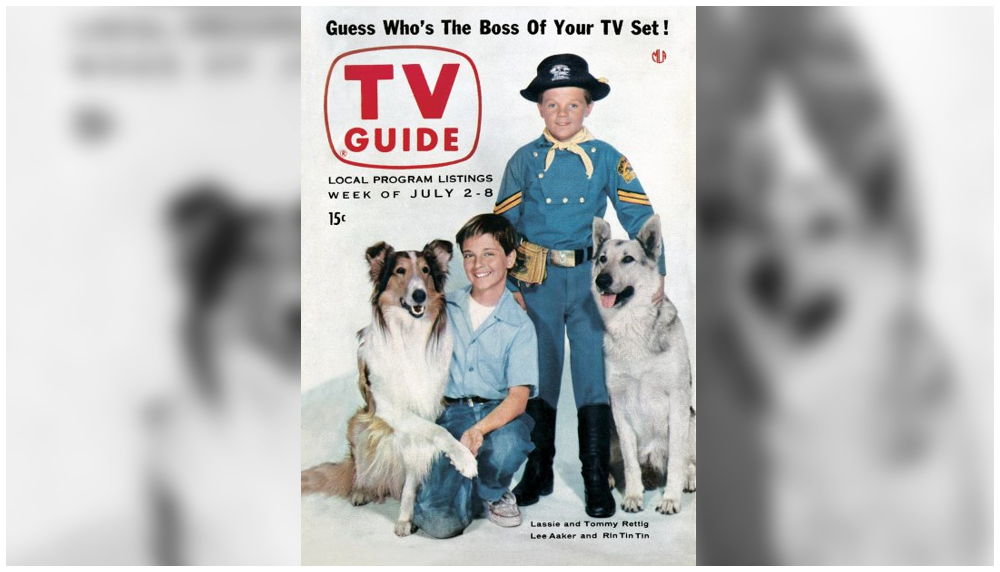
Now, I know what you're thinking: you've seen the cover of this week's issue, and you're waiting for me to make some remark about television going to the dogs. Well, that would be too easy, and as you know, we don't do anything easy around here. 

Instead, we learn that these two canines, Lassie and Rin Tin Tin (Lassie Jr. and Rin Tin Tin IV, for those keeping count), are each earning about $100,000 for their owners. And no wonder: in their first seasons on television, Rin Tin Tin is pulling a rating of 37.6 (a cumulative rating for two shows a week), while Lassie is at 30.3 for it's single broadcast. If you need more evidence of their popularity, look at their fan mail: Lassie gets an average of 2,000 letters a week (the rest of the cast combined get about 3,000 a week), and a recent contest to name one of Rinty's puppies, the show received 700,000 entries.  

These dogs work hard for their money. Rin Tin Tin is often involved in scenes that include Cavalry horses, which means a potentially life-threatening situation every time they film such a scene. Both dogs' trainers get worked up over suggestions that stunt dogs are frequently used. Rudd Weatherwax insists that Lassie appears in 98 percent of the shots, and that his brother is used only when a previous scene has been so strenuous that Lassie needs to rest; likewise, Lee Duncan says Rinty's stand-in is used only "where absolutely necessary," although his voice is often dubbed in—the stand-in "is considered a superior growler and snarler."

Directors say the dogs are easy to work with, and they get less "back talk" than they do from live actors. That's not to say that there are no egos involved, though; according to the author of this unbylined piece, "it took several weeks of delicate negotiations before both camps would agree to let the two dogs pose together" for the cover picture. (During the shoot, the dogs remained calmer than everyone else in the studio.) And nobody's allowed to play with the dogs between takes except for the two boys who act with them, Tommy Rettig with Lassie and Lee Aaker with Rinty; it's important that the dogs and their boys have good chemistry.

Of the two shows, Lassie has probably had the lasting impact, even though Rin Tin Tin remains famous. I always think of the latter's show as falling into the era of the pre-adult Western, whereas Lassie ran for 19 seasons with a variety of co-stars. In their day, though, they each thrilled millions of children, and each of them has their star on the Hollywood Walk of Fame.

l  l  l

Edie Adams is, to my way of thinking, either the luckiest woman in the world, or the most put-upon. As you probably know, she's married to one comedian, the incomparable Ernie Kovacs. However, she's currently working with another, the up-and-coming young Jack Paar; for several months she was part of his ensemble cast on CBS's Morning Show, and now she's made the move to Paar's half-hour daily variety show, which debuts Monday at 1:00 p.m. ET, also on CBS. 

Wisely, the former "Miss Television 1950" avoids any direct comparisons between her husband and her employer. They both smoke cigars, as you can see above. And they're both funny. "They think alike. They're both satirists, see humor in commonplace things. I don't know when something is funny. But with Ernie and Jack around, who has to be a comedian? I play it straight." 

In fact, Edie considers herself more a singer than a comedianne. She attended Juillard and studied opera in five languages, and it was as a singer that she "lost miserably" on Arthur Godfrey's Talent Scouts. On the other hand, she received nine job offers as a result of her Godfrey appearance, so let that be a lesson to those of you who have a fear of failure. She received critical acclaim for her Broadway performance in 1953's Wonderful Town, and her future includes a Tony Award for Li'l Abner. 

In fact, she quite comes into her own in the years after this article, earning Emmy nominations while working with Ernie, and another for her own show, Here's Edie, which ran in 1963, after Kovacs' death. She'll go on to found two successful businesses of her own, and for 20 years is the commercial face of Murial Cigars. She had been in deep debt after Kovacs's death in 1962 (Kovacs was as free with his finances as he was with his comedy), but by 1989 she was a millionaire. She also rescued many of Kovacs's videotapes at a time when much of television history was being dumped into New York Bay. No matter how you look at it, Edie Adams is quite a star, and that makes us the lucky ones. 

l  l  l

A moment ago, I mentioned Jack Paar's new show premiering on Monday, and this week appears to be the start of the Summer Season on television, with more than one show deserving some attention.

Saturday
leads off with a big one: the debut of The Lawrence Welk Show (9:00 p.m., ABC). You might remember I wrote about Welk's enduring popularity last Wednesday; well, this is what got me thinking about it. The Maestro started his show on KTLA in 1951, and tonight marks his national premiere; he'll remain on ABC until 1971, and then in first-run syndication until 1982. At this point the show is known as The Dodge Dancing Party, and the listing in this week's issue promises "60 minutes of music and comedy." Sixty minutes, and 27 years.

Also on Saturday, NBC presents Steve Allen in Movieland! (9:00 p.m.), a 90-minute spectacular featuring movies and stars from Universal-International. Allen himself is in Hollywood to star in The Benny Goodman Story, and Goodman joins the show with drummer Gene Krupa and pianist Teddy Wilson; Tony Curtis, Jeff Chandler, Audie Murphy, and Piper Laurie are among the other stars appearing. So which show would you choose?

Sunday gives you another choice to make: on NBC, the Colgate Variety Hour (8:00 p.m.) stars Guy Lombardo and His Royal Canadians, performing from Lombardo's restaurant in Freeport, Long Island. The hour also features highlights from "Arabian Nights," the Lombardo-produced musical being performed at Jones Beach, New York; and a film clip from We're No Angels, the upcoming movie starring Humphrey Bogart, Peter Ustinov, and Aldo Ray. That's opposite Toast of the Town (8:00 p.m., CBS), with the show coming from the aircraft carrier U.S.S. Antietam, currently moored in the Hudson River. No big names on tonight's show, so I'm afraid I'm going to have to give the edge to Guy, even though it isn't New Year's Eve.

On Monday, it's the national debut of The Soupy Sales Show (7:00 p.m., ABC). Like Lawrence Welk, Sales started out on local television, in his case, Detroit; like Welk, he's destined for a long and successful career. That's followed at 7:15 by John Daly and the News, ABC's evening news program. Reliable sources (OK, Wikipedia) have this starting in 1953, so my assumption is that this is the local debut. At 8:00 p.m. on NBC, it's another newcomer, as comedian Phil Foster begins his run as summer replacement for Sid Caesar; joining Phil are singer (and future soap opera star) Bill Hayes, actress Barbara Nichols, comedians Cliff Norton and Sid Gould, and tonight's guest star, singr Martha Wright. And to celebrate July 4th, Tonight (11:30 p.m., NBC; coming to you from California, where, as we know, Steve's doing that Benny Goodman movie) does a remote highlighting a fireworks show.

WPTZ, Channel 3 in Philadelphia, boasts "Top Stars in Hollywood's Best" every afternoon at 1:00 p.m., and they're doing a pretty good job on Tuesday, with the noir classic D.O.A., starring Edmond O'Brien as the man who knows he's been poisoned, and only has a few hours to solve his own murder. In primetime, singer Patti Page debuts her twice-weekly 15-minute music program (7:45 p.m., CBS); you can also catch it Thursdays at the same time. 

Wednesday, The United States Steel Hour makes its CBS premiere (10:00 p.m.); for its first couple of seasons, it aired on ABC before switching networks, and it would continue on an alternating basis (with Armstrong Circle Theatre) until 1963, when it became the last of the live dramas from the Golden Age to leave television. Tonight's episode is "The Meanest Man in the World," starring Wally Cox, and my guess is it's a bit more lighthearted than most. And in a preview of the future, young Floyd Patterson, who next year will become Heavyweight Champion of the World, takes on Archie McBride from Madison Square Garden in New York. (10:00 p.m, ABC)

Not a new show, but a new star; I've previously mentioned Star Tonight (Thursday, 9:00 p.m., ABC), a half-hour anthology that features rising young stars in leading roles, paired with more established actors and actresses in supporting roles. As is always the case, some young stars go on to great things, others not so much. Tonight's new star is one of the former, Theodore Bikel, who goes on to a long and successful career as a respected stage and screen actor and folk singer.

Play the home version!
On Friday, it's the return of Pantomime Quiz (8:00 p.m, CBS), one of television's most enduring summer replacement shows, as well as one of the few to air on all four networks—ABC, NBC, CBS, and DuMont. As was the case with Lawrence Welk, Pantomime Quiz got its start on KTLA before moving to national television; its broadcast history deserves a paragraph of its own, if for no other reason than to demonstrate that it was either a great idea for a show (two celebrity teams playing charades), or an example of how desperate networks were for programming:
  • KTLA: November 1947 - June 1949
  • CBS: October 1949 - August 1951
  • NBC: January - March 1952
  • CBS: July - August 1952
  • DuMont: October 1953 - April 1054
  • CBS: July - August 1954
  • ABC: January - March 1955
  • CBS: summers, 1955 - 1957
  • ABC: April - September 1958 (as well as daytime May 1958 - October 1959)
  • CBS: September 1962 - September 1963 (from hereon, known as Stump the Stars)
  • Syndicated: February - September 1964
  • Syndicated: September 1969 - September 1970
That's quite a run, isn't it? For all but four months of the 1962 edition, the host was Mike Stokey, who also produced several television series. Pantomine Quiz was a winner at the first Emmy Awards show, taking the prize for "Most Popular Television Program." If there was an award for shows ping-ponging between networks, I'm sure it would have wone that as well. If you're interested, you can see an episode here.

One more show that deserves mention this week: Five Minutes More, which airs Monday through Friday at 11:25 p.m. on Philadelphia's WCAU, and stars Ed McMahon. I've mentioned many times how, in these early days, local television served as something of a feeder system for the networks, and here's another example; Ed started with WCAU in 1949, appearing as a clown on Big Top, the nephew on the cooking show Aunt Molly’s Den, and host of Cold Cash, Million Dollar Movies, and Five Minutes More, in which he presented commentary. 

l  l  l

Speaking as we are of Philadelphia, here are the May viewing numbers, as measured by the American Research Bureau (which later became Arbitron):


So, I wondered, keeping in mind how different parts of the country view television differently, how does this compare to the national ratings? I Love Lucy, #4 here, was #1 for the season nationally, followed by The Jackie Gleason Show and Dragnet (neither of which show up in Philadelphia). Other discrepencies: Stage Show (#5 locally / not rated nationally), This Is Your Life (#6 / #12), Person to Person (#7 / not rated), The Jack Benny Program (#8 / #7), Your Hit Parade (#9 / #15), What's My Line? (tied for #10 / not rated), and Arthur Godfrey's Talent Scouts (tied for #10 / #18). Other national hits that didn't make the local scene: Disneyland (#6), The George Gobel Show (#8), Ford Theatre (#9), and December Bride (#10). 

Naturally, this isn't an apples-to-apples comparison, since we're looking at only one month locally as opposed to the entire season nationally. Still, it's interesting to look at our local market and see what's hot in Philadelphia.

l  l  l

Monday is Independence Day (as alluded to earlier), and you'd expect to find some appropriate programming in the cradle of independence. Actually, however, much of the holiday red, white and blue airs on Sunday, beginning at 3:00 p.m. on WFIL with Day of Deliverance, a short film by Freedoms Foundation, from Independence Hall; Howard K. Smith narrates. That's followed by American Forum of the Air (3:30 p.m., NBC), with four United States Senators (John Butler, Clifford Case, Hubert Humphrey, and Karl Mundt) debating the question, "Is American Freedom in Danger?"

At 4:00 p.m., CBS's You Are There takes us to "The Signing of the Declaration of Independence," as we see the tense, and seemingly irreconcilable, differences of opinion between the delegates to the Continental Congress. Walter Cronkite hosts. (Personally, if today's media had been covering this, we'd probably still be singing "God Save the King.") And on Let's Take a Trip (5:30 p.m., CBS), host Sonny Fox takes us on a tour of Independence Hall, the Liberty Bell, and other historical items.

On July 4, Voice of Firestone (8:30 p.m., ABC) presents a program of patriotic music including "God Bless America," "America the Beautiful," and a medly by George M. Cohan. WCAU hosts a July 4 party from Fairmount Park in Philadelphia. Finally, in a story that may be more of a parable for today, Robert Montgomery Presents (9:30 p.m., NBC), has an episode called "Fourth of July," about a corrupt American politician hoping to rebuild his reputation by moving to a South American country and changing his name. 

l  l  l

I think I've told this story before, but it's worth repeating: the first time I ever saw It's a Wonderful Life it was nowhere near Christmastime; it was in the middle of the night and I was up waiting to watch an early space shuttle launch. There was a long delay in the countdown, during which Channel 5 put the movie on while everyone was waiting to return to live coverage. (They did, and so the movie was cut off somewhere around the time George loses his hearing.) 

I was reminded of that this week, seeing that WPTZ's Saturday Night Playhouse is showing the Alistair Sim version of A Christmas Carol. (11:30 p.m.) Now, it's true that this version had only been out for a year, so it was probably part of a package of newish English movies that had just been imported for American television. Nonetheless, let's be real: unless you're Hallmark and it's Christmas in July, this just doesn't feel right, does it? TV  

October 13, 2018

This week in TV Guide: October 17, 1964

Hmm. The Hollywood Palace is preempted this week by a Dinah Shore special, and there's no Cleveland Amory review. I wonder if it's too late to change issues...

Just kidding! I know we've gotten used to those features in TV Guides from this era, but even without them, there's still plenty to look at this week. For instance, the Hollywood Teletype has a couple of interesting notes that I'd not heard of before. First, the story that "CBS executives are thinking of building a whole new series around Gilligan's Island co-star Tina Louise. I assume they're talking about her and not her character, but Gilligan stayed on the air until 1967, and most of the cast thought another season was on the way until Mrs. Paley convinced her husband to save Gunsmoke and ax the castaways instead. So how were they planning this? Replacing her on the island? Rescuing the castaways? Cancelling the show? Ah, sweet mystery of life.

And then there's Mel Allen, perhaps the most famous sports announcer in the country. Those of you born in the 1970s have probably heard of him, but you might have heard him only as the narrator on This Week in Baseball. But in his day, Mel Allen did every big sporting event, from the World Series to the All-Star Game to the Rose Bowl, and, as TV Guide puts it, he "is as much a fixture in the World Series broadcasting booth as his team, the New York Yankees, is on the field." As the longtime announcer for the Yanks, Allen has invariably been one of the four announcers (two from each team) chosen by NBC to announce the Series either on TV or radio. However, for the first time since 1947, Allen wasn't chosen, and most insiders think it was due to CBS, the new owner of the Yankees. Lest you think it's because the network doesn't want one of their employees appearing on NBC, there are also rumors that CBS is preparing to sack Allen from the broadcast team for next year, which they did.

Allen had already been dropped for the 1964 Rose Bowl broadcast in favor of Lindsey Nelson, and there's long been speculation that Allen's sudden drop in fortune is traceable back to the end of the 1963 World Series, when the Dodgers swept his beloved Yanks in four games. Near the end of that final game, Allen had lost his voice and been unable to continue; his partner in the booth, Vin Scully, took over for him. Immediately afterward, rumors began that Allen had choked up, that he had been unable to broadcast the Yankees' defeat to the hated Dodgers. (The legendary New York sportswriter Dick Young cracked that Allen suffered from a case of "psychosomatic laryngitis.") Whatever the reason, and no matter how much personal pain the sacking had caused Allen, he responded heroically in print. "What the devil," he said, referring to CBS and the 1964 Democratic Convention, "they took Cronkite off as anchor man, didn't they?" As to the true reason for his fall from grace (some said drugs or booze, others said he was too opinionated and too expensive, there were even whispers that the bachelor was gay), it's another mystery.

Regardless, the fact that TV Guide sees fit to cover it tells you what you need to know about Mel Allen's fame.

◊ ◊ ◊

One of things I mentioned in my talk at MANC, and which you've probably noticed over the years, is that talk of political bias on television is nothing new. Some of the letters which appeared in TV Guide over the years could have been written today, virtually word-for-word.

This from the Letters to the Editor section, and as is always the case, the letters TV Guide prints are representative of the many letters they receive on each topic. In this case, the focus is on NBC's That Was the Week That Was, and the opinions being expressed—well, let them speak for themselves. An anonymous writer from Stevenson, Alabama, says that "the idea crept into my head that at the end of the show, when the credits were shown, I would see the name of LBJ's campaign manager." George Morriss, of Cos Cob, Connecticut (nice alliteration there), has also had it. "It seems to me there should have been a notice at the end of the show saying: 'This was a paid political broadcast by the citizens for Johnson.' How about giving Barry a chance—we do have a two-party system." And Mrs. R. W. Hirst of Louisville, Ohio sums it up: "Enjoyed the new TW3 skits. What a relief—a program packed with bias and utterly lacking in humor!"

That probably goes some way toward explaining why the show didn't last that long. It's never a good idea to alienate almost half your viewers. Of course, as Jack Paar once suggested, it would have helped if it had been funny in the first place.

◊ ◊ ◊

As was the case last week, I don't want to emphasize sports, but I'd be remiss if I didn't point out that the Summer Olympics continue this week from Tokyo, and NBC has a 15-minute wrap-up show each night, plus two hours of coverage Saturday and an hour on Sunday, Tuesday and Thursday. Although, as you'll see below, NBC's regular coverage was in black-and-white, their live telecast of the opening ceremonies last week was the first color broadcast televised live via satellite back to the United States (at 1:00 a.m. ET, following The Tonight Show).

Here's NBC's recap:


◊ ◊ ◊

This week's cover story is about the major change to the format of Lassie. After all these years, reports Richard Warren Lewis, The Martin family (June Lockhart, Hugh Reilly, and Jon Provost) has moved on, leaving Lassie in the hands of a new master. It's all due to the machinations of the Wrather Corporation*, the show's owner, which decided that the old format—farm, family—was too confining, too predictable, in need of refreshing. Try selling that to June Lockhart, though, who scoffs at the explanation. "There's also an old show-business axiom that you just don't mess around with a hit," she says. "The Wrather people wanted to protect themselves against any future lack of popularity. As far as this property is concerned, the humans are all expendable."

*And owner also of Muzak; make of that what you will.

I had this picture, although mine wasn't
personally autographed.
The story of how this was accomplished is fascinating, or at least interesting. In part one of a five-part story, Lassie is separated from her family by a boating accident; she's found and nursed back to health by forest ranger Corey Stuart (Robert Bray). At the conclusion of part five, the family returns to reclaim the dog. The storyline—Lewis calls it a "trial separation"—was indeed a trial, to see how viewers might react to a new scenario. The results were astounding; the ratings went through the roof, lifting the show to sixth place in the ratings for several weeks, and the decision was made to adopt the new format permanently. In a subsequent three-part adventure, the Martins decide to relocate to Australia, where dogs must undergo a six-month quarantine. "It would have broken Lassie's heart to be penned up for sixth months," according to producer Bob Golden, and after having been left with a friendly neighbor, the collie is reunited with Corey.

There's a real tension expressed in the article; Lockhart, as the spokeswoman for the cast, lets a certain amount of bitterness seep through, not only in the way the family was summarily removed from the show, but the ridiculous restrictions put on the characters during their six years in the role. "I was hardly ever allowed to kiss Hugh Reilly on the cheek. There was no affection shown. Any embrace we had, had to be like Cio-Cio-San—very cool." Still, they agree, it was a great experience, a hard one to give up. For all the fun playing "fallen women," Lockhart notes, "motherhood pays off better in the long run." For Bray, who maintained a low profile while the off-screen drama played out, it's a chance to revive a career that never quite hit the heights projected for it. For the series, which will continue until it wraps up in syndication in 1973, it's a new lease on life. And for Lassie—all six of them—the adventures keep on going.

◊ ◊ ◊

I suppose we should take a closer look at some of the programs on this week

On Saturday, Gunsmoke takes on topical issues with a thinly-disguised civil rights story about "hatred of Indians after a slain and scalped." (9:00 CT, CBS). Earlier, The Outer Limits (6:30 p.m., ABC) mixes topicality with an intriguing Harlan Ellison script in "Demon with a Glass Hand," in which the last man on Earth returns to the 20th Century (time travel, too!) to find out why alien invaders killed everyone but him. Meantime, Sunday features New York senate candidate Robert F. Kennedy on Meet the Press (5:00 p.m., NBC), and the return of Tele-Bingo (5:30 p.m., WTCN and other stations), a live, interactive bingo game show in which home viewers get an opportunity to win an appearance on the show.

Monday night Lucy offers a take on The Ladykillers with a tale of two gentlemen to whom she rents a room. They claim to be visitors to New York's World's Fair, but they're actually here to rob Mooney's bank. (8:00 p.m., CBS) At 9:00 p.m. on NBC, Andy Williams' guests are Tennessee Ernie Ford, Al Hirt, and movie producer Ross Hunter; Andy and Ernie spoof political debates. Speaking of which, Tuesday's Petticoat Junction is preempted by CBS for a half-hour political talk by Republican candidate Barry Goldwater—it's up against what, according to the letter writers anyway, must be Lyndon Johnson's favorite show, That Was the Week That Was. (8:30 p.m., NBC)

On Wednesday, CBS Reports looks at the hotly contested Senate race between RFK (see above) and his opponent, Republican incumbent Kenneth Keating. (6:30 p.m.) Keeping with the political motif, as we seem to be, Bob Hope takes on a rare dramatic role as the controversial, prohibition-era mayor of New York City, Jimmy Walker, in Beau James. (8:00 p.m., NBC) And if entertainment is what you're looking for, Danny Kaye might have it, with Angela Lansbury and John Gary. (9:0 p.m., CBS) Thursday's Perry Mason  (7:00 p.m., CBS) is a rare humorous episode (keeping in mind that there's also a murder), with John Larkin and Neil Hamilton both very funny as a family patriarch and the family's butler. Hint: the butler didn't do it. The Defenders (9:00 p.m., CBS) has a different kind of legal drama, with Cloris Leachman and Edwards Woodward on opposite sides of a libel case. Finally, on Friday George Hamilton plays, of all things, a Communist Chinese spy on Bob Hope's Chrysler Theatre (7:30 p.m.,, NBC), an episode that has a little of The Manchurian Candidate about it. Hope himself follows up on it with a guest appearance on Jack Benny's show. (8:30 p.m., NBC)

◊ ◊ ◊


Last but not least, how about this ad? Brings back some memories, doesn't it? The local Saturday (or Friday)-night horror movie, often with a host, although as this article at a very cool website recounts, there was no host on Dimension 5. It's the kind of thing most of us miss nowadays. TV