On this day before Independence Day, let's see if we can find some fireworks in the world of classic television.
One of the hallmarks of this country is, at least in theory, free speech, so it's appropriate that we begin at Cult TV Blog, where John looks at the Play for Today, and "Speech Day," a story which, as John says, explores "who benefits and how the structures of society and state aren’t quite real." Very appropriate for today.
Free speech is also a key component of CBS's Lou Grant, with our beloved hero from Mary Tyler Moore running a newspaper. Why do I bring that up? Because David's on to Mondays in 1978 at Comfort TV, which for me meant Monday Night Football, but there's also Little House, WKRP, Kotter, and plenty else to keep us busy.
Whenever I start to worry about a week with light content, I can rest assured tha Roger's going to bail me out at The View from the Junkyard with another A-Team summary, and this week is no exception, with the episode "Incident at Crystal Lake," which does, in fact, occur at a lake, and has plenty to keep us going.
Character actor David Sheinerdied last month, age 98, and if the name doesn't mean anything to you, the face likely will, as well as a very impressive list of television and movie credits. At A Shroud of Thoughts, Terence talks about his long career, and you're sure to find shows you'll recognize on the list.
It is, I think, appropriate, that we wrap up a light week with a heavyweight miniseries, Centennial, which, as Paul says at Drunk TV, was NBC's "ambitious" 1978 attempt to explore the history of the United States. Based on James Michener's similarly epic novel, the miniseries failed on many levels, as Paul details, but what a cast! It's hard to imagine that there were many unemployed actors left while this was being shot.
I've never cared for holidays like the 4th of July falling on a weekend; it seems to make it too much like a regular day off (of course, when you're retired, every day is like that), but that doesn't mean that it's not still a reason to celebrate, so I'd suggest you go out tomorrow and do just that. And remember to be careful and not go out there and shoot your eye out, as Ralphie's mother might say. TV
If you enjoy the content here and want to support my broader creative work, please consider leaving a tip at my Ko-fi page. Any amount you contribute helps me continue writing, researching, and sharing these articles and projects. Thank you!
Wt Cult TV Blog, John's latest look at the 1970s anthology Play for Today focuses on "The Right Prospectus," a challenging drama by noted playwright John Osborne. What kind of commentary might Osborne have been offering here? See for yourself.
In his review of Friday night television in 1977 at Comfort TV, David notes that this was the first night in which there were no top 30 shows for the year on the schedule. Does that mean they were bad shows? Wonder Woman, Rockford, Quincy, Donny & Marie?
At ReMind, Rob Edelstein looks at the worst game shows of all time, and while there are plenty to choose from throughout the years, I don't think you'll disagree that some of these shows are really bad.
The Metzingers review the 1974 British teen drama series Soldier and Meat Silver Scenes, and find an unusually literate, gritty series that includes Cold War spies and genuine danger for its young heroes. It's the kind of series Disney would never offer, because of what it doesn't include.
At The View from the Junkyard, Roger's weekly foray into The A-Team takes us to "Cup A' Joe," a contender for the funniest episode of the series, and one that gives us a little more insight into Murdoch's character.
At Drunk TV, Paul takes a look at one of the infamous miniseries of the '70s, Washington: Behind Closed Doors(it helps if you imagine Howard Cosell's voice), a sleazy, over-the-top Watergate-esque story that, as I recall, helped diminish the stature of the miniseries genre.
Cult TV Lounge returns with the 1980s adventure series Tales of the Gold Monkey, a hit show that fell victim to network politics. Good credentials, though: Donald P. Belisario as creator, Stephen Collins as star, and some rollicking good fun. Which is really what it's all about, right? TV
If you enjoy the content here and want to support my broader creative work, please consider leaving a tip at my Ko-fi page. Any amount you contribute helps me continue writing, researching, and sharing these articles and projects. Thank you!
Doctor Who has been in the news a bit lately with the excitement from the recent discovery of two episodes from the William Hartnell era of the series. I haven't made a secret of my disgust with the current version of Who and its emphasis on woke politics, and at The Spectator, Gareth Roberts offers an article on the surprising conservatism of the original series. It's well-worth a read, for Whovians and non-Whovians alike.
Coming off from the Easter week, Herbie J Pilato takes a look back at one of the groundbreaking miniseries of the 1970s, Jesus of Nazareth. Somehow, this is seldom mentioned in the pantheon of great miniseries of the era, yet it's made a profound impact over the years.
We'll transition to angels of the non-heavenly kind (depending on your definition), with David looking back on Charlie's Angels at 50over at Comfort TV, and an awkward anniversary "celebration" at the Paley Center that didn't really do the series justice.
At Cult TV Blog, John turns to "The Assistant," an episode of the comedy series Hancock from 1963, and written by Terry Nation, who just happened to create the Daleks for the aforementioned Doctor Who.
I do remember Gentle Ben, although I can't imagine why I would have seen it; probably because it came on after the late Sunday football game. But I've always liked bears, and I also like Paul's fond recollection of the series' second and final season, at Drunk TV.
Character actor James Tolkan died at the end of last month, aged 94, and at A Shroud of Thoughts, Terence has a fond appreciation of the actor's long and varied career, including the show for which I most remember him, Nero Wolfe, where he was a part of the rep company.
I always enjoy stopping at Television Obscurities when there's an anniversary notice regarding some of our favorite obscure series, and this week Robert takes a look at series celebrating anniversaries in April. How many of them do you remember?
Finally, at The View from the Junkyard, Roger's latest A-Team review is of the episode "Breakout!" (complete with exclamation point), in which our heroes fight through plot holes galore to escape a southern penal colony where the team is being unjustly held. Because, of course. TV
If you enjoy the content here and want to support my broader creative work, please consider leaving a tip at my Ko-fi page. Any amount you contribute helps me continue writing, researching, and sharing these articles and projects. Thank you!
At Comfort TV, David's journey through 1970s prime-time TV brings him (and us) to Friday nights, 1976. For a schoolkid, Friday nights were the best nights of the week, and in a night with movies on two of the three networks, NBC offers three shows you're sure to remember.
Jodie returns at Garroway at Large with a Today Show feature on the Whirlpool Space Kitchenthat comes very late in Garroway's run on the show. It's an archival treasure not just for what it tells us about Dave after so many years on the show, but a delightfully optimistic take on what the future could do for us.
At Cult TV Blog, John looks at the 1973-74 Walter Mittyesque sitcom Billy Liar, based on the movie of the same name, and the episode "Billy and the Scales of Justice." Is ths show as much fun to watch as it must have been to make? Well, that's up for debate; see what John thinks.
Garry Berman hearkens back to a time when a talk show host had a run-in with his network and left the air, albeit temporarily. We all know who that was, right? Jack Paar. Take a look back at one of the most memorable, and infamous, moments in TV history.
At Mavis Movie Madness, Paul uses the 70th anniversary of James Dean's death to look back at the 1981 East of Eden miniseries, featuring an all-star cast led by the star-making performance of Jane Seymour. How did it measure up to its storied film predecessor? You might be surprised.
A pair from Terence at A Shroud of Thoughts: the 40th birthday of The Golden Girls, a show of which I have never seen a single episode, although I readily concede its small place in television history; and a tribute to the legendary Robert Redford, who appeared in many a drama in TV's early days.
To be honest, I wasn't sure TV Guide still did a Fall Preview issue; it's been so long since I watched network TV that I wasn't even sure there was still a Fall season. But Robert bailed us out at Television Obscurities with his thoughts on this year's edition.
At The View from the Junkyard, Roger's tour of The A-Team comes to "Water, Water Everywhere," and some perspective comments on our four heroes are really misfits who've come together to form a Team. And how great that is when it happens.
Finally, in this week's round of self-promotion, you'll want to check out my terrific interview with Tommy Kovac on his "Splat from the Past" podcast, which touches on details that I haven't had a chance to discuss on other programs. And my latest "Two Minute Author" video is also up, in which I discuss the tantalizing British telemovie The Year of the Sex Olympics. Enjoy! TV
If you enjoy the content here and want to support my broader creative work, please consider making a donation at my Ko-fi page. Any amount you contribute helps me continue writing, researching, and sharing these articles and projects. Thank you!
Well, where should we start this week? How about at The Twilight Zone Vortex, where Jordan's review of the fifth season of TZ progresses with "Ring-a-Ding Girl," starring Maggie McNamara as a woman with a most unusual ring.
At Drunk TV, Paul's look at the NBC miniseries-series Best Sellers concludes with the final miniseries, "The Rhinemann Exchange," a "four-hour drag" starring Stephen Collins. What else can be said, other than to marvel at how far down the series went after "Captains and the Kings."
Martin Grams has a nice little piece on Jill Leporte's book The Secret History of Wonder Woman, which presents us with an equally interesting look at the famed superhero, the man who created her, and the actresses who played her.
At Cult TV Blog, John's "Sylvia Coleridge Season" continues with the episode "Mr. Nightingale" from the 1977 British anthology series Supernatural, in which our heroine plays one of the old ladies of the household facing a very nasty guest.
If you enjoy Jack's regular Hitchcock Project articles at bare-bones e-zine, here's something from the same site that I think you'll like: Lawrence Herman's piece on the writer Henry Slesar, who authored stories or adaptations for 47 episodes of Hitchcock. And more!
Terence gives tribute to the late Ruth Buzzi at A Shroud of Thoughts. We all knew her from Laugh-In, of course, but there was much more to a career that spanned seven decades on television and in the movies. She will be missed.
And at Comfort TV, David offers Ruth Buzzie's top TV moments. Some of them might come as surprises to you; did you know that she was the voice of Granny Goodwitch for the cartoon Linus the Lionhearted? Or that she made her TV debut on The Garry Moore Show? Check it out.
At The View from the Junkyard, Roger turns his eye to The A-Team, and the ripped-from-the-headlines episode "Children of Jamestown," based on the infamous Jim Jones cult. Ah, if only it had turned out this way in real life. TV
Xt bare•bones e-zine, Jack's latest Hitchcock Project subject is Alvin Sargent, who wrote the ninth-season episode "The Ordeal of Mrs. Snow," with Patricia Collinge, Jessica Walter, and Don Chastain. It's not only a nifty mystery, but it provides a bit of social commentary on the lives of the rich and famous at the same time.
At Drunk TV, Paul focuses on the 1987 miniseries Poor Little Rich Girl: The Barbara Hutton Story, starring Farrah Fawcett as the department store heiress, Burl Ives as her grandfather F.W. Woolworth (yep, that Woolworth), and a good guest cast; weighing in at nearly five hours, it proves the old adage that nothing exceeds like excess. Your mileage may vary, but it sounds right to me.
Maddy takes on the grim, moody British spy series Callanat Classic Film and TV Corner, with Edward Woodward outstanding as the eponymous agent, assigned to deal with those who threaten UK internal security. It's far closer to John le Carré than Ian Fleming, and cynical in the extreme, which means it's just right for our time.
We'll stick with British TV as John continues his look at the roles of Denis Shaw at Cult TV Blog. This week, it's the 1958 series The Invisible Man, and the episode "Man in Disguise." By the way, one of the things I remember reading about this series, which John confirms, is that we never do find out the actor (or actors) playing the title role. We know Shaw, though, and he's perfect in this episode.
At A Shroud of Thoughts, Terence riffs on the 60th anniversary of Jonny Quest, one of the most-loved animated series of the 1960s, moving from prime time to Saturday mornings and then into syndication before being revived in the late 1990s. In some ways it shows its age, but its fans remain thrilled by its sense of adventure.
At Comfort TV, David draws some interesting parallels between photography and television, not only by looking at how picture-taking has been a part of classic episodes, but whether the ease of taking pictures with your phone makes them somehow less special, just as the glut of television today makes these shows less special. Thoughtful, as always. TV
Happy Fifth of July to all of you out there; hopefully, you're joining us with all your digits still intact, because you'll want to make sure you can maneuver your keyboard around the latest news from the week.
At Second Union, Chris looks at the 1983 telemovie Still the Beaver, and the subsequent revival series that ran, first on the Disney Channel and then on TBS, for four seasons from 1983 through 1989. It's a great in-depth look that covers everything you might want to know, including why it's never been released on DVD.
Paul revisits the 1981 miniseries East of Edenat Drunk TV, an adaptation of John Steinbeck's classic that's much more faithful than the iconic 1955 James Dean feature, and includes Jane Seymour (padding her resume as Queen of the Miniseries) as the delightfully evil villain. How does it stack up to the movie in entertainment terms? Read and find out.
Martin Mull died last week, aged 80, leaving behind many happy memories for his fans, and at A Shroud of Thoughts, Terence reviews Mull's long career, from his comedic songwriting in the 1970s to his unforgettable roles in the Mary Hartman universe, to his many appearances guest-starring in television and the movies. You can also read about his many roles in a tribute at Inner Toob.
At Television Obscurities, Robert has an excellent editorial on why YouTube is not suitable for preserving television. This is of particular interest to those of us involved in writing about the history of the medium, and considering how frustrating it can be dealing with the careless way in which the industry itself treats its history. While you're there, look at all of Robert's posts for July 1, as he celebrates "Lost TV Day 2024."
Television's New Frontier: the 1960s dips into the 1962 episodes of Naked City, one of my favorite police dramas. It does a very good job, particularly in the opening paragraphs, of describing what made Naked City different from other police shows of the era, as well as those procedurals we often have to suffer through today.
At Tales from the Junkyard, Roger and Mike compare notes on "Wish You Were Here," an Avengers episode that parodies The Prisoner, if you can believe that. The show may not be on its A game with this one, not that it would have been an easy task in the first place, but, unlike Mike, I still count myself a fan of The Avengers, so I'll give it a mulligan.
I've never seen Anatomy of a Murder in a theater, but I've seen it many times on television, which means I'm counting it here; this week, Rick looks back on it at Classic Film & TV Café and speculates that it might be the greatest courtroom drama ever. If you've never seen it, you'll be doing yourself a favor by checking out Jimmy Stewart's last Oscar-nominated performance.
For the first time in eleven years, John returns to the world of Spyder's Webat Cult TV Blog; the 1972 series tells the story of a secret government espionage unit (always a worthwhile subject), and features among its stars Anthony Ainley, so memorable as The Master on Doctor Who. It is, says John, of a kind with 1960s eccentric TV, which makes it worth a look.
David continues his Comfort TV look at his 50 favorite classic TV characters with Sabrina Duncan, the Charlie's Angel played by Kate Jackson. Though she may have been difficult in real life, there's no questioning the importance of her character to the success of Charlie's Angels; as David says, there was no coming back once she left.
Last week was the fiftieth anniversary of Bob Crane's murder (can it really be that long ago?), and at Bob Crane: Life & Legacy, the team looks back at that date, and takes the time to, once again, correct the malicious and false stories that always appear at these anniversaries. Hard to believe that Bob Crane has now been dead longer than he lived. TV
Norman Lear died this week, aged 101, with a resume that includes All in the Family, The Jeffersons, Maude, Sanford and Son, Mary Hartman, One Day at a Time, and others. That's more than enough to ensure his place in television history, and at A Shroud of Thoughts, Terence looks back on his career.
At Cult TV Blog, John takes on another Brit series that I've actually seen: Sapphire and Steel, starring Joanna Lumley and David McCallum as, what? Supernatural investigators, I suppose, although it's a little to explain without having seen it. Anyway, this week it's Assignment 6 Part 1, and for once even the investigators seem puzzled about why they're there.
Sticking with British TV, Cult TV Lounge (not to be confused with the above) continues to explore the color (colour?) episodes of The Saint. Did you find yourself having a preference for the series in black-and-white, or are you just fine with it moving into the color era? Check out some of these episodes.
Maddy celebrates the first anniversary of Classic Film and TV Corner with an update on her health and her latest projects; be sure to keep this blog on your reading list.
At Reelweegiemidget, it's a summary of a blogathon I'd have enjoyed being part of, but I just didn't have the time: a tribute to the films of Hammer and Amicus, featuring some fun horror flicks, with stars like Christopher Lee, Peter Cushing, Judy Matheson, Charles Gray, Joan Collins and Britt Ekland. I've linked to the first installment, but be sure to check out the links running through the week.
Paul returns to NBC's 1970s Best Seller series at Drunk TV, with the third of the miniseries to be shown under the umbrella title: Seventh Avenue, starring Steven Keats and a cast of dozens. It's a hard-to-find series; find out from Paul whether or not the effort to track it down was worth it.
One of Roger's complaints in his Avengers reviews at The View from the Junkyard is that the writers often prioritize silliness over the plot itself. Such is not the case in this week's episode, "Something Nasty in the Nursery," with Steed and Peel and killer nannies and hypnosis; who could ask for more?
The subject of Les Crane came up in my most recent podcast, and so it's appropriate to look at this post from Travalenche on the man whose star shone brightly momentarily with his eponymous late-night talk show, and should be better-remembered today than he is.
Ah, Halloween is just around the corner, so I expect we'll see some seasonal fare over the next couple of weeks, starting at Comfort TV, where David looks at the haunted houses of classic TV. When you think about it, all the houses from classic television shows are haunted, in a way—haunted by the ghosts of the past, the ghosts of our own memories.
In that spirit, we'll continue to The Last Drive In and a look at the 1960 horror classic The Leech Woman, starring Grant Williams, Coleen Gray, and Phillip Terry. It will come as a surprise to absolutely no one that this movie was featured on MST3K, so expect to see it in a TV Guide one of these days.
At Silver Scenes, the Metzingers visit the 1959-61 series Riverboat, starring Darren McGavin and Burt Reynolds. It's notable for three things: an early appearance of Reynolds in a prominent role; the fact that McGavin appeared in this series at the same time as he was in the syndicated Mike Hammer; and an epic quote from Reynolds (who did not get along with McGavin) that McGavin "is going to be a very"T disappointed man on the first Easter after his death."
John continues his look at Seventies TV at Cult TV Blog with (apparently) the only existing episode of Barlow, a 1971-75 police drama that captures the evolution of television portrayals of police; it's also notable in that, per Darren McGavin, series star Stratford Johns played the character Barlow in two different shows being broadcast at the same time.
Let's stay in the UK and jump over to The View from the Junkyard, where Roger and Mike exchange quips and opinions on the Avengers episode "The Winged Avenger," a Steed/Mrs. Peel adventure involving the murders of wicked businessmen "who don't deserve to live." A sticky one there, isn't it? And yet the law must prevail! See what they think, and what you think.
Remember our discussion of Captains and the Kings, the first story of NBC's 1976 series Best Sellers? Well, at Drunk TV Paul reviews the second installment, Once an Eagle, based on the bestseller by Anton Myrer, starring Sam Elliott, Cliff Potts, Darleen Carr, Amy Irving, and Glenn Ford. I remember watching this as well when it was originally on, and Paul's review does it thorough justice.
At Travalanche, it's a feature on Harvey Comics, home of comic books starring cartoon characters such as Casper the Friendly Ghost and Wendy the Good Little Witch, Baby Huey, Richie Rich, Little Audrey, Hermin and Katnip, and others. I read all these comics in the day, and watched their adventures on television. Good memories.
Terence celebrates the 65th anniversary of 77 Sunset Stripover at A Shroud of Thoughts. This is one of the gems of the WB production line of detective shows, a series that has likable characters, interesting storylines, and (at least until the final, lousy season) simply fun to watch. By all means watch the others in the stable: Hawaiian Eye, Bourbon Street Beat, and Surfside 6, but don't miss this one.
At Shadow & Substance, Paul looks at the "unofficial" pilot for The Twilight Zone, "The Time Element," which aired on Westinghouse Desilu Playhouse in 1958, a year before TZ itself premiered. It doesn't carry the brand name, but nobody could possibly mistake Rod Serling's story as anything other than being from the fifth dimension.
It can be hard to envision Jack Webb as anyone other than Joe Friday, but the Dragnet star could be found on old-time radio in other roles; this week, Martin Grams looks at one of them, Pete Kelly's Blues, in which Webb plays a jazz musician who solves crimes on the sleazy side of the street. The scripts of the 13 programs in the series have now been collected into a book—read all about it.
Finally, at the Comfort TV link at the top of the page, David offered a prayer for peace for those in the Middle East, and I'd like to add one of my own: Blessed are the peacemakers: for they shall be called children of God. —Matthew 5:9. May it be so. TV
It isn't often that a horse race provides the lead story in TV Guide. It isn't often that a weekday afternoon sporting event, other than the World Series, becomes the most talked-about event of the week. But then, it isn't often that you see two horses like Swaps and Nashua, and therein lies the story.
The California-bred Swaps won the Kentucky Derby in May, defeating Nashua, the "Pride of the East," by a length-and-a-half—a "convincing victory," according to Sports Illustrated. Yet Swaps' owner chose not to run him in the remaining Triple Crown races, returning instead to the West Coast, where the horse remained undefeated through the summer. Nashua, on the other hand, ran in, and won, both the Preakness and the Belmont Stakes; the Derby defeat to Swaps was his only loss of the year. The public, and the horse racing industry, clamored for a rematch between the two, to settle the question of which horse was the year's best.
Before we go any further, you have to remember that two of the biggest sports in the United States, circa 1955, were horse racing and boxing. Professional football was just beginning to outgrow its infancy, but was not yet as popular as its college counterpart. Baseball was, undisputedly, the national pastime, but the World Series was still a month away. Basketball, hockey, soccer—well, those are sports for another day. Horse racing was where the wealthy rubbed elbows with ordinary folk, where educated touts who studied the Daily Racing Forum matched wits against amateurs betting on a hunch or a lucky number. It was a brilliant microcosm of America in the 1950s. And so, when Ben Lindheimer, the owner of Washington Park in Chicago, arranged for a match race between the two horses to decide things once and for all, it captured the attention of the nation.
The race was scheduled for the afternoon of Wednesday, August 31, at Washington Park: just the two horses, the Eastern champion vs. the Western champion for horse racing supremacy. The jockeys, Willie Shoemaker on Swaps and Eddie Arcaro on Nashua, were two of the very best in the game. The prize was $100,000, winner-take-all. CBS would broadcast the race live to a national television and radio audience estimated in the millions, and despite a post time of just past 5:00 p.m. Central time, a crowd of 35,262 came to Chicago from around the country, while millions more tuned in on radio or television. It was the Super Bowl of its day.
After all that, was the race an anticlimax? Perhaps, although championship games have a way of generating a mystique all their own, regardless of the outcome. Arcaro drives Nashua from the start, forcing Swaps to the outside on a heavy track. (The Western champ was also troubled by a chronic foot problem, but the stakes had been too high to even think of cancelling the race.) Nashua wins the race by six-and-a-half lengths, and with it, the Horse of the Year. Swaps would not race again in 1955, but returned as a four-year-old and won Horse of the Year the following season. Nashua continued to run mostly in the East, Swaps mostly in the West, and although they both raced until 1956, the two never met again.
And even though the names might fade into the history books—unless you're a dedicated sports or racing fan, do you even remember them?—Nashua leaves his mark: his half-brother, Bold Ruler, a champion in his own right, will sire another horse who created a bit of a stir. His name is Secretariat.
lll
Well, that's quite a way to start the week, isn't it? There's actually more big-time sports over the weekend, though it doesn't quite create as much of a buzz: the Davis Cup tennis finals between the defending champion United States team and the challengers from Australia. (Saturday, 1:30 pm., Sunday, 1:00 p.m., NBC) The Davis Cup is a team competition spread over three days: two singles matches on Friday, a doubles match on Saturday, two singles matches Sunday. The first team to win three matches wins the Cup, although all five matches are played regardless. The U.S., as defending champion, was seeded directly into the final, while Australia competed against 34 other countries in matches running from March through early August. No matter; the Aussies, with some of the world's greatest players on the team, sweep the Americans 5-0 to take back the Cup; they'll win again in 1956 and 1957.
Musical comedy is always a crowd pleaser, and on Saturday Max Liebman Presents showcases 1943's "One Touch of Venus" in a live broadcast (8:00 p.m., NBC) with Janet Blair, Russell Nype, and George Gaynes. The music is by Kurt Weill with lyrics by Ogden Nash, and the book by Nash and S.J. Perelman; I think there are as many stars in the credits as there are in the cast. The TV production is generally considered superior to the movie version (you can see a clip of it here; it's on DVD), which starred Ava Gardner and Robert Walker, but I wonder how well it did in the ratings? Live "spectaculars" such as this were the brainchild of NBC's Pat Weaver, but the lavish productions were costly (one Liebman special cost $500,000), and the ratings seldom justified that kind of spending. Lawrence Welk is on at the same time as Liebman, and I'd bet the maestro more than held his own.
You all know the premise of You Are There, right? The show presents a historical event as it might have been covered had television been in existence at the time, with Walter Cronkite as the host and actual CBS newsmen interviewing the participants. I don't know that I've ever seen them do a presentation of an event that actually was broadcast on TV, though, but they come pretty close on Sunday, as the show relives the events of December 7, 1941 at Pearl Harbor. (5:30 p.m., CBS) As we know, New York television stations carried wire service reports of the attack (no video from Hawaii, of course), but the major radio networks covered the breaking news. I wonder how many of the newsmen on You Are There were part of that radio coverage?
On Sunday's Toast of the Town (7:00 p.m., CBS), Ed Sullivan's guests are Eartha Kitt, the singing Mariners(formerly of the Arthur Godfrey show); comedian Jay Lawrence; German child acrobat "Wonder Boy John;" and the Chicago Festival singers. Godfrey and Sullivan feuded over Sullivan's propensity of featuring fired Godfrey performers (e.g. Julius LaRosa) on his show, so I'll bet Ed loved zinging Godfrey by having the Mariners on. Opposite Sullivan, the Colgate Variety Hour (7:00 p.m., NBC) has Charlton Heston as host, promoting his new movie The Private War of Major Benson with reenactments of scenes from the movie; his guests are singer-dancer Marjorie Fields, Edger Bergen and Charlie McCarthy, and comedian Bob Wiliams.
A couple of prominent shows feature guest hosts this week; on the season premiere of The Loretta Young Show (Sunday, 9:00 p.m., NBC), Rosalind Russell fills in as hostess for the ailing Loretta, who won't return to the show until Christmastime; her Hollywood friends will continue to sub for her until then. Meanwhile, Steve Allen isn't ill, just on vacation after finishing his lead role in the movie The Benny Goodman Story, so Ernie Kovacs guest hosts for two weeks on Tonight (M-F, 11:00 p.m., NBC). Ernie winds up hosting Tonight two nights a week beginning the next season.
Speaking of vacations, Kukla, Fran and Ollie return from the summer break on Monday (6:00 p.m., ABC), and compare notes on what each one of them did on their summer vacations. And they're not the only ones starting the new season; Jane Wyman is the new host and occasional star on the dramatic anthology series Fireside Theater (not to be confused with Firesign Theatre), which returns Tuesday at 8:00 p.m. on NBC. Father Knows Best returns for a second season (Wednesday, 7:30 p.m., NBC), with Scott Paper as the new sponsor, keeping the show on the air after Kent cigarettes chose not to renew. Joe Friday and Frank Smith kick off the fifth season of Dragnet (Thursday, 8:00 p.m., NBC), and Edward R. Murrow is back, too, with his first Person to Person show of the new season featuring Dick Powell and his wife, June Allyson, plus the famed photographer Margaret Bourke-White. (Friday, 9:30 p.m., CBS)
And in a preview of coming attractions, The Big Picture, ABC's Army documentary, goes off the air on Tuesday, to be replaced next week by a series that revolutionizes the television Western: The Life and Legend of Wyatt Earp.
lll
This week's cover story by Robert E. Johnson begins with an anecdote about "a shrewd operator who studied the best-seller lists and decided the most consistent money-makers were books about Lincoln, doctors and dogs. So he sat down and wrote a book called Lincoln’s Doctor’s Dog. There is such a story, by the way, a short story by Christopher Morley that was adapted into an episode of Screen Director's Playhouse; it'll be seen at the end of 1955, with Robert Ryan as Lincoln and Charles Bickford as the doctor. (No note on who plays the dog.)
I digress, though. The point of the story is that health, dogs, and Lincoln are three of the subjects most commonly explored on Groucho Marx's You Bet Your Life, now entering its eighth season (including radio) and boasting a weekly audience of 40 million. And what we're here to learn about is what makes the ideal contestant—or foil, if you prefer—for Groucho. According to Bernie Smith, head talent scout for the show, that would be "a sexy relative of Abraham Lincoln's who made a lot of money raising dogs and now spends it trying to improve her health by eating baby food." Failing that, school teachers are always popular; in addition to knowing a lot about Lincoln, "a lot of them are good looking, and we always have at least one pretty girl on the show."
Groucho with contestant Jean Moorhead of MST3K fame
Smith and his staff look through the yellow pages (that was the business part of the phone book, for those of you too young to remember, and it was printed on yellow paper), searching for offbeat occupations; public officials and war heroes are also well-received, and if you've been fortunate enough to have gotten your name in the paper recently (for a good reason), you can expect a call from the show. Once they've been vetted, they're interviewed by members of the staff in order to compile information that Groucho and his writers can use for his jokes. "If he knows, for instance, that a man was born a block from the Fulton Fish Market," Smith says, "he’s got the basis for a dozen gags."
Johnson's look behind the scenes ends with the story of the female contestant, a mountain climber who'd climed higher mountains than any other woman. Four months later, another contestant, a female aqualung diver who'd gone lower than any other woman. "Now," Groucho said, "all we need on this show is a woman who never did anything!" One hundred fifty letters followed, from women who'd "never been kissed, never had an operation, never been anywhere." One of them wound up a lucky contestant, and ruined her perfect record: she won $145.
lll
If you've been reading these reviews for any length of time, first of all, you might require a doctor's care, so you'd better check just to be sure. Second, you'll know that one topic I frequently return to is that of movies on TV—or, nowadays, the lack thereof. In 1955, movies comprise between 25 and 30 percent of the average station's broadcast day; when you filter out network programming, movies make up more than half of a station's local schedule. In fact, as Frank De Blois points out, one New York station airs 50 different movies each week, or more than 1,500 bookings (including repeats) over the course of a year. With all those movies floating about, how do stations decide what to show?
William C. Lacey, manager of the film department at WCBS in New York, explains to De Blois his movie programming philosophy. WCBS programs four movies per day, starting with the Late Matinee, which runs Monday through Friday between 5:00 and 6:00 p.m. ("Liberally pruned with the editor's shears," De Blois notes). For this time slot, Lacey prefers "romantic adventure stories," such as Salome, starring Yvonne De Carlo, aka Lily Munster. The Early Show, from 6:15 to 7:25 p.m., features "family" viewing, including It's a Wonderful Life—which, as I've mentioned before, was not always limited to Christmastime viewing.
Beginning at 11:15 p.m., The Late Show, perhaps the most famous of the WCBS movie slots, is geared toward an "adult" audience, with "high adventure, romance and an occasional dash of gore." One of this week's features, Susan Hayward's Smash-Up: the Story of a Woman is a good example, as is the station's most popular late night movie, Pygmalion, "which ran 14 times on four channels in New York during a single year." Also in this timeslot: 20 Charlie Chan mysteris, which Lacey bought several years ago; each was run six times, for a total of 120 showings. Chan you beat that?
The most outspoken audience belongs to The Late Late Show, which starts around 12:30 a.m. and runs until nearly dawn. The show boasts of nearly 300,000 regular viewers: "shipyard workers, cab drivers, firemen, waitresses, bartenders, short-order cooks in all-night cafeterias, invalids and people who just can’t sleep." It was temporarly dropped a year or so ago after it lost its sponsor, but viwer outcry was such that the station was forced to bring it back.
Nothing is perfect in TV land, of course, and viewers have complaints about the movies they're offered. Given how the studios view television as a threat to the business, they're reluctant to offer stations anything new; amost all the movies on TV are pre-1950, and it isn't until 1961 and the advent of NBC's Saturday Night at the Movies that movies made post-1950 were shown on network TV. Likewise, viewers get miffed about seeing the same films over and over. ("If you show 'The Bowery Boys' once more," one viewer complained, "I’ll stinkbomb the studio.") And then there are those who complain that the movies are too new: they still want to see Rudolph Valentino and Mary Pickford.
lll
Are there such things as celebrity authors anymore? I'm not talking about someone like Stephen King, who I view as more "celebrity" than "author" (and I'm still trying to figure that one out), but authors who are famous for being authors. I noted somewhere that when Colson Whitehead appeared on the cover of Time in 2019, it was the first time an author had been on the magazine's cover since Jonathan Franzen in 2010.
There was a time, though, when it was an event for a mainstream novelist to come out with a new book, and that's the case on Friday's Today (7:00 a.m., NBC), when Herman Wouk sits for an interview with Dave Garroway. Wouk, who won the Pulitzer Prize for The Caine Mutiny in 1951, is promoting his new novel, Marjorie Morningstar, which (natch) lands him on the cover of Time, and gets made into a movie starring Natalie Wood, Gene Kelly, and Claire Trevor.
The reason I point this out, though (aside from having a vested interest in the fame of authors) is that Herman Wouk has a significant link to television. His novel The Winds of War was published 1971, and its sequel War and Remembrance followed in 1978; both were made into huge miniseres for ABC in the late 1980s and were ratings successes (The Winds of War was the most-watched miniseries ever at the time), but they were also expensive; War and Remembrance, which ran for 30 hours, was the most expensive miniseries ever made, and when it underperformed in the ratings (although winning its timeslot), it was one of the factors that cost ABC programming chief Brandon Stoddard his job. ABC lost between $30 and $40 million on the production, and along with the changing times and the growth of cable, signaled the beginning of the end of the prestige miniseries format.
lll
That's kind of a downer, though, so let's end on a brighter note, with a look at Eddie Anderson, who's risen to fame—an American institution, according to this unbylined article—as Rochester Van Jones, Jack Benny's valet and foil on the latter's popular radio and television series. Anderson's been with Benny since he debuted in 1937 as a gravel-voiced porter; he proved to be so popuar that the Rochester character was created for him. (Jack Benny owned the copyright to the Rochester character, and sold it to Anderson—for a dollar.)
That was 18 years ago, and now he makes upward of $75,000 a year, owns a custom-built sports car, lives in a handsome four-bedroom home in Los Angeles (with a pool), and until a few years ago had a stable of race horses (none of then named Swaps, sad to say). He's at a bit of a loss since the recent death of his wife; he talks about producing a Western with a Negro cast, based on a true-life character. In the meantime, he lives with his adopted son Billy (a former world-record hurdler and professional football player with the Chicago Bears) and Billy's wife and daughter.
Rochester was an enormously popular character, and despite his status as a "colored" servant, he often got the better of Jack, frequently offering acidic commentary that got huge laughts (which is all that Benny ever cared for; he was never selfish about who got them); the writers continuously worked to phase out stereotypical aspects of the character. Anderson remained with Benny until 1965, when the TV show ended, and the two maintained a friendship that lasted until Benny's death in 1974. For many years, Eddie Anderson was the highest-paid black entertainer in the business; he invested his money wisely, and had several business interests. He's a member of the Radio Hall of Fame, and has a star on the Hollywood Walk of Fame. As a descendant of slaves who traveled to freedom on the Underground Railroad, that's not bad at all. America—what a country! TV
Xere's Jane Seymour, looking not at all like the future Dr. Quinn, but with a bit of a slutty, come-hither appearance to her, quite consistent with the role she's playing in ABC's three-part miniseries, East of Eden (starting Sunday, 7:00 p.m.). And for those who think we don't need another version of John Steinbeck's classic, especially when we have one with James Dean in it, TV Guide assures us that we do—this one is "more faithful to Steinbeck," and Seymour, as the "Satanic siren" Cathy Ames, is a major attraction.
In Bill Davidson's profile, Seymour (real name: Joyce Penelope Wilhelmina Frankenberg) confesses she likes "evil parts," as did Barbara Stanwyck, Bette Davis and Joan Crawford. She's just now coming into her own as an actress; despite her appearance as a Bond Girl in Roger Moore's 007 debut Live and Let Die, her most recent fame comes from her Emmy-nominated turn in Captains and the Kings, followed by another miniseries, Seventh Avenue. With East of Eden, she's ready to cement her status as "Queen of the Miniseries." And this is before appearing in War and Remembrance.
Perhaps her fame today rests on her ability to sell jewelry, but Jane Seymour has come a long way from being mistaken for one of Henry VIII's wives.
lll
There's another movie on this week, CBS's A Gun in the House (Wednesday, 8:00 p.m.), starring Sally Struthers, and that's the subject of this week's editorial. As one might imagine from the title, there's a gun involved in the story, and it's the violence surrounding the gun that's attracted TV Guide's "anger and disgust." "Television drama," Merrill Panitt writes, "had gone too far again, in pursuit of a Serious Issue." Surprisingly, given the movie's title and TV Guide's political leanings, the Issue is not gun control, at least as far as this editorial goes.
In the movie Struthers plays a woman terrorized by two robber-rapists who resorts to a gun "only when she has good reason to believe it is her only chance to avoid being raped and possibly murdered." So far, so good. "But the script establishes this by offering scenes of prime-time soft-core sadism that go considerably beyond the artistic requirements of showing a woman who fears for her life." To cite one extreme example, "Was it really necessary for the would-be rapist to pour pear brandy over the head of his intended victim? Two glasses of pear brandy? (What is this, 9½ Weeks?) And then force her to wipe the floor with her body?" Ooh, kinky. Too bad Jane Seymour wasn't available for the role.
But I get what Panitt is saying here. It sounds campy today (and even he described it as blackly humorous), but over thirty years ago, something like this quite possibly would have earned a theatrical release an R rating. And, in fact, what does it have to do with the main story? Are the writers trying to establish the rapist as a sadistic, possibly psychotic, criminal? It is, as Panitt says, "an excuse for scenes of gratuitous nastiness."
The point, the editorial concludes, is that scenes like this aren't necessary. "For lessons on how to create terror without sleaze, they should see any movie of Hitchcock's."* But in this case, it was business as usual for the writers, who simply followed the maxim of "hasty TV writing" that "tastelessness is a shortcut to powerful effects."
*Notwithstanding that Hitch received much of the same criticism for a movie called Psycho.
It isn't just Panitt feeling that way, though. Judith Crist's review calls it a "simple-minded" movie that winds up "exploiting sex and violence," is more interested in "sadistic perversions," and "loses all its credibility with the introduction of a near-manic district attorney and Struthers' being left to solve her own case." Says Crist, "It's true that social-issue movies need juicing-up to hold the viewer, but lascivious drool isn't the lubricant."
lll
And now a local note: I've had occasion in these reviews to allude to the Great Affiliate Switch of 1979, in which three of the Twin Cities' four commercial stations changed their affiliation, with KSTP switching from NBC to ABC; WTCN teaming with NBC instead of being an independent; and KMSP, the former ABC affiliate, winding up with the short end of the stick, becoming the new independent.
Or maybe things didn't turn out so bad after all.
lll
As I said a couple of weeks ago, I'm not going to take up space with another of my gratuitous shots at what's become of the Hallmark Hall of Fame—I mean, it's like catching fish in a barrel, isn't it? Instead, I'm just going to concentrate on this week's presentation, the one-man show Mister Lincoln (Monday, 9:00 p.m., PBS), starring Roy Dotrice and taped at Ford's Theatre in Washington, D.C.
The broadcast is one of three that appear this season on PBS*, the other two being Casey Stengel, another one-man show with Charles Durning, and Dear Liar, a two-person play with Jane Alexander and Edward Herrmann. It's one of the Hall of Fame's most interesting recent seasons, the only one since 1979 in which the presentations were staged as plays rather than movies. As for Mister Lincoln, I recall having seen this when it was first broadcast. Dotrice, an English actor known as a man of many faces, is a most convincing Abraham Lincoln, and TV Guide's description of his "stirring reading of the Gettysburg Address" is no exaggeration. This is one of the few instances in which Hall of Fame was done before a live audience, and at the end of that reading the audience burst into spontaneous applause. But here—see for yourself. The Address comes about an hour and 10 minutes in.
*Somewhat disingenuously, back when PBS still pretended to be commercial-free, these presentations were simply called the Hall of Fame, with Hallmark providing the grant. Today, using the full title would hardly be an issue.
There's also a nice article by Herbert Mitgang, author of the play, putting Lincoln's life in context and debunking many of the myths that have grown up around him, such as his being a hick lawyer, and that he opposed racial equality. TV Guide would do this from time to time under the label "Background," with an article, often by an outside expert, providing added information regarding one of the more significant programs being shown during the week.
lll
A warning, though—if you want to see Mister Lincoln, you're going to have to pass up part two of East of Eden (8:00 p.m., ABC), and the remake of the Doris Day movie Midnight Lace (8:00 p.m., NBC), starring Mary Francis Crosby in Dodo's role. Capitalizing on the whole Dallas angle, the teaser proclaims, "She Shot J.R. Now Who's Trying To Kill Her?"
That's the way of it during Sweeps Weeks of course, and February has long been known for the networks packing as much star power into their programming as possible. East of Eden has it particularly hard; not only does it go up against Midnight Lace on Monday and A Gun in the House on Wednesday, its Sunday night premiere has to face NBC's three-hour docudrama Kent State (7:00 p.m.), which Crist calls a "stunning film [that] allows us our individual judgment but, more important, does not allow us to forget."
And that's not all. Both Kent State and East of Eden have some real competition with the week's other blockbuster movie, Burt Reynolds' Hooper (7:00 p.m., CBS), co-starring Sally Field and Jan-Michael Vincent. It was one of the big box-office hits of 1978, and Crist's favorable review describes it as "wonderfully rowdy, funny and on occasion touching."
On the other hand, all this week Family Feud features competition between Miss USA and Miss Universe. I don't suppose that has anything to do with Sweeps, do you?
lll
What else is on this week?
With Howard Hesseman's death last week, there's only one choice for Saturday: a special one-hour edition of WKRP in Cincinnati (7:00 p.m., CBS) in which Johnny Fever moonlights as a TV disco host.
On Sunday night, it's part 6 of one of the most popular Masterpiece Theatre stories of the '80s, Danger UXB (8:00 p.m., PBS), the story of a bomb disposal unit during World War II. I must admit I never saw an episode of it, but I hear it was a blast.
With all the sensationalism on Monday's shows, it's nice to know you can depend on a wholesome family drama like The White Shadow (7:00 p.m., CBS). Tonight: "Falahey's girl friend is young, pretty, and pregnant!" Never mind.
TV Update reports that Fred Silverman's job as programming boss at NBC is in jeopardy, and we might have a glimpse into why by looking at the network's Tuesday night lineup. Whereas top-rated ABC has Happy Days, Laverne & Shirley, Three's Company, Too Close for Comfort, and Hart to Hart, NBC counters with Lobo, BJ and the Bear, and Flamingo Road. Maybe that's it, or maybe it's something else?
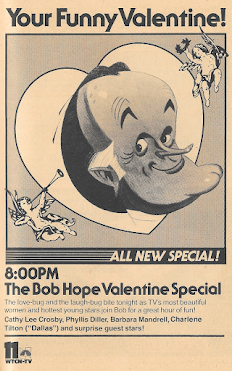
Wednesday, NBC presents The Bob Hope Valentine Special (8:00 p.m.), with the usual lineup of beauties: Cathy Lee Crosby, Barbara Mandrell, Charlene Tilton, and, of course, Phyllis Diller—plus "surprise guest stars!" The listing mentions Dr. Joyce Brothers, but I can't believe that's all, can you?
Thursday NBC rolls out a brand-new series, The Gangster Chronicles, starring Joe Penny, Michael Nouri, and Brian Benben, with a three-hour premiere. This was later repackaged into movie form as Gangster Wars. The series itself runs for 13 episodes, after which it's edited down into a 121-minute VHS presentation also called Gangster Wars. Confused? So am I.
I'm also a bit confused by Friday's movie Inmates: A Love Story (8:00 p.m., ABC), starring Perry King (Joe Penny's old running mate from the series Riptide) and Kate Jackson as residents of an experimental co-ed prison (!) who fall in love. Gee, who could have seen that coming? Fortunately, Judith Crist reports that it wasn't made available for preview.
lll
As I was running through those blockbuster Sweeps matchups, I wondered how much any of this would mean to younger viewers, those who've grown up with DVRs and streaming video. I mean, when you can record a half-dozen or shows at once, or go to your computer and watch a show any time you want, what difference does it make if there are two or three good ones simultaneously?
Remember, though, that this particular electronic age is in its infancy right now. I was reminded by an ad that appeared just before the programming section. It was for Audio King, an electronics chain that was big in the Twin Cities at the time. It asks you to imagine the absolute wonder of being able to play a television program over again and again.
But be forewarned: this technical marvel will cost you. The top-of-the-line MGA HS300U features infrared remote control, speed search, slow motion and a 7-day timer, all for $1,450. If that's a little too rich for you, there's the Hitachi—it's compact and easily programmable, and only sets you back $1,250. And for those of you on a budget, JVC has a two-speed model that still offers remote control, still-frame and slow motion for $950.
These are all in the VHS format, but don't forget there's another player in the field. An ad for Video Images offers you your favorite movies and television shows on either VHS or Beta! And when you buy three, you'll get a fourth title free! What a deal! And free with your order, you'll get their giant video catalog with "over 400 all-time favorite TV shows, feature films, cartoons, etc!" (That should just about cover it all.) The cost? Well, each Beta is $39.95, while VHS runs you $42.95. And to think - today you can get a movie on DVD, a far-superior format, out of the bin at Walmart for a buck.*
*And you can download to your laptop or the cloud and not even have to have it physically in your possession. How far we've come.
With prices like that, it's no wonder people are still complaining that they always put all the good shows on at the same time.
TV