Showing posts with label NBC. Show all posts

June 13, 2025

Around the dial


Let's kick things off this week with one of my favorite British detectives, Frank Marker, as played by Alfred Burke in Public Eye. But this isn't about either Frank or Alfred; it's the finale of the "Sylvia Coleridge Season" at Cult TV Blog, and I'll forgive John for ending the season since he's chosen well: the episode "No Orchids for Marker."

At Comfort TV, David looks at some of our classic shows to see what they have to say about the ubiquitous computer, which was a thing to behold back then—and something to be feared. The question that these shows posed: can the computer be trusted? 

The Broadcast Archives celebrated Game Show Wednesday this week with a look at the "Golden Age" of game shows, at least in number: the 1970s. They were everywhere, and I'm willing to bet you're going to recognize at least one or two of the hosts pictured.

Jack's Hitchcock Project returns at bare•bones e-zine with "Act of Faith," a seventh season episode written by Nicholas Monsarrat, starring George Grizzard and Dennis King. It is, as Jack says, a curious choice for a Hitchcock episode; you'll have to see whether or not it works.

At The View from the Junkyard, Roger continues to survey The A-Team, and points out that this week's episode, "The Out-of-Towners," keeps a trend going: that of the team taking on missions to right wrongs, rather than purely as mercenaries. It's part of what makes the show fun.

Television's New Frontier: The 1960s is back with the 1962 episodes of The Danny Thomas Show, and I'm always amazed that a show as successful as this was, with a star as big as Thomas was, can become so obscure today. Or maybe it's just me, I don't know.

At A Shroud of Thoughts, Terence bids farewell to Pippa Scott, a frequent presence on classic TV over the years, who died last month at the age of 90. If you had a favorite show back in those days, the chances are excellent that she was on it.

Better twice than never: at Drunk TV, Paul reprises a piece from Mavis Movie Madness on NBC's 60th anniversary show in 1986. I think it's safe to say that both Paul and I have our doubts about how well it worked, and what it may augur for the 100th anniversary show coming up. TV  

November 19, 2022

This week in TV Guide: November 20, 1976


True story: I was leafing through the pages of today's issue, getting ready to do some typing, and I started reading out loud some of the blockbuster programs that were on. Parades! Football! NBC's anniversary special! What a terrific week, I said.

"You must have been in seventh heaven," my wife said. 

My face clouded over. "This is while I was living in the World's Worst Town™, remember?"

"Oh," she said after a moment. 

It occurred to me then that it had been awhile since I’d had a really good rant about the World’s Worst Town™, and I was overdue for one. Now, I realize you didn't come here to listen to me gripe about this, but that's what you're going to do anyway, at least for the next few minutes. The WWT, we'll call it for the sake of convenience, is the small town in which I spent the so-called formative years of my life, from ages 12-18. While we lived there, we had access to one commercial television station, an NBC/ABC affiliate. There was a PBS station. On occasion there was a snowy picture from an out-of-state CBS affiliate. And that was it, which meant that 90 percent of our television viewing was restricted to NBC. For someone who may have been a descendent of Mike Teavee, it was—well, I don't really have the vocabulary to describe what it was like, at least not that I can use here.

I will allow as to how this arrangement did have one benefit this week: I was able to watch NBC's magnificent 50th anniversary show (Sunday, 6:00 p.m.) The four and one-half hour program, narrated by Orson Welles and featuring just about every living star who's ever appeared on the network, goes all the way back to the days of radio, and because television itself only makes up about have of the history, the program doesn't suffer from the recency bias that plagues so many of these kinds of shows today. Looking through some of the highlights, you get a really impressive look at the breadth of NBC's hits over the years: Rowan and Martin's Laugh-In; This is Your Life; Kukla, Fran and Ollie; The Wonderful World of Disney; Bonanza; The Tonight Show; Peter Pan; the Halmark Hall of Fame; Milton Berle's Texaco Star Theater; Mutual of Omaha's Wild Kingdom; Martin and Lewis on The Colgate Comedy Hour; Dr. Kildare—among others. There are also highlights of Rose Bowls and World Series, the moon landing and the JFK assassination, Dean Martin and Frank Sinatra, Rudy Vallee, and Bob Hope. The program ends with a tribute to David Sarnoff.

Ellen Torgerson's accompanying article shows how difficult it is to put together a program like this; it was over a year in the making, and the video archives weren't nearly as helpful as producer Greg Garrison would have liked. "We found lots of things missing, or they'd been erased or given away or stolen. And one of the warehouses was destroyed by fire." The storage building in New Jersey contained thousands of cans of film; they were labeled, all right, but there was no cataloging system, which meant "it might have taken 10 years to look through all those tins of tape to find, say, Grace Kelly in Lights Out." Garrison recounts the search for a color print of a 1957 Gene Kelly special with Donald O'Connor. A black-and-white print was located in Akron, but Garrison really wanted color. Finally, six weeks before the show, and resigned to using the B&W clip, Garrison was out shoveling hay in the barn of his horse farm, "and under an old pule of hay I found this box. There it was, a color print of the Kelly show, right in my own barn." He'd stored tapes of all the shows he'd produced in the rafters of the barn, and this one had fallen through an opening and into a bale of hay, unnoticed until his cleaning. It may have been a lot of work putting the special together, but it's worth it.

All three broadcast networks would arrive at milestone anniversaries in the next a couple of years, and each one approached their anniversary programs in different ways. CBS spread their celebration over an entire week, devoting each night to a particular genre; ABC, which had no radio history to speak of and was recognizing its 25th anniversary, put on a show that was more like a series of tributes at an awards show, with a live audience to boot. The NBC celebration is a show apart, though; with a script by Oscar winner Abby Mann, it combines gravitas, celebrity and history, and brings home the storied legacy of the Peacock Network. If nothing else, I'm grateful to the WWT for giving me the chance to see it.

l  l  l

As I said, it's a very, very good week of television; Thanksgiving week was often that way. The college football season's almost over, so you've got plenty of big games between big rivals. There are plenty of specials on—movies, variety shows, and the like; there's so much to look at that I've decided to treat Thanksgiving Day itself separately, on Monday. 

And, as I've progressed through this issue, it happens that I'm able to judge pretty much everything about this week based on whether or not I had access to it in the WWT. That's the key, I think; not that I would have watched it, but that I could have if I'd wanted to. For instance, I'm pretty sure that KCMT carried the Big Ten showdown between Michigan and Ohio State (Saturday, 11:45 a.m., ABC)—it was pretty good at picking up college football from ABC. (I'm not sure about the second half of the doubleheader, USC vs. UCLA, though.) KCMT even played fast and loose with NBC programming; it never carried Saturday Night Live (10:30 p.m., this week with host Paul Simon and musical guest George Harrison), instead substituting a local movie. I'm not quite sure what the motive was; it could have been the ad revenue generated by local commercials, or the station might have thought that the show's content was in poor taste, too "adult" for rural audiences. (If I had to bet cash money, I'd put it on the second explanation, because SNL wasn't recorded and played back later—it just wasn't shown period.) NBC's Saturday Night at the Movies is Billy Jack (8:00 p.m.), and that's probably what we watched, even though Judith Crist calls it "primitive" and says it "manages to insult every segment of society, as well as the intelligence of its devout audience." 

As I mentioned in the lede, I did get to see that NBC anniversary special, which means I passed up Sunday's Hallmark Hall of Fame, which ironically aired this season on PBS instead of NBC, its longtime home. All the presentations this season were celebrating the Bicentennial, and this one is "The Rivalry," a dramatization of the Lincoln-Douglas debates, with Arthur Hill as Abraham Lincoln, Charles Durning as Stephen Douglas, and Hope Lange as Mrs. Douglas. (9:00 p.m.) Now, I'm not positive that this would have been carried on KWCM, the PBS affiliate we got; it was kind of funky in what it did and didn't show, compared to its counterpart in the Twin Cities. I don't think I've ever seen "The Rivalry," in fact; I wonder if it's on YouTube. (Checking.) Nope, apparently not. Still, I'll look around if I have time later.

Arthur Hill's also on Little House on the Prairie Monday night (7:00 p.m., NBC). Little House wasn't a favorite in this house, though, so I probably was in my room doing homework. No Charlie Brown Thanksgiving* or Bugs Bunny and Daffy Duck in Carnival of the Animals, of course (starting at 7:00 p.m., CBS), and KCMT wouldn't pick up Monday Night Football unless the Minnesota Vikings were on, so you can forget the Baltimore Colts-Miami Dolphins game as well. (8:00 p.m., ABC) Instead, the TV-movie is The Savage Bees, with Ben Johnson and Michael Parks (8:00 p.m., NBC). Yep, homework.

*We have A Charlie Brown Thanksgiving on DVD, so we can watch it whenever we want. It's not the best of the Peanuts specials, though, so we don't usually watch it. Another case of irony, I suppose.

KTCA, the PBS affiliate in the Twin Cities, has a solid lineup on Tuesday; I don't know if KWCM carried it or not. One of the highlights is Mark Russell's post-election musical-comedy review (8:30 p.m.). Russell was one of the most astute, and funniest, political satirists around, an equal-opportunity humorist who puts someone like Art Buchwald to shame, and I thoroughly enjoyed watching his shows over the years until politics became too discouraging to be funny anymore. Anyway, I suspect Russell has a field day with Jimmy Carter's election; Carter always provided Russell with a lot of material. That's followed at 9:00 p.m. by Ingmar Bergman's magnificent The Seventh Seal. I probably wouldn't have watched that back then; I mean, I was precocious, but not that precocious, and besides, it would have run past my bedtime, but I own it today. No, if I watched anything, it would have been Police Woman (8:00 p.m., NBC). I don't think I'd watch it today, but you have to remember that back then I was a 16-year-old male, so you have to give me credit for that. 

Wednesday
night's NBC TV-movie is Irwin Allen's Flood, with Robert Culp, Martin Milner, Barbara Hershey, Teresa Wright, Carol Lynley, and Roddy McDowall (7:00 p.m.). There's a reason why NBC's TV-movies aren't usually remembered with the same affection and nostalgia as ABC's Movie of the Week, and maybe this is one reason why: "An overwhelming action-spectacle about an overwhelming disaster that swept through the lives—and revealed the lies—of a whole city!" I don't know; maybe it's really good! Or maybe those ABC movies weren't all that people remember them to be—remember, I didn't get to see them. Tonight is better-remembered for what wasn't available: The French Connection (8:00 p.m., CBS), which Judith Crist describes as "a milestone police-chase movie and a remarkable feat of filmmaking." The film, director William Friedkin, and star Gene Hackman all took home Oscars. And then there's Charlie's Angels (9:00 p.m., ABC; part of a big lineup that includes The Bionic Woman and Baretta): "Jill applies as a centerfold candidate for a girlie magazine that had its two previous centerfolds murdered." C'mon—Farrah Fawcett-Majors as a centerfold? I ask you, who's going to believe that?

Since you'll have to wait until Monday to read about Thanksgiving in detail—I'll have today's rant out of my system by then—I'll only point out that it was a very good day; the parade, football, turkey with all the trimmings. Nothing to complain about there, and who would want to complain, anyway? It's a day to be thankful for what you have, not dwell on what you don't have. (Still, you'll see that we missed a lot.)

And that brings us to Friday, the bonus day-off that's so great when you're a kid (and isn't bad when you're an adult, either, which might mean I haven't grown up yet). One of the big college football games of the year is the annual day-after-Thanksgiving* battle between Nebraska and Oklahoma, one that used to decide the Big 8 title each season. It's on ABC at 1:15 p.m. I had to listen to it on the radio, which I was able to swing by getting a fairly clear signal from a Nebraska radio station. The same applied to the nighttime half of the doubleheader, Penn State vs. Pittsburgh. (8:00 p.m.) It was harder finding a Pennsylvania radio station, but I was able to do it. Let's see; what else wasn't on? There's the animated adaptation of the beloved children's story Charlotte's Web (7:00 p.m., CBS), featuring the voices of Debbie Reynolds, Henry Gibson, Paul Lynde, Agnes Moorehead, and others (7:00 p.m, CBS). There's the All-Star Tribute to John Wayne (7:00 p.m., ABC), with appearances by Bob Hope, Angie Dickinson, Claire Trevor, Ron Howard, Lee Marvin, James Stewart, Sammy Davis Jr., Maureen O'Hara, and host Frank Sinatra. Plus. there are some great film clips There's the sequel to The French Connection, aptly titled The French Connection II (8:00 p.m., CBS) which still has Gene Hackman, but little else; Judith Crist says it's "not only resistible but repugnant, a botched, pointless and plodding film that thunks its way through detestable personalities and sadomasochistic details to an incredible ending." So I guess it was OK to miss it. Opposite that, KCMT offers The Lawrence Welk Show (6:30 p.m.), Chico and the Man (7:30 p.m.), The Rockford Files (8:00 p.m.), and Dean Martin's roast of Redd Foxx (9:00 p.m.). No evening that includes Jim Rockford can be all bad.

*One of the reasons ABC scheduled big games like this on the day following Thanksgiving was because of a little-known exception to the limit on how many times a team could appear on national television over a given period. Games played on days other than Saturday didn't count, as I recall, giving times like Nebraska and Oklahoma a bonus appearance.   

Oh, and if we're talking about bad television, we should mention the MST3K alert: Plan Nine from Outer Space (Friday, 3:30 p.m., WCCO). "Space aliens enlist the aid of the dead in trying to conquer the universe." Bela Lugosi, Lyle Talbot, Vampira. It wasn't on MST3K, but the Rifftrax gang did this live a few years ago. It's widely considered one of the worst movies ever made; since I didn't see this in the WWT, perhaps the week was better than I thought!

l  l  l

OK—time to take a deep breath, step back, and pull myself together. Perhaps I got just a little carried away with that last bit. Let's take a look at what else there is in this week's issue.

Doug Hill has a very nice article on Charles Kuralt—hopeful, even, for as he puts it, "Kuralt's reports from the church-supper, county-fair beat suggest that while journalism is crisis-ridden, America is not." That's an important message to hear; the country was going through a hard time in 1976, with the Cold War still strong, the wound from the Nixon resignation still fresh, and a very narrow presidential election just having concluded. Inflation, unemployment, and interest rates were all high, and morale was low. But as Kuralt points out, "I think that 'On the Road' should be irrelevant—uttterly. It serves to remind people that there are people besides politicians and entertainers and criminals [all one and the same, aren't they?] in the country." Kuralt has been doing his "On the Road" feature on the CBS Evening News since 1967; I always used to enjoy those whimsical pieces—back when we actually had CBS, of course. Now that we're in the WWT, where we don't get CBS—

No, wait, wait! Don't go there again! Get your mind off it, do you hear! (Takes deep breath.) Sorry about that. I don't know what came over me. Here's another look at what goes on behind the scenes: Frank Sean Swertlow's story on the "elite squad of New York's finest" delegated to keep TV stars out of trouble while doing location filming. "There are 15 police officers and four sergeants in the group," Swertlow writes, "with a lieutenant in charge. And one of the missions is to make sure all the production is done without inconveniencing millions of residents." One of those productions is Kojak, and the squad has its hands full—not just keeping the crowds away from Telly Savalas, but also keeping Telly away from them, especially the ladies. "Telly is a real ladies' man," says Lt. Paul Glanzman of the actor who headlines CBS's hit detective series—

A series I can't watch, right? Because it's not shown where I live! (Takes another deep breath.) I'm sorry again. I've really got to stop all this. It's not healthy, and it isn't doing anyone any good, especially me. Let's read about something more relaxing, funny even. Stephen Rubin talks to Beverly Sills and Carol Burnett about their holiday special at the Metropolitan Opera House on Thanksgiving night. They'd never worked together, or even met, until Burnett picked up the phone and asked Sills if she'd like to work with her on a special. The two clicked from the very beginning, and they make a delightful pair; "I'm having the time of my life," Beverly exclaims, while Carol "nearly fainted" when Sills told her she couldn't wait until they got started. Apparently the audience at the Met agreed, enthusiastically responding throughout the special, taped last March for . .  CBS . . .

All right, that's it! I give up! You win, World's Worst Town™! Even though it's been 46 years, you still have the power to bring me to my knees! How you nearly ruined my adolescence, stunted my cultural growth, deprived me of some of the simple pleasures of life. No, I can't let it go! I need to see Dr. Raymer or Dr. Thompson from that ABC series Breaking Point. Wait, they wouldn't have shown that either! (Collapses sobbing, a broken man.)

l  l  l
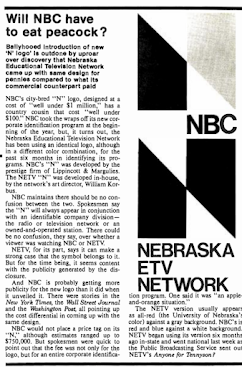
NBC's year got off to a bad start
I feel much better now, thank you. What this little exercise accomplished, besides allowing me to vent my spleen, is the frustration that any TV connoisseur would have experienced during a week where most of the best programs were unavailable. With the exception of Sunday night (due to the NBC anniversary show), one could arguably claim that what NBC had to offer was inferior every night of the week. As evidence, I submit the list of top-rated programs of 1976-77; of the top 30 shows, NBC had only four, with one of those being Monday Night at the Movies and another being The Big Event, the umbrella title given to Sunday night specials from the World Series to, well, the NBC 50th anniversary show. The only two actual series to make the list were Little House on the Prairie and Sanford and Son; and KCMT, in its provincial way, preempted Sanford for Lawrence Welk.

In a way, I have only myself to blame for this, and in recognition of this, I can only throw myself on the mercy of the court—you, my readers. As I've said, I was already committed to television by then, and so the culture shock of moving to the World’s Worst Town™ would have affected anyone in my position. Had I grown up with only one television station, things might have been different. You could also argue that I attach too much importance to television, and you'd probably be right about that as well, but on the other hand, if not for that, you wouldn't be reading this now. (All right, that's a push.)

However, had there not been others like me, there wouldn't have been the push for cable television in rural areas. There wouldn't have been the evolution of pay-TV, the explosion of cable networks, the exponential increase in televised sports, the demand by the consumer for more choice. And that's what it all boils down to: choice. I'm not saying I would have watched all those shows on other networks, had I had the choice; it's that I didn't have the choice. And it's not as if I didn't know what I was missing, because thanks to TV Guide, I did know. 

What's ironic about it, I guess, is that now, with more stations than ever to choose from, I hardly watch any current TV. The programs I do watch are mostly from the classic era, and some of them are shows I chose not to watch when they were originally on. Maybe I'm just not as dependent on TV as I used to be, and that's something I can truly be thankful for. TV  

September 23, 2020

The "It's About TV" Interview: William Bartlett, author of NBC and 30 Rock: A View from Inside


This latest edition of the "It's About TV" Interview is one that I think you'll really enjoy, as we dip into the history of one of America's greatest television networks and look at a wonderful coffee table book. 

William Bartlett has been with NBC since Seinfeld was in originals and the company consisted of NBC and CNBC. Fresh out of grad school with a PhD in English, he was hired in 1995 as the press department’s editor, where he embarked on a futile effort to get publicists to use the Chicago Manual of Style. After a few months though, he had a lucky break when then-CEO Bob Wright’s speechwriter left the company and Bartlett was tapped to replace him. For the next decade (not counting a short stint as Sumner Redstone’s speechwriter), he worked closely with Wright as the company grew into the diversified media giant it is today. Today, he heads up NBCUniversal’s in-house corporate video production team, which produces videos for clients around the company. He still writes or edits the occasional speech. Most significantly for our purposes today, he serves as NBC’s in-house historian, curating exhibits in the employee commissary and the 30 Rock lobby. To share the company’s enormous legacy more widely, he recently wrote a history book, NBC and 30 Rock: A View from Inside.

t  t  t 

 It's About TV: How do you get what sounds like the coolest job in the world? 

William Bartlett: I went to graduate school, thinking I’d be a college English teacher, and I’ve managed to end up with a job that is probably as close as you can get to being in academia while being in the corporate world. For most of my career my focus has been on executive communications: speeches, op-eds, annual report copy, and so on. But when NBC turned 75 in 2001, we partnered with John Wiley & Sons on a coffee-table book. A book packager was hired to create the book, and I was tasked with being the corporate point person in charge of reviewing and approving all the copy and photos. That taught me a lot about the company’s history, and I ended up not just fact-checking and approving the copy but writing portions of the book myself.

Fast-forward to 2011, when we were acquired by Comcast. In the months leading up to the close of the deal, the incoming CEO, Steve Burke, asked me to put together a fact sheet that employees would get on “day one,” which would explain what the new company consisted of. I agreed that employees wouldn’t necessarily know all the new company’s holdings, but it struck me that they really didn’t know the histories of the three remarkable companies that were now joined together: NBC, Universal, and Comcast. So instead of doing what I’d been asked, I wrote a short book on the history of the three businesses, with the glue holding them together being the fact that all three were founded by visionary outsiders: David Sarnoff (NBC), Carl Laemmle (Universal), and Ralph Roberts (Comcast). I showed it to Steve and he (fortunately for me) loved the idea. The rest is history, you could say. I became the go-to guy for info about NBC’s history, and I started getting more and more history-related assignments, from curating art for the hallways, to building a website, to putting together exhibits.

How did the idea for the book come about?
 
I didn’t know it at the time, but the seeds for the book were planted in 2012 with the construction of a new commissary for employees in 30 Rock. When it was finished, it was a beautiful, elegant space looking out over the ice-skating rink. But nothing about it said “NBC.” As an employee, you could have just as well been in a cafeteria at a bank headquarters. Steve Burke asked me to come up with a solution to this problem. I did two things: I selected archival black-and-white photos of NBC stars for the walls, and I commandeered two wooden cabinets intended for waste disposal and turned them into cases to hold historical exhibits.

For the next several years, drawing primarily on NBC archives at the Library of Congress and the Wisconsin Historical Society, I researched and curated four exhibits a year for these two cases, changing them every six months. I explored the history of NBC and World War II, the origins of the Tonight Show, the story of David Sarnoff, Arturo Toscanini and the NBC Symphony, the beginning of sports broadcasting – basically, anything that I thought would be interesting to employees and for which I had assets to work with: photos, documents, and physical artifacts.

After doing a few dozen of these exhibits, it struck me that almost every one of them would lend itself to a spread in a coffee-table book. The research was done. The photos and documents largely sourced. I just needed to write the text and add a few chapters to fill some gaps. I thought this would be a book that anyone who took our famous NBC Studios Tour might want to take home as a keepsake, and that in fact would appeal to anyone who was interested in NBC and the history of broadcasting.

One of the many things I most love about the book, going back to that story about the commissary, is how rich the history of NBC is, and how important it is to keep that institutional history alive for people who work there today, to remind them of how special it is to be able to say "I work for NBC." Have you gotten much feedback from employees, comments along the lines of "I didn't know that!"

Yes I have, and it’s been very gratifying. Right before I went to press, I shared page proofs with the CEO (I figured that would be prudent!). He called me the next day and said he thought it was terrific and wanted to know what I thought about printing enough copies so that every New York-based NBCUniversal employee could get one. He thought that the book would do exactly what you just said: make employees feel that they work for a very special company, one that they can be proud to be part of. I thought that was a great idea but told him the money for the extra copies would have to come out of his budget! So last November, more than 5,000 employees arrived at work to find the book on their desks.

Younger readers might think of "30 Rock" as the name of a television show, but I like to think of "30 Rock" as being to television what Yankee Stadium is to baseball. Tell me a little about how 30 Rock came to such prominence.
 
Financed by John D. Rockefeller, Jr., Rockefeller Center was built in the early 1930s as the largest privately-financed construction project in history. As originally conceived, it did not include any broadcast studios. The anchor tenant was intended to be the Metropolitan Opera, which was in dire need of a new theater. The Great Depression scotched those plans, however, and Rockefeller needed a new tenant. Coincidentally, RCA – then a booming technology company – needed more space and agreed to come on board and design studio facilities for its broadcasting subsidiary, NBC. The building’s address was 30 Rockefeller Plaza, but it was commonly known as “Radio City.” When it opened in 1933, it included among its many studios the then-largest broadcast studio in the world, Studio 8H, now famous as the home of Saturday Night Live. Over the years, more quality radio and TV programming has originated from this building than any broadcast facility in the world.

The readership here is obviously one that understands the importance of television’s past, not only in terms of history, but for the sheer enjoyment value. We both know, though, that there are younger people out there who, once they see something in black and white, just shut it down completely. What would you say to them about why they should be interested in this, and what they’re missing?
 
I would encourage any young person who is a fan of late-night comedy such as SNL to check out Sid Caesar and his Show of Shows, and Rowan & Martin’s Laugh-In, both on NBC. Two very different shows; both enormously influential. I would hope that a young audience could notice the writing of the Caesar show, and Sid’s timing. The man was a genius. And as for Laugh-In, well, Lorne Michaels was one of the writers. There’s a direct connection between that show and Saturday Night Live.
 
What would you consider some of the most significant moments in the network’s history?
 
A rare photo of Texaco Star Theater being shot
Well, given that NBC was the first national broadcaster, dating back to 1926, there are a lot of big moments. Here are a few that come to mind. On Christmas Day of 1937, Arturo Toscanini made his debut as the maestro of the NBC Symphony. Broadcast live from Studio 8H in Rockefeller Center, this was the first of nearly 500 concerts over the next 17 years, which for the first time made classical music accessible to a middle-class audience of millions. This was a seismic shift from its role as a rarified art form enjoyed primarily in concert halls by the well-to-do. A decade later, I would say the launch of two early TV programs, Howdy Doody on December 17, 1947, and Milton Berle’s Texaco Star Theater on June 8, 1948, both had the effect of selling lots of TV sets and paving the way for television to be a truly mass medium. Next, the debut of three programs that are still with us today and have had an enormous impact on our lives for generations now: Today (January 14, 1952), The Tonight Show (September 27, 1954), and Saturday Night Live (October 11, 1975). With the exception of Tonight, which was broadcast from Burbank from 1972 until 2014, all five of these shows have originated from 30 Rock for most of their runs. One final moment I’ll mention was more accurately three days rather than a moment: the work of NBC and the other networks covering the national trauma of the assassination of John F. Kennedy. NBC News broadcast nonstop, commercial-free, for 71 hours. There were moments when 9 out of 10 television sets in the nation were tuned in to network television. This was a tragic time during which television served the nation as a unifying force in a way that was unprecedented and certainly never to be repeated.

Did you run across anything in your research that surprised you, one of those moments when you found yourself thinking, "I had no idea!"
 
Sure, here is my favorite discovery from my research. I tell the short version of this story in the book. Here’s the full story. When I joined the company in 1995, I met a talented on-air promo producer named Skip Stuart. His office was adorned with many odd things, including a small, rather ugly green upright piano. The story he told me about it was that back in the radio days, it belonged to a now-nameless executive and it at one time was adorned with the signatures of celebrities. Then, after a wild party on Skip’s floor in the late seventies or eighties, a cleaning crew was brought in and one of the cleaners scrubbed all the signatures off the piano, after which the piano was put in the freight elevator bank for disposal. Skip, being Skip, salvaged it and put it in his office. When he retired in 2012, I inherited the piano. I knew nothing about it except what Skip had told me, but that was enough for me to want to hang on to it. Then, shortly after that, my department moved floors and I left the piano behind, in a storage closet. I told my contact in the facilities department to let me know if the piano became an issue. Sure enough, I eventually got a call from him, who explained that they really needed the space taken up by the piano and would it be okay if they disposed of it. As much as it pained me, since I didn’t know the full story behind the piano, I couldn’t justify keeping it and gave him the go-ahead to throw it out.
 
A few years after that, I was doing research on Bertha Brainard, NBC’s leading female executive in the early days of the company. I was reading a profile on Bertha in the August 1942 NBC employee newsletter, and I ran across this sentence: “A tiny upright piano in her office is decorated with the signatures of celebrities—all of whom Miss Brainard has met in her program-building and program-selling tasks in the past two decades.”
 
My heart skipped a beat and sunk at the same time. One, it hit me that Skip’s piano was surely Bertha’s piano. Two, I remembered giving the go-ahead for it to be thrown away! I rushed from my office on the 25th floor down to the storage closet on 10. And … yes! The piano was still there! Facilities had failed to follow through, and I couldn’t have been more thankful.
 
Although I had no doubt that this was indeed Bertha’s piano, I felt solid proof would be good. A check of NBC’s photo archive database revealed the existence of a folder labeled “Bertha’s Piano.” I had that folder retrieved from storage and the contents scanned and sent to me. A perfect match! Even better, on the photo, you could make out the many of the signatures on the piano! Fred Allen, Jack Benny, Jerome Kern, Mary Pickford, Babe Ruth, Ed Sullivan, and on and on.
 
I had a piece of NBC history, and now I knew the story behind it. I had the piano moved to my office, cleaned it off, and contacted a Saturday Night Live producer who I knew to be a history buff. My pitch: Put the piano at the entrance of Studio 8H and invite every guest host and musical guest to sign it, thus reviving the tradition Bertha began in the first years of NBC. Lorne Michaels gave his blessing to my scheme, and for the last two seasons the piano has been slowly filling up with signatures of the celebrities of our age.

Were there other stories or figures that you weren't able to get to in this printing that you're considering adding if there's a second printing?
 
Oh, for sure. Remember that the conceit of the book is to deal only with NBC’s activities within 30 Rock. Obviously, there are many stories to tell about NBC’s time producing shows from the studios in Burbank. But as far as activities in 30 Rock go, ◄ Tom Snyder and his late-night show Tomorrow, which debuted in 1973, certainly deserves a spot in the second edition. (The show flip-flopped between Burbank and New York but aired from 30 Rock for four or five years.) Radio program Monitor, which was yet another one of Pat Weaver’s programming innovations, deserves space as well. It launched in 1955 and at the beginning aired for 40 hours every weekend. I would also like to say more about how innovative the NBC Studios and the building that housed them were. There had never been anything like it. When the NBC tours began, the first stop was the air-conditioning unit on the tenth floor, where the guests would marvel at the 54 dials on the giant control panel as the page informed them that the “mammoth plant circulates 23,000,000 cubic feet of air every hour completely changing the air once every eight minutes” (I’m quoting the 1933 NBC Tour script).
 
Television has obviously changed a great deal through the decades, from rabbit ears to cable and satellite and now streaming, but it still is, after all, television. What are some of the constants that you see running through NBC’s history from then to now?
 
One obvious constant is advertising. NBC is still a broadcaster, even if relatively few people receive the broadcast signal through the air, the old-fashioned way. And that means it’s an ad-supported medium, even if we are now offering a ton of content through Peacock (our new streaming service) with an ad-free option. And, even if an enormous amount of viewing is time-shifted, we still do offer a schedule, whereby you know that if you tune in at 8 p.m. on Tuesday, you’re going to see the same show that aired at that same time the previous week and the following week. (Well, this isn’t entirely true but it’s more true than not, still!) The other constant is implied in the word “broad-caster.” Just as was the case in the early days of television, NBC wants to attract a broad audience, not just a niche. That’s what cable is for! Again, this is less true now than ten or twenty years ago, but it is still part of our legacy and ingrained in the thinking of our programmers. Come back to me with this question in another ten years, though!
 
If there’s one moment from NBC’s history that you could bring back for present-day viewers, what would it be, and why? 

I think I’d go back to the fall of 1948 when the entire country (or those homes with televisions) was captivated by a madcap comedian named Milton Berle and his show, Texaco Star Theater, broadcast on NBC Tuesday evenings at 8 p.m. There were nights when 95% of the nation’s TV sets were tuned to the man dubbed “Mr. Television.” Today, it is hard for us to imagine the nation’s collective attention being drawn to one TV program. An astonishing thought for us indeed. How fun would it be to recreate that! Apparently, Milton’s popularity was such that he disrupted the nation’s waterworks. In Detroit, officials were mystified by the sudden drop in the city’s reservoir levels just after 9 p.m. on Tuesday nights, until they figured out that the entire city waited until after Texaco Star Theater ended to use the bathroom, and they all flushed at once! I think the closest we’ve been to replicating this situation in recent years would be in the mid-1990s with the popularity of NBC’s “Must-See TV” Thursday night lineup.

NBC’s had a great run of success that’s continued to this very day; are there one or two series from the last few years, or something that’s even on right now, that you think would be at home with the very best that the network’s had to offer?
 
Sure, I think The Office was brilliant and certainly holds up against the best that NBC has ever put on the air. And I know I have mentioned Saturday Night Live. Granted, not every sketch works. But think about this: The show premiered in 1975 and today, 45 years later, it is still relevant, with moments of brilliance. That’s extraordinary.

You’ve got a time machine that can take you back to any program that’s ever aired on NBC. You’re there on the set. You can talk to anyone on the cast, or any member of the crew. Where do you go, what do you do, and why?  

Fred Coe in the control room
Great question. So many possible answers. But I think I’d pick Studio 8G on May 24, 1953. “Marty” is about to air, live, an episode of Goodyear Television Playhouse and perhaps the high-water mark of the (first) Golden Age of television. Rod Steiger and Nancy Marchand are in their dressing rooms. But I’m more interested in talking to the producer Fred Coe, hearing him explain how he figured out how to exploit the possibilities of the TV camera in ways that had never been envisioned. Delbert Mann, the director, is on set as well, reviewing last-minute script changes with Paddy Chayefsky. The atmosphere must have been electric. Here’s a quote from Rod Steiger that I used in my book, in the chapter on the Golden Age: “You had one shot. The pressure was hideous. You had to be a masochist to do it.” I would get such a kick out of being there to see it unfold.

t  t  t

Wasn't that fun? I'd like to thank William for his time, and especially his most gracious patience in putting up with an interviewer who was shoehorning him in-between starting a new job and moving to a new home. Many programming directors would have put me on hiatus long ago. I'd also like to thank our mutual friend, the mighty Jodie Peeler, for helping to arrange this interview; you're undefeated once again! Since we completed our interview, William has told me that his last day at NBC will be October 16, ending a 25-year career there. (I can't imagine what it must be like to spend 25 years at one place; I've had trouble lately making it to 25 months.) 

If you want to purchase a copy of NBC and 30 Rock: A View from Inside—and let me say here that I cannot recommend this book strongly enough (full disclosure: I was provided with a copy of the book for my review)—you can purchase it at the NBC Store website. It is one of the rare coffee table books where the text more than lives up to the pictures. Remember, the holidays aren't that far away; a copy of  NBC and 30 Rock coupled with, say, The Electronic Mirror, would be a great gift for that classic TV fan you know, even if it happens to be you.  TV  

December 26, 2013

The Bell Telephone Hour, 1959

My apologies for the relative silence this week - remarkably, I've been spending more time celebrating Christmas than I have blogging.  And I don't feel one bit guilty about it.

Perhaps I should have posted this earlier, but here's a glimpse of what we were watching on Christmas Eve - from the archives of the Bell Telephone Hour, which was one of NBC's classiest shows from 1958 to 1969.  A highlight of each season was the annual Christmas show, often broadcast live, featuring the best in classical and Broadway artists.  I've mentioned the program several times in past Christmas posts; here's a chance to see for yourself the beauty of the program - the beauty of the kind of television that appears all but lost.


And on that subject - television that's been lost and can't be found - I'll have more to say tomorrow.  In the meantime, a belated Happy Christmas to all, and to all a good night.

May 29, 2012

We now return control to your computer keyboard

"As I was saying…”

- Jack Paar’s first words after returning to The Tonight Show following his month-long walkout over a joke NBC had censored as being in bad taste.

***

The story is that during a climactic moment late in the 1958 NFL Championship Game between the Baltimore Colts and the New York Giants, as the Colts were driving for the winning touchdown in the first title game ever to go to sudden-death overtime, the jumping up and down of the excited fans in ankee Stadium jarred loose an NBC television cable, which in turn caused TV sets across the country to abruptly go dark.

The network was frantic:  they had no idea how long it might take to rectify the problem – and how much of the game they might miss.  In these days before television controlled sports, they could hardly ask the referee to stop the game while the technicians worked to restore the coverage.

Marshalling all of his resourcefulness, an employee from NBC did the only thing he could think of: he ran out on the field. The officials promptly stopped play, while police took off in hot pursuit of this apparently drunk fan who had suddenly staggered out of the stands. The delay worked: while the game was held up, NBC resolved the problem, and the picture returned just as the Colts came out of the huddle following the delay (although this may be slightly romanticized; various reports suggest NBC missed the first play after the delay), allowing all of America (or at least everyone watching the game, an audience that had grown as the game had gone on) got to see Alan Ameche bull his way over the goal line for the touchdown that would win the championship for the Colts and cement the game’s legendary status as the greatest ever played.

***

And so, having discussed a brief history of famous television delays, we come to the recent, checkered past of this blog.

As you may recall, sometime in early April, regular pieces on the blog ceased to appear. Oh, there was a long story on the Titanic, and a couple other short bits, but nothing substantial save a brief notice describing technical difficulties.

It was nothing quite as simple as a disconnected cable; it was, rather, a virus (educated guess) that, somehow, rendered access to Blogger impossible – or at least incredibly difficult.

Putting up the piece on the Titanic was, in its way, as challenging as it must have been for that ship’s radiomen to send out the distress signal using the rapidly dwindling power supply.

It was an incredibly frustrating situation, compounded by a concurrent (and perhaps related) loss of wireless capability. The solution was slow in coming, which meant that the drunk would have to run on the field for awhile longer.

Happily, if expensively, this problem has now been rectified. The field has been cleared, the host is back in the studio, and as this post demonstrates, It’s About TV (and its parent site, Our Word) is back on the air.

You might think that in the interim I’d stockpiled dozens of fascinating bits that I could share with you (and I know you’re out there) as soon as coverage had returned. Alas, such is not the case. I do have, as you will see shortly, an obituary of Mike Wallace that has been long delayed but not forgotten, and as I write this I’m looking at a pile of TV Guides that are begging to be explored.

So I would expect that in the next week or two we’ll get ramped back up to regular speed. And in the meantime, for those of you who noticed our absence, thanks for sticking with us. TV  

June 14, 2011

Conference Who, or "Haven't I seen you somewhere before?"

You may have seen this recently, but it seems as if the Mountain West athletic conference has introduced a new logo, to capitalize on the new image they want to create with several new schools (including football power Boise State) joining the conference.  Here's a look at the new logo, along with the one it replaced:


Now, if that new logo seems slightly familiar to you, let me draw your attention toward the British Isles (or BBCAmerica, at least):


Hmm. Interesting, huh? Of course, I'm not the only person who's noticed this, nor found it somewhat ironic. I guess imitation is the sincerest form of flattery. But when you're doing battle with a Time Lord, it's probably best to remember that anyone who can go back in time can surely wreck havoc with your conference.

To be fair, however, we should recall that this isn't the first time something like this has happened.