Showing posts with label New Year. Show all posts

December 31, 2025

Happy New Year!


On this last day of 2025, many are wondering if 2026 will be a better year, or a worse year. There's no question that this past year has been a rough one: bad in many ways, not quite so bad in others. For some, the year has been one of personal success, while some have seen heartbreaking setback, and still others have triumphed over adversity. I don't have much room to complain about 2025 myself; I published Darkness in Primetime, and I'm nearly finished with the first go-round of my new novel, which should be out next year. 

One of the great things about classic-era television is that it is, in somewhat the same sense as the Latin language, dead. By that I mean it's established, unchanging, set in its ways. There will always be debates regarding what makes a television series a classic, and what constitutes the canon of classic television. For me, whenever I think about it, I'm looking at an era that is comprised primarily of the 1950s, 1960s, and 1970s. That's the classic era. It's not completely frozen in time; there's always room for additional programs, and some of my favorites are far more recent than this seemingly narrow definition would allow. But what unites all of these programs is a common thread, something that brings them all together in a recognizable way. In other words, for a relatively recent program to achieve classic status, it has to adhere to the definitions and conventions of what made these older programs classic in the first place. This can be done in different ways, but even with the advent of color, even with the introduction of special effects, and even when it comes to rougher, more adult content, there are still threads that retain the quality and durability of classic TV. 

That's good news for fans of such programming, because in a world that seems to change by the millisecond, it provides us with something reliable, trustworthy, dependable. As my friend David Hofstede puts it, it's comfort TV, and in uncomfortable times, there's somethign to be said about these programs to which we can all relate in one way or another. That's what makes my job here easy: I don't have to invent anything, I just have to look back at what was, and see what it can tell us about what is. 

And as we prepare to begin this new year of 2026, there's no lack of what is to look at, and no end to how looking at what was can help us understand it. And as long as I keep typing about it, I hope you'll keep reading about it. 

In all respects, may this be a happy, holy, and providential 2026 for us all. TV


If you enjoy the content here and want to support my broader creative work, please consider making a donation at my Ko-fi page. Any amount you contribute helps me continue writing, researching, and sharing these articles and projects. Thank you!

December 28, 2022

Happy New Year?


I was scrolling through YouTube the other day, looking for some video of Guy Lombardo ringing in the new year as crowds cheered in Times Square, when it occurred to me to wonder if people really celebrate New Year's like this anymore, with a sense of optimism about the coming year. Otherwise, I mean, what's the point of celebrating, other than as an excuse for getting drunk? (And frankly, wouldn't that make more sense if you were convinced that next year would be even worse than this year had been?)

As 1940 passed into 1941, there would have been a sense of apprehension about the European war, but still confidence that we'd be able to remain out of it. As 1962 turned to 1963, we lived in dangerous times, but nobody would have had a clue about what was coming next. And then 1967 becomes 1968, and the new year couldn't possibly be as bad, could it? We all worried about Y2K, and when that didn't happen, we celebrated 2001 because of the movie and all. When 2019 slid seamlessly into 2020, the talk was about a new Roaring Twenties. How'd that work out for you? It would all be fixed by 2021 though, which had to be better, but it wasn't. Neither was 2022. Is there any reason to believe 2023 will be any different?

On a personal level, our lives have shown improvement each year, but I like to think it's been because of proactive things we've done to make things better for us. In that sense, I have guarded optimism that 2023 will continue in that trend. But make no mistake; if so, it will be a personal victory in a world that continues to deteriorate. And I have to ask myself, in all this, how a society can possibly keep going when its people have no confidence that things will, or even can, get better? Without that hope, how does it survive? The answer can only be inside each of us, I suppose.

Ah yes, Guy Lombardo. For those of you who don't remember the name, Guy Lombardo epitomized New Year's Eve for generations of Americans. He and his Royal Canadians began ringing in the New Year on radio in 1929 and on television in 1956, and though he displayed a musical style that some thought was old fashioned even back then, his fans included both Lawrence Welk and Louis Armstrong. You could usually find Guy and the orchestra ringing in the new year from the Waldorf Astoria in New York City, and it was a fixture on CBS (except for a few years in the late 1960s when the show was syndicated), with no serious challenger until Dick Clark's New Year's Rockin' Eve came along. His popularity remained, though, to the extent that even though he died in 1977, the broadcast continued for a couple of additional years. For many people, his rendition of "Auld Lang Syne" remains the definitive way to celebrate the beginning of the new year, even if they don't know who's performing it.

Here's the 1957-58 show in glorious black and white, as well as a clip from his last show, on New Year's Eve 1976; although the show's in color (and some of the music is a painful attempt to be modern), there's still kind of a black and white sense to it, don't you think? (I love how CBS is still using the same kind of clock they had on the Gemini and Apollo flights!)

New Year's Eve hasn't been the same without Guy Lombardo, just as it isn't the same without Dick Clark. Just as it isn't the same without hope and optimism. Nevertheless, you have the opportunity to make it good for you, so go out there and make it so. TV  

January 1, 2022

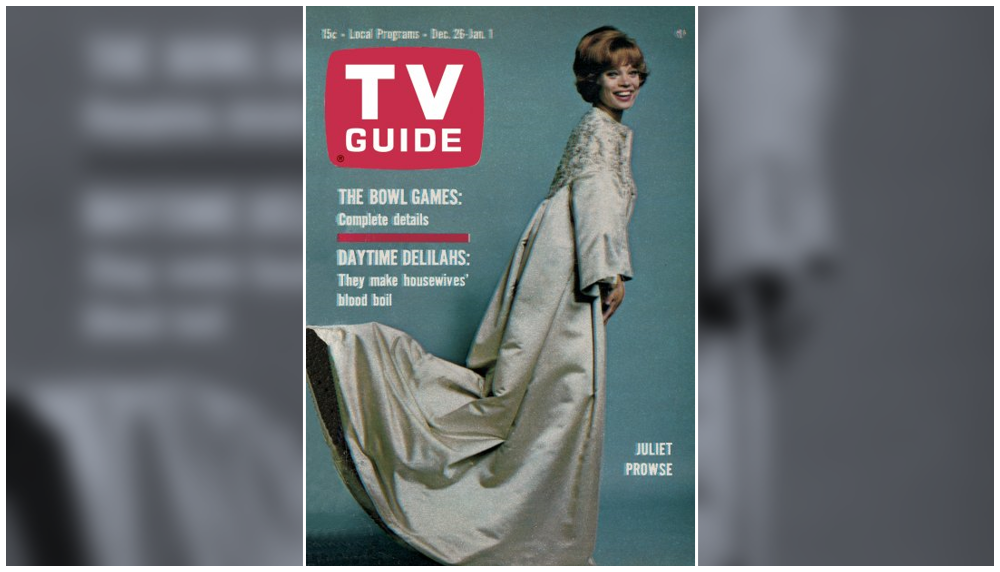
This week in TV Guide: December 26, 1964


A Happy New Year to everyone from this little corner of the world. I'm sure many of you are waking up this day with hopes that 2022 will turn out to be a better year, perhaps the best year yet. It would be hard to imagine things could continue to get worse (although on a personal note this year ended on a real high note), so let's look on the bright side of things—namely that flickering box in your living room. Just what does it have in store for us?

l  l  l

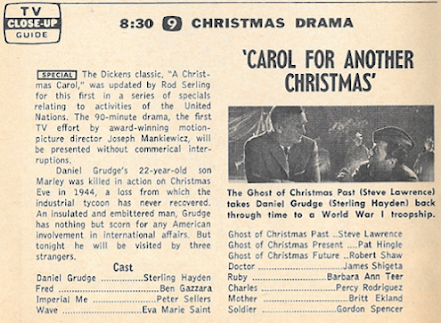
Last week, I mentioned the program The Legend of Silent Night, which appeared in TV Guide under the generic heading "Christmas Drama." This week (Monday, 8:30 p.m. CT, ABC), we have another such Christmas Drama, Rod Serling's legendary take on A Christmas Carol, Carol for Another Christmas.


The movie, directed by Joseph L. Mankiewicz and featuring an all-star cast, is the first in a series of planned movies made by the United Nations for the purpose of demonstrating the organization's mission. (I wrote about them a few years ago at TVParty!, so I won't rehash all the details here.) Now, your mileage may vary, but it's true that Carol got some pretty bad reviews at the time, with many critics suggesting that Serling's strident, polemical script served to undercut its intended drama; in fact, its "legendary" status may be due to being considered a "lost classic," having gone unseen for nearly 50 years after its original broadcast until it was rebroadcast in 2012 on TCM. 

But you know, not everything that Rod Serling wrote was great; he knew that better than anyone. And not every "lost classic" is actually a classic. It's still worth watching, though, as a part of television history. 

One last thing; you know how I've written about how quick we are to declare Christmas over as soon as the calendar flips over to December 26. Well, Carol for Another Christmas was aired on December 28. And it was still called a Christmas Drama. And that's not all; on Saturday, Jackie Gleason offers his annual Christmas show (6:30 p.m., CBS), in which he talks about his own childhood Christmas memories and reads "'Twas the Night Before Christmas," while his sidekick Frank Fontaine offers his version of "A Christmas Carol." Try telling the Great One that Christmas was over before his Christmas show aired!

I've made this point before, but the 12 Days of Christmas don't start until Christmas, and it's quite apparent from past TV Guides that even in the '60s, the period of time between Christmas and New Year's was considered an extension of the holiday. Schools were out, parties were held, many people were taking time off if their office wasn't already closed. Heck, WCCO even has the Mora High School choir singing Christmas music Saturday afternoon. Today things seem different; a couple of years ago we actually saw store employees taking down decorations on Christmas Eve. By the time December 26 rolls around we're already on to something else, stripped trees already sit on the curbside waiting to be picked up by the trashman. By December 28, it can often be as if Christmas had never happened. As I said, we're in too much of a damn hurry.

l  l  l

During the 60s, the Ed Sullivan Show and The Hollywood Palace were the premiere variety shows on television. Whenever they appear in TV Guide together, we'll match them up and see who has the best lineup.

Sullivan: Scheduled guests are singer Leslie Uggams, impressionist Frank Gorshin, comedian Rip Taylor, the Serendipity Spingers, comedienne Jean Carroll, the Czechoslovakian State Folk Dance ensemble and Burger's animals. On tape: juggler Gil Dova and the comedy team of Davis and Reese.

Palace: Host Van Johnson introduces actress-singer Betty Grable; tenor Sergio Franchi; comedian Jackie Mason; French trapeze artist Mimi Zerbini; comic Paul Gilbert; the Jambaz balancing act; the dancing Bal Caron Trio; and the Zeros, knife throwing act.

I'm not convinced that this is the strongest week you'll see. Of course, Frank Gorshin probably could have impersonated everyone on either show, and that would have been worth watching. I'm not a big Leslie Uggams fan, though, and Rip Taylor always used to drive me crazy. On the other hand, if therest of the cast weren't enough, I think Betty Grable gives Palace at least one leg up on the competition, if not two. 

l  l  l

Throughout the 60s and early 70s, TV Guide's weekly reviews were written by the witty and acerbic Cleveland Amory. Whenever we get the chance, we'll look at Cleve's latest take on the shows of the era. 

When this week's series first premiered in 1962 it was called, simply, The Nurses. Now, by the time Cleveland Amory has gotten to it, it's become The Doctors and the Nurses. What's it all about? Says Cleve, "There are four kinds of opera—grand opera, soap opera, horse opera and, last and least, hospital opera. We have our own thoughts as to why so many people have, for so many years, found the hospital shows so fascinating—including every last gory operation-room detail—but up to now we have spared you this theory."

As I say, the show started out as The Nurses, starring Shirl Conway and Zina Bethune in the titular roles, but after a couple of seasons doctors Michael Tolan and Joseph Campanella were brought in to add some bulk to the dramatis personae; as one of the producers put it, there's only so much drama you can squeeze out of a storyline that deals with nurses, because there's only so much nurses can do on their own. At some point, you have to bring doctors into the mix. According to Amory, the additions have done little good: "CBS, not content to do the gentlemanly thing and let the old show, The Nurses, go—a decision by which they could have won the undying gratitude of millions yet unborn—have, instead, in their infinite obstinacy, seen fit not only to keep The Nurses on, but, horror of horrors, to add to it."

Storylines are almost uniformly grim, "some of the heaviest fare this side of the Black Hole of Calcutta—and we hesitate to mention that for fear they'll shoot that, too." Stories include examinations (no pun intended) of menopause, the concerns a black patient has about having a black doctor, and a two-parter about abortion. That one, in which a woman apparently died as the result of a botched abortion, climaxes with "about as silly a chase as we can recall, with the abortionist engaging in a high school debate with his chaser (Tolan), who had been accused of performing the operation." The innocent Tolan, says Amory, "behaved like such a heel that to this day we don't believe the script got it right. We believe he was guilty. As to the Mata Hari girl who helped him (Katherine Crawford), if ever we saw a nurse's aide who needed aid, she was it."

To be fair, there have been some good episodes, marked by good writing and acting, but these seem to be the exception rather than the rule, as the very next episode will invariably be another turkey. He did like one, which featured an interesting guest-star turn by Barbara Harris, but "As for the writing, the kindest thing on could say about it was that there wasn't any. Maybe Miss Harris ad-libbed it from an old movie."

l  l  l

I'm surprised there's no New Year's Eve programming on the networks, at least here in Minneapolis-St. Paul. I'd assumed that CBS might have been showing Guy Lombardo, but as we look into it further, it turns out we're in that period from 1965-70 in which Guy and his Royal Canadians were syndicated, and apparently no one in the Twin Cities thought it was worth carrying. Over on NBC's Tonight, Johnny Carson probably has a cutaway to Times Square for the ball drop, and ABC has The Les Crane Show (carried in Minneapolis on WCCO, the CBS affiliate), which doesn't even begin until midnight. In fact, the only New Year's Eve show is a local one, from KSTP, Channel 9. It's called Nightwatch, a three-hour live music program from Souls Harbor ministries in downtown Minneapolis. I never watched this, but I remember this program running on New Year's Eve for years. Not the same program, of course.


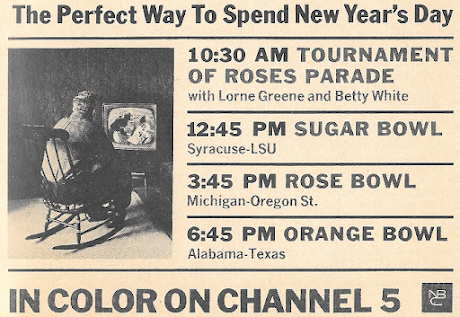
The New Year rings in bright and early with The Today Show (7:00 a.m., NBC), which devotes the entire two hours to the Grammy-award winning Swingle Singers. The festivities continue with the Cotton Bowl Parade from Dallas (9:30 a.m., CBS), hosted by Allen Ludden and for-mer Miss America Marilyn Van Derbur. At 10:00 a.m., NBC carries a half-hour of highlights from last night's King Orange Jamboree, hosted by Dennis Weaver, with Grand Marshal Jackie Gleason. At 10:30 a.m., CBS and NBC offer dueling coverage of the Tournament of Roses Parade and Grand Marshal Arnold Palmer; CBS's features Bess Myerson and Ronald Reagan, while NBC has the long-running team of Lorne Greene and the now-late Betty White. Finally, at 11:00 a.m., ABC's Les Crane and Kathy Nolan host the Mummers Parade from Philadelphia. Added to the football to come, there should be no complaints about finding something to watch. 

l  l  l

After months of struggle, the college and pro football seasons both come to conclusions this week. (Yes, I know it's hard to believe the NFL season once ended before February, but it's true.)

The two pro leagues have coordinated their championship game schedules to avoid conflict, and so the AFL leads off on Saturday with the defending champion San Diego Chargers taking on the Buffalo Bills at 1:00 pm on ABC. It's one of the most memorable games in AFL history, as the Bills, riding the arm of Jack Kemp and a ferocious defense, dismantle the Chargers 20-7. Most remembered of all is Bills linebacker Mike Stratton's tremendous hit on Chargers star Keith Lincoln, "The Hit Heard 'Round the World," which knocked the MVP of last year's title game out for the rest of this one. As a side note, NBC's new contract with the AFL, one that provides the upstart league with financial security, begins in 1965; until the start of Monday Night Football in 1970, this will be the final pro football telecast by ABC.

The following day at 12:30 pm, CBS gives us the NFL championship between the heavily favored Baltimore Colts and the Cleveland Browns. After a scoreless first half, which one sportswriter describes by writing, "Never have so many paid so much to see so little," the Browns come alive in the second half, and dominate the Colts, winning 27-0. It's the first time CBS has broadcast the championship game, under a unified new contract; even though the network carried most of the league's regular season games, previous title contests had been carried by NBC. It's also, to this day, the last championship won by the Brownies.

As for college football, believe it or not, the title—rather, the mythical national championship—has already been decided. The college football landscape is a lot different in 1964 than it is today; the national champion is chosen by the Associated Press and United Press International polls before the bowl games, which are considered little more than exhibitions. Speaking of bowls, there are only nine of them, and some conferences, like the Big Ten and Pac-8, put limits on how many of their teams can go bowling, and where. 

And so the undefeated Alabama Crimson Tide, led be star quarterback Joe Namath, have already been proclaimed national champions when they travel to Miami to play the #3 Texas Longhorns in the first-ever nighttime Orange Bowl (6:45 p.m., NBC). It's also the conclusion to NBC's "Football Widows" triple-header, which begins at 12:45 p.m. with the Sugar Bowl (LSU 13, Syracuse 10) and continues at 3:45 p.m. with the Rose Bowl (Michigan 34, Oregon State 7) before winding up in Miami. And while the Crimson Tide stride into the Orange Bowl as champs, they leave as chumps after losing to the Longhorns 21-17. Meanwhile, Arkansas, ranked #2 and also undefeated, beats #6 Nebraska 10-7 in the Cotton Bowl (12:45 p.m., CBS), and is chosen national champion by the Football Writers Association and the Helms Foundation. Don't feel too sorry for Joe Namath, though; the following day he'll sign with the AFL's New York Jets for $400,000, making him the highest-paid player in the history of professional football.

l  l  l

Let's see what else we've got this week.

On Saturday, ABC's Wide World of Sports (4:00 p.m.) presents the Australian Rules football championship between Melbourne and Collingwood. Having watched many matches over the years, I can safely say that the description of the sport having "a complicated set of rules" is an understatement. Having no rules at all would be closer. 

At 9:00 a.m. Sunday morning, CBS presents another in their series of Sunday cultural specials, with a broadcast of a 1959 staging of "Noye's Fludde," a 15th Century miracle play set to music by Benjamin Britten. A nice color feature article accompanies the broadcast, taking a look at the nature of miracle plays and background behind the production. Of course, shows like this have always been stuck somewhere harmless in the broadcasting schedule, where they can't do much ratings damage. Later in the evening, Gordon and Sheila MacRae host Winterland on Ice (6:30 p.m., ABC), supported by members of the Ice Follies, including former world champion Donald Jackson. Then CBS puts a cultural bookend on the day with an 8:00 p.m. telecast of the Royal Ballet doing "Les Sylphides" by Chopin, followed by the third act of "The Sleeping Beauty" by Tchaikovsky. featuring the legendary Margot Fonteyn and Rudolf Nureyev.

One of the things I find interesting is that the networks are still showing first-run episodes throughout Christmas and New Year's, in addition to specials. For example, there's a full-page ad for The Lucy Show on Monday night (8:00 p.m., CBS), with special guest star Danny Kaye (another CBS star, natch). 

Tuesday's episode of the aforementioned The Doctors and the Nurses (9:00 p.m,, CBS) probably drives Cleveland Amory crazy, and I'm not sure I blame him: the staff and patients witness a life-and-death drama across the street as a man threatens to jump off a building. 

And speaking of Danny Kaye—well, on his own variety show (Wednesday, 9:00 p.m., CBS), he has his own crossover guest, with The Beverly Hillbillies' Buddy Ebsen doing the honors. I just love this self-promotion.
 
I mentioned the dearth of New Year's Eve programming, but that doesn't mean there isn't anything on Thursday: on Kraft Suspense Theatre (9:00 p.m, NBC), Roddy McDowall stars as an alcoholic former teacher trying to prove a skid-row friend innocent of a robbery and murder that claimed his own life.

And if you're not into the football scene, Friday's highlight is probably Nuthouse (7:30 p.m., CBS) an hour-long satire of pop culture produced by Jay Ward and Bill Scott of Bullwinkle fame. As I recall, it was a pilot for a series that never went anywhere.

l  l  l

Finally, if you've been past the toy aisle of a store lately, you know the Marvel Cinematic Universe has taken over pretty much everywhere. But this week's article about Fess Parker, written by Arnold Hano, reminds us that merchandising has always been a part of hit entertainment.

Parker became a huge star in the '50s by playing Davy Crockett, King of the Wild Frontier, on Walt Disney's show. Everywhere you heard "The Ballad of Davy Crockett," you saw kids wearing coonskin caps, and Parker drew thousands to his every appearance. When Disney declined to revive the series, Parker and producer Aaron Rosenberg sat down to see what other kind of Crockett-like character they might be able to adapt into a series. They settled on Daniel Boone, and today the Boone publicity machine is going non-stop.  "A comic-strip syndicate ordered an artist-writer team to rough up two weeks of panels for a daily Boone strip. A soft-drink TV commercial featured a cartoon figure of Daniel Boone. And—bless their hammer pin heads—the kiddies began singing: "Daniel Boone was a man . . . a big man . . ." Adds Parker, "We are ready to meet the demand for a merchandising program. NBC is even ready to create the demand, if it has to." As I often say, the more things change, . . .

Daniel Boone ran for six seasons. Parker, already a millionaire from the Crockett series and owner of 30% of Boone, became even more wealthy, turned down the lead role of McCloud, and retired from acting to oversee various real estate developments and operate a successful winery. Not a bad career. I imagine Disney took some notes, don't you? TV  

December 31, 2021

Around the dial


We'll start the final Around the Dial of 2021 at bare-bones e-zine, where Jack's Hitchcock project focuses on "The Lonely Hours," the first solo Hitchcock script by William D. Gordon. Once again, one of the most interesting aspects of this very interesting writeup is Jack's description of how the episode differs from the original source material.

At Garroway at Large, Jodie is back to give us an update on the progress of her Garroway biography. This is another book that I'm really looking forward to reading when it comes out, and my suspicion is that the Garroway family will be very pleased with the final product.

John at Cult TV Blog (yup, changed the name again) recalls the 1980s series Max Headroom, with a look at the brilliant pilot that established the story behind one of the stranger series of the time. I remember seeing that movie, and thinking that the series never lived up to its heights.

At Comfort TV, David takes a look at the classic TV year in review. There are actually several highlights here that I'd forgotten about, as well as a look at some of David's most popular posts of the year. And let me echo his wishes for 2022.

In a similar vein, Rick spends this week's Classic Film & TV Cafe looking back at his top 10 posts of 2021. I always enjoy these retrospectives, because it's so easy to forget some really good writing over the course of a hectic year. (I don't do them myself, because I hate rereading most of what I've written.)

Let's get a final Christmas 2021 post from The Horn Section, as Hal looks at Love That Bob's 1955 episode "Grandpa's Christmas Visit." Grandpa, of course, is played by none other than Bob Cummings himself. 

Sally Ann Howes, the British musical comedy star, died this week, aged 92. I did not know her from her movies, such as Chitty Chitty Bang Bang, but from her appearances on American game shows like Password. Fortunately, Terence has a more comprehensive look at her career at A Shroud of Thoughts.

And with that, we'll say farewell to 2021; the next time you visit here, whether tomorrow or sometime next week, we'll be in 2022, with hopes for a happy New Year indeed. And remember, let's be careful out there. TV  

January 2, 2021

This week in TV Guide: January 1, 1955

Growing up, I always felt that a holiday falling on a weekend was something of a letdown. After all, Saturday and Sunday were already like holidays; any day without school was like being let out of prison on a work-release program. (Little was I to know that it wouldn't get any better as an adult, except that the sentence was more like 40 years, and you got paid while doing time.) They were, in a way, less special; when it came to television, even less so. amon

New Year's Day 1955, which falls on a Saturday, is one of those days. You're enjoying a day off that you already have, and you're probably spending it watching college football, just like you've done every Saturday for the last three or four months. What's the big deal about that? It is, I would learn, just one of the harsh realities of life. Be that as it may, here we are at the first day of 1955, and if you aren't still getting over your hangover from last night, there's no end of reminders that this Saturday is not quite like those of the last twelve months.  

Our first clue comes at 11:15 CT, with NBC's coverage of the 66th Tournament of Roses Parade, live from Pasadena, California, with the theme "Familiar Sayings in Flowers," . Bill Goodwin (announcer on the Burns and Allen radio program) and Betty White are NBC's hosts, and they'll be introducing, among others, the parade's Grand Marshal, Chief Justice of the United States Earl Warren. There's also a strong contingent of Western stars, befitting the genre's status as television's reigning programming, including Roy Rogers and Dale Evans, Hopalong Cassidy, Andy Devine, Leo Carrillo, Guy Madison and Rex Allen. We should also note that "unique feature" of NBC's coverage, "the placement of a television camera in a dirigible hovering between 700 and 1000 feet above the parade." That's right: it's not just any dirigible, but the very first appearace at the Rose Parade of the Goodyear Blimp, without which no major event today would be complete. There may be many imitators, but there's only one Goodyear. And I'm sure the roses look lovely in living black-and-white.
 
t  t  t

You wouldn't have seen these teams in yesterday's bowl games—except for one lucky school, that is.

It's ironic that Hopalong Cassidy is appearing in the Rose Parade, since his namesake is playing in the Rose Bowl. (I wonder how many times that's happened?) I'm talking about Howard "Hopalong" Cassidy, star back of undefeated, top-ranked Ohio State, third in the voting for the Heisman Trophy (he'll win it the following season), and future member of the college Hall of Fame. He came by his nickname honestly; after one game, a sportswriter said he "hopped all over the field like the performing cowboy." Ah, of such things are legends made. 

Anyway, the game is played in a steady rain (the last time rain falls on a Rose Bowl game), and Ohio State rides a dominant performance to a 20-7 victory over USC. The game likely would have been more competitive had the Buckeyes played UCLA, the undefeated and second-ranked team, but the Uclans were prevented from playing in their second consecutive Rose Bowl due to the Pacific Coast Conference's "no-repeat" rule. (The networks would never allow that to happen today.) And speaking of networks, you can see one reason why the Rose Bowl has always enjoyed such big ratings compared to other bowl games: the Orange Bowl airs at 1:00 p.m. on CBS, the Sugar Bowl at 1:00 p.m. on ABC, and the Cotton Bowl at 1:00 p.m. on NBC, leaving the 4:00 p.m. timeslot wide open for Pasadena. It's a priviledge that, with a handful of exceptions over the years, the Rose Bowl enjoys to this day.

Oh, and in the other games: Duke 34, Nebraska 7; Georgia Tech 14, Arkansas 6; and Navy 21, Mississippi 0.

t  t  t

But what's that, you say? You don't like football? Well, there's not a lot of hope for you, at least during the day. You can watch Pygmalion, the original, non-musical George Bernard Shaw story from which My Fair Lady was adapted (4:00 p.m., WGN), with Leslie Howard and Wendy Hiller as Rex Harrison and Audrey Hepburn. (Psst - Leslie Howard was probably as good a singer as Rex Harrison.) Range Defenders, an hour-long Western, airs at the same time on WBBM. At 5:00 p.m., it's Superman to save the day, at least on WBKB.


In primetime, Victor Borge hosts a special on NBC immediately following the conclusion of the Rose Bowl (6:30 p.m. or thereabouts), while at 7:30 (following The Mickey Rooney Show), it's the debut of This Is Hollywood (actual title: So This Is Hollywood), a sitcom presenting the adventures of stunt girl Queenie (Mitzi Green) and her roommate, aspiring actress Kim (Virginia Gibson). It runs for 24 episodes, and, unlikely as it may seem, there's an episode of it here. At 9:00, The Jimmy Durante Show (NBC, again), with special guest George Raft.

t  t  t

We all know, though, that while a year lasts 365 days, New Year's Day only lasts for one, so here's a look at the highlights from the rest of the week

In the Sunday afternoon cultural ghetto, Omnibus (4:00 p.m., CBS) features an excerpt of the trial scene from George Bernard Shaw's St. Joan, accompanied by background information by host Alistair Cooke. That's followed at 5:00 p.m. by You Are There, with Walter Cronkite and other CBS correspondents looking at "The Torment of Beethoven." Moving into primetime, the monthly Max Liebman Spectacular (6:30 p.m., NBC, preempting the Colgate Comedy Hour) pits Liebman's "new trio" of Judy Holliday, Steve Allen and Dick Shawn (!) against the "zany" Ritz Brothers in dueling sketches, songs and dances. That goes up against Ed Sullivan's Toast of the Town (7:00 p.m., CBS) with a guest lineup that includes Pearl Bailey, June Valli, Sam Levenson, Ted Lewis, and Francis L. Sullivan and Patricia Jessel in a scene from the new Agatha Christie Broadway play, Witness for the Prosecution. Both Sullivan, as barrister Sir Wilfrid Robarts (later played in the movie by Charles Laughton), and Jessel, as Romaine Vole (Marlene Dietrich in the movie) will go on to win Tonys for their performances. And in an event that should be circled on the calendar of my friend Hal Horn, it's the premiere of The Bob Cummings Show, also known as Love That Bob (9:30 p.m., NBC), which runs for five successful seasons. The MeTV website suggests that it was the first series to debut as a midseason replacement, and who am I to disagree? Maybe Hal knows.

Under the category "a new year calls for a new start," Monday sees a trio of daytime premieres on NBC, starting with Way of the World (9:30 a.m.), an anthology of short stories taken from women's magazines. That's followed at 9:45 a.m. by The Sheila Graham Show, a 15-minute update on the latest in Hollywood news hosted by the TV Guide columnist. And at 11:00 a.m., it's the debut of the Tennessee Ernie Ford show, with singer Molly Bee and a six-piece musical group. 

Rod Serling, who always had something interesting to say about men in battle, takes another look at in on Tuesday in Armstrong Circle Theater's "Save Me From Treason" (8:30 p.m,. NBC), as a young soldier in Korea contemplates getting even with his heartless father by defecting to the communists. The cast isn't listed in the issue, and even on the IMDb we don't really know who played who, but we'd probably remember it more if the lead had been played by a young actor in the cast, one making his television debut, who appeared in only one uncredited scene. His name: Steve McQueen.

Wednesday night, CBS's Best of Broadway presents a comedy that was certainly among the bests on Broadway: Arsenic and Old Lace (9:00 p.m.), with Helen Hayes and Billie Burke as the murderous-yet-loveable spinsters, Orson Bean as their befuddled nephew, Boris Karloff as the serial killer who looks like Boris Karloff and Peter Lorre as the plastic surgeon responsible for his appearance, John Alexander as the man who thinks he's Teddy Roosevelt, and Bruce Gordon, in his pre-Untouchables days, as a policeman. Hard to say how it is compared to the movie (Cary Grant hated his performance in it, by the way), but it certainly has the look of a winner.

There's a rare morning special breaking up the regular schedule on Thursday, but it's not just any special. It's President Eisenhower's State of the Union address (11:30 a.m., all networks). The State of the Union didn't become a primetime television spectacle until President Johnson's address on January 4, 1965 (the opening day of the new Congressional session), but the idea of giving it in the evening actually dates back to Franklin D. Roosevelt in 1936*, and I'm guessing the reasons were the same: to reach the largest audience possible. (By the by, two weeks later Ike will conduct the first televised presidential press conference.) Later, on the mystery series Climax (7:30 p.m., CBS), Art Carney (above) plays a private detective enmeshed in shady dealings and a double-double cross in "The Bigger They Come," based on the short story by A.A. Fair, the pseudonym of Erle Stanley Gardner.

*According to the House of Representatives history site, FDR's decision created quite a protocol stir, leading some to wonder if formalwear ought to be worn. (It was only the second time a president had ever addressed Congress at night.) Imagine wearing white tie or evening gown for a presidential speech.

On Friday, it's a future star of another kind, as Gillette Cavalcade of Sports presents future champion Floyd Patterson, 20 years and three days old, against Willie Troy, whom he defeats in five rounds in a light-heavyweight bout. It's already Patterson's 20th professional fight, and he'll fight again ten days later, defeating Don Grant. (Ah, the energy of youth.) Less than two years later, he'll knock out Archie Moore to win the heavyweight championship. And Edward R. Murrow's Person to Person (9:30 p.m, CBS) visits Dinah Shore and her husband, actor George Montgomery.

t  t  t

Finally, how about some gossip? I don't see anything online about Ike's State of the Union speech, but based on what columnist Earl Wilson says, I'd imagine it went pretty well. Actor Robert Montgomery has been serving as the president's unpaid consultant and coach, and, according to Wilson, "Montgomery's suggestions on President Eisenhower's TV style have finally begun to pay off. 'Ike' was so eloquent—and smooth—at a recent dinner that his speech topped all others. Montgomery sat on the front row—'watching him like a mother,' said one observer. Montgomery, homburg-hatted and all, looks almost like a diplomat these days."

On the other side of the aisle, Wilson reports that Margaret Truman, daughter of the former prez, "has agreed to do three or four more shows for Jimmy Durante in late winter or spring." Durante has a letter from Harry, "thanking him for being so nice to Margaret."

In a sign of things to come, the Teletype notes that The Great One, Jackie Gleason, is "very interested" in an offer from Milton Berle's sponsor (Buick?) "to finance a half-hour telefilm version of The Honeymooners next season." In a throwaway line, reporter Bob Stahl notes that "the comedian would also share in rerun sales." No dummy he. Today, that single season of shows is known as the "Classic 39."

Also in the Teletype, Jack Paar is taking a couple of weeks off from his CBS morning show to vacation in (pre-Castro) Cuba as a guest of the government, "in honor of Paar's employing Pupi Campo and Jose Melis, both native Cubans," on the Morning Show. Replacing Paar while he's off: Johnny Carson. 

I kid you not. TV  

December 30, 2020

Tomorrow and tomorrow and tomorrow

I don't think anyone's really going to miss the end of 2020, do you? In retrospect, the omens were there for anyone to see, with so many people talking about it being the start of a "New Roaring 20s,"* and we all know how that turned out: the aftermath of the Great War introduced a spiritual nihilism, prohibition, the first sexual revolution, massive labor unrest, the rise of Marxism, the Great Depression, and finally—a decade later—a second world war that included the Holocaust and culminated in the introduction of nuclear weapons and the start of the Cold War. 

*Not to be confused with the TV series of the same name. We could have used Dorothy Provine this year.

And now here we are, one year later, and the first year of the new Roaring 20s has given us the worst twelve months since, what? 2001? 1968? 1941? It doesn't matter, I guess, except in degrees. It's like asking whether you'd rather have your skull smashed or your heart torn out. No matter which one you choose, it's gonna hurt. I know there are people out there who think 2021 will be a better year, and you can't blame them for that hope. Hey, I hope it's better, too. 

In a way, New Year's provides us with a choice, a fork in the road. One path continues the status quo, the other leads to something new, different, uncertain. Sure, this may be symbolic more than anything else; after all, you don't need to wait for a new year to start to make decisions about your future. Seeing that date 1/1 does make things so much easier, though.

The Monsters
I suppose this last essay of 2020 serves as something of a "best of" for the blog; over the past year, I've written several times about the foreboding nature of 2020, of those prescient movies and television shows that seem to reflect in their black-and-white images the nightmarish visions of today; paranoia, people ratting on their neighbors, the dehumanizing isolation into which so many have been fooled or forced. From 1984 to "The Monsters Are Due on Maple Street" we see it all unfolding before us. The scientists in the Outer Limits episode "The Architects of Fear" assumed they had the answer, if only the right question is asked, but found out that they knew nothing at all. It is, indeed, Apocalypse Theater, and every time you see this rerun on TV you wonder how it can be happining, whether or not this Great Reset is in fact a Great Betrayal, and you want to cry out, in David Shoemaker's words, You told us this was fake. You lied!   

Tomorrow at midnight, another year joins the pantheon of history, and there are those out there who think that we're headed for some kind of epiphany in which this brave new world will take care of everything. To say that I'm apprehensive about the future is an understatement; 2020 looks to me like it was just the prelude to a complete meltdown: soft totalitarianism, social credit systems, elections that don't count, unending constraints on basic social interaction, globalists who want to control what we can and can't think and say and believe, wars and rumors of war—from biological to civil—and you can't even face them with a smile, because nobody'll see it behind your mask. 

It only takes Two
But then, there are those two paths I talked about, and invariably the stories from Apocalypse Theater offer us that moment of choice, when disaster can be averted, when our leaders pull their fingers away from the button at the last moment. Perhaps, a la Jack Benny in the TV version of The Horn Blows at Midnight, we'll have a little angelic intervention on our behalf. And, of course, we haven't even begun to discuss that other popular genre, the post-apocalyptic story. In the Twilight Zone episode "Two," it is suggested that humans (in the form of Charles Bronson and Elizabeth Montgomery) can, after all, come together to create a hopeful future: true, that's only after the war has been fought, but at least there's a future, and that's something to hang on to. I always like to think that, in a twist on the old saying, where there's hope, there's life.

          There would have been a time for such a word.
          — Tomorrow, and tomorrow, and tomorrow,
          Creeps in this petty pace from day to day,
          To the last syllable of recorded time;
          And all our yesterdays have lighted fools
          The way to dusty death.

Tomorrow night we say "Good Riddance!" to 2020 and look forward to 2021, but we'd better be careful what we wish for.  TV  

January 4, 2020

This week in TV Guide: December 31, 1966

We've discussed TV disasters before, you and I, and although the circumstances differ from show to show, there's one thing that remains constant, one statement that you can take to the bank with the assuredness that it will generate more interest than the show itself: someone should have known better.

This brings us to The Tammy Grimes Show, one of this week's cover stories. That the series was cancelled after four weeks wouldn't be such a big deal today, when shows come and go while creating barely a ripple, but in 1966 this is a big deal, "one of the fastest and most ignominious nose dives in TV history," according to authors Neil Hickey and Joe Finnigan.* The show's failure implicates a lot of big names in the process: executive producer Bill Dozier, responsible for Batman and The Green Hornet; writer George Axelrod, author of Broadway smashes such as The Seven Year Itch and Will Success Spoil Rock Hunter; Grimes herself, who's just come off of two years on Broadway in The Unsinkable Molly Brown; and a supporting cast that includes Dick Sargent, Hirman Sherman, and Maudie Prickett. Oh, and by the way, the cost of the four-week failure amounts to $1,000,000.

*At the time, the only competition in terms of rapid cancellations is ABC's 1963 quiz show 100 Grand, which lasted but three weeks.

So what happened with "Grimes' Fairy Tale" to cause such a debacle? Dozier was enthusiastic; he'd been pursuing Grimes to play the lead in Bewitched, and though she'd turned it down, he still wanted to create a vehicle for her. Axelrod produced the script, based on the "madcap heiress" idea that appealed to Grimes. And everyone agreed: the pilot was terrible, so bad that General Foods pulled out as a sponsor. However, Bristol-Myers liked the talent involved with the show and thought it had a chance, so it pushed for a place on the schedule, between F Troop and Bewitched. Reluctantly, ABC decides to go ahead, with reservations, and sends the show back to the drawing board. The revised version, however, is no better: "It wasn't like we just had a bad show," one of those involved says. "This was an unfixable show. There was nothing to fix. The whole premise was cockeyed. There was no natural nor well-reasoned flow of events in the stories. The main character wasn't related properly to the basic premise."

The solution seems easy enough—admit defeat and move on. But it's too late for that; the network has already included it on the schedule and in the promotions. Fearing the worst, ABC decided to move ahead; after all, sometimes a show becomes a smash despite all expectations. Er, no. The ratings are an absolute disaster, plummeting from the heights delivered by Batman and F Troop; Chevrolet, primary sponsor of Bewitched, makes clear their unhappiness with Grimes as a lead-in. Something has to be done—and ABC decides to play its trump card, an idea that they'd kept in reserve as they'd watched the difficulties surrounding Grimes. The idea is called The Dating Game, and with that, The Tammy Grimes Show is off the air four weeks after its debut, "the quickest casualty of any comedy or drama series in TV history."

Why was this an "unfixable show"? Depends on who you ask. According to some, Dozier was too involved with Batman and The Green Hornet to give the show proper attention. Likewise, Axelrod lacked the time to get more involved. Others point to Grimes herself as someone whose talent doesn't translate to television; "She has a brittle quality which just doesn't work on TV. You've got to be warm on that cold tube," according to co-producer Alex Gottlieb. "If she were one-tenth as warm and likable on film as Dick Sargent was, the show would have been a hit." Sargent has nothing bad to say about Grimes, calling her "the greatest performer I've ever worked with." Co-producer Richard Whorf, who came out of the experience with bleeding ulcers, would rather not talk about it, saying it wouldn't be "gentlemanly." And Grimes, who disagrees with the assessment that she's not right for TV, simply says, "You cannot blame anyone for this. Please don't blame anybody".'

In the end, the death of The Tammy Grimes Show may be more notable for what replaced it—The Dating Game—than anything else. As a disaster, it will soon enough be eclipsed by one of the greatest of all time, ABC's Turn-On. It is interesting, though, that unlike most disasters, this doesn't seem to be one where everyone was afraid to point out that the emperor had no clothes. It was a show that just didn't work.

t  t  t
During the 60s, the Ed Sullivan Show and The Hollywood Palace were the premiere variety shows on television. Whenever they appear in TV Guide together, we'll match them up and see who has the best lineup..

Sullivan: Scheduled guests: pianist Peter Nero; the New Vaudeville Band; ballerina Sandra Balsti of the New York City Opera Company; comics Joan Rivers, Georgie Kaye, and Hendra and Ullett; singers Lana Cantrell and the Castro Brothers; Les Ballets Africans, a native dance troupe; the acrobats Tovarich Troupe; and the Three Houcs, jugglers.

Palace: Host Bing Crosby presents singers Dorothy Collins, Charles Aznavour and the Mills Brothers; pianist Skitch Henderson, formerly of The Tonight Show; the comedy team of Burns and Schreiber; Johnny Puleo and his Harmonica Gang; dancers Szony and Claire; and the Volentes' unicycle act.

Sometimes you can't tell who's going to come out on top until the very end, and sometimes the outcome is clear from the start. This week it's the latter; Bing gives Palace an edge at the outset, and by the time we get to Skitch Henderson it's all over. Peter Nero is a fine pianist in his own right, but he's not enough to keep Palace from winning in a landslide.

t  t  t

Throughout the 60s and early 70s, TV Guide's weekly reviews were written by the witty and acerbic Cleveland Amory. Whenever we get the chance, we'll look at Cleve's latest take on the series of the era. 

In case you're not sure whether or not Cleveland Amory likes the NBC sitcom Occasional Wife, starring Michael Callan and Patricia Harty, he settles the issue in the opening sentence: "If you haven't seen this show yet, you've been missing something. It's a fine, fast, funny situation comedy—and, for once, the situation is comic."

The premise of Occasional Wife is guaranteed to outrage modern sensibilities: a young man (Callan) whose boss has a policy of married executives ("I'm sorry, Peter—no marriage, no promotion.") teams up with a young woman, Greta, (Harty) who agrees to pose as his wife in return for rent, art lessons and contact lenses. It's a patently illegal premise today, and for all I know it might have been even when the series was made, but if we're going to appreciate this series in the way that Cleve does, we're going to have to look beyond that to the humor that arises from it. The couple live in the same building; Peter on the seventh floor, Greta on the ninth floor, and they commute back and forth via the fire escape (including those times when Peter's boss unexpectedly drops by), to the consternation and amusement of the "Man in the Middle" (Bryan O'Byrne) who views the comings and goings from his apartment on the eighth floor.

The show is set up for misunderstandings aplenty, which, as Amory notes, come not from the idea of a couple trying to hide the hanky-panky, but from the fact that there is no hanky-panky (both Peter and Greta have their own dating lives) and they have to pretend that there is. The writing is good, the situations are funny, and the acting—particularly from Callan and Jack Collins, who plays his boss—deserves credit. The best thing, though, might be the "peerless tones" of the narrator, none other than the Voice of the Dodgers, Vin Scully. Occasional Wife lasts for 30 episodes, but don't cry for Vin: he'll have his job with the Dodgers to fall back on for the next 50 seasons.

t  t  t

As you would have noticed by the date on this issue, Saturday is the last day of 1966, and even though we did that "ring-out-the-old-ring-in-the-new" bit with last week's issue, we have a chance to do it over again.

We'll clear up one thing at the outset: whenever New Year's Day falls on a Sunday, the parades and bowl games are moved to Monday. This has nothing to do with the NFL, as some youngsters with no sense of history seem to think; the Tournament of Roses Committee has a policy, dating back to 1893, against holding the parade on a Sunday, as organizers did not wish to disturb horses hitched outside Sunday church services. When the Rose Bowl came along, it followed suit, as did all the other bowl games and parades that were created over the years. Even though most other sporting events have since come to bend Sundays to their will without regard to church (or anything else), the New Year's tradition remains sacrosanct. Besides, nowadays it would conflict with the NFL.

Anyway, enough of all that. New Year's Eve is lively enough; the Cotton Bowl (2:15 p.m. ET, CBS, preceded by the Cotton Bowl Parade at 1:00 p.m.) is being held on December 31 to get away from the glut of games on New Year's. (Georgia 24, SMU 9.) At 7:30 p.m., it's the prime-time King Orange Jamboree, in color on NBC, with Lorne Greene and Florence Henderson. At 10:30 p.m., Philadelphia's WIBF presents the WGN-produced Big Bands, a four-hour extravaganza featuring the music of Tommy Dorsey, Si Zentner, Guy Lombardo, Hary James, Sammy Kaye and Count Basie. And at 11:30 p.m. on WFIL, it's Guy Lombardo himself, ringing in the New Year on a syndicated network, with his Royal Canadians, Nelson Eddy, and Gail Sherwood at the Waldorf-Astoria, and Jack Lescoulie live in Times Square.

While the New Year's festivities may have moved to Monday, that doesn't mean there aren't fireworks waiting for us on Sunday. Today the American and National Football Leagues select their champions for the inaugural Super Bowl, to be played in two weeks. (You're right; who could have imagined it would become such a big deal?) It begins in Buffalo, as the two-time AFL champion Buffalo Bills take on the Kansas City Chiefs (1:00 p.m., NBC) for the AFL crown, followed at 4:00 p.m. by the defending champion Green Bay Packers playing the Cowboys in Dallas for the NFL title. We all know how those games turned out. A pair of terrific music programs round out the day: at 6:30 p.m., NBC's Bell Telephone Hour features "The First Ladies of Opera," four of the greatest voices around: Birgit Nilsson, Leontyne Price, Joan Sutherland, and Renata Tebaldi. Trust me when I say that the word "great" is not hyperbole. And at 10:00 p.m., also on NBC, Andy Williams welcomes Ella Fitzgerald, Henry Mancini and his orchestra, Phyllis Diller, and Rose Queen Barbara Hewitt and her court. And late night (10:00 p.m., WHYY), David Susskind's Open End features, along with night club owners and Congress of Racial Equality director Floyd McKissick, Dr. Sam Sheppard, who last month was acquitted in the retrial of the 1954 murder of his wife, Marilyn.

If you love a parade, Monday's for you. The Mummers parade is a Philadelphia tradition, and it's covered on not one but two local channels. WFIL's six hour coverage begins at 8:30 a.m., while CBS affiliate WCAU offers an hour of coverage, after which the network picks up an additional hour, with Allen Ludden and Betty Furness hosting. All three networks cover the Rose Parade in Pasadena, starting at 11:30 a.m. Take your choice of hosts: Elizabeth Montgomery and Vin Scully on ABC, Bess Myerson and Mike Douglas on CBS, or Bill Cullen, Betty White, Barry Sullivan, and Pat Boone on NBC. (Network coverage runs for between 15 and 30 minutes longer than it does today, by the way.) The bowl games are the exclusive province of NBC, kicking off with the Sugar Bowl at 1:45 p.m., with Jim Simpson and Charlie Jones (Alabama 34, Nebraska 7), followed by Lindsey Nelson and Terry Brennan covering the Rose Bowl at 4:45 p.m. (Purdue 14, USC 13), and wrapping up at 7:45 p.m. with Curt Gowdy and Paul Christman at the Orange Bowl (Florida 27, Georgia Tech 12). None of these games have any significance; top-ranked Notre Dame, which doesn't play in bowl games, has already been named National Champion.

On Tuesday it's The Girl from U.N.C.L.E. at 7:30 p.m. on NBC; Richard Warren Lewis's cover story is on the star of Girl, Stefanie Powers. Stefanie wasn't the first choice to play April Dancer, the female counterpart to Napoleon Solo and Illya Kuryakin; former Miss America Mary Ann Mobley had originally been cast in the role, before network brass, for some reason, decided on Powers. She works out using Royal Canadian Air Force exercises, has killed bulls in a slaughterhouse in Mexico, and performs countless stunts, all with a $1,000 per episode wardrobe budget. (Robert Vaughn should do so well.) Later in the evening, it's the final episode of the comedy The Rounders (8:30 p.m., ABC); next week it will be replaced by the debut of the new science-fiction series The Invaders, the success of which helps fuel the cancellation of Occasional Wife. And on CBS at 10:00 p.m., it's another in the continuing series of audience-participation tests; this one is the National Current Events Test, with Walter Cronkite, Harry Reasoner, and Mike Wallace. I suspect people back then did better than they would today.

Wednesday sees Batman take on his latest villain, the Mad Hatter, played by David Wayne (7:30 p.m., ABC), and it's the final episode of the Robert Lansing spy series The Man Who Never Was (9:00 p.m.) On I Spy (10:00 p.m., NBC), singer Leslie Uggams plays a straight dramatic role as a Communist revolutionary trying to break up Kelly and Scott's partnership. And perhaps it's because I'm watching Boris Karloff in Colonel March of Scotland Yard as I type this, but at 1:10 a.m. on WCAU, it's Abbott and Costello Meet the Killer: Boris Karloff. At that time of the night, what do you expect? NBC leads off Thursday with the Battle for Asia, looking at developments in "Laos: The Forgotten War." (7:30 p.m.) At 10:00 p.m., Dean Martin's guests are Florence Henderson, Jack Jones, Dom De Luise, Bob Melvin, and Kaye Stevens; opposite that on ABC, it's a special report on the pro football merger between the NFL and AFL, which gives its first sign with the upcoming Super Bowl, and culminates in four years with a complete merger between the two leagues. Finally, Friday brings us comedian Victor Borge's TV dramatic debut on The Man from U.N.C.L.E. (8:30 p.m., NBC), and we can certainly use the laugh.

t  t  t

Finally, a Letter to the Editor worth sharing. It's from Sheila Ryan Buttram of Hollywood, the wife of Green Acres actor Pat Buttram. It seems that the October 22 issue featured a very commendable article on Pat which gave him wonderful publicity, for which Mrs. Buttram is most grateful. However, there's just one thing: the mention that Buttram collects buttonhooks, a fact that immediately captivated the readers of TV Guide. "So far we have received 1734 beautiful antique buttonhooks, and offers for hundreds more. Meanwhile, Pat has forgotten about buttonhooks and gone on to some other hobby. I won't say what it is for fear of receiving mail boxes full of 'it.' Now what do I do with 1734 buttonhooks?" Merrill Panitt didn't seem to have an answer for that, but he did helpfully add this note: "Pat now collects sheet music of old songs."  There's no record of Mrs. Buttram's response to that. TV