Showing posts with label Predicting the future. Show all posts

August 12, 2026

The home of tomorrow, today


It's been awhile since I've popped up here on a Wednesday, and I'm embarrassed to have slacked off the pace. What else can I say but that sometimes life happens? Between promoting my last novel, writing my next novel, and steering my way through a potential nervous breakdown, it juet doesn't leave as much time for the Wednesday essay as I'd like. I appreciate your undestanding, and hope you'll bear with the captain here as I navigate the rapids for the next little while.

It does make be yearn for the past, even the recent past, when things seemed to be a lot less complicated. It also makes me wonder where all those time-savings devices are that we were promised back in the day. Was it just another hoax perpetrated on us by the creators of The Jetsons? As it turns out, we have good reason to wonder if our present look anything like the future that was imagined in the past. Readers of my book Darkness in Primetime will know that some things, unfortunately, came all-too, but others fell, well, a little short.

For example, the computers in Star Trek look laughably primitive when compared to the technology of today (which is probably one reason why the remastered versions of the series have upgraded special effects). In fact, today's technology has far surpassed what Gene Roddenberry & company imagined; there's probably more power in an iPhone than there was running the Enterprise. Sometimes it seems as if we're afraid to let our imaginations truly run wild and imagine the possibilities. On the other hand, we still don't have those flying cars that George Jetson tooled around in.

Before pro football completely took over Sunday afternoons, CBS had a long-running documentary series called The 20th Century, which took a look back at the major historical events of the century. In January 1967 the show changed both its title and focus; renamed The 21st Century, the program now looked forward to what the future might have in store.

In that light, I'm reminded of David Gelenter's book 1939: The Lost World of the Fair, in which Gelenter reminds us that much of the scientific progress on display at the 1939 World's Fair was designed for one purpose: to make our lives easier. Not that there weren't world-altering inventions on display, but we shouldn't underestimate the importance attached to such technological marvels as the washer and dryer or the refrigerator. We may take them for granted now, but these were major accomplishments.

With that in mind, let's take a look at this episode of The 21st Century from March 1967, in which Walter Cronkite hosted this episode, entitled "At Home: 2001." How much do you think they got right?


TV
If you enjoy the content here and want to support my broader creative work, please consider leaving a tip at my Ko-fi page. Any amount you contribute helps me continue writing, researching, and sharing these articles and projects. Thank you!

June 18, 2025

The home of tomorrow, today


with my book Darkness in Primetime: How Classic-Era TV Foresaw Modern Society's Descent into Hell scheduled for release in August, it seemed an appropriate time to resurrect this piece from five years ago, when I took another, less sinister, look at how television of the past predicted the future. Enjoy!

l  l  l

We spend a lot of time looking back at the past in an effort to understand it, but it can be just as enlightening to consider how the past viewed the future. Does our present look anything like the future that was imagined in the past?

For example, the computers in Star Trek appear laughably primitive when compared to today's technology (which is likely one reason why the remastered versions of the series have upgraded special effects). In fact, today's technology has far surpassed what Gene Roddenberry & company imagined; there's probably more power in an iPhone than there was running the Enterprise. Sometimes it seems as if we're afraid to let our imaginations truly run wild and imagine the possibilities. On the other hand, we still don't have the flying cars from The Jetsons.

Before pro football completely took over Sunday afternoons, CBS had a long-running documentary series called The 20th Century, which took a look back at the major historical events of the century. In January 1967, the show changed both its title and focus; renamed The 21st Century, the program now looked forward to what the future might have in store.

In that light, I'm reminded of David Gelenter's book 1939: The Lost World of the Fair, in which Gelenter reminds us that much of the scientific progress on display at the 1939 World's Fair was designed for one purpose: to make our lives easier. Not that there weren't world-altering inventions on display, but we shouldn't underestimate the importance attached to such technological marvels as the washer and dryer or the refrigerator. We may take them for granted now, but these were major accomplishments.

With that in mind, let's take a look at this episode of The 21st Century from March 1967, in which Walter Cronkite hosted this episode, entitled "At Home: 2001." How much do you think they got right?


TV  

June 11, 2025

How classic television foresaw the future


Xx  Unless you're a complete stranger to this website—and if so, what took you so long?—you know that for years, I've been beating the drum for the value of classic-era television as a primary document of sorts, a glimpse into not just the history of television itself, but of our culture: the trends, the influences, how it reflects our national and cultural history, and how, in turn, how it has been influenced by it. 

However, if you require any further proof of this, my new book Darkness in Primetime: How Classic-Era TV Foresaw Modern Society's Descent into Hell gives you a precise look at our current world—as it was envisioned by the writers of television shows in the 1950s and 1960s. With remarkable foresight, these writers applied the lessons they'd learned from history—the French Revolution, the rise of Communism, the McCarthy era of the Blacklist—to a view on what the world might be like twenty, thirty, fifty years from now. It was, in many ways, a depressing look, filled with totalitarian images, widespread consumerism, constant surveillance, oppressive governments, and a purposeless society that had descended into an endless quest for pleasure. By then, many people had abandoned God altogether, content with their reinvention as their own gods, masters of the environment, controllers of the mind, arbiters of the soul. In place of the individual, there was only the monolith: the State, the collective, the society in which all must look alike, think alike, be alike, in order to avoid confronting our worst fears.

If we'd paid more attention to these programs at the time, and what they were saying—ah, but that ship has long since sailed. As cultural historians, we can only look back at the themes of these shows and what they reveal about the world that helped spawn them. These programs served as more than simple entertainment, though entertaining they often were; the problem was that even the television industry didn't take them seriously enough. My efforts to track down some of these programs were ample proof that when it came to preserving its own history, television took itself no more seriously than many of its critics did. It was, as I write, as if "painters were to throw out their canvases following an exhibition, or playwrights burned their manuscripts after a performance." Hopefully, in addition to informing readers about the fascinating history of these programs, it will serve as a reminder that television can do more than produce cheap laughs, real-world exploitation, and dramas that carry no moral weight.

Many of you have probably seen this already, but for those of you who haven't, this is the trailer for Darkness in Primetime. Please take a couple of minutes to watch it, and feel free to share with others who have an interest in classic-era television.


Darkness in Primetime will be available in August; you can sign up for updates on when you can preorder, as well as information not only about this book but the others that I've written. I feel confident that after you've read Darkness in Primetime, you'll have a new appreciation for the value of classic-era programs, and the light they can shed on our history: who we were and who we are. TV  

August 4, 2021

The home of tomorrow, today


we spend a lot of time looking back at the past in an effort to understand it, but it can be just as enlightening to consider how the past viewed the future. Does our present look anything like the future that was imagined in the past?

For example, the computers in Star Trek look laughably primitive when compared to the technology of today (which is probably one reason why the remastered versions of the series have upgraded special effects). In fact, today's technology has far surpassed what Gene Roddenberry & company imagined; there's probably more power in an iPhone than there was running the Enterprise. Sometimes it seems as if we're afraid to let our imaginations truly run wild and imagine the possibilities. On the other hand, we still don't have the flying cars from The Jetsons.

Before pro football completely took over Sunday afternoons, CBS had a long-running documentary series called The 20th Century, which took a look back at the major historical events of the century. In January 1967 the show changed both its title and focus; renamed The 21st Century, the program now looked forward to what the future might have in store.

In that light, I'm reminded of David Gelenter's book 1939: The Lost World of the Fair, in which Gelenter reminds us that much of the scientific progress on display at the 1939 World's Fair was designed for one purpose: to make our lives easier. Not that there weren't world-altering inventions on display, but we shouldn't underestimate the importance attached to such technological marvels as the washer and dryer or the refrigerator. We may take them for granted now, but these were major accomplishments.

With that in mind, let's take a look at this episode of The 21st Century from March 1967, in which Walter Cronkite hosted this episode, entitled "At Home: 2001." How much do you think they got right?


TV  

January 5, 2019

This week in TV Guide: January 3, 1970

It's not only the start of a new year, it's a whole new decade, and something about the 1970s seems to contain the promise of exciting, dynamic change. After all, we've already landed on the moon; can the world of The Jetsons be far behind? TV Guide takes advantage of the occasion to devote this entire issue to a look at what the future has in store; namely, "a startling communications revolution that will change the way you live." Three of TV Guide's best—Neil Hickey, Richard K. Doan and David Lachenbruch—have talked with experts to find out more about this Communications Revolution: what it entails, and how it will "alter life in America." For the most part, their predictions have come true—not all of them in the decade of the '70s, and not all of them in the way that was forecast, but I think you'll agree that their view of the future is at least as good as that of, say, Gene Roddenberry.

Your Home Wired for Sight, Sound. This will come primarily from cable TV, which will still be in its infancy during the '70s, but will eventually provide most American homes with 50 or 75 channels, providing not only minority-interest programming, but "handing the family's varied needs via special hook-ups with stores, ban, airlines and post offices; plugging into college-credit courses for home study; reading the day's newspapers off the face of the tube and receiving automatic print-out copies of pages one wishes to preserve; tapping the almost infinite resources of computer-fed storage banks for data on every imaginable subject." In other words, the internet.

The World Will Become a Village. Satellites will unite the world's communications systems, and I don't think anyone would disagree that this has come true; predictably, however, TV Guide's experts saw this as providing more than entertainment, thinking of the potential for world leaders to hold joint summits on vital issues with the world's viewers tuning in. However, notes Comsat's Dan Karasik, "By the end of the 1970s, I can't think of an event of any importance that won't be on television world-wide." True dat.

Add ERV, SV to Your Stock of Initials. What does this mean? For ERV and SV, substitute DVR. Check another one off the list of correct predictions. One expert predicted that eventually, "TV cartridges may be sold as paperback books or phonograph records are sold today." They also think the TV will be used to transmit things called "facsimiles," which are already widespread in business. I think this might be one area in which technology moved even faster; I had a fax machine at home, but by the time it became practical for everyone, email attachments might already have taken their place.

Programming? A Mystery. Prime time movies might be cutback due to a shortage of Hollywood features that can be shown on TV (because of their sex and language content). Because of the cyclical nature of programming trends, formats that are currently on the outs, such as crime shows, Westerns, and action-adventure dramas, will likely come back. Well, got 'em al; except the horse operas. Here's one that's flat-out wrong, although we couldn't have known it at the time: NBC's program head Mort Werner says TV will never reach the levels of violence it had before, say, RFK's assassination; and that the networks will never adopt the BBC formula of series running for limited lengths of, say, 12 weeks. And here's one that's right, but for the wrong reason: TV viewing will decline sharply—they say it will be due to bland programming, but they couldn't possibly have known about social media.

The News: Space May Be The Story. Not outer space, but the amount of space devoted to news on the networks. Most experts see news expanding, but nobody predicts all-news cable stations. And actually there is a lot of talk about the space program and how it will be covered; live pictures of Mars and Venus will come from unmanned vehicles, and activities on space stations will be covered heavily. It's true that we'll be fascinated by the pictures coming from Mars and beyond, but they're wrong that manned space exploration "seems secure, at least through Apollo 20, by which time the astronauts will be staying on the moon for days at a stretch, and chugging over the lunar surface in vehicles." Yes, but if you can't remember Apollo 20, you're not alone...

Public TV 's Future Hinges on Funds. Duh. Although John Macy, head of the Corporation for Public Broadcasting, thinks it would be swell to have Senate and House sessions opened to TV cameras. They have been, but again, nobody had expected C-SPAN.

We Must Move Information, Not People, Things. Very true. You don't need a library when you can call up books online, for example. This idea of bringing information to the people, rather than the other way around, will help alleviate traffic, overcrowding, and pollution. Even more important is the ability of individuals "to choose for themselves what they will know and with whom they will communicate." That's perhaps the truest statement of them all.

All in all, I'd say the future envisioned in this article has more or less come to pass. Now, as to whether or not it's a good thing, I'll leave that up to you.

📺 ðŸ“º ðŸ“º

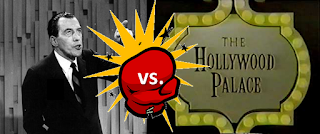
During the 60s, the Ed Sullivan Show and The Hollywood Palace were the premiere variety shows on television. Whenever they appear in TV Guide together, we'll match them up and see who has the best lineup..

Sullivan: Ed's scheduled guests are the Temptations, Oliver, Roy Rogers and Dale Evans, New York City Ballet dancer Jacques d'Amboise, and comedians Scoey Mitchell and Rodney Dangerfield.

Palace: Host Bing Crosby presents Met soprano Mary Costa, Sergio Franchi, the Establishment, singer-dander Leland Palmer, comics Patchett and Tarses, pantomimist MacRonay, and the Kuban Cossicks, folk dancers.

We're in the waning days of this type of big-name variety show; The Hollywood Palace will air its final episode next month (its upcoming cancellation is noted in this week's Teletype), and Ed Sullivan will be off the air by the summer of 1971. From now on, the type of variety show we see will fall back on the comfortable template popularized by stars from Garry Moore to Carol Burnett, Dean Martin, and Glen Campbell: a recurring cast, one or two guest stars, and a mix of musical acts and comedy sketches. Programs like Sullivan and The Palace, with their roots in vaudeville and musical comedy revue, will be a thing of the past, And there's nothing wrong with that; it's getting harder and harder to find a lineup of guests that can appeal to the increasingly diverse viewing audience, to both the rock 'n' roll generation and their parents.

Palace gets off to a strong start, with strong-voiced singers Costa and Franchi, but even with Der Bingle as host, the lineup tails off. Ed doesn't have the strongest lineup himself, but it's consistent, and it runs the gamut from Roy and Dale to Dangerfield to Oliver.  The verdict: comfortably Sullivan.

📺 ðŸ“º ðŸ“º

.Throughout the 60s and early 70s, TV Guide's weekly reviews were written by the witty and acerbic Cleveland Amory. Whenever we get the chance, we'll look at Cleve's latest take on the series of the era. 

I've always thought that My World—And Welcome to It, the William Windom sitcom based on the writings of humorist James Thurber, was a show ahead of its time; people didn't really know what to make of its combination of live action and animation. Now we come to Cleveland Amory, a man who complains often in his reviews about the lack of creativity and imagination on the nation's television screens. Perhaps now we'll be able to determine the truth about My World: misunderstood genius, or pretentious gobbledygook?

The problem, according to Amory—and here, in my use of the word problem, we should have a tipoff to Amory's verdict—is that the witty, light satire of Thurber is a poor match for the heavy-handed unsubtlety of television, with its temptation to take any good idea and do it to death. And indeed, the slapstick humor prevalent in My World not only kills Thurber, "it also kills the whole point of the show." Cleve cites an episode in which John Monroe (Windom), the show's Thurberesque hero, is stuck helping his daughter with her homework. We wind up, says Amory, with "one of themost sophomoric, overdone, tasteless sketches we have ever seen—of a drunken Grant and an idiotic Lee at Appomattox*—and went on from there with an almost equally overdone and unfunny scene when the artist Walter-Mittys up a sexy school teacher."

*Makes you wonder what Amory would have made of The Secret Diary of Desmond Pfeiffer, doesn't it? Actually, I think I already know the answer to that.

This is the kind of thing that plagues every episode of My World that Amory has seen, and that's a shame, for this show has such promise. Did things improve, later on? Did the show begin to find its rhythm, to figure out how to handle Thurber? Hard to say; I don't know that Amory ever voiced any other opinions on it, and My World disappeared after the one season. But for Cleve, it's a downer, because television needs a program whose hero is a grumpy misfit, and unless the show improves, "a fine cast will have labored in vain."

📺 ðŸ“º ðŸ“º

This issue seems to be about endings and beginnings, and nowhere is this more apparent than on Sunday, when we see the last NFL Championship game of its kind, and the last AFL Championship game ever.

At 11:00 a.m. MT on CBS, the Cleveland Browns take on the Minnesota Vikings in Bloomington, Minnesota for the NFL championship. That's not quite the prize it used to be though, not since the advent of the Super Bowl; as the Baltimore Colts found out last year, the NFL title doesn't mean a thing if you lose the Big One. Next season the two leagues will be the first under the NFL-AFL merger, and this game will become the National Football Conference championship. By any name, the Vikings dominate, earning their first Super Bowl birth with a 27-7 victory.

It's not quite the same thing in Oakland at 2:00 p.m. on NBC, where the Raiders will be hosting their archrivals, the Kansas City Chiefs, in the tenth and final AFL championship game. There's always been a keen sense of identity in the underdog AFL, and the Raiders and Chiefs are two of the original eight teams that started out challenging the establishment ten years ago. Even though the Super Bowl is the big game, there's a great deal of pride and honor in being the last AFL champion, and it seems right that it should come down to these two bitter rivals. In a hard-fought battle, the Chiefs—after having lost to the Raiders twice in the regular season—come out on top, 17-7. 

This special commemorative electric football game
honors the final NFL-AFL Super Bowl
Kansas City will beat Minnesota in that Super Bowl, 23-7. For the Vikings, it is the first of four Super Bowl appearances in a span of eight years, all of them losses; it's symmetry that the Chiefs, having lost to Green Bay in the first Super Bowl, now bookend it with a win in the last NFL-AFL showdown. For the Super Bowl, the merger is the beginning of an evolution into not just the biggest sporting event of the year, but a cultural institution—one to which neither the Chiefs nor the Vikings, after that dominant stretch, have returned since.

📺 ðŸ“º ðŸ“º

Endings and beginnings. Rosemary Prinz, who for twelve years starred as Penny Hughes in the CBS soap As the World Turns, makes her return to daytime television as the star of Agnes Nixon's new serial, All My Children, which makes its debut Monday on ABC. The event is heavily hyped in this issue, with ads appearing daily in the listings. Although Prinz only remains with the show for six months (by design), All My Children remains a staple of ABC's daytime schedule until 2011.

Let's see, what else is there? Well, Bob Newhart hosts A Last Laugh at the 60's at 8:00 p.m. Thursday on ABC. It's a look back at the decade in comedy, including a roundtable discussion with Newhart welcomeing Don Adams, Richard Benjamin, Godfrey Cambridge, Buck Henry, and George Schlatter. There are also performances by some of the decade's biggest names, including Carol Burnett, John Byner, Mike Nichols and Elaine May, and Tiny Tim, as well as an appearance by the late Lenny Bruce's daughter, Kitty.

On Friday, CBS enters the made-for-TV movie arena with a story that requires going back to the beginning in order to find out the ending. It's Sole Survivor (7:00 p.m.), based on the 1958 discovery in the Libyan desert of the U.S. bomber "Lady Be Good," which had disappeared in 1943. Vince Edwards and William Shatner are the present-day investigators looking into what caused the crash, and Richard Basehart is the sole survivor, a general with secrets of his own. The Twilight Zone presented its own version of the "Lady Be Good" story in 1960, in "King Nine Will Not Return." You can find out how it all ends by checking Sole Survivor out on YouTube.

Wednesday NBC goes into the past and stays there, as Milburn Stone (Doc in Gunsmoke) hosts the latest Project 20, "The West of Charles Russell." (9:00 p.m.) Russell was one of the greatest Western artists, a friend not only of Will Rogers, but Fred Stone, Milburn Stone's uncle. At left is one of Russell's most famous paintings, "Lewis and Clark Meeting the Flathead Indians," which hangs in the Montana state capitol in Billings. Seeing as how this week's issue is from Montana, I thought including this would be appropriate. Before that, at 8:00 p.m., Alan King hosts the year's first Kraft Music Hall, with guests Michele Lee, Paul Lynde, and David Frye.

Judith Crist gives a rare rave to ABC's Sunday movie presentation of The Naked Prey (7:00 p.m.), produced, directed, and starring Cornell Wilde as a white hunter himself being hunted by African tribesmen. Crist calls it "an extraordinarily exciting chase movie" and "a stunning survival story" that's not for the squeamish.

Finally, the end is coming for The Huntley-Brinkley Report later this year, with the rumored retirement of Chet Huntley. What does NBC have in mind for the beginning of the new era? Well, if Richard K. Doan is to be believed, the favorite to join up with David Brinkley just might be Joe McGinniss, author of The Selling of the President 1968. Frank McGee and John Chancellor are among those on the short list, according to an NBC insider, but "the fact that McGinniss's name is the only new one on the list of replacement candidates seemed to suggest McGinniss might have an inside track." He doesn't have any newscasting experience, but he's become "quite experienced before talk-show cameras, where he has been plugging his book." Now, I've read McGinniss's book, I've read about the reaction to McGinniss's book, I've read about Chet Huntley. I've never, however, read anything to suggest that McGinniss was ever a contender to take over from Huntley, so a note like this is of real interest to me, if only for the curiosity value. As it happens, there was no direct successor to Huntley, per se; NBC first tried a rotating anchor chair with Brinkley, McGee and Chancellor, but after a few months settled on Chancellor as the sole anchor, with McGee taking over The Today Show, and Brinkley offering commentary. Brinkley would return to the anchor chair with Chancellor for three years in the late '70s, and in 1982 Tom Brokaw would take over. I guess this proves that network news can't be anchored by just any old Joe... TV  

September 7, 2016

The future of the sitcom

A couple of weeks ago, at the conclusion of the panel discussion on sitcoms in which I participated, the question came up as to the future of the sitcom. Remember, prior to the appearance of The Cosby Show, the sitcom was thought to be an art form that was dead and buried.  The ratings were dominated by hour-long dramas, and there was a serious question as to whether or not the format could rebound. It did, of course; in the wake of the renaissance triggered by Cosby, it seemed as if every stand-up comedian who'd ever gone to an open-mic night had his or her own sitcom.

Now, however, the pendulum has swung back again. There are maybe three sitcoms in the top 25; the genre once again has been overshadowed by scripted dramas and reality programs, and while the networks haven't stopped trying, many of today's sitcoms are crude, unfunny, or both. New sitcoms have found a home on cable, where the demands are lower and the number of episodes fewer, but the question remains: does the sitcom need to evolve in order to remain a viable television genre?

I addressed this at the very end of the program, and I don't blame you if you didn't sit through the entire show to get to it. You should; it's a very good program, with three intelligent, literate participants plus me, but I understand that it's also a long program, and you might not have time to make it all the way to the end. So I'll paraphrase what I said, and also expand on it a bit.

The long and short of it is that the television sitcom absolutely needs to change if it is going to survive. In discussing the -com part of sitcom, it's often easy to overlook the sit- part of the equation. And if we want to contemplate the future of the sitcom, its ability to attract and retain an audience, that is where we must begin.

The point I made in the program is that sitcoms have always been built around the interactions that occur within groups of people; over time, the groups may have changed, but the situations themselves remain. In the early days of television, those groups were often built along either ethnic (The Goldbergs) or economic (The Honeymooners) demographics. As the baby-boom continued, the relevant group became the family, almost always a family with children (Father Knows Best, Leave it to Beaver, Ozzie and Harriet, The Donna Reed Show). The mother stayed at home in these families, and though the father had a job, that was seldom if ever shown.

That would change when the focus of the sitcom incorporated the workplace as well as (or instead of) home, first with The Phil Silvers Show, which was set on a military base, but most famously with The Dick Van Dyke Show, where Rob Petrie's co-workers were as important to the plot as Laura and Richie. This would continue in series from Barney Miller, where the office was a precinct house, to Hogan's Heroes, where it was a prisoner-of-war camp, to Room 222, where it was a school. The Mary Tyler Moore Show was built around a television station, but with a twist; as single women became more prevalent in the workplace, and as the birthrate shrank, we saw that a single woman and her single friends could form the basis of a situation, as could a married couple with no children (The Bob Newhart Show).

Eventually, the family was redefined, as it was in American society, and in a show like Cheers the group of regulars at the bar became a sort of family of misfits, while Friends and Seinfeld showcased a group of, well, friends, that had willingly chosen to share their lives together. The families that remained were either blended ones (The Brady Bunch, Two-and-a-Half Men) or dysfunctional (Married...With Children).  And, of course, there was overlap, as many series incorporated two or more of these situations into their premise.

My point here is not a recitation of the history of the sitcom; rather, what I'm saying here is that the situation in a sitcom depends on that group of people, and in the individualistic, social-media-dominated society in which we live today, actual groups of people are becoming less and less common. More people are working or going to school online, more and more our friends are the ones we have on Facebook and Twitter. We can watch and listen to whatever we want whenever we want, which means there are fewer and fewer shared experiences, hence fewer and fewer interactions within groups. And without groups, I'd contend, you can't have a sitcom.

Look at the most popular programs on television today: most of them are either police procedurals (and their spinoffs), where a face-to-face workplace is required, or reality programs, in which an artificial family - but a family nonetheless - is created. Even when computer and/or social media experts are involved, it's a group of them, which gives the viewing audience their traditional group.

The disappearance of these groups isn't complete; it hasn't all happened at once, nor will it. These trends are only going to continue, however, which means the sitcom is going to have to evolve to incorporate them. After all, a series based on a group that, in real life, is exceedingly uncommon, is going to be hard for an audience to identify with, especially when they're sitting alone in their apartments watching on their laptops or iPads.

Let's not forget that sitcoms exist to entertain. Even dramedies, a genre I'm not inclined to favor, still have to be funny occasionally. And I'm not sure how entertaining it's going to be to watch characters swap emoticons, or trade texts, or sit around sharing memories on Skype. Talk about a static form of television!* Does this mean that future sitcoms will be built less around groups of people, that the situations depicted are going to have to undergo a radical transformation? And if that is the case, what will the new situation be? How will the writers illustrate it? Or will it be the look that changes, as screens are divided to show five or six people at the same time, all participating from different places, with on-screen text co-existing with the spoken word? Could we see a truly interactive sitcom, in which several characters are fully scripted and fleshed out, but giving the viewer the choice of which characters' plots to follow? These are radical redefinitions of what the contemporary sitcom looks like, but some current shows (Broad Street) already incorporate aspects of it. Can the sitcom survive without such a redefinition?

*It is, ironically, a far better situation for books and graphic stories, which require what is supposed to be the dying art of reading; it's much easier to depict social media in a book than on a television screen.

The major point here is that television, no matter how much influence it has in society, is not going to be able to dictate the terms of the situation comedy of the future. It will only be able to react, as is usually the case. It will be society, and not television, that defines how people interact, and what kinds of groups are formed. The success of the sitcom future will depend entirely on how well television is able to capture the new reality of human interaction, and how successful it is at making that an entertainment that people will want to watch.

January 25, 2014

This week in TV Guide: January 29, 1966

I'm generally not one to make hay of other people's misfortunes, but there's a line in Robert De Roos' cover story profile of Pat Crowley that shouts out for contextualization.

The actress, currently starring with Mark Miller in NBC's Please Don't Eat the Daisies, is talking about her marriage to attorney Ed Hookstratten.  De Roos asks her if the marriage, now eight years long, will last now that she's working on a weekly series.  "It sure is," she tells him.  "We are Catholics and there is a little solidity there."

That sounded like such a refreshing attitude to me that I immediately went to Google, to find that the Hookstrattens had divorced sometime in the 70s or 80s - Crowley remarried in 1986, to producer Andy Friendly.*

*Fun fact: Andy Friendly's father is legendary TV newsman Fred Friendly; his brother, David Friendly, was nominated for an Oscar in 2006 as producer of Little Miss Sunshine.

I hasten to say here that I have no knowledge of why Crowley and Hookstratten divorced, and I don't want to play either a pop psychologist, a pop marriage counselor, or a pop theologian.  But one of the many tragedies of the Catholic Church in the latter half of the 20th Century - particularly the post-Vatican II turmoil, which reached a peak in 1968 with Paul VI's encyclical Humanae Vitae - is the breakdown of basic Catholic beliefs.  By the late 60s, Catholic doctrine had become a smorgasbord; if you didn't like what one priest had to say on birth control, for example, you could shop around and find a priest who would readily sanction it.  Similar situations existed for everything from premarital sex to divorce and remarriage to a whole host of previous elements of Catholic teaching that had rarely been questioned.  Inevitably, this kind of confusion among the faithful led many to doubt the Church's sincerity, authority, - what have you.  Bottom line: no solidity.

Again, I have no reason to think that this might have had any role to play in Pat Crowley's divorce from Ed Hookstratten. But I do think it's part of this blog's narrative to fit these kinds of things into the larger cultural environment.  The 60s were already a period of flux by now, and they were headed toward even more cataclysmic change. Understanding the climate of the times (even though the insufficient space here hardly scratches the surface) puts little moments like this into some sense of context.  It even adds, I think, a note of poignancy.

*Hookstratten, Elvis Presley's personal attorney, represented The King in his divorce from Priscilla, which certainly suggests mixed feelings regarding divorce.  


***

During the 60s, the Ed Sullivan Show and The Hollywood Palace were the premiere variety shows on television. Whenever they appear in TV Guide together, we'll match them up and see who has the best lineup..

Sullivan: Scheduled guests: Dinah Shore; puppet Topo Gigio; comic Jackie Vernon; the rock'n' rolling Four Tops; Les Feux Follets, Canadian folk dancers; guitarist José Feliciano; comic Dick Capri; Markworth and Mayana, trick bow-and-arrow act; and Army sergeant Barry Sadler, who sings "The Ballad of the Green Berets."  In a special film segment, Sir Laurence Olivier is seen in excerpts from his film of Shakespeare's "Othello."
  
Palace: Host Arthur Godfrey presents comedian Sid Caesar; singer Abbe Lane; The Mamas and the Papas, rock 'n' roll group; comic Corbett Monica; the Berosinis, Czechoslovakian acrobats; and Les Apollos, balancing act.

I like Dinah, and you can't beat Olivier doing Shakespeare (nor the beat of "The Ballad of the Green Berets"), but I think Abbe Lane and Sid Caesar, with a little help from The Old Redhead, are enough to push Palace over the finish line first this week.

Now, if you lived in LaCrosse, Wisconsin and were so inclined to tune to WKBT, Channel 8 (the NBC affiliate), you would have been able to catch last week's episode of Palace at 10:30pm on Tuesday night*. Let's see if that might have made for a better show:

*Since Western Wisconsin lacked an ABC affiliate at the time.

Palace (from last week):  Fred Astaire hosts this night at the Palace making a rare TV appearance with dancer Barrie Chase.  Guests include Mickey Rooney and his nightclub partner Bobby Van; British singer Petula Clark; the Nitwits, musical cutups; the Lenz Chimps; and comedian Ray Hastings.

Yes.  It definitely did make for a better show. See?


***

In the early days of this blog, I did a piece on the short-lived Sammy Davis, Jr. Show, which featured the oddity of its star having to sit out nearly a month's worth of shows immediately following the premiere due to a no-compete clause.  Seems that Sammy had done a special for ABC, and the terms of that contract prohibited him from appearing on any other network for the three weeks immediately preceding the show. The Sammy Davis, Jr. show was on NBC.  You can, of course, see the problems coming a mile away.

SOURCE: HADLEY TV GUIDE COLLECTION
Well, this is the week that Sammy and His Friends, the ABC special in question, airs, and he hangs out with a pretty cool bunch of people: Frank Sinatra, Count Basie, Edie Adams and Joey Heatherton.  It's on Tuesday night at 7:30pm ET, up against Red Skelton on CBS (with guests George Gobel and The Hollies) and Dr. Kildare on NBC.*  As for Sammy's own show, it airs its fourth episode on Friday night, the third to feature a guest host - this week, Jerry Lewis, who welcomes Peggy Lee, the comic Weire Brothers, singer Danny Costello, and The Skylarks.  Debuting your own show and then having to follow it up with three weeks' worth of guest hosts doesn't seem to me to be a successful formula.  I said it in my earlier article and I'll say it again here - what a strange, strange situation.

*I wonder how NBC felt about all this?  On the one hand, a ratings win for Sammy might well have boded well for the ratings on his NBC series; on the other, the network would probably have wanted to see Kildare beat Red.  Should such an absurd thing happen nowadays, I wonder if the network would consider airing a Kildare rerun?


***

Sammy's show probably didn't stand much of a chance anyway - it's opposition was Hogan's Heroes and Gomer Pyle on CBS, The Addams Family and Honey West on ABC.  But later on that Friday night, we'll see another oddity: Garry Moore on a network other than CBS.

Moore had been a fixture on the network since his radio show debuted in 1949; from 1950 on he'd had both morning and evening variety programs, as well as his long-running emcee duties on I've Got a Secret.  But Moore's prime-time show had been cancelled by the network in 1964, after which he'd left Secret and the network.  Now, a year and a half later, Moore's ready to come back.  There's only one problem - CBS, to whom he's still under contract, doesn't want him.  Or, to be precise, they don't want what he has to offer.

Moore acknowledges that the variety format he'd been so successful with has seen better days, and he's ready for something new and different.  He thought he'd found the answer when CBS news chief Fred Friendly approached him about working on some public affairs programs, but the network's policy forbade entertainers from working in news or public affairs.  In later years, Moore will talk with TV Guide about his desire to move into news and "people" programming, even becoming a news reporter, and his immense frustration at CBS' reluctance to see him in that light.  You can see the seeds of that disappointment here, as Moore chafes at being paid "to sit around and do nothing."  His exclusive contract with CBS, which prevents him from doing a series for any other network and requires him to give CBS first refusal on any one-shot special, still has nine years to run. He's asked the network to release him from the contract, but they refuse to do so.  His only recourse is to sue, an option he says he'd consider.

In the meantime, an agency came up with an idea right up Moore's alley.  Garry Moore's People Poll, a special in which he gets to travel around the country interviewing ordinary people and asking them basic questions: Do you kiss your wife when you get up in the morning?  Are you stricter than your own parents?  Are you satisfied with your life - and what changes would you make if you could start over? Things like that.  Per the provisions of the contract, the show is first offered to CBS, which turns it down.  So he turned elsewhere.  "We were delighted," Moore says, "to find a more flexible policy at ABC."

Earlier in the article, Moore mentions a project he and Jay Ward are working on for CBS, a comedy-variety program.  It debuts in the fall, and is quickly wiped out by Bonanza.  Moore will eventually come back to regular television as host of the syndicated To Tell the Truth (with CBS' approval) in 1969, and will host it until 1977, after which, suffering from throat cancer, he'll retire for good, dying in 1993.

Here's footage from Moore's final appearance on To Tell the Truth in 1977.

***

Some classy programming this week, the kind you'd never see today:  Sir John Gielgud stars in part two of Ages of Man, in which he gives dramatic readings from Shakespeare's works.  It runs for an hour on CBS, which split the original two-hour version of Gielgud's one-man Broadway show into two parts and broadcast them on Sunday afternoons, because they worried that viewers wouldn't be able to sit still long enough to listen to a longer show, and wouldn't tune in if it were on prime-time.  At least they showed it at all - I doubt they would today.  If you're curious about what kind of show it was, here's a brief excerpt:


If you liked that, you can get the whole program (both hours) here.

And on Thursday night, NBC reminds us of what Hallmark Hall of Fame used to be before it became home to tear-jerking sentimental chick flicks, when they present a rerun of "The Magnificent Yankee," a biography of the Washington years of Supreme Count justice Oliver Wendell Holmes starring the husband-and-wife team of Alfred Lunt and Lynn Fontanne, two of the greats of the theater.  "The Magnificent Yankee" won five Emmy awards when it was originally broadcast, including Best Actor (Lunt), Best Actress (Fontanne) and Best Drama.

SOURCE: HADLEY TV GUIDE COLLECTION
Oh, and one of the co-hosts of the 1965 Emmy Awards show?  Sammy Davis, Jr.

***

John Schneider, president of CBS, had this to say at the recent convention of the Association of National Advertisers:
By 1975 virtually every television home in the United States will be capable of receiving programming from six times as many sources as today!. . .
By 1975 it looks as if three out of four homes will own at least two sets. . . No longer will every member of the family be forced to look at the same program.  Viewing will become fractionalized and selective. . . 
The teen-ager, the intellectual, the tired businessman, the housewife - each will be able to tune in the particular kind of entertainment, information, music or discussion that suits his or her respective desires.

Now, I don't know how things were by 1975, but his predictions become very interesting when viewed in light of today's cultural norms.  For example, every home today has at least six times as many programming sources, but Schneider couldn't have anticipated how they would shake out.  Streaming video on laptops, tablets, iPhones, Roku; original programming on services like Netflix that mean you don't even have to have access to conventional television broadcasting; DVDs and DVRs that enable viewers to watch an entire season of a series over a weekend,even if that series is 50 years old - it has, indeed, resulted in fractionalized viewing.

But even more, technology has forever changed the impact of television viewing.  Because people can watch whatever they want whenever they want, the shared experience of watching television has virtually disappeared, except for the Super Bowl.  Schneider did indeed foresee this kind of individual viewing, with the concurrent result that programs no longer had to appeal to a broad audience, but could he have predicted the kind of Balkanization that resulted?

TV Guide's editors wonder about this vision of the future.  They look at the current state of television in Los Angeles, where numerous multi-TV homes and ten stations have merely produced programming "given over to hundreds of old movies and old TV series."  And isn't that what we have today?  I've made this complaint before (as have others) so I won't belabor the point, but who can tell TNT from TBS from USA from Cloo from Bravo from Hallmark? What's the difference between A&E and History and TLC and Discovery?

Reality programming of one kind or another dominates networks as diverse as HGTV and TruTV.  MTV is all about lifestyle, and ESPN spends half their broadcasting day with editions of SportsCenter.  Cultural programming, which used to be seen at least occasionally on some of these networks, is all but gone.  And overnight hours (on both cable and OTA stations) is dominated by informercials and replays of previously broadcast shows.  Is this really what the future was supposed to give us?

The editors compare Schneider's view of TV's future to the state of radio in 1966, "which long since has become fractionalized (several sets per home) and selective (there's a choice of many stations everywhere).  In most areas these days, once you've heard the news, radio offers records, talking disc jockeys and very little else."  Is TV today any more diverse than that?

TV Guide's conclusion was this:  "Improvement and variety in programming will not just happen in television any more than they happened in radio.  There must be planning.  There must be direction.  So far we have neither."  I'll end by asking the question: is there any evidence that television executives are doing any planning today?  Or are they simply waiting for things to happen? TV 

October 3, 2013

Around the dial

We're running a little behind this week, but I did want to take time to highlight a couple of interesting pieces from the week.

At the Onion A/V Club, Dennis Perkins asks whether specialty networks are beyond redemption.  I can remember when channels such as History, HGTV, A&E and other "niche" networks started up.  There was something dependable about them - the idea that you could turn to them at any time and not only know what you were getting, but have a pretty good chance of really liking what you were seeing.  (I never minded the Hitler documentaries that The History Channel had., but their series of "As It Happened" replays of original television news coverage was outstanding.)  I suppose it was inevitable that they'd run out of material (after all, how many biographies are there really worth watching?), but to look at what's happened to Bravo, Sci-Fi (or Syfy, for the stupid out there), and MTV, or to see how general cable networks like TBS and USA have turned into clearinghouses for binge police procedural watching - well, they're living and breathing advertisements for cutting the cord, aren't they?

Comfort TV takes a look at how TV shows of the past portrayed the future.  I think this is always entertaining, as these old shows never seem to get it quite right - they either dramatically overestimate or grossly underestimate the leaps and bounds that technology makes, often within the same series.  Take Star Trek for example - cheesy digital control board combined with warp speed and transporters.  It's probably a testament to the greatness of human creativity that technological advances multiply and morph exponentially, at a far greater clip than the mind can even comprehend.

Sorry for the brevity this week - sometimes it happens!  I'll make up for it on Saturday with a brand new TV Guide! TV  

June 12, 2013

The kitchen of the future

We spend a lot of time looking back at the past in an effort to understand it, but it can be just as enlightening to consider how the past viewed the future.  Does our present look anything like the future that was imagined in the past?

For example, the computers in Star Trek look laughably primitive when compared to the technology of today (which is probably one reason why the remastered versions of the series have upgraded special effects).  In fact, today's technology has far surpassed what Gene Roddenberry & company imagined - there's probably more power in an iPhone than there was running the Enterprise.  Sometimes it seems as if we're afraid to let our imaginations truly run wild and imagine the possibilities.  On the other hand, we still don't have the flying cars from The Jetsons.

Before pro football completely took over Sunday afternoons, CBS had a long-running documentary series called The 20th Century, which took a look back at the major historical events of the century.  In January 1967 the show changed both its title and focus; renamed The 21st Century, the program now looked forward to what the future might have in store.

In that light, I'm reminded of David Gelenter's book 1939: The Lost World of the Fair, in which Gelenter reminds us that much of the scientific progress on display at the 1939 World's Fair was designed for one purpose: to make our lives easier.  Not that there weren't world-altering inventions on display, but we shouldn't underestimate the importance attached to such technological marvels as the washer and dryer or the refrigerator.  We may take them for granted now, but these were major accomplishments.

With that in mind, let's take a look at this episode of The 21st Century from March 1967, in which Walter Cronkite hosted this preview of the kitchen in the year 2001.  How much do you think they got right?