


His article consists of excerpts from a recent speech he gave to National Educational Television affiliates. "He expected to be lynched by his audience," the introduction says, but instead, he "was asked to become consultant to the president of the National Educational Television network." And he says right from the start that he has no complaints with the daytime, classroom-oriented programs that local stations air; it's the evening programming that bothers him. "It's one thing to reach intellectuals and TV snobs, like me, and the 'upward with the arts' crowd who couldn't wait for the educational channel to get under way in their city." However, and this has been the knock against public television for a long time, "how about going out of your way to reach the average person who would go for better evening's worth of TV in a minute, but doesn't even understand the meaning of the term 'Educational Television.'"
It seems to Freberg that "ETV doesn't really make an effort to reach thes people, choosing instead to reach out to the intellectuals, and then writes it off by saying, 'Well, that's not our audience anyhow.' We don't want to reach 'the mass.'" But, he points out, where would Christianity be today if all the church ever did was look for people who already shared their beliefs, instead of seeking out those who were looking for something in which to believe? (That's a lesson, by the way, that most internet pundits could take to heart.)

So educational television is plagued by apathy (the viewer) and lack of creativity (the stations). He notes also that most educational stations are on the UHF dial (if you're old like me, you'll understand that), and ETV has to convince people why they should spend 50 bucks to buy a UHF converter. That brings us to the fourth challenge: can educational television produce anything entertaining, or will it choose to remain in its academic ivory tower? "I must report that the program my wife and I watched the other night, in prime time—an explanation of the human nervous system, showing each individual vein and nerve fiber—was, shall I say, only semigripping." In the end, they were, somehow, glad: "glad it wasn't in color." He's sure, though, that some people found it gripping: "My doctor. . . the man who was narrating it. . . his doctor."
Freberg stresses he's not against this kind of television, but it has to be balanced by programming that has a wider reach. A few years ago I recall one of television's critics pointing out that you can't survive on dessert; you have to have veggies as well. ETV, Freberg seems to be saying, has the opposite problem: it can't survive on veggies alone. "You're so worried about your special-interest audiences—and so concerned lest you stoop down to the mass, and so 'Educational' with a capital E, that you're getting hung up on your own image."
I wonder what Stan Freberg would think of PBS today? It seems to me they might have taken his suggestions a little too much to heart. Look at the state of educational television—I mean, public broadcasting—today. Arts programming, which was a major part of what ETV supporters envisioned all those years back, is virtually non-existent. The endless pledge breaks seem to be geared almost entirely to boomers, with nonstop showings of Suze Orman, Dr. Wayne Dyer, and refugees from the seniors rock tour. Even shows with an educational background often seem to have as much glitz and celebrity as they do facts.
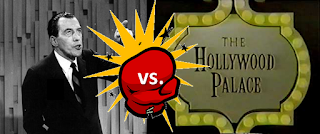 During the 60s, the Ed Sullivan Show and The Hollywood Palace were the premiere variety shows on television. Whenever they appear in TV Guide together, we'll match them up and see who has the best lineup..
Sullivan: Ed's guests this week are Tony Bennett; puppet Topo Gigio; rock 'n' rollers Billy J. Kramer and the Dakotas; comic Jackie Vernon; the singing Kim Sisters; magician Johnny Hart; the two Carmenas, acrobats*; and Africa's Djolimba song and drum ensemble.
*My wife, upon hearing this lineup, suggested that the two Carmenas would be followed by the two Buranas. If you don't get it, look it up.
Palace: Host David Janssen introduces vocalists Edie Adams and Vic Damone; comedians Carl Reiner and Mel Brooks; Les Surfs, a singing group from Madagascar; the Harlem Globetrotters; Tim Conway; the knife-throwing Zeros*; and the Princess Tajana trapeze act.
*Let's hope that refers to the number of errant throws they make.
Actually, we're cheating a little here, since Hollywood Palace is preempted this week by football (more about that in a minute). The episode we've got is last week's, as it appears on WKBT, Channel 8 in LaCrosse, Wisconsin, a CBS affiliate that also dabbles in that wacky cross-affiliate programming. They air Palace on Tuesday night at 10:30 p.m., right after your late edition of the local news, but we don't care, do we? We're talking about this week in TV Guide, so it counts.
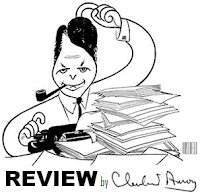 Throughout the 60s and early 70s, TV Guide's weekly reviews were written by the witty and acerbic Cleveland Amory. Whenever we get the chance, we'll look at Cleve's latest take on the shows of the era.
That's not the only sports on Saturday, though; in fact, the day gets off to an early start with the Irish Sweeps Derby horse race (8:45 a.m., ABC), live via Early Bird satellite from Dublin, with Jim McKay and Irish sports announcer Michael O'Hehir providing the call. It's not unprecedented for ABC to provide Saturday morning sports coverage from overseas (the 24 Hours of Le Mans and the British Open, for example). The Early Bird, quite famous at the time, was launched in April, leading me to suspect ABC is covering the Derby not just because it's a big race, but because they can. Lending credence to this theory is a mention in "For the Record" that Comsat is set to start collecting fees for the use of the Early Bird, ending the free run that had existed prior to then. By the way, the Derby was won by Meadow Court, partly owned by Bing Crosby. I'm surprised a tape of the race wasn't found in his basement.
Also on Saturday night, it's Secret Agent (8:00 p.m., CBS), the precursor to The Prisoner, starring Patrick McGoohan as John Drake, the man who may or may not be Number 6. (In England, the show is known by the name Danger Man.*) This week's episode, "Whatever Happened to George Foster?", doesn't play into the Prisoner theme in the way that some other episodes do, but it's a strong one in its own right. And speaking of familiar faces in unfamiliar roles, isn't that Bernard Lee playing the heavy? You know, "M"—as in the James Bond movies? Glad he finally turned away from his life of crime.
*Admit it though, Johnny Rivers singing Secret Agent is way cooler than the original theme.
Way back when, I wrote about The Rogues, the clever, humorous series about a family of thieves (Gig Young, David Niven and Charles Boyer, with Gladys Cooper and Robert Coote) embarking on delightful scams of people who deserve to be scammed. Sunday night's episode (9:00 p.m., NBC), "The Boston Money Party," features Young's character (the three stars rotated turns as leads) "posing as the owner of a New England textile plant, to trap Paul Mannix, the 'wolf' of Wall Street." (J.D. Cannon, not to be confused with Leonardo DiCaprio) An attraction of this episode: it's written by William Link and Richard Levenson, the creators of Columbo and countless other clever shows.
 Monday, CBS presents It's What's Happening, Baby! (8:30 p.m.), a public-service announcement disguised as a variety show. Listed as a "Teen-Age Special," What's Happening is "designed to acquaint teen-agers with the work of the U.S. Office of Economic Opportunities" (TV was filled with do-gooder shows like this back then), and is hosted by New York DJ Murray the K, The guests, all of whom appeared without pay, include Bill Cosby, Johnny Mathis, Ray Charles ►, Dionne Warwick, Herman's Hermits, the Dave Clark Five, Tom Jones, the Supremes, Marth and the Vandelias, Jan and Dean, and Mary Wells. It runs for 90 minutes, and needs every one of them. (And guess what? It's made its way to PBS! Look for it during pledge break season!)
 Fred Astaire has essentially retired from Hollywood a few years ago, limiting his appearances to rare (and critically acclaimed) variety specials, but he and his current partner Barrie Chase are back this week in a comedy on NBC's Bob Hope Presents the Chrysler Theatre called "Think Pretty." (Friday, 7:30 p.m., NBC) "Record company owners Fred Addams* [played by you-know-who] wants to win over female talent manager Tony Franklin—he's trying to sign one of her clients to a recording contract." Fred and Barrie do a few dances, and Fred sings the title song. Nice.
*I wonder—since this was up directly against ABC's The Addams Family, did they perhaps spell Fred's character's last name that way on purpose?
 This week's starlet is "well-designed" Janine Gray, the 25-year old British actress currently making her way through various TV appearances in search of stardom. Though she's only had a "fistful" of roles so far, "It really is a marvelous time for English girls," she says, thanks to the impact of Julie Andrews. "Julie broke all the rules, you see. Though attractive, she's not conventionally beautiful. She has sex appeal, but mainly she's a lady."*
*Cue Tom Jones.
Among her credits to this point are appearances in The Man from U.N.C.L.E., 12 O'clock High and The Alfred Hitchcock Hour. Quinn Martin says "She has an interesting talent to go with those lovely looks." While she's a newcomer to the U.S. scene, though, she's had considerable experience in England, including a stint as emcee on a Shindig-like show called Six-Five Special and a number of dramatic roles. And between jobs, she was a cab driver. (Oh, and we shouldn't forget her near-nude role in The Americanization of Emily.)
She has upcoming roles in The Bob Hope Show and the "new comedy series" Get Smart! And she remains steadily in credits through the end of the Sixties, when her IMDb list pretty much runs out. Not a bad career, though—certainly better than mine. According to the always-reliable Wikipedia, she now lives with her husband in Cape Town, South Africa.
As it turns out, a very funny letter to the editor from Arthur Joel Katz, former producer of The Doctors and the Nurses, suggests (likely tongue-in-cheek) that he proposed just such an idea. "A one-armed man comes into the hospital, confesses to Zina [Bethune, one of the nurses] that he killed David Janssen's wife, and dies. The police broadcast the news, but Janssen suspects a trap and doesn't believe it. Thereafter, Zina sets out in search of David, but at every town she gets off the back of the bus just as David gets on the front. The only trouble with this story is that I couldn't sell it to the writers. Thus The Fugitive continues his adventures in oblivion, while we just fade into it." TV
I'd love to hear what he had to say.
t t t
 During the 60s, the Ed Sullivan Show and The Hollywood Palace were the premiere variety shows on television. Whenever they appear in TV Guide together, we'll match them up and see who has the best lineup..
Sullivan: Ed's guests this week are Tony Bennett; puppet Topo Gigio; rock 'n' rollers Billy J. Kramer and the Dakotas; comic Jackie Vernon; the singing Kim Sisters; magician Johnny Hart; the two Carmenas, acrobats*; and Africa's Djolimba song and drum ensemble.
*My wife, upon hearing this lineup, suggested that the two Carmenas would be followed by the two Buranas. If you don't get it, look it up.
Palace: Host David Janssen introduces vocalists Edie Adams and Vic Damone; comedians Carl Reiner and Mel Brooks; Les Surfs, a singing group from Madagascar; the Harlem Globetrotters; Tim Conway; the knife-throwing Zeros*; and the Princess Tajana trapeze act.
*Let's hope that refers to the number of errant throws they make.
Actually, we're cheating a little here, since Hollywood Palace is preempted this week by football (more about that in a minute). The episode we've got is last week's, as it appears on WKBT, Channel 8 in LaCrosse, Wisconsin, a CBS affiliate that also dabbles in that wacky cross-affiliate programming. They air Palace on Tuesday night at 10:30 p.m., right after your late edition of the local news, but we don't care, do we? We're talking about this week in TV Guide, so it counts.
Now, I'll admit that when it comes to variety show hosts, David Janssen is not the first name that comes to mind. However, the producers have surrounded him with a very strong cast, especially the wonderful Edie Adams and Carl Reiner and Mel Brooks, and Janssen's up for it in a skit where his team of "Hollywood Dribblers" take on the Globetrotters.
Ed has Tony Bennett, and while that's not nothing, it's not enough. This week it's the Palace in a slam dunk.
t t t

We're in the age of Peyton Place, the first great primetime soap opera, which ABC airs twice a week. As you might expect, with Peyton Place a hit, now everyone wants one, and CBS's version is called Our Private World, which is also on twice a week. It's not exactly like the ABC drama, though; for one thing, Peyton Place is based on a best-selling novel, while Our Private World is a spin-off, or at least a nighttime version, of the top-rated daytime soap As the World Turns, and even has Eileen Fulton reprise her daytime role as Lisa Hughes, newly moved to Chicago to start over after a divorce. (She'd boarded the train for Chicago in her last episode on the daytime show, and arrives as Our Private World begins. After its cancellation, she'd return to As the World Turns.)
Be that as it may, though, Cleveland Amory warns that if you're looking for something deep to come out of this series, you're looking in the wrong place. "In fact, if it weren't for repeating everything twice, we don't think they'd be on twice a week." Take, for instance, the following piece of dialogue, which I repeat because it makes the point far better than I could: "All the man said was, 'Can I help?' And do you know what I wanted to do? I wanted to murder him. Becuase he couldn't help. Does that make sense? 'Can I help you?' That's all he said. And I hate him." Now, that kind of dialogue might work for Samuel Beckett or Harold Pinter, but it does not work in a soap opera.
Anyway, Cleve cites several other examples pointing to the pointlessness of Our Private World, and the quality, or lack thereof, but again, I'm going to defer to his exact words to give you an idea of what he really thinks. For a man who delights in clever word play, he's pretty blunt: "Altogether it is the first show we've seen in a long time where literally nothing is good—the idea, the producing, the writing or the directing. As for the acting, it has to be seen to be believed—and, believe us, it shouldn't be. The girls are bad and the boys are worse." He concedes two things, though: one, that it makes Peyton Place look good; and two, that the title, Our Perfect World, is perfect: "The mistake was in making it public."
t t t
That football game I mentioned earlier is the Coaches All-America college football game, live from Buffalo. (Saturday, 8:30 p.m. CT, ABC) This is one of the more unusual post-season all-star games, coming as it does more than five months after the end of the college football season, the last opportunity for many of these players to be seen before they enter the NFL. (Unless they're in next month's College All-Star game, which pits an all-star team against the defending NFL champions.) For football fans, though, the game is a treat, a much-needed antidote to the endless stream of baseball throughout the summer, and a signal that football season is just around the corner. And besides, with Curt Gowdy and Kyle Rote on hand to announce, it has to be a big game, right? Among the stars in this year's edition are a trio of immortals: Gale Sayers, Dick Butkus and Roger Staubach; plus Brian Piccolo, Craig Morton, and Marty Schottenheimer.
 |
| Bing takes home the prize |
t t t
*Admit it though, Johnny Rivers singing Secret Agent is way cooler than the original theme.
Way back when, I wrote about The Rogues, the clever, humorous series about a family of thieves (Gig Young, David Niven and Charles Boyer, with Gladys Cooper and Robert Coote) embarking on delightful scams of people who deserve to be scammed. Sunday night's episode (9:00 p.m., NBC), "The Boston Money Party," features Young's character (the three stars rotated turns as leads) "posing as the owner of a New England textile plant, to trap Paul Mannix, the 'wolf' of Wall Street." (J.D. Cannon, not to be confused with Leonardo DiCaprio) An attraction of this episode: it's written by William Link and Richard Levenson, the creators of Columbo and countless other clever shows.

I think we all enjoy running into well-known actors in these old issues, and Tuesday is quite the night for guest stars: Celeste Holm and Ed Asner on Mr. Novak (6:30 p.m., NBC), Robert Duvall on Combat! (6:30 p.m., ABC), Lloyd Bridges on Cloak of Mystery (8:00 p.m, NBC), Nick Adams, Edgar Bergen, Gale Storm, Debra Paget, and Marie Wilson on Burke's Law (9:00 p.m., KDAL), and Pat Hingle, Dabney Coleman, Tom Skerritt, and Burt Mustin on The Fugitive (9:00 p.m., ABC). Some were already well-known, some would become far better-known. All of them were on TV Tuesday night. Did we appreciate it?
And speaking of guests, on Wednesday CBS brings the Lucy-Desi Comedy Hour back for a summer run of 11 episodes. Lucy-Desi began as a series of specials during the 1957-58 seasons and continued through 1960, with a grand total of 13 episodes; this is the fourth time that the network has aired the series as a summer replacement. (It will return one more time, in 1967, as the last black-and-white series to be run on the network. Tonight, Danny Thomas and his TV family are guests. (9:00 p.m.)
We're still three seaasons from the premiere of Hawaii Five-0, but we still have a double-dose of Jack Lord this week. First, on a Dr. Kildare rerun (Thursday, 7:30 p.m., NBC), Lord plays a doctor who fears rheumatoid arthritis may end his surgical career, just as it once ended his professional football career. I'll bet we get Jack in full-on bitter mode here. Question for any of you doctors out there, though: if his character had rheumatoid arthritis as a young man, bad enough that it stopped him from playing football, how was he ever able to become a surgeon in the first place? I'm no doctor, I'm just wondering. Later in the week, Jack's back in an episode of his very good modern-day cowboy series Stoney Burke, which I wrote about in this space just last week (Friday, 10:15 p.m., KDAL). In this episode, a rodeo colleague of Stoney's is killed while riding a Brahma bull. How does Stoney figure into it? We'll find out.

*I wonder—since this was up directly against ABC's The Addams Family, did they perhaps spell Fred's character's last name that way on purpose?
t t t

t t t
The CBS drama The Nurses, starring Shirl Conway and Zina Bethune, debuted in 1962, and continued for two seasons before Joseph Campanella and Michael Tolan were brought in as doctors, to increase the dramatic possibilities. Accordingly, the show's title was changed to The Doctors and the Nurses, but none of it helped, as the show was scheduled opposite ABC's new hit series The Fugitive. and disappeared after its third season.*
*Only to return as a daytime soap opera, under it's original name of The Nurses. It was shown, ironically, on ABC.
Anyway, in a TV Guide article earlier in June, the humorist Art Buchwald wrote about how The Doctors and the Nurses could have survived against The Fugitive. His suggestion, as you can see here, was that a man would be brought to the Doctors/Nurses emergency room, "and as one of the doctors took the sheet off him, the audience would discover he had one arm. Just before he dies on the operating table he would gasp, "I am the one-armed man the Fugitive is looking for. Richard Kimble is innocent and I killed his wife."
As it turns out, a very funny letter to the editor from Arthur Joel Katz, former producer of The Doctors and the Nurses, suggests (likely tongue-in-cheek) that he proposed just such an idea. "A one-armed man comes into the hospital, confesses to Zina [Bethune, one of the nurses] that he killed David Janssen's wife, and dies. The police broadcast the news, but Janssen suspects a trap and doesn't believe it. Thereafter, Zina sets out in search of David, but at every town she gets off the back of the bus just as David gets on the front. The only trouble with this story is that I couldn't sell it to the writers. Thus The Fugitive continues his adventures in oblivion, while we just fade into it." TV


