



This is not one of those stories. Instead, it's the case of an article in a recent issue of TV Guide about television's race for ratings. At the bottom of the page was a coupon that asked, perhaps rhetorically, "Which are your favorite shows?" As the editors note, "There was no poll or contest intended, and we offered no prizes or other inducements to send in the coupons. As a matter of fact, we buried the thing at the bottom of a page because we were, quite frankly, curious to see just how much trouble viewers would take to make their program likes known."
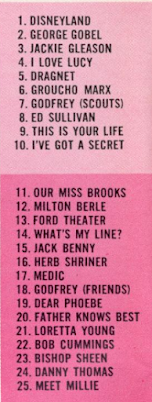 As it turns out, "despite the lack of fanfare or bonuses," more than 45,000 people took the time to fill out the coupons, address envelopes, lick stamps, and send them in. (A number that, they note, is larger than the population of New Brunswick, New Jersey.) You can see the results of that at left.
There are some interesting aspects to this poll. For one thing, the top two shows—Disneyland and The George Gobel Show—are in their first season. At the time of the non-contest, they'd been on the air for less than five months, meaning there was an instant identification from the viewers.
 Dan Jenkins's Hollywood Teletype has the lowdown on Warner Bros. and their "all-out bid for TV supremacy among the major studios." They're launching four new series on ABC next season: Casablanca, Kings Row, and Cheyenne, all under the umbrella title Warner Brothers Presents. (A fourth, Men in the Sky, appears nowhere on the schedule—at least not under that title.) All three of the shows are based on successful Warners movies, but the only one that survives is Cheyenne, which sends an important message to Warners: rather than spinning off movies to television, it will be more profitable to develop original titles. Even if they are derivative.*
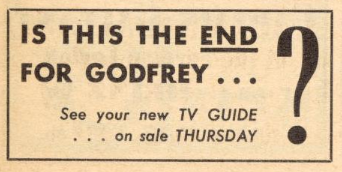 I want to stick on this Julius LaRosa-Arthur Godfrey thing for another minute. This TV Guide issue contains no fewer than five—five!—promos for next week's issue, like that one over on the left, asking if this is the end for the Old Redhead.
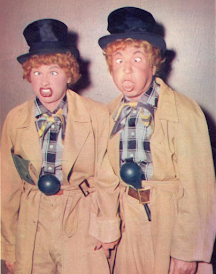 There's another teaser for something else that you'll be reading in next week's issue: next Monday's I Love Lucy, which features Harpo Marx and the famous "double in the mirror" bit, which you can see here. Items like this are precious parts of television's legacy: the chance to read about history before it becomes history, to view something fresh for the first time.
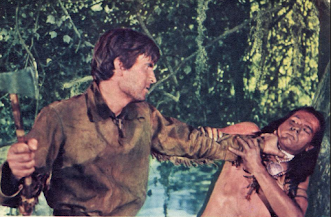 In fact, as the quiet Parker points out, he's been bumming around in Hollywood for a few years now. He's been in nine movies, and did an episode of Dragnet once, in which he "Played the whole thing on m'knees opposite Webb and ol' Ben." Did we mention that Fess stands six-foot-five? He's a favorite around the Disney lot; "This boy has no illusions about himself," one associate says. "Gives the impression of being real naive, but look out. West Texas common sense—and he's loaded with it—is about as naive as British diplomacy of the old school." Considering that Parker would go on to be a successful businessman (including a resort and winery), as well as owner of a number of lucrative properties, I'm not surprised. That's in the future, though; right now, he owns one good suit, one good tie, and a four-year-old car, and he's "just now wearin' out my last set of GI underwear."
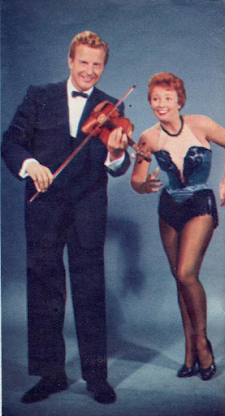 Finally, I've been at this for a long time now, and it's not often that I run across a show I've never heard of. I'm not saying it's impossible, but it's a rare experience. That is, until I was introduced to The Florian ZaBach Show. Perhaps you have heard of it, and if so, you're a better man than I, Gunga Din.

And then there are the write-ins. Readers were invited to name their own favorites if they didn't find them among the shows listed on the coupon. That's just what they did in the case of Medic, which wound up 17th in this list. Shows 18 through 20 were also write-ins, and while Dear Phoebe only ran one season, Medic brought the same level of realism to the medical series that Dragnet (#5) did to police shows. And Father Knows Best, a series also in its first season, ran for six well-loved years. Five other shows, although they didn't make the list, also gathered a substantial number of votes.
I mentioned those letter-writing campaigns at the beginning, and perhaps there's a greater similarity here than I first thought, because one of the things to come out of this viewer response is that fans of television shows take their fandom quite seriously, and they're not afraid to take the time and the effort to let people know about it. In this most intimate of communications mediums, we shouldn't be surprised to find that out.
l l l
Linking to myself is kind of like riffing Mystery Science Theater 3000, if you know what I mean. Sometimes it can't be helped, though, especially when I'm the primary source of background information on something in this week's issue. It's Monday night's Producers' Showcase colorcast of Darkness at Noon, Arthur Koestler's classic novel, adapted by Robert Alan Aurthur, directred by Delbert Mann and featuring an all-star cast including Lee J. Cobb, David Wayne, Ruth Roman, Oscar Homolka, Joseph Wiseman, Nehemiah Persoff, and Henry Silva. (5:00 p.m., NBC—the early hour suggesting this is a live broadcast.)
I wrote about Darkness at Noon last year—the novel, this production, and the meaning of Koestler's grim warning on the terror of communism. Cobb stars as Nicholas Rubashov, the revolutionary-turned-enemy of the people; "As he is brutally pressed to confess to political crimes he never committed, Rubashov begins to re-think all the principles of his life, and to reconsider his entire career as an Old Bolshevik." There's not much more to say about this than what I wrote last year; it's one of the great stories about one of the great evils of all time, and a story that's as important now as it was during the Cold War, though I'm sure it wouldn't find a place on TV today.
l l l
We're at an interesting point in the relationship between movie studios and television. From the outset the attitude of the movie moguls toward the new medium has alternated between scorn, ridicule, and fear. TV is either a novelty to be ignored, or a form of free entertainment that threatens the very existence of the studios.
This begins to change in 1954 when Walt Disney makes a deal with ABC to produce a weekly series for the network in return for funding his California theme park. Perhaps taking to heart that old adage that "if you can't beat 'em, join 'em," the 1955-56 season will see a raft of studio-produced series making their way to the small screen.

*Don't think that Warners is deserting the movie scene, though: they're also planning to spin off several TV series into movies, including Our Miss Brooks (with the original TV cast), Pete Kelly's Blues, Sincerely Yours, and Foreign Intrigue.
Not to be outdone, Republic is considering going 100 percent into television; in the last two years the studio grossed $7 million from selling its old movies to TV, and they're already heavily into TV production. And MGM is rumored to be next, "in the near future," leaving only Howard Hughes's RKO "out of the magic circle," as Jenkins puts it.
That's not all that's planned for next season, though. In the New York Teletype, Bob Stahl reports that, NBC is busy putting together its Tuesday lineup, to be headlined by Milton Berle and Martha Raye, alternating every other week (the network would also like Martin and Lewis, and Bob Hope, to appear in the timeslot at least once in a while), followed by Jane Wyman's Fireside Theater, and a series of rotating dramatic anthologies sponsored by Pontiac and Armstrong. Meanwhile, CBS plans to counter with the new Phil Silvers Show (as the conniving Ernie Bilko), followed by The Red Skelton Show, and the new quiz show (premiering in June), The $64,000 Question. (Wonder what ever happened to that?)
Stahl also has a bit of "old" news on hand; Julius LaRosa will be making his first TV appearance since he "left" the Godfrey show (or was pushed), taking over the Perry Como/Jo Stafford 7:45 p.m. timeslot on CBS for two months. Meanwhile, Perry heads for NBC in the fall, where he'll do battle with Jackie Gleason and The Honeymooners. Classics all, eh?
l l l
I'm not sure what today's equivalent would be of the furor surrounding Godfrey's dismissal of LaRosa; maybe the uproar when people found out that Ellen Degeneres wasn't as nice as she appeared on TV. And yet her fame wouldn't begin to rival Godfrey's; at one point, he had three shows on television simultaneously, all of them in the top 10. Then there's his radio show, his public appearances, his commercial endorsements, and his warm, folksy image. That image is what was eviscerated in the LaRosa matter (and the dismissals of other "Little Godfreys" Marion Marlowe, Haleloke, and the Mariners, which is the subject of next week's article), and while this wasn't the "end" of Godfrey—he would continue his radio program for another two decades, and he made occasional television appearances for years—it was the end of his reign as one of America's biggest stars.
One last thing about the teasers in this week's issue: if this all smacks of sensationalism, you have to remember that TV Guide, as a national publication, is still young, still much closer to the fan magazines of the time than a publication with articles that treat television as something worthy of serious journalism and insight. In that sense, one could say that today's TV Guide has simply returned to its roots.
l l l
According to this article, one of the most interesting aspects of the routine is that "pieces of the scene were spliced together. Why? Harpo kept changing up the routine, throwing Lucy off-balance at times. She had to go over and over again with him how the routine would work." Lucy would say of Harpo that he was "So bright and so darling and, ooh, such a great musician," but it was Lucy who had to keep teaching him the routine.
l l l
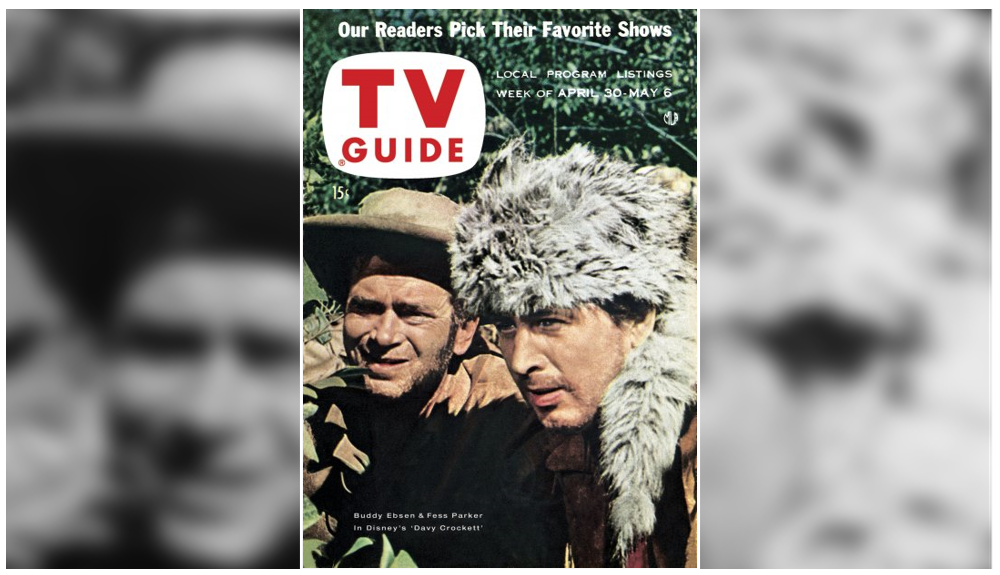
Speaking of Disney, as I suppose we were in a sense earlier on, our cover story this week is on Fess Parker, who's become "something of a phenomenon" as Davy Crockett, "King of the Wild Frontier" in the recent three-part Disneyland adventure. He is, in fact, the first and only Disney live actor under the standard Hollywood seven-year contract, and he's being called television's "first genuine overnight star."

As far as his immediate future is concerned, there are four more Crocket shows lined up, plus another Disneyland story. And in the next decade, he'll star as yet another frontier legend, Daniel Boone, running for six highly successful seasons, before retiring from acting at age 49, as one of television's most popular stars. And as down-to-earth as ever.
(By the way, it occurs to me that this issue mentions two of the three tallest cowboys on television: with 6' 5" Parker, as well as 6' 6" Clint Walker (of Cheyenne); the only one we're missing is 6' 6" Chuck Connors—but The Rifleman won't be on until 1958.)
l l l

Florian ZaBach was a violinist, and a good one. He was discovered by Arthur Godfrey, won fame with a recording of a piece called "The Hot Canary," and appeared on most of the New York-based television shows of the day, and because of that he has a star on the Hollywood Walk of Fame, which makes me think that perhaps I should have heard of him.
And so Guild Films, producer of The Liberace Show, has latched on to ZaBach for his own weekly series of violin music, augmented by Mary Ellen Terry (left), "a lithe young dancer," who appears with him many weeks. ZaBach, who was once timed (according to the always-reliable Wikipedia) as playing 12.8 notes per second, performs a pleasant repertoire of popular music—musical comedy, operetta, and standards. With "his wavy blond locks and handsome smile, he undoubtedly impresses the same brand of feminine viewer who dotes on Liberace." And he seems like a nice guy, one "whom housewives would like to know, if not to mother."
Despite all this, ZaBach has yet to match Lee's ratings success (possibly, according to the review, because he doesn't have a brother named George). The show runs a full season, and after it leaves the air ZaBach spends years performing and conducting around the world with various symphony orchestras. And now that we know him, I suspect none of us will ever forget Florian ZaBach. TV


