when I was a kid. I didn't know anything about country music, or the demographics that would doom shows from
. If Jimmy Dean's sausage had been available back then, I wouldn't even have known about that. All I knew was that I liked Jimmy Dean, and I liked his sidekick, Rowlf.
Rowlf was the first Muppet I remember having seen; I don't think I'd even seen Kermit at that point. There was something about this dopey puppet that I thought was hilarious, and as I write this I suspect that maybe I liked Rowlf even more than I did Jimmy. The banter between the two was easy; Jimmy always called Rowlf (or, as he pronounced it, "Ralph") "my ol' buddy," and Rowlf in turn displayed the typical Muppet humor that would endear him, and them, to so many over the years.
In fact, according to Richard Gehman's profile of Dean in this week's issue, Rowlf's popularity has at times threatened to overshadow that of the boss. During a location shoot, delighted crowds swarmed over Jim Henson to the point that Dean was overheard muttering, not entirely approvingly, "Next thing you know, they'll be calling the dog the star of this here ol' show." If it happens, though, it will only be through Dean's suffrage, because Jimmy Dean is in fact the boss of his show. He knows his audience, he knows himself, he knows what the viewers would buy. In the show's first season, when the network had tried to pass him off as urbane and sophisticated, the show teetered on the edge of cancellation until Dean put his foot down. "Lemme do it mah way," he told the suits, and the ratings took off.
Though he is undeniably in charge, there is an easy camaraderie between Dean and the crew, and his producer acknowledges that nine times out of ten Dean's suggestions for changes wind up improving the finished product. Unlike, say, Andy Griffith's character in
A Face in the Crowd, the Dean you see in front of the camera is in essence the same as the one off-camera. Sure, the accent is maybe a bit put-on. (His wife acknowledges that in real life he "really doesn't have much of an accent.") And for all the down-home cornpone humor, he's quite a bit more sophisticated than that.
Behind that aw-shucks country boy was a shrewd businessman who know
exactly what he was doing. The Dean show ends in 1966, and three years later Jimmy Dean sausage hits the shelves. And, of course, Rowlf goes on to be a fixture on many Muppet presentations over the years (not to mention
a few business films), and of course
The Muppet Show. The ol' country boy and his dog didn't do too badly, did they?
l l l
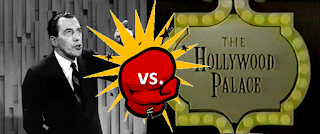 During the 60s, the
 Ed Sullivan Show
and The Hollywood Palace
were the premiere variety shows on television. Whenever they appear in TV Guide together, we'll match them up and see who has the best lineup..In this first rerun of the season, Ed welcomes singer-dancer Juliet Prowse, singer Connie Francis, comics Allen and Rossi, French pop singer Jean Paul Vignon, the Harlem Globetrotters, comedienne Jean Carroll, Country and Western singer Roy Orbison, and the Youngs, a teeterboard act.
Palace: Bette Davis hosts this rerun from February, with guests Bert Lahr; singer Julius LaRosa; comedian Jan Murray; dancer Barrie Chase; the Nerveless Nocks, acrobats; Australian comic juggler Rob Murray; and Les Cinci, a Parisian couple.
Well, what do we have this week? On the
Palace side, Bette Davis is a legend, but is she also a host? She has some star power helping her out: Bert Lahr, a talented man; Barrie Chase, both talented
and a babe; Jan Murray a very funny comedian; and Julius LaRosa a pretty fair singer. Ed has Juliet Prowse, who's not quite in the same league as Chase; Jean Carroll, who's not quite as funny as Murray, and Connie Francis, who—well, OK, she might win that matchup with LaRosa. But can acrobats and jugglers keep pace with the Harlem Globetrotters, who can acrobat and juggle with the best of them? Allen and Rossi are favorites of Ed's. And then there's Roy Orbison, who's pretty much of a legend himself. As much as I'd like to pick one or the other (and, at one time, I
might have chosen one or the other), the only way I see out of this week is to
call it a Push.
l l l
You can't really ignore a quote as incendiary as the one on this week's cover, "I've seen pig pens better run," and Edith Efron chats this week with the author of those choice words, FCC commissioner Lee Loevinger. Loevinger, a former justice on the Minnesota State Supreme Court, is something of a libertarian when it comes to Federal control over the airwaves, setting him apart from his colleagues on the Commission; for instance, Loevinger believes that the separation of church and state (which, we all know,
never appears in the Constitution) would seem to render moot the FCC's authority to mandate religious programming on local broadcasters.
 |
| Lee Loevinger |
For that matter, Loevinger seems skeptical that the FCC has much of
any authority over broadcasters (making him a curious choice to serve on the Commission), saying that the Commission's charter requiring stations to operate "in the public interest," combined with the FCC's authority to determine just what that public interest is, amounts to an infringement on the First Amendment rights of broadcasters. Loevinger cites the relevant section of the Communications Act, which explicitly states that "nothing in the statues 'shall be understood or construed to give the Commission the power of censorship over broadcasting.'" According to Loevinger's reading of the First Amendment, "The plain truth is that we have no damn business getting involved in programming at all."
His strongly-held beliefs lead him to oppose the Fairness Doctrine that requires equal time be offered to any controversial issue, and extends as far as the realm of dramatic programming, about which he says that "[y]ou can't constitutionally compel people to read good books, or watch good plays, even on the assumption that you know what good art is, and that is a perilous assumption." Of former chairman Newton "Vast Wasteland" Minow, he says, "The Minow view, that it is the FCC's duty to elevate the level and quality of broadcasting, is legally and morally wrong," and uses words like "ill-considered . . . illogical . . . silliness . . . nonsense . . . contradictions . . . essential error" to describe Minow's famous speech.
One wonders what exactly Loevinger thinks the FCC
ought to be doing. Mostly, he says, granting broadcast licenses, which is what the Commission was created to do in the first place. But it was that license-granting authority which originally gave the FCC the foothold into regulation of programming, and the problem of how to separate the two—how the FCC can still grant licenses without making subjective judgments regarding the merits of the applicants and their proposed programming. There are no standards for judging, Loevinger complains, which makes the separation between licensure and regulation almost impossible to maintain.
It's no surprise that Loevinger has few friends on the Commission, and most experts remain puzzled as to why the late President Kennedy appointed him to take Minow's place (although students of JFK's style know how he enjoyed appointments that "rocked the boat"). He'll remain at the FCC until 1968, fighting the lonely fight, his most lasting accomplishment being to encourage AT&T to establish a uniform emergency phone number: 911.
l l l
The Famous Adventures of Mr. Magoo (
Saturday, 8:30 p.m. PT, NBC) was inspired by the success of
Mr. Magoo's Christmas Carol; the premise has Magoo starring each week in adaptations of famous literary classics such as
Robin Hood and
Moby Dick. As was the case in
Christmas Carol, Magoo plays the roles straight without the jokes about his nearsightedness, but tonight's episode, "Don Quixote de la Mancha," would have been a perfect opportunity to explain why Don Quixote was able to mistake windmills for attacking knights. Marvin Miller, from
The Millionaire, plays the Don's sidekick Sancho Panza.
Sunday marks the first network broadcast of the final round of the U.S. Women's Open Golf Championship, from the Atlantic City Country Club in Northfield, New Jersey (1:00 p.m., NBC). As is par for the course (har har!), only the final three holes are covered in the one-hour telecast*; future Hall of Famer Carol Mann shoots an even par 72, including a birdie on the final hole, to win by two strokes over Kathy Cornelius.
*The Women's Open is followed at 2:00 p.m. by the final round of the Western Open, one of the longest-standing tournaments on the men's tour; coverage of this limited to the final three holes as well.
Sunday is also the Fourth of July, which, as we've noted in the past has never been a particularly notable day for TV specials. However, ABC's Issues and Answers (1:30 p.m.) does display something of a wry humor, interviewing Sir Patrick Dean, Great Britain's ambassador to the United States, on the 189th anniversary of the Declaration of Independence. On the local scene, KXTV in Sacramento has the movie Stars and Stripes Forever, starring Clifton Webb as John Philip Sousa; later on, it's James Cagney in his Oscar-winning role as George M. Cohan in Yankee Doodle Dandy (11:35 p.m., KPIX in San Francisco).
Monday is the start of another week of celebrity appearances on afternoon game shows: Buddy Greco and Molly Bee on NBC's What's This Song? (9:30 a.m.); Rita Moreno and Les Crane on the same network's Call My Bluff (11:00 a.m.); Ann Jeffries and Alan Young on Password (1:00 p.m., CBS), followed by Peggy Cass, Orson Bean, Tom Poston and Kitty Carlisle on To Tell the Truth (1:30 p.m., CBS); and a pair of NBC shows rounding out the day, Dwayne Hickman and Emmaline Henry on You Don't Say! (2:00 p.m.), and Gisele MacKenzie and Bobby Vinton on The Match Game (2:30 p.m.). Dwayne Hickman was, of course, the star of The Many Loves of Dobie Gillis; coincidentally, the movie appearing opposite Password is none other than 1953's The Affairs of Dobie Gillis (2:00 p.m., KTVU in San Francisco), with singer/dancer Bobby Van as Dobie. Fun fact: Bobby Van also appeared as a contestant on Password, in 1974 with his wife, Elaine Joyce.
Moment of Fear is one of those summer dramatic anthology series comprised of episodes from
other dramatic anthologies, something that wasn't particularly unusual in the 1960s;
Tuesday's episode, though, is really dipping back into the past. It's "The Secret Darkness" (8:30 p.m., NBC), starring Vincent Price and Bethel Leslie, and it first appeared on
Studio 57 in 1957, eight years ago—you could only do this back in the days when there were still black-and-white programs in prime time. By comparison, the anthology series that follows,
Cloak of Mystery (9:00 p.m., NBC), has a story that's virtually brand new: "Mr.. Lucifer," with Fred Astaire and Elizabeth Montgomery, which ran on Astaire's
Alcoa Premiere series only three years ago, back in 1962.
Wednesday's highlight relies on cameo appearances by Rudy Vallee and Hedda Hopper as themselves in "Lucy Takes a Cruise to Havana" on The Lucy-Desi Comedy Hour (10:00 p.m., CBS). Besides the Mertzes, the guest cast includes Ann Sothern, Cesar Romero, and Frank Nelson. In case there's anyone out there who doesn't know this, legendary gossip columnist Hedda Hopper is the mother of William Hopper, who plays Paul Drake in Perry Mason.
Robert Goulet makes his American TV dramatic debut in the
Kraft Suspense Theatre episode "Operation Greif" (
Thursday, 10:00 p.m. NBC), in a story about the
real-life German plot to infiltrate American lines with saboteurs and terrorists wearing American uniforms. Goulet is known for his singing and musical-comedy performances, but his success in this dramatic role might be the impetus for his casting in the 1966 World War II drama series
Blue Light, where he plays an American double agent working in Germany during the war. Kind of a counter-Operation Greif.
Rounding out the week is a program that manages to be both dated and timely: it's "Is Democracy Too Expensive This Year?", an episode of the political drama series Slattery's People, starring Richard Crenna (Friday, 10:00 p.m., CBS). The plot has Slattery and a party fundraiser visiting a potential Congressional candidate who needs money to run a viable campaign; Slattery wants to help raise the money, but the fundraiser doesn't want to waste it on a candidate who doesn't have a chance. It's timely in that it shows how money makes politics go around; dated in that it shows how much more money candidates need today.
l l l
I'm not quite sure how to break it to James Gilgour, of Wynnewood, Pennsylvania, but his Letter to the Editor marks him as a trusting soul who needs to be let down easy, and that's what the editor does in response to his missive regarding a recent profile of
Gunsmoke's Doc, Milburn Stone. "You use the expression—'Miss Kitty’s questionable character'," notes Gilgour. During all the years of watching
Gunsmoke, I never once saw or heard anything which made me question Miss Kitty’s character. In what way can you justify the statement?
The editorial response, delicately phrased, is that "Histories of the West bear out, we think, that dance-hall girls of the era were, more often than not, of "questionable character." Less delicately put, many of them were prostitutes, the upstairs of the Long Branch was a brothel, and Miss Kitty herself, according to no less an authority than Amanda Blake, was the madame, having started out as a "working girl" before becoming half-owner of the Long Branch. Now, it's true that the radio version of Gunsmoke was a little more explicit about this than the television series, but I think that in this case we can rest assured as to what the rest of the story really is. Sorry to have to be the one to tell you, Jim, but that's the way it is. If it's any consolation, though, she does have a heart of gold.
l l l
Finally, remember that "Six Degrees of Separation" game we played the other week? Well, I'll go you one better here. On this week's nighttime version of Password (Thursday, 9:00 p.m., CBS), the celebrity panelists are Woody Allen and Nancy Sinatra. The following year Nancy's father, Frank, will marry Mia Farrow. That marriage won't last, but eventually Farrow hooks up with—Woody Allen. Apparently the connection between Frank and Mia wasn't entirely dead though, based on her suggestion that son Ronan might belong to Frank. The password is. . .
l l l
MST3K alert: Teenagers from Outer Space (1959) Three aliens decide that the earth is the perfect spot to graze their man-eating monsters. David Love, Dawn Anderson, Bryan Grant. (Thursday, 3:00 p.m., KRON in San Francisco) There's no particular reason for the titular alien in this movie to be a teen—unless it's meant to serve as a warning to parents out there. See what can happen to your kids if you're not careful? They'll be blasting the skin off humans! I guess kids are the same all over, aren't they?
TV 


