Showing posts with label The Rogues. Show all posts

June 13, 2026

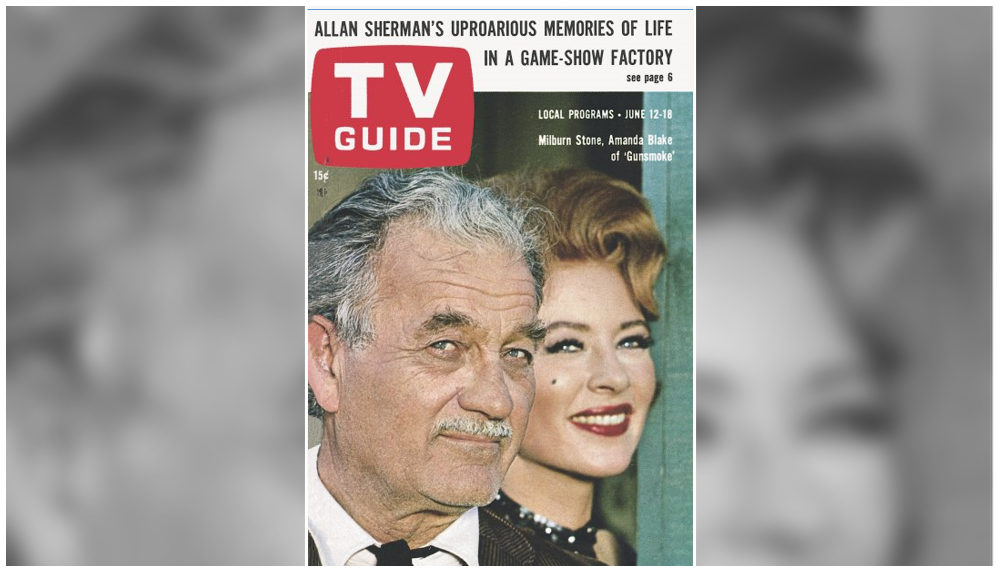
This week in TV Guide: June 12, 1965


WI suppose I was about five, the year this issue came out, that I received a book from my mother. It was an illustrated version of "Hello Muddah, Hello Fadduh!", the hit song by comedian Allan Sherman. I loved both the song and the book, and for many years this was how I knew Sherman—this and the other novelty songs he did, many of which were pantomimed on the beloved Twin Cities children's show Lunch With Casey.

But I digress. As I say, it wasn't until much later that I found out Sherman was also a game-show empresario of sorts. As he describes this week in an excerpt from his autobiography, A Gift of Laughter (which might be worth tracking down some day), he and his partner, Howard Merrill, created the show I've Got a Secret, which they then sold to Goodson-Todman Productions for the princely sum of $1, with the proviso that if the show made it to air they would each receive a weekly royalty of $62.50, and Sherman was named Associate Producer, receiving an additional $125 a week. (A few years later, Sherman notes, Goodson-Todman sold I've Got a Secret to CBS for three million dollars.) 

Lest you think creating a game show concept is all fun and games, it was neither for Sherman; as he puts it, "After all those months of taking out the bugs, we had a regular insectarium on our hands." Sherman frankly admits that the first show was a disaster, and that the "secrets" that they created for celebrity guests were insipid. This came to a stop around the time that actor Monty Woolley's secret was disclosed to be that he slept with his beard under the covers. Asked by Henry Morgan whether this was really true, Woolley shouted, "Of course not, you bloody idiot. Some damn fool named Allan Sherman told me to say it." 

And then, there was the president of one of the sponsors, Prom Home Permanent, who kept meddling with the lineup of the panel. He was "violently" opposed to Laura Hobson, Nina Foch and Faye Emerson, because they all had straight hair. "His idea of the perfect panelist was Harpo Marx."

Sherman also tells of when Sir Edmund Hillary became the first man to reach the top of Mount Everest. Figuring he'd never have a better guest, he told his Production Assistant Adraia to get him on the phone." Where? she asked. "At the top of Mount Everest," he replied. "It had never occurred to me that there might not be a telephone booth at the top of Mount Everest." As it turned out, she was able to get through to the bottom of Mount Everest, where she was told Hillary was expected back in a month. "Too late!" Sherman shouted. Tell them we need him now!"

Frankly, I don't believe this story, or at least I suspect Sherman embellished it for effect, and that effect is very effective indeed. He goes on to share Mark Goodson's mania for memos (when Sherman complained that Goodson would "exhaust the world's supply of paper" if he didn't desist, Goodson replied by memo. Bill Todman wasn't any better; Sherman's request for a raise had to wait until Todman finished a call to Henry Ford to have a Lincoln Continental made to order; Todman then told Sherman that while he wouldn't give him a raise, he had something even better: a promotion from Associate Producer to Producer. 

Whether or not any of this actually happened doesn't really matter, though, because it's entertaining, and Allen Sherman is an entertainer. This book might be worth tracking down some day. In part two of this article, he promises to tell us of the day when he finally got a secretary, and he spent that weekend wondering if she'd be blonde, slinky, with a throaty voice and exotic perfumes. That is, until he got to the office on Monday and met his new secretary, Roger Peterson. 

l  l  l

During the 60s, the Ed Sullivan Show and The Hollywood Palace were the premiere variety shows on television. Whenever they appear in TV Guide together, we'll match them up and see who has the best lineup.

Sullivan:  Ed's live this week, with comedian Sid Caesar; comics Allen and Rossi; French pop singer Jean Paul Vignon; British rock 'n' roller Tom Jones; comic London Lee; singer Dee Dee Sharpe; the Seekers, folk singers; and the Wychwoods, an illusionist act which uses 14 trained poodles.

Palace:  We’re in the rerun zone at the Palace this week, with host Arthur Godfrey welcoming comedian Shelley Berman; songstress Dorothy Collins; singer John Gary; the comedy team of Gaylord and Holiday; Dwight Moore and His Mongrels; juggler Eva Vidos; and the Dalrays, comic acrobats.

Let's see: dog acts? Check. Comedians? Check. Comedy teams? Check. Singers? Check. Each show has ticked the boxes this week, which leaves us to look at the personalities.  Shelley Berman can be very funny, Dorothy Collins is easy on the eyes, and John Gary has a smooth voice. On the other hand, you have the Ceasar of comedians, and Tom Jones is still going strong! So it's not unusual for Sullivan to be the winner this week.

l  l  l

Throughout the 60s and early 70s, TV Guide's weekly reviews were written by the witty and acerbic Cleveland Amory. Whenever we get the chance, we'll look at Cleve's latest take on the shows of the era. 

This week, Cleveland Amory is conducting what we might think of as something of a self-review, in which he takes a look back at some of his reviews of the past season about which, in his words, he's had "second thoughts" For, as he says, "One cannot re-review the past season without coming to grips—and possibly even stagehands—with the show which, ratings or no ratings, has become the biggest thing since Amos 'n' Andy." 

That show would be Peyton Place, and while Cleve was taken to task by many over his favorable review of the program, there's no question that everyone was talking about it. He still has one criticism, though: the pace. "The show has an irritating habit of making a federal case out of every conversation. At the wedding, for example: Rod: 'Your mother looks—beautiful.' Allison: 'You were going to say "happy," weren't you? Why didn't you, Rod?' Rod: 'Why didn't I say "happy"? Why didn't I, Allison? I don't know.' Etc, etc." And speaking of Allison, "If she can't get another emotion—or even another boy friend—would it be too much to ask for her to get another speed?"

Amory also offers praise for the best performances of the year: Jim Nabors and Frank Sutton were standouts on Gomer Pyle, as were Elizabeth Montgomery and Dick York on Bewitched. He also mentions a "splendid quartet" in serious drama: Richard Crenna (Slattery's People), David Janssen (The Fugitive), Vic Morrow (Combat!), and Robert Lansing (Twelve O'clock High).  

In late night, Amory's discouraged by the failure of ABC's Nightlife, which he calls a "monument to futility," which started out with Les Crane, and adds that "even when they did finally come up with the right man, Dave Garroway, they didn't seem to know it." And he laments the absence of new faces in the news, with the exception of ABC's Peter Jennings, and the lack of commentary on network news (specifically citing NBC, but it could apply to all three). However, let us not end on a down note. There were three bits of good news: the real possibility of a fourth commercial network, the growth of educational television, and the best news of all: CBS has a new president. James Aubrey is dead, long live James Aubrey.

l  l  l

We're always looking for good, or interesting, programs during the summer rerun season, and we've got several this week.

Secret Agent is still in first-run on American television, and Saturday's episode is one of particular interest, especially for those who debate whether or not John Drake became Number Six. "Colony Three" (8:00 p.m., CBS) is, as one author put it, "a fascinating anticipation of The Prisoner." The premise: "Drake assumes a new identity and joins a group of defectors about to be transported to a training school for spies in Eastern Europe."

On Sunday, ABC presents the third installment in their Daring Americans series, "Assault on Le Mans" (6:30 p.m.), portraying American Grand Prix champion Phil Hill, one of the greatest racing drivers of the 1960s. Hill was the first American, and the only native-born one, to win the World Driving Championship. Now he's at the fabled Le Mans, a race he's won three times in the past. His teammate in the 24-hour race is Bruce McLaren, as they drive for the upstart American Ford team, taking on the legendary European powers, particularly Ferrari. Hill and McLaren don't win; as a matter of fact, they dropped out after 192 laps. But two years later, Ford would topple mighty Ferrari, the legendary Ford GT taking first, second and third. The documentary is done in cinéma vérité style by Robert Drew Associates, which famously did several similar documentaries on John F. Kennedy, including Primary.

As we move into reruns, Monday's Ben Casey (9:00 p.m., ABC) presents a story that, for all the complaints scriptwriters have about not being able to tell adult dramas, probably wouldn't have been told even five years ago. In "A Disease of the Heart Called Love," Shelley Winters plays a divorced, middle-aged nurse who becomes pregnant. She's also got a medical condition that makes her pregnancy dangerous. Casey and Zorba advise her to "terminate the pregnancy," but she wants to keep the baby. So this touches a number of buttons: unmarried mothers, abortion, the loneliness of the unmarried. They don't get much more adult than that. It's directed by Mark Rydell, and features Milt Kamen and, as Dr. Watson, James Doohan.

Tuesday features one of those how-many-times-has-this-happened-to-you moments on The Fugitive: (9:00 p.m., ABC): "When a philandering husband is found murdered, the chief suspect is his girl friend Lucey Russell. But Lucey has an alibi: she was with Kimble." I did a bit on this many years ago, where I looked at the typical tropes of typical series and wondered just how many times they actually happened to ordinary people. This one is a little better, though, in that you don't have to be relying on an escaped convicted murderer to provide your alibi; it could be someone cheating on their spouse, someone who called in sick to work, or any number of people who wind up in the wrong place at the wrong time doing something they shouldn't be doing. I think it's called karma.

I'm going off the primetime grid for Wednesday's choice: Stanley Kubrick's terrific noir The Killing (10:30 p.m., KMSP), with Sterling Hayden leading a gang planning a race-track robbery. The gang includes Vince Edwards, who was Ben Casey on Monday night; Elisha Cook, Jr. as a very nervous teller working for the gang on the inside; and Marie Windsor as the dame who does him wrong. Based on this movie, Kubrick and his producer, James Harris, got the chance to make a movie for MGM: Paths of Glory. That was a pretty fair movie, too.

Thursday's repeat episode of The Defenders is "Blacklisted" (9:00 p.m., CBS) with Jack Klugman starring as a formerly blacklisted actor whose comeback is being threatened by a "vigilante" group trying to get him fired. So we have Klugman, one of the most intense, scene-chewing actors around; we have McCarthyite villains in the "vigilantes" trying to prevent a decent man from earning a living; and we have The Defenders itself, one of the more strident, issues-oriented programs on the air.

In fact, the episode is quite good. Klugman is, for the most part, well within himself as a man who shows his regrets not by what he says or does, but by what he keeps inside him. Your opinion of the episode is going to be based in large part on your opinions of the blacklist, the Red Scare, and everything that's happened since.  The Defenders was one of the quality programs of the early 60s, a series that wasn't afraid to take on serious issues. Its flaw, and it was a major one, was when it stepped over the line into strident advocacy, as it increasingly did in later seasons. But decide for yourself—you can see it here.

On Friday night, ABC turns its attention to gambling in another amusing documentary, as host Terry-Thomas takes a humorous look at "the urge to gamble" in Everybody's Got a System. (7:30 p.m.) The show visits horse racing tracks in Europe, talks to bettors and bookies to learn about the sport's attraction, visits a bingo parlor to see how even small-scale gambling can thrill, and visits the casinos, where Thomas explains his own "system" at the roulette wheel. It seems lightweight, but a fun show, not unlike something you might see on History or A&E today.

Also on Friday, Jack Paar's in London for this week's rerun (9:00 p.m., NBC), with a stellar cast of his own: the legendary Judy Garland, the very witty Robert Morley, and the distinguished journalist Randolph Churchill, son of the late Winston. I've seen clips of this on one of the Paar compilation videos, and it's very funny—particularly this bit where a slightly tipsy Judy has some fun at Marlene Dietrich's expense:


Oh, and she can still sing a bit, too. What a sad, sad life she led.

l  l  l

Fashion alert: it's time for another starlet to display the latest in haute fashion.  This time it's actress Janet Margolin, who will go on to a successful career with appearances in media as varied as Woody Allen movies, a Ghostbusters sequel, and episodes of Columbo and Murder, She Wrote.  But never mind that—her mission this week is to show off the newest craze, the Finnish Marimekko, made famous by Jackie Kennedy.


Janet Margolin died of cancer in 1993, not quite 30 years after this issue.

l  l  l

James Arness is so big (besides being 6'7", that is), he even dominates this week's profile of Milburn Stone, who plays Doc on the long-running Gunsmoke. Stone remembers the first few years working with Arness, and he wasn't impressed: "He'd be late or wouldn't show up—never apologize. And once he was there he'd clown around." When Stone couldn't take it any longer, he lit into Arness at a rehearsal, telling him that he didn't belong in the business, and added that "I've read my contract and there's nothing in it that says I have to put diapers on you or wait for you. And if you ever show up late again, buddy, you'll have two things to explain—not only where you were, but where I went!" To Stone's surprise, Arness took the tongue-lashing like a man, telling him that "You're absolutely right." "From that moment on," Stone says, Arness changed, becoming the consummate profession we've read about in TV Guide. "I began to love that guy. He's a great big wonderful cub bear."

I watched Gunsmoke when I was a kid, primarily because my grandfather did, and although I wouldn't rank it as a favorite it was a memorable show nonetheless. The byplay between the main characters—Matt, Doc, Festus and Kitty, and the obvious chemistry between the actors playing them—is the glue that held the show together, and watching it in reruns today confirms the quality of the program.

l  l  l

Finally, on this longer-than-usual entry, a brief mention of Edith Efron's profile of Gig Young. Young is an acclaimed stage and movie actor, and his career will end with three Oscar nominations (and one win) to his credit, but in this issue he's talking about his current series, The Rogues, in which he stars along with Charles Boyer and David Niven. I bring this up because this article, which I read some years ago now, was the first time I'd read about The Rogues, a series about a family of good-natured con artists making a living out of swindling people who deserve it. According to the reviews, there is a sense that The Rogues is too literate, too clever, for the average viewer who wants his television without having to think about it.

I first saw The Rogues a few years ago on MeTV, and I was absolutely charmed by it. It's a show that desperately deserves a commercial DVD release (although you can get copies if you know where to look); it's better than Leverage, more humorous than The A-Team, and not nearly as complicated as Mission: Impossible. And since it is a series, unlike The Sting, you get to see it every week. It should have run for more than one season, and if you ever get the chance you should give it a try. I will be surprised if my readers aren't as charmed by it as was I.


nsert text here TV
If you enjoy the content here and want to support my broader creative work, please consider leaving a tip at my Ko-fi page. Any amount you contribute helps me continue writing, researching, and sharing these articles and projects. Thank you!

June 11, 2022

This week in TV Guide: June 12, 1965


I suppose I was about five, the year this issue came out, that I received a book from my mother. It was an illustrated version of "Hello Muddah, Hello Fadduh!", the hit song by comedian Allan Sherman. I loved both the song and the book, and for many years this was how I knew Sherman—this and the other novelty songs he did, many of which were pantomimed on the beloved Twin Cities children's show Lunch With Casey.

But I digress. As I say, it wasn't until much later that I found out Sherman was also a game-show empresario of sorts. As he describes this week in an excerpt from his autobiography, A Gift of Laughter (which might be worth tracking down some day), he and his partner, Howard Merrill, created the show I've Got a Secret, which they then sold to Goodson-Todman Productions for the princely sum of $1, with the proviso that if the show made it to air they would each receive a weekly royalty of $62.50, and Sherman was named Associate Producer, receiving an additional $125 a week. (A few years later, Sherman notes, Goodson-Todman sold I've Got a Secret to CBS for three million dollars.) 

Lest you think creating a game show concept is all fun and games, it was neither for Sherman; as he puts it, "After all those months of taking out the bugs, we had a regular insectarium on our hands." Sherman frankly admits that the first show was a disaster, and that the "secrets" that they created for celebrity guests were insipid. This came to a stop around the time that actor Monty Woolley's secret was disclosed to be that he slept with his beard under the covers. Asked by Henry Morgan whether this was really true, Woolley shouted, "Of course not, you bloody idiot. Some damn fool named Allan Sherman told me to say it." 

And then, there was the president of one of the sponsors, Prom Home Permanent, who kept meddling with the lineup of the panel. He was "violently" opposed to Laura Hobson, Nina Foch and Faye Emerson, because they all had straight hair. "His idea of the perfect panelist was Harpo Marx."

Sherman also tells of when Sir Edmund Hillary became the first man to reach the top of Mount Everest. Figuring he'd never have a better guest, he told his Production Assistant Adraia to get him on the phone." Where? she asked. "At the top of Mount Everest," he replied. "It had never occurred to me that there might not be a telephone booth at the top of Mount Everest." As it turned out, she was able to get through to the bottom of Mount Everest, where she was told Hillary was expected back in a month. "Too late!" Sherman shouted. Tell them we need him now!"

Frankly, I don't believe this story, or at least I suspect Sherman embellished it for effect, and that effect is very effective indeed. He goes on to share Mark Goodson's mania for memos (when Sherman complained that Goodson would "exhaust the world's supply of paper" if he didn't desist, Goodson replied by memo. Bill Todman wasn't any better; Sherman's request for a raise had to wait until Todman finished a call to Henry Ford to have a Lincoln Continental made to order; Todman then told Sherman that while he wouldn't give him a raise, he had something even better: a promotion from Associate Producer to Producer. 

Whether or not any of this actually happened doesn't really matter, though, because it's entertaining, and Allen Sherman is an entertainer. This book might be worth tracking down some day.In part two of this article, he promises to tell us of the day when he finally got a secretary, and he spent that weekend wondering if she'd be blonde, slinky, with a throaty voice and exotic perfumes. That is, until he got to the office on Monday and met his new secretary, Roger Peterson. 

l  l  l

During the 60s, the Ed Sullivan Show and The Hollywood Palace were the premiere variety shows on television. Whenever they appear in TV Guide together, we'll match them up and see who has the best lineup.

Sullivan:  Ed's live this week, with comedian Sid Caesar; comics Allen and Rossi; French pop singer Jean Paul Vignon; British rock 'n' roller Tom Jones; comic London Lee; singer Dee Dee Sharpe; the Seekers, folk singers; and the Wychwoods, an illusionist act which uses 14 trained poodles.

Palace:  We’re in the rerun zone at the Palace this week, with host Arthur Godfrey welcoming comedian Shelley Berman; songstress Dorothy Collins; singer John Gary; the comedy team of Gaylord and Holiday; Dwight Moore and His Mongrels; juggler Eva Vidos; and the Dalrays, comic acrobats.

Let's see: dog acts? Check. Comedians? Check. Comedy teams? Check. Singers? Check. Each show has ticked the boxes this week, which leaves us to look at the personalities.  Shelley Berman can be very funny, Dorothy Collins is easy on the eyes, and John Gary has a smooth voice. On the other hand, you have the Ceasar of comedians, and Tom Jones is still going strong! So it's not unusual for Sullivan to be the winner this week.

l  l  l

Throughout the 60s and early 70s, TV Guide's weekly reviews were written by the witty and acerbic Cleveland Amory. Whenever we get the chance, we'll look at Cleve's latest take on the shows of the era. 

This week, Cleveland Amory is conducting what we might think of as something of a self-review, in which he takes a look back at some of his reviews of the past season about which, in his words, he's had "second thoughts" For, as he says, "One cannot re-review the past season without coming to grips—and possibly even stagehands—with the show which, ratings or no ratings, has become the biggest thing since Amos 'n' Andy." 

That show would be Peyton Place, and while Cleve was taken to task by many over his favorable review of the program, there's no question that everyone was talking about it. He still has one criticism, though: the pace. "The show has an irritating habit of making a federal case out of every conversation. At the wedding, for example: Rod: 'Your mother looks—beautiful.' Allison: 'You were going to say "happy," weren't you? Why didn't you, Rod?' Rod: 'Why didn't I say "happy"? Why didn't I, Allison? I don't know.' Etc, etc." And speaking of Allison, "If she can't get another emotion—or even another boy friend—would it be too much to ask for her to get another speed?"

Amory also offers praise for the best performances of the year: Jim Nabors and Frank Sutton were standouts on Gomer Pyle, as were Elizabeth Montgomery and Dick York on Bewitched. He also mentions a "splendid quartet" in serious drama: Richard Crenna (Slattery's People), David Janssen (The Fugitive), Vic Morrow (Combat!), and Robert Lansing (Twelve O'clock High).  

In late night, Amory's discouraged by the failure of ABC's Nightlife, which he calls a "monument to futility," which started out with Les Crane, and adds that "even when they did finally come up with the right man, Dave Garroway, they didn't seem to know it." And he laments the absence of new faces in the news, with the exception of ABC's Peter Jennings, and the lack of commentary on network news (specifically citing NBC, but it could apply to all three). However, let us not end on a down note. There were three bits of good news: the real possibility of a fourth commercial network, the growth of educational television, and the best news of all: CBS has a new president. James Aubrey is dead, long live James Aubrey.

l  l  l

We're always looking for good, or interesting, programs during the summer rerun season, and we've got several this week.

Secret Agent is still in first-run on American television, and Saturday's episode is one of particular interest, especially for those who debate whether or not John Drake became Number Six. "Colony Three" (8:00 p.m., CBS) is, as one author put it, "a fascinating anticipation of The Prisoner." The premise: "Drake assumes a new identity and joins a group of defectors about to be transported to a training school for spies in Eastern Europe."

On Sunday, ABC presents the third installment in their Daring Americans series, "Assault on Le Mans" (6:30 p.m.), portraying American Grand Prix champion Phil Hill, one of the greatest racing drivers of the 1960s. Hill was the first American, and the only native-born one, to win the World Driving Championship. Now he's at the fabled Le Mans, a race he's won three times in the past. His teammate in the 24-hour race is Bruce McLaren, as they drive for the upstart American Ford team, taking on the legendary European powers, particularly Ferrari. Hill and McLaren don't win; as a matter of fact, they dropped out after 192 laps. But two years later, Ford would topple mighty Ferrari, the legendary Ford GT taking first, second and third. The documentary is done in cinéma vérité style by Robert Drew Associates, which famously did several similar documentaries on John F.Kennedy, including Primary.

As we move into reruns, Monday's Ben Casey (9:00 p.m., ABC) presents a story that, for all the complaints scriptwriters have about not being able to tell adult dramas, probably wouldn't have been told even five years ago. In "A Disease of the Heart Called Love," Shelley Winters plays a divorced, middle-aged nurse who becomes pregnant. She's also got a medical condition that makes her pregnancy dangerous. Casey and Zorba advise her to "terminate the pregnancy," but she wants to keep the baby. So this touches a number of buttons: unmarried mothers, abortion, the loneliness of the unmarried. They don't get much more adult than that. It's directed by Mark Rydell, and features Milt Kamen and, as Dr. Watson, James Doohan.

Tuesday features one of those how-many-times-has-this-happened-to-you moments on The Fugitive: (9:00 p.m., ABC): "When a philandering husband is found murdered, the chief suspect is his girl friend Lucey Russell. But Lucey has an alibi: she was with Kimble." I did a bit on this many years ago, where I looked at the typical tropes of typical series and wondered just how many times they actually happened to average people. This one is a little better, though, in that you don't have to be relyiI' ng on an escaped convicted murderer to provide your alibi; it could be someone cheating on their spouse, someone who called in sick to work, or any number of people who wind up in the wrong place at the wrong time doing something they shouldn't be doing. I think it's called karma.

I'm going off the primetime grid for Wednesday's choice: Stanley Kubrick's terrific noir The Killing (10:30 p.m., KMSP), with Sterling Hayden leading a gang planning a race-track robbery. The gang includes Vince Edwards, who was Ben Casey on Monday night; Elisha Cook, Jr. as a very nervous teller working for the gang on the inside; and Marie Windsor as the dame who does him wrong. Based on this movie, Kubrick and his producer, James Harris, got the chance to make a movie for MGM: Paths of Glory. That was a pretty fair movie, too.

Thursday's repeat episode of The Defenders is "Blacklisted" (9:00 p.m., CBS) with Jack Klugman starring as a formerly blacklisted actor whose comeback is being threatened by a "vigilante" group trying to get him fired. So we have Klugman, one of the most intense, scene-chewing actors around; we have McCarthyite villains in the "vigilantes" trying to prevent a decent man from earning a living; and we have The Defenders itself, one of the more strident, issues-oriented programs on the air.

I don't say that this wasn't a good episode; regardless of the show's political slant, The Defenders was one of the quality programs of the early 60s, a series that wasn't afraid to take on serious issues. It's their advocacy that often grinds on me. Likewise, Klugman's a man who's very good at intense but doesn't have any other speed, and I think it's a race to see who tires first: the actor or his audience. And we don't need to deny that there were misdeeds done during the blacklist to acknowledge that the anti-Communists make a juicy straw man target. But decide for yourself—you can see it here.

On Friday night, ABC turns its attention to gambling in another amusing documentary, as host Terry-Thomas takes a humorous look at "the urge to gamble" in Everybody's Got a System. (7:30 p.m.) The show visits horse racing tracks in Europe, talks to bettors and bookies to learn about the sport's attraction, visits a bingo parlor to see how even small-scale gambling can thrill, and visits the casinos, where Thomas explains his own "system" at the roulette wheel. It seems lightweight, but a fun show, not unlike something you might see on History or A&E today.

Also on Friday, Jack Paar's in London for this week's rerun (9:00 p.m., NBC), with a stellar cast of his own: the legendary Judy Garland, the very witty Robert Morley, and the distinguished journalist Randolph Churchill, son of the late Winston. I've seen clips of this on one of the Paar compilation videos, and it's very funny—particularly this bit where a slightly tipsy Judy has some fun at Marlene Dietrich's expense:


Oh, and she can still sing a bit, too.  Yesterday would have been her 100th birthday. What a sad, sad life she led.

l  l  l

Fashion alert: it's time for another starlet to display the latest in haute fashion.  This time it's actress Janet Margolin, who will go on to a successful career with appearances in media as varied as Woody Allen movies, a Ghostbusters sequel, and episodes of Columbo and Murder, She Wrote.  But never mind that—her mission this week is to show off the newest craze, the Finnish Marimekko, made famous by Jackie Kennedy.

SOURCE: HADLEY TV GUIDE COLLECTION

Janet Margolin died of cancer in 1993, not quite 30 years after this issue.

l  l  l

James Arness is so big (besides being 6'7", that is), he even dominates this week's profile of Milburn Stone, who plays Doc on the long-running Gunsmoke. Stone remembers the first few years working with Arness, and he wasn't impressed: "He'd be late or wouldn't show up—never apologize. And once he was there he'd clown around." When Stone couldn't take it any longer, he lit into Arness at a rehearsal, telling him that he didn't belong in the business, and added that "I've read my contract and there's nothing in it that says I have to put diapers on you or wait for you. And if you ever show up late again, buddy, you'll have two things to explain—not only where you were, but where I went!" To Stone's surprise, Arness took the tongue-lashing like a man, telling him that "You're absolutely right." "From that moment on," Stone says, Arness changed, becoming the consummate profession we've read about in TV Guide. "I began to love that guy. He's a great big wonderful cub bear."

I watched Gunsmoke when I was a kid, primarily because my grandfather did, and although I wouldn't rank it as a favorite it was a memorable show nonetheless. The byplay between the main characters—Matt, Doc, Festus and Kitty, and the obvious chemistry between the actors playing them—is the glue that held the show together, and watching it in reruns today confirms the quality of the program.

As for Stone, he's now making the circuit with Ken Curtis, the former Ripcord star who plays Festus, playing fairs, rodeos and horse shows. Of all the characters on Gunsmoke I think Doc and Festus were my two favorites. Seeing them appear together must have been quite an experience.

l  l  l

Finally, on this longer-than-usual entry, a brief mention of Edith Efron's profile of Gig Young. Young is an acclaimed stage and movie actor, and his career will end with three Oscar nominations (and one win) to his credit, but in this issue he's talking about his current series, The Rogues, in which he stars along with Charles Boyer and David Niven. I bring this up because this article, which I read some years ago now, was the first time I'd read about The Rogues, a series about a family of good-natured con artists making a living out of swindling people who deserve it. According to the reviews, there is a sense that The Rogues is too literate, too clever, for the average viewer who wants his television without having to think about it.

I first saw The Rogues a few years ago, when we first got MeTV, and I was absolutely charmed by it. It's a show that desperately deserves a commercial DVD release (although you can get copies if you know where to look); it's better than Leverage, more humorous than The A-Team, and not nearly as complicated as Mission: Impossible. And since it is a series, unlike The Sting, you get to see it every week. It should have run for more than one season, and if you ever get the chance you should give it a try. I will be surprised if my readers aren't as charmed by it as was I. TV  

September 23, 2015

Sunday night TV: The FBI and The Rogues, two sides of the legal coin

Continuing a look at the Hadley Broadcasting Company's DVD viewing schedule,

Sunday Night Lineup:
The FBI
The Rogues

THE FBI'S STALWARTS: INSPECTOR ERSKINE AND SPECIAL AGENT RHODES
I
know I've mentioned this before, but it bears repeating - the two greatest dramatic themes on television are Perry Mason and The FBI.  Each, in concert with its opening credits, summarizes its show perfectly: in Mason's case, Fred Steiner's music captures the single-combat warrior preparing to do battle on behalf of an unjustly accused defendant, while the jazzy, aggressive beat suggests the confident, determined man unafraid of taking chances - unafraid, really, of anything or anyone.  With The FBI, it's Bronislaw Kaper's majestic theme, set for the first two seasons against the symbols of Washington authority: the Capitol, the Washington Monument, the Supreme Court, and the Department of Justice, home of the Federal Bureau of Investigation.  It makes you want to run right out of the house and sign up.

One of the things which I appreciate most about The FBI is its refusal to indulge in the private lives of its regulars; aside from the ill-advised addition of a daughter (Lynn Loring) for Inspector Erskine (engaged to Erskine's partner, no less), you rarely get a glimpse into the home life of its principals.  Who knows whether Erskine (Efrem Zimbalist, Jr.) lives in a house or an apartment?  What does Assistant Director Ward do in his spare time?  Do any of Erskine's partners (Stephen Brooks, William Reynolds) have any hobbies?  What are their favorite books?  What do they watch on TV in the evenings, aside from Quinn Martin programs?

Like Perry Mason, the story isn't about what happens outside the office, a blessed change from the soap opera-like obsession of today's programs and the quirkbot characteristics of their characters.  Instead, The FBI, like several series of the era, turns that focus on the guest stars.  It's one way to ensure a relatively constant supply of big-name stars, rather than the B-listers that populate most guest star rosters.  An early episode featuring Charles Bronson as a particularly nasty fugitive was a revelation; Bronson infused his character with a sensitivity and backstory that made him far more three-dimensional than the average criminal.  Not only was it a fine acting job and a well-written episode, it made the FBI's adversaries human rather than a foil for its regulars - something that today's series would do well to learn.

There's a crispness about the investigations in the show as well; without many of the technical shorthand that today's procedurals use, we're left to watch the Bureau's men engage in good, old-fashioned hard work, pounding the sidewalks and wearing out the shoe leather, following up on countless leads, most of which they already know will lead nowhere, seeing the frustration that accumulates as one suspect after another is crossed off the list, before hitting upon the one thread that leads to the next and eventually pulls the whole case together.  Again, it's a relief from the "and then a miracle happens" work of today's shows.

The casting is quality as well; Zimbalist has got to be J. Edgar Hoover's ideal FBI agent (no wonder the two of them were friends), and once Erskine's boss Ward (Phillip Abbot), gets off Lew's case (as he was for almost the entire first seasons), he becomes a supportive boss instead of a hard-ass.  I enjoyed Stephen Brooks as Erskine's first partner Jim Rhodes, but I also like William Reynolds, as Tom Colby.  And then, of course, there's the music!

But what I like the most about The FBI is that it's truly a throwback, not only in style but in tenor, back to a time when the Federal Bureau of Investigation was an organization of integrity and gravitas*, when the scene of an agent pulling out his credentials and solemnly saying, "FBI" put literal fear into the hearts of criminals.  Nobody, but nobody, wanted the FBI on their trail; look at how many times you hear them, even in movies not remotely connected with the series, talk about their fear of the FBI being called in the case. There was great dignity, even nobility, in the idea of being a part of the world's greatest police organization, which brings us back once again to the opening credits, and how The FBI portrayed an American justice that was, even if it never was.

*Yes, I know all about Hoover's excesses, and how the FBI had been used for political purposes, and all that.  This was an imaginary FBI, in a sense.  But it was the organization you wanted if you were dealing with kidnappers or extortionists or bank robbers or Communists.

***

THE FAMILY THAT STEALS TOGETHER STAYS TOGETHER: (FROM L) BOYER, YOUNG, NIVEN, COOTE; BELOW, COOPER 
It is a pity that The Rogues ran for only one season, 1964-65 on NBC, and a pity as well that it has never had a complete series commercial release.  But for those fortunate enough to have seen it during one of its runs on MeTV, or purchased it on the grey market, it is a delightfully offbeat, satisfying show - not as serious as Mission: Impossible, not as violent as The A Team, not as coy and self-important as Leverage.  What it is, mostly, is fun.

The tree stars of The Rogues, Charles Boyer, David Niven and Gig Young, play members of a most conniving family of con artists, the St. Clairs and the Flemings.  Gladys Cooper is the matriarch of the family, while Robert Coote plays Timmy, the loyal sidekick and master of disguise, who supports whichever lead happens to be appearing in the scam of the week.  From top to bottom, it's an outstanding cast.

The great thing about the show is that the family is often quite open about their goal: to bilk a rich businessman out of a significant amount of money.  The fact that the businessman in question is generally an asshole plays an important part in the plan, as it could be said they deserve what they've got coming to them, but sometimes they're just in it for the money.  On occasion the episode may start off with a smaller, self-contained scam which serves no purpose to the larger story other than to provide the family with seed money for the bigger sting they're about to pull.  Sometimes their scams go off without much trouble, but more often they're scrambling due to an unforeseen change in plans, and their adaptability is hilarious.  There are times when they don't end up with any money at all, due either to a narrow escape or a soft heart.

The writing is witty and literate, the plots significant without being wholly incomprehensible, the bad guys (Broderick Crawford, Telly Savalas and Darren McGavin to name three) are properly villainous, their innocent victims (either employees, family members, or those who've come out on the short end of the stick) satisfyingly innocent.

But there's no question that the star of The Rogues is, well, the stars.  Although it was not uncommon for two, or even all three, to appear in the same episode, one of them always takes the lead.  Boyer, as Marcel St. Clair, is a delight, his broad characterization often approaching laugh-out-loud funny, and his ladies' man approach being the perfect epitome of a Frenchman.  And yet, it is most unwise to take Marcel lightly; not only is he often the shrewd mastermind of the sting, but behind that light exterior there's an edge to his character (a former member of the underground) that can get quite hard when it comes out into the open.  This is a man, we are reminded, who could get quite dangerous when called on, even if it never happens in the show.

On the other hand, Niven's Alec Fleming is what you'd expect from the suave British actor: confident, let projecting an air of vulnerability; urbane, but with a twinkle in his eye.  Owing to his busy schedule with movies, Alec appears less frequently than the others, often appearing in a single scene, or on the other end of a telephone conversation.  Needless to say, his infrequent appearances are always highlights.

And then there's Young as Tony Fleming, the American cousin: a ladies man himself, and a born con man.  He's often wonderfully over-the top in his portrayals, able to present himself as anything from a wealthy industrialist to a down-on-his-luck bum.  He can even play a con man as cover for being a con man - how many people can pull that off?  Throw in Coote and Cooper, who are in virtually every episode (and were rewarded for their work with Emmy nominations for supporting actor and actress) and you've got a complete, flawless cast.

I called The Rogues fun, but the other word I'd use to describe it is "charming."  And they kind of go together, the two words, don't they?  "Charming rogue"?  That describes the Flemings and the St. Clairs to a T.  Gig Young once said in an interview that there were "a lot of people who liked The Rogues, and a lot of people who didn't."  Maybe they didn't want to see crooks hailed as good guys.  That's all I can think of, because there's no other reason you shouldn't be a fan of the con artists on the side of the Angels.