Showing posts with label Thanksgiving. Show all posts

November 28, 2025

Around the dial


Well, here we are on Black Friday, and hopefully, everyone had a thankful Thanksgiving and took at least a few minutes to reflect on the true meaning of the day. It really does represent a whole lot more than just the first cog in the Christmas machine, and we can probably come up with a great many reasons to be thankful, if we just shut out the noise and think about it for a bit. Having said all that, I'm now prepared to add some noise of my own to the general din of the day.  

Mavis Movie Madness commemorates Thanksgiving with a look at A Charlie Brown Thanksgiving, one of the lesser Peanuts efforts, as Paul correctly describes it. I know that people like to think of this as a classic, usually packaging it with The Great Pumpkin and A Charlie Brown Christmas, but while there are some good moments, it doesn't add up; never have you had a greater desire to shout, "Where are the adults?"

How many of you remember the sitcom Fay? It was a vehicle for Lee Grant, and ran for ten episodes in the 1975-76 season. At Television Obscurities, Robert shares the video of the fall preview of the series. Does it give us any clues as to the failure of Fay

Was there ever an episode of The A-Team that didn't tick all the boxes on the show's signature formula? Well, at The View from the Junkyard Roger reviews "It's a Desert Out There," in which a couple of tweaks to the formula provide a surprising episode.  

At Cult TV Blog, John continues his fascinating series on whether or not The Prisoner could refer to Soviet Russia, with the episodes "Checkmate" and "Hammer into Anvil," and while they may not fit John's thesis, they still make for a couple of fascinating episodes.

Now, as a kid I happen to remember the big screen version of The Flintsones, the spy spoof The Man Called Flintstone. Did we stand in line at the theater, waiting to get in along with a bunch of other kids? Perhaps. I hadn't thought about it for awhile until Captain Video came up with the comic book adaptation of the movie. Whaddya think? Does it still hold up after all these years?

At Eventually Supertrain, I'm back with Dan to talk about Garrison's Gorillas; there's also the continuing saga of Ghosted, and a mystery show! Like Dan, I'm not telling you about it: you'll have to check it out for yourself and see!

Finally, I'm back on Ed Robertson's great TV Confidential podcast to discuss Darkness in Primetime(Part two is here). Hopefully, I live up to the high standards of Ed's other guests; that's part of what makes it a fascinating show.

Speaking of which: have you started your Christmas shopping yet? TV


If you enjoy the content here and want to support my broader creative work, please consider making a donation at my Ko-fi page. Any amount you contribute helps me continue writing, researching, and sharing these articles and projects. Thank you!

November 26, 2025

Let's give thanks for Thanksgiving!


It's been said that in New York, people refer to it as the "Macy's Day Parade," such is the identification the parade has with Thanksgiving. There are other, and older, Thanksgiving parades; Detroit, Philadelphia, Chicago, and Houston come to mind. And, if you ask me, the telecast of the Macy's parade has suffered over the years; the floats and bands and balloons almost seem to take second place to the pop stars and dancers lip-synching their way through Herald Square. If I wanted to torture myself that way, I'd watch the Grammys. (I don't know if MTV has music anymore, but if it does. . .) I seldom flip over to the Macy's parade anymore; I rely on the streaming coverage of the parades in Detroit and Chicago, and p.

But I come here not to bury the Macy's parade, but to praise it. No matter how bad the coverage may be (and whether you watch it on NBC or CBS, it's equally bad), I still have to catch a few minutes of it while flipping back and forth between the other parades. And when you strip away all that's annoying, it's still magically colorful. (Probably the best way to see it is to go to New York and view it from a point where the pop stars aren't warbling.) Take a trip through the years with the ads below, most of which have a prominent mention of the television coverage.

There was no TV for the first parade, though. I wonder if anyone thought it would last.


No parade was held between 1942 and 1944 due to the war. I'm guessing this might have been from the first year without the parade; having the balloons enlist is a clever way to make the point that everyone needs to sacrifice for the war effort.


The 1946 parade was not only the first to be televised, it was also the parade that appears in the greatest Christmas movie of all time, Miracle on 34th Street. Edmund Gwynn, who plays Santa in the movie (and won an Academy Award for it), was in fact the Santa in the Macy's parade that year. 


This ad for the 1954 parade is just fun, don't you think? It sums up the magic of Thanksgiving and Christmas all in one. You can see that, since the 1946 broadcast, television has now become an integral part of the company's advertising strategy.


The 1963 parade went on as scheduled, even thought it was six days after the assassination of President Kennedy, and the day after Lyndon Johnson's speech to a somber joint session of Congress. The rationale was to try and keep the day as normal as possible for children. All of the floats were adorned with black mourning streamers.


McDonald's was a sponsor of the telecast in 1965; it looks kind of like kids were supposed to color this in, doesn't it? And take a look at the vintage version of the Golden Arches at the bottom. Remember when all McDonald's looked that way?


An ad for the 1968 parade, from WRGB-TV in Albany, New York.


The 1982 parade; Bullwinkle is in the parade for the 22nd time, despite the fact that Rocky and Bullwinkle haven't been on network TV since 1964. The years may change, but the characters stay the same.


Garfield the cat appeared for the first time in the 1984 parade, as did Raggedy Ann, at least this incarnation. As the small print says, be sure to "See it live or on NBC-TV.!


Here's the poster for the 2019 parade. It's filled with the iconic images from history; the Tom Turkey float (which from that angle inspires thoughts of the NBC Peacock—coincidence?), the elves, and, of course, Santa. And speaking of iconic, there's Snoopy in his space suit, throwing back to the famous image of him that became so popular around the 1969 moon landing. And notice the things you didn't see on the other posters: the web address and hashtag. 


Even though I complain about them, the parades are one of my favorite things about Thanksgiving. Thanks to those miracles of technology, you can see the Macy's parade, as well as those in other cities, via streaming video (in the case of Macy's, the cameras from other locations probably make for a better viewing experience). Whatever, wherever, and however you watch, I hope it lends to the pleasure of your day, and that you all have a peaceful and most thankful Thanksgiving Day! TV


If you enjoy the content here and want to support my broader creative work, please consider making a donation at my Ko-fi page. Any amount you contribute helps me continue writing, researching, and sharing these articles and projects, and I'd be so thankful! Thank you!

November 22, 2025

This week in TV Guide: November 19, 1955


The holiday issues of TV Guide are always my favorites, not only because they offer special programs, but because they bring back memories of Thanksgiving and Christmas past. This week, we go all the way back to 1955, and what we'll see is that, for all its differences, there are still so many similarities between Thanksgivings then and now.

Take parades, for instance. Macy's Thanksgiving Day Parade has already become a television staple, with this year's coverage hosted by Buffalo Bob Smith, and including special appearances by Danny Kaye and his daughter Dena, Lee Acker and Rin Tin Tin, and Hopalong Cassidy. The parade, then as now, is on NBC, but it starts at a much later time than we're used to—11:00 a.m. Eastern—and the running time is but one hour, not the three hours of today's bloated broadcast. It's also preceded by two other parades: the J.L. Hudson parade in Detroit, hosted by ventriloquist Jimmy Nelson and his dummy, Danny O'Day (10:15 a.m., ABC), and the Gimbels parade from Philadelphia (10:15 a.m., WCAU, with the national audience joining at 11:30 a.m. on CBS). Considering this is the Philadelphia edition of TV Guide, it's not surprising the close-up is heavy on details, but I've never seen one that includes the entire parade lineup; kind of cool, don't you think? Anyway, the Detroit parade runs for 45 minutes, while Philadelphia takes the prize at an hour and 45. 

(The parade action actually starts on Thanksgiving Eve, with coverage of the Bamberger's Parade of Lights, from Newark, New Jersey (6:00 p.m., CBS). The Bamberger's parade (sponsored by the department store of the same name) was held from 1931 to 1957, and was on Thanksgiving Day until the last couple of editions. Coverage of this year's parade is hosted by CBS newsman Charles Collingwood, and features Abbott and Costello, Phil Silvers, Captain Kangaroo, and Rin Tin Tin, among others. I think having something big on Thanksgiving Eve is a great idea, myself.)

Something else that's the same on Thanksgiving: football! At noon, it's the Detroit Lions in their annual Turkey Day classic, taking on the Green Bay Packers (ABC), followed by the traditional college clash between Texas and Texas A&M (2:00 p.m., NBC). Although the Packers and Lions don't play each other every Thanksgiving nowadays, they're playing in this Thanksgiving of 2025, while A&M and Texas play on Black Friday. As I said, it's the same, only different.

For some people—not me, but there are some—the highlight of Thanksgiving is the National Dog Show. That wasn't on back in 1955, but that's not to say there wasn't special programming on Thursday afternoon: what better than the seventh annual Longines Wittnauer Thanksgiving Television Festival (5:00 p.m., CBS), hosted by  Frank Knight, and featuring Basil Rathbone, Burl Ives, the famous Longines Symphonette and the Choraliers under the direction of Eugene Lowell, and the Corps de Ballet. You don't see programs like that anymore; I guess their time ran out. 

I don't know whether or not networks even bother with first-run programming on Thanksgiving night nowadays, but in 1955 they did, and the highlight of tonight's anthology dramas may well be Climax! (8:30 p.m., CBS) which features "Portrait in Celluloid," written by Rod Serling, directed by John Frankenheimer, and starring Kim Hunter, Jack Carson, Audrey Totter, and Don Taylor in the story of a writer's agent who's spent years living off the one great writing success of his own, an Oscar he won back in 1929. Now, he finds himself with an opportunity for a comeback in the shape of a young writer who's written a great script. What's interesting about this is parallel to Serling's own writing career: the tag line for "Portrait in Celluloid" contains a line about an award-winning writer who "finally learns he can't bank forever on a single success." Serling himself was in a similar spot, identified almost exclusively as the author of the award-winning teleplay "Patterns." It wouldn't be until the next year that Serling was able to break from that pattern (no pun intended) with "Requiem for a Heavyweight." 

Not a bad Thanksgiving, do you think? Nary a turkey in sight.

l  l  l

As you know, there are few television genres bigger in the mid-1950s than the quiz show, and we have two examples in this week's issue to prove it. First up is Kathy Pedell's look at the man with all the questions, Dr. Bergen Evans. Evans, longtime English literature professor at Northwestern University, is known as the "question authority," responsible for the questions you hear on quiz shows from ABC’s Down You Go to CBS's The $64,000 Question. Speaking of Evans, Question's associate producer, Mert Koplin says, "The man is a Biblical authority, is writing a dictionary on contemporary American usage of words and knows literature the way a professor of the subject should. He could pull whole series of questions out of his head without once reaching for a book." And yet Evans describes himself as a "good research man," who knows little about jazz and nothing about baseball; those questions get farmed out to other authorities. He "reaches for books often," and won't use any question if the answer can't be authoritatively verified.

On the matter of what constitutes a "fair" question, Evans is firm: it should be "one which asks for information an expert in the field would be reasonably expected to know." In fact, what he'd really like to see is "to bring on a renowned scholar, quiz him on his specialty and throw him to the wolves." He says "There isn’t a man alive who couldn’t be stumped by a question in his field," and points to conversations he's had with his colleagues at Northwestern, in which he asks them if they'd be willing to serve as the expert that a contestant is allowed to consult for the final $64,000 question. (Similar to the phone-a-friend gimmick from Who Wants to Be a Millionaire?) "All said, 'No.' The reasoning: If the contestant turned to the expert for help and if the expert let him down, the blow would be terrible. The expert has too much to lose and not enough to gain."

Anyway, Evans doesn't choose the final questions actually used on the programs; he groups them according to difficulty level, then works with Koplin and executive producer Steve Carlin to choose 66 of them (one for each of the eleven levels in Question), from which Koplin and Carlin make the final choices. "That's a decision," Evans says, "which I'm happy not to have on my conscience.

l  l  l

On the flip side, there's Dan Jenkins's review of the NBC quiz show The Big Surprise, which, no surprise here, is the network's answer to the aforementioned $64,000 Question, the CBS megahit. Jenkins, in the great tradition of Our Critic Cleveland Amory, does not mince words: the first edition of The Big Surprise "took all the worst features of Question, This Is Your Life and Strike It Rich, putting them together with a fine and total disregard for a maxim once propounded by playwright Moss Hart: The members of an audience may not know— or even care—why a show is wrong, but they certainly know it is wrong."

With nowhere to go but up, the show was quickly retooled, dropping its gimmick of rewarding people who'd done good deeds, added an "electronic brain" element, and "took off at a hard gallop toward its one purpose in life: to give away, if humanly possible, $100,000, thus topping the loot given away by 'that other show.'" The problem is that, again no surprise, Question is a much better show than Surprise, and while it can't match the $100,000 grand prize, it more than makes up for it with "careful planning and showmanship." Even veteran quizmaster Jack Barry can't save this turkey, for it's unlikely that "his wealth of experience has prepared him to emerge unscathed from his present assignment." In 1956 (yes, the show lasts that long), Barry will be replaced as host by Mike Wallace (bet he never talked about that on 60 Minutes), and even later we'll find out that The Big Surprise was part of the quiz show scandal. Are we surprised?

l  l  l

The Big Surprise
happens to air on Saturday night (7:30 p.m., NBC), with Mrs. Kyra Shirk going for $100,000 in the category of ballistics. However, your better bet is to cast your lot with Ford Star Jubilee's brilliant presentation of Herman Wouk's "The Caine Mutiny Court-Martial" (9:30 p.m., CBS), which Wouk adapted for the theater from his Pulitzer Prize-winning novel. The story, which takes place entirely within the courtroom, stars most of the original Broadway cast, including Lloyd Nolan as Captain Philip Queeg, Barry Sullivan as defense attorney Barney Grenwald, and Frank Lovejoy as Lt. Stephen Maryk, the man accused of staging the mutiny. Charles Laughton, who directed the play on Broadway, rehearsed the cast for tonigh's broadcast, which is directed by Franklin Schaffner. I've always believed that The Caine Mutiny to be a deeply flawed story, with Wouk's misplaced sympathy for Queeg challenging the reader's own judgment, but there are no complaints with this adaptation.

Sunday is a good day for cultural enlightenment, starting with the Hallmark Hall of Fame presentation of George Bernard Shaw's satire "The Devil's Disciple" (4:00 p.m., NBC), produced by and starring Maurice Evans, with Ralph Bellamy, Teresa Wright, and Margaret Hamilton. It's one of Shaw's so-called "Plays for Puritans," in which all ends well but "love doesn't make the world go round." Meanwhile, Omnibus has Oliver Goldsmith's 18th-century comedy of manners, "She Stoops to Conquer," starring Michael Redgrave and Hermione Gingold. (5:00 p.m., CBS). Later on, ABC's Famous Film Festival, the first primetime network movie series, which featured British movies made within the past decade or so, airs the television debut of The Lavender Hill Mob (7:30 p.m.), the 1951 comedy classic starring Alec Guinness and Stanley Holloway in a scheme to rob a bank of a treasure in gold. 

Sid Caesar and his crew satirize Anchors Aweigh-style movies on Caesar's Hour (Monday, 8:00 p.m., NBC). That's followed by a program of Thanksgiving music on Voice of Firestone (8:30 p.m., ABC), and then Robert Montgomery Presents (9:30 p.m., NBC) has the story of a female mystery novelist who becomes involved in the murder of a young girl whose name is the same as that of a character in one of the novelist's stories. To complicate things, the authoress was apparently the last person to see the young girl alive. Geralding Fitzgerald and Alfred Ryder star.

Former First Daughter Margaret Truman is a special guest on the Playwrights '56 presentation "Daisy, Daisy (Tuesday, 9:30 p.m., NBC), which stars Tom Ewell and Jane Wyatt in the story of an author who helps publish a gushy romance written by "a dying 17-year-old Australian girl." Nancy Walker helps Red Skelton celebrate Thanksgiving on his show (9:30 p.m., CBS), featuring a fish peddler (Red) whose hopes for a romantic dinner go afoul when the turkey he's supposed to bring flies away. 

Besides the Banberger's Parade, Wednesday sees some pre-Thanksgiving festivities in the form of "The Courtship of Miles Standish" on Matinee Theater (3:00 p.m., NBC), based on the poem by Longfellow. On Father Knows Best (8:30 p.m., NBC), "Jim is very proud of Kathy, who has written the best Thanksgiving Day poem in the fourth grade, until he hears the poem. His disappointment increases when plans for a family dinner go awry." Oh, dear. Rod Serling returns for a second look this week; besides his script for Climax! on Thursday, he's the author of "Incident in an Alley" on The United States Steel Hour (10:00 p.m., CBS), with Farley Granger starring as a rookie policeman tortured by guilt after being forced to kill a young boy in the line of duty.

Is there anything else on Thanksgiving that we haven't already covered? Well, there's Assignment India (5:00 p.m., NBC), narrated by former ambassador Chester Bowles, an hour-long color documentary on India, including an interview with Prime Minister Nehru, and rare clips of Gandhi. The score is by Alan Hovhanness, the great American 20th century composer; quite a coup to have him working on a television program. And Johnny Carson's guest on his early primetime series (10:00 p.m., CBS) is William Bendix, star of The Life of Riley.

The week ends (and the shopping season begins) with an interesting episode of Crossroads (8:30 p.m., ABC) entitled "The Good Thief"; it's the true story of Army chaplain Fr. Emil Kapaun, who resisted torture and brainwashing by his Chinese Communist captors during the Korean War, and tried to help his fellow POWs by stealing from Communist food stores. Fr. Kapaun died in captivity in 1951, and for his efforts he was posthumously awarded the Distinguished Service Cross in 1951, the Legion of Merit in 1955, and the Congressional Medal of Honor in 2013; he was declared a Servant of God by the pope in 1993. James Whitmore plays the Fr. Kapaun, and you can see that episode, by the way, on YouTube.

l  l  l

And now a word about Jack Benny, the man on this week's cover, the "top man" in the business of comedy, and without doubt one of the most loved entertainers in the business. Benny, says one friend, "is the kind of guy every kid should have as an uncle. He’s as honest and comfortable as an old shoe. He’s decent. He laughs at even the most terrible jokes—the kind kids are full of. He could even get ’em interested in their violin lessons. And he’s rich without making a big thing of it." An associate of his calls him "the kind who will be sitting in a hotel room with his press agent and suddenly want breakfast—and who will reach over for the phone and call Room Service himself. Forty-nine out of 50 comics wouldn’t dream of doing that—unless they wanted to put on an act." And he belies the "nice guy" curse that has been the kiss of death for more than one Hollywood performer.

He's also one of those rareties, a comic who shares the spotlight wth others, who doesn't care who gets the credit as long as the audience laughs. He's had a guest list over the last few years that is second to none, and he's effusive in his praise of other comics. His secret, in his own words, is simple: "If a comic situation is basically honest, it’s gotta be funny. If I were a lousy violin player, this routine wouldn’t be funny. But I’m a pretty good violin player. I’m just good enough to make a fluff look funny." (Would that more "comedians" took that advice today.) He also knows how to keep his team happy and together; two of his four main writers have been with him for a dozen years; Don Wilson has been on the show for 21 years, and Rochester for 17; Hilliard Marks, the producer, is on his 10th season, and Ralph Levy, the director, as been there for five.

Now 61, there were rumors that his twice-monthly show might move to airing weekly; he considered it, but ultimately rejected the idea. He did, however, agree to appear in several episodes of CBS's Shower of Stars, and as a concession to his workload, he decided to drop his radio show of 21 years. Regardless of how long or where he is, though, you can be sure his fans will follow. It's good to know that sometimes nice guys do finish first.

l  l  l

Finally, here's a reminder from TV Guide that it's not too early to start thinking about those Christmas gift ideas. My point here isn't the incredible price ($5 for one year!), it's just that this ad is so darn festive! It's a great way to usher in the Christmas season, don't you think?


TV


If you enjoy the content here and want to support my broader creative work, please consider making a donation at my Ko-fi page. Any amount you contribute helps me continue writing, researching, and sharing these articles and projects. Thank you!

November 27, 2024

The Jimmy Dean Show, Thanksgiving, 1964


I mentioned on Monday that there'd be something extra from this week's TV Guide, and here it is: the Thanksgiving night episode of The Jimmy Dean Show as seen on Thursday, November 26 at 9:00 p.m. CT. Jimmy's guests are comedian Norm Crosby, singer Johnny Cash, pianist Floyd Cramer and singer Molly Bee. (Plus his Muppet sidekick, Rowlf; you'll see him as well.)

Jimmy's variety show was always entertaining; although he was primarily a Country singer with strong crossover appeal, he had guests from accross the entertainment spectrum, all of which he seemed to know personally. As a host, he projected a warmth and genuine likeability that viewers picked up on, something especially appropriate on a holiday like Thanksgiving. All in all, I can't think of a better way to wind down from a big meal on a big day than to spend an hour with Jimmy and the gang.


It's always nice to find and share the shows you run across in TV Guide, and holiday episodes are doubly enjoyable. Hopefully, you'll enjoy it sometime in the next couple of days. Happy Thanksgiving everyone! TV  

November 23, 2024

This week in TV Guide: November 21, 1964


Sunday is the first anniversary of the assassination of President John F. Kennedy, and television remembers with a number of somber tributes that lend a grim backdrop to the beginning of the holiday week. 

The day begins with the CBS special Four Dark Days (10:30 a.m. CT), an hour-long retrospective of the events one year ago, including the assassination, the murder of Lee Harvey Oswald, and the President's lying in state and funeral. It's not to be confused with "The Four Dark Days," a much longer recap that the network aired on the evening of November 25, 1963; however, it's safe to assume that everything airing on the Sunday morning special can be found in this much longer broadcast. 

At 1:00 p.m., NBC follows with John F. Kennedy Remembered, which takes a unique approach to the subject; rather than simply following CBS's lead, this program uses films of his funeral as a background for a review of Kennedy's presidency. "The cortege will not be shown, but cameras will follow the cortege route and will pause along the way at various points where NBC correspondents will recall, in their own words and through the use of appropriate films, the high points of his career as President." The link above is to part one of the four parts on YouTube; you'll be able to find the other three from that.

ABC's special, "John F. Kennedy: His Two Worlds" (5:30 p.m.), focuses on Kennedy's private as well as public life. In addition to films of Kennedy and his family in leisure hours, the special incudes interviews with those who played a role in Kennedy's life, from his seventh-grade teacher, Mrs. Irene Guiney, to Supreme Court Justice Arthur Goldberg. 

In addition to these specials, several regular programs offer tributes to the late president: Directions '65 (1:00 p.m., ABC) looks at the effect of Kennedy's leadership on people throughout the world in "A Figure of the Possible." NBC's Sunday (3:00 p.m.), hosted by Today newscaster Frank Blair, devotes the entire hour to a Kennedy tribute. And on The Ed Sullivan Show, Pat O'Brien recites "What Is A Little Girl?" dedicated to Caroline Kennedy, Victor Borge recites a tribute to JFK while pianist Leonid Hambro plays an overture by Strauss, and a group of Irish boy singers from County Wexford, Kennedy's ancestral home, perform one of his favorite songs, "The Boys of Wexford.

And on Monday afternoon, NET offers perhaps the week's most thoughtful tribute, An Essay on Death (2:00 p.m., WMVS in Milwaukee), a "reflection on the meaning of life and death" including films and a narrative of readings from poets and philosophers, including Albert Camus, John Donne, Robinson Jeffers, Plato, and Shakespeare. There were also national and local programs offered in the preceeding week, including another CBS tribute.

One year after Kennedy's death, it would have been impossible to disassociate Thanksgiving from the assassination; November 22 was less than a week before Thanksgiving in 1963, and while the Macy's parade went on as scheduled, many of the floats bore bands of black mourning crepe. It's likely, I'd think, that the holiday season in 1964 was not nearly as somber as it was in 1963; after all, life goes on, and Lyndon Johnson had been elected president in a landslide earlier in November. 

Nonetheless, Fall is an evocative time, and the memory of those days certainly must have hung over the tranquility of these.

l  l  l
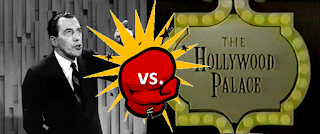
During the 60s, the Ed Sullivan Show and The Hollywood Palace were the premiere variety shows on television. Whenever they appear in TV Guide together, we'll match them up and see who has the best lineup..

Sullivan: Ed's guests include Victor Borge, singers Tony Bennett and Leslie Uggams, actor Pat O'Brien, the folk singing Women-folk and the clowning Cairoli and Company. A group of Irish boy singers from County Wexfort, John F. Kennedy's ancestral home, pay tribute to the late President by singing two of his favorite songs: "The Boys of Wexford" and "Kelly, the Boy from Killane."

Palace: Host Arthur Godfrey welcomes comedian Shelley Berman, singer Dorothy Collins, Dwight Moore and His Mongrels, singer John Gary, the comedy team of Gaylord and Holliday, and the Dalrays, mimes. 

The informal tribute to President Kennedy offered on Sullivan isn't something that Palace could be expected to match; setting that aside, Tony Bennett and Leslie Uggams provide star power, and pianist Leonid Hambro, mentioned in the lede, was a regular foil for Victor Borge. As for Palace, a lot of its appeal is going to depend on how you feel about Arthur Godfrey. John Gary and Dorothy Collins are tops, and Shelley Berman is almost always funny. If you include the JFK tribute, then it's almost impossible to vote against Sullivan; without it, I think this week is a Push.

l  l  l
From 1963 to 1976, TV Guide's weekly reviews were written by the witty and acerbic Cleveland Amory. Whenever they appear, we'll look at Cleve's latest take on the shows of the era

We've often discussed "wheel" series, ones which consist of three or four different shows that appear on alternate weeks; think of the NBC Mystery Movie, for example. But this week Cleveland Amory looks at a wheel of a different shape, NBC's 90 Bristol Court, which isn't three-shows-in-one as much as it is one-show-in-three. It is, in essence, a 90-minute program consisting of three separate sitcoms—Karen, Harris Against the World, and Tom, Dick and Mary—all set in a Southern California apartment complex called, appropriately, 90 Bristol Court. None of the shows interact with each other, but they're all loosely connected through the presence of the complex's handyman, whose presence is confined mostly to making asides to the viewers. What all this really accomplishes is the opportunity for Cleve to take on three shows at once, and that's very bad news for at least two of them.

The best of the three, Harris Against the World, stars Jack Klugman, and while he "has always been good, and sometimes wonderful," the show itself is praiseworthy in that it "can be very funny." Mrs. Harris, played by Patricia Berry, is fine, and the supporting cast includes Hope Holiday, Elliott Reid, Hans Conried, and Joyce Jameson, all of whom provide fine foils for Harris. It is, says Amory, the only one of the three that can be recommended "with real confidence." As for the other two, the night begins with Karen, starring Debbie Watson as the title character, and Amory's conclusion is that "In none of the episodes we've seen has there been a single redeeming feature, ecept the song about Karen at the beginning [performed by the Beach Boys], and even that is reminiscent of a number of other shows." And the 90 minutes wrap up with Tom, Dick and Mary, with Don Galloway, Steve Franken and Joyce Bulifant, and without going into details, the show does, at least, "have the temerity to make fun of the medical profession." There are also some good nonsticky slapstick moments. Faint praise, indeed.

None of the shows, Amory says are terrible by themselves, but taken as a whole, "the plain fact is that running three none-too-original and all-too-similar half-hours into one hour-and-a-half total not only doesn't make a good three-act comedy, it doesn't even let you fully appreciate the occasional half hour that is good." That half hour, of course, is Harris. Based on the above, you can rightly assume that 90 Bristol Court, as a concept, doesn't last the season. One of the segments does manage to survive on its own; however, and sadly for Cleve, that one is Karen, which survives until April; the other two, as well as the concept itself, is foreclosed in January. 

l  l  l


Thanksgiving issues, along with those from Christmas, are unquestionably my favorites. It was always a time of great anticipation, to get the TV Guide and see the listings for the parades, the football games, the specials, and anything else that might be on. Thanksgiving, 1964, is no exception, and once again it doesn't let us down.

Things get started early; on The Today Show (7:00 a.m., NBC), Hugh Downs airs interviews taped last week in Europe, in which he reports on how American GIs will be spending Thanksgiving Day. On Captain Kangaroo (8:00 a.m., CBS), the Captain talks about the Pilgrims, and Mr. Green Jeans reads "The Doubtful Pumpkin Seed." They'll be sticking around after the show to anchor CBS's coverage of four Thanksgiving Day parades, with Bud Collyer and Carolyn Mignini, Miss Teenage America 1965, covering the Macy's Parade in New York; Allen Ludden and Shari Lewis reporting on the Gimbels Parade in Philadelphia; Arthur Godfrey and Bess Myerson doing the honors at the J.L. Hudson Parade in Detroit; and Canadian-born Art Linkletter hosting taped coverage of Eaton's Santa Claus Parade. Coverage runs until 11:00 a.m., leading up to football. I always enjoyed the CBS parade coverage; I'd sit there watching the parade and looking through the toy catalogs from Sears and Penneys. Ah, a child's life.

At NBC, Lorne Greene and Betty White host the Macy's Parade, including exclusive coverage of the entertainment staged at Herald Square. The balloons have always been the featured attraction, and this year Bullwinkle, Elsie the Cow, Popeye, Donald Duck, and Dino the Dinosaur are joined by Linus the Lionhearted; the Rockettes, Fred Gwynne and Al Lewis from The Munsters, Bil Baird, Soupy Sales, and Fess Parker are also part of the fun. Interesting note: NBC's coverage runs 90 minutes, far preferable to the bloated and commercial-laden three hours that we now get.

I mentioned football earlier, and the games kick off with the traditional NFL Thanksgiving Day tilt in Detroit. There's a new twist this year, though: after 13 years, the Lions will no longer be playing host to the Green Bay Packers; from now on, they'll face a different opponent each year. This year the Lions take on the defending champion Chicago Bears (11:00 a.m., CBS); the Bears come out on top, 27-24. NBC offers collage football at 1:30 p.m., with one of the South's great rivalries, the Iron Bowl, pitting Auburn vs. Alabama from the neutral site of Birmingham. Alabama takes the prize, 21-14, en route to the mythical national championship. The day's fun wraps up with the AFL contest between the Buffalo Bills and San Diego Chargers in San Diego (2:30 p.m, ABC); in a preview of this year's AFL championship game, the Bills come out on top, 27-24. (They'll win the title game next month as well.)

A couple of entertainment specials round out the day; first, Dean Martin, Eydie Gorme, and Al Hirt unite for Your All-Time Favorite Songs (6:30 p.m., NBC), chosen by a Reader's Digest poll. The choral director for the hour is Dick Williams, one of the famous Williams Brothers, the most famous of which being Andy; Oscar nominee Jerry Fielding serves as musical director. You can see a clip of it here. And singer Jo Stafford welcomes actor Kenneth More and song-and-dance man Roy Castle to her hour-long special. (7:00 p.m., WISN in Milwaukee) It's a day and night of entertainment that the whole family can enjoy.

l  l  l

In industry news, Los Angeles DJ Bob Crane, who plays the next-door neighbor on The Donna Reed Show, will be leaving the series after this season, possibly for one of his own. It's true: the series is Hogan's Heroes. There's also talk that Milton Berle is working with Danny Thomas to return to television with a half-hour series: one that isn't Jackpot Bowling. That never materializes, but following a number of successful guest spots, Berle does come back with The Milton Berle Show in 1966, but it's a brief one. Peter Jennings has become the second Canadian correspondent to be added to ABC News, joining Baden Langton, with whom Jennings anchored the CTV National News. Langton returns to Canada in 1967, two years after Jennings takes over ABC's evening news. And that NBC special about John F. Kennedy that I mentioned in the lede—more than 24 countries have signed up to air it.

Meanwhile, NBC plans a new musical show for January in the event of a vacancy in the schedule. The series is Hullaballoo [sic], and it debuts on Tuesdays when The Man from U.N.C.L.E. moves to Mondays. Another series scheduled to debut in January is Branded, a new Western starring Chuck Connors, which will take the place of NBC's The Bill Dana Show, the first cancelled series of the season. Branded will be unique in that it's the only half-hour Western on network television. 

l  l  l

How about just a little more football? It's possible that nothing, save perhaps politics, has been changed by television more than sports. And the sport that has benefitted the most from television is, without doubt, football. In January, CBS paid the National Football League the princely sum of $28,200,000 for the right to televise games for the next two seasons.* For that kind of money, the network figures they have the right to call the shots, and William C. MacPhail, CBS's vice president in charge of sports, is the man to do it. He is, as the cover states, "Pro Football's New Boss."

*This in answer to NBC's five-year, $36 million contract with the American Football League, scheduled to start in 1965.

The network has some interesting innovations in mind. In the past, CBS assigned a play-by-play announcer and color commentator to work with each team. "You should feel you're almost with the club first, and with CBS second," they had been told. In a game between Chicago and New York, for example, viewers that generally get Chicago's games would hear the Chicago announcing crew, while those in the New York market would here that team's crew. Now, however, CBS wants the two play-by-play announcers to work together, alternating each quarter, while the color commentators would report from the sidelines. The network thought this was a great idea, a chance to capture what MacPhail called the "inside scoop." 

The announcers, on the other hand, didn't like it much; it broke up a team that was used to working together—a team that viewers, in many cases, liked—and the value of the information they picked up on the sidelines was questionable. Besides, if they happened to be in the vicinity of the losing coach, they might pick up some colorful language in the process. Neither did many coaches, a noticeably circumspect group. However, when it was explained that each team was making roughly $1 million a year from the TV contract, the coaches' objections were overcome. The system was quickly put to the test when the cameras cut unexpectedly to sideline reporter Pat Summerall, who ad-libbed with some pertinent information he'd been given by the New York Giands head coach. Summerall neglected to mention that the coach had given him this information several days earlier, during a production meeting. (In fairness, Summerall never claimed it was something he'd just been told.) The network said it was merely poetic license. 

Then there was the idea that the sideline reporter would speak with the game officials turing time outs to get their explanations on various calls they'd made. Mark Duncan, the league's supervisor of officials, thought that was a terrible idea, and said so in so many words. Until, that is, CBS expressed its disappointment. Duncan agreed to ask the head officials at each game to make themselves available to reporters. Finally, the league wanted the scoreboard clock to show the "official" game time; presently, the official time is kept by one of the officials on the field, and the scoreboard clock only indicates the "unofficial" time. CBS pointed out, quite reasonably, that being able to show the official time in the last moments of the game would add to the drama and suspense. The league said they'd see what they could do.

A lot has happened since this article was written. Sideline reporters are a staple of modern television coverage, although coaches still don't like talking to them and the information they impart is frequently trivial. The referees don't talk to the sideline reporters, but every network has its own in-house rules expert, a former official, to try and explain what the officials are doing. The scoreboard clock is now official, and has been for many years, but it's not used on broadcasts; instead, the networks' graphics are now synchronized to the game clock, and shown continuously on the screen.

One other thing has changed as well: there are more commercials, and more commercial interruptions, than ever. Cash, after all, speaks louder than words.

l  l  l
 
MST3K alert: Attack of the Giant Leeches
(1959) Milwaukee TV Debut. A Florida game warden investigates mysterious deaths in the Everglades. Ken Clark, Yvette Vickers, Jan Shepherd, Michael Emmet, Tyler McVey, Bruno Ve Sota, Gene Roth. (Friday, 11:30 p.m., WISN in Milwaukee) This time, it isn't just the movie that sucks! We've got a hero who's a jerk, a sheriff who's an idiot, a cheap hussey, a fat guy, and monsters that suck the lifeblood out of their victims. I ask you, what more could anyone look for in a movie? TV  

December 6, 2023

When real life intrudes


This seems to be as good a time as any to remind you that, although the It's About TV channel on YouTube doesn't have a lot of content, it does have a playlist devoted to the Christmas programs that comprise such a part of the holiday memories you and I share. These shows, along with a healthy number of movies, animated specials, and variety shows, will make up the bulk of our television viewing for the next month. I first made this available last year, and since then I've been able to add several new programs, which I hope you'll enjoy as much as we do.

But let's take a time out from our Yuletide festivities to look back a couple of weeks at Thanksgiving. It does sometimes seem as if Thanksgiving gets short shrift, a metaphorical speed bump on the way to Christmas, although the recent trend away from having stores open on Thanksgiving seems to have scaled back. But back in the day, when variety shows were common, it was also common to have Thanksgiving-themed shows on or near the holiday, and today we'll take In a look at couple of these shows, ones that have a time capsule significance apart from their entertainment value. 

I've written about time capsule moments before, those moments that provide us a glimpse into what the world was like when these shows were aired. They're more subtle than surface appearances like hair and clothing styles, or the kinds of music being played; oftentimes they're left unsaid, requiring the viewer to read between the lines, and if you're not able to put the show into the context of when it was aired, it you might miss it altogether.

One such moment occurred on the Thanksgiving episode of The Jimmy Dean Show, which, appropriately enough, aired on Thanksgiving night, November 28, 1963. It's a fun episode, with the McGuire Sisters, the Jubliee Four, Don Adams, the Crum Brothers, and Rowlf, the Muppet dog who was a regular on the show. Adams contributes a very funny bit where he plays a defense attorney, and a charming scene in which Jimmy and Rowlf talk about what there is to be thankful for. 

The moment comes near the very end of the show, and you have to listen for it. The entire cast has just finished singing "Home for the Holidays," and the spotlight falls on Jimmy. Against a dark background, he sings the Gospel song "How Long Has It Been?" and then, after a breath and with some evident emotion, he says, "It's been a trying week, on the entire world. Sometimes, things look very black. But may we all remember that we still have a great deal to be thankful for." The cast then reunites to sing, "Bless This House."  

That could be taken as nothing more than a normal, if somewhat darker than usual, reflection on the state of the world, and the need to be thankful for what you have. But it has a much more significant meaning when you place it in historical context. It had indeed been a trying week; the last time the show had aired, on November 21, John F. Kennedy was president of the United States, and spending the weekend in Texas. Since then, Kennedy had been assassinated, his accused assassin had been murdered, and Kennedy had been laid to rest. The funeral and burial took place on Monday, November 25; the new president, Lyndon Johnson, delivered a speech to the nation two days later, on Wednesday, November 27. It's now Thanksgiving Day, but it was a somber one for most people, who very well might have wondered what there was to be thankful for. Yeah, that was a hell of a trying week.

I don't know when this show was taped, and I'd love to find that out. It could be that it had been taped days in advance, and Dean had returned to the studio to record his comments, after which the scene faded to merge with the ending as originally recorded. It's also possible that the show had been done that very week, a day or two before Thanksgiving. Either way, it seems obvious to me that Dean felt it imperative to address the situation, and that he did so in a heartfelt manner, with a couple of sentences that didn't require any other explanation—everyone back then would have known to what he was referring. Regardless, it's a very powerful moment, an intrusion of the real world into the world of entertainment.

The second example comes from an Alan King Thanksgiving special that aired on Tuesday, November 25, 1980, two days before Thanksgiving. Its subtitle is, "What Have We Got to be Thankful For?" and it plays into the acerbic, "kidding-but-not-really-kidding" humor that King was known for. Watching it this year, I have to admit I'd forgotten about some of the events King references, including the infamous Abscam investigation that caught several members of Congress trying to sell their influence in return for large amounts of cash. No wonder King suggests in his opening monologue that there has been "a breakdown of moral fiber."

King goes on to take shots at the economy (bad), the recent actors' strike and the fall TV schedule (bad), and a growing sense that Americans are becoming apathetic to it all. There are several references to the election of the new president, Ronald Reagan, which gets sustained applause from the studio audience. There's also an extended, and very funny, bit in which King attempts to explain the madness of the Middle East in 1980, including the war between Iran and Iraq, the growing involvement of the Soviet Union (including in Afghanistan!), and other complications that remind us how the Middle East has always been a tinderbox and a mess. And that leads to our second moment.

In a show filled with topical humor, it can be hard to identify a moment that can be said to travel under the radar, but it comes, again, at the end of the show, as King concludes with a prayer for the nation, for  both the incoming and outgoing presidents (itself something you probably wouldn't see nowadays), and for the viewers, he adds, "If I can ask for an old favor that you granted us once before, see if you can get the Ayatollah [Khomeini] to let our people go."

That's right—the hostage crisis! It's easy to forget that the hostages hadn't yet been freed; that wouldn't come until January 20 of the following year, after Reagan had been sworn in as president. And remember that, although we all know how things turned out, nobody knew that back in November, 1980. I don't recall whether or not King had explicitly mentioned the hostages prior to that moment; I kind of doubt it; it isn't the kind of thing you'd joke about. No, this is a subtle, but knowing, reference to an event that was, again, hanging over everything. It's also heartfelt, as opposed to a bid for cheap applause; bipartisan, rather than attempting to score points. I don't know if entertainers would handle it that way today.

Maybe I make too much of moments like these, but I think there's value to them. They remind us that television is a part of history—our shared history—and that, like anything else in history, it doesn't occur in a vacuum. Television, like other forms of entertainment, often seems to come from the world of make-believe (and there definitely isn't anything real about reality television), but every once in a while, the real world shows itself, and when that happens, it's worth remembering. 

These shows can be found on the Christmas playlist as well, and I'll be adding more as the opportunity arises. TV  

November 24, 2023

Around the dial


Wednesday was the 60th anniversary of the assassination of John F. Kennedy, and Garry Berman tells us about the effect it had on the world of comedy: the behind-the-scenes story of the British satire series That Was the Week That Was, and the scramble to prepare a tribute to JFK for the November 23 show; Neil Simon making a pitch for two of his comedies; and Vaughn Meader's career.

There were all sorts of unexpected television ramifications from that day, and the Broadcast Archives links to a piece by Michael Hayde on an "unfortunate" listing in TV Guide for December 4: a live program called "The Kennedy Awards," sponsored by the Joseph P. Kennedy Jr. Foundation, at which JFK was scheduled to appear. I'd not heard of this one before; it's a show that never took place.

Long before the politicians of the day, the Kennedys were intertwined with Hollywood, thanks to papa Joe's involvement. Find out more about that, as well as the Hollywood connections of the future president, in Maddy's interesting piece at Classic Film and TV Corner. 

At Drunk TV, Paul does exactly the kind of thing I love to do: look back at past holidays and see what was on TV. In this case, it's Thanksgiving 1971, and I can identify with it: studying the listings to plan out your day's viewing, watching the parades (which often seemed a vague letdown), the special movies and cartoons (with, yes, too many songs), and—for me, at least—the football, including one of the greatest college football games ever played. Not like that anymore, but we still have the memories.

Nothing to do with TV, but I agree 100%: at A Shroud of Thoughts, Terence opines on why it's too soon for Christmas, and why Christmas doesn't end on December 25, but is just getting started. As he says, "Everything has its own season. I want to celebrate Halloween, the Day of the Dead, and Thanksgiving before I get to Christmas."

However, television networks don't happen to see things that way; they've got their holiday programming all queued up, and Joanna is here, or at least at Christmas TV History, with a handy guide to where and when many of those shows and movies can be seen. I'll be the first to say many of these are not my cup of tea, but who am I to play Scrooge at this time of year? Tune in next Wednesday, and you'll find out.

At Comfort TV, David's journey through 1970s TV continues with Tuesday night, 1973. It's a night of favorites old and new: NBC's Police Story being the new, while ABC's Marcus Welby, M.D. and CBS's Maude and Hawaii Five-O being the old. A good night for television; even Hawkins, the single-season series starring Jimmy Stewart, wasn't bad. 

John takes a pause from his own travels through the '70s at Cult TV Blog to bring us The Organisation, ITV's 2005-06 supernatural series that takes the tropes of the classic Victorian ghost story and brings them to our time, along with a meditation on life and death and the afterlife. I like that kind of ambition in a series.

Hopefully today finds all of you still basking in the glow of a most happy Thanksgiving, and that if you dared to go out on Black Friday (is that still a thing in the stores, or is it all done online now?) you found everything you were looking for and returned safe and sound. TV