November 12, 2013

It's true - travel does broaden the mind

One of the things I've noticed in looking through TV Guides of the 1960s is that there used to be a lot of travel shows on TV.  In other words, The Travel Channel isn't anything new. Specials, weekly series, travelogues - many of them in color.  It's one of the things we tend to forget, with travel having become so ubiquitous, that it wasn't always thus, and many people got their first glimpses of life in other parts of the country, or the world, through television (and newsreels before that).

When Edward R. Murrow's See It Now premiered in 1951, both he and the viewers were impressed by television's ability to show, for the first time ever, live pictures of the Atlantic and Pacific Oceans simultaneously.  Seeing both Oceans, even if it were only on television, was something that many people could only hope to experience in real life.

This came to mind the other day when, while watching Barclays Premier League soccer, I saw an ad for Dubai's bid for Expo 2020, otherwise known as the World's Fair*.  Commenting on it, my wife replied that she wasn't even aware that World's Fairs were still being held.  Indeed, Expos are now only held every five years or so, and I can't really remember the last one that made big headlines.  Perhaps it was Expo '67 in Montreal, which birthed the name of a baseball team, or the 1962 World's Fair in Seattle, which gave us the Space Needle.  The 1939-40 World's Fair in New York - the "World of Tomorrow" - is one of the most iconic ever, and the 1933-34 "Century of Progress" in Chicago included an exhibition baseball game that continues to this day - the All-Star Game.

*Alright, a "Registered Exposition," if you want to be technical about it.

One of the last iconic fairs, at least in this country, was the 1963-64 World's Fair in Flushing Meadow, New York.  There seems something so "modern" about it - not just the times, but the architecture, such as the Unisphere, that fair's version of the Trylon and Perisphere.  There's also the idea that the wondrously exotic world of the Fair, which up until now had been something one could see only at the Fair itself, was now available to anyone.  The jet age, the age of Pam-American and TWA, meant that world travel wasn't just for the select few, but now was available to a broader section of Americans.

NBC's Edwin Newman hosted a documentary on that World's Fair, one of the earliest existent color broadcasts still available.


There's something both progressive and innocent about the fair. I like the idea that a lumberjack competition could be considered exotic, just as much as the wonders of the Orient. Again, it's a glimpse at a time that offered a glimpse into a world few people had seen - but, as the song of the time said, "It's a small world."

The special is complete on YouTube in six parts.  Part 1 is above; here are the links to Part 2, Part 3, Part 4, Part 5 and Part 6.

November 9, 2013

This week in TV Guide: November 9, 1968

Last week we dabbled in food, sharing a TV Guide recipe for minestrone. This week we go even farther, as Richard Gehman tells us how "You too can be a chef" by watching The Tonight Show with Johnny Carson. You see, Carson makes a perfect companion for the hungry view (and Gehman finds himself, for some unknown reason, starved every time he watches Carson).  Forthwith, Gehman's complete late-night supper, made during a recent episode of Tonight.

Start with the small potatoes, which can be prepared for boiling during Carson's commercial for a new spot remover.  You can do the whole thing from your easy chair while Don Rickles comes on and insults everyone in sight.  As Rickles continues, it's time for you to separate slices of chipped beef, which you've brought to your easy chair along with the spuds.  As Ed McMahon shills for Alpo, take the separated beef to the kitchen, toss the potatoes in a pot for boiling, and while you're there put an eighth of a pound of butter in a frypan which has been preheated to 300°.  Turn up the TV while Sergio Franchi is singing, so you can hear him while toasting two slices of bread and opening a can of peas.  With the next commercial, you can drain the potatoes and toast a couple more slices of bread.  The next guest, possibly George Jessel, allows you to chop a fresh green or red pepper.

When the show pauses for a station break, that's your chance to add two tablespoonfuls of sifted flour to the sizzling butter, stir with a whisk, and add a half teaspoonful of salt, a couple of pinches of dried parsley, a very small dash of oregano and some pepper, preferably fresh-ground.  You can add a half-cup of water while the next singer (probably named Connie) warbles away.  Add the chipped beef to the mixture when shills for a sewer-cleaning device, along with a half-cup of milk, stirring until the mixture bubbles, at which time you include the drained peas.

This whole thing should take you to within about ten minutes of the end of Carson's show.  During the next-to-last commercial, add a tablespoonful of capped black pitted olives, and as Carson interviews his final guest (Mary Martin Mary McCarthy, Mary Healy, or maybe Mary Queen of Scots), you can serve your creamed chipped beef, either on the toast or the potatoes you've put on the side.  Turn off the set.  Eat heartily.

I don't know.  I don't think I can eat that heavy a meal right before bedtime.

***

During the 60s, the Ed Sullivan Show and The Hollywood Palace were the premiere variety shows on television. Whenever they appear in TV Guide together, we'll match them up and see who has the best lineup..

Sullivan: Tentatively scheduled guests: singers Tom Jones, Vikki Carr and Jimmi Hendrix; comedians Wayne and Shuster, and Scoey Mitchell; the Chung Trio, instrumentalists; and Valente and Valente, balancing act.

Palace: Host Mike Douglas presents Polly Bergen, Sergio Mendes and Brasil '66, Donovan, comics Hendra and Ullett, juggler Rudy Schweitzer and the Solokhins, balancing acrobats from the Moscow State Circus.

Once again, KMSP, the Twin Cities ABC affiliate, has seen fit to tamper with the schedule of Hollywood Palace.  The station had a frequent habit of pre-empting the network's prime-time fare for local programming (and the accompanying ad revenue) - in this case sixing ABC's Saturday night shows (after Lawrence Welk, of course) in favor of a movie (Back Street, with Susan Hayward)*, and airing Palace on Sunday afternoon (opposite NFL football).

*Full disclosure: looking at the picture of Susan Heyward in the movie ad, I think I would have preferred Back Street to the Palace myself.

Be that as it may, I love these examples of the variety show adapting to contemporary culture.  Vikki Carr is a traditional songstress, Tom Jones epitomizes the power of sexual dynamism, and Hendrix - well, he's out there in an area code of his own, isn't he?  Case closed - the verdict goes to Sullivan.

***

On the cover this week is Barbara Feldon in marryin' garb, and inside is a layout of Feldon in the year's smartest outfits..  The hook is the upcoming wedding of her Get Smart character, Agent 99, to Don Adams' Maxwell Smart, but it's clear that there's more to Feldon than meets the eye - or the secret agent, as it were.

SOURCE: HADLEY TV GUIDE COLLECTION

***

Last week we also took a look at the story of PBL, the experimental new Sunday night program launched by NET. (I don't have anything to check on in this week's edition; KTCA, the Twin Cities' educational channel, is dark this Sunday.)  This week we read of the network's plans to add a half-hour prime-time news program. James White, head of NET, hopes to have the newscast on by the fall of 1969.  I don't know that it ever happens; if it did, I've not seen any evidence that it was shown in Minneapolis.  It may well have been broadcast in one of the network's larger markets, such as New York, Washington D.C. or San Francisco.  But a newscast delayed is not a newscast denied; following their coverage of the Watergate hearings, Robert McNeil and Jim Lehrer begin The McNeil/Lehrer report, which quickly goes nationally and continues today as PBS NewsHour.  White had said that he would seek "top-ranked commentators" - there's no arguing that's what they got.

And in one more follow-up from that piece, the Hawaiian Open golf tournament is back, and this time the broadcast really takes advantage of the time difference - Saturday coverage starts at 7:30pm CT on Channel 11, with the final round airing Sunday at 7:00pm.

***

The week's football is kind of a meh, but Stanley Frank provides a fascinating look behind-the-scenes at what happens in the television control booth.  The focus is on CBS' coverage of the season opener between the New York Giants and Pittsburgh Steelers, where announcers Frank Gifford and Jack Whitaker go through the preparation for the week's game with the production team, producer Bill Creasy and director Chris Erskine.  Gifford runs through each team's tendencies, gives insight on key players, and advises the team on what to look for.  (Bobby Walden, the Pittsburgh punter, has "been known to pass from kick formation.")

Covering football has changed dramatically over the years.  There are five color cameras assigned to the game: three near the 50-yard line, one on the sidelines, one behind an end zone.  (By contrast, the average game today uses at least twice as many, and NBC has 40 for its Sunday night broadcasts.)  CBS gets off to a rough start; despite Gifford's warning that Steelers running back Dick Houk had the capability of throwing on the option play, the cameras miss his 62-yard pass on the game's first play.  Later in the first half Erskine cuts to the field-level camera as Giants quarterback Fran Tarkenton unleashes an 84-yard pass to Homer Jones; the ground shot "projects the speed and power of the players but loses a panoramic view of the field," blowing the live shot.  An instant replay showing the completed pass doesn't make up for Erskine's frustration at missing the original play.

Click to enlarge
The game continues through to a 34-20 victory by the Giants, a dull affair that, as Frank notes, proves the truism that "false excitement cannot be pumped into an event."  Despite the early glitches, the broadcast goes well, and Gifford's tip about a fake punt means the cameras are in perfect position when Walden does in fact opt for the pass in the fourth quarter (which was dropped).  It's particularly interesting to note how commercials were treated back in the day: under the current agreement, CBS can ask the officials for a commercial time-out "if there has been no natural break in the action during the first seven minutes of a quarter."  The referee misses the network's initial fourth quarter signal, and Creasy nixes a commercial during a first-down measurement.  ("We can't interrupt a drive.")  The network is eventually bailed out by Giants kicker Pete Gogolak, who obligingly kicks two field goals to provide natural breaks for the spots.

Televising a game is tough work for everyone; as Creasy says after the game's end, "I feel as though my eyes are falling out of my head, and they pop out a little farther every week."

***

Us classic television fans remember Robert Young as the wise Jim Anderson on Father Knows Best, or the kindly family doctor Marcus Welby, M.D., but Young was a fine actor who wasn't above showing an edge in his work.  We're reminded of that in Friday's episode of NBC's Name of the Game, as Young plays Herman Allison, "an ultraright fanatic who's building a private army" to guard against the growing race problem.  Gene Barry, one of the three stars of Name of the Game, enters the scene while investigating the death of an investigative reporter, and runs into a cast of characters that includes an influence-peddling former senator, a washed-up actress, a restaurateur, and another murder.  Name of the Game currently plays on Cozi, so you might be able to catch this one.

It's just another indication of the sign of the times, as we can see in a Letter to the Editor from Doris Mathews of Checotah, Oklahoma.  Miss Mathews writes in praise of a recent special called Soul, which could have been any one of a number of specials but was probably a public broadcasting series of the same name.  In the letter, she says "The Negro 'Soul' special was fabulous.  More shows like this should be aired so that the whites can see all the talent among the Negro people."  Wince-inducing to modern ears perhaps, but this is a time not far removed from the infamous interracial kiss on Star Trek, which caused NBC so much trouble in the South.

Thomas J. O'Neal of New Orleans has a hilarious take on Howard Cosell, who's not quite the household name he'll become in two years thanks to Monday Night Football, but has become plenty familiar thanks to ABC's coverage of boxing - especially Muhammad Ali.  In response to an October 19 article entitled "I'm Irreplaceable" (I'm assuming Humble Howard is speaking of himself here), O'Neal writes "In musing over the word 'saturnine,' which Howard Cosell believes everyone 'ought to learn,' it occurred to me that this Argus-eyed, stentorian Palladium of narcissism should pause on his commercial odyssey, pick up his aegis, take his Antaean virtues and his cornucopia of money - and paddle down the Stygian Way to Hades.  [That's "go to hell," for the rest of us.]  Cosell, you are a myth!"  Couldn't have said that better myself.

I'll defer to the following as the Letter of the Week, though, as it checks a number of boxes that I've written about in the past months.  Karen Fiedler, of Columbus, Ohio, has CBS' new Western series Lancer in mind in her letter.  "Lancer is based on the fact that Murdoch Lancer [Andrew Duggan] was shot so badly he had to send for his boys, Scott [Wayne Maunder] and Johnny [James Stacy].  Scott gets shot int he first episode, Johnny gets shot in the second, and Scott gets shot again in the third by a family trying to avenge Johnny's killing of one of their brood.  Johnny is forced to shoot one of them because they shot Scott.  Luckily everyone recovers quickly except the bad guys.  It is certainly a joy to view the new lack of violence."  Got all that straight? TV  

November 7, 2013

Around the dial - JFK, Thanksgiving and more!

Recently I got a very nice email from Marc Ryan, in the course of which he mentioned his e-book Three Shots Were Fired, a look at the coverage of “TV’s first global story,” the assassination of John F. Kennedy. Regular readers know of my interest not only in the Kennedy assassination itself, but in the media coverage during and after the event, and so it should come as no surprise that Marc’s book is right up my alley, one that’s going to find its way to my Kindle queue sooner rather than later. Marc also has an informative blog supporting the book. Do check it out!

With Thanksgiving just around the corner, Kevin Butler has a great piece up at TVParty! reviewing the history of CBS’ Thanksgiving Day Parade Jubilee coverage.  Growing up, I always preferred CBS’ multi-parade coverage, which included (at various times)New York, Detroit, Philadelphia, Toronto and Hawaii, to the bloated Macy’s broadcast on NBC.  Alas, there’s not much difference between the two anymore, which is why I’ve switched over to WGN’s broadcast of the McDonald’s Thanksgiving Parade in Chicago. 

At About Last Night, Terry Teachout links to the broadcast of Gian Carlo Menotti’s opera The Medium, originally broadcast on CBS’ Studio One in 1948.  I own this broadcast myself (probably the oldest TV show in my collection), which was part of the very good boxed set of Studio One productions that came out a few years ago.  It never ceases to amaze that operas were once a regular (if infrequent) part of television.  I admit a bias in that Menotti is one of my favorite composers, but this broadcast shows just how tight and suspenseful an opera can be without taking any more than an hour.


More great stuff coming your way on Saturday - don't miss it! TV  

November 5, 2013

Us vs. U.S.

One of my goals with this blog has been to use the television lens to trace changes in American culture, and one of the most significant, if subtle, examples of this can be found in the nomenclature of television news anchormen when referring to the U.S. Government.

I suppose if you're of a certain age, you wouldn't even notice that there had been a change, an evolution in the way the news reporter thinks of himself.  And perhaps this change isn't universal; it's been so long since I've had the stomach to watch network news that I may be completely off-base here.  But what I'm talking about here is the idea that reporters once viewed themselves - and identified themselves - as Americans.  You watch and in their words there's almost a pride of ownership when Walter Cronkite refers to Adlai Stevenson as "our Ambassador to the United Nations," or when Bob Young, giving Vietnam casualty reports, says that "1,842 enemy troops" were killed.   Who can tell who the enemy is nowadays?

Today, I think it more likely that Stevenson would be called "the United States Ambassador to the U.N.," and that the troop casualty figures would be reported with more of a grammatical dispassion.  That's not entirely bad, mind you; I think objectiveness is generally a good thing when it comes to news reporting.  I'm not going to get into any suggestions of political bias here, because I try to keep this a partisan-free zone, but let's face it - there have been accusations of a liberal bias for decades, and Fox News can often sound like a shill for the GOP.

And yet there's something almost touching about those old days.  It's as if reporters understood that while their very occupation set them apart from others, they were still part of a larger collective - they were part of the media, yes, but they were also part of America.  When John F. Kennedy was assassinated, it wasn't only a news event, but a personal one as well.  Kennedy was a world leader, but he was also their president, and they reacted not as journalists, but as Americans.*

*Many of them were also personal friends of JFK, but there's something more at work here.  Jay Watson, news director of WFAA in Dallas, had seen Kennedy in the motorcade just moments before the assassination.  He applauded Kennedy, not out of a partisan sense but because he was showing the respect due the office.

I suppose this all changed during the Vietnam/ Watergate era, when the media become more political, more adversarial.  I first became cognizant of this dynamic during one of those media roundtable discussions that Fred Friendly used to conduct on PBS.  A question arose, and I'm going by memory here so I may be off on the details, but the gist of it was that in reporting battle action, a correspondent comes upon information of a pending attack upon American troops.  Does the correspondent let them know?  The panel, which as I recall included Peter Jennings and Mike Wallace, agreed to varying degrees that their jobs made them journalists first, Americans second.*

*Yes, I know Jennings was Canadian.  But you get the point - the assumption was that he would have been on "our" side.

Wait - Here it is!  Amazing what you can find out on the Internet.  The scenario posed was thus:

In 1989, ABC's Peter Jennings and CBS's Mike Wallace were asked, "In a future war involving U.S. soldiers, what would a TV reporter do if he learned the enemy troops with which he was traveling were about to launch a surprise attack on an American unit?" Wallace responded that, ideally, journalists would "regard it simply as another story that they are there to cover." Jennings initially indicated that his first move would be to "do what I could to warn the Americans." But after hearing Wallace's comments, he changed his response, admitting, "I think [Wallace is] right . . . I chickened out."

I don't know how the journalists of the 50s and 60s felt, but something suggests to me that they would have viewed an attack on American troops as an attack on them.  If I had the time (and maybe I will sometime), I'd go back and look at the differences (if any) between coverage of Pearl Harbor and 9/11.  Would there be differences?  What do you think?*

*An interesting comment from the site I linked to above, from Philip Meyer, who at the time of this comment held the Knight Chair in Journalism at UNC: "Paraphrasing George Washington, 'When we assumed the journalist, we did not lay aside the citizen.' Journalists in World War II followed that maxim. The postmodern drift toward rejection of all authority has weakened it, but, when there's a real war, we remember who we really are."  The question thus becomes: has today's journalist laid aside the citizen?

At any rate, whether journalists have become more professional, whether they belong to what Jeanne Kirkpatrick referred to as the "Blame America First" crowd, or whether they're simply a product of our cynical times, I think this does suggest a difference in how reporters view the relationship between themselves and their country.  And in that sense, it seems a perfect mirror of how the feelings of our own society have changed.

November 2, 2013

This week in TV Guide: November 4, 1967

Back in the day – “the day” in this case being before DVDs, before VHS, before even TCM – there were only two ways to catch classic movies. One was to see them in a revival or art house theater, the other came courtesy of The Late Late Show on local TV.

My personal guide to the classic movie was the Academy Awards program listing that appeared each year in TV Guide. As a studious lad in college, I’d spend the last half-hour or so of each day in the periodicals stacks of the library, going through bound issues of TV Guide from the past dozen or so years, developing the pop culture interests that have stayed with me to this day. The Oscar Close-Up would feature pictures of the nominees for Best Actor and Best Actress, plus a list of the nominees in Picture, Supporting Actor and Actress, Director, and Song, and as a top-line guide to movies, it wasn’t bad. I’d make mental lists of the movies I hadn’t heard of, less well-known movies that struck me as interesting or at least intriguing, and I’d keep an eye out for them when they ran on local TV. I saw a lot of good movies that way – This Sporting Life (with nominees Richard Harris and Rachel Roberts), Séance on a Wet Afternoon (Kim Stanley), Tom Jones (the movie, not the singer – Best Picture of 1963), Becket (Richard Burton and Peter O’Toole), among others. Many of them were not what I expected at all, which increased my personal pleasure.

One of those little-known movies was a British film called The Mark, a bleak story of a man trying to rebuild his life after being released from prison for child molestation. It starred Stuart Whitman, an B-actor better known for television, who’d somehow copped a nomination for Best Actor. He didn't win – Maximilian Schell did, for Judgment at Nuremberg*), but The Mark was an obscure movie that was well worth watching.

*Fun fact: Maximilian Schell’s sister, Maria, was Whitman’s co-star in The Mark.

Stuart Whitman’s on the cover of TV Guide this week for what is probably his best-known role: Marshal Jim Crown in Cimarron Strip, CBS’ 90-minute answer to the mega-Westerns Wagon Train and The Virginian. Actually, Cimarron Strip bears more resemblance to another CBS oater, Gunsmoke – no surprise, since the series is helmed by that show’s former executive producer, Philip Leacock. Whitman hopes Cimarron Strip will be the start of a new stage in his career, which to date has consisted mostly of roles that had originally been intended for others: Darby’s Rangers (Charlton Heston), The Story of Ruth (Stephen Boyd), The Sound and the Fury (Robert Wagner), An American Dream (David Janssen). Even The Mark was inherited from Richard Burton, and despite the nomination, Whitman concedes, “I wasn’t sure I was in the right profession.” He feels that this role “is definitely going to hit me with an image. It’s the image that makes the star. I’m on the brink of the stardom that I’ve always sought and wanted. I wasn’t ready for it before.”

Whitman’s confidence in Cimarron Strip is misplaced – the show, perennially over-budget, will only run for one season – but his career will continue, never as the star he’d hoped to be, with a few more movie roles and plenty of guest appearances in series, not to mention a turn as Superman’s Earthly father in The Adventures of Superboy.

***
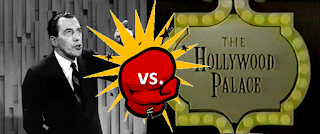
During the 60s, the Ed Sullivan Show and The Hollywood Palace were the premiere variety shows on television. Whenever they appear in TV Guide together, we'll match them up and see who has the best lineup..

Sullivan: Tony Bennett; jazz clarinetist Woody Herman and his Swinging Herd; singer Shirley Bassey; comedians Marty Allen and Steve Rossi, Rodney Dangerfield and Totie Fields; accordionist Dick Contino; and the Jovers, comedy-acrobatic team.

Palace: Host Sid Caesar, with Marlo “That Girl” Thomas; singers Sergio Franchi and Fran Jeffries; and the pop-rocking Checkmates.

Am I excited about this matchup? No, but there’s more than enough here to work with. ABC, in its infinite wisdom, has moved Palace to Tuesdays to make room for Dale Robertson’s Western The Iron Horse. (That move doesn’t last long.) The show has a mensch with Caesar, a miss with Marlo, and “meh” with the rest. By contrast, Sullivan packs more star power – and in a rarity for these old TV Guides, several of them are still going strong, including Bennett and Bassey*. I never cared much for Allen and Rossi, but they were big stuff in 1968, and Dangerfield was getting plenty of respect as well. And Woody Herman? Well, he was the halftime entertainment at Super Bowl VII. I assume there was no wardrobe malfunction involved. The verdict: Sullivan.

*Not sure who Shirley Bassey is? Listen to the theme to Goldfinger.

***

This week’s cover promises something different, and that something is PBL.

The Public Broadcast Laboratory, premiering Sunday, November 5, is a first for the nation's fledgling public television system: the first time a show will be broadcast nationwide on the same day at the same time.  It's intent, according to Richard K. Doan, is to "try just about everything its producers can think of that will demonstrate what Public Television ought to be."

The major domo of PBL is Fred Friendly, former head of CBS News, now the TV consultant to the Ford Foundation, which will be underwriting the venture.  Bossing the project for him is Av Westin, formerly executive producer of CBS' election coverage.  The host is Edward P. Morgan, ABC news anchorman, who is taking a two-year sabbatical from the network to helm the program.

Note the lit candle used as the "I" in the word
"Television" - possibly alluding to the flame in
the NET logo shown here.
The challenge to PBL is the challenge that PBS has faced ever since, in microcosm: "They do not want to appear to strive for broad mass appeal, a la commercial TV, and must perforce adopt the stance that since they are not interested in ratings they can afford, if they so choose, sometimes to devote their attention to a subject palpably interesting to 50,000 people" rather than the audience of millions that tune into commercial broadcasts.  At the same time, "it would be helpful to the cause of Public Television if they could create excitement at the very outset."  Failing that, the program "could be quickly dismissed as a dud."  It's this lack of identity, not to mention mission, that's plagued the network ever since.

Fish or fowl?  Experimental programs or Britcoms?  Classical opera or seniors-tour pop stars?  PBS has never really made up its mind, with the result that increasingly the network doesn't seem capable of doing anything exactly right.  It's hard enough when you try to be all things to all people, but as Doan points out, PBL has to "come on like Gangbusters and seem nonchalant about it."

Nowhere is this more evident than in the very structure of a typical PBL episode, which could include news, drama, satire, music, and discussion - all within one two-hour slot.  Originally, according to Ford Foundation president McGeorge Bundy, the show's objective was to "pull together the intellectual and cultural resources of this country to speak directly, once a week, to the great issues of the day in every field of action."  Westin, referring to the popular magazines of the day, vowed to present "everything from Harper's to Playboy - without the latter's centerfold."  At the same time, Westin talked of live drama with a regular repertory company, commentary ranging from political pundit Walter Lippmann to Groucho Marx, an "in depth" examination of vital issues such as Vietnam and race relations, and even "consumer reports done with the slickness of TV commercials."  The show might even go on the road from time to time, broadcasting from locations other than its New York studio.

PBL will run for two years, eventually giving way on Sunday nights to the British drama The Forsythe Saga, forerunner to Masterpiece Theatre.  The show receives many critical plaudits and more than a few brickbats.  It retrospect, it seems impossible that any program could hope to capture the ambitious variety of PBL, and in truth the network probably would have been better served to figure out what PBL could do best and stick to it.  As it is, PBL remains at the same time both a tantalizing hint as to what Public Broadcasting could have been, and a reminder of how in so many ways it has failed totally.

Television Obscurities has a very good overview of PBL here.

***

Anything interesting on the tube this week?  Let's take a look.

Chet Huntley and David Brinkley make a rare joint prime-time appearance on Friday night with a first look at the upcoming Presidential race.  The issues, it appears, have already been brought to a head: Vietnam and the inner cities.  (Of course, 1968 has even more horrors in store.)  What's particularly interesting is the cast of candidates whose strengths and weaknesses are surveyed: President Johnson, at this point the presumptive Democratic nominee, is the lone Democrat profiled; on the Republican side are the four men who do, in fact, dominate much of the pre-election speculation: George Romney, Richard Nixon, Ronald Reagan and Nelson Rockefeller.*  And then there's the wildcard - Alabama Governor George Wallace, who will run on a third-party ticket in an effort to throw the electoral vote into the House of Representatives.

*Between the two parties, a veritable Murderer's Row of heavy-hitting politicians.  Perhaps it's just me, but the larger-than-life persona of national figures seems to have shrunk dramatically over the decades.

While LBJ might seem the sure thing for the Democrats, I find it interesting that his first major rival, Minnesota Senator Eugene McCarthy, is a guest on the Mike Douglas show on Channel 4 Thursday afternoon.  McCarthy has been hinting for some time that he might challenge the President, and he's less than a month from making the formal announcement of his candidacy.  Clean Gene's fellow guests include Anne Baxter and Booker T. and the MGs.  Must have been an interesting show.

Bob Hope appears in an NBC special Wednesday night, a kind of meta-concept show that nicely summarizes the state of television in the late 1960s.  The variety show concept as presented by Hope is itself kind of hoary, increasingly out of touch with contemporary culture, and the premise of this one - a star-studded battle between Westerns and sitcoms* for control of NBC's schedule - illustrates the changing tides.  "Cowboys have taken over TV, leaving the comedians up in arms and out of work.  Hope's mission is to don a disguise, sneak into the Westerners' secret meeting - and arrange a shootin' showdown between the cowpunchers and the punch liners."  As TV Guide points out, the irony is that all season long the sitcoms have dominated the Westerns in the ratings race (ask Stuart Whitman how well that worked out), meaning the show's premise - like the variety show itself - is already approaching obsolescence.  Within a few years, Westerns will have virtually disappeared from the screen, and variety isn't far behind.

*Virtually all of the stars on both "sides" are featured in various NBC properties.  Imagine that.

How about some prime-time golf?  It's possible when your tournament is being played in Oahu.  Syndicated coverage of the Hawaiian Open, which nowadays is called the Sony Open and is played in January, airs at 6:30ET on Saturday, 6:00ET on Sunday.  Actually, given the time difference, it could have been televised a lot later in the evening than that; tournaments from California had occasionally veered into prime time in the past, and more recently NBC's U.S. Open coverage from San Francisco ran until 10pm ET.

More conventional Sunday sports: football!  Again, having the Minnesota Vikings playing at home, not to mention including Wisconsin and Iowa channels in the Guide, means our TV games are all over the place. KGLO in Mason City, IA, has the Bears-Lions game from Detroit, while the rest of the CBS affiliates in Minnesota and Wisconsin carry the Packers-Colts showdown in Baltimore.  But it's doubleheader Sunday, which means that the affiliates outside the blackout area will carry the Giants-Vikings game, joined in progress, after the conclusion of the first game.  Sorry Twin Cities, but you're study with Gadabout Gaddis and Almanac Newsreel.  Over on the NBC affiliates, it's the Jets vs. the Chiefs from Kansas City, and given that NBC's top crew of Curt Gowdy and Paul Christman are on the scene, I'm guessing this is probably the feature game of the day.

***

November is soup season, and what TV Guide would be complete without a recipe for something you can enjoy while seated in front of the tube.  So let's close with this recipe for minestrone - serves 10-12, and goes great with a crusty piece of Italian bread!


Sauté onion, carrot, celery and garlic in olive oil until golden.  Add chicken broth, water and tomato sauce. When soup begins to boil, add vegetables and macaroni.  Cook until macaroni is tender.  Add remaining ingredients and stir until well blended.  Reheat.  It may be necessary to add salt and pepper to taste.

- Helen Feingold, food consultant

If any of you out there try it, let us know how it turned out! TV