I'll admit that, as I was leafing through this week's issue, I wasn't sure what I was going to use as a lede. Oh, there'll be no problem filling up space, don't worry about that. But I was looking for something that leapt out at me, something besides the usual stories —you know, changing trends, updated technology, things like that. I might get to David Lachenbruch's article on killer X-rays by the end of the day, but as the first story? It just doesn't
sing. And then I ran across Burt Prelutsky's profile of Michael Parks, and my problem was solved.
Parks, the star of NBC's Then Came Bronson, is, let's say, intense; "the angriest young man on two wheels." He's also undiplomatic, having told producers and studio heads where they could go and what they could do with their cameras. Prelutsky describes him as "brash, arrogant, defensive and insecure. He is also undeniably talented." When he first interviewed Parks for another story, it took him less than ten minutes to take an extreme dislike to him. "l didn't know you from Adam—pardon the joke— when you rang my doorbell," he told Parks. "I didn’t dislike you; I had no reason to. But, believe me, I’m working on it now." That seemed to satisfy Parks, and from there on they developed a common ground, if not a close friendship.
What we come to learn about Parks is that he is honest to a fault, unable to pull his punches, almost allergic to tact. He'd just finished producing an anti-capital punishment film for the ACLU, and so Prelutsky assumed he was a liberal, but far from it. He's against the Pill ("I'm opposed to birth control. People are beginning to look at children as a plague. That's terrible."), against welfare* ("the way it is now. Too many people collecting it own new cars and go to the race track all the time."), the Warren Supreme Court ("It’s a laugh; it's not a good laugh. They’re undermining justice and destroying the Constitution."), and gun registration ("I’m opposed to it. In 1936 Hitler made the Germans register their guns, and in 1939 he just went around and collected them with no trouble."). His candidate in 1968 was George Wallace. I mention this not to make any kind of political point, but to illustrate the issues of the day, and how similar they seem to be to the issues of our day. Once again, the more things change. . .
*Lest you think he doesn't put his money where his mouth is, so to speak, he once tried to return payment he was contractually owed for a Quinn Martin project that was cancelled, on the grounds that he'd done nothing to earn it; because he desperately needed the money, his agent and Martin agreed to make it a loan that Parks would pay in full after he'd made three more movies.
Visiting Parks on the set of Then Comes Bronson, Prelutsky finds a changed man. His agent, Jack Fields, says Parkes had evolved; "Maybe for the first time in his life, he's happy." He's enjoying the series, and enjoying having his family around. "You know what they key is with that kid?" Fields asks. "Don't ever give him orders; if you just take the time to talk to him, he'll deliver the goods." I knew there was a reason I liked him.
It doesn't last, of course. After disputes with Bronson's producers, Parks will say that he was informally blacklisted in Hollywood, but continues to work in independent projects. He'll find late-life success working with directors who, like him, are nonconformists: David Lynch, Quentin Tarantino, Kevin Smith, and Robert Rodriguez. No matter how difficult he could be to work with, everyone agreed that he was a true talent; as Prelutsky says, "If he were half as talented and twice as diplomatic, he would have had this town by the tail." Jack Fields told him once that he was winning Pyrrhic victories but losing the war, but I guess there are some of us who will always keep thinking that if you win enough victories, the war will take care of itself.
l l l
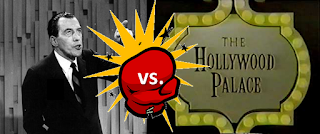 During the 60s, the
Ed Sullivan Show
and The Hollywood Palace
were the premiere variety shows on television. Whenever they appear in TV Guide together, we'll match them up and see who has the best lineup.Ed's guests are singers John Davidson, Lainie Kazan and the Jackson Five; comics Guy Marks, and Wayne and Shuster; puppets in a dance number choreographed by Peter Gennaro and featuring Muppet Big Bird (from
Sesame Street); El Conquistador Strolling Violins; the Mecners, novelty act; puppet Topo Gigio; and the Ed Sullivan Singers.
Palace: Flip Wilson co-hosts with Andy Williams’ scene-stealing bear (Janos Prohaska). Guests: O.C. Smith, Judy Carne, singer. Dana Valery, the Friends of Distinction, comic Gene Baylos, the juggling Villams and the Dancing Devils, Argentine folk dancers.
A situation like this calls for honesty, and as you all know, I'm nothing if not honest around here. I'm not a fan of John Davidson. I'm not a fan of the Jacksons. All right, there's Lainie Kazan, but she has other assets working for her as well. It's all there for Palace to steal, but can it take advantage? I'm not a fan of Judy Carne, and I'm not a fan of O.C. Smith (I don't eat green apples). Note that I'm not putting down any of these acts; they're not my flavor, but you may disagree, and you're prtobably more well-rounded if you do. As for me, well, this week's a Push.
l l l
 Throughout the 60s and early 70s, TV Guide's weekly reviews were written by the witty and acerbic Cleveland Amory. Whenever we get the chance, we'll look at Cleve's latest take on the shows of the era.
It's rare that we get a Cleveland Amory review about a program that is well-done. (Do you know how long it took me to come up with that line?) We've seen Cleve dole out faint praise to shows that are good enough, but how often have we seen him nearly faint with pleasure over a program that may well exemplify the future of entertainment? I speak of The Forsyte Saga, the landmark 26-episode BBC series from 1967, now being shown on NET, and if you think I exaggerate Amory's praise of it, let me use his own words: The Forsyte Saga is "entertainment—prime, rare, rib-roast, Kansas City-cut entertainment. To say it is great is an understatement. It would be hard to imagine how it could be any better. It is, in short, television’s shining hour—and if you are lucky enough to be in a locality where The Forsyte Saga is shown, you will see not only what might have been, but also, and perhaps more important, what in the future must be." Is that good enough for you?
The Forsyte Saga, based on a series of novels by John Galsworthy, tells the saga of an English family over the course of nearly a half-century, from 1879 to 1926. So successful was it in England that evening church services were rescheduled in order to allow parishioners to catch the next episode. And it's not just the mother country that's gone wild over it. In the Netherlands, sporting events and public meetings have been rescheduled; in Israel, it's prohibited from being shown on the Sabbath to allow bigger audiences. It's a smash in Norway, in Zambia, in Taiwan and the Soviet Union. And now it has come to America, and Amory is right: it will change the face of television here. It's progenitor of the miniseries, gives birth to Masterpiece Theatre, and introduces the glories of British television to American audiences.
But, Amory reminds us, as good as The Forsyte Saga is—and proper credit belongs not only to Galsworthy's novel, but to the writers "apparently prepared to admit that Galsworthy was Galsworthy and they were not", the producers who cast great actors and actresses, and those stars, who are "magnificent" one and all—it is "no impossible dream that has somehow managed to come true once and can never again." It can be done here, tomorrow or even today. It needs only three things: a good book, the ability to stick to it, and good actors to bring it to life. That isn't asking too much, is it?
l l l
One of these years, I'm going to spend the entire month of December with issues from the same year and in the same market; it's the only real way to get a true picture of when your favorite Christmas specials are shown. As I recall, I did come close to doing that sometime in the distant past, but I'm too lazy to check on it now, and in any case, it leaves me with something to look forward to in the future, and where would we be without that?
Anyway, the point is not what might happen next year, but what is happening in the here and now: Northern California in 1969. And for that, we'll start with the deeply moving special
J.T., making its debut on the
CBS Children's Hour (11:00 a.m. PT). It stars Kevin Hooks, son of actor Robert Hooks, and later on one of the stars of
The White Shadow, as a shy black youngster from Harlem, trying to nurse a sick alley cat back to health as Christmas approaches. Ja'Net Dubois plays J.T.'s mother, and Michael Goran is the store owner who comes to understand what J.T. needs.
J.T. will later win a Peabody Award, as well as a place in the hearts of those who see it. (Take
that, Hallmark!) You can be one of them, as
it's available here. Later on Saturday, the Doodletown Pipers host a musical Christmas special (7:30 p.m., KXTV in Sacramento; also Sunday at 6:00 p.m. on KCRA in Sacramento), and while Lawrence Welk and his Champagne Music Makers have their annual Christmas show next week, there's plenty of holiday spirit tonight as well. (8:30 p.m., ABC)
Sunday features one of those "family specials" that are so often a part of the holiday season even though they have nothing to do with Christmas:
Hans Brinker (7:00 p.m., NBC), starring Eleanor Parker, Richard Basehart, and Cyril Ritchard, with Robin Askwith as Hans. (You can
see that one here.) Monday, Carol Burnett welcomes back her old colleagues Garry Moore and Durward Kirby, along with the Mitchell Boys Choir, for Christmas music and comedy. (10:00 p.m., CBS)
Tuesday's
Red Skelton Hour features, in Red's "Silent Spot" pantomime section, "The Magic of Christmas," with Santa at work in his toy shop. (8:30 p.m., CBS;
view it here) And on ABC's
Movie of the Week (9:00 p.m.), Lloyd Bridges and Shirley Jones star in
Silent Night, Lonely Night, about two lonely people who meet at Christmastime. (By the way, this airs opposite another made-for-TV movie starring Lloyd Bridges,
The Silent Gun, on NBC. I wonder how often someone has appeared on two different movies airing on two different networks at the same time? And with similar titles?)
Now here's something I don't understand—a couple of things, in fact. On Thursday, we find something called "Christmas Story" at 7:30 p.m. on NBC. What is it?
The Little Drummer Boy, the Rankin-Bass classic narrated by Greer Garson, with Jose Ferrer, Teddy Eccles, Paul Frees, and the Vienna Choir Boys. That's followed on the same network at 8:00 p.m. by "Variety Special," which happens to be Bing Crosby's Christmas special, with Carol Burnett, Juliet Prowse, and Roy Clark. (The Close-Up at right is from a different TV Guide issue.) Could we get any more generic in our program descriptions? Why didn't TV Guide just use the actual titles of the shows? (
Bing Crosby uses less space than
Variety Special.) Especially since the Crosby clambake is followed by "Bob Hope" at 9:00 p.m. Or would that have been asking too much? (This isn't the Bob Hope Christmas special, by the way, although it is his year-end show, with an appearance by the Football Writers Association All-America team.)
Friday features high drama for The Brady Bunch—Carol has laryngitis, and may have to cancel her solo at the church's Christmas service. Will she recover in time, or will Dr. Marcus Welby be called in at the last minute? Tune in at 8:00 p.m. on ABC. Later, Jimmy Durante Presents the Lennon Sisters celebrates Christmas in a big way, with Lorne Greene, Jimmy's eight-year-old daughter Cece, and 25 members of the Lennon family, before an audience made up entirely of Lennon family members, friends, and neighbors. (10:00 p.m., ABC)
By the way, remember that Lloyd Bridges doubleheader on Tuesday? We've got something similar tonight, although on a much smaller scale; Antoinette Bower guests on NBC's Name of the Game at 8:30 p.m., while she's also playing Berlin Betty on Hogan's Heroes at the same time on CBS. So maybe it wasn't quite as unusual as I thought; at the very least, it shows who the working actors are. Meanwhile, the CBS Friday Night Movie at 9:00 p.m. is Seven Brides for Seven Brothers, while the TV series it's said to have inspired, Here Come the Brides, airs opposite it on ABC. Coincidence?
l l l
All right, here's that story on the dangers of X-rays emitted by color television sets. It's written by TV Guide's resident tech expert, David Lachenbruch, so it should be reliable. Not surprisingly, the opinions of top radiation scientists have been mostly buried because they're not as sensational as the scare headlines newspapers love to run.
The concern isn't that the rays given off by TVs are harmful to individual viewers; rather, it's that the collective release from some 20, 40, or 80 million sets might add to background radiation, which could increase the pollution of the atmosphere. It's also possible that people who spent a lifetime in front of a color set could experience a cumulative exposure that could cause illness or defects in future generations, but there's considerable doubt within the scientific community about this.
In fact, because radiation is so easy to block by using metal shielding within the set, it's never been considered that much of a problem. The standard for acceptable radiation emission was set extremely low—five times stricter than that used by UL. All the fuss started in 1967, when an unnamed television manufacturer (General Electric, for the record) discovered a higher-than-permitted amount of radiation escaping from their sets due to inadequate shielding and a poorly designed regulator tube. The sets were recalled, the tube replaced, and additional shielding added.
Most important, says Lachenbruch, "Even though some of the sets radiated hundreds and even thousands of times the amounts specified by [the National Council on Radiation Protection and Measurements], there have been no reports of any harm to any individual." According to Dr. Victor P. Bond, associate director of Brookhaven National Laboratory, it's certainly prudent to limit exposure to radiation; nevertheless, "it is quite clear that the probability of significance or even detectable medical effects from X-rays emitted by faulty color receivers is vanishingly small." Even the Public Health Service has decided the risk is too small to continue with further tests on existing sets.
So, the bottom line is this: John C. Villforth, director of the Bureau of Radiological Health, Department of Health, Education and Welfare, says there's no reason for people to "go easy" on color TV watching. "There is no danger in color TV." Now, when it comes to the programs on TV . . .
l l l
Finally, no cultural review of TV Guide would be complete without a look at one of the dominant figures in American television in the last part of the 20th century: Aaron Spelling. Dick Hobson calls him a "Triple T," which stands for "Tremendous Television Tycoon." (His associates call him "Big A".) Keep in mind that at this point in his career, Spelling is only 43, yet he has "made-to-order suits, a big black Cadillac, and a $275,000 house in the Golden Triangle section of Beverly Hills. He plays softball on Sunday afternoons with Tony Curtis, Bill Cosby, Paul Newman and James Garner." And his weight never goes over 145, because he works so hard.
He's become ABC's chief independent supplier of prime-time programs, numbered among which are The Mod Squad, The New People, seven of the 25 Movie of the Weeks, and more pilots in the pipeline than the Air Force. (He was also responsible for one of my favorite shows, Burke's Law.) He believes that what's in today is the youth movement, and when someone asks about The New People, which is getting smothered by Laugh-In, Gunsmoke, and Here's Lucy, he replies, "At least it's a show of today. I'd rather fail with The New People than get rich with Petticoat Junction." I suppose, although I'm not sure the network, let along Paul Henning, would agree.
We get a chance to see Spelling at work: in his office, at meetings with ABC executives, and on the set of The Mod Squad, where he helps comfort Peggy Lipton, still grieving over the recent murder of her close friend, Sharon Tate. "Driving to the studio I had to pull over," she tells her costars. "I couldn't see through the tears." "When your phone didn't answer," Clarence Williams replies, "I thought you were up identifying bodies or something." If that doesn't give you an idea of the atmosphere in Hollywood at the end of the Sixties, nothing will.
What I find most interesting about this article, though, is the temptation that must have existed back in 1969 to see Aaron Spelling at the top of his game—and yet we haven't even begun to approach Peak Spelling. So many of the people we read about in these pages are of the moment, if you will; movers and shakers, stars and starlets who were big at the time, or about to be big—and yet they're either strangers to us today, or people who were already as big as they were going to get, though nobody knew it yet.
Not Aaron Spelling. I'm sure he never doubted that there were more hits in his in box, but could anyone have predicted how many, or how big? This is the man who goes on to give us Charlie's Angels, The Love Boat, Hart to Hart, Dynasty, Beverly Hills, 90210, Melrose Place, 7th Heaven, and Charmed, and those are only the biggest hits. By comparison, in 1969 he's just getting started. Had TV Guide surveyed his career based only on those eight series I listed above, he would have been considered one of Hollywood's most successful producers ever. But to think that he was already there well before any one of them—well, we should all be so lucky. I wonder what level comes after Triple T? TV


