, is the failure of Judy Garland's much-heralded TV series debut. This week we'll rectify that oversight, thanks to Vernon Scott's in-depth look at Judy's side of the story.
"I don't blame people for watching
Bonanza instead of
The Judy Garland Show," she tells Scott. "It was a natural choice." She says it without rancor, without bitterness, because in doing the show, she felt that there was something more important than ratings. "I wasn't disappointed," she says of them. "I don't think we deserved [higher ratings]. The time slot was impossible. After four or five years of loyalty to
Bonanza, I can understand why viewers did not switch to my show." What was more important, she insists, is what she demonstrated to the industry. "I did prove to everybody that I was reliable. They said I'd never answer the bell for the second round. But we turned out 26 shows. And some of them were damned good, too. Especially the last five we did."
She calls the experience of doing a weekly series "very enlightening—and funny." It was "instant disaster" from the beginning, and sometimes "instant success." Every week, one way or the other. Speaking of the last five shows, which were done in a concert format (something Judy had wanted from the outset), she says, "By the time we discovered where we were going it was too late." But the network had insisted on a variety series, that it would be impossible to do the equivalent of a special every week, and she went along because "I believed they did know what they were doing."
They, meaning the network executives, didn't like how she touched her guests so much, that viewers would think she was drunk or that there were sexual impliations. She didn't like the turntable stage they installed on the set; not only was it too noisy, it gave her motion sickness. There were nine different formats during the 24 weeks the show aired, and oftentimes she couldn't hear the orchestra because they were off to one side; she finally succeeded in getting them put on stage behind her. She was never a part of the editing process, so her hairdo and wardrobe would change from scene to scene with no explanation.
Everyone agrees she could be difficult to work with. She only rehearsed two days a week, Thursdays and Fridays, with taping done on Friday nights. Last minute changes would be made after dress rehearsals, throwing everyone into a panic. Sometimes, she says, she'd be learning the lyrics to new songs by singing them off idiot cards. Despite all this, nobody has a bad word for her. "She wears everybody out," says producer Gary Smith, who lasted the longest of anyone on the show (21 episodes). "But she is a magnificent performer and she adapted herself beautifully to the weekly TV format." Smith, like everyone else who worked on the show, was eventually fired, presumably by Judy. But he only says, "She's a great creative star and an awesome personality."
It was, Scott says, more of a personal than a professional defeat for Garland, for whom being popular is very important. Yet she remains grateful for having done the series, which she feels introduced her to new fans who'll want to see her in person on concert tours. "All in all, the show was a good thing to have happened to me. I learned a great deal. But if I had known what I was in for, I would never have tried a weekly series. Not ever."
l l l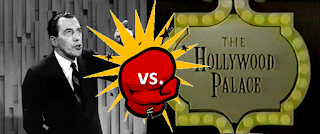 During the 60s, the
 Ed Sullivan Show
and The Hollywood Palace
were the premiere variety shows on television. Whenever they appear in TV Guide together, we'll match them up and see who has the best lineup..
Sullivan: Guests include songstress Patti Page; comics Bill Dana and Vaughn Meader; Jerry and the Pacemakers, English rock 'n' rollers; the Claytons, whip and rope act; and rock 'n' roller Little Stevie Wonder. (Plus the cat of "America Be Seated," with Louis Gossett, May Barnes, and Bibby Oscarwall. Vaughn Meader was apparently a no-show.)
Palace: Host Louis Jourdan introduces Olympic gymnasts Muriel and Abe Grossfeld, Armando Vega and NCAA champion gymnast Ron Barak; songstress Anna Maria Alberghetti; the singing King Sisters; comedian Henny Youngman; tap dancer John Bubbles; ventriloquist Russ Lewis; comics Lewis and Christy; and juggler Johnny Broadway.
We have plusses and minuses on both shows this week; after Palace's brief excursion into Wide World of Sports territory, there are some recognizable names, if nothing to set the world on fire. Over on Sullivan, we can't be too surprised in Vaughn Meader didn't appear; his career all but ended after the death of Kennedy. Otherwise, we see Bill Dana and Jerry and the Pacemakers while they were still big, and Stevie Wonder while he was still little, and that's good enough to give Sullivan the gold medal for the week.
l l l
 From 1963 to 1976, TV Guide's weekly reviews were written by the witty and acerbic Cleveland Amory. Whenever they appear, we'll look at Cleve's latest take on the shows of the era.
There's folk music, as Cleveland Amory points out, and there's folk music. Gospel folk, country folk, city folk, Dixieland folk, and just plain folk folk. And just about all of it can be seen, from week to week, in ABC's music series
Hootenanny. The show, hosted by Art Linkletter's son Jack, is broadcast from a different college each week, and features a wider range of talent than just about any other show on the air. Folk music, I should interject here, is just about my least favorite kind of music, and I'm someone with fairly eclectic tastes. Even I've heard of some of these acts, though—the Travelers Three, the Brothers Four, the Serendipity Singers, the New Christy Minstrels, even Johnny Cash, who I'd never considered a folk singer until now, but as Cleve says, just about
everything is folk music today except for the Boston Symphony, and he isn't even sure about
that.
It's all put together in an unpretentious manner by producer Richard Lewine and director Garth Dietrick, and that has to be a relief compared to some of the more overly produced variety shows on the air today. I doubt, for instance, that you'd see the same kind of staging as you do on NBC's Hullabaloo. "At its best," Amory says, "it's very little short of wonderful and even at its worst it's pretty fair TV fare. You name your favorite song and if you're patient, sooner or later someone will sing it." (I kind of doubt it in my case, but then, who knows?)
It's all music, except for one comedian featured on each show, something that seems to have been a trademark of music shows of the era. One of the best, Amory says, is a "diffident young man" named Jackie Vernon, whom we all know as the voice of Frosty the Snowman. "Everything about me used to be dull," he says in his trademark deadpan voice. "My favorite comedians were Bert Parks and Allen Ludden." He also tells a story about his grandfather, who had to leave the west because "he said a discouraging word." (It helps if you read the line in his voice.) Like so many things, Hootenanny eventually falls victim to the changing musical tastes that resulted from the British Invasion, but it was fun while it lasted.
l l l
The biggest sports event of the week comes to us from Louisville, Kentucky, where the great Northern Dancer wins the 90th running of the Kentucky Derby (5:00 p.m. ET, CBS). Nothern Dancer will go on to win the Preakness before finishing third in the Belmont Stakes; he will run one more race before pulling up lame and going to stud, having an equally successful career there.
However, the bigger sports news came not from any arena, but at the Hollywood Advertising Club, where ABC president Tom Moore sounded off on a few things, including some "radical changes" to sports in America. According to Henry Harding, these suggestions included replacing college football bowl games with an elimination tournament, determining champion golfers by a points system during the PGA tour, and shortening the major league baseball schedule to 60 games—two per weekend. The reaction from sportswriters was mostly negative, but let's take a step back and look at Moore's suggestions. The PGA has, indeed, gone to a points system, culminating in the FedEx Cup; whether or not that really determines the champion golfer of the year, it's a fact. Also a fact is the creation of the College Football Playoff, which has reduced the role of bowl games to filler on ESPN. It has many faults, but it's a reality. As for shortening the baseball season, it hasn't happened and probably never will, but the increase in playoff teams pushing the World Series into November and rendering much of the regular season meaningless, I think there are a lot of people who'd be on board to at least cut back. It'll probably happen when pigs fly, but who knows?
l l l
Saturday night's late movie on Maine's WMTW is one that should bring a smile to any fan of the
Zucker/Abrahams/Zucker team:
Zero Hour! (10:30 p.m.), the movie that served as the model for
Airplane! Dana Andrews stars as Ted Stryker, the ex-fighter pilot haunted by guilt who's called on to land a passenger airlineer after the crew becomes sick from eating bad fish; Linda Darnell is his wife, who's preparing to leave him because of his inability to pull his life back together; and Sterling Hayden is Captain Treleaven, Stryker's old commanding officer, who's called in to help talk Stryker down. If all this sounds familiar, it should; ZAZ paid $2,500 for the rights to the screenplay in order to make sure they didn't run into a problem with copyright while working on
Airplane! (See the comparisons
here.) If you're looking for something a little more conventionally great, stick around until 11:40 p.m. for the John Wayne classic
The Searchers (WJAR in Providence).
Nelson Rockefeller's brother Winthrop, currently running for governor of Arkansas, is the guest on Sunday's Meet the Press (6:00 p.m., NBC), notable because it originates from the World's Fair in New York. I've noticed that a number of programs are broadcast from the Fair during its two-year run; today, you might see Meet the Press broadcast from the site of the Super Bowl, but only if NBC's showing it, and only if the topic concerns sports on TV. Later, on Lassie (7:00 p.m., CBS), Timmy and Lassie bring an injured raccoon back to the farm after a tornado. No word on whether or not they found a dislodged building with a woman's legs protruding from underneath it.
On Monday, it's the debut of the daytime drama Another World (3:00 p.m., NBC), which will spawn a spinoff, Somerset, and will run on the network for 35 seasons and 8,891 episodes; as I recall, that was one of my mother's favorite soaps. In primetime, the echo of President Kennedy's assassination continues to reverberate on Sing Along With Mitch (10:00 p.m., NBC), a special segment of which is devoted to songs that were favorites of the late president, including "Beyond the BLue Horizon," "Too-ra Loo-ra Loo-ra," and "Greenland's Icy Mountains." I can't help but wonder if those really were JFK's favorites; the whole Camelot legend was predicated in part on stories that the soundtrack to the musical was one of his favorites, although I've read reports that, in fact, he had barely any interest in the show. But as we know, when the truth confronts the legend, print the legend.
Red Skelton's guests on
Tuesday are a pair of child stars: Mickey Rooney and Jackie Coogan (8:00 p.m., CBS). Interesting paring, don't you think? And tonight's episode of
The Jack Benny Program (9:30 p.m., CBS) is a classic of its type; Jack finds himself (in his dream) on trial for murder, with none othet than the great Perry Mason (Raymond Burr) defending him. You can see that episode, including the hilarious courtroom scene,
on YouTube. And the
Bell Telephone Hour (10:00 p.m., NBC) presents a truly eclectic hour of music, with Van Heflin narrating "Concord Bridge" to Morton Gould's "Declaration Suite" in honor of Armed Forces Day; Connie Francis singing a medley of popular songs, and opera stars Jon Vickers and Giulietta Simionato performing the judgment scene from
Aida.
Speaking as we have been of classics,
Wednesday's
Dick Van Dyke Show (9:30 p.m., CBS) gives us one of the best: the episode "That's My Boy??," where Rob has doubts that the baby Laura brought home from the hospital is the right one, until he meets the parents of the other baby. You can see, and laugh along with, the episode
here; stories persist that the joke from the end of the episode produced the longest laugh ever, much of which had to be edited out due to the length. You can read an interesting anticdote about that episode
here. And
The Danny Kaye Show (10:00 p.m., CBS) kicks off a series of reruns with its Christmas show, featuring the aforementioned Dick Van Dyke and Mary Tyler Moore, along with Mr. Christmas, Andy Williams.
On
Thursday, the primetime edition of
Password (7:30 p.m., CBS) features Lucille Ball and her husband, Gary Morton as the celebrity players.
Dr. Kildare (8:30 pm., NBC) has a rare dramatic appearance by Cyril Ritchard as an eccentric writer who throws Blair General into a tizzy when he insists he'll be dead within a week. And on
Kraft Suspense Theatre (10:00 p.m., NBC), Keenan Wynn portrays an innocent man charged with murder; when he finds that he enjoys the notoriety, he confesses to the crime.
The week's end kicks off with the day's beginning: the recently retired baseball great Stan "The Man" Musial is a guest on
Today (
Friday, 7:00 a.m., NBC). Sticking with NBC for primetime, David Frost makes a return appearance on
That Was The Week That Was (9:30 p.m.), guesting for the first time since the early weeks of the show; he was, of course, one of the creators and stars of the British edition. And at 10:00 p.m., Jack Paar's guests include Richard Burton, currently starring in "Hamlet" on Broadway; you can see an excerpt from that appearance
here.
l l l
And now the story behind a concept called Project 120, a movie called Johnny North, and the picture below, in which Ronald Reagan is beating the hell out of Angie Dickinson.
It all started with a deal between NBC and the production company MCA to produce a series of two-hour feature movies that would be made especially for television, and distributed later to movie houses. (In the pre-DVD era, this would make more sense that it does today.) The first of the planned features to emerge from
Project 120 was called
Johnny North, based on Ernest Hemingway's short story "The Killers." "But, as the poet said, there's many a slip 'twixt the conference table and the screen." The movie, which was budgeted at just under $250,000, came in instead at more than $900,000. Not only that (as if that wasn't enough to begin with), the powers that be judget that the finished product was both too sexy (witness a kissing scene between Dickinson and her race-car-driver boyfriend, John Cassavetes) and too violent (not only did Reagan rough up Angie, she also got belted around by both Lee Marvin and Clu Gulager). In order to recoup the costs, MCA has now decided that the movie will be released in theaters, renamed
Ernest Hemingway's The Killers. NBC says
Project 120 will continue (as, indeed, it does), only with less sex, less violence, and less cost.
As for that picture—well, The Killers was Ronald Reagan's last movie, one which he made against his better judgment. It was the only time he ever playedd the heavy, and he was said to be quite distraught over the scene in which he slaps Dickinson; it was the one role that Reagan most regretted playing. Of course, unbeknownste to all, he has a much bigger role ahead of him.
MST3K alert: The Indestructible Man (1956) On his way to the gas chamber, "The Butcher" vowed he'd return from the grave and get the three men who doublecrossed him. Lon Chaney, Casey Adams. (Saturday, 11:30 p.m., WNAC in Boston) When combined with the short that preceded it, part two of "Undersea Kingdom," Lon Chaney became the first and only actor to appear in
both segments of a single
MST3K episode. Look for a short, fatal, turn from future
McHale's Navy star Joe Flynn. Your pleasure, I promise, will not be indestructible.
TV 


