October 19, 2022

Over the Transom: Wishing upon the stars

by Stephen Taylor

Watched a couple of Ironside episodes the other night; one was routine but entertaining for another reason, and one was sterling in every way. Both episodes are from the end of the Seventh Season.

My evening led off with "Come Eleven, Come Twelve." It’s s a routine little thriller; Ed has to bring home from Chicago a prisoner (Andy Robinson) who’s going to testify in a high-profile
murder trial. Obstacles arise immediately; his gangland buddies don’t want him to testify and are trying to shut him up permanently. Through a bizarre series of events, Ed and his prisoner become trapped in an abandoned bar way out in the mountains. Pretty routine, but fun for another reason.

I have this little game I play. In any movie or TV show I watch I look for the Star Trek connection. Star Trek was a prime locus of my television watching in the Seventies, and I enjoy seeing Star Trek veterans in other productions. The Star Trek connection may be in any iteration of the franchise, from the early days when Spock still smiled, to the execrable reboots with Chris Pine. It’s a lot of fun. Westerns are usually pretty easy; if John Hoyt wasn’t in a Fifties western, then Karen Steele or Paul Fix was. My personal all-time best catch was a bit player in a Randolph Scott movie from 1943 (Barfly / Man eating with Edith Keeler) I thought Leave It to Beaver was going to be a tough slog, but Tony Dow directed a Deep Space Nine episode in 1999. Ironside hasn’t been any sort of challenge, due to Barbara Anderson and producer Cy Chermak (story for a Next Generation episode in 1993.) Sometimes I strike out but most times I’d find someone. It can be an actor or someone involved in production. Like I said, a little game.

Whoa. "Come Eleven, Come Twelve" had Andy Robinson as Ed’s prisoner, Michael Strong and Paul Comi as mobsters, Ken Lynch, Bill Zuckert, Paul Kent, Cy Chermak (producer), David Huddleston, and Shelley Manne (musician). Seven actors and two production personnel. Like I said, lots of fun. This episode was just loaded with Star Trek talent.

The second episode was "Riddle at 24,000 Feet"; it’s about the pilot of a small airplane who has a heart attack in mid-flight, leaving his wife to land the plane. A small-town doctor crawls up into the plane to start the post-mortem, and immediately becomes suspicious. We’re already off to a good start, but it gets even better when the small-town doctor opens his mouth and starts to speak and Ay-yi-yi-yi-yi it’s Desi Arnaz. What a treat!

It’s simply impossible to overstate just how much impact Desi Arnaz and Lucille Ball had on television, past and present. Both were very shrewd business people, with both having that perfect combination of foresight and the ability to solve problems. Arnaz decided that I Love Lucy needed to be filmed, and in doing so solved the time-zone kinescope problem and at the same time inventing the concept of re-runs. And in a masterstroke of genius, he talked CBS into allowing him to retain the rights to I Love Lucy, and in doing so invented the concept of syndication of television shows. (Fredrick Ziv could be said to have originated the concept of syndication before Arnaz, but Ziv was syndicating original product, while Arnaz and Ball were syndicating already-shown product created for a TV network.) American television looks like it does today in large part due to Desi Arnaz and Lucille Ball.

And here he was on Ironside. His Cuban accent was just as thick as ever, but he had the same charisma that has charmed TV viewers for 70+ years. People just liked seeing him and allowing him into their living rooms. Here he was older, but still vigorous.

And he was excellent. He’s a small-town doctor in a solo practice, and his old friend Chief Ironside is coming to visit. All good so far, until the small plane makes that unscheduled landing. And Dr Domingo immediately smells a rat. And after Domingo ‘splains things to Ironside, the Chief becomes interested as well. They decide it’s murder. And there are a number of suspects; the dopehead son (Michael Richardson), his business partner (Ralph Meeker) as well as the business partner’s wife (Dolores Dorn). There’s a local cop who tries to supervise (L.Q. Jones)* but allows the Chief to take over the case after observing that the Chief seems competent.

*I see by the papers that L.Q. Jones died back in July of natural causes. He was everywhere, but is probably best known for the five movies, all Westerns, that he did with Sam Peckinpah. My favorite? Ride The High Country, with Joel McCrea, Randolph Scott and a very young Mariette Hartley. He’ll be missed. He was 94.

The car dealer/business partner is very nasty; Ralph Meeker runs away with the part. He doesn’t much care for Domingo; he has no use for "wetbacks." He didn’t care for his business partner, either. Meeker, who’s put on weight since the first time he was on Ironside way back in Season Two, is really good; he has no redeeming qualities and doesn’t care who knows it.

It’s odd, but the whole thing felt like a backdoor pilot. Dr Domingo is a very strong character who could have carried a television series, and the episode went to great pains to show us the very close relationship he has with his nurse Big Sue (Linda Foster); there’s even a cute sub-plot involving a teenage boy with a sick duck. It had an interesting feel to it. Having said that, the writing, acting and directing were all outstanding. Not the best episode of the series, but in the top ten for certain.

No spoilers here, but the murder involved a thermos and an oxygen tank. Dr Domingo walks us through the entire murder, from how it was committed to what the suspect did wrong, and ties up the case very neatly, doing everything except enjoying a glass of port with the post-confession suspect. Lieutenant Columbo would have approved. TV  

October 17, 2022

What's on TV? Monday, October 22, 1951


One of the things you have to keep in mind when looking at this week's listings is that not all stations program continuously during their broadcast day. Therefore, as enjoyable as it might be, we should not assume that WABD's Johnny Olsen Rumpus Room runs for five hours. Ah well. Studio One's "Macbeth" stars Charlton Heston, who did a lot of live television before moving to the big screen. And WNHC's Ruth Lyons’ 50 Club is from the show's brief national run; I wrote about the storied Ruth Lyons here. It's fun how these little bits all eventually come together, isn't it?

October 15, 2022

This week in TV Guide: October 19, 1951


Sometimes the only way to find out whether or not an idea really works is to just jump right in and try it. For instance, I had a couple of TV Guides to choose from today, issues from the mid-50s; I also had one from the '60s that I'd used eight or so years ago, long enough that it would still be new for many people. Those would have been the safe choices, but, I asked myself, why not live dangerously this week and try something different? (Now, it's true that if this is the best I can do when it comes to living dangerously, it's no wonder why I live such a sedate life. And if you asked yourself that, you'd be right. But maybe that's what it takes to break out of a fog.)

And that's how, with the aid of the Internet Archive, we find ourselves looking at the TV Guide of October 19, 1951. This is a year-and-a-half prior to the national rollout, when TV Guide was limited to New York, New England, and the Washington-Baltimore area, so expect an emphasis on local, rather than national, stories. Since most of the familiar features have yet to appear, I have no idea what we're in for, so we'll just take it as it comes and hope for the best!

l  l  l

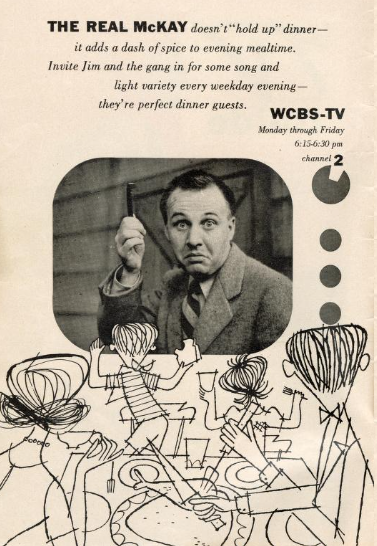
Here's a promising start: an ad on the inside cover (labeled page 2) for Jim McKay's 15-minute WCBS variety series, The Real McKay.

You might know that Jim McKay's real name is Jim McManus; in fact, his son Sean, who is chairman of CBS Sports, uses the family name. And it might have been ABC's Wide World of Sports with Jim McManus, had it not been for this show.* The title is, of course, a pun on "The Real McCoy," and it was to be young McKay's first break in big-time television. He wasn't thrilled to find out that his name would now be McKay; "I liked my own name just as it was," he wrote in his autobiography The Real McKay. "The thought of James K. McManus disappearing into thin air didn't please me at all, and I knew would be even less pleasing to my parents, and to [wife] Margaret, who had easily taken to the liquid sound of my real surname." He quickly realized, however, that there was no sense in jeopardizing his chances, and so, though he wondered "why they didn't just call me Jim McCoy," Jim McKay it was, and would remain, for one of the legendary careers in television.

*Roone Arledge, who produced Wide World, would always refer to McKay as "McManus" over the headset. 

The format of The Real McKay, which McKay helped develop with WCBS's program director, is that of a standard interview/variety program, taking place on a faux living room set designed by McKay's wife, Margaret. For the first program, the producer lined up a couple of singers from the Catskills, one male and one female; McKay would interview them, they would each sing, and then a few months later they'd be brought back to the show to see how their careers were progressing. The female singer was Barbara Cook, who a few years later would co-star on Broadway with Robert Preston in The Music Man, playing Marian the Librarian (the role played by Shirley Jones in the movie version). And the male singer: the man who would go on to marry said Shirley Jones, Jack Cassidy—TV and Broadway star in his own right, and father of Sean and David. And the program director of WCBS, who helped create The Real McKay and get it on the air? His name is Dick Doan—Richard K. Doan, who will later produce "The Doan Report" for TV Guide. Where he doubtless will carry a report on his old colleague, Jim McKay.

l  l  l

Well, that went pretty well, so let's go to page 3, "a terse weekly report" called "Inside TV," which serves as a prototype for the future TV Teletype that we know and love sio well. And among other facts (did you know, for instance, that actress Adelaide Hawley actually played Betty Crocker in a Saturday noon weekly show called Betty Crocker Star Time? And here, you thought she was only a picture on a box.), we learn, in a section called "Program Possibilities," that "Dave Garroway may be emcee of an NBC-TV 7 to 9 a.m.—and we mean a.m.—program to be called The Rise and Shine Revue." That, of course, is The Today Show, which will premiere on the network the following January, and which Garroway will host until 1961.

Joining Garroway on that first Today and remaining on the program until 1967 as co-host, announcer, and occasional foil is Jack Lescoulie. (Garroway was known as "The Master Communicator"; he dubbed Lescoulie "The Saver" for his ability to liven up dull segments.) Lescoulie had previously worked as a game show host, announcer, and producer for WCBS. Among the shows he produced: The Real McKay—he was the producer who chose Barbara Cook and Jack Cassidy as guests for that first program. I tell you, you can't make this stuff up.
 
l  l  l

Let's turn now to the man on the cover, actor Lloyd Nolan. Over a long and successful career, Nolan made a lot of movies and appeared on a lot of TV shows; you might well recognize him most from a series of movies he made featuring private detective Michael Shayne, or from his role as Dr. Chegley in Julia. Shayne is in the past, however, and Julia is in the future; we're concerned with the present, where Nolan is the new star of Martin Kane, Private Eye (he's one of four actors to play the part over the show's five seasons on radio and television).

Among the things we learn about Nolan in this brief profile: he once worked as a stagehand in a theater where one of the ushers was a young woman named Bette Davis; he and his wife introduced square dancing to Hollywood and had a group called the Beverly Hillbillies (what a pity he never did a guest stint on the sitcom); and that his real name, in fact.is Lloyd Nolan. (I know, it would have been great if his real name had been McCoy or something like that, but you can't have everything.) One of his most acclaimed roles is still ahead of him; his stage and television portrayal of Captain Queeg in The Caine Mutiny Court-Martial, which Herman Wouk adapted from his own novel, and for which Nolan wins an Emmy in 1955.

l  l  l

The listings in this issue are very short on details; no Close-Ups, and while there are ads for movies (mostly The Late Show on WCBS, Channel 2), there are also ads for movies in the theater, for horse racing, for restaurants (prime Angus steak dinner for $1.95!), and for companies that sponsor various shows (though not for the shows themselves).

But as different as things may look, there are still programs you're going to recognize. either from having watched them or seen them in pages of future TV Guides:
  • Your Show of Shows (Saturday, 9:00 p.m., NBC)
  • Meet the Press (Sunday, 4:00 p.m., NBC)
  • Toast of the Town, aka The Ed Sullivan Show (Sunday, 8:00 p.m., CBS)
  • Colgate Comedy Hour (Sunday, 8:00 p.m., NBC)
  • Red Skelton (Sunday, 10:00 p.m., NBC)
  • What's My Line? (Sunday, 10:30 p.m., CBS)
  • The Voice of Firestone (Monday, 8:30 p.m., NBC)
  • I Love Lucy (Monday, 9:00 p.m., CBS)
  • Studio One (Monday, 10:00 p.m., CBS)
  • Texaco Star Theater with Milton Berle (Tuesday, 8:00 p.m., NBC)
  • Arthur Godfrey and His Friends (Wednesday, 8:00 p.m., CBS)
  • Suspense (Wednesday, 9:30 p.m., NBC)
  • The Lone Ranger (Thursday, 7:30 p.m., ABC)
  • Burns and Allen (Thursday, 8:00 p.m., CBS)
  • You Bet Your Life (Thursday, 8:00 p.m., NBC)
  • Amos 'n' Andy (Thursday, 8:30 p.m., CBS)
I didn't include a number of less well-known shows that are still among the era's best (Armstrong Circle Theater or Robert Montgomery Presents, for instance), nor did I go into the daytime (Love of Life, Search for Tomorrow) or the pre-primetime (Kukla, Fran and Ollie, The Perry Como Show) schedules. I also left out boxing, which will be a staple on all networks throughout the 1950s. Still, that's pretty good.

Then there are the shows that aren't starting up until later in the season. That movie on Channel 2, for instance, isn't for the Dragnet that we know and love. (Besides, Henry Wilcoxon is no Jack Webb.) But the famed cop series is on the way; Dragnet, with Joe Friday and Frank Smith* patrolling the streets of Los Angeles, makes its television debut on December 16, 1951, alternating every other week with Gangbusters. 

*Barton Yarborough, who had played Friday's partner Ben Romero on the radio version of Dragnet since 1949, died after two episodes of the television series had been filmed. After a short time working with several other partners, Smith (Ben Alexander) became Friday's partner for the remainder of the series.

By the way, although Jack Webb enjoyed playing the character of Joe Friday on the radio, he was not at all sure that he was the right actor to play him on TV. He was, however, much too closely identified with the role, and the network insisted that he continue. The actor who was Webb's choice to play Friday: Lloyd Nolan, of course.

l  l  l

One more story I wanted to get to, and that's the show advertised on the back cover: New York Close-Up, Monday through Friday at 6:30 p.m. "The program that tells the story of the people who have a story to tell"—don't you appreciate the urgency that conveys? The show is hosted by the inimitable married couple of Tex McCrary and Jinx Falkenburg, and in the day they were a media sensation. "Mr. and Mrs. New York," indeed. They were pioneers in the talk show format, just as Dave Garroway was with Today, and like Garroway they are mostly forgotten today.

Tex McCrary had not only been a correspondent during World War II, he was also a colonel in the Army Air Corps who led the first journalists into Hiroshima after the bomb. Jinx Falkenburg was considered one of the most beautiful women of her time: cover girl, athlete, USO entertainer. That nightgown that Rita Hayworth wore in her famous pinup? That was loaned to her by her friend, Jinx. I imagine it looked just as good on her.

Tex taught Jinx the basics of how to conduct an interview (other protégés of his included Gabe Pressman, Ted Yates, Barbara Walters, and Barry Farber), and she wound up being one of the best in the business. They began a breakfast radio show in 1946, then made the transition to television (while doing two radio shows and a newspaper column). In 1952, they staged a rally in Madison Square Garden that helped convince Dwight Eisenhower to run for president. Tex would move into public relations, where he would work behind the scenes with William Levitt and Thurgood Marshall to make sure Levittown was integrated. Jinx, meanwhile, traveled to the Soviet Union in 1959 to open a model house belonging to one of Tex's clients at a U.S. exhibition—in the kitchen of the model, Nixon and Khrushchev would engage in their "kitchen debate." Accompanying Jinx on that tour was a young researcher who became a well-known columnist and political speechwriter: William Safire. In other words, just ordinary people like you and me. 

It's true that only a handful of people in this world live lives like this—we all know that. And yet, reading through these issues, you're overwhelmed by the extraordinary lives of extraordinary people. It shouldn't make us feel inadequate, because if everyone lived like this, no lives would be extraordinary; they'd all be average. So if you're inclined to feel kind of down after reading this, just remember that you're doing your part to help create extraordinary people.

l  l  l

So that's a look around a 1951 TV Guide. Only 32 pages, including the front and back covers. There are no reviews of programs or movies, no crossword puzzles, and the Letters to the Editor are rather mundane. Yet it's been a fascinating experiment, don't you think? Maybe I'll do it again sometime.

And by the way, this week's MST3K alert: I Accuse My Parents (Sunday, 1:00 p.m., WPIX). Some things never change. TV  

October 14, 2022

Around the dial


One of the pleasures of this weekly feature is that there's almost always one kind of linkage or another going on, and this week is no exception. For instance, at Cult TV Blog, John continues his look at Hammer House of Horror with the 1980 episode "Children of the Full Moon," featuring a terrific performance by Diana Dors.

By remarkable coincidence, Rick's latest edition of "The Alternate Movie Title Game" at Classic Film & TV Café focuses on Hammer films. (See what I mean about linkage?) Be sure not to read the comments until you've made your own guesses.

At Comfort TV, David concentrates on the actors who also wrote for the TV shows in which they appeared. Some are more familiar than others; Robert Culp and Alan Alda wrote several episodes each of I Spy and M*A*S*H, respectively, but Peter Falk also wrote an episode of Columbo.

One of the several programs hosted by Dave Garroway was the Sunday afternoon show Wide Wide World (not to be confused with Wide World of Sports, although wouldn't that have been interesting? "I'm Dave Garroway with great moments in Olympic history!") At Garroway at Large, Jodie is back with Bob and Ray's hilarious parody, Big Big Earth. (And don't miss that video, which predates Today and has a surprise visitor.)

At Television's New Frontier: the 1960s, we turn to Rawhide circa 1962. As noted before, by this time the show is closer to the end than the beginning, and the quality of the stories is wildly uneven, but even so there are a few episodes that look to be well worth watching, one of which was written by star Eric Fleming.

I think it was last week that Terence noted the 60th anniversary of Combat!, and this week at A shroud of Thoughts he takes up the 60th anniversary of another iconic series: McHale's Navy. I know I've made this point before, and some of you may have commented on it, but it's quite interesting how many of these iconic shows of the time were ABC products; in addition to these, you've got The Fugitive, The Addams Family, Ozzie and Harriet, Bewitched, Donna Reed, Peyton Place, Patty Duke, and more. And yet we also know how long it took the network to finally rise to the top.

And of course, last but not least, one has to take time to remember the great Angela Lansbury, who died this week aged 96. Stage, screen and television, comedy, drama and musicals—it seems as though there was nothing she couldn't do, and she remained beloved throughout her magnificent career. Terence is always my go-to for such remembrances, and he provides a fitting tribute here.

By the way, my continuing apologies for not responding more quickly to your comments and inquiries (or, in some cases, not responding at all). I believe I'll be back on track quite shortly, at which time you probably won't be able to shut me up. TV  

October 12, 2022

Over the Transom: Roman Carnival


by Stephen Taylor

Watched a pretty good Ironside tonight; it was also very funny. How, you might ask, could Ironside be funny? It’s funny when Nurse Skinner (Ruth Roman) is running a blackmail/murder scheme out of a nursing home. 

The episode is called "Gentle Oaks." Ironside receives a tip that strange things are taking place at Gentle Oaks, and goes undercover to find out more. Good supporting work from John Carradine and Lynn Hamilton, along with character actor Jon Lormer. (Only a Star Trek fan would know his name, but everyone else knows his face; even my wife spotted him as "that guy on the planet with Susan Oliver.") 

But this episode belongs to Ruth Roman. We open with Nurse Skinner dancing in front of a mirror, modeling furs and wondering "where did all the pretty years go?" before declaiming that she’ll be returning to Hollywood real soon now, and opening another can of beer. She’s got other problems, however. Why, just yesterday she had to have the suspicious young doctor murdered, and Gentle Oaks is for sale, and if she’s going to make another score by killing someone’s elderly parent, she’ll need to act fast. The one remaining doctor (Harry Townes) is a drunk, but when sober he’s started having regrets. She needs another victim, and fast. How about the cripple in the wheelchair?

Roman explodes across the screen; I suspect the screenwriter had Joan Crawford in mind as the nurse, but Ruth Roman took the part and made it hers. She’s calculating and cold at the same time, but also way over the top. it’s as if someone told the rest of the cast to dial back the acting, but for her to take it to 11. After pushing over Ironside’s wheelchair, she opens up. "Listen, buster. You’re nothing but a crippled old man that no one cares about; your children are waiting for you to die. Your time here will be what you make of it. So get with the program..." One cheesy howler follows another. When the children of a potential patient plead poverty, "Dad’s stocks aren’t doing so well," she suggests that "perhaps your father needs a better stockbroker." Upon meeting a student priest, "Don’t take any wooden crosses." She talks to herself; "...How do I sleep? With all those faces and voices?" She slings whiskey glasses with abandon. She lights a cigarette during a monologue, then exhales smoke like a dragon while facing the camera. Ruth Roman was one of those actresses who had more than one speed, and she has it turned way up tonight; her tachometer is in the red zone. The part is written as evil, but she adds some camp to it and makes it work. She’s quite good.

I’ve watched about eight episodes of Season Five so far, and here are some thoughts. First, Elizabeth Baur continues to underwhelm. She has no gravitas. Her voice is high and tentative; she doesn’t project the same refinement as Barbara Anderson, and, frankly, she’s just not as pretty. Yes, I know. You male chauvinist pig. Yada yada yada. But television and the movies have always looked for sex appeal in casting choices, and they still do today. Ironside was no exception. Barbara Anderson was a clotheshorse, had a pretty face and a great figure. Elizabeth Baur not so much. Tonight they had her in boots, and boots always look great on a nice set of legs, but her legs are like matchsticks. She can’t act, and got off on the wrong foot with the audience by having a crying screaming fit in front of Ironside and the rest of the gang. Barbara Anderson never had crying screaming fits on this show; she saved her histrionics for Lenore Karidian. An interview with Baur included with this set makes the claim that Raymond Burr had a hand in her casting. I doubt it.

Second, Barbara Anderson wasn’t even mentioned during the transition. No "hope officer Whitfield does well in her new assignment in bunco" or "We’ll miss Eve now that she’s returned home to take care of her sick father" or "Only fragments were left of Eve after her car hit the side of that building." Nothing was said; it was as though she never existed. That was irritating. Ironside could have taken a lesson from M*A*S*H, which wrote the book on transitioning characters.

Third, Gene Lyons as Commissioner Dennis Randall is in almost every episode. Most times it’s only one short scene, but he had a 13 in 26 contract in the first four seasons, and now we’re seeing more of him. (This was an illusion.) He’s an interesting character; he and "Bob" go way back, and it would’ve been neat if we’d have had an episode giving us his backstory. But Gene Lyons had a problem with his elbow; he died in 1974 of a liver ailment "related to chronic alcoholism." Could be they’re filming all his bits at the same time; perhaps he’d become unreliable by this point. It was sad to watch his physical appearance deteriorate over the course of the series. Lyons really only knew how to play one character, that of an officious authority figure with a good heart, so he really nailed Commissioner Randall. (He ended up in 10 episodes of Season Five. He did 66 episodes across eight seasons, for an average of eight episodes a season, so the 13/26 thing may not have been the case. Perhaps a commenter can
offer greater clarity.)

Like every other season of Ironside, Season Five has hits and misses, with more misses than not. But there are very few TV series that cast a pearl every time the camera was turned on, and Ironside was no exception. TV