


In fact, the list of American programs being bought by the Communists is a fascinating mix of drama, music, and culture. Among the most popular are Dr. Kildare, Perry Mason, The Defenders, Ben Casey, The Rebel, and Playhouse 90 on the drama side, while Leonard Bernstein's Young People's concerts, The Jackie Gleason Show, The Dinah Shore Show, and The Swinging World of Sammy Davis Jr. have given viewers music to tap their toes to. There's also been a brisk business in documentaries on JFK, Shakespeare, Casals, and Hemingway, as well as stalwarts such as The Twentieth Century, Wild Kingdom shows are favorites in Czechoslovakia, Poland, Yugoslavia, and Bulgaria.
What's behind this gold rush of American television? As Hickey says, it's not too hard to figure out: "greater tourism from the West, a growing independence of thinking among the long-oppressed peoples of Eastern Europe, and their natural desire for a manner of life with a little more fun in it." According to George A. Graham Jr., president of NBC Enterprises, satires on the government are even being allowed in a few countries. (Imagine the thought of That Was the Week That Was, Soviet-style. Kind of boggles the mind, doesn't it?)
 The one country that so far has resisted the trend, you probably won't be surprised to find out, is the Soviet Union itself. After all, these shows we've been talking about are designed to provide entertainment to viewers, which goes against the Soviet line that "television is a mighty tribune which helps in carrying out Party and government policy. This is the main task of our television... ” The Central Committee recently adopted a resolution calling on television to "demonstrate the people’s condemnation of loafers and good-for-nothings who try to live at the expense of others."
Despite the dryness of Eastern bloc television (a typical evening on Bulgarian television, for instance, includes a news program, a speech by the Deputy Minister of Defense, a documentary on the Bulgarian Army, and a basketball game between the Bulgarian and Russian Army teams), one recent traveler reports that "TV antennas are sprouting from every type of house, including the tenements of the poorest districts," and over the last decade, the number of television sets in use behind the Iron Curtain has expanded from a little over one million to nearly twenty million. Sixty percent of Czechs watch television from two to four hours a day, and ninety percent of the country has television reception. A service called Intervision links all the Communist countries (excepting Albainia and Yugoslavia) to provide telecasts of major sporting events, concerts, and special news events.
Analysts are bullish on television's ability to bridge the gap between East and West, and, as Hickey concludes, the trend may be impossible to stop, even if authorities want to. "If the Iron Curtain ever does lift, to allow those poor nations full commerce with the free world, television can claim much of the credit." Or the blame, one might suppose.
l l l
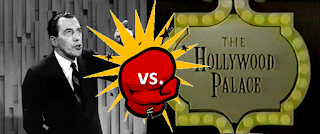 During the 60s, the Ed Sullivan Show and The Hollywood Palace were the premier variety shows on television. Whenever they appear in TV Guide together, we'll match them up and see who has the best lineup..
Sullivan: Scheduled: musical-comedy performers Phil Ford and Mimi Hines, who do scenes from Broadway’s “Funny Girl’; the Lettermen, vocal-instrumental group; actor-impressionist Frank Gorshin; song stylist Barbara McNair; TV personality Mike Douglas; and the comedy team of Stiller and Meara. (It looks like this was, indeed, the lineup.)
 It's that time of the year when news starts leaking out regarding shows being considered for the Fall schedule, and the editors have some thoughts on these shows in the As We See It editorial. There is, for example, Pursuit, in which the hero travels from town to town, chasing a wanted criminal. There's also Run, Buddy, Run, in which the hero travels from town to town, being chased by the Mafia. If you like war shows, we have Operation Razzle-Dazzle, a military comedy set behind enemy lines, The Recruiters, about a funny recruiting sergeant, The Sea Wolves, a submarine-service melodrama, Jericho, a commando melodrama, and Assault, a Pacific-war melodrama.
 But what about this season, you may ask? Well, wonder no more. Saturday's highlights come in the late-night movie slots, At 11:20 p.m., KPIX has Town Without Pity, a movie that spawned a hit record for Gene Pitney, and a pretty good courtroom drama to boot, dealing with the uneasy post-war relationship between the United States and West Germany. 1:00 a.m., KPIX is back with It Happened One Night, the first movie to win the Big Five Academy Awards of Best Picture, Best Actor (Clark Gable), Best Actress (Claudette Colbert), Best Director (Frank Capra), and Best Adapted Screenplay (Robert Riskin). Only two movies have done it since: One Flew Over the Cuckoo's Nest and The Silence of the Lambs. And at 2:00 a.m., KGO's all-night movies feature a Thin Man doubleheader: After the Thin Man, with a very young James Stewart in a very untypical role, and Shadow of the Thin Man.
 On Tuesday, The Red Skelton Hour (8:30 p.m., CBS) welcomes mime Marcel Marceau, who for the second straight year joins Red in "A Concert in Pantomime." The entire hour, needless to say, is in mime, with Marceau and Skelton performing separately, and joining together for the finale, in which they portray a toy soldier and rag doll who team up to bring happiness to a little girl who never smiles. And later, on NBC's Tuesday Night at the Movies (9:00 p.m.), it's The Tin Star, starring Henry Fonda and Anthony Perkins, which served as the inspiration for Fonda's later Western series The Deputy. Last, but certainly not least, it's The National Health Test (10:00 p.m., CBS), the latest in the network's series of programs (including The National Driver's Test and The National Citizenship Test) allowing viewers to test their knowledge on a variety of important subjects. Harry Reasoner and Mike Wallace are the hosts.
 Friday night sees a repeat showing of the 1960 production of the delightful Peter Pan (7:30 p.m., NBC), making its first appearance in three years, starring Mary Martin and Cyril Ritchard. It's not only one of television's most beloved productions of all time, it's one of the most significant TV specials of television's first two decades; when the original live version was shown in 1955, it drew 65 million viewers, making it, at the time, the largest audience to ever see a television program. It was done live again the following year, and then recorded in 1960; it's that version that's being shown tonight. Don't accept any cheap substitutes.
 MST3k alert: First Spaceship on Venus (Italian-German; 1962) Eight scientists set out for Venus. Yoko Tani, Oldrick Lukes. (Wednesday, 5:00 p.m., Channel 7) This isn't a terrible movie, which alone makes it a rarity on MST3K, but that doesn't mean it's good, either. The movie was made in Poland, where it was titled The Silent Star (a better title, if you ask me), it has the kind of ethnically-diverse cast that was somewhat unusual for the time. Still, as Mary Jo Pehl says, it doesn't make you care about the fate of the characters. TV
 During the 60s, the Ed Sullivan Show and The Hollywood Palace were the premier variety shows on television. Whenever they appear in TV Guide together, we'll match them up and see who has the best lineup..
Sullivan: Scheduled: musical-comedy performers Phil Ford and Mimi Hines, who do scenes from Broadway’s “Funny Girl’; the Lettermen, vocal-instrumental group; actor-impressionist Frank Gorshin; song stylist Barbara McNair; TV personality Mike Douglas; and the comedy team of Stiller and Meara. (It looks like this was, indeed, the lineup.)
Palace: Host Phil Harris presents Alice Faye (Mrs. Harris), tenor Sergio Franchi, the singing Kim Sisters, comedians Tim Conway and Georgie Kaye, the acrobatic Three Mecners and the Jubilee Four, Phil’s own singing group.
Well, there's not a lot to say about this week. Each show has a perfectly serviceable lineup, neither one of them knocks the other out of the park. Where does that leave us? Why, with a Push, of course.
Well, there's not a lot to say about this week. Each show has a perfectly serviceable lineup, neither one of them knocks the other out of the park. Where does that leave us? Why, with a Push, of course.
l l l

From 1963 to 1976, TV Guide's weekly reviews were written by the witty and acerbic Cleveland Amory. Whenever they appear, we'll look at Cleve's latest take on the shows of the era
This week, Our Man Cleve heads West: the Old West, that is, or at least the West in the post-Civil War era, with Rod Serling's new Western, The Loner, airing on CBS. The results are, as is so often the case, a mixed bag.
First, the good: Lloyd Bridges, the titular loner, who plays William Colton, a former Union officer in the War, in search of meaning to his life after four years of killing. I had never been a huge admirer of Bridges as a dramatic actor, but, like Amory, I came away from my viewing of The Loner greatly impressed by his performance. As Amory says, Bridges "is convincing in every department of an exceedingly demanding role," one that requires him to appear in virtually every scene. The show also has its share—perhaps more than its share—of fine episodes, featuring excellent performances from such guest stars as Barry Sullivan, who was particularly good in a story involving a handicapped surgeon who has to walk Colton through the process of operating on a gunfighter with a ruptured appendix. Brock Peters was another standout as a black Union soldier who returns home from the war only to find out that his father has been lynched.
Ah, but whenever you have good news, you also have bad, for, as Amory points out, Serling was obviously intent on developing a "realistic, adult Western," one that presented a contrast to that typically seen on television. However, based on the ratings, The Loner is "either too real for a public grown used to the unreal Western or too adult for juvenile Easterners—we hesitate to say which." Amory also points out something that fans of The Twilight Zone will recognize as an unfortunate Serling trait: the tendency to overwrite. In "The Oath," the episode featuring Sullivan, a young Spanish girl says, "Never tempt death, senor. Never beckon for it. Death comes in its own good time." Likewise, there is this "strange" speech that Peters gives to his father's hanging body: "Hey, Papa. I’m here. Hey, Papa. I done fight the war to make us free. Hey, Papa." Now, perhaps this is the way real people talk in real situations, although I doubt they talk with this kind of eloquence or rhythm. Nonetheless, as one of my favorite authors, D. Keith Mano, once said when a student of his explained a particularly bad piece of writing by saying that this is how it had happened in real life, "Yes. And see to it that it doesn't happen again." My own experience with The Loner, more often than not, was that the verbosity didn't interfere with the dramatic effectiveness, and to be fair, some of the worst episodes were those not written by Serling. Nevertheless, as Cleve points out, the patient that Colton operates on eventually dies—as will The Loner itself.
l l l

On the comedy side, there's Hero in the House, about an inept, bumbling Western actor, Green for Danger, about an inept, bumbling insurance agent, The Clumbsys, about an inept, bumbling family, and Ace of the Mounties, about an inept, bumbling dog. And if stories ripped from the comic pages are your thing, there's Tarzan, Li'l Abner, and Dick Tracy. There's also The Girl from U.N.C.L.E., Mr. Terrific, Silver Springs, about a game warden’s son who finds a mermaid, The Best Years, dramatizing the life of a small-town doctor, Hawk, whose detective hero happens to be a Mohawk Indian, and The Unpardonables, a comedy featuring funny inmates of a civilian prison.
Now, not all of these series will make it to television. There are some in that batch you should recognize, however, enough to convince you that this list is for real. But, the editors assure us, "we thought you’d like to know that, despite what you may have heard, the present season’s shows are not the last word in originality, creativity, or freshness. Next season may top them.
l l l
Sunday's highlights start early, with "In the Beginning, God...." (8:00 a.m., CBS), an historic hour-long program of sacred music from San Francisco's Grace Cathedral, written by Duke Ellington and performed by the Duke and his orchestra, hailed by religious leaders for its combination of jazz and sacred music. At 6:30 p.m., it's music of a different kind on The Bell Telephone Hour (NBC), with Donald O'Connor hosting a salute to "The Song-and-Dance Man," starring musical-comedy star Anthony Newley, singers Janet Blair, Shani Wallis and Nancy Dussault, and the dancing Nicholas Brothers.
Monday night's episode of Run For Your Life is the pilot, "Rapture at 240" (10:00 p.m., NBC), which was originally shown April 15, 1965 on Kraft Suspense Theatre. This episode includes Paul Bryan (Ben Gazzara) receiving the deadly news from his doctor* that his disease is incurable. Normally, I'm not a fan of series where the episode establishing the premise is shown after several other episodes have been run, but given that this is technically a repeat of the original showing, we'll let it go this time. I wonder if he was ever tempted to get a second opinion from either Dr. Kildare (8:30 p.m., NBC) or Ben Casey (10:00 p.m,. ABC). Perhaps not.
*Fun fact: the doctor is played by S. John Launer, who was the judge in many an episode of Perry Mason, where he never had to deliver the death sentence to one of Perry's clients.
Wednesday's highlight is the traditional close to televison's Christmas season, the Bob Hope visit to Vietnam (9:00 p.m., NBC). Bob's joined on this trip by actresses Carroll Baker and Joey Heatherton; singers Jack Jones, Kaye Stevens and Anita Bryant; comics Jerry Colonna and Peter Leeds; Dianna Lynn Batts, Miss U.S.A. titlist in the Miss World contest; the dancing Nicholas Brothers; and Les. Brown and his band. We also see entertainers Martha Raye; Eddie Fisher and song-and-dance man John Bubbles, who were doing separate tours in Vietnam.
Bob's show preempts I Spy, ironic since our cover features the stars of I Spy, Robert Culp and Bill Cosby. Dick Hobson's cover story focuses on Culp, who by all accounts is a man devoted to his craft, and what he believes in. For instance, Godfrey Cambridge, the controversial black comedian and actor, calls Culp the real deal, a white man who doesn't pretend to use hip, urban lingo, but prefers to let his work speak for him. At a time when "A Negro’s always got to be the Good Guy on TV these times," Cambridge says Culp dared to cast him as the heavy on I Spy. Cosby speaks warmly of Culp as well; "I could be just a nothing. I could be crumpled and crushed if Bobby had turned out to be the kind of guy who wants everything for himself," Cosby says. "But we made contact. We tuned each other in. Now Bobby knows me better than anybody. We’re closer than brothers." Culp talks of his early years in the business, when he had what he believes was a deserved reputation for being difficult to work with, sparked by his desire to say something in his work. With help from his agent, Jimmy McHugh, Culp was able to transform his image by steering him toward comedy as well as drama, which paid off with four successful feature movies over a two-year period, and wound up with I Spy. Without minimizing the impact of Cosby's various crimes, one of the unfortunate side effects was the kneejerk reaction to yank I Spy from various viewing options, which certainly does a disservice to Culp's talents.
Thursday sees the premiere of another ITC British import targeted for American audiences: The Baron (10:00 p.m., ABC), a mystery-adventure series starring Steve Forrest as John Mannering, a wealthy American antique dealer (nickname: "The Baron") who occasionally gets involved in cases with British intelligence. It is not a great show, but it is fun to watch; if you enjoy The Saint, I think you'll find this to your liking. Also to your liking is this morning's Today (7:00 a.m., NBC), which features an appearance by Kukla, Fran, and Ollie.
l l l
And now, the sports. Now that the champions have been crowned in the NFL and AFL, it's on to the all-star games. The AFL All-Star Game (Saturday, 10:30 a.m., NBC) features a unique, one-time format in which the AFL champion Buffalo Bills take on a team of stars from the rest of the league, live from Houston. (The All-Stars win, 30-19, by the way.) On Sunday, it's the NFL's turn with the Pro Bowl Game, live from Los Angeles. (1:00 p.m., CBS) In this more conventional setup, the East All-Stars, including Frank Ryan, Jim Brown, and Bob Hayes, route the West All-Stars, led by Fran Tarkenton, Gale Sayers, Mike Ditka, and Alex Karras, 36-7.
You'll notice that I made a point of mentioning that those games were live. One that is not live, at least in this issue, is the NBA All-Star Game, which took place on January 11 in Cincinnati, but is seen Saturday night at 11:00 p.m. on KCRA in Sacramento. An explanation: ABC is, for the second year, the national home of the NBA, but the contract does not include the All-Star Game, which was broadcast by Sports Network International. And while parts of the country saw the game live, Sacramento was not one of them. Reminds me of the days when the NBA Finals were shown on tape delay after the late local news. The league's come a long way since then. And if you're interested, the East wins in a walk, 137-94.
l l l

If you enjoy the content here and want to support my broader creative work, please consider making a donation at my Ko-fi page. Any amount you contribute helps me continue writing, researching, and sharing these articles and projects. Thank you!


No comments
Post a Comment
Thanks for writing! Drive safely!