Showing posts with label Additions to the Top Ten. Show all posts

July 12, 2023

Burke's Law: the cop show with a heart—or at least wallet—of gold


A badly wanted to do comedy," Gene Barry said in a profile for the November 23, 1963 issue of TV Guide. "I searched the scripts for the inherent comedy that can be found in almost any drama. I searched for the twinkle, the lift of an eyebrow [that] could change the tone of a serious sentence. I read Burke’s Law. I envisioned the twinkle in it."

And so, after three seasons as the Western hero Bat Masterson, after having said he would never do another television series, Barry returned to the small screen to portray Amos Burke, millionaire captain of the LAPD homicide division (and eventual secret agent, but we’ll get to that later), in the whimsical mystery that ran on ABC, in two different formats, for a total of three seasons.

When you keep finding new-old programs to watch, you have to be careful not to forget the old-old programs you’ve already enjoyed. It's been close to a decade since we last watched Burke's Law, and so last month we reintroduced it into the Saturday night schedule. Sometimes when you revisit an old favorite, you find your ardor somewhat diminished, but it's not the case here; it's every bit as enjoyable now as it was back then. 

I never saw Burke’s Law when it was in first-run. My only recollection of it was from the reruns in syndication in the late-60s, and from that all I can remember is the Rolls Royce tooling down the road while a woman’s voice cooed, "It’s Burke’s Law!" To tell you the truth, that voice kind of scared me a bit. (Of course, I hadn’t yet learned the meaning of the world "sultry.")

Based on the premise alone, it would have been impossible to produce Burke’s Law without that twinkle Barry mentioned. Burke is indeed a millionaire (the source of his money is never definitely stated, though he refers to an inheritance from his father, and implies that he’s multiplied that fortune through shrewd investments*) who lives in a mansion, is often clad in a tuxedo and surrounded by beautiful women, and is chauffeured to crime scenes in a Rolls Royce by his driver/valet, Henry (Leon Lontoc).

*Gene Barry himself was no slouch when it came to investing. That same 1963 TV Guide article mentions Barry’s ownership of a 40-acre orange ranch, mines in Nevada, a half-share of a construction company, and prime land in Los Angeles on which he and his partners planned to put up office buildings and apartments. Substituting Burke for Berry does a pretty good job of filling in the gaps.

Which, of course, begs the question: why does a man who clearly doesn’t have to work for a living choose a profession that’s not only difficult, but dangerous, one that required him to work his way up the ladder from beat cop to captain of homicide and could claim his life at any moment? I don’t know if Barry was one of those actors who composed backstories for each of the characters he played, but he does drop hints as to his concept of Burke. He is "a carry-over of the Old World, but part of this world," cultured, mannered, sophisticated, worldly. "Police work is as important to Amos Burke as building a building is to me. Hell, he wouldn’t be happy sitting in a stock-exchange seat. He is alive, vital, now." Probably the best answer comes from fellow detective Tim Tilson, who in the premiere episode is asked by a bystander at a crime scene why a millionaire would bother being a cop. "Why are you a construction man?" Tilson counters. "That's what I do best," the man says, to which Tilson replies, "That's why he's a cop."

It's a premise that requires some selling, but Barry is just the man to do it. Producer Aaron Spelling describes him as a man "at home in [a tuxedo], secure in it," and his portrayal of Burke owes much to his previous turn as the Western dandy Masterson. In this updated environment Berry is still a crimefighter, albeit with a gun instead of a walking stick. And, as his colleagues are quick to remind others, a millionaire is what he is, but a policeman is who he is.

Given its various elements, Burke’s Law could have gone in several directions, but its success derives from the direction it chose. Neither traditional police drama nor comedy, each episode is centered on a spectacular murder (with the victim identified by the episode title Who Killed …) and a cast of flamboyantly eccentric (to put it lightly) suspects, mostly played by big-name guest stars (listed in alphabetical order in the opening credits, and frequently making little more than cameo appearances). Given that, one could hardly be blamed for expecting the investigating detectives to be just as zany, but far from it: Burke and his two cohorts, Sergeant Les Hart (veteran actor Regis Toomey) and Detective Tim Tilson (Gary Conway), could have been buffoons or broad caricatures, but instead they’re skilled cops who understand that murder is a deadly business and take their jobs seriously (if not always how they do them). They’re very smart, and very, very good.

L-R: Regis Toomey, Gary Conway,
and Gene Barry
The show’s premise also offers Burke an unusual advantage, never overtly stated but often implied, that as a millionaire he has the ability to deal with rich, powerful suspects on an even footing. Their money can’t intimidate him (he’s probably as wealthy as they are), nor can their influence scare him off. He’s beholden to nobody but the public, and he doesn’t scare easily.

The interplay between the three is one of the show’s delights. Hart is the veteran, wizened cop and mentor to the young Tilson, who has an encyclopedic knowledge of almost everything but lacks the experience and intuition to put the pieces together. Burke and Les obviously go back a long way (Les will on occasion drop the formality and refer to Burke as "Amos,"), and while Tim can sometimes be a bit of a showoff, it’s clear that Burke has a paternal affection for the young detective, often imparting a bit of his collected wisdom. ("Never ask a question unless you already know the answer—Burke’s Law.") The three men split up the investigative work, with Burke generally reserving for himself ("Your old Captain") the interrogation of the most interesting suspects. Those suspects are frequently also beautiful women, and their attraction to the handsome, dashing Burke may be genuine—or an attempt to throw him off the trail.

Indeed, Burke is seldom out of the company of an attractive female—the episode often begins with him in the embrace of some such lovely companion—but the moment the phone rings, with Les or Tim calling him to the scene of yet another murder, Burke is all business. The debonair playboy is gone, replaced by the determined homicide captain. There’s never an attempt to avoid his job, just a request to his female companion that she not go away.

And that, I think, is one of the main reasons I find this show so enjoyable. For all of the light touches— and the mix of comedy and drama works surprisingly well—Amos Burke is a policeman before all else, a damn good one who understands the importance of his job. His suspects may include glamorous women, but their beauty never blinds him to the possibility that behind their makeup may be the face of a killer. He’s not afraid to trade either punches or gunshots, and he’s not satisfied until the killer is apprehended.
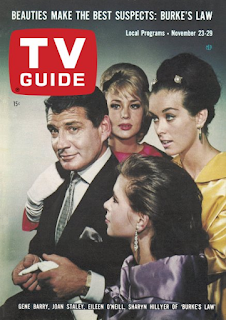
Then there's that twinkle in the eye that Barry talked about, the priceless reactions when Burke meets yet another crazy suspect or has to listen to yet another ridiculous story. It’s when Burke lets us know that it’s a joke, and that we’re in on it. Throw in some great supporting players, such as Michael Fox as the droll medical examiner and Eileen O’Neill as a desk sergeant who doesn’t have to take second place to any of Burke’s beauties, and you’ve got the ingredients for a great show.*

*And by the way, speaking of beauties, did I mention that Anne Francis’ detective series Honey West was a direct spin-off from Burke? She was introduced in the second-season episode "Who Killed the Jackpot?" and would go on to a one-season run in 1965-66.

Which is why the third and final season is such a disappointment. Caught up in the spy hysteria of the early James Bond years, for 1965 the series changed format completely. Amos Burke was now a secret agent (hence the show’s new title: Amos Burke, Secret Agent), working for a spymaster known only as "The Man" (Carl Benton Reid). It had a flashy opening title and fun gadgets and even more beautiful women, if that was possible. It even had Burke’s Rolls. What it didn’t have was the chemistry of the original. No Les, no Tim, no Henry. It ran for 17 episodes, and by January 1966 it was over.

Apparently, Amos Burke tired of the secret agent business and returned to the LAPD, or at least that’s what had happened in the 1994-95 revival of Burke’s Law. Burke was now a chief, his sidekick was his son Peter (during the intervening years Burke had married and was now a widower), and Henry was back behind the wheel of his Rolls (albeit with a different actor). It was a middling success, running for 24 episodes over two seasons.

Burke’s Law could have been many things. It could have been a comedy, a la Barney Miller or Car 54. It could have been a police procedural, like any one of the cop shows on at the time. Instead, it was a one-of-a-kind, a comedy-mystery, a sophisticated whodunit. Most of all, Burke’s Law was fun. It wasn’t searing drama, it didn’t involve impossibly convoluted plots. It was easy to watch, and easy to enjoy. It has suffered from one of the most frustrating of DVD issues, with the first season coming out in 2008, and nothing since. Fortunately, it has aired on Me-TV in the past (which is where I caught it), and hopefully it will again. It's also available on YouTube—all three seasons, including Amos Burke, Secret Agent. And whether you're watching it for the first time or rekindling an old memory, you'll feel the same way.  TV      

November 20, 2019

Additions to the Top Ten: Man in a Suitcase

RICHARD BRADFORD IS McGILL IN MAN IN A SUITCASE
I'm not what you'd call an Anglophile; I don't scour newsstands looking for magazines with one of the Royals on the cover, I don't give a rat's you-know-what about what Meghan and Harry or William and Kate are up to (I'm not even on a first-name basis with them), and I root for the home team on the Fourth of July.

When it comes to television, however, I'm more than willing to look across the pond, especially the shows from the 1960s that migrated to American TV: Doctor Who, The Prisoner, The Avengers, The Saint, The Persuaders, and—Man in a Suitcase.   

Man in a Suitcase ran for only one season (1967-68 on ITV; 1968 on ABC), but it's more than worthy of being mentioned with those other series. It stars American actor Richard Bradford in a galvanizing performance as McGill ("Just McGill," he brusquely tells people), a former American spy who's been dismissed from the service, and prevented from returning to the United States, for having allowed a scientist (accidentally, or on purpose) to defect to the Soviets. As befits his role as series protagonist, all is not what it seems: McGill's the victim of a frame-up, and he's determined to clear his name, even though it's unlikely he'd ever want to return to the service after the way he's been treated. In the meantime, he's holed up in London, taking various assignments as an unlicensed private detective, accompanied always by the battered suitcase that holds the remnants of his life. He's hard and cynical, and in the first episode*, "Man from the Dead," we see why: the service knows he's innocent. It turns out the scientist is acting as a double agent, passing information back to the Americans, and McGill was targeted to take the rap in order to make the whole thing convincing to the Reds (as well as keeping him from figuring out the truth). In other words, while everyone else thinks he's a disgrace (and possibly a traitor!), the people who know better, who could with one word restore his reputation, are perfectly content to let him twist in the wind to provide cover for their larger deception. No wonder he's bitter.

*As you watch the series, don't follow the broadcast order of episodes, which lists "Man from the Dead" as Episode #6; it is, in fact, meant to be seen first. One could make an argument, however, that it could equally function as the final episode.

There's a lot to like about this series. It has that stylish Sixties feel, from the pitch-perfect theme by Ron Grainer (who also did The Prisoner and Doctor Who, among others) to the fashions, the style of cinematography, and the Cold War tension. The series has a dark, cynical feeling, right out of shows like Secret Agent and The Prisoner, and McGill is the perfect protagonist: a loner, sardonic, brittle, and suspicious; a mercenary who doesn't let his fee stop him from biting the hand that feeds him, whether it be a client, the authorities, or someone who might be an ally. And yet he also has the proverbial Heart of Gold, a strong sense of justice that causes him to put his own life on the line in order to help those he sees as true victims—people like him, although he never drifts into self-pity. (It also shows the value of casting an American actor as an American character, rather than a British actor with a bad accent.)


Certainly these are the elements that one sees in traditional noir stories, and in lesser hands it could fall into cliché. Bradford's performance ensures that it never happens, though. A classic method actor, he's thoroughly invested in his character, determined to play him as realistically as possible. When McGill's slugged, he bleeds; getting sapped in the head leaves him woosey and uncertain; and he makes it clear he doesn't always have all the answers. This kind of dedication made Bradford difficult to work with (and perhaps explains why Man in a Suitcase was his only starring role), but it results in a charismatic, convincing portrayal of a man who's honest, dedicated (often in spite of himself), as must have been one hell of an agent.

Even when the stories are relatively straightforward, there's a perpetually unsettling feeling about Man in a Suitcase: no guarantees that the good guys will win, that everyone will survive, that McGill won't be (once again) betrayed by someone he's reluctantly decided to trust. There's also a sense that not everything is as it seems, and indeed the story rarely unfolds all at once. McGill's background is only occasionally mentioned (usually by prospective clients who take the opportunity to remind him that beggars can't be choosers), but it's never far from the surface, and never far from McGill's thoughts. It's a subtle, unspoken element that hangs in the air throughout the series.

It's too bad that Man in a Suitcase only ran for one season, but perhaps that's really a good thing; like The Prisoner, it may have been impossible to sustain the premise and the quality of the series for more than the 30 episodes that were made. I watched Man in a Suitcase right after having finished Coronet Blue, a series from roughly the same era with a similar look; but Man in a Suitcase quickly underlines the missed potential of Coronet Blue: the atmosphere, the subtleties, the distrust, the sense that the ground could shift under your feet at any moment. A little mystery, done well, can go a long way, and while we never find out who Michael Alden was, just as we never know if McGill clears his name, it's clear which series offers the more satisfying journey. TV  

March 23, 2016

Additions to the Top Ten: Breaking Point

EDUARD FRANZ (LEFT) AND PAUL RICHARDS: THE DOCTORS OF BREAKING POINT

I've written a couple of times these last few months about Breaking Point, the Ben Casey spinoff that ran in the 1963-64 season on ABC. As was the case with so many series from that era, I first became acquainted with it through TV Guide, where I would see it in the listings each week, reading the description of an episode that sounded intriguing or provocative.

Like Casey, the show followed the tried-and-true formula: Paul Richards plays Dr. McKinley Thompson, the young chief resident in psychiatry; Eduard Franz, as psychiatric clinic director Dr. Edward Raymer, is the older mentor. Although each story tends to focus on one doctor*, both men appear in most episodes. And, as is the case in so many dramas of the era, plots revolve around the guest stars more than the doctors themselves.

*The emphasis, as was the case in most medical dramas, was on the younger of the two men; Franz, noting this and pointing out to the producers that his contract stipulated co-star status, calmly mentioned he'd be asking to be released from his contract unless the imbalance was corrected. Fortunately, it was.

In one particularly fine episode, "And If Thy Hand Offend Thee," James Daly (Medical Center) portrays Mitchell Farnum, a veteran of the Pacific theater in World War II, who appears to be dealing with what today we'd call PTSD, spending nights in an Asian bar, raving about his experiences with the Japanese. Just when it looks as if a fight might break out, though, he finds his right hand cramping and breaking out in a rash. Since his regular doctor can't find anything physically wrong, he sends Farnum to see Dr. Thompson.

Slowly, through Thompson's questions, Farnum's story begins to unfold in unexpected directions. First, we find that Farnum has had this problem with his hand for several years. We are told that Farnum has been separated from his wife for over a decade, and then discover that his wife is Japanese, that he met her during the occupation, that she lived in Hiroshima but was not caught in the blast. We learn that they spent several happy years in Japan, but that the problems began once they relocated to the United States. We see a flashback in which Farnum's unit has a hatred of Japanese drillled into them - that they lack emotions, that they will kill without scruples, that they are not even human. Fine, we think - this confirms our initial theory that Farnum has a bitter hatred of the Japanese based on what he saw in the Pacific.

James Daly (left) with Paul Richards
But then the story begins to shift, as Farnum tells Thompson that he was involved in testing of the atomic bomb. that he played the key role in testing the trigger mechanism. As he describes the horror that unfolded at Hiroshima (in a stunning, documentary-like look at the damage), Dr. Thompson begins to understand the situation. Farnum's hatred of the Japanese is merely a defense mechanism to mask his true problem - an intense hatred of himself, fueled by guilt over his role in the bombing. Having unlocked the key to understanding the situation, Thompson stresses, does not mean Farnum's illness will go away magically. It will take work, it will take desire on Farnum's part to get better, but Thompson will be there to help him get there.

And in truth, one of the best parts about Breaking Point is that it usually avoids the easy answer. It is clear that Farnum and his wife still love each other after all these years, but Farnum tells her it will take time for him to accept all this. When he checks out of the hospital, to continue his therapy as an outpatient, he tells Dr. Thompson that he's not ready to return to his wife yet. He wants to, but it isn't going to happen overnight. The episode ends, on a note of hope, but with no certainty that Farnum and his wife will live happily ever after.

This is far from an unusual episode of Breaking Point, however. Another standout, "My Hands Are Clean," involves Telly Savalas as Vincenzo Gracchi, a loan shark who may be experiencing the Stigmata, bleeding that mimics Christ's wounds on the Cross. His priest, played by Henry Silva, refuses to believe that this is a miracle - Gracchi is an unrepentant loan shark, after all* - and convinces Cracchi to see his old friend Dr. Thompson, who through patient but persistent questioning determines that Gracchi's problems have something to do with his father. Sounds Freudian, right? Gracchi says his father was the best man he's ever known, and that he'd wanted Gracchi to become a priest, but the young Gracchi was too consumed with succeeding, with rising above his station in life, the area where Gracchi feels his father was a failure.

*In doing so, the priest's comments echo those of G.K. Chesterton, who said that it was only because he believed in the existence of miracles that he could discount those that were not real.

What does this have to do with the Stigmata? Thompson confesses his frustration to Dr. Raymer, who shrewdly reminds the younger doctor that there was more than one man on the hill at Calvary. And with that, Thompson gets to the bottom of Gracchi's problem - his guilt is about the kind of lifestyle he has chosen, the way he has unscrupulously taken advantage of so many people, and in doing so he is identifying not with Christ, but with the Good Thief. It's more of a happy ending than most episodes, with Gracchi vowing to give up loan sharking and become an honest businessman, but both he and the viewers know that he'll need continued therapy to get over what has plagued him for so long.

In many respects, "My Hands Are Clean" illustrates why Breaking Point is so good. We see the patient struggling (and initially rejecting) the idea of psychiatric help. The doctors ask questions, probe, but are never intrusive. They stress the reasons the patient needs help, but don't force the issue. Eventually, we see the patients hit bottom, and in desperation return to the hospital - where Drs. McKinley or Raymer are there, waiting for them. They are never dismissive of the problems faced by their patients, nor do they scoff at things like religious belief, which they give great respect.

Most of all, a couple of things I mentioned earlier: first, that there are no easy answers. In an episode featuring Bradford Dillman as a doctor blinded in an accident, the episode ends with Dillman finally adjusting to a future without sight, and returning home with his new guide dog - only to find his wife, unable to provide him with the support he needs, has left him. Dillman starts the process of learning how to function as a sightless doctor, but we have no idea whether or not he and his wife will reconcile. A similar situation occurs in an episode I wrote about earlier, with Dr. Raymer treating Gena Rowlands, a woman with a drinking problem. At the conclusion of the episode her husband, fed up with her repeated promises to stop drinking, has left her. She's determined, with Dr. Raymer's help, to overcome her problems and win her husband back - and on that hopeful note, but with no guarantee that the couple will get back together, the episode ends. Some people might complain that the story isn't tied up in a nice bow, as would be the case with so many other shows of the era - I simply call it real life.

In writing about that episode, I also mention the other thing that I like so much about Breaking Point - there is no personal drama concerning the doctors. Are they married, do they have girlfriends, are their lives like those on, say, Gray's Anatomy? As Dr. Raymer says, "Does it matter?" Breaking Point is a medical drama, not a soap opera, with the story concentrating on the lives of the patients, people at the very breaking point. See that picture above of Daly with Paul Richards? It's a key point in the episode, played with Richards' back to the camera, and that's symbolic of how the show lets those lives take center stage. It never becomes melodramatic, and only rarely does it even try to pull strings or manipulate viewers. The cast is first-rate, the writing is quality, the episodes demonstrate the intense drama of the human condition, and remind us that this drama doesn't need to be tarted up to be compelling. Breaking Point is compelling, consistently, and it's unfortunate that the show lasted only the one season, competing with East Side/West Side on CBS and Sing Along With Mitch on NBC.

Breaking Point reminds us that television has always been capable of delivering quality drama, and that the human mind is perhaps the most fertile ground for such drama. My question is simple: where is this kind of drama today?

October 21, 2014

Additions to the Top Ten: Naked City

PAUL BURKE IN A SCENE FROM NAKED CITY
Most people of a certain age are familiar with the saying, "There are eight million stories in the Naked City," though I'm not sure that it means anything to people today.  But back in the early '60s, the Naked City was New York, and there were indeed eight million stories to be told - many of them on the television series of the same name.

The Naked City was one of the great noir films of the '40s, directed by Jules Dassan in 1948.  It was notable for its gritty, documentary-like style, aided by its extensive use of location shooting in New York City.  (It won an Academy Award for cinematography.)   It followed two police detectives, veteran Detective Lieutenant. Dan Muldoon (Going My Way's Barry Fitzgerald) and his young associate Detective Jimmy Halloran (Don Taylor) as they investigate a murder.

In 1958, the story made the transition to television as a weekly half-hour drama on ABC, with John McIntyre taking on the role of Muldoon and James Franciscus portraying Halloran, joined by Harry Bellaver as Sergeant Frank Arcaro.  It didn't take long for things to change, though; halfway through the season, McIntyre left the show (his character was killed off in a spectacular car crash), replaced by Horace McMahon as Lieutenant Mike Parker.  The series won critical acclaim but didn't fare so well in the ratings, and was cancelled after that first season.

A year later, though, after lobbying by the show's sponsor and producer, the series returned to ABC with a new title (dropping the article The; it would now simply be called Naked City), a new running time (expanded to one hour), and a new star to join the returning McMahon and Bellaver - Paul Burke, as Detective Adam Flint, replacing Franciscus' Halloran.  This version of the series lasted an additional three seasons before going off the air for good in 1963.

Naked City the series was created by Sterling Silliphant and produced by Herbert B. Leonard, and it shared the movie's trademark location shooting, which means that, like Silliphant and Leonard's other series, Route 66, it serves today as an almost documentary look at the city of New York, much of which no longer exists.  It wouldn't be an exaggeration to say that New York City, it all its glory and grime, is as much a star of the show as any of the actors. It's a highly atmospheric show, and it wouldn't be possible with a studio-bound production.

Although I'd read about Naked City for years, it wasn't until a couple of years ago that I actually got to see an episode of it, courtesy of MeTV.  The first few episodes took a while to grow on me, but once I got hooked it became one of my favorites.  The chemistry between the three leads - with Burke as the young, intellectual, sensitive Flint, McMahon as the grizzled, gruffy veteran with the astute eye, and Bellaver as a solid, hard-working cop who also provides much of the show's humor - is perfect.  Like another of my favorite series, Burke's Law, the viewer can't help but be impressed by the competency of the cops.  They don't get a lot of screen time (more on that in a moment), but they so fully inhabit their characters that you can see the wheels turn every time they're confronted by another tough case.  Best of all (to my thinking) is that the series rarely strays into the characters' personal lives.  Oh, there's Flint's girlfriend Libby (Nancy Malone), but she's not in every episode, and often she's shown helping Flint think through a difficult part of the case, or dealing with the stress of police work.  No quirkbots here, no soap opera stories.

One reason why the series stays out of the personal lives of the leads is because most stories focus on the guest stars - the victims of crime, or the perpetrators.  It's their stories that make up the bulk of Naked City, and unlike procedurals of today, they're fully fleshed-out characters, with backstories and motivations that make the cases far more complex and less black-and-white than the normal police show.  I think, for example, of Jack Klugman as a henpecked husband talked by his domineering wife into a kidnapping.  He's a disappointment to his ambitious wife, he knows, and a disappointment to himself as well.  But he loves his wife so much that in order to keep her, he'll do anything to make himself a "big man" - and when she suggests kidnapping a young girl in order to bankroll a more luxurious life, he has no choice but to go along with the scheme.  Klugman, an actor with a limited range but a marvelous expressiveness within that range, wonderfully portrays a man who wants nothing more than to be a father (to the chagrin of his wife), and his genuine affection for and worry about their victim makes him a lousy kidnapper, but a good man.  It's that kind of depth that typifies the stories on Naked City.

Another thing that distinguishes the series is the absence of cynicism that clouds so much of television today.*  Not every case turns out the way Naked City's detectives would like - sometimes they don't get the breaks, sometimes it's just the way the system's made up.  But through this, the detectives always keep in mind that they're public servants, hired to protect the people of the city.  They don't view the public as their adversary, they don't assume that everyone they run into is either guilty or hiding a secret, and they don't greet every accused suspect with a sneer and a smirk.  Flint, the most sensitive of the three, is the most likely to shoot from the heart rather than the hip, but he's always able to back it up with solid police logic; his boss Parker, in turn, emphasizes that if he feels that strongly about his hunch, he has to be willing to do the hard legwork required to see it through to the end.  And although Flint sometimes feels the stress of not being able to change the whole world, he never falls victim to a cynical view of the job, never stops trying to make a difference in the cases that come his way.  It's a refreshing change from today's shows.

*Which I intend to write about at length one of these days.

One of the things I worried about when I started watching Naked City is Silliphant's penchant for writing preachy, achingly earnest scripts, filled with dialogue that's about as far from how real people talk as you can get.  But once Route 66 started, Silliphant devoted most of his time and energy to that series, and it's to Naked City's benefit.  The show never shies away from offering social criticism or taking on the issues of the day, but in so doing it remembers that it's first and foremost a police drama, and never fails to deliver an intricate investigation, highlighting the hard work and frustration that make up the unglamorous lives of detectives.

Naked City is terrific drama and terrific storytelling, backed up by a terrific cast.  It's gritty, grimy, and original.  (And would have been a disaster in color.)  It's free of the cliche and crassness of today's television, and its protagonists are actually likable.  Best of all, with its movie parent, it shares the closing narration: "There are eight million stories in the Naked City.  This has been one of them."  Truth in advertising, to be sure.  Maybe it didn't tell eight million stories, but the 138 it did tell were pretty damn good.