Showing posts with label Anthologies. Show all posts

April 26, 2024

Around the dial


At Realweegiemidget, Gill looks at the 1956 Robert Montgomery Presents version of Sunset Boulevard. Most of us are probably familiar with the classic movie, starring Gloria Swanson and William Holden, but how does this version hold up, with Mary Astor and Darren McGavin? Let's find out!

There's always been controversy about the effect scary television shows have on children. I've never heard of a scary TV lamp, though—at least not until this bit at the Broadcast Archives. TV lamps are, themselves, an interesting subject, so be sure to check out the link within the piece for more.

At Cult TV Blog, John turns his attention to the long-running British series Comedy Playhouse, and the episode, "Elementary, My Dear Watson." If you like Monty Python, John assures us, you'll probably like this Holmes takeoff, with John Cleese as the master detective. Well, I do, so I'll have to watch this!

We've lived in Indiana for 2½ years now, and after having moved so many times, I'd be happy to never see the interior of a moving van again. There are several classic TV families who felt the same way, contemplating moving but deciding to stay put: read about them in David's latest at Comfort TV.

We all know that the growth of television had a major effect on radio, meaning it was up to local DJs to find a formula that would keep them (and their stations) in business. Martin Grams reviews one such example with Janice and Mike Olszewski's book Mad Daddy, a look at the career of Cleveland's legendary Pete Myers.

Terry Carter, whose TV career ranged from military camps to the streets of New York to the stars and beyond, died this week, aged 95. At A Shroud of Thoughts, Terence remembers the actor, whose work included The Phil Silvers Show, McCloud, Battlestar Galactica, and much more.

At Travalanche, it's a look at Edward R. Murrow and his legendary series Person to Person. There's always been something of a dichotomy between Murrow, the hard journalist, and the celebrity interviews he did in Person; learn more about the man, his career, and the show.

"Noon Doomsday" is the latest Avengers episode to get the treatment from Roger and Mike at The View from the Junkyard. It's a Western-themed episode written by Terry Nation, creator of the Daleks, and like most Nation scripts, it has its good points and bad. Does this one have more good than bad?

Finally, A Vintage Nerd looks at the impressive list of classic Hollywood actors who appeared in Rod Serling's Night Gallery. Daffny lists over one hundred of them, and that's quite a list for any series, let alone one with a relatively short run. Makes you want to watch an episode right now. TV  

January 28, 2023

This week in TV Guide: January 28, 1967

Sometimes—perhaps most times—even when you're able to watch a program from 50 or 60 years ago it can be difficult to recapture the impact that show must have had on viewers at the time. After all, times change, people change. 

Take, for instance, Sunday's episode of CBS Playhouse, the network's successor to the fabled Playhouse 90*. Set in 1963, "The Final War of Olly Winters" stars Ivan Dixon as an Army sergeant serving as a United States military adviser in South Vietnam at a time before American soldiers had been committed to combat.

*Unlike the original, CBS Playhouse aired on an occasional basis (only twelve were shown over the three years that the show ran; it was dropped for lack of sponsorship).  

A couple of points about this: first, it's a neat trick to set the story in 1963, before Vietnam had become so polarizing. By the late 1960s, war protestors were vilifying American soldiers as war criminals, baby murderers, and the like. By doing this, I wonder if Ronald Ribman, the author of the play, wasn't trying to create some distance in order to make it easier for Winters to be accepted as a protagonist by the audience. I'm not attempting to psychoanalyze Ribman or his motives, but it does seem logical that making it a period piece by only four years would make sense. 


What I was really thinking about, though, was the casting of Ivan Dixon as Winter. Dixon was far from being unknown (he'd appeared in many movies and television shows, including a memorable appearance on The Twilight Zone in "The Big Tall Wish." At this point, however, he's been on Hogan's Heroes for nearly two full seasons, playing Staff Sergeant Kinchloe; Olly Winter is also a staff sergeant. Same rank, same uniform, same mustache. Surely viewers (and there were 30 million of them) would have been alerted by the TV Guide description that they were going to see something far different from Hogan. Still, look at him in that picture. Consider that he's been a soldier for 20 years—since 1943. Sure, Kinch would have been promoted for his heroic service in Stalag 13, but in some way you might have thought of Winter as Kinch, but in a very, very different story. I don't want to make too fine a point there, but you have to admit that it's kind of unnerving to see an actor playing a role that, on the exterior, looks so similar to the role in which we know and love him. And don't forget that he's playing Kinch at the time; as a matter of fact, you could have seen him on Hogan's Heroes just 48 hours earlier, Friday night at 8:30 p.m. 

In addition to Dixon, who will be nominated for an Emmy for Best Actor for his brilliant performance, "Olly Winter" boasts top credentials; Paul Bogart, the director, had already won an Emmy for The Defenders and he'll get a nomination for Best Director for this as well. (He was also nominated for directing sitcoms like All in the Family and The Golden Girls; hell, he could have directed an episode of Hogan's Heroes!) Fred Coe, the producer, had also done Playhouse 90. And the music was by Aaron Copland. "The Final War of Olly Winter" is a critical as well as popular success; I wish this had led to even more dramas of this type.

CBS would make one final effort in the early 1970s to bring back the dramatic anthology concept, this time resurrecting the Playhouse 90 title in its entirety (as well as the opening music and graphics); CBS Playhouse 90 would air a number of quality plays, including Ingmar Bergman's "The Lie" and Brian Moore's "Catholics." "The Final War of Olly Winter" isn't available commercially or online, but it can be seen at the Paley Center in New York or the UCLA Film & Television Archive in L.A. It's probably the thousandth show I have on my list to watch at places I'll likely never get to.

l  l  l

Throughout the 60s and early 70s, TV Guide's weekly reviews were written by the witty and acerbic Cleveland Amory. Whenever we get the chance, we'll look at Cleve's latest take on the shows of the era. 

When you think of The Jackie Gleason Show, what comes to your mind first? Is it The Honeymooners, the classic sitcom? Is it the 1950s variety show, on which the Honeymooners sketches first appeared? Is it The American Scene Magazine, Gleason's 1962 return to weekly television? Or is it the show that Cleveland Amory reviews this week, which originates from "The Sun and Fun Capital of the World," Miami Beach and brings The Honeymooners back as a regular feature? If you're like me (and, once again, I hope you aren't), this is the version you're most familiar with. And it's a good thing, Cleve says, because this show, which has for too long been too average, is now "not only as bright comedy as is available anywhere on your dial, but it is also, at its best each week, a full-scale musical comedy."

Key to the show's evolution has been the reunion of Gleason with his Honeymooners on a regular basis—not just the great Art Carney, who makes The Great One "a great deal Greater," but the additions of Sheila MacRae as Alice (who, in her first continuing TV role, shows herself "not only a fine actress but a terrific reactress") and Jane Kean as Trixie ("both singer and swinger"), to make what Amory calls "a winsome foresome and then some." The idea of making The Honeymooners into a musical comedy (which, I'll admit, would not have occurred to me) has been transformational; the songs by Lyn Duddy and Jerry Bresler "are, if not Broadway caliber, so close to it that, when you consider they are turning them out week after week, even more remarkable than Broadway."

The show isn't perfect; Amory finds that the characters of Ralph and Norton are still "unnecessarily crude," a critique that many will agree with today; and, he says, "too many of the routines are routine," although my personal opinion always was that by (for example) sending the Kramdens and Nortons on adventures around the world, they were straying too far from the skit's original concept. But I suppose the tenements of New York don't lend themselves to all that many musical storylines, unless you're making West Side Story. All in all, Cleve concludes, "when you see wonderful episodes like Ralph being blackmailed by a senorita or being duped into becoming a Santa Claus bookie, somehow you like the show the way it is—warts and all."

l  l  l

Now that the inaugural Super Bowl (and yes, that's what TV Guide has called it) is over, Stanley Frank is here to answer the big question: no, not which league is best, but which network won the TV game—CBS, with their broadcasting team of Ray Scott, Jack Whittaker, and Frank Gifford, or NBC's long-running announce booth of Curt Gowdy and Paul Christman.

As you probably know, both networks televised the game, with an agreement that they would alternate coverage of future games. With the largest U.S. audience ever to watch a sporting event on the line, the stakes were high. During the regular season, CBS outdrew NBC by two to one, which isn't surprising considering the NFL is not only the more established league but has the larger television markets; it was thought that CBS needed to win by about five ratings points in order to show it had retained its core audience, while NBC needed to keep things close or else they'd have trouble selling the AFL to advertisers next season.

As is typical when ratings are involved, there was good news for everyone. According to the Arbitron overnight figures, CBS scored a "smashing" victory, drawing 59 percent of the football audience and besting NBC by more than seven points; NBC countered with Nielsen figures that showed them trailing CBS by only 1.2 points in the critical New York City market. (The final ratings: CBS won the Nielsens 22.6 to 18.5, and the market share 43-36.)

How did the announcers do? Frank's analysis is that NBC's Gowdy betrayed his rooting interest in the AFL's Kansas City Chiefs, "flout[ing] the objectivity a reporter is supposed to observe," but he did inject excitement into the game while the score was still close. (I don't find that unexpected, considering that Ray Scott, who did the first half of the game for CBS, is known for his minimalist, "just the facts" style of play-by-play.) The NFL's Green Bay Packers made Gowdy look bad several times; after proclaiming that "Green Bay's famed ground game has been stopped!" Gowdy watched as Green Bay's Jim Taylor rolled 14 yards on the ground for a touchdown. He was, Frank says, "a prophet without honor and a partisan without a winner." Better was Gowdy's color analyst, Paul Christman, and it's too bad that more aren't familiar with his work today. He was the first announcer with the ability to, in Frank's words, "explain what was happening clearly and concisely, with a minimum of technical gobbledygook." He shrewdly anticipated plays and wasn't afraid to lay it on the line; with the Packers leading 7-0 and the Chiefs threatening, he called the next play the pivotal moment of the game, saying, "Kansas CIty will have to prove itself and score to have a chance to win."

CBS, in general, displayed a more impartial voice; Gifford "almost dislocated a vertebra bending over backward to laud the Chiefs and make character for his firm with AFL owners," no doubt hoping it would improve the network's chances of getting the whole TV package after the leagues merge. The inexperienced Gifford, a rookie announcer, struggled working the first half with the bare-bones Scott, but he became more comfortable as the game progressed, and worked well with second-half play-by-play man Jack Whittaker. Although he didn't have the analytical acumen of Christman, and he sometimes seemed surprised that the Chiefs were, in fact, an accomplished professional football team ("The Chiefs came to play football," he remarked "lamely" after they'd tied the game), he was particularly good at explaining the emotional aspects of the game; Frank feels that "his human-interest touches brightened what had become a dull contest" by the fourth quarter. Perhaps he knew what Kansas City players were feeling, Frank concludes; after all, in 1961 "Gifford's Giants met the Packers for the NFL title and were clobbered, 37-0."

Why did I spend so much time on this? Well, 29 of the top 30 most-watched television broadcasts of all time have been Super Bowls. The cost of a 30-second commercial in 1967 was $42,000; last year, it was between $6.5 and $7 million.

l  l  l

I missed the point of The Monkees when they debuted in 1966. Sure, I watched the show from time to time, but since I wasn't a fan of The Beatles, the comparisons were lost on me. And since I wasn't a teenage girl, the "cute" factor was a non-issue as well. In fact, now that I think of it, I probably saw the show more often on Saturday mornings than I did in the original airing. I was never a fan, but neither did I dismiss them out of hand.

Leslie Raddatz's article rehashes everything we know about the group: the Daily Variety ad ("MADNESS!! Auditions—Folk & Roll Musicians-Singers—Running parts for 4 insane boys, age 17-21.") and the descriptions of our four heroes (Davy, "the little one"; Mike, "the one with the hat"; Mickey, "who was Circus Boy when he and TV were both young"; and Peter, "the shy one with the dimples."), and we're not surprised to find that the four not only are referred to as "kids" by everyone, "they act like kids, and that's the way they seem to think of themselves." But as Bob Rafelson and Bert Schneider, the co-producers, point out, their goal was not to find four actors to play The Monkees, but to be The Monkees.

Each one of them has his own story; Davy was a jockey in England as well as an actor; under contract to Columbia, he's the only one of the four who wasn't cast from the Daily Variety ad. Peter flunked out of college and worked as a kitchen boy while he sang in coffee houses; he originally didn't want to audition, "but I had let my hair grow in the Village, so I was ready for the part." Mickey was part of an acting family and starred in Circus Boy when he was 10; Raddatz describes him as "the only one who seems to be acting, rather than just being himself." Even at this early stage in their history, Mike is seen as different from the other three; he has "a brooding quality," and is the only one of the four who is "reluctant to talk about himself." He's worn his hat for five years, but "Now that I've got to wear it, I'm gettin' tired of it."

The Monkees cut quite a swath through pop culture in the 1960s, even though the series only runs for two seasons, with a total of 58 episodes. The show makes a comeback in 1986, thanks to a marathon on MTV, and it never really dropped off the map after that, with the group, in various incarnations, touring around the country. And yet, I don't know if anyone truly appreciated the impact it made until Davy Jones's unexpected death in 2012, and the overwhelming outpouring of grief and memories across social media. Sure, the Monkees had been popular, and Davy's death was a shock, but I think very few people were prepared for the tidal wave of warmth and affection that resulted. There were those, I know, who didn't understand, maybe couldn't understand, how a silly TV show could mean so much to so many people. And yet there it was. We saw it again in 2019 with Peter Tork's death, and in 2021 when Mike Nesmith died, leaving only Mickey Dolenz. 

And if that seems impossible to believe, well, Mickey's 77 now, and while he should have many years to go, eventually that time will come, and then The Monkees will be just a memory, four young men frozen in time on video. Even the thought of that seems impossible, but there it is. And then all of us will look back then, back to the days when we, too, were young.

l  l  l

All right, let's look at what's on this week, and see if they interest anyone besides me.

Words mean things and they tell stories, and on Saturday's Lawrence Welk Show (8:30 p.m. ET, ABC), the story is told herein in the description of tonight's show, "A tribute to the late Walt Disney." Disney died the previous December 15, six weeks past, and the phrase "the late Walt Disney" must still have looked very strange (and very sad) to a public that had become so used to him and fond of him. 

You may have notice that there's no "Sullivan vs. Palace" this week; The Hollywood Palace is preempted tonight by the "Deb Star Ball," telecast live from the Hollywood Palladium and hosted by Steve Allen and Jayne Meadows. It's kind of hard to describe just what this event is; think of it as something like a beauty pageant with actresses. Donna Loren describes it like this: "Each year, ten of Hollywood’s most promising young actresses were dubbed Deb Stars by the Hollywood Makeup Artists and Hair Stylists Guild and were presented with the coveted 'Debbie' at the Guild’s annual ball." Past debs include Yvette Mimieux, Mary Ann Mobley, Yvonne Craig, Raquel Welch, Sally Field, and, of course, Donna Loren. This year's debs include Linda Kay Henning (Petticoat Junction), Debbie Watson (Tammy), Celeste Yarnall (The Nutty Professor), and E.J. Peaker (next season she'll be in That's Life). Not a bad lineup. We won't ignore Ed, though; his guests on Sunday's show (8:00 p.m., CBS) include the comic Smothers Brothers; the folk rocking Mamas and Papas, who sing "Words of Love"; singers Enzo Stuarti and Gale Martin (Dean's daughter); comedians Nipsy Russell and George Carlin; and Your Father's Mustache, banjo-playing singers. Frankly, I would have liked the Palace's chances. 

Also on Sunday, we see the transition of CBS's long-running 20th Century to the forward-looking 21st Century (6:00 p.m.). Still hosted by Walter Cronkite, tonight's debut episode is "The Communications Explosion," looking at the radical innovation of fiberoptics, which will allow "100 million phone calls on a single beam of light." 

I got to thinking about Monday's episode of Run for Your Life (10:00 p.m., NBC), in which Paul (Ben Gazzara) is defending an ex-cop charged with murder. (Remember, Paul Bryan is a lawyer by profession.) In the series, Paul has only one to two years to live due to his disease. Today, the average time it takes for an accused murderer to go to trial can take one to two years. Knowing that, would you want to hire Paul as your attorney? Mind you, I'm not criticizing the author of this script; 55 years ago, this probably wouldn't have been an issue. After all, Perry Mason gets his clients off in a matter of weeks. 

On the other hand, here, I think, is an example of why The Girl from U.N.C.L.E. failed: "April and Mark join a rock 'n' roll combo to protect Prince Efrem, the swinging heir apparent to a Tyrolean throne. The rockin' Daily Flash do 'My Bulgarian Baby. ' " (Tuesday, 7:30 p.m., NBC) This sounds to me more like a skit on a Bob Hope special, with Bob playing Prince Efrem. Help me out on this; would this ever have been hip? At least Vito Scotti is one of the guest stars; that helps. Occasional Wife, which airs a half-hour later on NBC, has a far more plausible plot: the man whose female friend agrees to pose as his wife in order for him to advance in the corporation.

Speaking of Hope, Wednesday's episode of Bob Hope Presents the Chrysler Theatre is notable in that the director of "The Lady Is My Wife," is Sam Peckinpah. Not surprisingly, the story is a Western, with Bradford Dillman, Jean Simmons, and Alex Cord. Peckinpah actually did quite a lot of television early in his career, including The Rifleman; he created the Brian Keith Western The Westerner in 1960, and had a major success in 1966 with "Noon Wine" on ABC Stage 67. but at the time of this Hope episode, he's also started to make a mark on the big screen, with both Ride the High Country and Major Dundee

     An ad from the 1964 airing.
Thursday
begins with yet another quality drama on the Hallmark Hall of Fame: "Abe Lincoln in Illinois" (9:30 p.m., NBC), a 1964 rerun starring Jason Robards as Honest Abe, with Kate Reid as Mary Todd. Robert Sherwood's Pulitzer winning play begins in 1830 with young Lincoln establishing his law practice, and ends in 1860 with him bidding farewell as he departs by train for Washington, D.C., to be sworn in as President of the United States. Thursday ends with "David Frost's Night Out in London" on the aforementioned ABC Stage 67 (10:00 p.m.), with David "heading where the action is" in "the most 'In' town in the world," and running into Sir Laurence Olivier, Albert Finney, and Peter Sellers. 

On Friday night, NET Playhouse presents Roman Polanski's feature film debut, 1962's Knife in the Water (8:00 p.m., NET), a psychological thriller about two men fighting for the same woman. Ah, an eternal story, but not the way Polanski does it. After that, you can get The Avengers' take on The Invisible Man, as Steed and Mrs. Peel check out the case of two Slavic (i.e. Soviet) agents who've obtained an invisibility formula (10:00 p.m., ABC). You won't be able to see through that plot.

l  l  l

MST3K alert: Gunslinger (1953). "The female owner of the town saloon imports a killer to slay the town's female marshal. John Ireland, Beverly Garland, Allison Hayes." (Thursday, 6:00 p.m. WEMT) The saloonkeeper is Allison Hayes; the gunman is John Ireland; the marshal is Beverly Garland, the producer/director is Roger Corman. Need we say any more? TV  

February 9, 2022

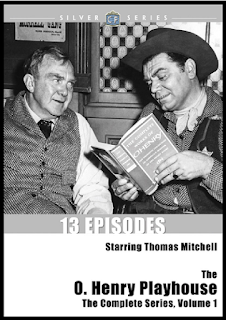
Review: The O. Henry Playhouse, Volume 1


Xn television's earliest days, dramatic anthologies were, if not the rule, at least quite common. They were populated by young, hungry actors and actresses, and since New York was still the center of television activity, there was no shortage of stage talent looking to make a break into television or the movies. And while we're familiar with the biggest of them—Studio One, Playhouse 90, The Twilight Zone, Hallmark Hall of Fame, Kraft Television Theatre—there were dozens of lesser-known shows that, nonetheless, introduced viewers to up-and-coming performers, directors, and writers. They may have been modest in their ambitions, but for that they were no less entertaining.

Thanks to the miracle of video (and, considering how negligent networks and studios were with their inventory, it is something of a miracle), we've had the opportunity to catch glimpses from many of these shows. Some survive almost intact, while others have but an episode or two as their legacy. And while some can best be described as, well, time fillers—you know, shows that are maybe a step or two above amateur productions—others have proved to be well worth watching. And, thanks to our friends at ClassicFlix, we have another of these programs that we can consider: The O. Henry Playhouse.*

*Full disclosure: I received this disc gratis for the purposes of 1) reviewing, and 2) enjoying. Thanks to Classic Flix for supplying both.

You're probably familiar with O. Henry (real name: William Sydney Porter,), or at least with his most famous stories, such as "The Gift of the Magi" and "The Ransom of Red Chief." His stories were best-known for their surprise endings, and while critics often panned them, they were immensely popular with readers of the magazines in which they appeared. 

In 1957, The O. Henry Playhouse came to television as a syndicated series which ran for 39 episodes. Starring as O. Henry (and that's always the way people referred to him; I guess neither "Mr. Henry" nor "O"—or would that be pronounced "Oh"?—would have felt right) was veteran character actor Thomas Mitchell, who appears in each episode through the framing device of telling his publisher, or some other acquaintance, his latest story. Sometimes, as in the early episode, "Man About Town," O. Henry is himself an active participant in the story; but most of the time he's simply content to let the story unfold, luring his listener in until he springs the surprise ending on them. Mitchell's very good in the role, exuding a warmth that immediately draws you in, while exhibiting a little of the larceny of the real O. Henry (who was, among other things, a convicted bank embezzler), as when he repeatedly asks his publisher for an advance on his next story.

The stories themselves are, for the most part, fun and entertaining. No, it's not Shakespeare, but, as I've mentioned many times in the past, it doesn't have to be. It does, however, need to be enjoyable, and it succeeds. And, in keeping with one of the great charms of early television, it's a kick seeing some of the stars in their early years, such as Charles Bronson, DeForest Kelley, Johnny Crawford, Chuck Connors, Claude Akins, Jean Cooper, and Roger Smith—as well as more established not just stars like Ernest Borgnine (in the very first episode!), John Carradine, Morey Amsterdam, Tom Conway, Beverly Garland, Louis Hayward, and Gerald Mohr. Even if the names don't always ring a bell, you're likely to recognize their faces or voices.

As for the product itself, the first (of three) volume of The O. Henry Playhouse (the volume I'm reviewing) comes with 13 half-hour episodes on one disk. There are no extras, but the prints are clear and crisp ("lovingly restored") and are far better than what you might find on YouTube. Volume 1 retails for $11.99 at Amazon; you'll have to decide whether or not that fits your price point. Volumes 2 and 3 are scheduled to be released later this year.

I can't say that The O. Henry Playhouse is going to make or break your classic television collection, but who doesn't have room for an enjoyable 30-minute story that isn't going to get you upset, will probably give you a chuckle or two, and might just introduce you to some classic faces you haven't seen for awhile? If you watch television for pleasure, then this comes strongly recommended. TV  

February 5, 2020

What I've Been Watching: January, 2020


Shows I’ve Watched:
Shows I’ve Bought:
The Eleventh Hour
Playhouse 90
Perry Mason
Hogan's Heroes
Star Trek: The Original Series
Batman 
Columbo: The Complete Series

There's a thin line in the writing business between inspiration and plagiarism. One day you think you’ve come up with a great idea; the next day (or month or year) you discover not only that it wasn’t original, it also mirrors very closely something that someone else had already written—and better than yours. Sometimes when you run across a particularly good idea, you forget to put it in quotation marks, and the next thing you know somebody’s lawyer is on the line claiming you stole something from their client. Fortunately, that’s something I haven’t had to worry about during my writing career, primarily because I haven’t sold enough books to give anybody a chance to accuse me of theft.

That’s plagiarism. Inspiration is what we’re onto today, though, and I’ll be completely honest in admitting to stealing a brilliant idea from one of my favorite writers, Nick Hornby. Hornby writes a regular column for the magazine The Believer in which he reviews both the books he’s read in a given month, and the books he’s bought. Sometimes they’re the same books, and you’ll be fascinated to find out how one book from an author can lead you to another, and another, until you find you’ve read four or five of their books in a row. Other times, the books he’s bought but hasn’t yet read get no mention at all; rest assured, however, that they’ll probably be popping up in a future column.

It occurred to me the other day that there’s no reason why this can’t be done with television shows as well as books. (That, plus the fact I didn’t have anything else ready to post this week.) It requires a few adjustments, of course; considering how many television shows exist as streaming options, why, I figured, should I limit myself simply to shows I’d purchased? Why not include those that I’ve become aware of, even if I haven’t viewed them yet? That is, after all, why the “Watch Later” button was invented. And since the shows we watch often stretch out over months, if not years (we haven’t fallen into the binge mode yet), it might be appropriate to revisit a show I’ve already written about when it starts another season, or takes a particularly wicket plot twist.

That’s a wordy way to introduce you to what I hope will become a regular feature here, “Shows I’ve Been Watching.” It might appear monthly, or every other month, or whenever I feel I’ve got enough material to write something. Depending on the reactions of you, the readers, it might have a very short shelf life, or it might provoke intense and stimulating discussion. Rebuttals are welcome, of course, as well as suggestions—if you’ve got something you think ought to be on the futures list, the comments section is the place for you to make your case. Some of my favorite shows, ones I might never have thought of watching on my own, came from recommendations. I can’t promise I’ll take you up on them, but I can guarantee I’ll take them seriously.

(Talking about wordy, that added a few dozen more words, didn’t it?)

The golden TV Guide, the one that introduced me to the pleasures of reading about old TV shows, gave me the first hint I’d had to a psychological drama on NBC, The Eleventh Hour. The episode I read about in that issue came from February 1964, the show’s second, and last, season, when Ralph Bellamy was the lead. Unfortunately, that season hasn’t yet come out on DVD, but the first season, in which Wendell Corey starred, has. (Jack Ging, the young doctor to Corey and Bellamy’s wizened veterans, a la Dr. Kildare, the series from which The Eleventh Hour was spun off, co-starred in both seasons.) Having watched and liked all the available episodes of a similar ABC program, Breaking Point (which in turn was a spin-off from Dr. Kildare’s television rival, Ben Casey, complete with the young doc/old doc dimension), I figured this was my thing, and after a couple of years of deliberation, it found itself under the Christmas tree in December.

Wendell Corey (far left), with Steven Hill (center)
in "There Are Dragons in this Forest"
In The Eleventh Hour—the title comes from the decisive point at which a patient either breaks or starts on the road to recovery—Corey plays Dr. Theodore Bassett, a psychiatrist in private practice whose cases often involve patients brought to him by the legal system. In the first episode, for instance, Vera Miles plays a woman who’s killed her husband; Bassett’s job is to discover whether or not she was legally insane at the time. A second episode features Steven Hill as an American soldier accused of desertion in the final days of World War II, who has been apprehended after 17 years and returned to America to face court-martial. Bassett, working with attorney Lloyd Bochner, tries to uncover what caused Hill, a decorated soldier, to leave his unit and marry a German woman, despite already having a wife back home. It’s a fascinating character study of a man struggling with what he perceives as the life that has been chosen for him, all of which is exposed by Bassett’s insistence that he and his (German) wife recreate the events surrounding their initial meeting.

Given Wendell Corey’s tortured personal life, including a long and unsuccessful battle with alcoholism, it’s understandable that he was replaced by Bellamy for the second season, but it’s unfortunate as well. I quite like his character, who exhibits a strong belief in the power of psychiatry (offset by a healthy cynicism), and combines both a deep sympathy for his patients and the necessary distance he has to maintain to be objective. He’s also not afraid to admit to his colleague, psychologist Dr. Paul Graham (Ging) that he isn’t always sure he’ll be successful. This is particularly evident in an episode starring Barbara Rush and David Janssen as a formerly married couple; Rush’s character, Linda Kincaid, was previously hospitalized for a nervous breakdown after attempting suicide, and a series of recent events (an auto accident, leaving the gas on, etc.) appears to suggest the same thing could be happening again. In the climactic scene Dr. Bassett drops his sympathetic demeanor to coldly demand that Linda confront the evidence of these things she’s supposed to have done. In a robotic manner, she says that she must have done all these things; what else could it be? Baloney, Bassett snaps at her. You don’t believe you did any of these things, do you? Stunned, Linda starts to fight back; no, she says, I didn’t try to kill myself. I wouldn’t do any of those things, I wouldn’t hurt my daughter that way. To which Bassett, softly and warmly, replies, “I know.” In breaking her, he has forced her to stand up for herself, and prove to herself what Bassett has already figured out: there is nothing wrong with her; her ex-husband, Janssen, was behind it all in an effort to get her committed and win custody of their daughter. (Janssen’s performance, full of gestures, tics, and repression, is masterful; you can easily imagine this marital drama evolving into murder without Bassett’s intervention. Oh, wait…)

There’s something stirring about one man standing up for someone in trouble, a lone individual insisting in the face of unanimous opposition that things aren’t always what they seem. It’s the kind of appeal that, as I’ve pointed out in the past, fuels a series like Perry Mason. If there’s one quarrel I have with the show, and it may be rectified in subsequent episodes, it’s that, unlike Breaking Point, the resolutions to each episode seem to be pretty conclusive, rather than the frequently ambiguous endings of the former series, in which a patient is presented with a road map to recovery, but the ultimate outcome is often left in doubt. It may be a little more than a nit, but not enough to dissuade my opinion that The Eleventh Hour has been, so far, a wise investment.

t  t  t

Who knew that there’d be a treasure trove of Studio One and Playhouse 90 episodes on YouTube? Well, yes, we know that you can find almost anything on YouTube; still, it’s not that common for drama series from the 1950s and ‘60s, especially ones that were often broadcast live, to still exist. And while we’re a long way from having access to all of these episodes (at least through the public domain), it’s a pleasure to go back to a time when the claustrophobic atmosphere provided by small sets and dark lighting contributed with the pressure of a live performance to give television an energy that rivaled that of live theater.

Last week, we watched an episode of Playhouse 90 from 1959, “Judgment at Nuremberg.” Like “Twelve Angry Men,” “Judgment at Nuremberg” started out as a teleplay before moving to the big screen; unlike “Angry Men,” writer Abby Mann added a substantial amount of material to the movie version of “Nuremberg,” perhaps due to the influence of producer-director Stanley Kramer, who never met a social cause he didn’t feel could be expanded to three hours—twice as long as the TV version, and not nearly as tightly written.

Maximillian Schell as Hans Rolfe
The star of the Playhouse 90 version, as was the case in the subsequent big-screen iteration, is Maximillian Schell, in the role of Hans Rolfe, attorney for one of four German judges accused of perverting justice by upholding Nazi laws against Jews. (Although he represents only one of the defendants, Ernst Janning, he speaks for the other three defendants and their lawyers.) Schell is nothing short of brilliant, raising disquieting points about the moral equivalency regarding the acts for which the judges (including a much more Germanic Werner Klemperer than who you see on Hogan's Heroes) stand accused. In one uncomfortable instance, Rolfe reads from a judicial opinion upholding the enforced sterilization of mentally handicapped people, lest they produce more “defects” that the state will be forced to take care of. Only at the conclusion does he reveal the author of the opinion: Supreme Court justice Oliver Wendell Holmes, in the case Buck v. Bell. You can’t have it both ways, Rolfe repeatedly insists: if we Germans didn’t know what Hitler and his cronies were up to, you can’t very well hold us responsible; on the other hand, if we did know about the concentration camps, then what about you, the Allies, who knew about them as well,  and yet did nothing? I’ve always had doubts about the morality of war crimes trials and the issue of post facto law; this story does nothing to dissuade those doubts, although Abby Mann might not have intended to do so. (I should note here that actual footage of the concentration camps, including the countless dead bodies of inmates, is included—perhaps the first time many in the viewing audience had seen it.)

Claude Raines, in the Spencer Tracy role as the American chief judge Dan Haywood, does a fine job, although his character isn’t nearly as fleshed out as in the movie. Paul Lukas, as Janning (in the role played by Burt Lancaster), shows a nobility to accept his fate, even as he fails (at least in Haywood’s eyes) to provide a convincing rationale for what happened. The replica courtroom, which serves as the setting for most of the drama, is filled with period detail, including the men providing simultaneous translation for both Germans and Americans (a detail ingeniously incorporated in both the television and movie versions). As I said, there’s a snap and crackle to this production that keeps it from dragging; one can debate which version better tells the story, but as my wife remarked when it was over, how often does television today provide such well-written, literate, adult dramas?

t  t  t

Since cutting the cord, we no longer have MeTV, which means we have to resort to watching our DVD versions of shows such as Hogan’s Heroes and Perry Mason, and after doing this for a while, you notice just how much you're missing when you watch them on Me (or any other network). The syndicated cuts over the years are bad enough, but you get the feeling that MeTV has removed even more, rendering some plotlines virtually incomprehensible. Watching the uncut episodes on DVD makes the Mason and Hogan episodes seem brand-new, filled with scenes not seen (by us) in years, giving the overall story a completely different feel. It's not quite like finding loose change in your couch after a party, but it's still pretty cool.

That's one reason why the "Shows Bought" column contains titles like Columbo and Star Trek,  shows that you can see for free on over-the-air channels. There's another reason, one that we picked up on last week, when we noticed that Perry Mason had disappeared from Prime Video, having become the property of CBS All-Access; The Twilight Zone is another series that's headed for CBS. I don't have a problem with his; after all, CBS owns the rights, and I can understand perfectly why they need reliable, commercially attractive properties to convince viewers to spend money on their subscription service. This is probably going to become more and more common, until the streaming business reaches a critical mass and begins to collapse upon itself like a black hole; what happens after that is anyone's guess, unless you're Neil deGrasse Tyson.

The point is that if you really, really want to make sure you've got access to watch your favorite TV shows whenever you want, your only choice is to own them. Even YouTube isn't safe, whenever they undertake one of their periodic reviews of copyright holders. No, you have to have them in your possession, on some sort of physical media or hard drive, if you want to enjoy that luxury. Is it worth it, though? Can you be sure you'll watch them often enough to make owning them pay? Can you take the chance there will still be a resell market if you don't? Perhaps we'll have some answers next month. TV  

June 4, 2016

This week in TV Guide: June 2, 1956

Surprise! Although I told you a couple of weeks ago I didn't have the first issue of the "new, improved" TV Guide - you know, the one with more color and more features - it turns out that not only do I have it, I'm looking at it right now.

Is this a case of lying, or as they put it nowadays "willfully misleading"? Does this mean you should never trust this writer again, never take what you read at this site at face value? Unfortunately (because this would be a great story), such is not the case. Instead, we have a situation where yours truly has forgotten what is in his collection, meaning that we come to Friday, the day before this piece is due, suddenly discovering that the review that had been written for tomorrow is in fact supposed to go up next week, which means much scrambling and vamping ahead. Well. If there's one thing this blogging gig has taught me, it's how to write on a deadline.

Having said all that as a precursor, let's dig into this issue and see what it has to offer. And don't worry; you can be sure that whatever you read here can be absolutely, positively trustworthy and believable - or my name isn't Joe Isuzu.


◊ ◊ ◊

On Saturday night, Ford Star Jubilee (CBS, 7:30 pm CT) presents a musical version of John Hersey's Pulitzer Prize-winning novel A Bell for Adano, starring Barry Sullivan and Anna Maria Alberghetti. This is at least the third adaptation of Adano I can think of; the first was the 1945 movie starring Gene Tierney and John Hodiak, the second a 1967 Hallmark Hall of Fame adaptation with John Forsythe and Murray Hamilton, which I think I may have mentioned previously - I know I've got the TV Guide issue in which it appears.

And so I wonder why this story happens to be so popular that it was adapted so often? Well, aside from the fact that it has good bones, having won a Pulitzer, I think you might be able to look at what the story is about, and the circumstances under which each adaptation appeared. The story's theme, that of American troops in an occupied Italian town winning the trust of the residents by replacing the town's bell (melted down by the Fascists) during the war, demonstrates not only the nobility and compassion of Americans, but their desire to return a sense of freedom and dignity to war-torn countries. In other words, it's a perfect story for the Cold War

The movie, which came out the same year as the book, is understandable enough, being an attempt to capitalize on the award-winning success of the book. By the time we get to 1956, though, such an adaptation can be a seen as a powerful message* used in the competition with the Soviets for the hearts and minds of the people. The same message could be applied to the 1967 version, coming as it does during a tumultuous time when both Vietnam and the battle for civil rights were tarnishing the American image overseas. As the always-reliable Wikipedia notes in its description of the book, "Another possible reason it was so well received was that the novel portrays the American army in a positive light and shows how democracy is inherently superior to Fascism. At the conclusion of World War II, the American people were anxious to believe that they had made the right decision to go to war, and then to occupy Italy."

*Much the same way in which sitcoms were used to demonstrate the higher standard of living afforded by capitalism, which even the working class could enjoy.

Which brings up another point: do stories like this have a domestic use as well? You'll recall how the UN-sponsored series of dramas shown in the early '60s by ABC were designed in part to increase support among the American people for the UN and its activities; in particular, Carol For Another Christmas was an overt attempt to convince Americans of the justification for international involvement. What with Vietnam ripping the country apart, could it be that this kind of show was done to create a sense of national pride, the idea that we could do something right, and to portray American soldiers in a more favorable light?

Could be. And then again, it could be that it was simply a good story and it was easy to obtain the rights to it. Like the mystery of the Tootsie Pop, we may never know.

◊ ◊ ◊

Whenever there's a TV Guide from this era, one of the more interesting projects is to look through the weekly televised boxing matches in search of fighters who actually amounted to something other than Marlon Brando's lament that he coulda been a contendah. On ABC's Friday night Fight of the Week we get one, in the pivotal heavyweight contest between #2 ranked Hurricane Jackson and #4 Floyd Patterson.

It's an important fight because Rocky Marciano's recent retirement has left the heavyweight crown vacant, and the winner is expected to lay claim to the #1 ranking. Though he has a lower ranking than Jackson, it is Patterson who is being groomed for the title, having won 16 consecutive fights, and Jackson is billed as his toughest opponent yet. It is a tough fight, with Patterson surviving to win a 12-round split decision, and five months later he will knock out Archie Moore in the fifth round to win the heavyweight championship.

Speaking as we were a moment ago of national pride, Patterson was responsible for quite a bit of it during his career. After he lost the title to Ingemar Johansson in 1959, the nation rallied around him in his attempt to regain the crown, which he did in a 1960 rematch, and retained in his third bout with Johansson in 1961. In his two bouts with Sonny Liston (in which he lost the title in 1962 and failed in to regain it in the 1963 rematch), he was portrayed as the good guy to Liston's thug. He also fought Muhammad Ali twice, losing both times, in the days before Ali was lionized by the public, when he was still seen as a smart-assed big mouth; Patterson, by contrast, was seen as quiet and dignified, a man who refused to use Ali's Islamic name and instead referred to him as "Clay." The second fight with Ali was his last, retiring with a record of 55 wins against eight losses and a draw, and he was seen as a gentleman to the end.

◊ ◊ ◊

A local note here, and isn't it odd to find a Texas TV Guide providing you with a note about a Minneapolis television and radio personality. Edward R. Murrow's Person to Person (CBS, Friday, 8:30 pm) visits with Cedric Adams and his wife from their home in Edina, Minnesota. Here's part one of the interview:


I think Murrow gets it about right with his description of Adams and his influence in the Upper Midwest. He was enormously popular in the area - I don't think beloved would be too strong a word - up until his sudden death in 1961. He was before my time, although I'm sure I must have heard him in the background from time to time (I was only nine months old when he died, so give me a break!), and I don't know how well he's remembered by our short-attention-span generations of today, but it's hard to go to an antique store or browse through old TV Guides or newspapers from the area without running into a reminder of him. There are books, record albums, articles - you name it. His newspaper column was read by thousands, in a time when people actually read newspapers, and his shows on TV and radio were heard by thousands more.

I think what I miss the most about someone like Cedric Adams - perhaps it would be better to describe it as the hole left by the passing of someone like him - is what he was not. He was not loud, brash, controversial, vulgar. He was warm, humorous, funny (they're not always the same thing), and very big-time for a place like Minneapolis in the '50s. Here, for example, is his interview with Dean Martin and Jerry Lewis, while he appears here in this "Christmas Sing with Bing." He was a major figure not only locally, but with the CBS network (this is one of the broadcasts from his regular five-minute network program), being one of the most popular personalities at one of their most powerful affiliates.

I'll leave you with my favorite Cedric Adams bit - this priceless collection of bloopers and outtakes from his radio program. Can you listen to it without laughing?

◊ ◊ ◊

There's an interesting article (featuring one of those new color photos of which TV Guide promises we'll see a lot more) about Armstrong Circle Theater, the long-running anthology series which began in 1950 on NBC and will continue there until 1957 before moving to CBS, where it will run until 1963.

(Boy, I'm listing to that Cedric Adams blooper reel I mentioned above; it's really hard to concentrate on this while listening to that.)

For the first few seasons, Circle Theater was a fairly conventional anthology, but beginning in 1955 with the takeover of David Susskind as producer, the show became, in his words, all about "actuals," that is, stories "which dramatize truth rather than fiction." The term eventually coined to describe programs like this was "docudrama," a word which let the viewer know that the story was based on real people and events, but was presented in a dramatic form rather than as a documentary. It's always been a controversial method of storytelling, in that sometimes the "drama" portion of the program takes precedence over the "true" parts, and such was the case during Circle Theater's lifetime as well, albeit in a more mundane fashion: "The Third Ear," a drama about wiretapping, aroused the wrath of the Private Detectives Association of America (who knew such a thing existed?), complaining that the program slandered the good name of all private eyes, while an episode about a young couple who bought and ran a small-town newspaper was cited by a critic as showing "people in a small-town newspaper plant [who] would never act as depicted." This despite the fact the episode's writer had worked closely with the couple on the script.

Susskind describes the challenges of portraying such real people, who usually have final approval over the script: "Naturally, most people whose lives are to be unveiled prefer that only good things be said about them." Challenges also abound for those subjects when they're brought on the show for a short talk at the end of the episode, Susskind relating how some talk too fast (a problem when your show is broadcast live), while others just can't seem to get their lines right no matter how much they rehearse. One of the biggest challenges, however, was in finding the type of story to do - Susskind rejected "the Horatio Alger bit - you know, stories of poor little boys who worked hard and grew up to win fame and fortune." The decision was made to select subjects as topical as possible.

In fact, Circle Theater isn't on this week, so I can't tell you what the topic is.* But as the '50s turn into the '60s, those topics increasingly turn to Communism: it's oppression, and stories of escape from its tyranny, as you can see in this rare complete episode dealing with the 1956 Hungarian Uprising, which hasn't even taken place yet as of this issue, but will break out in October.

*Armstrong Circle Theater was never a weekly program; at this point it's alternating with Playwrights '56, and once it moves to CBS it will partner on alternate weeks with The United States Steel Hour.


It's interesting how so many of this week's topics have to do in one way or another with the Cold War, or the attempts of television shows to serve as rallying points through educating the public about the threats of Communism. It was a much less cynical time.

◊ ◊ ◊

Building on that remark about cynicism, Tuesday night is the first anniversary of the quiz show The $64,000 Question, which will become one of the casualties of the Quiz Show Scandals. I don't know if the show was already fixed at this point, but if not now it will be soon.

That feature on the front cover about Sid Caesar and Janet Blair has to do with her becoming the third leading lady (after Imogene Coca and Nanette Fabray) on Caesar's comedy show. She accepted the gig with Caesar not only because of his tremendous creativity, but because it's a regular job on an established show, and her friends feel "this is the break that is going to" make her a big star. Ironically, Caesar's Hour, which airs on NBC, will take the summer off (customary for variety shows) before returning in September - but the "established show" will leave the air in May 1957.

Dan Jenkins reviews two new soap operas, and says they serve a purpose: "They are, for the most part, remarkably well played, at times with a dignity and restraint beyond the call of duty." Sounds promising. The two new entrants are As the World Turns and The Edge of Night. World ran for 54 years on CBS, while Edge, on CBS and ABC, ran for a mere 28 years. Piker.

And last but certainly not least, the new format for TV Guide. Circulation now tops 4,000,000, and as Editor Walter Annenberg points out, the magazine publishes "1712 pages of television program information" in 40 editions from coast to coast. As television grows, so too will TV Guide. In this edition we do see a few more color pictures and a more modern (for the times) look. It's a work in progress, but an improving one.

Next week I'll be sharing a completed crossword puzzle that stands as a monument to when classic television was contemporary, but I want to show you this week's puzzle for another reason. It's the very first TV Guide puzzle, and as such if you look closely at the page you'll notice something missing: the answers to last week's puzzle. Because there wasn't one. And you don't see that very often.


Unlike next week's crossword, it's only partially filled in, so if you want to take a shot at completing it, have at it. I can promise that the answers will be available next week! TV  

April 20, 2016

When television was live—and living

CBS CONTROL ROOM, MID '50S
You'll recall that in Saturday's review of TV Guide's top shows of all time, I mentioned in passing the thought that anthology series such as Playhouse 90 should perhaps have had their own category, rather than being lumped in with the rest of TV's dramatic series.

I wrote that primarily because I thought there was a distinct difference between an anthology, in which different actors and actresses tell different stories each week, and a "orthodox" series in which regulars tell a continuing story that may or may not also be serialized. However, there's another reason to think of anthology shows as their own genre, as noted in the book Fifties Television, written by William Boddy—for the most part, at least in the '50s, they were live.

Today, aside from sports and breaking news, there's very little live television, aside from the occasional network musical or other big event. In TV's early days, however, many shows were live—not only the anthologies, but series television as well. I think it was I Love Lucy that finally turned the trend once and for all, but I could be wrong about that.

So why do we think live television is special, worthy of being considered its own genre? Let's start with a definition of live television, one that goes beyond the obvious, that the show is happening as it's broadcast. Just what does that mean, and why is it relevant? Jack Gould, the television critic for The New York Times, wrote in 1956 that

Alone of the mass media, it removes from an audience's consciousness the factors of time and distance. . . . Live television . .  bridges the gap instantly and unites the individual at home with the event afar. The viewer has a change to be in two places at once. Physically, he may be at his own hearthside but intellectually, and above all, emotionally, he is at the cameraman's side.

Gould's point, Boddy continues, is that "both the player in the studios and the audience at home have an intrinsic awareness of being in each other's presence." Who knew interactive television went all the way back to the '50s?

Seriously, though, I think there's a real point to be made here. Boddy goes on to quote Gil Seldes, one of television's early pioneers:

The essence of television techniques is their contribution to the sense of immediacy. . . . The tension that suffuses the atmosphere of a live production is a special thing to which audiences respond; they feel that what they see and hear is happening in the present and therefore more real than anything taken and cut and dried which has the feel of the past.

Here we begin to get to the heart of it. There's a natural tendency to think of live programming not just as quaint, but as necessitated simply because video tape had not yet come into vogue. As we know, one of the main advantages to using tape (or film) is the ability to edit out rough spots, to do repeated takes of a scene until it comes out just right, and to preserve the performance for repeated viewings; therefore, pursuing this line of reasoning, we think of a recorded performance as something desirable, in that it gives us the best possible production. But is this always the case? And is it even desirable to have a presentation that's that spot-on? Seldes, as we have read, thinks not.

Gould, in a 1952* article entitled "A Plea for Live Video," describes the benefits of live programming as opposed to recorded, saying that a live broadcast contains a "sense of depth and trueness" which recorded programs cannot match. Carrying it through to the 1956 piece referenced above, Gould states unequivocally that "In their blind pursuit of artificial perfectionism, the TV film producers compromise the one vital element that endows the home screen with its own intangible excitement: humanness. Their error is to try to tinker with reality, to improve upon it to a point where it is no longer real."

*In 1952, more than 80% of all television shows were broadcast live.

We shouldn't be surprised by Gould's insistence on the humanness of television - after all, we say the same things about movies and music. We compare"human" epics such as Lawrence of Arabia and Ben Hur with SFX-driven spectacles such as Titanic and The Lord of the Rings, and even though we're impressed by the artistry and incredible technology of the latter, we also acknowledge that it just doesn't seem quite "real." We hear people talk about the crackle and imperfection of phonograph records, but at the same time we understand that digital music, despite its superior sound, is "sterile." It's the same thing.

We already know that television is the most intimate of mediums; as Seldes puts it, "Every television program is in a sense an invasion; you turn on your television set and someone comes into your living room." The magic of live television was that there was that interaction between actor and viewer. For those acting in a live production, there was a constant awareness of the audience "out there," that they were seeing your movements and hearing your words at virtually the same time as you were making them. For the actor, the camera was not the important thing; that performance was being delivered for the viewer, out there in the great darkness beyond the lens. Writer Donald Curtis put it well when he wrote that "There is no place for acting here. He must 'be' what he represents. . . . The television camera goes inside of an actor's mind and soul, and sends the receiving set exactly what it sees there."

"Requiem for a Heavyweight", 1955
For the viewer's part, having invited the actors into the living room, attention must be paid. It is more like going to a Broadway theater and watching a stage play than it is going to a movie theater and watching a movie. They know that what they are seeing is real, genuine, not a product of special effects or clever editing, but the actor's actual performance. Furthermore, they know that millions of others are sharing this experience at the exact time. It becomes fodder around the water cooler the next day, or at the dinner table that night with friends. Gore Vidal, who wrote 70 TV plays in the '50s, said "If you did a good show on 'Philco' [Television Playhouse, one of the prestige dramas], you would walk down the street the next morning and hear people talking about your play."

There's something very ironic about all this, although it isn't apparent right away. But think about it: the crucial elements of live television could be boiled down to three: the actor, performing for the viewer; the director, broadcasting what is taking place in front of him and not from the editing room later on; and the viewer, sharing the experience with cast, crew and other viewers.Today, our technology has managed to eliminate all of this: the actor plays to the camera, as he must, and often finds him or herself performing in front of a green screen, imagining what will be edited in afterward. The director relies on computer programmers as much as, if not more than, live acting; even with an animated feature like Toy Story, the end product, although the result of human work, doesn't feel quite as human as it would have been if it were hand drawn. The viewer can watch all of this whenever and however he or she pleases—on a television, phone or computer screen, as it happens or recorded to watch later, one episode at a time or all at once. It's the very opposite of the experience produced by live television.

Lest you think that we're just talking about the aesthetic component of live television, there were also many who felt the subject matter itself was influenced by the format. The divide between live and prerecorded television came to be seen as the difference between the "New York" and "Hollywood" schools. Live television, with its basis in the Broadway stage, tended to emphasize character development, whereas the Hollywood school, born of the motion picture industry, made plot the key element. Seldes felt that character-driven programming was more appropriate for television, where the "casual environment and attitudes of viewers" detracted from complex plot structures.

Such character dramas were perfect for live television, with its intimate relationship between performer and viewer, and the stripped-down, basic staging required by the small confines of the TV studio. In the meantime, Hollywood was busy producing half-hour action dramas, many of which starred either policemen or cowboys; many critics felt, as did Vance Bourjaily, that "the half-hour show is too brief, and it is interrupted by a commercial too soon after it begins, to be anything but a hook, a gimmick and a resolution." Gould said it "inevitably puts a premium on the contrived plot and on action for its own sake." The hour-long live drama was a writer's medium, and the writers were the stars: Rod Serling, Reginald Rose and Paddy Chayefsky were among the best and the best-known. As long as they continued to work in New York, the Hollywood school was left with weaker scripts; the emphasis on half-hour programs followed.

Times changed, of course, as did finances. Most of the prestigious live dramas were underwritten by sponsor dollars: Philco, Kraft, Hallmark, Westinghouse, and others. As the sponsor's role receded following the quiz show scandals, the networks gained control and based their decisions increasingly on the bottom line. Serling, fed up with interference from both network and sponsor, moved to a genre that required recording, while Chayefsky and others (including Serling) moved increasingly to movies. Talent began to shift from the East Coast to the West, movie studios started to work with television rather than against it, viewer tastes changed. It's hard to see live drama, or live television of any kind, returning to TV unless it's a special event.

However, there's more than enough reason to look at live television as a genre in and of itself. It required different production values, different styles of acting, different types of stories. TV Guide, which played such a role in the advocacy of quality television—including live drama—should have known better than to put Playhouse 90 in the same category as St. Elsewhere. To compare live TV to recorded programs is foolish; they're like apples and oranges. It may be long gone, but the era of live television was a unique and glorious, moment in history, and its memory lingers on long after the tape machines took over the control room. TV  

March 18, 2016

Around the dial

bare-bones e-zine has another of its Hitchcock writeups, this one on the witty (and not terribly scary) episode "The Diplomatic Corpse," which should be watched if for no other reason than the delightful performance by Peter Lorre as a detective who, sadly, would seem quite at-home in today's typical mass of bureaucratic red tape.

Lincoln X-ray Ida follows suit with a review of the third season Adam-12 episode "Blackmail." When I lived in The World's Worst Town™, Adam-12 was shown at 6:30 CT on Saturdays, in the local access period, because KCMT would regularly preempt it in its normal time period. I can't remember at the moment, but they were probably showing either Lawrence Welk or Marcus Welby, M.D., and so they would bump Adam-12 to another date and time. Oh well.

Silver Screens reminds me of a show I didn't know anything about, the 1964 British series Robinson Crusoe, starring Robert Hoffman. It did air in syndication in the United States in 1964, but I don't remember it, nor do I recall having run across it in my TV listings, although one of you eagle-eyed readers out there will probably remind me that I'm wrong about that. I am almost, but not quite, ashamed to admit I've never read Robinson Crusoe; it was never assigned reading during the years I was in school, and I've not looked it up on my own. I don't know if I've missed anything or not.

Recap Retro (love that name!) has a review of "The Wind from the South," a 1955 episode of The United States Steel Hour, one of the great dramatic anthology series I wrote about not that long ago. It stars Julie Harris, who frequently appeared on Golden Age-era TV in prestigious dramas and, as the piece says, had sterling careers both on TV and in the legitimate theater. Bonus mention to the little-known Merv Griffin, who sings the title song! As I mention in the comments section there, we really do need the unique genre called live television - it's a completely different type of performance.

Whenever we're tempted to forget that TV did not start in the 1950s, let alone emerge fully-grown in color and on cable, it's good to find something such as what TV Obscurities offers this week: the television listings for WCBW for the the week of September 7, 1941. Yes, before Pearl Harbor. They were listed in The New York Times, which means this wasn't exactly something that had escaped public notice. I forget this too often myself; I wonder what the evolution of television - and TV programming - would have been had not World War II intervened?

From a couple of weeks ago, Bob Sassone has a brief piece on the levels to which today's television coverage of the presidential race have sunk. I suppose it's a kind of chicken-and-egg scenario; does television simply present to us the candidates as they are, crude, superficial and all - or have the candidates learned what sells, and simply groomed their message in such a way guaranteed to get the most exposure? If you'll pardon the in-context pun. I can indeed imagine Cronkite spinning in his grave.

Again from a few days back, The AV Club lists for us the 19 essential books about television. Now, I consider myself fairly well-read as far as TV goes, and yet I only own three of these books, although I have read one or two of them from the library. For the most part these books either focus on shows I'm not interested in, or concentrate on a period of time outside my areas of interest. It's also an incomplete list as far as I'm concerned; for example, I agree with the books by Kisseloff, Zicree and Brooks & Marsh, and I think Barnouw is essential, if occasionally dated, but I would also include Steven A. Stark's excellent Glued to the Set (as you know, since I refer to it often) and Stephen Battaglio's superior biography of David Susskind, just for starters. Any suggestions out there? TV