We'll start the week off at bare-bones e-zine, where Jack has an entertaining look at Harlan Ellison's only contribution to the Alfred Hitchcock oeuvre: the tenth-season episode "Memo From Purgatory, based on his own non-fiction story of life in a street gang, with the young James Caan as Ellison.
If you've been following along the last few weeks at Cult TV Blog you've seen John look at The Prisoner as a series of episodes paired together into feature-length films. Having run through the possibilities, John arrives with his conclusions as to just how successful the experiment might have been.
At Comfort TV, David continues his quest through 1970s TV, attempting to watch one episode of every 1970s series, and we're now up to Thursday, 1971. A collection of interesting shows, some better and longer-lasting than others, but none of them as cool as The Dean Martin Show.
It can be hard to envision Jack Webb as anyone other than Joe Friday, but the Dragnet star could be found on old-time radio in other roles; this week, Martin Grams looks at one of them, Pete Kelly's Blues, in which Webb plays a jazz musician who solves crimes on the sleazy side of the street. The scripts of the 13 programs in the series have now been collected into a book—read all about it.
I've often lamented the loss of the traditional late-night talk show which was built around conversation rather than, you know, self-serving plugs by ersatz celebrities. Herbie J. Pilato revisits those days, and how they provided "decades of entertainment and information with class, sophistication, and elegance."
Awhile back, I came up with the idea of using the famous TV Guide crossword puzzle as a kind of occasional feature, not unlike the TV Jibe cartoons. The last one we did was, let's see—May 24, 2017. I guess I haven't kept up on this very well, have I?
Anyway, today's puzzle is from Saturday's TV Guide (January 28, 1967), so keep that in mind when you're thinking about the stars and the shows featured in the clues. Use the comments section for your answers, and I'll update our progress on Friday, with the answers next Friday. If you're reading this through Facebook or Twitter, make sure you go to the website with your answers.
Here's something we haven't done for awhile - the TV Guide Crossword. I usually reserve this for times when I know I've got the following week's issue; got to make sure we have the answers, you know.*
*If you've got that issue - no cheating.
As usual, feel free to suggest answers via the comments section; I'll provide the answers at the end of next Saturday's TV Guide review. Have fun!
You never know when you're going to run into something interesting in this business, and this week is no exception. For example, we have an intriguing item in the write up for this week's Ed Sullivan show: "In answer to popular demand, Sullivan will show again the animated fantasy "A Short Vision," which depicts abstractly the effects of the H-bomb."
Thesetwo articles do a very good job of summarizing the stunned reaction from viewers accustomed to much lighter fare from Sullivan. And while it's true that Sullivan might have had varied reasons for presenting the film, it is nonetheless difficult to suggest there were no political considerations involved in the decision to show "A Short Vision." Sullivan himself, after the first showing on his May 27 program, says that while "several people on his show warned him that it was “too grim” for TV consumption," Sullivan decided to go ahead with it, believing it "a powerful plea for peace" and adding “I figured with the H-bomb just being let go of last week it was apropos.”
As noted in the articles mentioned above, the reaction post-showing varied from “seven minutes of terror” to “the best piece of anti-war propaganda ever shown.” Regardless of where one comes down on the merits of the film itself, it's hard to imagine that there had been anything quite like it on television before, and I wonder why this whole thing isn't better known. Or maybe I'm the one who's in the dark, and every other classic TV expert knows all about it.
Just days after the broadcast, Sullivan mentioned his intention to air the film again, on June 10. Prior to the original showing, which was just before the end of the program, he warned viewers with children to remind them that this is just "a fantasy," and that they should not panic. (Privately, Sullivan believed children ought to be in bed by that time anyway.) He concluded that it was important for everyone to see "A Short Vision" as a reminder that "in war there is no winner." For this viewing, Sullivan issues a stronger statement:
Two weeks ago on this program I put on a film — an animated film — about the atom bomb. And the first tremendous reaction came from the World-Telegram, New York — three column story, ‘Shock Wave from A-Bomb Film Rocks nation’s TV Audience’ by Carol Taylor.* And I notice in Time this week, they have a big story on it. So, tonight, in answer to requests from civil defense bodies from all over the country, I’m going to show the film again, but for those of you who have youngsters in your living room, it is a harrowing experience for youngsters, so would you please take them out of the room and just have the older people in the family look at it. I think its something the country should know, should see, but the youngsters, that is the little ones, should not be looking at it. So now if they’re out of the room, here is this film, by two young Britons on the possible repercussions of an A-bomb. George, may I have it?
*The headline writer didn't quite get his alphabet right; we're talking about the H-Bomb, not the A-Bomb. As if it makes any difference.
Following the showing, Sullivan added this:
You know, a little boy last week, after he had seen it—by accident—he asked his dad, who is Marlo Lewis, he said, “Daddy, was God destroyed, too?” His father explained to him that God wasn’t destroyed and this was all fantasy and, of course, God never is destroyed and always looks out for little boys. But they’re some men out in the audience and I know they’re particularly interested in this short, “A Short Vision” by Joan and Peter Foldes, because they are the famed Blue Angels of the United States Navy. They’re the fliers who fly these precision formations—how they do it no one’s ever been able to figure out—but they’re celebrating their tenth anniversary and I’m going to ask them to stand up with their commanding officer, Richard L. ‘Zeke’ Cormier. The Navy Blue Angels, will you all stand up, please. [Audience applause].
Here is the film in question. From what I've read, it may have been even more horrifying in black and white, but this version is vivid enough:
With something like this, who needs Sullivan vs. The Palace?
Again, I must ask the question - had there ever been anything like this on television before? This must have marked a moment when television's potential as a medium for more than just entertainment was made vividly known. I sense this would make a very good chapter in a future book on television and American culture, should anyone out there care to write it.
◊ ◊ ◊
And here's another case where we need to find out "the rest of the story."
On Thursday's episode of the documentary series Where Were You? (7:00 pm CT, CBS), we read, "On April 27, 1928, tribute was paid to the man who made jazz respectable."
[Beat] Of course.
No details of the tribute are given, including just what it was. It's quite possible, given that in 1956 people were: 1) 60 years closer to the date in question than we are, and quite possibly would have been more familiar with the date and man in question; and 2) tended to be more educated on history (and other things) than today's generations.
At any rate, thanks be for the internet. A bit of Googling tells us that on the date in question, "the orchestra of W.C. Handy and the Jubilee Singers gave a blues and spiritual concert" at Carnegie Hall in New York City.* And so "the man who made jazz respectable" was none other than ''The Father of the Blues," William Christopher (W.C.) Handy. He composed the timeless ''St. Louis Blues,'' perhaps his best-known composition. But, then again, there's the equally famous "Beale Street Blues," so I suppose you can take your pick. The point is, there is no question of W. C. Handy's fame, and while I might suggest it would have been more proper to use the term "blues" rather than "jazz" in the TV Guide listing, the idea is right. Perhaps if they had used the title "Father of the Blues," it would have been more clear. As I say, maybe they figured people would automatically know who they were referring to in the listing, and if that's the case more power to them. Perhaps I've been too conditioned by our times, when a CNN article about corruption in Illionis can include a reference to "[Abraham] Lincoln." As if there was any other Lincoln worth mentioning in an article about politics and Illinois.
*The concert also featured the legendary Fats Waller on piano and organ.
But then, I suppose you can't be too careful nowadays.
◊ ◊ ◊
As we look at documents from the past, I generally advise caution when applying today's cultural standards to yesterday's actions. Often, the context of the times makes apples-to-apples comparisons challenging at best, and anyone who tries to do it can wind up looking like a fool if they're not careful. However, here's an item that I find so appalling, I may have to make an exception.
It's from Monday morning's Garry Moore Show (CBS, 8:00 am CT), and I'll give you the listing exactly as it's printed in front of me. "Garry, Durward Kirby, Denise Lor and Ken Carson discuss the 'New Theory' advocating that husbands beat their wives."
Now, it's difficult to know for sure exactly what this means. A quick Google search of "New Theory" combined with wife beating yielded no results, and I'm not entirely positive what other search parameters to use. This could have been some kind of satire, some play on the lyrics of a popular song, or something else that, having been read in 1956, gives the paragraph an entirely different context. (See what I mean about being careful?)
Otherwise, I just don't know what to make of this. Can they be serious? If so, what exactly qualifies as a "beating"? I mean, spanking is bad enough (unless you walk on the wild side), but it's a lot different from a sock to the jaw. I kid you not that the thought of this, even to try and figure out what it means, makes me sick to my stomach. Merely to consider the action, even to critique it, I find heartbreaking, and that doesn't happen to me often. I hope someone out there can tell me that it doesn't mean what it sounds like it means.
◊ ◊ ◊
I think we have a tendency, sitting in front of our flat-screen digital televisions, to forget what it was like to watch television in the '50s and '60s. If you're lucky, it's because you're too young to have ever known those days. But for someone like me, it's a good thing to be reminded every once in a while, lest I get too complacent and start complaining about little things I have no reason to get uptight about.
There's a semi-regular feature here entitled "TV Service Guide," in which the Philadelphia Radio Service Men's Association, a "veteran radio-TV group,"* answers the most commonly asked questions. Many of the questions revolve around improving the quality of the reception you get on your set.
*No surprise there, since TV Guide's headquarters are just outside of Philadelphia.
For example, "Why is it that I get some channels better than others?" "How can I tell when my antenna is no longer efficient?" or "How do I know that I am getting a new receiver tube?" I can relate to some of these questions; I remember the days of playing with dials and holding the rabbit ears at weird angles, and the satisfaction that could come from being able to see a particular program all the way through without something strange happening - especially if it was a station you ordinarily had trouble with.
A couple of weeks before, there was a cartoon illustration in TV Guide, showing how the signal traveled from the studio to your home. (It still amazes me.) My point here is that television was very much a mysterious machine, somehow able to transmit moving pictures from faraway places right into your home. I don't mean to suggest that people thought it was some kind of voodoo or anything like that - television wasn't exactly a novel concept to people who had kept up with technology since the days of radio - but it still created a bit of awe, and people enjoyed demonstrations of just how it worked.
On the other hand, maybe even this is too blasé; television probably was regarded as a wonder machine, and most of us have probably heard jokes about how viewers feared someone might be able to use the set as a two-way monitor, able to see into your home just as you were able to see into the studio. (Doesn't sound so far-fetched today, does it?) I can understand how fascinated people were with how it worked, how they needed to understand the technical side, at least to some extent, and how even the most obvious (to us) questions were probably triggered by some thought that this was all magic. And yet, for those who've seen both sides, those days look pretty simple: no DVR to hook up, no surround sound to adjust, no guides to program, . . .
◊ ◊ ◊
Speaking of magic (they don't call me the king of segues for nothing), what do you know about The Amazing Dunninger? Probably not as much as he would have known about you, if you were around back then.
I love this picture of Joseph Dunninger they use in this week's issue; the caption is just as snarky as one I would have come up with myself. (In case you can't read it, it says "Dunninger doesn't actually change color when he performs." Dunninger is"the man who does the impossible," the forerunner to The Amazing Kreskin. He didn't predict the future, he was always careful to note; he was a mind-reader - or, as he's described in the weekly listings, a mentalist*. "Of course I can read minds," he tells Frank DeBlois. "If I can't always tune in on the thoughts of a person, it's because that person is hostile. I'll read your thoughts, all right, but only if you concentrate." Dunninger's show runs on ABC Wednesday nights, where he demonstrates the amazing skills that have defied a standing $10,000 offer to anyone who can prove he uses plants or stooges in his act.
*Not to be confused with The Mentalist, a show which probably wasn't nearly as entertaining as Dunninger's.
I wasn't able to locate a clip of Dunninger's television show (he also had a radio program, back in the day) but here's a look at him in action, debunking spiritualists. Kreskin also did this kind of thing, and also refers to himself as a mentalist. He's going to be at the Mid Atlantic Nostalgia Convention this September; I'll let you know if he's able to read my mind.
◊ ◊ ◊
Quick hits: a preview of the new summer season reveals that, as is the case today, many of the new shows are genre types. For us, it's been reality shows; back in the mid '50s, it's quiz shows and musical revues. Among the quiz newbies are 20 Steps to $1,000,000 (Who Wants to Be a Millionaire, anyone?), Treasure Chest and High Finance, while bandleader Paul Whiteman, singer Snooky Lanson, and the variety show Polka Time highlight the musical offerings. An interesting footnote: Steve Allen prepares to give up his Tonight spot to take on Ed Sullivan head-to-head Sunday evenings.
The biggest successes of the season just past? The unexpected triumph of Phil Silvers as Sergeant Bilko, the smash hit The $64,000 Question, Rod Serling's gripping drama Patterns, Mary Martin's Peter Pan, and The Mickey Mouse Club. Interesting note: Jackie Gleason's "Honeymooners" skit, split off into its own freestanding show (the classic 39 episodes that have been cherished for so many years) is said to have "lost much of its zest" and was routed by Perry Como.
And finally, another crossword puzzle. I showed you the first one last week (answers to which can be seen below), so why another one so soon?
As you can see it's already been completed, but in a way that makes it even more of an artifact. Think of it: this puzzle was completed 60 years ago, by someone who lived in and watched the television of its era - not as nostalgia, but as contemporary entertainment. The answers, written in pencil, have faded a bit over time (unlike last week's entry), but that's as it should be. Now that's context! TV
Surprise! Although I told you a couple of weeks ago I didn't have the first issue of the "new, improved" TV Guide - you know, the one with more color and more features - it turns out that not only do I have it, I'm looking at it right now.
Is this a case of lying, or as they put it nowadays "willfully misleading"? Does this mean you should never trust this writer again, never take what you read at this site at face value? Unfortunately (because this would be a great story), such is not the case. Instead, we have a situation where yours truly has forgotten what is in his collection, meaning that we come to Friday, the day before this piece is due, suddenly discovering that the review that had been written for tomorrow is in fact supposed to go up next week, which means much scrambling and vamping ahead. Well. If there's one thing this blogging gig has taught me, it's how to write on a deadline.
Having said all that as a precursor, let's dig into this issue and see what it has to offer. And don't worry; you can be sure that whatever you read here can be absolutely, positively trustworthy and believable - or my name isn't Joe Isuzu.
◊ ◊ ◊
On Saturday night, Ford Star Jubilee (CBS, 7:30 pm CT) presents a musical version of John Hersey's Pulitzer Prize-winning novel A Bell for Adano, starring Barry Sullivan and Anna Maria Alberghetti. This is at least the third adaptation of Adano I can think of; the first was the 1945 movie starring Gene Tierney and John Hodiak, the second a 1967 Hallmark Hall of Fame adaptation with John Forsythe and Murray Hamilton, which I think I may have mentioned previously - I know I've got the TV Guide issue in which it appears.
And so I wonder why this story happens to be so popular that it was adapted so often? Well, aside from the fact that it has good bones, having won a Pulitzer, I think you might be able to look at what the story is about, and the circumstances under which each adaptation appeared. The story's theme, that of American troops in an occupied Italian town winning the trust of the residents by replacing the town's bell (melted down by the Fascists) during the war, demonstrates not only the nobility and compassion of Americans, but their desire to return a sense of freedom and dignity to war-torn countries. In other words, it's a perfect story for the Cold War
The movie, which came out the same year as the book, is understandable enough, being an attempt to capitalize on the award-winning success of the book. By the time we get to 1956, though, such an adaptation can be a seen as a powerful message* used in the competition with the Soviets for the hearts and minds of the people. The same message could be applied to the 1967 version, coming as it does during a tumultuous time when both Vietnam and the battle for civil rights were tarnishing the American image overseas. As the always-reliable Wikipedia notes in its description of the book, "Another possible reason it was so well received was that the novel portrays the American army in a positive light and shows how democracy is inherently superior to Fascism. At the conclusion of World War II, the American people were anxious to believe that they had made the right decision to go to war, and then to occupy Italy."
*Much the same way in which sitcoms were used to demonstrate the higher standard of living afforded by capitalism, which even the working class could enjoy.
Which brings up another point: do stories like this have a domestic use as well? You'll recall how the UN-sponsored series of dramas shown in the early '60s by ABCwere designed in part to increase support among the American people for the UN and its activities; in particular, Carol For Another Christmas was an overt attempt to convince Americans of the justification for international involvement. What with Vietnam ripping the country apart, could it be that this kind of show was done to create a sense of national pride, the idea that we could do something right, and to portray American soldiers in a more favorable light?
Could be. And then again, it could be that it was simply a good story and it was easy to obtain the rights to it. Like the mystery of the Tootsie Pop, we may never know.
◊ ◊ ◊
Whenever there's a TV Guide from this era, one of the more interesting projects is to look through the weekly televised boxing matches in search of fighters who actually amounted to something other than Marlon Brando's lament that he coulda been a contendah. On ABC's Friday night Fight of the Week we get one, in the pivotal heavyweight contest between #2 ranked Hurricane Jackson and #4 Floyd Patterson.
It's an important fight because Rocky Marciano's recent retirement has left the heavyweight crown vacant, and the winner is expected to lay claim to the #1 ranking. Though he has a lower ranking than Jackson, it is Patterson who is being groomed for the title, having won 16 consecutive fights, and Jackson is billed as his toughest opponent yet. It is a tough fight, with Patterson surviving to win a 12-round split decision, and five months later he will knock out Archie Moore in the fifth round to win the heavyweight championship.
Speaking as we were a moment ago of national pride, Patterson was responsible for quite a bit of it during his career. After he lost the title to Ingemar Johansson in 1959, the nation rallied around him in his attempt to regain the crown, which he did in a 1960 rematch, and retained in his third bout with Johansson in 1961. In his two bouts with Sonny Liston (in which he lost the title in 1962 and failed in to regain it in the 1963 rematch), he was portrayed as the good guy to Liston's thug. He also fought Muhammad Ali twice, losing both times, in the days before Ali was lionized by the public, when he was still seen as a smart-assed big mouth; Patterson, by contrast, was seen as quiet and dignified, a man who refused to use Ali's Islamic name and instead referred to him as "Clay." The second fight with Ali was his last, retiring with a record of 55 wins against eight losses and a draw, and he was seen as a gentleman to the end.
◊ ◊ ◊
A local note here, and isn't it odd to find a Texas TV Guide providing you with a note about a Minneapolis television and radio personality. Edward R. Murrow's Person to Person (CBS, Friday, 8:30 pm) visits with Cedric Adams and his wife from their home in Edina, Minnesota. Here's part one of the interview:
I think Murrow gets it about right with his description of Adams and his influence in the Upper Midwest. He was enormously popular in the area - I don't think beloved would be too strong a word - up until his sudden death in 1961. He was before my time, although I'm sure I must have heard him in the background from time to time (I was only nine months old when he died, so give me a break!), and I don't know how well he's remembered by our short-attention-span generations of today, but it's hard to go to an antique store or browse through old TV Guides or newspapers from the area without running into a reminder of him. There are books, record albums, articles - you name it. His newspaper column was read by thousands, in a time when people actually read newspapers, and his shows on TV and radio were heard by thousands more.
I think what I miss the most about someone like Cedric Adams - perhaps it would be better to describe it as the hole left by the passing of someone like him - is what he was not. He was not loud, brash, controversial, vulgar. He was warm, humorous, funny (they're not always the same thing), and very big-time for a place like Minneapolis in the '50s. Here, for example, is his interview with Dean Martin and Jerry Lewis, while he appears here in this "Christmas Sing with Bing." He was a major figure not only locally, but with the CBS network (this is one of the broadcasts from his regular five-minute network program), being one of the most popular personalities at one of their most powerful affiliates.
There's an interesting article (featuring one of those new color photos of which TV Guide promises we'll see a lot more) about Armstrong Circle Theater, the long-running anthology series which began in 1950 on NBC and will continue there until 1957 before moving to CBS, where it will run until 1963.
(Boy, I'm listing to that Cedric Adams blooper reel I mentioned above; it's really hard to concentrate on this while listening to that.)
For the first few seasons, Circle Theater was a fairly conventional anthology, but beginning in 1955 with the takeover of David Susskind as producer, the show became, in his words, all about "actuals," that is, stories "which dramatize truth rather than fiction." The term eventually coined to describe programs like this was "docudrama," a word which let the viewer know that the story was based on real people and events, but was presented in a dramatic form rather than as a documentary. It's always been a controversial method of storytelling, in that sometimes the "drama" portion of the program takes precedence over the "true" parts, and such was the case during Circle Theater's lifetime as well, albeit in a more mundane fashion: "The Third Ear," a drama about wiretapping, aroused the wrath of the Private Detectives Association of America (who knew such a thing existed?), complaining that the program slandered the good name of all private eyes, while an episode about a young couple who bought and ran a small-town newspaper was cited by a critic as showing "people in a small-town newspaper plant [who] would never act as depicted." This despite the fact the episode's writer had worked closely with the couple on the script.
Susskind describes the challenges of portraying such real people, who usually have final approval over the script: "Naturally, most people whose lives are to be unveiled prefer that only good things be said about them." Challenges also abound for those subjects when they're brought on the show for a short talk at the end of the episode, Susskind relating how some talk too fast (a problem when your show is broadcast live), while others just can't seem to get their lines right no matter how much they rehearse. One of the biggest challenges, however, was in finding the type of story to do - Susskind rejected "the Horatio Alger bit - you know, stories of poor little boys who worked hard and grew up to win fame and fortune." The decision was made to select subjects as topical as possible.
In fact, Circle Theater isn't on this week, so I can't tell you what the topic is.* But as the '50s turn into the '60s, those topics increasingly turn to Communism: it's oppression, and stories of escape from its tyranny, as you can see in this rare complete episode dealing with the 1956 Hungarian Uprising, which hasn't even taken place yet as of this issue, but will break out in October.
*Armstrong Circle Theater was never a weekly program; at this point it's alternating with Playwrights '56, and once it moves to CBS it will partner on alternate weeks with The United States Steel Hour.
It's interesting how so many of this week's topics have to do in one way or another with the Cold War, or the attempts of television shows to serve as rallying points through educating the public about the threats of Communism. It was a much less cynical time.
◊ ◊ ◊
Building on that remark about cynicism, Tuesday night is the first anniversary of the quiz show The $64,000 Question, which will become one of the casualties of the Quiz Show Scandals. I don't know if the show was already fixed at this point, but if not now it will be soon.
That feature on the front cover about Sid Caesar and Janet Blair has to do with her becoming the third leading lady (after Imogene Coca and Nanette Fabray) on Caesar's comedy show. She accepted the gig with Caesar not only because of his tremendous creativity, but because it's a regular job on an established show, and her friends feel "this is the break that is going to" make her a big star. Ironically, Caesar's Hour, which airs on NBC, will take the summer off (customary for variety shows) before returning in September - but the "established show" will leave the air in May 1957.
Dan Jenkins reviews two new soap operas, and says they serve a purpose: "They are, for the most part, remarkably well played, at times with a dignity and restraint beyond the call of duty." Sounds promising. The two new entrants are As the World Turns and The Edge of Night. World ran for 54 years on CBS, while Edge, on CBS and ABC, ran for a mere 28 years. Piker.
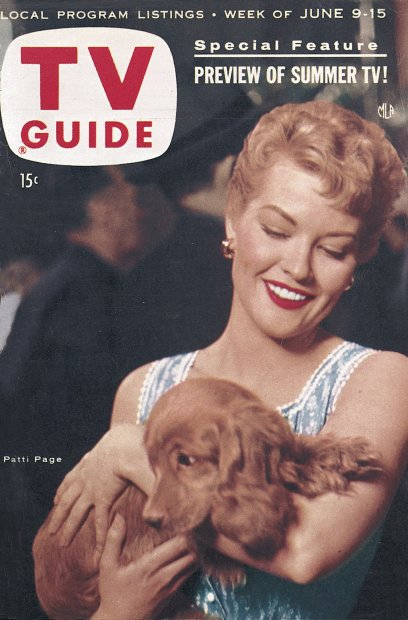
And last but certainly not least, the new format for TV Guide. Circulation now tops 4,000,000, and as Editor Walter Annenberg points out, the magazine publishes "1712 pages of television program information" in 40 editions from coast to coast. As television grows, so too will TV Guide. In this edition we do see a few more color pictures and a more modern (for the times) look. It's a work in progress, but an improving one.
Next week I'll be sharing a completed crossword puzzle that stands as a monument to when classic television was contemporary, but I want to show you this week's puzzle for another reason. It's the very first TV Guide puzzle, and as such if you look closely at the page you'll notice something missing: the answers to last week's puzzle. Because there wasn't one. And you don't see that very often.
Unlike next week's crossword, it's only partially filled in, so if you want to take a shot at completing it, have at it. I can promise that the answers will be available next week! TV
Several things to get to this week, so let's get started. First off, what you've all been waiting for: the answer to last week's crossword puzzle. So how did you do?
Not classic television, but according to many, Lost was a classic, and John Purzanski tells me that yesterday was the publication of The Take2 Guide to Lost, available now at all major eBook sellers. It's the "definitive resource of over 400 articles from an incredible community of Lost-lovers." If that's up your alley, sounds as if this is a no-brainer.
At the Criminal Element blog, there's an interesting article on Law & Order. Again, not from the classic era though many would consider it a modern-day classic, but in discussing the show's portrayal of Riker's Island and how it vastly undersells the length of time it takes for a case to move through the actual criminal justice system, Mary Buser makes this point: "Law & Order is an enjoyable series, viewed by millions. The only danger in this innocent entertainment is when it masks the horrible truth, and people start believing this is how the system actually works." Isn't that precisely what I've been saying all along when it comes to how today's procedurals act as a police state's wet dream?
In honor of yesterday, which was National Punctuation Day, Michael's TV Tray reminds us of the punctuation songfrom The Electric Company. Full disclosure: I never saw an episode of The Electric Company when I was growing up. My wife did, however, and has fond memories of it, particularly future Oscar nominee Morgan Freeman as Easy Reader.
Joanna Wilson at Christmas TV History sure sounds as if she's been having a great road trip: the Jimmy Stewart Museum, the site of the house from A Christmas Story, and now the It's a Wonderful Life Museum. Who knew?
One show I did watch growing up was The Dick Van Dyke Show, and although I've never had any particular urge to revisit it, I do remember the suspense every week as I wondered: would Rob trip over the ottoman this week or not? I know, it probably depended on what season was being shown, but if you mix in reruns and a kid's mind, you can see where the suspense comes from. Anyway, at How Sweet it Wasyou can read about the story of the show and the ottoman.
Televison's New Frontier: the 1960's is back with a look at the Western series Tombstone Territory, starring Pat Conway. I've not seen this series before, and from the sounds of this review, there wasn't much in the way of groundbreaking change in it.
Don't waste time - check out these stories now, and come back tomorrow for a new TV Guide story. TV
Random thought: why didn't I call this feature "This Week's Best Bets" when I started it? Named after the old TV Guide page, you know. I must have been too enamored with the idea of posting pictures of different television dials. Oh well. Another idea for another time.
It is true, however, that these are the best bets of the week. First off, though, here's an update on the progress of the crossword puzzle we started on Wednesday. Keep going, everyone - you're doing great so far!
I usually get my fix of British TV from Cult TV Blog, and we'll get to that shortly, but first this digression to a nice piece at Classic Film and TV Cafe on two British shows I've never seen, one of which I've never heard of. I've read about The Baron; just never motivated enough to check out a clip on YouTube, let alone buy the set. But Adam Adamant Lives! has escaped my attention completely. If you're reading this Cult TV, do you have any thoughts?
In Monday's TV listings feature, I mentioned Bowling for Dollars, which should not be confused with Celebrity Bowling. It's the later that takes center stage here, as David of Comfort TV writes about that show's appearances by members of The Brady Bunch. Not everyone would admit to owning this DVD, and for that alone I want to shake David's hand; if you ever make it to Dallas, David, I'm buying you dinner!
If you like those old TV listings, then check out The TV Guide Historian - there are a slew of them up this week (try this one on for size), and each one of them - as, indeed, is the case anytime one looks at old listings - tells a very specific story of time and place, and generates strong emotions, even if they're only of curiosity. Which is why we keep coming back to them week after week.
Now, back to Cult TV. To top off a week of good posts, there's an excellent essay on another show with which I'm not familiar: The Strange World of Gurney Slade, starring Anthony Newley! (Who knew?). To say I'm intrigued, after both the positive and negative comments in the essay, is an understatement. Here's the opening scene from the first episode to give you an idea of how quirky this show was. Now, to figure out how to see more of it...
Michael's TV Tray has a commercial for a do-it-at-home milkshake. Did I ever have this, or something like it? There seems to be something familiar about it, some sense of disappointment that it didn't measure up to the ones that I would get at Bridgeman's.
By the way, when you're browsing through the links on the sidebar, you might notice that some of the sites appear to be abandoned; that is, there hasn't been any new content for quite some time. And this is true. However, I keep the links up there because there's almost always something interesting buried in there somewhere (otherwise, I wouldn't have linked to it in the first place), and I'll bet none of us have read them all.
Rest assured that if I ever abandon this blog - and if I call it a day, you'll know about it; this won't be one of those where all of a sudden there are no new posts and no explanation - I'll still leave it up, so you can see what you've missed. But one thing you shouldn't miss is tomorrow's TV Guide review, so be here! TV
We don't usually do audience participation here at It's About TV, but this week I thought we'd try something different. If it works and you like it, we'll make it a recurring feature. It has to do with one of the most popular parts of TV Guide - the crossword puzzle.
Below is the puzzle from the September 14, 1974 issue we've been looking at this week. Pick out one or two of the clues, and enter your answers in the comments section below.* (I've got next week's issue, which means I know what the correct answers are.) Remember, this TV Guide is from 1974, so keep that in mind when answering the clues. Between all of us, let's see how many of the answers we can come up with. I'll print the correct puzzle next week. Ready? Let's get started!
*For those of you coming here from Facebook, please use the comments section here rather than answering on Facebook, so everyone can see your answers!