Showing posts with label Lee Marvin. Show all posts

January 28, 2026

What I've been watching: January, 2026


Shows I’ve Watched:

Leonard Bernstein
Doctor Atomic
The Bell Telephone Hour
The Iceman Cometh


Most of the time, my choices in this space focus on television series, and for good reason: this is called "It's About TV," after all, not "It's About Everything Else." (If you want to read that, go to my new author Substance, "In Other Words," which just started yesterday.) It occurs to me, however, that this is a somewhat self-limiting proposition, in that you can watch many different things on television—assuming you don't use your laptop or phone, just about everything you stream comes through your television set. And if you expand the definition of "TV" to include that, it opens up a whole new horizon of things to write about. This comes in especially handy when you've been watching the same series of shows for the past few months.

l  l  l

Having spent an entire paragraph explaining this, it therefore makes perfect sense to start my review of the last month's viewing with an actual television series—two of them, in fact. The first might more properly be considered an occasional series of specials: Leonard Bernstein's series of music lectures that were first presented on (or in place of) Omnibus, the public affairs variety show that aired on all three networks, at one time or another, during the 1950s and 1960s. These aren't the Young People's Concerts that many of you might be familiar with; these are programs done for a general audience, not limited to children. And it shows; while Bernstein, to his eternal credit, never dumbed down his programming for young people, the shows he presented on Omnibus attain a much higher level. So high, in fact, that I have trouble keeping up with some of his concepts.

I have no trouble watching, though, because even if you don't understand everything Bernstein is talking about, you get the gist of it, and when it starts to make sense—when the pieces begin falling into place—it actually gives you a bit of a rush, sort of like answering a question correctly on the old College Bowl series. On one recent program we watched, Leonard Bernstein on Rhythm, which was originally broadcast on March 13, 1960, Bernstein opens the program with films of a beating heart. He then goes to show how rhythms are built upon this natural part of the body: not just the simple beat-beat-beat rhythm, but the in-and-out of breathing, for example—in and out, one and two. He then elaborates on how classical music has been built on these rhythms: four beats, one-two, one-two; followed by a matching set that maintains the same rhythm even though the notes may be varied. These couplets of four-note sections now make up eight beats. This is then multiplied to create various passages that may repeat themselves in various ways throughout the piece. In fact, almost all music written prior to the 20th Century was composed in this manner, either in sets of two or sets of three, but always based on the number two. It is, he says, just like a mathematical equation. I hasten to add that I may not have all this right; I was struggling a bit to keep up. But you get the idea. 

Bernstein then goes on to demonstrate, both at the keyboard and while conducting the New York Philharmonic, how this changed in the 20th Century, using examples that range from Stravinsky to Copland to Gershwin. The patterns become more unpredictable, less symmetric, which helps give them the excitement and movement that can make Stravinsky, for instance, so enthralling to hear. By the end, even though I didn't understand everything, I understood enough. What made it most enthralling, though, was Bernstein's obvious love for his subject and the passion and excitement he was able to transmit to the viewing audience. Anyone with even a vague interest in music will find it impossible to resist. Richard Nixon once wrote that what separates leaders from thinkers is that leaders express their ideas in such a way to inspire, if not compel, others to follow them. If you can't articulate your ideas in such a way, then you're not a leader; you're a thinker. Bernstein comes across the same way; no matter how music was presented to you in school by your music appreciation teacher, it probably didn't captivate you the way Bernstein does. The man's enthusiasm is infectious. I've remarked before that Bernstein left a mixed legacy: his private life was often suspect, and his political ideology was idiotic at best. But when it comes to teaching, to injecting a love of music in those listening to him, to even just talking about music, he has no equal. Of all that he contributed during his lifetime, nothing can even come close to this, and we should all be grateful. It's one of the reasons why, despite all his flaws, I can't help but love Bernstein when I see him in these shows.

l  l  l

Another kind of music appreciation comes to us from The Bell Telephone Hour, the long-running series that was broadcast on NBC from 1959 to 1968. If you remember this, it might well be from the live Christmas specials presented each year, often on or near Christmas Day itself. But there's so much more to it than that, and thankfully, there are some episodes out there, thanks to YouTube, that you can watch and enjoy.

Earlier this week, we saw Robert Young host an hour on the American musical, and while Young might seem at first an odd choice for this—I've never thought of him as having a particular relationship to music—he does a very good job. As I mentioned, for most of its run, Telephone Hour was shown live, which means that in an episode like this, done before a live studio audience, with many separate segments, you need someone who can project the right amount of gravitas, combined with a personable personality and the knack of getting things right. Young certainly fills the bill there, whether he's introducing ballet stars Patricia McBride and Edward Vilella doing the Slaughter on Tenth Avenue dance sequence, the Brothers Four performing a song from Porgy and Bess, or Andre Previn and his trio doing the overture from West Side Story, the show is in good hands. Throw in songs from stars of the time such as Lainie Kazan, Earl Wrightson and Lois Hunt, and a monologue by Young to commemorate Thanksgiving Day (which was less than a week away), and you've got the kind of entertainment that makes people of our age ask why there isn't anything like that anymore.

So Telephone Hour was closely identified with both classical and popular music. In its last season or two, however, its emphasis shifted to filmed documentaries exploring various music topies, whether the history of jazz (Jazz, the Intimate Art, which includes profiles of and performances by Louis Armstrong, Dizzy Gillespie, Dave Brubeck and Charles Lloyd and is ten times better than anything Ken Burns could put on, at one-tenth the length, or South Carolina's Spoletto Festival. One of the many lingering gripes I have with my childhood is that The Bell Telephone Hour was frequently preempted in the Twin Cities by other programming; I suppose it was thought too highbrow for some of us yocals. Thankfully, with the internet, I'm at last having my revenge.

l  l  l

What's this, you say? More music? In a word, yes. Most of the Metropolitan Opera presentations done in HD for movie theaters were later repeated on PBS's Great Performances at the Met, so this counts as television. And recently we went back to look at one performance that we did see in the theater, many years ago: Doctor Atomic, the stunning opera by John Adams that tells the story of the testing of the atomic bomb. Now, you might not think that the bomb is a natural subject for an opera, and you'd be right; how many productions can you remember where a mock-up of "the gadget" (as the bomb was frequently referred to during its development) is the centerpiece of the set, always present even when you can't see it? 

As is typical of most modern opera, Doctor Atomic is mostly sung-through, meaning that instead of traditional arias, duets, choral pieces and the like, the dialogue (taken from the notes, memos, diaries, and letters of those people who actually worked on the Manhattan Project) is set to music and sung without repetitions. In the wrong hands, this can make for an extremely boring few hours. Adams pulls it off though, in the same way that he did with another unlikely subject for an opera, Nixon in China. This is due in no small part to the performance of Gerald Finley as J. Robert Oppenheimer, Sasha Cooke as Kitty Oppenheimer, Richard Paul Fink as Edward Teller, and Eric Owens as General Leslie Groves, the head of the project. The first act features a scene with Oppenheimer and his wife Kitty, which is unspeakably intimate without either of them taking off their clothes or even kissing; it's all carried by the choreography and the words, and it is breathtaking. Having seen the movie Oppenheimer a couple of years ago, it gives us a slightly different view of their relationship, but it is fascinating nonetheless.

The moment is exceeded by the concluding aria of Act One—the opera's only aria—"Batter My Heart," set to the text of John Donne's "Holy Sonnet XIV." Finley is spellbinding, and the music, especially at the act's conclusion, is dynamic, driving, propulsive—and laced with dark overtones that hint at what the scientists are well aware of: after the development of the Bomb, the world will never be the same again. The YouTube description calls it "thrilling," and that sums it up pretty well. Opera in general, and this opera in particular, might not be your cup of tea; it doesn't have to be. But it packs a wallop nonetheless.

l  l  l

I've been saving the longest for last. When The Iceman Cometh has been presented on television, it's usually been over two parts: sensible, given that Eugene O'Neill's play runs for nearly four hours, without commercial interruption. However, having watched it a couple of weeks ago, I can vouch that this is the only way to watch it. (Thankfully, it comes with an intermission for bathroom breaks.)

The television version, which aired on Play of the Week in 1960 and starred Jason Robards in the lead as Hickey (and Robert Redford as Parritt), is very good. That, however, is not the version we watched; instead, we opted for the 1973 film adaptation, which was directed by John Frankenheimer, and features a dynamite cast that includes Lee Marvin as Hickey, Fredric March as Harry Hope, Robert Ryan as Larry Slade, Tom Pedi as Rocky Pioggi, Bradford Dillman as Willie Oban, Sorrell Booke as Hugo Kalmar, and Jeff Bridges as Don Parritt. It's a faithful adaptation of the play, trimmed for time but otherwise intact, and it is a brutal experience; the flophouse at which the action takes place resembles nothing so much as hell on earth; Hickey, the travelling salesman whose regular appearances everyone anticipates, arrives this time not as the life of the party, but as a harbinger of doom, an avenging angel, a man preaching a unique type of repentance that involves giving one's self up to the freedom of nihilism.  Make sure you've got some antidepressants available while you're watching it.

Frankenheimer, of course, cut his teeth on live television, and his direction here is steady. And while the performances are uniformly good, a couple of them really stand out, those of Marvin and Robert Ryan. This was Ryan's final screen performance, and he conjures up every bit of world-weariness as a former political anarchist who no longer believes in the cause, and is now simply waiting for death to overtake him. In any other play, his role as a kind of Greek chorus would be what everyone talks about afterward, because he's twice as good as anyone else (including March, as good an actor as has ever graced the stage). However (and you knew there had to be one of those in here somewhere, didn't you?), when Marvin takes the stage, it's as if nobody else exists. Truly. He underplays the role with his patented menace; the quieter he is, the calmer and more collected, the more dangerous he becomes. When he's on camera, he's twice as good as Ryan, and in this play, that's really saying something. It's a performance that legitimizes Marvin's Oscar win (for the comedy Cat Ballou), and certainly could have scored another nomination here. I have a few qualms about O'Neill's play; I would have preferred a slightly different twist at the end, which I won't bore you with here, but who am I to compare myself to O'Neill? Anyway, like Doctor Atomic, this is not for everyone. But if it is for you, you'll thank me for introducing it to you. TV


If you enjoy the content here and want to support my broader creative work, please consider making a donation at my Ko-fi page. Any amount you contribute helps me continue writing, researching, and sharing these articles and projects. Thank you!

October 5, 2024

This week in TV Guide: October 3, 1959


Lee Marvin is one angry man. Not the Last Angry Man; that was Paul Muni, and anyway, this issue is 65 years old and there have been a lot of angry men since then. Angry women, too, for that matter. But Lee Marvin is, in fact, angry, although it's hard to say what, exactly, he's angry about. Or perhaps it's better to ask: what isn't he angry about?

Bob Johnson catches up with Marvin on the set of M Squad, now beginning its second season. The ensuing article—well, I can't really call it an interview, since aside from the first and last paragraphs, there's no evidence that Marvin actually answered any questions from Johnson. Instead, he conducted a very entertaining two-page stream-of-consciousness monologue. The following excerpts are, I can assure you, exact quotes.

The article begins with Marvin leaving the set for the lunch break. "'It's moving,' he said, stomping and muttering through smaller billows of the claylike material he was brushing out of his crew cut with both hands. 'If it's moving, baby, I say grab it. Look at this filthy mess. Let's go.'"

The topic turns to M Squad. 

"Who knows? You tell me. It's a cop series, what else? The guy's a cop. Who wants the truth? It's like an artist. He's got this painting. He says, 'But don't you see, it's yah-foo-lah-lah-lah. You notice how that yellow shines?

"I dunno, it's moving. Lieutenant Ballinger—who knows—he's a cop. You tell me. We took Chicago. It was all that was left. I know Chicago cops. Rough. They have to be. The whole city would explode. It's like a bomb, Chicago. I know. Look at the setup."

After spending some time on Chicago police politics, he continues:

"We shoot locations, twice a year. No permit, no co-operation. They don't want any part of us. We're going next week again. Shoot and run. It finally came down to: 'Okay, any public building, but nothing else, no stopping traffic.' I stay back, out of sight. Hat pulled down. Director says okay, walks through what I do, says, 'Like that, Lee.' I do it, we shoot it and blow. Kids come along, see the crowd, it's always the same thing in Chicago. Right away, 'Who got killed?'  That's what a crowd means to most Chicago kids.

"One time we're up on a roof. On the edge over the sidewalk. Me and this actor, struggling over a gun. I thought I'd hoke it up a little. We can't carry sound equipment, have to move too fast. Dub it later. I saw these two gals walking along. Right under us. I yelled, 'Gimme that gun, I'll kill you!' They looked up, yah, hoo, whu, hmm? Two men on a roof, killing each other. And these girls went right on. They didn't even break stride.

"Lieutenant Friday, Dragnet, Los Angeles, San Francisco, Lineup. What's their problem? No problem. It's routine. It's static. But not Chicago. They stop it before it happens. They have to.

"Chicago'd go like a bomb, the whole place. I know. I spent a year there, going to secretarial school. After the war, out of the Marines, wacked up, shot near the spine, whoo lah, hero. I couldn't do anything. Nothing. I didn't know ho. High school, no training. Navy ROTC school in New Jersey, 14 years old and they pulled rank on me. This old admiral, 61, still in uniform, and a kid 14 years old. I cut out and sold my uniform.

"Yeah, typing, shorthand, I didn't know. And then back to New York, digging ditches. Septic tanks. A guy digging ditches or a plumber wiping a joint, you know? It solves problems. Says, 'Dig this hole, so wide, so long, so deep,' you dig it. That's it. You climb out and say, 'Boy, I don't know what it was, and loo-foo-fah-foo, but I solved it today.' Good therapy for my back. Plumber in New York, fixed pipe up in Woodstock. They were doing a play, who knows? Said why didn't I give it a try. So? I tried it. One line, walk on, walk off, deep voice, big shoulders, and back the next night. And so on.

"It's like M Squad. The M doesn't stand for anything. It's any dirty job. Let's face it, we're the Storm Troops. A lone cop, Chicago, what else? M Squad. I liked The Loop. That's what somebody wanted to call it. I wanted to do a lot of things. I talk to myself, driving along, who doesn't? You come out of a conference, you sit there at a stop light, say, 'Yeah, fah-loo-dee-doo, BUT, you say."

There's more to the article, but you get the idea. You wonder if Bob Johnson had to do anything other than take notes. After starting Marvin off, he doesn't return again until the final paragraphs, when the two men return to the set ("Three steak sandwiches later."), Marvin talking all the way. As they part, he says, "If it's moving, baby, grab it."

M Squad, which runs for three seasons, will be Marvin's only television series (other than appearing as narrator in the 1963-64 true crime series Lawbreaker). In an interview later in his career, he refers to doing the series as something akin to a box he had to tick off before he'd be allowed to progress to bigger roles in movies. And they do get bigger, culminating in his Oscar-winning performance in Cat Ballou, and his acclaimed role in the neo-noir classic Point Blank. But, as good as those performances are, could they have been any more entertaining than his "interview" with Bob Johnson?

l  l  l

The World Series continues this week, though we don't really know when or where. The National League pennant had not been settled at press time, and so the specifics depend on which of three teams came out on top. If the Milwaukee Braves won the National League pennant, Saturday's Game 4 will begin at 12:45 p.m. CT on NBC, in black-and-white. On the other hand, if the pennant went to either the Los Angeles Dodgers or San Francisco Giants (and how strange those names must have seemed in 1959!), the first pitch will be at 2:30 p.m., and in color. What we do know for certain is that the opponent will be the American League champion Chicago White Sox, playing in their first World Series since the Black Sox scandal of 1919. The Series continues Sunday with Game 5 (if necessary; same time, same channel), before returning to the Windy City* for the final two games (noon, in color).  

*I wonder if they saw Lee Marvin while they were there?

At least that's what TV Guide says. In fact, there was no game on Saturday; the Dodgers and Braves finished in a tie for first place, and the resulting three-game playoff (won by the Dodgers two games to none) delayed the start of the Series to Thursday. The Dodgers and Sox split the two games in Chicago, and after using Saturday as a travel day, the Dodgers won two out of three in Los Angeles and closed out the Series with a 9-3 victory in Game 6 in Chicago.

If you have your heart set on sports on Saturday, you'll have to make due with the college football game of the week, pitting the California Golden Bears and Texas Longhorns from Austin (3:15 p.m., NBC), or the NFL's Saturday night tilt between the Chicago Bears and Baltimore Colts from Baltimore (9:30 p.m., ABC, tape-delayed).

l  l  l

Last season saw the premiere of the Warner Bros. detective series 77 Sunset Strip, starring Efrem Zimbalist Jr., Roger Smith, and Edd Byrnes; the show's success spawns a succession of similar "assembly line"-style detective shows from Warner, all employing exotic locations, handsome young stars rotating as the leads, and a variety of guest stars from the WB stable of talent*. First up is Bourbon Street Beat (Monday, 7:30 p.m, ABC), starring Richard Long, Andrew Duggan, Van Williams, and Arlene Howell. Although it only runs for one season, it's perhaps the best of the Sunset Strip clones; Richard Long's character will wind up on Sunset Strip after Bourbon Street Beat's cancellation, while the character played by Van Williams will be spun off into yet another series, Surfside 6, which will debut next season. 

*Classic TV fans will recognize this technique from the WB stable of Westerns, including Maverick, Cheyenne, Bronco, and Sugarfoot. You'll see it again next season, when, in addition to Surfside 6, the studio introduces the period drama The Roaring 20s, with Rex Reason, Donald May, and Dorothy Provine.

And that's not the only WB detective series to debut this week; on Wednesday night, it's Hawaiian Eye (8:30 p.m., ABC), starring Anthony Eisley, Robert Conrad, Connie Stevens, and Poncie Ponce. Hawaiian Eye is, next to Sunset Strip, the most successful of the WB detective shows, running for four seasons (Sunset Strip goes for six), although there's a notable drop in quality after Anthony Eisley leaves following the third season. The plots in all of these series are more or less interchangable, but that makes them no less entertaining. The characters are interchangable as well, sometimes literally; they all exist in the same universe, with each of the detective teams making at least one appearance on at least one of the other series. After all, why mess with success?

l  l  l

Although we're now into October, we're still seeing the debuts of new series, as well as the return of old standbys. Let's take a look a some of each.

This week Dan Jenkins reviews Dick Clark's weekly output, and I put it that way because the man seems to be on TV all the time. In fact, says Jenkins, we haven't seen anyone like Clark since the heyday of Arthur Godfrey: "an appealing personality, the 'soft-sell' commercial approach, and a back-breaking eight and a half hours a week on network TV." For starters, there's American Bandstand, which airs from Philadelphia, at 90 minutes a day, five afternoons a week. On Saturday night, he hosts The Dick Clark Show (6:30 p.m., ABC) from New York. And just last Sunday, his third series, World of Talent, debuted at 9:30 p.m., again on ABC. Clark sets a good example for the youth of America: "he dresses conservatively and neatly, is unfailingly polite, speaks quietly with an excellent command of English and has poise not often associated with is clamorous following." If Jenkins could add one thing, it would be to raise the music-appreciation level of his audience by throwing in a classical piece once or twice a week, "exposing the younger generation to music that is not a mixture of odd lyrics and monotonous chords." I think he's serious about that, by the way. And after all, if you can't get down and boogie to Wolfie Mozart, you just aren't rad, man.

Sunday presents us with a trio of new programs, all of which are available on DVD: Dennis the Menace (6:30 p.m., CBS), based on the popular comic strip, starring Jay North as Dennis; The Rebel (8:00 p.m., ABC), the post-Civil War Western with Nick Adams as Johnny Yuma, a Southern army vet looking for the meaning to his life following the war; and The Alaskans (8:30 p.m., ABC), yet another WB adventure series, starring Roger Moore, Jeff York, and Dorothy Provine in tales of the Alaskan gold rush of 1898. Interesting note: all three of these series are available on DVD. They join some returning favorites: Lawman (7:30 p.m., ABC), The Dinah Shore Show (8:00 p.m., NBC), and The Jack Benny Program (9:00 p.m., CBS). 

The rollout of new series continues on Monday with James A. Michener's Adventures in Paradise (8:00 p.m., ABC), starring Gardner McKay. Michener's creditentials for creating a series based in the Pacific are impeccable; a decade ago, he won the Pulitzer Prize for Tales of the South Pacific, which was made into the musical South Pacific; in an article written by Michener for this week's issue, he talks about having spent years on proposals for such a series (including, although he doesn't mention it, a weekly series based on South Pacific), but it's only now that all the pieces have fallen into place. He credits producer Martin Manulis for converting his ideas into reality, and heaps praise on leading man McKay: "He not only looks the part of a South Seas skipper. He is one. . . rugged, ready for a fight, yet reserved and marked for considerable self-control." Michener adds, "There is a bigness about all he does. He is small neither in size nor manner, and to serve as master of a schooner in the waters I know best requires a certain bigness of spirit." We've read McKay's views on his experience doing the show, so we'll let Michener have the last word on the prospects for his series: "A man and his boat have, since the beginning of history, been symbols of high adventure, and we want to keep it that way."

Tuesday
sees the premiere of Ford Startime (8:30 p.m., NBC), a big-name weekly anthology series that includes, comedy, drama, and variety presentations. For tonight's debut, Rosalind Russell hosts "The Wonderful World of Entertainment," a musical revue featuring Polly Bergen, Maurice Chevalier,Eddie Foy Jr., Eddie Hodges, Ernie Kovacs, Arthur O'Connell, Jack Paar, and Kate Smith. Startime was billed as "TV's finest hour," and its history is worth spending another minute or so; Alfred Hitchcock directed the drama "Incident at a Corner," Ingrid Bergman starred in an adaptation of "The Turn of the Screw," Dean Martin hosted a couple of variety hours, Jerry Lewis starred in "The Jazz Singer" (available on DVD), and Mitch Miller hosted "The Mitch Miller Variety Show," which, of course, became Sing Along With Mitch the following season. Unfortunately, the ratings for Startime didn't quite live up to the billing (it was up against, among other programs, The Red Skelton Show), and Ford pulled the plug on its very expensive investment after a single season. Another single-season series starts tonight: Phillip Marlowe (8:30 p.m., ABC), based on Raymond Chandler's famous private detective, starring Philip Carey. This series seems as if should have been a natural; Marlowe is one of the great characters in detective fiction, and Carey is a capable actor. Marlowe's a unique character, though, and it takes an actor like Dick Powell* to fully realize it.  It was probably too generic in its delivery, wasting its potential.

*Whose wife, June Allyson, appears on the cover of this week's issue.

Although Men in Space (Wednesday, 7:30 p.m., CBS) is classified as "Adventure," it's one of the first series to deal with manned spaceflight in a serious manner, as opposed to shows such as Rocky Jones, Buck Rogers, and Captain Video; think of it as Wyatt Earp ushering in the era of adult Westerns from shows like Roy Rogers.* The series stars William Lundigan as Col. Edward McCauley, America's most distinguished astronaut, and as the series begins (it debuted last week), he's preparing to lead the first manned flight to the moon. But complications arise, as a senator questions the expense of the flight. 

*In Britain, on the other hand, the show was marketed as a children's series; the timeslot it occupied was later filled by Doctor Who.

The Big Party
debuts Thursday (8:30 p.m., CBS), and in this case, when they say "Big" they mean it: a 90-minute variety show (a tough sell; ask Jerry Lewis how well those work), alternating every other week with Playhouse 90. I've seen it described as "a perfect melange of the television variety show genre and high camp": each week, a celebrity guest host invites various celebrities to their penthouse or hotel suite for a party, where everyone is supposed to act completely natural until they break into song. (Imagine that alternating with a show that once brought you the likes of "Requiem for a Heavyweight.") Tonight, Rock Hudson decides to throw a party and calls his friend Tallulah Bankhead to "get on the phone and invite some friends." The "friends" include Sammy Davis Jr., Matt Dennis, Lisa Kirk, Carlos Montoya, Mort Sahl, and Esther Williams. (You can see it here.) It sounds kinda similar to the scenario employed by Hugh Heffner's Playboy's Penthouse, and if it's anything like that, my advise is to ignore the camp for 90 minutes and just enjoy the performances. And you'd better hurry; although it's supposed to be on for a full season, it ends with the New Year's Eve party.
 
It's a good week for Red Skelton; not only does he appear in his regular Tuesday night slot, you can also see him on Friday's Red Skelton Chevy Special (8:00 p.m., CBS), an hour-long colorcast celebrating Red's 30th anniversary in show business. He's joined by Gunsmoke's James Arness, Burl Ives, Rhonda Fleming, Tommy Sands, and Lionel Hampton—and, of course, some of Red's most famous characters, including Clem Kadiddlehopper and Freddie the Freeloader. Afterwards, flip over to NBC for the premiere of The Bell Telephone Hour (9:00 p.m.), making its transition from a radio series that had started in 1940. Tonight's opener is headlined by musical-comedy stars Alfred Drake and Sally Ann Howes, the Kingston Trio, violinist Zino Francescatti, the Ballet Russe de Monte Carlo, Red Nichols and His Five Pennies jazz combo, and siner Connie Boswell. The Telephone Hour remains a mainstay on TV until 1968.

l  l  l

Finally, since we've spent a fair amount of time writing about Warner Bros. this week, it seems appropriate that we wrap things up with Adele Mara: WB contract actress, wife of WB producer Roy Huggins—and barber. "It's true," she says gleefully. "I cut Roy's hair, and I like it." Adele started out as a dancer with Xavier Cugat's band, before signing her fierst movie contract in the 1940s. She starred in 30 movies for Republic, and set a studio record by posing for 4,000 publicity photos, for all of which she wore only a bathing suit (see right). She and Huggins have been married for six years; they'll remain married until his death in 2002. While Huggins was producing Maverick, he fielded a complaint from a viewer about "a half-dressed woman I saw dancing on the bar." Replied Huggins, "That was no half-dressed woman. That was my wife." TV  

September 25, 2021

This week in TV Guide: September 28, 1968


Dean Martin is, in 1968, the highest paid entertainer in show business - anywhere. His eponymously-named variety show has just been renewed by NBC for not one but three years, at a cost (to the network) of $34 million. Added to the $5 million that Dean's already making*, the man they call the “King of Cool” is sitting pretty, on a very big pile of cold, hard cash.

*$750,000 each for three movies (not including his share of the profits), $825,000 for his records, $150,000 for three weeks at the Sands Hotel, and $2 million for the past season of the show.

It hasn't always been this way. After the tumultuous breakup of Martin and Lewis, Dean had watched as Jerry made it big with a string of solo movies. Martin’s movie career, by contrast, laid an egg - a bomb called Ten Thousand Bedrooms. He’d received $250,000 for that movie, but that wouldn’t do him much good if he wasn’t able to turn things around. That turning point came with a dramatic role in the movie The Young Lions, which Martin eagerly accepted even though it paid him almost $200,000 less than he’d received for Ten Thousand Bedrooms. He then followed up with his own string of hits—Rio Bravo and Some Came Running—and all of a sudden Dean Martin was hot stuff again.

When NBC approached Martin for a weekly series, he exhibited the same lack of interest he has about most things. His answer was no. Still, they pressed, so he gave them his terms.  He knew they'd never accept them; he wanted a lot of money, and only wanted to show up for the actual taping—no rehearsal. They said yes anyway. He told his family, "They went for it. So now I have to do it."

It's that laid-back, devil-may-care attitude, the attitude that Frank Sinatra so admired and wished he had, that keeps Dean Martin cool. It's reflected in the way Martin answers questions from writer Dick Hobson. A few examples:

TVG: Tell me, Mr. Martin, is this your third or fourth [television] season?
DINO: You know, I don't know! Boy, that's a tough question!

TVG: I understand you're building a big Spanish home out on your ranch in Hidden Valley, with stables, corrals and a heliport?
DINO: It's a place to live.

TVG: Why so far out? To get away from your admiring public?
DINO: Actually, it's the air. Gettin' away from the smog.

TVG: For a man whose public image is Mr. Devil-May-Care, don't you find those magazine articles about "The Illness Dean Martin is Too Ashamed to Admit" an embarrassment?
DINO: What illness?

TVG: That illness sometimes associated with nervous tension. To be blunt, Mr. Martin, is it true about your ulcer?
DINO: Oh, that. Well, you can say I'm eatin' my spaghetti with butter sauce now.

TVG: [Addressing Martin's lack of rehearsal] What happens when a problem comes up?
DINO: Problems aren't necessary. We don't put up with problems.

TVG: I suppose you have plenty of people to deal with any problem that might come along?
DINO: People who like problems aren't there any more.

TVG: Do you mean to say that you never have problems?
DINO: I have a very peaceful life. [Ironic, given that he pays $2,400 a month in alimony.]

TVG: Can you tell us your philosophy of life in 10 words or less?
DINO: I can do it in less.

TVG: Go ahead.
DINO: Everybody should have fun.

Well, it's hard to argue with that, isn't it? That's cool.

l  l  l
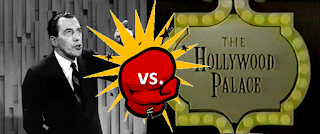
During the 60s, the Ed Sullivan Show and The Hollywood Palace were the premiere variety shows on television. Whenever they appear in TV Guide together, we'll match them up and see who has the best lineup..

Sullivan: Ed launches his 21st season with tentatively scheduled guests Red Skelton, Steve Lawrence and Eydie Gorme, Diana Ross and the Supremes, the Jefferson Airplane and the winners of the Harvest Moon Ball dance contest. Also: a scene from the movie "The Secret of Santa Vittoria," in which Ed appears as an Italian peasant.

Palace: The Palace's sixth season opens in traditional fashion - with Bing Crosby as host. Bing's guests: Sid Caesar; singers Bobby Goldsboro, Abbey Lincoln and Jeannie C. Riley, and the rock group from off-Broadway's hippie musical "Your Own Thing." Also: the acrobatic Iriston Horsemen from the Moscow State Circus, the tumbling Four Robertes and St. Louis Cardinal pitcher Bob Gibson.

Ed has Red Skelton and Steve & Edie, the Palace has Sid Caesar, Jeannie C. Riley (singing "Harper Valley PTA," natch) and Bob Gibson, promoting Wednesday's start of the World Series. I can't bring myself to go any further: The Verdict: Push.

l  l  l
Throughout the 60s and early 70s, TV Guide's weekly reviews were written by the witty and acerbic Cleveland Amory. Whenever we get the chance, we'll look at Cleve's latest take on the shows of the era. 

This week, Cleveland Amory takes on Dick Cavett's morning talk show on ABC, a precursor to his nighttime program. We'll get the suspense over with in a hurry, as Amory does: he likes Cavett and his show; in praising Cavett's low-key approach, he calls it "the least of the many virtues of this fine show."

After analyzing Cavett in relationship to TV's other talkers (he hasn't "the mugging, jack-in-a-box quality of a Johnny Carson, the deep-down goodness as well as on-top funniness of a Joey Bishop, the earnest naughtiness of a Merv Griffin or the nice-nelliness of a Mike Douglas"), he tries to put his finger on the source of Cavett's appeal: "a not-too-cute cuteness which somehow manages to make every woman over the age of discontent want to mother him and yet which somehow also manages not to make every man over the same age want to drown him." Interesting take on the other hosts, no?

Among Cavett's other plusses is an ability to tell jokes without having to get into joke-telling contests, a modesty about his status that adds to his charm, and a sly, often self-deprecating opening monologue that he describes as "a kind of high comedy of low errors." Best of all, though, are his guests: especially "the remarkable comedy team" of Bob and Ray, with their patented satires of everything, including the political scene. (Sample interview question of a possible Vice Presidential candidate: "What would you say if I said you were a backwoods booby?" "I'd say you have a right to your opinion.") Says Amory in conclusion, "Every single one of these satires was head and shoulders over the best of the elaborate kind of sketch on the Carol Burnett or Jerry Lewis shows, and Mr. Cavett deserves high marks for putting them—and us with them—on."

l  l  l

It's football season, with college and pro games galore: on Saturday, it's Purdue vs. Notre Dame (1:00 p.m. CT, ABC); Sunday belongs to the pros, with the Detroit Lions and Green Bay Packers in the NFL Game of the Week (1:00 p.m., CBS), and an AFL doubleheader on NBC, with the New York Jets taking on the Buffalo Bills at 12:30 p.m., followed by the Oakland Raiders and Houston Oilers ar 3:00.

Despite all this, the big story of the week is the World Series between the defending champion St. Louis Cardinals and the Detroit Tigers, commencing with Game 1 Wednesday afternoon in St. Louis (1:00 p.m., NBC). The 1968 World Series is a milestone for many reasons, foremost being the last to be held before the start of divisional play the following season. For the last time, the American and National League champions would face off without having to go through a playoff series first—it would be good enough merely to finish with the best record in the league. This presents a unique, never-again-to-be-repeated World Series preview on Saturday's Game of the Week (1:00 p.m., NBC), with cameras shuttling between the Astros-Cardinals and Senators-Tigers games. There's nothing left to settle, with the pennant races long over and the two teams just waiting for Wednesday, and if you think that sounds boring, then you've put your finger on the reason why both leagues introduced playoffs the following year.

The 1968 Series is one of the last to be played entirely in daytime (the first night game is introduced in 1971), and in this "Year of the Pitcher" it is the last to take place before the pitching mound is lowered and the strike zone redefined. As befits this year of superior pitching, two other accomplishments which haven't been duplicated since: in Game One, Bob Gibson strikes out 17 Tigers to set a World Series record, and in Game Seven Mickey Lolich becomes the last pitcher (to date) to start a Series game on two days' rest. Today's pitchers require four, and sometimes five, days' rest between starts; Lolich pitches three games in eight days, going the distance all three times, winning all three games. These guys today are such wimps!

l  l  l

When last we met Lee Marvin, it was on the set of M Squad, his early-60s Chicago cop show. At that time, he gave what can only be called a remarkable interview with TV Guide, in which his interviewer had barely any chance to say anything. Now Marvin's a big star; an Oscar winner for Cat Ballou, with the highly-anticipated (!) musical Paint Your Wagon coming up. This week he's in TV Guide for the network television premiere of Cat Ballou, and we asked ourselves: could this interview possibly be anything like the other one?

"What has TV Guide ever done for me?" it starts out. "I never had a cover in TV Guide; all the crocodiles and dancing bears and honeysuckle farm boys got the covers. All those big stars of TV, and where are they now, baby? Where are they now?

"I don't make any deals with TV any more, " he continued. "What for? The reason to do a TV series is to get accredited, to establish yourself so you can go into features. You hit 35 million people a week for three years and they start to know who you are. I did that with M Squad, so I don't have to do it any more. Now I can burn my union card. Or maybe I'll dip it in the blood of Ronnie Reagan."

All right, it's not the M Squad interview, but it's not bad.

l  l  l

A brief political note—it is an election year, after all. According to The Doan Report, there's a general consensus in Congress on suspending the Equal Access provision of the FCC regulations in order to allow presidential debates, but only if they include George Wallace, the American Independent candidate. Wallace is all for it, of course, as is Democratic nominee Hubert Humphrey. Against it, however, is Republican candidate Richard Nixon, to nobody's surprise—not only is he the front-runner, with everything to lose in a series of debates, he has bad memories from the last time something like this happened. You'll still be seeing plenty of Nixon in the last few weeks, though - he has a huge monetary advantage over Humphrey, who winds up holding telethons to raise the funds for his final push.

It's no wonder Humphrey finds himself in the hole, after that disastrous convention in Chicago. The TV coverage of that riot-filled week hasn't escaped the notice of Congress, which is threatening an investigation of the networks after the FCC was flooded with complaints from viewers upset about the images being beamed into their homes - most of them accusing the networks of bias in favor of the protesters and against Mayor Daley and Chicago police.

It's a sentiment shared by Mrs. Eugene Robinson of Schriever, Louisiana, whose Letter to the Editor complains about the reference to "Stalag Daley". "Mayor Daley is one leader in this country today who is trying to live up to his responsibilities," she writes. As Godfrey Hodgson would point out in his book America In Our Time, the media had, to a man, been shocked and appalled by the brutality they'd witnessed on the streets of Chicago, and they'd brought what they felt was the truth to the viewers. They were even more shocked to find that those viewers, by a wide margin, rejected their editorializing and sided instead with Daley and his police against the media. It is, in retrospect, a turning point in the way Americans saw the American media, one which Spiro Agnew would build upon in the next year, and which continues to play itself out today.

l  l  l

Even though it's the end of September, it's still the honeymoon period for the shows of the new fall season. It's great to see so many ads for ABC's new series, since so many of them will be around for so little a time. The Don Rickles Show? Journey to the Unknown? The Ugliest Girl in Town? That's Life? The Outcasts? Easy come, easy go. They're not all flops, naturally—The Mod Squad has a nice run, and Here Come the Brides runs for two seasons.

Besides, ABC doesn't have a corner on the market for unsuccessful series: Lancer, The Good Guys and Blondie fail to crack the top of the charts for CBS, while NBC's sole disappointment is The Outsider. On the other hand, Hawaii Five-0 starts its long run for CBS, with Here's Lucy, Mayberry R.F.D. and The Doris Day Show among CBS's other successes; NBC, meanwhile, will be able to celebrate the debut of the very solid Adam-12, with Julia, The Name of the Game and The Ghost and Mrs. Muir as, at the very least, minor successes.

Returning series undergo changes of their own; Peyton Place, one of ABC's worthies, is going through some growing pains of its own, as Carolyn See points out, with the show attempting to assimilate a more realistic demographic; "the population has become younger and blacker." June Lockhart signs on to Petticoat Junction, where she'll become the female lead following the death of the beloved Bea Benaderet. And Roy Rogers and Dale Evans will host the Country Music Association awards on an upcoming episode of NBC's Kraft Music Hall (Wednesday, 8:00 p.m., NBC). Now's, it's got a show of it's own.

It's not only the new season for TV series, but for movies as well, and two of Hollywood's bigger hits make their TV debuts this week. ABC's offering is Cat Ballou (Wednesday, 8:00 p.m., ABC) which, as we pointed out, won a Best Actor Oscar for Lee Marvin in a duel role as "Kid Shelleen, the lushest gun in the West, and Tim Strawn, the villainous silver-nosed gunfighter." Judith Crist calls it a classic comedy, and adds that it's "a family film in the finest sense, with good rousing fun for all." It's followed on Thursday night by a completely different movie, Tennessee Williams' The Night of the Iguana (8:00 p.m., CBS), which Crist calls "a penetrating and affectingly compassionate exploration of the human agony." Richard Burton, Deborah Kerr, Ava Gardner and Grayson Hall headline the cast.

And finally, one more look at Letters to the Editor. I don't know anything about the 1968 Miss America Pageant other than that Judith Ford, Miss Illinois, comes away with the crown. It must not have been a very impressive show, though; according to Mickey Falton of Carle Place, NY, "After seeing the girls on this year's 'Miss America Pageant,' I cast my vote for Bert Parks." As Jack Benny would say, "Well!" TV  

July 10, 2020

Around the dial

T
he week leads off at Eventually Supertrain, where Dan and I discuss the final episode of Bourbon Street Beat, the Warner Bros. detective series we've been following for the last couple of years. Listen also for discussions of Nero Wolfe and Shadow Chasers. And don't worry about me—I'm gone for now, but. . .

At Shadow & Substance, a great Twilight Zone/Rod Serling site, Paul talks about the availability (or lack thereof) of classic television programs on streaming services, and makes an excellent point. Two, actually. When classic shows disappear from Prime or Netflix or Hulu, we can always get them on DVD if we know about them. What about people who discover them while they're surfing around Netflix?  As Paul says, "A lot of our cultural memory is fading bit by bit—memory-holed not by censorship, but an accidental victim of convenience." For old shows to survive, they need to be "discoverable by new fans" or they'll drift into obscurity. And that will happen anyway, unless studios open their vaults and either release their inventory on DVD themselves, or let someone else do it.

Rick provides a very good primer on the history of Perry Mason adaptations over at Classic Film & TV Cafe. I've seen several of the pre-Raymond Burr movies that Rick mentions (one each for Warren William, Ricardo Cortez and Donald Woods), which are fun if you forget that the character's name is Mason. I have no appetite for the new version, though.

At Inner Toob, it's a tribute to the late Hugh Downs, including not only his turns on The Jack Paar Show, Concentration, The Today Show and 20/20 but also the many times he played himself on other shows, always with good humor.

That Today reference is a good segue to the latest at Garroway at Large, as Jodie continues her look at Dave Garroway's brush with late night television in the form of Nightlife, ABC's failed Les Crane challenge to The Tonight Show. Garroway would have made a great late night host.

Television's New Frontier: The 1960s moves to the 1962 episodes of My Three Sons, at this point still airing on ABC, with Mike and Bub still part of the family. Always interesting to read about this era of the show; I never watched it that much, but it was always from the CBS/William Demarest era.

At Ed Robertson's TV Confidential podcast, it's an encore of the July 2014 conversation with Dwayne Epstein, author of Lee Marvin: Point Blank, and how Marvin became a household name partly because of television (and, particularly, the terrific nourish crime drama M Squad). TV  

September 24, 2016

This week in TV Guide: September 28, 1968

D ean Martin is, in 1968, the highest paid entertainer in show business - anywhere. His eponymously-named variety show has just been renewed by NBC for not one but three years, at a cost (to the network) of $34 million. Added to the $5 million that Dean's already making*, the man they call the “King of Cool” is sitting pretty, on a very big pile of cold, hard cash.

*$750,000 each for three movies (not including his share of the profits), $825,000 for his records, $150,000 for three weeks at the Sands Hotel, and $2 million for the past season of the show.

It hasn't always been this way. After the tumultuous breakup of Martin and Lewis, Dean had watched as Jerry made it big with a string of solo movies. Martin’s movie career, by contrast, laid an egg - a bomb called Ten Thousand Bedrooms. He’d received $250,000 for that movie, but that wouldn’t do him much good if he wasn’t able to turn things around. That turning point came with a dramatic role in the movie The Young Lions, which Martin eagerly accepted even though it paid him almost $200,000 less than he’d received for Ten Thousand Bedrooms. He then followed up with his own string of hits – Rio Bravo and Some Came Running – and all of a sudden Dean Martin was hot stuff again.

When NBC approached Martin for a weekly series, he exhibited the same lack of interest he has about most things. His answer was no. Still, they pressed, so he gave them his terms.  He knew they'd never accept them - he wanted a lot of money, and only wanted to show up for the actual taping - no rehearsal.  They said yes anyway.  He told his family, "They went for it. So now I have to do it."

It's that laid-back, devil-may-care attitude, the attitude that Frank Sinatra so admired and wished he had, that keeps Dean Martin cool. It's reflected in the way Martin answers questions from writer Dick Hobson - a few examples:

TVG: Tell me, Mr. Martin, is this your third or fourth [television] season?
DINO: You know, I don't know! Boy, that's a tough question!

TVG: I understand you're building a big Spanish home out on your ranch in Hidden Valley, with stables, corrals and a heliport?
DINO: It's a place to live.

TVG: Why so far out? To get away from your admiring public?
DINO: Actually, it's the air. Gettin' away from the smog.

TVG: For a man whose public image is Mr. Devil-May-Care, don't you find those magazine articles about "The Illness Dean Martin is Too Ashamed to Admit" an embarrassment?
DINO: What illness?

TVG: That illness sometimes associated with nervous tension. To be blunt, Mr. Martin, is it true about your ulcer?
DINO: Oh, that. Well, you can say I'm eatin' my spaghetti with butter sauce now.

TVG: [Addressing Martin's lack of rehearsal] What happens when a problem comes up?
DINO: Problems aren't necessary. We don't put up with problems.

TVG: I suppose you have plenty of people to deal with any problem that might come along?
DINO: People who like problems aren't there any more.

TVG: Do you mean to say that you never have problems?
DINO: I have a very peaceful life. [Ironic, given that he pays $2,400 a month in alimony.]

TVG: Can you tell us your philosophy of life in 10 words or less?
DINO: I can do it in less.

TVG: Go ahead.
DINO: Everybody should have fun.

Well, it's hard to argue with that, isn't it? That's cool.

◊ ◊ ◊

During the 60s, the Ed Sullivan Show and The Hollywood Palace were the premiere variety shows on television. Whenever they appear in TV Guide together, we'll match them up and see who has the best lineup..

Sullivan: Ed launches his 21st season with tentatively scheduled guests Red Skelton, Steve Lawrence and Eydie Gorme, Diana Ross and the Supremes, the Jefferson Airplane and the winners of the Harvest Moon Ball dance contest. Also: a scene from the movie "The Secret of Santa Vittoria," in which Ed appears as an Italian peasant.

Palace: The Palace's sixth season opens in traditional fashion - with Bing Crosby as host. Bing's guests: Sid Caesar; singers Bobby Goldsboro, Abbey Lincoln and Jeannie C. Riley, and the rock group from off-Broadway's hippie musical "Your Own Thing." Also: the acrobatic Iriston Horsemen from the Moscow State Circus, the tumbling Four Robertes and St. Louis Cardinal pitcher Bob Gibson.

Ed has Red Skelton and Steve & Edie, the Palace has Sid Caesar, Jeannie C. Riley (singing "Harper Valley PTA," natch) and Bob Gibson, promoting Wednesday's start of the World Series. I can't bring myself to go any further: The Verdict: Push.


◊ ◊ ◊


Throughout the 60s and early 70s, TV Guide's reviews were written by the witty and acerbic Cleveland Amory. Whenever we get the chance, we'll look at Cleve's latest take on the series of the era. 

This week, Cleveland Amory takes on Dick Cavett's morning talk show on ABC, a precursor to his nighttime program. We'll get the suspense over with in a hurry, as Amory does: he likes Cavett and his show; in praising Cavett's low-key approach, he calls it "the least of the many virtues of this fine show."

After analyzing Cavett in relationship to TV's other talkers (he hasn't "the mugging, jack-in-a-box quality of a Johnny Carson, the deep-down goodness as well as on-top funniness of a Joey Bishop, the earnest naughtiness of a Merv Griffin or the nice-nelliness of a Mike Douglas"), he tries to put his finger on the source of Cavett's appeal: "a not-too-cute cuteness which somehow manages to make every woman over the age of discontent want to mother him and yet which somehow also manages not to make every man over the same age want to drown him." Interesting take on the other hosts, no?

Among Cavett's other plusses is an ability to tell jokes without having to get into joke-telling contests, a modesty about his status that adds to his charm, and a sly, often self-deprecating opening monologue that he describes as "a kind of high comedy of low errors." Best of all, though, are his guests: especially "the remarkable comedy team" of Bob and Ray, with their patented satires of everything, including the political scene. (Sample interview question of a possible Vice Presidential candidate: "What would you say if I said you were a backwoods booby?" "I'd say you have a right to your opinion.") Says Amory in conclusion, "Every single one of these satires was head and shoulders over the best of the elaborate kind of sketch on the Carol Burnett or Jerry Lewis shows, and Mr. Cavett deserves high marks for putting them- and us with them - on."

◊ ◊ ◊

It's football season, with college and pro games galore: Purdue vs. Notre Dame on ABC Saturday, the Detroit Lions and Green Bay Packers in the NFL Game of the Week on CBS Sunday, and an AFL doubleheader on NBC, with the New York Jets taking on the Buffalo Bills, followed by the Oakland Raiders and Houston Oilers.

Despite all this, the big story of the week is the World Series between the defending champion St. Louis Cardinals and the Detroit Tigers, commencing with Game 1 Wednesday afternoon in St. Louis. The 1968 World Series is a milestone for many reasons, foremost being the last to be held before the start of divisional play the following season. For the last time, the American and National League champions would face off without having to go through a playoff series first - it would be good enough merely to finish with the best record in the league. This presents a unique, never-again-to-be-repeated World Series preview on Saturday's Game of the Week, with cameras shuttling between the Astros-Cardinals and Senators-Tigers games. There's nothing left to settle, with the pennant races long over and the two teams just waiting for Wednesday, and if you think that sounds boring, then you've put your finger on the reason why both leagues introduced playoffs the following year.

The 1968 Series is one of the last to be played entirely in daytime (the first night game is introduced in 1971), and in this "Year of the Pitcher" it is the last to take place before the pitching mound is lowered and the strike zone redefined. As befits this year of superior pitching, two other accomplishments which haven't been duplicated since: in Game One, Bob Gibson strikes out 17 Tigers to set a World Series record, and in Game Seven Mickey Lolich becomes the last pitcher (to date) to start a Series game on two days' rest. Today's pitchers require four, and sometimes five, days' rest between starts; Lolich pitches three games in eight days, going the distance all three times, winning all three games. These guys today are such wimps!

◊ ◊ ◊

When last we met Lee Marvin, it was on the set of M Squad, his early-60s Chicago cop show. At that time, he gave what can only be called a remarkable interview with TV Guide, in which his interviewer had barely any chance to say anything. Now Marvin's a big star; an Oscar winner for Cat Ballou, with the highly-anticipated (!) musical Paint Your Wagon coming up. This week he's in TV Guide for the network television premiere of Cat Ballou, and we asked ourselves: could this interview possibly be anything like the other one?

"What has TV Guide ever done for me?" it starts out. "I never had a cover in TV Guide; all the crocodiles and dancing bears and honeysuckle farm boys got the covers. All those big stars of TV< and where are they now, baby? Where are they now?

"I don't make any deals with TV any more, " he continued. "What for? The reason to do a TV series is to get accredited, to establish yourself so you can go into features. You hit 35 million people a week for three years and they start to know who you are. I did that with M Squad, so I don't have to do it any more. Now I can burn my union card. Or maybe I'll dip it in the blood of Ronnie Reagan."

All right, it's not the M Squad interview, but it's not bad.

◊ ◊ ◊

A brief political note - this is an election year, after all. According to The Doan Report, there's a general consensus in Congress on suspending the Equal Access provision of the FCC regulations in order to allow presidential debates - but only if they include George Wallace, the American Independent candidate. Wallace is all for it, of course, as is Democratic nominee Hubert Humphrey. Against it, however, is Republican candidate Richard Nixon, to nobody's surprise - after all, not only is he the front-runner, with everything to lose in a series of debates, he has bad memories from the last time something like this happened. You'll still be seeing plenty of Nixon in the last few weeks, though - he has a huge monetary advantage over Humphrey, who winds up holding telethons to raise the funds for his final push.

It's no wonder Humphrey finds himself in the hole, after that disastrous convention in Chicago. The TV coverage of that riot-filled week hasn't escaped the notice of Congress, which is threatening an investigation of the networks after the FCC was flooded with complaints from viewers upset about the images being beamed into their homes - most of them accusing the networks of bias in favor of the protesters and against Mayor Daley and Chicago police.

It's a sentiment shared by Mrs. Eugene Robinson of Schriever, Louisiana, whose Letter to the Editor complains about the reference to "Stalag Daley" "Mayor Daley is one leader in this country today who is trying to live up to his responsibilities," she writes. As Godfrey Hodgson would point out in his book America In Our Time, the media had, to a man, been shocked and appalled by the brutality they'd witnessed on the streets of Chicago, and they'd brought what they felt was the truth to the viewers. They were even more shocked to find that those viewers, by a wide margin, rejected their editorializing, speaking out in favor of Daley and the police and against the media. It is, in retrospect, a turning point in the way Americans saw the American media, one which Spiro Agnew would build upon in the next year, and which continues to play itself out today.

◊ ◊ ◊

Even though it's the end of September, it's still the honeymoon period for the shows of the new fall season.  It's great to see so many ads for ABC's new series, since so many of them will be around for so little a time. The Don Rickles Show? Journey to the Unknown? The Ugliest Girl in Town? That's Life? The Outcasts? Easy come, easy go. They're not all flops, naturally - The Mod Squad has a nice run, and Here Come the Brides runs for two seasons.

Besides, ABC doesn't have a corner on the market for unsuccessful series: Lancer, The Good Guys and Blondie fail to crack the top of the charts for CBS, while NBC's sole disappointment is The Outsider. On the other hand, Hawaii Five-0 starts its long run for CBS, with Here's Lucy, Mayberry R.F.D. and The Doris Day Show among CBS's other successes; NBC, meanwhile, will be able to celebrate the debut of the very solid Adam-12, with Julia, The Name of the Game and The Ghost and Mrs. Muir as, at the very least, minor successes.

Returning series undergo changes of their own; Peyton Place, one of ABC's worthies, is going through some growing pains of its own, as Carolyn See points out, with the show attempting to assimilate a more realistic demographic - "the population has become younger and blacker." June Lockhart signs on to Petticoat Junction, where she'll become the female lead following the death of the beloved Bea Benaderet. And Roy Rogers and Dale Evans will host the Country Music Association awards on an upcoming episode of NBC's Kraft Music Hall. Now's, it's got a show of it's own.

It's not only the new season for TV series, but for movies as well, and two of Hollywood's bigger hits make their TV debuts this week. ABC's offering is Cat Ballou which, as we pointed out, won a Best Actor Oscar for Lee Marvin in a duel role as "Kid Shelleen, the lushest gun in the West, and Tim Strawn, the villainous silver-nosed gunfighter." Judith Crist calls it a classic comedy, and adds that it's "a family film in the finest sense, with good rousing fun for all." It's followed on CBS Thursday night by a completely different movie, Tennessee Williams' The Night of the Iguana, which Crist calls "a penetrating and affectingly compassionate exploration of the human agony." Richard Burton, Deborah Kerr, Ava Gardner and Grayson Hall headline the cast.

And finally, one more look at Letters to the Editor. I don't know anything about the 1968 Miss America Pageant other than that Judith Ford, Miss Illinois, comes away with the crown. It must not have been a very impresive show, though; according to Mickey Falton of Carle Place, NY, "After seeing the girls on this year's 'Miss America Pageant,' I cast my vote for Bert Parks." As Jack Benny would say, "Well!" TV