Showing posts with label War Shows. Show all posts

January 29, 2025

The New Top Ten, #7: Combat!


You have to understand something about the way I watch television to fully appreciate why Combat! makes it onto my Top Ten list, besides the fact that it's a consistently superior program.

Just because we spend our evenings watching television, it doesn't mean that's the only thing we're doing. For instance, I'm frequently working on this blog with the television on; for all you know, I may be writing these very words while Mannix is suffering yet another concussion. There are some shows that lend themselves to multitasking more than others; it's not a criticism, just a fact. 

On the other hand, some shows absolutely demand your attention—they engage all your senses, and don't let go until the episode is over. Combat! is one of those; I look forward to watching it each week, and it has my undivided attention for the full hour. That's a measure of how good it is: the dialogue, the cinematography, the framing of each shot, the music: it all becomes a sensory experience, an essential part of experiencing the show. Combat!, in its intensity, its storytelling, its performances, in the way it makes you think, is such a series; it engages, and it doesn't let go. That doesn't make it unique among the shows in our collection; it does make it good.

Combat!, 
properly understood, is not a war drama; rather, it's a drama about men during war. Without being strident or sanctimonious, as was often the case with a show like M*A*S*H, it manages to be both a forceful antiwar statement and a reminder of why war is sometimes necessary. It's also a tribute to the bravery of those men who put their lives on the line, often in situations that seem to make no sense, in defense of their country.

Oddly enough, I don't have any specific memories of having watched Combat! while I was growing up, unlike other shows that were set in World War II, Twelve O'clock High, The Rat Patrol, Hogan's Heroes, and McHale's Navy. And yet I must have been familiar with it; I recognized the ads for it in the old TV Guides, and when Vic Morrow was killed while filiming the Twilight Zone movie, I immediately associated him with Combat!. It wasn't until the show was featured on the late, lamented KXLI, which branded itself as "TV Heaven." Combat! was a part of the regular schedule, as well as the subject of occasional weekend marathons, and that's where I became reacquainted with it. Still, it took until I bought the box set for it to make the final impression that puts it on the list. 

Combat! tells the story of an American unit, beginning with its D-Day landing on the beaches of France and continuing as they make their way toward occupied Paris, and it has to be one of the grimmest, grittiest programs to air on television during the 1960s. It surrounds you with war: when the shells fall, you feel yourself flinching; when the soldiers are covered with muck and grime, you want to scrub it all off your face and hands and feet, if you can even remove the boots that you feel like you've lived in for half your life.* Most of all, it puts you in the middle of a line of American soldiers running toward German lines, running straight at guns that are shooting at you. It makes you wonder what you'd do. It makes you wonder how they did it, day after day, living in a kind of boring anxiety where you have to fight off hours of routine knowing that a bomb or a mine or a sniper could appear literally at any second. How do they relax, you wonder. How do they live their lives with such a heightened sense of danger constantly hanging over them? Why would you wish this on anyone?

*One of my favorite stories, according to the always-reliable Wikipedia: "During the battle of Hue during the Vietnam war US troops trying to retake the city, not having been trained in urban combat, resorted to using tactics for assaulting buildings and clearing rooms they learned from watching Combat!, reportedly to great effect."

At the same time that Combat! takes you into the horrors of war, it also takes you into the lives of these men, men who've learned how to do all the things I mentioned because, in James Burnham's words, "When there's no alternative, there's no problem." You learn to do what you have to do, and if you don't exactly become used to it, you do come to terms with it. These are the kind of characters that make it easy for viewers to root for them, to become vested in their welfare, perhaps even to identify with them. And that's before you even get to know them.
 
The alternate leads in Combat! are Rick Jason, who plays the leader of the platoon, Lieutenant Hanley; and Vic Morrow, who plays the veteran Sergeant Saunders. The episodes starring Morrow generally focus on the missions of him and his men, checking out seemingly deserted towns or doing reconnaissance work to sniff out German troop locations; Jason's episodes deal with the challenges of being in command or leading special missions. Each will occasionally appear in the other's episodes, although in a more incidental role, and many of the stories are built around guest stars and their own stories; it's a mark of the excellence of the writing and acting that the stories of rear echelon replacements, played by character actors, can be as engrossing as that of a tank commander, played by Jeffrey Hunter, who before the war was a failed priest.  

It's often the case with a superior show that one episode typifies its sustained excellence, and in the case of Combat!, that episode comes from the very first season, the Robert Altman-directed "I Swear by Apollo," which finds the squad holed up in a French convent with a gravely injured member of the Resistance. Their mission is to get him to French intelligence so he can give them vital information. Without a doctor of their own, they are forced to kidnap a Nazi doctor to perform life-saving surgery. Virtually the entire final act is conducted in silence—no music, no dialog, only the sound of the Frenchman’s labored breathing. Altman’s hand is evident in the way the story cuts between scenes of the surgery, the soldiers watching as burning candles drip wax, the contemplative nuns silently praying in their chapel, the sweat on the brow of the doctor (Sanders has threatened to kill him if he allows the Frenchman to die) and a large Crucifix mounted on the wall, with the crucified Christ looking down on the makeshift operating room; the blood He sheds may well be the blood of the gravely-injured Frenchman. 

The episode "I Swear by Apollo"
It’s gripping television; there is no guarantee that the patient will survive the operation, and the confidence that viewers have when watching a regular cast member in the same situation is nowhere present here. In the end, the Frenchman lives—and as the doctor prepares to leave (it would have been against the rules of engagement to take a non-combatant prisoner), he asks Saunders whether he would have cared about the Frenchman so much if he didn’t have military information; Saunders, in turn, asks him if he would have worked as hard to save the Frenchman's life without Saunders' threat of death. The war takes its toll on the living as well as the dead, a message that comes through in virtually every episode of the series.

Combat! runs for five seasons—longer, as more than one person has pointed out, than the actual campaign that took the troops from D-Day to Paris. For the final season, the show transitions from black-and-white to color, and I don't think the series is served well by that change—warfare, like pool halls, is more fitting when it's done in B&W, not to mention color makes it a bit easier to tell when they're shooting on a backlot. Regardless, there's a weight to the battle scenes and the drama that still comes through, that still makes Combat! television's definitive drama about men in war. And that's enough to earn a spot on anyone's Top Ten. TV  

February 19, 2022

This week in TV Guide: February 24, 1962


Troy Donahue, this week's cover boy, is nothing if not an accidental star, at least in name. His real name is Merle Johnson, and the way he came to be Troy Donahue is more interesting than many other aspects of his life. His agent, Henry Wilson, had the name "Troy" left over when one of his clients, Jimmy Ercolani, decided to keep his own first name while taking Wilson's suggestion for a new last name—he became James Darren. The name "Donahue" came from another Wilson client, Timothy Durgin, who had his first name changed to Rory, and chose "Calhoun" over "Donahue." So just think—we could be talking about Troy Calhoun here.

Anyway, Troy Donahue is Hollywood's current glamour boy, coming off the movie A Summer Place, which made him a household heartthrob, and currently starring in ABC's detective series Surfside 6. So what kind of guy is Troy? One of his movie costars, Suzanne Pleshette, was prepared to dislike him based on the publicity, but instead found him to be "a very unusual boy—gracious and considerate." I guess so, because the two of them were married in January 1964. Of course, they divorced in less than nine months.

There's some thought that Donahue is letting the fame get to his head; he's more demanding than he used to be, more outspoken, urging colleagues to mention in interviews how lousy their director was. He's late to the set and often comes unprepared, blowing his lines more times than anyone would like to admit. He's not an actor yet, but he's still learning.

And though he's got a very well-known name, and has a fairly long career, Troy Donahue never really does achieve the fame that seems to be his for the taking. He never achieves the long-running television series that, at the time, substitutes for movie stardom, he never has the defining role that makes him a genuine star, never gets the Oscar nomination that sometimes comes to the pretty boy that turns into an actor. He's never anything other than Troy Donahue—which is still a lot more than a lot of us ever achieve.

l  l  l

After a career of ups and downs, Judy Garland is on top again. Her recent concert tours have been critical and popular successes, particularly her Carnegie Hall concert in April of 1961, which many have called "the greatest night in show business history," and resulted in a gold album and a Grammy for Album of the Year. She's been nominated for an Academy Award for her supporting role in Judgment at Nuremberg. And now she's returning to television for the first time in six years, with a deal in place for a new round of specials with CBS.

Her first, this Sunday (8:00 p.m. CT, CBS), is treated as a television event, and it isn't hurt by the appearance of Frank Sinatra and Dean Martin as co-stars, and that it's produced and directed by Norman Jewison. The show's a smash—as you might expect with that kind of star power; it's also nominated for four Emmys—and it results in a deal for Garland to return in a weekly series, with Jewison later coming in as executive producer. The show only runs for one rocky season, and Garland returns to the stage and her final sad years. For Norman Jewison, though, the future is much brighter. Although his experience with the Garland show is hardly what one would call a success (as the second of the show's three executive producers, he only works on eight episodes), Tony Curtis suggests he start directing movies, which he does, amassing a brilliant portfolio that includes The Cincinnati Kid; The Russians are Coming, The Russians are Coming; The Thomas Crown Affair; Fiddler on the Roof, and his best-known movie, the Oscar-winning Best Picture In the Heat of the Night.

So this special is the start of a great career for Jewison. A pity that it wasn't able to turn things around for Judy Garland as well.


l  l  l

Garland's Sunday special is not the only interesting programming on tap that day. In fact, Sunday might be the best TV day this week. 

In the sports world, CBS Sports Spectacular has the 1961 Formula One United States Grand Prix (1:30 p.m.), taped last October 8 at Watkins Glen, New York. That was fairly common back in the day, networks covering Formula One races weeks or even months after the fact. If race fans were really lucky, they might get to see the race only a week or two later on Wide World of Sports. (I'll admit, though, four months is a bit extreme.) Speaking of which, the U.S. Grand Prix was notable in that 1961 was the year that Phil Hill became the first and, to date, only American-born Formula 1 World Champion. Having the final Grand Prix of the year on his home turf should have been a tremendous personal as well as professional moment for him—but it wasn't. Hill had clinched the world title in the previous race, the Italian Grand Prix at Monza, when his Ferrari teammate and rival, Wolfgang von Trips, was killed in a horrible accident that also claimed the lives of 15 spectators. Out of respect for Trips, Ferrari withdrew all of their cars from the U.S. Grand Prix, including Hill. Instead of racing for the championship of his country, Hill got a drive around the circuit in a convertible. Phil Hill was a great champion (among other achievements, he won the 24 Hours of LeMans three times), and he deserved better than that. 

Meanwhile, NBC Opera Theatre is back with Italo Montemezzi's rarely performed The Love of Three Kings (2:00 p.m.), starring Phyllis Curtin and Giorgio Tozzi. (No video, but you can hear the audio of that broadcast here.) ABC's Issues and Answers (3:00 p.m.) features a face more familiar to viewers of CBS: Edward R. Murrow, appearing in his role as Director of the U.S. Information Agency, in celebration of the 20th anniversary of the Voice of America. And speaking of the Tiffany Network, Ed Sullivan comes to us tonight live from Miami Beach (7:00 p.m., CBS), with guests Lloyd Bridges; the singing and dancing Crosby Brothers; opera singer Patrice Munsel; comedian Jan Murray; singer Damita Jo; the Gimma Brothers, acrobats; and Brascia and Tybee, dance team.

l  l  l

A look at the Teletype this week gives us a snapshot of the times. First, we see that Merv Griffin and Hugh Downs are two of the guest hosts who'll be filling in on Tonight during the interregnum between the departure of Jack Paar in March and the debut of Johnny Carson when his ABC contract expires in October. ABC's reporting a flood of requests for interviews with Carson, but they're pretending not to know whether they want to talk about Carson's upcoming gig with NBC, or his current ABC show Who Do You Trust? Yes, I'm sure everyone wanted to talk about that. Paar himself is gearing up for his once-a-week prime time show on NBC, to debut in the fall.

ABC's got a World War II drama in development, Combat, which would star Rick Jason, Vic Morrow and Shecky Greene. Unlike so many of the pilots we read about in this section, Combat not only debuts on ABC in the fall of 1962, it becomes one of the most successful war dramas on television, running for five seasons before leaving in 1967. Shecky Greene only lasts for the first season, but Rick Jason and Vic Morrow alternate as episode leads throughout the show's run.

Speaking of the war, Peter Brown, one of the stars of ABC's Lawman series, is said to be testing f or the role of JFK in the upcoming big screen adaptation of PT 109, the story of Kennedy's wartime exploits in the Pacific. The movie will indeed come out in June of the following year, while Kennedy is still alive and in office, but with Cliff Robertson in the starring role.

Finally, in April, Burt Lancaster is scheduled to host At This Very Moment, a "Cancer Control Month" special on ABC. I didn't know this, but April is still Cancer Control Month by presidential proclamation. I've mentioned how, prior to the telethon years, Jerry Lewis used to host a one-hour Muscular Dystrophy special, and this seems to have been the same type of show. I checked it out on IMDB and the guest list is impressive, so much so that I wonder how they all fit into an hour-long show: Harry Belafonte, Richard Chamberlain, Bobby Darin, Jimmy Durante, Connie Francis, Greer Garson, Charlton Heston, Bob Hope, Lena Horne, Rock Hudson—well, you get the picture. The cast is listed in alphabetical order, so I've only gotten about halfway through. The special includes taped remarks by President Kennedy and Vice President Johnson, and an archival message from Eleanor Roosevelt.

l  l  l

Let's see what the rest of the week's highlights are.

Saturday:  Boxing is still prime-time box office, and ABC's got a good one this week: the lightweight championship fight between Joe Brown and Carlos Ortiz from Las Vegas (9:00 p.m.). Or at least that's what's in TV Guide, but for whatever reason—an injury, probably—the fight doesn't come off until April, when Ortiz ends Brown's five-year reign as champion. Since this was a special rather than a regularly-scheduled broadcast, I'm not sure what ABC wound up showing.

Sunday
: The Breck Golden Showcase (9:00 p.m., CBS) presents "Saturday's Children," a play written by Maxwell Anderson and produced by Leland Hayward,* and starring Ralph Bellamy, Cliff Robertson, Inger Stevens, and Lee Grant.► At the same time, an NBC White Paper takes an inside look at "Red China," which would seem to be a relevant topic today.

*In addition to being a very successful Hollywood and Broadway producer (including South Pacific and The Sound of Music), Leland Hayward was also co-founder of Southwest Airlines, and father of actress Brooke Hayward.

Monday: According to the Teletype, the police drama 87th Precinct (9:00 p.m., NBC) has been renewed for another season; unfortunately, because it was unable to find a sponsor, that second season never came off. Too bad; the series, based on Ed McBain's series of hard-hitting 87th Precinct police procedurals, was very good, with a strong cast that included Robert Lansing, Ron Harper, Gregory Walcott and Norman Fell (and occasional appearances by Gena Rowlands as Lansing's deaf-mute wife).

Tuesday: Bob Hope's on with his third special of the season (8:00 p.m., NBC), and he has an interesting collection of guest stars: Jack Paar, the current (for now) host of Tonight: Steve Allen, the original host of Tonight, Joan Collins, who's co-starring with Bing and Bob this year in The Road to Hong Kong and looks painfully young; singer Joanie Sommers; and comedians Robert Strauss and Sid Melton. Sid's one of the co-stars on Danny Thomas' show, and coincidentally there happens to be an article on Thomas in this week's issue. On the other hand, you can watch the show that precedes Bob, The World of Sophia Loren.

Wednesday: Kraft Music Hall gives Perry Como the night off for Music Hall Goes West (8:00 p.m., NBC), hosted by country singer Rex Allen, with Jaye P. Morgan, the Sons of the Pioneers, Carl Ballentine (as the Great Ballentine), and Vic Schoen and his orchestra. Music Hall would have a recurring association with country music, hosting the Country Music Association Awards and devoting several shows to country, hosted by Eddy Arnold. At 9:00 p.m., Armstrong Circle Theater (CBS) has a docudrama on "Teen-Aged Junkies," a problem that's apparently going to be with us as long as drugs are. Or, if these two shows are too exciting for you, KTCA debuts a new series at 6:00 p.m., Aspects of Supervision.

Thursday
: I've written before about how circuses are a dying breed, but that isn't the case back in 1962, when WTCN presents coverage of the opening night of the Zuhrah Shrine Circus (9:00 p.m.), taped earlier in the evening. This was a big deal when I was growing up; there were always special matinee performances for schoolchildren (the area around the Minneapolis Auditorium always looked like a used school bus lot), and it was a rare opportunity for me to see the grand Auditorium and Convention Center. Unlike Ringling Bros., though, the Zuhrah Shrine Circus continues in Minneapolis to this day, and I think that's a good thing.

Friday:  The best night of the work week is here, and it's a great night for music, with the Bell Telephone Hour presenting an hour of the songs of Irving Berlin (8:30 p.m, NBC). If that's not your cup of tea, there's a fine episode of Route 66 with guest star Ed Asner (7:30 p.m., CBS), a suspenseful episode of The Detectives Starring Robert Taylor (7:30 p.m., NBC), and an exciting episode of 77 Sunset Strip (8:00 p.m., ABC). Of course, you could always try out the return of KTCA's Efficient Reading at 6:30 p.m.

l  l  l

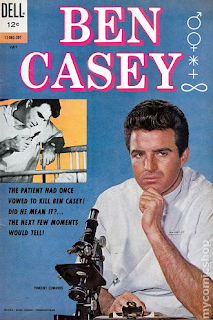
Finally, while we've yet to welcome Cleveland Amory to the scene, the very able Gilbert Seldes is on hand to provide us with a review of ABC's hit medical series, Ben Casey. And Mr. Seldes proves himself able indeed as he describes, "on my honor," the following cases that came up in a single one-hour episode of Casey (and I quote):
  1. A woman who has been coming to the clinic for years with imaginary ailments.
  2. A tough kid, supposed to have swallowed a razor blade.
  3. A rather dear old man whose family is trying to get rid of him, alleging failing memory.
  4. A woman who, so far as I could gather, was sick.
  5. A dipsomaniac.
  6. A man who got an ice pick accidentally in his heart but survived two hours on the city's transit system.
  7. A girl in a state of shock—mute.
  8. A victim of a gang war.
Remember, this all happened in 60 minutes. But, says Seldes, "the individual fragments were sharp and effective," the cases were all presented to viewers in moments, and there was interaction between the characters, As for the elements that tied the story together—well, that's another story: there were "three lectures on medical ethics, two at least on race relations, and assorted lofty epigrams on life, society and fate." And lines such as, "These hands are for healing, not for violence," and "It's the verge of midnight—it could be the verge of a new life." They're only missing exclamation points to make it complete.

Maybe the story isn't very true to life. Most certainly the dialog from the doctors and nurses isn't. But the episode was exciting, which I suppose is what's important. And a tip to the writers: if the characters "shortened their sentences and spoke like human beings we could have three more episodes as good as the eight we got—in an hour!" TV  

February 21, 2015

This week in TV Guide: February 24, 1962

Troy Donahue, this week's cover boy, is nothing if not an accidental star, at least in name.  His real name is Merle Johnson, and the way he came to be Troy Donahue is more interesting than many other aspects of his life.  His agent, Henry Wilson, had the name "Troy" left over when one of his clients, Jimmy Ercolani, decided to keep his own first name while taking Wilson's suggestion for a new last name - he became James Darren.   The name "Donahue" came from another Wilson client, Timothy Durgin, who had his first name changed to Rory, and chose "Calhoun" over "Donahue."  So just think - we could be talking about Troy Calhoun here.

Anyway, Troy Donahue is Hollywood's current glamour boy, coming off the movie A Summer Place, which made him a household heartthrob, and currently starring in ABC's detective series Surfside 6.  So what kind of guy is Troy?   One of his movie costars, Suzanne **sigh** Pleshette, was prepared to dislike him based on the publicity, but instead found him to be "a very unusual boy - gracious and considerate."  I guess so, because the two of them were married in January 1964.  Of course, they divorced in less than nine months.

There's some thought that Donahue is letting the fame get to his head - he's more demanding than he used to be, more outspoken, urging colleagues to mention in interviews how lousy their director was. He's late to the set and often comes unprepared, blowing his lines more times than anyone would like to admit.  He's not an actor yet, but he's still learning.

And though he's got a very well-known name, and has a fairly long career, Troy Donahue never really does achieve the fame that seems to be his for the taking.  He never achieves the long-running television series that, at the time, substitutes for movie stardom, he never has the defining role that makes him a genuine star, never gets the Oscar nomination that sometimes comes to the pretty boy that turns into an actor.  He's never anything other than Troy Donahue - which is still a lot more than a lot of us ever achieve.

***

After a career of ups and downs, Judy Garland is on top again.  Her recent concert tours have been critical and popular successes, particularly her Carnegie Hall concert in April of 1961, which many have called "the greatest night in show business history," and resulted in a gold album and a Grammy for Album of the Year.  She's been nominated for an Academy Award for her supporting role in Judgment at Nuremberg.  And now she's returning to television for the first time in six years, with a deal in place for a new round of specials with CBS.

Her first, scheduled for Sunday, February 25, is treated as a television event, and it isn't hurt by the appearance of Frank Sinatra and Dean Martin as co-stars, and it's produced and directed by Norman Jewison.  The show's a smash - as you might expect with that kind of star power - and it results in a deal for Garland to return in a weekly series, with Jewison later coming in to direct.  The show only runs for one rocky season, and Garland returns to the stage and her final sad years.  For Norman Jewison, though, the future is much brighter.  Tony Curtis suggests Jewison start directing movies, which he does, amassing a brilliant portfolio that includes The Cincinnati Kid, The Russians are Coming, The Russians are Coming, The Thomas Crown Affair, Fiddler on the Roof, and his best-known movie, the Oscar-winning Best Picture In the Heat of the Night.

So this special is the start of a great career for Jewison.  A pity that it wasn't able to turn things around for Judy Garland as well.


***

Garland's Sunday special is not the only interesting programming on tap that day.  In fact, Sunday might be the best TV day this week.  NBC Opera Theatre is back with Montemezzi's The Love of Three Kings, featuring the great American bass Giorgio Tozzi.  Now, it's kind of rare to see dueling operas on television, but we have it here - Boston's ABC affiliate, WNAC, counters with Tchiakovsky's classic Eugene Onegin, with a Russian cast full of vowels.

Meanwhile, CBS Sports Spectacular has the 1961 Formula One United States Grand Prix, which was taped October 8 at Watkins Glen, New York.  That was fairly common back in the,day, networks covering Formula One races weeks or even months after the fact.  If race fans were really lucky, they might get to see the race only a week or two later on Wide World of Sports.  I'll admit, though, four months is a bit extreme,.

Edward R. Murrow is one of the legendary names in television news, with his CBS series See It Now and Person to Person, along with his landmark documentaries, becoming part of television history.  Which is why it's so strange at first glance to see him on ABC this afternoon, as the guest on Issues and Answers.  He's appearing on the show in his role as Director of the U.S. Information Agency, in celebration of the 20th anniversary of the Voice of America.

***

A look at the Teletype this week gives us a snapshot of the times.  First, we see that Merv Griffin and Hugh Downs are two of the guest hosts who will be filling in on Tonight during the interregnum between the departure of Jack Paar in March and the debut of Johnny Carson when his ABC contract expires in October.  ABC's reporting a flood of requests for interviews with Carson, but they're pretending not to know whether they want to talk about Carson's upcoming gig with NBC, or his current ABC show Who Do You Trust?  Yes, I'm sure everyone wanted to talk about that.  Paar himself is gearing up for his once-a-week prime time show on NBC, to debut in the fall.

ABC's got a World War II drama in development, Combat, which would star Rick Jason, Vic Morrow and Shecky Greene.  Unlike so many of the pilots we read about in this section, Combat not only debuts on ABC in the fall of 1962, it becomes one of the most successful war dramas on television, running for five seasons before leaving in 1967.  Shecky Greene only lasts for the first season, but Rick Jason and Vic Morrow alternate as episode leads throughout the show's run.

Speaking of the war, Peter Brown, one of the stars of ABC's Lawman series, is said to be testing for the role of JFK in the upcoming big screen adaptation of PT109, the story of Kennedy's wartime exploits in the Pacific.  The movie will come out in June of the following year, while Kennedy is still alive and in office, but when it does it won't have Brown, but Cliff Robertson, in the starring role.

Finally, in April, Burt Lancaster is scheduled to host At This Very Moment, a "Cancer Control Month" special on ABC.  I didn't know this, but April is still Cancer Control Month by presidential proclamation.  I've mentioned how, prior to the telethon years, Jerry Lewis used to host a one-hour Muscular Dystrophy special, and this seems to have been the same type of show.  I checked it out on IMDB and the guest list is impressive, so much so that I wonder how they all fit into an hour-long show: Harry Belafonte, Richard Chamberlain, Bobby Darin, Jimmy Durante, Connie Francis, Greer Garson, Charlton Heston, Bob Hope, Lena Horne, Rock Hudson - well, you get the picture.  The cast's in alphabetical order, so I've only gotten about halfway through.  The special includes taped remarks by President Kennedy and Vice President Johnson, and an archival message from Eleanor Roosevelt.

***

Monday's trip through the TV listings will cover Wednesday, February 28 - let's see what the rest of the week's highlights are.

Saturday:  Boxing is still prime-time box office, and ABC's got a good one this week: the lightweight championship fight between Joe Brown and Carlos Ortiz from Las Vegas.  Or at least that's what's in TV Guide, but for whatever reason - an injury, probably - the fight doesn't come off until April, when Ortiz ends Brown's five-year reign as champion.  Since this was a special rather than a regularly-scheduled broadcast, I'm not sure what ABC wound up broadcasting.

Sunday: In addition to the programs I listed earlier, Ed Sullivan wraps up his series of shows from Miami Beach, with guests Lloyd Bridges, the Crosby brothers, opera star Patrice Munsel, comedian Jan Murray, singer Damita Jo, acrobats the Gimma Brothers, and the dance team of Brascia and Tybee.

Monday: NBC's 87th Precinct airs at 9:00pm ET.  According to the Teletype, the show's been renewed for another season, but because it was unable to find a sponsor, that second season never came off.  Too bad; the series, based on the novels of Ed McBain, was very good, with a strong cast including Robert Lansing, Ron Harper, Gregory Walcott and Norman Fell.  In fact, the only weak episodes were the ones with Gena Rowlands as Lansing's deaf-mute wife.  Too much personal information there, but the other stories were hard-hitting police drama.

Tuesday: Bob Hope's on with his third NBC special of the season, and he has an interesting collection of guest stars: Jack Paar, the current (for now) host of Tonight: Steve Allen, the original host of Tonight, Joan Collins, who's co-starring with Bing and Bob this year in The Road to Hong Kong and looks painfully young (and **sigh**-able); singer Joanie Sommers, whom I don't remember - but my wife does, and she didn't like her voice; and comedians Robert Strauss and Sid Melton.  Sid's one of the co-stars on Danny Thomas' show, and coincidentally there happens to be an article on Thomas in this week's issue.  On the other hand, you can watch the show that precedes Bob, The World of Sophia Loren.  Speaking of **sigh**...

And speaking of late-night shows, did you know that Mike Wallace once had one?  Imagine him competing with Jack Paar and Johnny Carson.  It was called PM, and ran on the Westinghouse-owned stations in 1961 and 1962, falling in-between The Mike Wallace Interviews and Biography in Wallace's career.  It actually was two shows in one - PM East, based in New York and hosted by Wallace, which ran for an hour; and PM West, with San Francisco Chronicle television critic Terrence O'Flaherty.  It would have been interesting to see how this would have gone had it been able to reach a broader audience - it wasn't seen at all in the South and Southwest.

Thursday: Boston's WBZ preempts NBC's The New Bob Cummings Show at 7:30 to show syndicated reruns of You Bet Your Life, packaged as the Best of Groucho.  Groucho's not nearly as funny as he is in the Marx Brothers movies, which I've really come to appreciate over the years, but he can still bring it as the host of a game show.  If you haven't seen You Bet Your Life, by the way, it's one of the shows you can check out at the Movie and Music Network, and you can find out how to subscribe - at a special rate - here.

Friday:  The best night of the work week is here, and it's a great night for music, with WGBH carrying a concert by Charles Munch and the Boston Symphony, and the Bell Telephone Hour presenting an hour of the songs of Irving Berlin.  If that's not your cup of tea, there's a fine episode of Route 66 with guest star Ed Asner on CBS, a suspenseful episode of The Detectives Starring Robert Taylor on NBC, and an intriguing episode of the syndicated The Third Man, which recasts Harry Lime (Orson Welles in the movie, Michael Rennie in the series) as a good guy.  I can't recall if it was supposed to take place before Lime had turned bad, or if it was kind of an alt-Lime who'd reformed, but in the movie Lime was anything but good.  Oddly enough, this series is actually pretty good, and I really like the way Rennie plays the role.  But then, he's that way in a lot of roles. TV  

October 17, 2012

How television influenced the Cold War

In last week's piece on TV campaign commercials, I mentioned Erik Barnouw’s book The Image Empire. I want to return to that book today, to look at something that we don’t think much about: the role that the regular television series played in the Cold War.

Understand, we’re not talking about news coverage. No, we’re talking about the average TV series – comedy, drama, western, movie – and how it may, consciously or subconsciously, have influenced viewers.

We can cut to the chase fairly quickly here. It is true that in the wake of the James Bond movies, there was something of a “spy mania” in entertainment circles. You had serious spy shows, slyly humorous spy shows, spy shows masquerading as westerns, spy spoofs. Not only were spy shows such as Mission: Impossible, I Spy, Get Smart and The Man (and later Girl) from U.N.C.L.E. sprouting up, but, as Barnouw points out, the trend was apparent even in established, non-spy programs.  "Even comedy series like I Dream of Jeannie, Mr. Ed, and The Lucy Show took up spy themes."

This was mostly because, as more than one person has pointed out, imitation is the sincerest form of flattery – and profit-making. Just as television had ridden through waves of westerns, police dramas and ethnic comedies, Hollywood was now in the throes of international espionage. Of course, the conflict between good and evil isn’t anything new – it dates back to the Bible, and had been a staple of television since the beginning. However, Barnouw sees a difference in this new wave of programming.
Like earlier action telefilms, the new cycle concerned struggles against evil men who had to be wiped out. Bosomy girls fitted easily into the picture. But in one respect the new wave departed from precedent. Older action heroes, especially the cowboy, had maintained a code of honor and fought fairly. This tradition was rapidly vanishing. When the U.S. Navy in a 77 Sunset Strip episode (“The Navy Caper”) hired a private eye to try to steal one of its top-secret gadgets – to test its own security arrangements against enemy powers pursuing the same objective – the hero’s instructions were: “You can lie, steal, cheat – whatever the enemy might do.” What followed was an epic adventure in deception and counterdeception.

After citing other examples, including Mission: Impossible’s “the Secretary will disavow any knowledge of your actions” warning, Barnouw concludes that “The official lie was thus enshrined.”

Now, I’m not sure I go along with Barnouw’s thinking here.  TV's police officers were always going undercover, passing themselves off as people they were not. The private detective, especially of the Mike Hammer type, was forever operating outside the law, under a private code of ethics that could be seen as promoting the public welfare even as it might endanger the detective’s mortal soul.

At the same time, Barnouw does have a point. The policeman, like the cowboy, always had the potential of becoming a tragic hero, and Dragnet’s Joe Friday tracked down more than one dishonest cop brought down by his failure to follow procedure in his honest pursuit of justice. And it was always a given that the private eye was a different type of character, the dark side of society, performing a public service that the public (in the guise of the official organs of law enforcement) accepted only reluctantly. They may have secretly envied the P.I.’s freedom from official rules, but those rules were nonetheless respected.

Now, however, things were different.

In reality, life had never been as simple as it had been depicted in television.* An event such as the botched Bay of Pigs operation revealed the extent – the need, if you will – for the United States to take action in foreign countries in order to protect its own interests. Barnouw thinks this required an adjustment in the way we thought:

*Just as it was never as corrupt as it is often portrayed today.
To many Americans, accustomed to a national image of clean uprightness – the cowboy – the revelations were disturbing and called for some adjusting. They seemed to require either indignation or rationalization. For most people, rationalization was the easier solution. If our government had really developed a “department of dirty tricks” to organize putsches, unseat rulers, and murder when necessary, all masked by elaborate fictions, it must have been brought on by dire necessities.
Barnouw quotes an article by Robert Lewis Shayon in Saturday Review as to what was wrong with all this:
The heroes of Mission: Impossible, for pay and at government instigation, interfere directly in the affairs of foreign nations with whom we are at peace and from whom no direct threat to our safety emanates.
They break the laws of these nations.  It pretends that individual Americans are morally impeccable when they break the laws of a foreign nation under the shield of our ideology. . . in emergent nations the viewer may say: “The Americans are telling us, in these programs, that this is the way to run a society.”

The end result of such programming was that the viewer was subconsciously taught to "accept the government’s assertions without exception."

Here, I think Barnouw (and Shayon) is much too willing to attach a sort of moral equivalence between the United States and the Soviet Union. In the struggle between good and evil, one must be careful to use whatever resources are at hand while at the same time resisting the temptation to use the tools of evil against evil. That’s not an easy balance to maintain, but one must be willing to grant best intentions to those who, in their efforts to act in America’s best interests, may have crossed that line. In this sense Barnouw too often cynically dismisses the sincerity of those in the government who truly believed in the rightness of the American cause and were determined to act in its best interests.

These spy shows, Barnouw contends, work hand-in-hand with another facet of 60s programming.  For as the conflict in Vietnam grew, the administration "constantly tried to recapture the consensus of World War II by depicting the Vietnam expedition as a continuation of older struggles against tyranny." As such, it played into the growth of series set in World War II - shows popular not only because of their action, but because of their appeal to the many veterans in the viewing audience. Not coincidentally, they also portrayed a war from which America emerged victorious.

Dramas such as Combat, The Rat Patrol, The Gallent Men, Garrison's Gorrillas and Twelve O'Clock High and comedies like McHale's Navy and Hogan's Heroes were common in the 60s, as were toys like G.I. Joe, Mattel's Fighting Men, remote-controlled Tiger Tanks, and mock M-16 rifles.  The practical effect of all this, Barnouw suggests, was important.  While "[i]t was not the conscious intention of producers to buttress administration arguments linking Vietnam with World War II," nonetheless it was true that
[a] visitor from another planet watching United States television for a week during the Vietnam escalation period might have concluded that viewers were being brainwashed by a cunning conspiracy determined to harness the nation – with special attention to its young – for war. Of course there was no conspiracy. Manufacturers were making things for which they saw a market, promoting them through advertising agents, producers, and broadcasters who believed in serving the client. In so doing, all avoided anything that might seem to undermine current government policy – and thereby gravitated toward its support.

Though these shows didn't intend to produce such a result, "the rash of heroic and amusing World War II series, in conjunction with the flood of enemy-conspiracy drama, probably did just that."

Ultimately, I suppose the validity of Barnouw's contention rests on how influential you feel television is.  If you think sex and violence can have an objectivizing and dehumanizing effect on people, then it might well be true that the spy and war dramas of the 60s had, at least for a time, the effect of conditioning the viewer to be more inclined to accept the administration's pronouncements on the Cold War, and its persecution of the very hot war in Vietnam - not to mention a  trust of government in general and its ability to take on other efforts such as the War on Poverty.

But if television was indirectly responsible for creating this climate of acceptance, as Barnouw suggests, then it must also accept the responsibility for what came next. As the 60s turned to the 70s, and public opinion turned violently against the war, a new breed of television show would appear, with a far more outward anti-war slant.  Whereas the programs of the 60s encouraged trust in the government, the programs of the 70s would consciously, intentionally, tear down that trust and replace it with a cynicism that pervades modern culture to this day.  Maybe - likely - it would have happened even without television.  How long it would have taken, and how widespread it would have been, are questions that we can't answer.