Showing posts with label What's My Line. Show all posts

May 13, 2023

This week in TV Guide: May 15, 1953


I have a question for those of you out there reading this. (If you're not reading this, then never mind.) How do you all feel about TV Guides from the 1950s? Do you have any interest in them, or do you prefer issues from the '60s, '70s, and '80s? Do the stars and the shows resonate with you, or is it too far back for you to have any connection with them? The reason I ask is because we don't get a lot of feedback on these early issues, and it would be helpful for me to know if they just don't float your boat. I've got an issue from 1955 scheduled for next week, so it'll probably be too late for me to make any changes to that one, but it will guide me going forward. In the meantime, I'll try to concentrate on anything that looks interesting.

And to that point, I know there are a lot of Ozzie and Harriet fans out there, so we'll take a look at this week's cover story on Ricky and David Nelson. It's a short article (only a page long) and mostly about Ricky, but it tells us something about how things used to work back then. Each boy makes $1,600 per week—$1,100 for the television series and $500 for the radio series (which ran from 1954 to 1954). The boys don't get to enjoy much of that money, though; 12-year-old Ricky, for instance, gets an allowance of $1.50 per week. He also gets reminders from mom, dad, and big brother to keep from getting a big head—"Don't be a child actor," they remind him. 

It's hard to deny his star power, though. At a recent church dance, it was Ricky, not older brother David, who got the dances with all the girls, even though he was four years younger than the youngest of them. (He told them he was older—13.) He also has a sharp eye for clothes, having recently ordered a Tattersall vest just like Ozzie's; the elder Nelson toled the salesman that "from now on you check with me before you charge anything." He used to go to a public school, but because of the many absences required by the show, he now has a private tutor. He's also an athlete, fast and agile. 

Harriet calls Ricky "intelligent and understand of adults," and adds that he's straightforward and not a troublemaker. The principal of the school he used to attend calls him "a very free soul." And that does lead me to wonder about his sad adult life, which ended at age 45. It's hard to believe that any child star has a "normal" childhood, but even with that, was this free soul ever really allowed to be a real teenager? Did Harriet, who had "certain expectations" for his career, allow him to find his own life? But all this in the future, of course.

l  l  l

Speaking of "boys," Mark Goodson and Bill Todman are a bit too old to have that label applied to them in a literal way, but there's no doubt they're the "Golden Boys" of television right now, with seven primetime programs airing across the three network—and all of them based around the question mark.

It all started for the duo with a radio quiz show, Winner Take All (and they currently have two shows going on radio), but their major success comes from television. Six of the seven Goodson-Todman shows are quiz shows: What's My Line?, The Name's the Same, It's News to Me, I've Got a Secret, Two For the Money, and Beat the Clock. (The seventh show, The Web, is a mystery series; the question involves "whodunit.") Their success is based on a simple formula that they apply to each show: first, spontaneous humor. The "unwritten ending" that's inherent in a quiz show means that "all the humor that occurs is spontaneous," Todman says. "That's why if I tell you a certain ad lib that Herb Shriner or Groucho Marx made to a contestant, it isn't nearly as funny as if you'd heard it first hand." It's also important to have a well-balanced panel of celebrities. "The idea is to get people who are well known," says Todman. "But we don't want their specialized knowledge on our show. We just want them to be themselves."

That became a problem with comedy writer Hal Block, one of the first permanent panelists on What's My Line? "Hal never was able to live with the idea of being a celebrity," according to Todman. "When he started on the show he had no trouble at all. Bujt after a little publicity. . ." And while newspaper columnist Dorothy Kilgallen has her critics, "we haven't had many complaints about her," Todman says. "She's a good deductive reasoner and is loaded with feminine intuition." The crown jewel is, of course, John Daly, moderator of both What's My Line? and It's News to Me (while continuing as a news reporter and executive), and one of the most urbane men ever to appear on American television. (He has "an apparently endless and effortless charm.") Goodson says "He rules a panel with a velvet whip," and he will be the one constant in WML?'s 17½ year run.

For people today, What's My Line? and I've Got a Secret are probably the two best-known of the early Goodson-Todman stable, and thanks to GSN (and now Buzzr), people can still see the charm and wit of these shows, and how they reflect the days of early television.

l  l  l

Sporting event of the week: well, that would have to be the world heavyweight boxing championship fight on Friday (9:00 p.m. CT, NBC), pitting heavyweight champion Rocky Marciano against Jersey Joe Walcott, the former champion, live from Chicago Stadium. The two men first met last September, when Marciano, then the challenger, scored one of the greatest knockout blows in boxing history to take the title from Walcott. According to TV Guide's sports editor, the great sportswriter Red Smith, the key to this week's bout is Marciano's nose; it had been broken by his sparring partner while in training, forcing the fight to be rescheduled from its original April 10 date. The injury was the talk of the sporting world, or, as Smith puts it, "the greatest gush of literature created about anybody's beezer since Rostand wrote 'Cyrano de Bergerac.' "

Walcott, the crafty veteran, will be trying to take advantage of that injury in this, Marciano's first title defense, and everyone expects the same kind of brawl that marked their first fight, when Walcott battered and bloodied Marciano through 12 rounds, only to see the Rock flatten Walcott in the 13th round. But with anticipation running high, anyone who stepped out for a beer and was late getting back to his seat is going to be in for a disappointment when, a little over two minutes into the first round, Marciano launches a right uppercut that sends Walcott sprawling on his back. Walcott takes the count sitting, apparently unhurt, until the referee counts him out, and then protests what he says is a fast count. Did Jersey Joe throw this, his last fight, or was it simply a case of being mentally unprepared to face Marciano a half-year ago? To this day, you can make arguments either way. What is known for sure is that Marciano retains his title en route to being hailed as one of the great champions of all time; and that as far as this fight goes, the anticipation far outweighs the reality.

l  l  l

Let's take a look at some of the other non-quiz-show, non-sports shows worth tuning into this week.

The era of Saturday morning cartoons is a relatively narrow one; they're a thing of the past today, and they hadn't yet been introduced in the days of this issue. So what did kids watch on Saturday mornings? Well, for one thing, broadcasting didn't even start until 9:00 a.m., when WBKB came on the air. But count on live-action kids's shows, Westerns and space adventures; WBKB has Rogue of the Rio Grande on at 9:00 a.m. and Space Patrol on at 10:00 a.m., while WBBM offers the circus show Big Top at 11:00 a.m. Similar programming continues well into the afternoon.

You know how often I talk about how "the more things change, the more they stay the same"? Here's an example for you, on Sunday afternoon's American Forum of the Air. (1:30 p.m., NBC) The topic: "What Should Be the U.S. Immigration Policy?" Surprisingly, the debate is between two Democrats; surprising because nowadays it's almost impossible to get two people from the same party to have differing opinions.

Here's something of interest: Grace Kelly, two years away from winning an Oscar for Best Actress and three years before becoming Princess Grace of Monaco, appears in the Hollywood Screen Test presentation "Right Hand Man." (Monday, 6:30 p.m., ABC) Fun fact: Hollywood Screen Test, which sought to give exposure to relatively unknown actors by teaming them up with established stage and screen actors, was the first regularly broadcast television series by ABC. Also on Monday, CBS's Studio One (9:00 p.m.) presents "The Laugh Maker," with Jackie Gleason and Art Carney. Gleason plays a version of himself, a nightclub and television comedian who turns out to be anything but the lovable character his fans know, while Carney is the reporter sent to do a feature story on him. Gleason and Carney had already been working together since 1950; this is a chance to see them both in a different light. 

There's nothing special on Tuesday, although I'm always amused that the daytime program listings include descriptions for soap operas. For instance, on The Guiding Light (11:45 a.m., CBS), "Mrs. Grant visits Kathy in the hospital & upsets her." That's too bad for Kathy; hope the nurse throws Mrs Grant out! But on Search For Tomorrow (11:00 a.m., CBS), "Pearl March reveals a secret." Shouldn't that be on The Secret Storm?

On Wednesday, Ralph Bellamy stars as private detective Mike Barnett in Man Against Crime (8:30 p.m., CBS). Bellamy talks with TV Guide's reporter about the differences between his show and other crime stories on TV; for one thing, he and the police have a cordial relationship. "When something omes up that is within the jurisdiction of the police, he calls them in. He thinks they all have at least average I.Q.'s and quite a few of them are intelligent." He also never carries a gun, relying instead on the self-defense techniques used by operatives in the underground and behind the Iron Curtain. 

Bellamy's route to Man Against Crime, which started in 1949 and will run until 1954, has been interesting, to say the least. His movie career became stymied when he was typecast as the "naive boyfriend" who always loses the girl to the glamorous star; instead, he returned to the Broadway stage, where he appeareed in a string of hits: Tomorrow the World, State of the Union, and Detective Story (which ran for two years). He says he's not sure what the future holds; he'd like to go back to roles about people, rather than cops and robbers, and he might even write a play sometime. And though he's successfully shaken his movie typecasting, some of his greatest successes are still ahead: a Tony Award for Sunrise at Campobello, the story of Franklin D. Roosevelt's triumph against polio, which he reprised in the film version; four terms as president of Actors' Equity; an appearance on Studio One with William Shatner in "The Defender" (which eventually became a series with E.G. Marshall and Robert Reed); two more turns as FDR in The Winds of War and War and Remembrance; the Eddie Murphy movie Trading Places; a Lifetime Achievement Award from the Screen Actors Guild; an Honorary Academy Award; and a star on the Hollywood Walk of Fame. He worked steadily until his death in 1991.

Thursday evening—well, every weekday evening, for that matter—NBC presents the Camel News Caravan, presented by John Cameron Swayze (6:45 p.m.), and that is this week's "Program of the Week." News Caravan, which debuted five years ago, was "network TV's first attempt to usurp the role of pictorial reporting preveiously held by the newsreels." Although the network originally used Fox Movietone camermen for their film footage, they were soon able to set up their own staff of cameramen, who've won critical plaudits. In the time since then, the program has gone on to use instant switching between cities to cover news in the making, was the first to use jets to fly in films from places where live pickups were uavailable, and has become "a skillful-roundup nightly of world news events." Today the program is, according to Bob Stahl's review, "a polished product, a combination of live and film coverage," complete with switches to Washington correspondents for the latest news.

l  l  l

Finally, even when we're looking at issues of the past, we always have an eye on potential stars of the future, so we'll end with this look at "the blondes, brunettes and redheads" with hopes for the future, and see if any of them made it.

The most successful is probably Judy Tyler, who plays Princess Summerfall Winterspring on Howdy Doody. (We read her, uh, interesting story here.) She's one of "the hundreds wo besiege the production offices and haunt the model agencies," and beat out more than 200 girls who auditioned for Howdy Doody. (I'm sure she worked hard to get that job.) The stauesque blonde Siri—no, not the computer voice, although it is an interesting coincidence—has "a comic gift for doing strange things to the English language," and admits "I know I have no talent as an actress. My dream is to work steadly as straight-woman with comedians—like Dagmar." Georgia Landeau "never passes up a job," whether modeling, doing commercials, or performing a walk-on. Shirley Cotler wants to be "top commerial talent" and makes $170 a week performing in the chorus at the Copacabana nightclub. Linda Lombard, discovered on Arthur Godfrey's Talent Scouts, does go on to make several movies, in mostly uncredited roles.

None of these young women made the big time, but they all had talent, and all knew what they wanted to do. Several of them succeeded in getting roles, and while they may not have been big ones, they at least gave it their best shot, and one hopes they were able to achieve some satisfaction from that. Not every issue provides us with a big revelation of a future star, but like these women, we don't stop trying. TV  

November 26, 2022

This week in TV Guide: November 26, 1955


You probably know John Daly best as the charming and urbane host of CBS's What's My Line? on Sunday nights, but this week we get a chance to see him at his day job: vice president in charge of news, public affairs, special events, religion and sports for ABC television and radio, and anchorman of ABC's evening news program. 

The combination of the two jobs isn't quite as incongruous as it might seem. "[Goodson-Todman] thought a newsman would have the necessary background to keep an ad lib show going," he says of his Sunday night job. And he enjoys his work as moderator, although he understands that "What's My Line? has got to go sometime. I'm surprised it lasted this long." (It would, in fact, last another twelve years, all with Daly at the helm.) He's really a natural at the job; "Serious and intelligent, he can rarely resist the temptation to be funny." It's what keeps him, he says, from getting ulcers.

Newsman—that's his line.
He talks with you, someone says, "as if he has nothing else on his mind but to say what he's saying, and to you." Some call this his "charm technique," but he says it's his news training. "When a newsman works on a story, he concentrates fully on it. It's the only way to get things done." And make no mistake, despite his work on WML, his news days go way back to when he was with CBS. He announced the bombing of Pearl Harbor and the death of FDR, and covered Patton in Europe. And he's a man with strong opinions on the news business, opinions that don't always align with those of his friend and former colleague at CBS, Edward R. Murrow. Whereas Murrow strongly believes that networks, like newspapers, have the responsibility to take editorial chances ("Let the networks choose their sides and fight it out."), Daly things this is impractical, for several reasons. Suppose, he says, the editorial policy of a local station differs from that of the network? Does the affiliate simply not carry the network's opinion?

And while it's fine for a news show to make "a legitimate comment on any event of public interest," it should be "a conclusion drawn on clearly defined fact." "There should be no subjective declaration of opinion," Daly insists. It's too easy for editorial opinion to drift into subjective opinion, which "could play into the hands of those who might attack the concept of a free press. If we took one stand, they might claim all our news was slanted." I can't help but wonder what he'd think of today's network and cable news divisions.

Daly's weekday schedule runs from 9:00 a.m. to 9:30 p.m. After an hour during which he "plays executive," he works on the script for the evening's news. Lunch is "a business event." At 3:30 p.m. he heads into the newsroom, where he remains until after the show. Then it's on the train and back home. All in all, he reads eight newspapers a day, plus current magazines and biographies. Sundays he spends at home with his family, heading to the studio at 6;00 p.m. for What's My Line?, which airs live at 10:30 p.m. Eastern. With all that, he still gets "eight full hours" of sleep every night. It's another way to prevent ulcers.

John Daly remains at ABC until 1960, when he resigns in protest over the network delaying its election coverage for an hour in order to show Bugs Bunny and The Rifleman. A principled man, he'll also resign as the director of the Voice of America when personnel changes are made without his approval. And to this day, every time I watch him on WML, I say to myself that he's what I want to be when I grow up.

l  l  l

It was, let's see, about three weeks ago that I last mentioned the trend of movie studios getting into television. Back then, it was Warner Brothers and M-G-M, and before that the focus was on Walt Disney. This week we turn to Fox, whose offering, The 20th Century Fox Hour (Wednesday, 9:00 p.m., CBS) is perhaps the "most ambitious attempt" yet to crash the TV landscape. Unlike the other studios, the Fox Hour "isn't a collection of clips from old films, nor is it a 'showcase' for young, little-known actors." Instead, the studio has chosen to recruit top talent in adaptations of past Fox movie hits. 

It's an ambitious proposal indeed, but it faces a not-insignificant challenge: how to adapt a 90-minute or two-hour movie into a 45-minute timeslot. (Especially, I'd think, if viewers have already seen the movie version, and know what you're leaving out.) So far, the results have been mixed: Merle Oberon and Michael Wilding starred in Noel Coward's Cavalcade, but as the review points out, "even the full-length movie version had trouble chronicling a British family from the Boer War [circa 1899] to the 1930s." Next, it was Laura, with George Sanders, Robert Stack, and Dana Wynter; alas, the cast tried "valiantly, but in vain, to evoke the feature film's suspenseful mood." It wasn't until the third outing, The Ox-Bow Incident, that they hit the jackpot, with an outstanding cast including Cameron Mitchell, Raymond Burr, and Robert Wagner; it was "something TV—and Hollywood—could be proud of."

You might have seen episodes from this series on YouTube or in syndication, under the title Hour of Stars. (The most frequently seen DVD episode is "The Miracle on 34th Street," starring Thomas Mitchell as Kris Kringle. Compare and contrast.) It runs for two seasons, continuing to feature big-name stars (though not every week), and by the second season it incorporates original stories as well as movie adaptations. Perhaps that's what the show should have done in the first place, when the story could be tailored to a shorter running time. As anyone familiar with old-time radio knows, it's very difficult to adapt a movie to a finite running time, and the results are not always satisfactory.

There's also a review of another new series that you might be interested in, a Western called Gunsmoke (Saturday, 9:00 p.m., CBS), starring James Arness as Marshal Matt Dillon, and so far the show has produced "taut, action-packed stories." As a frame of reference, Gunsmoke, like Wyatt Earp and Cheyenne, is one of the early "adult" Westerns, in contrast to previous fare by Western heroes like Roy Rogers, Hopalong Cassidy, and Gene Autry, and the storylines reflect it, both in terms of action (in these shows those who get shot often die), and in the moral dilemmas faced by the heroes. Already in this first season, Marshal Dillon "has killed a psychotic gunslinger who had wounded him in an earlier gun battle; he has saved another gunman from being lynched by an angry mob; and he has amputated the leg of a wounded rancher." It is, to be sure, a good day's work. 

Arness is excellent in the role, and he's ably backed by a fine supporting cast including Dennis Weaver and Amanda Blake. From the sounds of things, this show might just have a future.

l  l  l

'Tis the season and all, and if you have any doubt about what's in Santa's bag of toys this year for good little television watchers, look no further than this:


There are more than 20 television programs represented in the picture above, with tie-ins everywhere: everything from a Ramar of the Jungle chemistry set to a Dragnet squad car and game. Even The Today Show gets in the act, with a J. Fred Muggs doll. (So much for those Matt Lauer talking dolls that are gathering dust in some warehouse.) Not surprisingly, Disney is represented by several toys; some things never change. I imagine that if, the next time you're browsing in your local antique store, you run into a Honeymooners bus with Ralph Kramden behind the wheel, or a ukulele endorsed by Jimmy Durante. you'll be shelling out a little more than you would have back in 1955. And if you have one in your attic, better call Antiques Roadshow.

l  l  l

As for what's on TV this week, what catches my eye?

Saturday's highlight is one of the nation's great sporting traditions, the Army-Navy game, live from Philadelphia, with Lindsey Nelson and Red Grange providing the play-by-play (12:15 p.m, NBC). The usually-mighty Army team has lost three games this season, but they rally this week, defeating #11 Navy 14-6. I notice that one of the Navy players is named Forrestal; any relation? Moving to primetime, it seems that no matter what issue it is from the 1950s, we're running into one of those Max Liebman spectaculars; this time, it's the Rodgers and Hart musical "Dearest Enemy" (8:00 p.m., NBC), with Anne Jeffreys, Robert Sterling, Cyril Ritchard, and Cornelia Otis Skinner. It's a romantic comedy set during the Revolution, but I'm skeptical—none of my enemies are dear to me.

Sunday afternoon on See It Now (4:00 p.m., CBS), the aforementioned Edward R. Murrow hosts a 90-minute documentary on "The Nation's Schools" and the challenges they face, including aging school facilities, federal aid to education, and the lack of good teachers. Let's see, that was nearly 70 years ago, and it seems like the same problems still exist. On a lighter note, Ed Sullivan's guests tonight (7:00 p.m., CBS) are Pearl Bailey, who recently completed a role in Bob Hope's film That Certain Feeling (and that's Bob at left, in an ad for RCA, plugging that very movie); comedian Dick Shawn; the Goofers, comedy vocal and instrumental group; the Princeton Triangle Club; Collier's magazine's All-America football team; and opera star Licia Albanese and her three-year old son doing a scene from Madama Butterfly. Afterwards, catch WCCO's movie The Stranger (9:30 p.m.), a sinister noir with Edward G. Robinson investigating a Nazi spy (Orson Welles).

I'm not positive, but I think Monday's presentation on Studio One (9:00 p.m., CBS) relates to a part of pop culture history that would have been assumed knowledge back in 1955. The episode is "The Man Who Caught the Ball at Coogan's Bluff," by Rod Serling, starring Alan Young and Gisele MacKenzie, and the storyline is thus: "George was a shy and unsung government worker when he entered the ball park. But after making that spectacular bleachers catch of a home-run ball, he was a national hero, and sky no longer." I haven't seen the episode and couldn't find a whole lot out about it other than what you read here, but there are a few assumptions we can make. Coogan's Bluff was the location of, and the nickname for, the Polo Grounds; the most famous home run ever hit there was probably Bobby Thomson's "The Giants win the pennant!" blast in the 1951 playoff against the Brooklyn Dodgers. Even non-baseball fans were familiar with it; if this story doesn't actually use that game as the background, the viewers would have supplied the details.

On Tuesday's Warner Brothers Presents edition of "Casablanca" (6:30 p.m., ABC), "A dealer in antiques and a professor are both interested in acquiring a priceless page from an ancient Bible. But Rick wants money to provide education for the ragged Arab shoeshine boy who gave him the valuable parchment." Does this sound like the Rick we know and love from Humphrey Bogart's portrayal? I suppose, if you're a cynic with a heart of gold. Personally, it sounds more to me like a case for Indiana Jones. Later, on The Red Skelton Show (Tuesday, 8:30 p.m., CBS), Red and guest star Peter Lorre appear in a sketch called "Phantom of the Ballet." "Skelton, as a private detective with a mail-order-school diploma, tries to track down a maniacal killer (Lorre). The murderer as a penchant for assassinating members of a ballet troupe." OK, you've got me on that one. 

Wednesday is the second big sporting event of the week, the world welterweight boxing championship from Boston, with champion Carmen Basilio taking on the #1 challenger, former champ Tony DeMarco (9:00 p.m., ABC). Basilio defends his title with a 12th round knockout in what will be voted the fight of the year; you can see it all here. Thursday's highlight, if you can call it that, comes on Tonight (11:00 p.m., NBC), when a dentist comes on the show to drill Steve's teeth. There's also a modern dance interpretation by Katherine Litz; whether or not she's actually doing an interpretation of Steve's dental work is anyone's guess. And Friday gives us some good, old-fashioned murder: a bank embezzler is suspected of it in International Playhouse (8:30 p.m., KEYC), a young man plots it against his lover's husband in The Vise (8:30 p.m., ABC), and the men of The Lineup investigate it when an ad executive is found dead (9:00 p.m., CBS). 

l  l  l

This week's words of wisdom come from George Burns, via the As We See It editorial. Burns has a new autobiography out, I Love Her, That's Why!; it's mostly anecdotical, talking about Gracie and their friends, but near the end of the book he turns serious for a moment. He and Gracie have moved into television, and he discusses his philosophy of playing to the audience. 

If we are successful, it is because we don't play down to an audience—we don't believe in that. There has been foolish talk about audiences having an average 12-year-old mind; it just isn't true. They are older than anybody, and wiser. And what is more, every individual among them is a manager, because in this day of television, he owns his own theater. The first thing an actor learns is to get along with the manager. He does well when he doesn't forget it.

Now, I don't know if that was ever really true, in television or in any other form of entertainment, but already, as we come to the end of 1955, it is becoming an issue for Merrill Panitt and the editors. "We would like to see that paragraph engraved on the forehead of every network official, advertising executive, producer, director, writer and performer who has anything to do with television," he writes. "Whatever real progress television has made has come from men who realize that the only 12-year-old thinking in America is done by 12-year-olds; that the surest way to lose an audience is to talk down to it."

As I said, this may never have been the case, but it certainly isn't the case today. In just about every way, today's maestros, people not only are being pandered to, we're practically demanding it. Whether it's the entertainment industry or the political establishment, the lowest common denominator rules; the simpler the answer, the better. We don't want to be stimulated; we don't want to face anything difficult. This isn't to suggest that there aren't intelligent forms of entertainment today, television programs that challenge not only the intellect but the conscience. They are, however, the exception rather than the rule. 

The editorial concludes by suggesting that the television audience "will turn away from a program that does not respect its intelligence," but I fear that's a pipe dream nowadays. We've been dumbed down in every way, from the cradle to the grave and everything in-between, and we seem to like it just fine. In a world dominated by memes, simplistic thinking, and short attention spans, we are all 12-year-olds now. TV  

August 27, 2022

This week in TV Guide: September 2, 1967


This is, by my count (and I actually did check!), the 538th edition of "This Week in TV Guide," and even when you allow for a number of reruns I've done over the years, that still makes for a lot of issues. It's also true that one of the drawbacks you run into when you've covered that many issues is finding out that some of the most interesting stories, the ones you think you might like to write about, are ones that you've already written about previously.

For example, Richard K. Doan reports that NET has booked an exclusive interview with Stalin's daughter, Mrs. Svetlana Alliluyeva, in October. That's old news to you out there, since you read about it here six years ago. Doan also mentioned that Jacqueline Kennedy's sister, Lee Radziwill, will be making her TV acting debut next winter in ABC's Laura remake. But you knew that already—you've even read the reviews. A musical comedy version of Aladdin done by the Prince Street Players of New York? We saw them adapting Pinocchio. (And they're doing The Emperor's New Clothes this Sunday anyway.) The ABC WWII action series Garrison's Gorillas premieres Tuesday; I've already reviewed it here. And so on.

The temptation is to just throw your hands up in the air and give up; nothing new to see here! But you'd be wrong! There's plenty of spanking newness here, courtesy of ABC and CBS, who are busy rolling out some of their new shows already, even though the Fall Preview isn't until next week. And you know, some of these are pretty good! In addition to the aforementioned Garrison's Gorillas, ABC debuts the excellent half-hour police drama N.Y.P.D. (Tuesday, 8:30 p.m. CT, which—whoops!—I already wrote about here); Custer (Wednesday, 6:30 p.m.), with Wayne Maunder in a series that lasted only slightly longer than the Battle of the Little Big Horn; The Second Hundred Years (Wednesday, 7:30 p.m.), starring Monte Markham in a dual role that doesn't really double your fun; The Flying Nun (Thursday, 6:30 p.m.), a show that's both ridiculous and a product of the Second Vatican Council; Good Company (Thursday, 9:00 p.m.), in which famed attorney F. Lee Bailey tries (and fails) to duplicate the success of Person to Person; Off to See the Wizard (Friday, 6:30 p.m.), ABC's version of The Wonderful World of Color; a pair of Westerns trying to defy the dying genre in Hondo (Friday, 7:30 p.m.) with Ralph Taeger and The Guns of Will Sonnett starring Walter Brennan; and the courtroom drama Judd for the Defense (Friday, 9:00 p.m.), which—as you know—I favorably covered here. I count four series which made it to my rotation, which is pretty good.

Meanwhile, the Tiffany Network has some stars of its own, starting with the comedy Good Morning World (Tuesday, 8:30 p.m.), with Joby Baker and Ronnie Schell as radio DJs; He & She (Wednesday, 8:30 p.m.), the very stylish comedy with Richard Benjamin and Paula Prentiss that may have been just a little ahead of its time; Dundee and the Culhane (Wednesday, 9:00 p.m.), and I just don't know how they hoped to sell a series with a title like that; and Cimarron Strip (Thursday, 6:30 p.m.), a 90-minute Western with Stuart Whitman hanging on to that horse for dear life—seriously, have you ever seen the opening credits to this series? Go here and watch them now and tell me I'm wrong about that; I'll wait. Now, it should be noted that three of CBS's most successful series aren't in this this week's issue: Gentle Ben, Mannix, and The Carol Burnett Show. They'll be along in the next week or two, and that's where the network makes its impact.

As for NBC? Well, I believe NBC Week is next week, although we do get a sneak peek on Saturday Night at the Movies of one of the network's upcoming hits: the pilot for Ironside.

l  l  l

It's true, though, that in order to make room for these new shows, some of our favorites have to go, although they couldn't have been favorites of all that many people, or else they would have stayed a little bit longer. So farewell to Bob Hope Presents the Chrysler Theatre; so long to Please Don't Eat the Daisies; see you in the daytime, Candid Camera and Let's Make a Deal; Godspeed, The Saint; it was nice knowing you, summer replacements Away We Go, Piccadilly Palace, and Our Place, You all made our TV viewing worthwhile!

And then there were the shows that didn't follow the typical path. Coronet Blue, the enigmatic spy series that was a surprise summer hit, makes its enigmatic farewell with an episode that answers none of the questions raised by the preceding 10 episodes (two of the original 13 were unrun); ABC gloats that the popularity of Coronet's young star, Frank Converse, will spill over into his new series, N.Y.P.D. And Gilligan's Island still has the ratings to continue for another season, but it says bon voyage because the show that's replacing it on Monday nights, Gunsmoke, is the favorite of one very important person: Babe Paley, the wife of the network's legendary president, William S. Paley. In cases like that, it doesn't really matter how many fans you've got; it's a battle you're going to lose, so don't bother even trying to fight it. 

l  l  l

During the 60s, the Ed Sullivan Show and The Hollywood Palace were the premiere variety shows on television. Whenever they appear in TV Guide together, we'll match them up and see who has the best lineup.

Sullivan: The Smothers Brothers, Mel Tormé and the Woody Herman orchestra, singers Enzo Stuarti and Gail Martin (Dean's daughter), comedians Nipsey Russell and George Carlin, the banjo-playing Your Father's Mustache, and the Seven Staneks, a balancing act.

Palace: Bing Crosby opens the fifth season at the Palace, with Jimmy Durante and Milton Berle; singer Diahann Carroll; singer-dancer Joey Heatherton; Indian musician Ravi Shankar; and Every Mothers' Son, vocal group.

It's something old and something new this week, a rerun from last season on Ed's show while Bing is the traditional season-opening host for the Palace. And each show boasts a strong lineup. But while it's always hard to go against Bing (especially when he has Durante as one of his guests), I'm afraid this week there's just too much depth on the Sullivan bench. Mel Tormé and the Woody Herman orchestra! This time Sullivan opens the season in winning fashion.

But that's not all. ABC, in its infinite wisdom, has moved The Hollywood Palace to Saturday night (don't worry; it won't be there for long), but Piccadilly Palace, the show's summer replacement, appears in the old timeslot this week (meaning two Palaces for the price of one), with singers Millicent Martin and Frank Ifield and comic Bruce Forsythe. Sorry, but this week even two Palaces don't equal one Sullivan.

l  l  l

Since we're on the subject of season premieres, are you ready for some football? Well, ready or not, here it comes, as NBC kicks off its third season of American Football League coverage on Sunday with the Boston Patriots taking on the Broncos at Denver (3:30 p.m.) The Patriots are coming off an 8-4-2 season, led by MVP Jim Nance; the Broncos, on the other hand, struggled through a 4-10 season. For Denver, the good news is that they're already 25 percent of the way to matching that total, as they take Boston 26-21. The bad news is that they'll only win two more games the rest of the way. But then, the Patriots will only win three games themselves. 

Unlike the AFL, the NFL season doesn't start until next week, but all's not lost, as CBS comes up with a practice—I mean exhibition—I mean preseason game between the defending champion Green Bay Packers and Cleveland Browns, live from Cleveland (Saturday 8:30 p.m.). That's probably what keeps Mannix from premiering until next week.

But don't forget about baseball! There's a month to go in the American League's Great Race, and on Saturday's Game of the Week (1:00 p.m., NBC), the scheduled game you'll see is either the Chicago White Sox vs. Boston Red Sox, or Detroit Tigers vs. Minnesota Twins, with a note that if these teams are still in contention, coverage may alternate between both games. I don't know whether NBC did or not, but all four teams are indeed still in contention, and will remain so until the final weekend of the season, in one of the great pennant races of all time.

And in case you hadn't noticed, and there's really no reason why you should have, Monday is Labor Day, which explains why CBS has golf on at 3:30 p.m. Monday afternoon. It's the final round of the $200,000 Carling World Golf Championship, from the Board of Trade Golf Club in Toronto. (And have you ever heard of a less-romantic name for a golf course than that? Maybe the National Cash Register Country Club in Dayton, Ohio.) An international field tees off in search of the $35,000 first prize, which was quite an amount back then, but in the end a pair of Americans duel for the title, with Billy Casper defeating Al Geiberger in a sudden-death playoff. It is the last Carling World Championship after having been played since 1953. 

l  l  l

A couple of political notes, because in 1967 you can't really go for long without running into something political. Monday night on NET, radical activist Saul Alinsky is interviewed about his work as director of Chicago's Industrial Areas Foundation (10:00 p.m., WDSE). Alinsky died in 1973, but his influence in politics, both in America and around the world, remains as strong as, if not stronger than, ever. 

On Tuesday, Harry Reasoner takes a look at the South Vietnamese elections (9:30 p.m., CBS), with General Nguyễn Văn Thiệu winning with 35 percent of the vote, easily defeating civilian candidate Trương Đình Dzu. Don't expect election night coverage like you'd get here; no exit polls or projections, I suspect.

I looked for something else that might cleanse the palate, but no such luck.

l  l  l

Finally, there's one last series making its final bow this week, and I think it deserves a place all to itself. 

Point number one: What's My Line? debuted on CBS on February 7, 1950. By October of that year, it had settled in on Sunday nights at 9:30 p.m. Central, and it would remain there for the next 17 years. Think about that for a minute—today's network programs often change dates and times multiple times each season, while WML maintained the same spot in the schedule for more than 800 weeks. During its long run, not one but two regular panelists—Fred Allen and Dorothy Kilgallen—died. When it left the air, only Ed Sullivan and Ted Mack had been on primetime longer.
.
Point number two: During the entire run of WML, the show never aired a rerun. It was often broadcast live, especially during the first nine or ten years, and it was preempted perhaps 20 times during the course of its run. But it aired 876 episodes during its time, and not one of them was a rerun.

Point number three: For all but four of those episodes, WML was hosted by John Daly, perhaps the most urbane man ever to host a network television program. Keep in mind that during the first ten years of WML, Daly was also vice president in charge of news for ABC, hosting the network's evening news, as well as other major news events. When Daly went to Chicago and Los Angeles to cover the national political conventions, WML went on the road with him. The three most familiar regular panelists—Arlene Francis, Bennett Cerf, and Dorothy Kilgallen—would occasionally take vacations, go on assignment, or make public appearances. For the show's long run, the only true constant was John Daly.

On Sunday night, What's My Line? airs on network television for the last time. Arlene and Bennett, the longest serving panelists, are there, along with Steve Allen, who had been a regular for several years, and Martin Gabel, Arlene's husband, who had appeared on the show more often than any other guest panelist. The contestants from that very first episode in 1950 were back, as they had been on a previous anniversary show. But the highlight of the show—perhaps the highlight of the entire run of WML—was the identity of the Mystery Guest.

 
For years John Daly had been the emergency Mystery Guest in case something had gone wrong or a guest had failed to show, and a couple of times it had looked as if he might have to fill in, but it had never happened, and in retrospect it seems as if there could have been only one man to fill the bill. It's one of the great moments of television.

It's true that What's My Line? had been showing its age for the last few years; it's also true that the winds of change were blowing through the world of television at an increasing speed. But What's My Line? represented something different: a style and élan, a time when men wore tuxedos and women dressed in evening gowns and everyone was called Mr. and Mrs. (or Miss). There was a je ne sais quoi that's absent not only from today's television, but from life in general. It's that, not the genteel parlor game, that remains irreplaceable. 

And of course I already wrote about all this, too. Could we end today any other way? TV  

July 23, 2022

This week in TV Guide: July 23, 1966


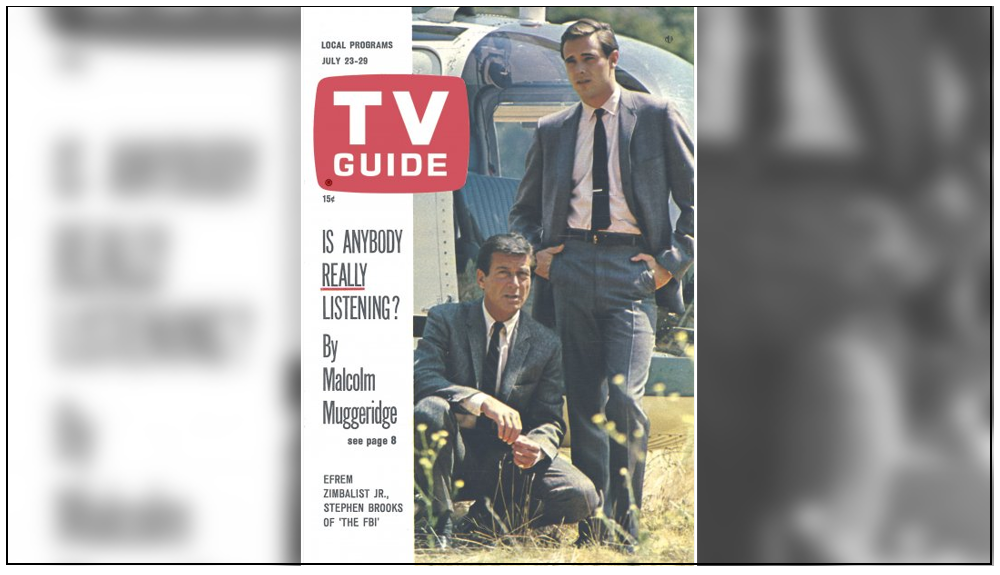
This week’s lead story is written by British humorist and critic Malcolm Muggeridge, the sixth in a series of articles "assessing television's effect on our society." Muggeridge wrote for TV Guide several times over the years (I think this was my favorite); he was one of many distinguished writers appearing in TV Guide through the ‘60s and ‘70s, a period when the magazine was capable of a particularly high intellectual content. (Unlike today.) As interesting a writer as Muggeridge was, he was an even more interesting individual: a leading journalist, social critic and television personality in Britain, a soldier and spy during World War II, a left-winger who eventually because staunchly anti-Communist, an editor with Punch magazine, an interviewer with the BBC, a stinging satirist who became a harsh critic of ’60s permissiveness, eventually converted to Christianity, and was widely credited with bringing Mother Teresa to popular consciousness in the West. Incredible.

In this issue, many of his talents are on display. He freely acknowledges the influence of television— "what [children] see on it more than anything else, governs their present hopes and future aspirations"—and that the medium has become a major shaper of opinion: "If Nixon had been better made up, without that devastating afternoon-shadow, for his encounters with the late President Kennedy, it is perhaps he who would have gone to the White House."

He acknowledges that television is often of dubious artistic merit ("The old music hall, as I remember it in my childhood, was, by comparison, a feast of reason and a flow of wit."), and that the quality "declines visibly year by year."  However, he also cautions against throwing the baby out with the bath water, as it were:

Let it be remembered, however, that, on the same line of reasoning, the invention of printing might be as summarily dismissed. After all, far more type is dedicated to Peyton Place and Playboy magazine than to “Paradise Lost” or “La Recherche du Temps Perdu.” . . . How tragic if, because men could be debauched by “Fanny Hill” and the works of the Marquis de Sade, they had been deprived of the solace of the New Testament and Shakespeare’s plays, which also come to them largely through the printed word!

To critics who charge that television numbs the mind and turns people into what we today would call "couch potatoes," Muggeridge replies, "Nor is it true that, before television, those who now spend their evenings viewing sat at home doing embroidery or listening to 'The Mill on the Floss' read aloud. They were much more likely to be out at the pub studying tomorrow’s racing lineup or swapping dirty stories." He adds that television may indeed be "a cultural wasteland, but what about what they replaced? Was that a well-tended garden?"

The fact is, according to Muggeridge, there has been little serious art produced in any media—there has been far more "wealth, talent, skills and endeavor" spent in the last half-century of cinema than produced the Italian Renaissance, but the yield in terms of "enduring worth and interest" is "virtually nil."  Garbo, the Marx Brothers, Chaplin: "these are not the equivalent of even a minor work or art." A bit harsh perhaps, but not without merit. Rather than being constantly disappointed by television’s output, he suggests lowering expectations—"We do not expect tabloid newspapers to serialize Kierkegaard, or women’s magazines to run extracts from Thomas a Kempis. . . Why, then, should television be expected to manifest its seriousness and concern for culture by every now and again putting on a half-fisted production of 'King Lear' or mounting a boring lecture on the French Impressionists?" Far better that TV concentrate on what it does best: news, sports, comedy, soap operas.*

*He had some definite thoughts on those who appeared on television as well, as was shown in a memorable confrontation with Monty Python's John Cleese and Michael Palin on a BBC show in 1979. Maybe we'll talk about that someday.

This is Muggeridge as he came to be known in the late ’60s and ‘70s: an acerbic wit who nonetheless could not disguise an increasing seriousness creeping into his works. And it’s in that spirit that he leaves us with this optimistic note: for as many times that people have stopped him and mentioned how they’ve seen him on television, "not one has ever so much as mentioned, let alone quoted, anything I have said."  If that same "blissful ignorance" applies to all who air their views on the tube, "how splendid!"

l  l  l
During the 60s, the Ed Sullivan Show and The Hollywood Palace were the premiere variety shows on television. Whenever they appear in TV Guide together, we'll match them up and see who has the best lineup.

Sullivan:  Satirist Allan Sherman; the Supremes and the Dave Clark Five, rock ‘n’ roll groups; Richard Kiley and Joan Diener, appearing in a scene from “Man of La Mancha”; actor Menasha Skulnik; golf champion Ken Venturi; comics Stiller and Meara; and juggler Ugo Garrido.

Palace: Host Bing Crosby and son Gary, comedian Henny Youngman; singer Rosemary Clooney; Edgar Bergen and Charlie McCarthy, dancer-choreographer Hugh Lambert, comedy xylophonist Roger Ray, and the Band of the Fiji Military Forces.

"Those are both pretty good," my wife said when I read this week’s lineups to her. "I think you have to give a very slight edge to the Palace. They’ve got Bing Crosby, even with that talentless Gary, and besides, it seems like the Supremes were on with Sullivan every other week." Hard to argue with that, not if you want to have a successful marriage. Besides, with Bing and Rosie you’ve got a White Christmas reunion, and Bergen and Charlie are always funny. Maybe if it had been the Stones instead of the Supremes—but, alas, we’ll never know. The winner: Palace, by the slimmest of bouffant hairdos.

l  l  l

With Cleveland Amory taking the summer off, we're fortunate to have TV Guide's movie critic, Judith Crist, filling in. And we're particularly fortunate that this week, the subject of Crist's review is none other than ABC's blockbuster prime time soap, Peyton Place.

Back in the olden days of radio, Crist says, things were simpler, and soaps often focused on a main character. But now, "the affluent society won't settle for simplicities," she writes. "We'll take our emotional calories in assorted nuts, by the handful." And as Peyton Place "snail-paces along toward its third season," the storylines seem, if anything, to be getting more complicated: "It was possible to keep track of things in the early days but more and more outlanders are drifting into the precinct. Blink an eye and there are three more mysteries on hand, with half-forgotten characters to go with them." Crist admits to harboring a secret desire that Martin Peyton will turn out to be his own grandfather. 

Indeed, Peyton Place seems to be a miserable place to live, a place where "people face life, hunching over the ghastly sins and secrets that have taken place off-screen and long ago, and reveling in all the sorrows and suspicions and soul searching they produce on screen and in perpetuity." And the show always seems to be on the verge of some monumental reveal, some dark secret that threatens to boil over; Crist thinks it will be that "somewhere in Peyton Place there's somebody whose parents were a properly married unadulterous pair, whose birth was therefore legitimate and who has reached his 20th year without having had a nervous breakdown, committed mayhem or even murder or, hope among hopes, stumbled upon the secret of his neighbor's sins!" Well, one can always hope.

Not that there aren't some positives connected to PP: the show has shifted to color, the production values are first-class, and some of the cast members provide a dignity that can produce the illusion that this show, compared to the daytime soaps, is of a "higher class"; and Mia Farrow, caricatured above, has "eternity in [her] wide, wide eyes." But then there's the "near-camp dreariness" of the dialog, the pace that makes it clear the program was "designed for sporadic viewing," and those complicated plots. Watching Peyton Place, Crist concludes, "is getting a big much—and lower-calorie diets are healthier in the long, long run."

l  l  l

Since the death of Dorothy Kilgallen the previous November, the What’s My Line? crew from Goodson-Todman has been engaged in "The Great Woman Hunt," a furious search for a permanent replacement for Kilgallen, who had been with the show since its inception in 1950. So far, the seat has remained in the possession of a rotating cast of guest stars—everyone from Kitty Carlisle (a stalwart of Goodson-Todman’s To Tell the Truth) to Dr. Joyce Brothers, with magazine publisher Helen Gurley Brown, TV Guide critic Judith Crist, columnist Sheilah Graham, and actresses Joanna Barnes, Joan Fontaine and Dina Merrill thrown in. Even Muriel Davidson, the author of this article, has been considered for the list. It’s a tough gig, though, coming into a long-running show with a veteran cast; as host John Daly puts it, "If she doesn’t fit into our family, we’ll just freeze her out."

At press time there are three clear contenders for the seat. There’s Phyllis Newman, another veteran of To Tell the Truth, married to legendary Broadway composer Adolph Green; charming, bubbly and very girlish (and I mean that as a compliment), always having to tilt her head upward slightly during the Mystery Guest segment so her mask wouldn’t fall off. Sue Oakland is a surprise finalist; married to TV producer Ted Cott (David Susskind’s cousin), she’s got both beauty and brains: "Besides being breath-takingly beautiful and gowned, she is a near-genius, with a Master's degree in political science from Columbia University and with one lovely leg up on a Ph.D.*

*Her Master’s was in the inside workings of the United Nations; her Doctoral dissertation was "The Function of Television on the Presidential Election Campaign of 1968."

And then there’s society columnist Suzy Knickerbocker, whose nameplate will eventually simply read "Suzy" rather than the letter-crunching "Miss Knickerbocker."  Her real name is Aileen Mehle and passing mention in the article is made of her having a 22-year-old son. (That son, Roger, is an Annapolis graduate and naval officer, and on the Christmas episode of WML, on which his mother is a panelist, he appears as the Mystery Guest.)

The tongue-in-cheek question remains: "Can a girl be found who can win the hearts of a great, established family, still grieving the loss of one of its most beloved members? . . . Or will her struggle for acceptance bring about the destruction of the entire, proud, 16-year dynasty?" In the end, despite the producers’ vows, none of the ladies above, or anyone else, for that matter, wind up filling Dorothy’s seat. WML is starting to show its age, "developing creaks of the Nielsen in its venerable beams," and it will leave the air in September 1967, with a run of 17½ seasons—at the time the fourth-longest-running non-news series of all time, trailing only The Ed Sullivan Show, The Original Amateur Hour and Lamp Unto My Feet. Whether the right fit was never found, or time just wound up running out, that fourth seat on the panel will continue to be filled with rotating female guests until the very end.*

*Or almost the very end; the final show features a panel of Arlene Francis, long-time guest Martin Gabel (Arlene’s husband), former regular Steve Allen, and Bennett Cerf.  Host John Daly himself plays the final Mystery Guest.

l  l  l

I've mentioned before that it can be a challenge finding noteworthy shows during the summer, but I think we've done quite well for ourselves this week. As always, though, you can be the judge.

NBC’s Saturday Night at the Movies has the Kirk Douglas classic Ace in the Hole, which is airing under its alternate title, The Big Carnival. (8:00 p.m. CT) It's a cynical, cynical story of a newspaperman trying for a comeback with the story of a man trapped in a cave. But it's only a story if he stays trapped long enough for a dramatic rescue. Not to disparage any of my friends in the media, and I do have them, but this kind of news manipulation could never happen today, right? Right?

Sunday, the sports world focuses on the final round of the PGA Championship, from the famed Firestone Country Club in Akron, Ohio. (3:00 p.m., ABC) It’s an early appearance for golf’s final major championship of the year, which is usually played in August. It’s also an unplanned location for the tourney; originally it was supposed to take place at Columbine Country Club in Columbine, Colorado, but severe storms in 1965 had damaged the course, forcing the PGA to swap sites—Firestone had been scheduled to host in 1967, but traded with Columbine. After 54-year-old Sam Snead turns back the clock by leading the first two rounds, the young Al Geiberger comes on during the weekend to finish at even par, good enough for a four-shot win over Dudley Wysong.

*A footnote: that night, a few hours after the tournament, 1964 British Open champion Tony Lema and his wife are among those killed in the crash of a small plane flying Lema to Illinois to compete in a Monday event. The 32-year-old “Champagne Tony,” one of the best and most charismatic players on tour, had finished 34th in what turned out to be his last tournament. Had he not died, I think a lot more people would know who he is today.

Burgess Meredith is on prime-time three out of five nights this week, all on ABC, which is pretty good for both him and the network and a treat for us viewers. His first appearance is Monday night on 12 O'clock High (6:30 p.m.), where he plays a scientist who's developed an airborne radar that allows bombers to zero in on targets even when they're obscured by clouds. Trouble comes when the Germans figure out how to zero in on the radar. According to the Close-Up describing the episode, during one scene, "Meredith received a rare accolade: spontaneous applause from the other actors on the set." Also appearing in a semi-regular role is Robert Dornan, before he gives up acting and runs for Congress; MST3K fans will remember him from The Starfighters.

Jack Hawkins, who was so good as Quintus Arrius in Ben-Hur, is also on multiple nights; later in the week, he appears as a prim and insensitive Englishman on Bob Hope's Chrysler Theatre (in a story for which Shelley Winters would be nominated for an Emmy), but on Tuesday night he's on Dr. Kildare (7:30 p.m., NBC), as an atheist whose heart attack may have been Divine Punishment. Or not.

Burgess Meredith is back Wednesday in the first of two consecutive nights on Batman (6:30 p.m. tonight and tomorrow, ABC); this week, Alfred, the butler of millionaire Bruce Wayne, is kidnapped by "that piscatorial pirate of plunder." No window cameo, alas; although Jerry Lewis had appeared in the first one earlier in the season, it didn't become a semi-regular feature until the second season.

Thursday night Eve Arden stars on an episode of Bewitched (8:00 p.m., ABC) in which Endora shows Darren what Samantha's baby will look like in 25 years. Arden plays a nurse at the hospital, while the episode also marks the first appearance of Elizabeth Montgomery in her dual role as Samantha and her Cousin Serena. Meanwhile, Rowan and Martin continue in their summer replacement series that eventually leads to Laugh-In; this week, their guests are singer Barbara McNair and comedian Jackie Vernon. (9:00 p.m., NBC)

On Friday, a delightful rerun of Sing Along with Mitch (7:30 p.m., NBC) features Shirley Temple as the special guest, performing the songs she made famous as such an adorable child star. And at 9:00 p.m. on CBS, the Canadian comedians Wayne and Shuster conclude their documentary series Wayne and Shuster Take an Affectionate Look at... with a review of the career of W.C. Fields. Unless you're in Minneapolis, that is, where WCCO pre-empts the show for a double-feature of Marshal Dillon.

l  l  l

Ah, this is the kind of thing I always appreciate finding: a 1966 CBC documentary hosted by—Alex Trebek! Yes, the same Alex Trebek who hosted Jeopardy since who-knows-when and became a beloved American icon! And what makes this even better is that the original Jeopardy, with host Art Fleming, is still on NBC’s daytime schedule! Who could possibly have looked at this issue and thought to themselves that nearly 60 years later Jeopardy would still be on, and it would have been hosted for 37 by this obscure Canadian appearing on a CBC documentary being broadcast by NET?

The show itself is, I think, striking: a look at "The Cultural Explosion" of the 1960s. "More people go to concerts, museums and theaters than ever before—but are we on the threshold of a new Renaissance?" What, exactly, does this tell us about today?  It’s very intriguing; after all, we hear constantly about how the arts must appeal to young people, who are increasingly turned off by the arts, and yet when it comes to the ‘60s, we tend to assume that the young dominated the tenor of the decade.

So: were older people driving this cultural boom? If so, why? Was it merely a measure of the post-war disposable income that drove the growth of the consumer society of the ‘50s? Or did they have more influence over popular culture than we might think?

Their offspring, who today represent the demographic most interested in culture (i.e. grey-haired) must have had some of that rub off on them. If so, why haven’t they been able to do the same thing with their descendants? We know that schools played a greater role in art and music back then than they do now – is that the difference? Were they already interested in culture in the ‘60s as well, or did that interest come to them later in life?

If the latter is the case, does it suggest that today’s youth, for whom culture is dead, might yet come around when they get older?  Or is it that things have changed so dramatically over the last 60 years that they must be reached earlier, or be lost forever?

Obviously you could write a whole book about this. And yet, when those of us with an interest in the arts read daily about the difficulties faced by classical music organizations, theaters, museums, and more, there’s something depressing about this program, so full of optimism for the future, talking about a culture "explosion" and the possibility of a new age. Who would have imagined that the arts would survive the tumultuous ‘60s, only to run aground on the shoals of the new millennium? TV