Some quick hits on the best from the week in classic TV:
I love this post from Captain Video - Burke's Law in comic book form!
Halloween doesn't mean as much when you live in a complex without trick-or-treaters, but Comfort TV has a list of five horror-themed episodes "more frightening than a Miley Cyrus video."
Classic Sports TV and Media previews the latest ESPN documentary on one of the most colorful teams in pro sports history - the ABA's Spirits of St. Louis.
And how great is this - Vincent Price on F Troop! Thanks, How Sweet It Was.
TV Gems lists TV Guide's "60 Greatest Animated Shows of All Time." Tom's got some doubts - and I have to ask: where's Alvin?
If you've commented lately and I haven't responded, don't take it personally - I'm scrambling on a few projects right now, which means I don't spend nearly as much time here as I'd like. But don't let that stop you from coming back on Saturday for another great look at another great TV Guide! TV
October 10, 2013
October 8, 2013
Mitchell's Top Ten, #4: Doctor Who (Classic)
It's just possible I may have told this story before, so if I have bear with me.
It was many years ago now, over 25 at least, and I was spending a Friday night at a friend’s house. Around about 10pm or so, he flipped on the TV to the PBS channel, to a show he wanted me to watch with him. “I think you’ll like it,” he said, or words to that effect. The show was a British import, as so many of the local presentations were (and are), a science fiction series called Doctor Who. I’d seen the show listed in the TV Guide before, but hadn’t paid any attention to it. As the episode unfolded ("The Face of Evil," my episode guide informs me), my friend briefed me on the basics: the show’s hero was an alien with the ability to travel in both time and space. His space ship was a blue box, normally used by British police to phone the station, which was bigger on the inside than it was on the outside. His personality was outsized, a man who met challenges with an impervious humor, and something of an Enlightenment attitude toward religion. He often traveled with attractive women, but there was no hanky-panky involved. And there was one other thing, though it wasn’t germane to this particular episode, but he thought I should know about it because Doctor Who was on twice a week—Friday and Saturday—and a different actor was playing the role on each night. That was because whenever the hero was seriously injured, on the point of death, he had the ability to regenerate into a new person, or rather the same person, but with a new body, appearance, and personality. Right.
Watching Doctor Who was an agreeable-enough experience, although I’ve always struggled when it came to watching programs that weren’t my idea to watch, especially when I’ve been assured that it was a show I would like, so I tolerated the show for the 90 minutes that it ran, assured my friend that I’d have to keep an eye on it, and then promptly forgot about it.
Fast-forward a few weeks, to another Friday night. In these pre-cable days (for us, at least), there weren’t many viewing choices, perhaps six or seven channels in all, so when all three versions of the 10pm news led with the same story (the Jordan child-abuse scandal, which was a staggeringly big deal in the Twin Cities), a story I was sick to death of, I stretched out my arm, desperately flipping the dial in search of the first channel to have something on besides the news, at least until they were done with the Jordan story. I landed on Channel 2, which was airing Doctor Who.
It stayed there, every Friday (and Saturday) night, for the next five years.
At first I watched it because it was fresh and new. Later, after I’d fully enveloped myself in the Doctor Who universe, I watched it because I couldn’t not watch it. It was maybe the second show that had ever had that effect on me, where I became so fully a part of the world of the show and its inhabitants. I even became a member of the local PBS station, since they were offering a Doctor Who picture-disc as the pledge-break premium. I don’t mean to say that I ventured into the territory of the Trekkers and role players, although Doctor Who has its fair share of those.
No, it was the desire to learn as much about the program as I could, its history and continuing storyline, the actors who’d played The Doctor, the rules governing Time Lords and time travel, the whole thing. As the BBC released more episodes from the early days of Doctor Who, dating back to the first episode in 1963, I was enthralled. To find that there were others aware of this TV show with the cult following, not typical sci-fi nerds but people such as the man who maintained the plants in the office in which I worked, was thrilling. I attended the conventions at which actors who'd played The Doctor appeared (Peter Davison, Patrick Troughton and Colin Baker, to be precise; but not, alas, my favorite, Tom Baker). I celebrated the show's twenty-fifth anniversary in 1988. I even took up eating jelly babies. And when the newest episodes came over, with only a few months’ delay, my dedication to the show was complete.
*Don't pay any attention to the 12-foot scarf I have hanging in the library at home.
I came to know and appreciate each Doctor for his own personality quirks: William Hartnell's overarching imperiousness, Patrick Troughton's innocent playfulness, Jon Pertwee's suave swashbuckling, Tom Baker's bohemian unpredictability, Peter Davison's reluctant heroism, Colin Baker's anti-hero rudeness, and Sylvester McCoy's mysterious omniscience. And for the cheesiness of of some of the monsters and special effects, there were stories with a remarkably deep insight into the human condition; in "Planet of the Spiders," the Third Doctor risks his life against overpowering odds because it was more important to him to confront his fears than to simply "go on living"; in "The Sunmakers," the Fourth Doctor reminds a group of slaves that "you're human beings, and humans always have to fight for their freedom," and in "Genesis of the Daleks," he asks if he has the right to destroy another life form—even if it happens to be the most evil of adversaries, the Daleks. For what was putatively a children's show, it dealt with some heavy ideas.
Then the BBC, after twenty-seven seasons, pulled the plug. It wasn’t cancelled, they insisted —only on hiatus—but as the years went on, the show became less and less of a presence, both on television and in my life. I still had the books and that scarf, and as the show began to come out on video I enjoyed the episodes, but somehow it wasn’t the same, knowing that what we had was all we had and that there wouldn’t be anything more.
Until there was. Doctor Who reappeared, first in a Fox movie that briefly rekindled the hope of a regular series; and then, following years of rumors and false starts, in a revival that picked up where the old series had left off, one that, for the first few years at least, did a remarkably good job of integrating itself with the original, so that was easy to believe that each of the actors who'd played The Doctor had all inhabited the same universe, even though the special effects were fancier and the monsters weren't as cheesy and the show itself is less campy and more dramatic.
And then the show went off the rails, getting too much into gender identity and woke politics, and it forced me to reassess my thoughts abou the new version. One could make the case that there was still a line of continuity, at least up through Peter Capaldi, the Twelfth Doctor, but there the show ended for me. And when it came to my love for the series, I was forced to concede that there were, after all, two versions of Doctor Who: the original, and the new. Which meant that, for me, the last Doctor was really the Eighth, Paul McGann, who had played the Doctor in the TV movie. But since he'd only played the role once (not including the many audio adventures he'd done since), the last "classic" Doctor was Sylvester McCoy, who'd also appeared in the movie, and who, during his time on the show, had really grown on me.
*Don't pay any attention to the 12-foot scarf I have hanging in the library at home.
![]() |
| Sylvester McCoy: the last real Doctor? |
Then the BBC, after twenty-seven seasons, pulled the plug. It wasn’t cancelled, they insisted —only on hiatus—but as the years went on, the show became less and less of a presence, both on television and in my life. I still had the books and that scarf, and as the show began to come out on video I enjoyed the episodes, but somehow it wasn’t the same, knowing that what we had was all we had and that there wouldn’t be anything more.
Until there was. Doctor Who reappeared, first in a Fox movie that briefly rekindled the hope of a regular series; and then, following years of rumors and false starts, in a revival that picked up where the old series had left off, one that, for the first few years at least, did a remarkably good job of integrating itself with the original, so that was easy to believe that each of the actors who'd played The Doctor had all inhabited the same universe, even though the special effects were fancier and the monsters weren't as cheesy and the show itself is less campy and more dramatic.
And then the show went off the rails, getting too much into gender identity and woke politics, and it forced me to reassess my thoughts abou the new version. One could make the case that there was still a line of continuity, at least up through Peter Capaldi, the Twelfth Doctor, but there the show ended for me. And when it came to my love for the series, I was forced to concede that there were, after all, two versions of Doctor Who: the original, and the new. Which meant that, for me, the last Doctor was really the Eighth, Paul McGann, who had played the Doctor in the TV movie. But since he'd only played the role once (not including the many audio adventures he'd done since), the last "classic" Doctor was Sylvester McCoy, who'd also appeared in the movie, and who, during his time on the show, had really grown on me.
So when it comes to considering the Top Ten, I have to make a distinction: Doctor Who 1.0 belongs, Doctor Who 2.0 does not. It isn't, when all is said and done, much of a concession to make. Those initial 27 seasons provided more than enough pleasure to guarantee a place on the list. Perhaps I don’t have the same passion for Doctor Who that I once did; after all, the blaze from the spark that ignites any love affair eventually lessens, and the thrill of discovery can’t last once everything’s discovered. But, in rewatching the series from the start, from that very first presentation of William Hartnell's the crotchety old man living in a battered police box sitting in a junkyard, I find that my enjoyment of the series continues—not as something new and different, but something familiar and comfortable.
It’s a show that I can look back on with a deep and abiding affection, and I'm not embarrassed to display my fandom. No list of my favorite television shows can exist without it. TV
October 5, 2013
This week in TV Guide: October 1, 1966
For the first time, the stain of the 1960s - Vietnam - graces the cover of this week's TV Guide.Neil Hickey, TV Guide's New York Bureau Chief and author of some of the best news features published by the magazine, presents the first of a four-part series on how - and how well - television is covering its first war. It is a war "exorbitantly more demanding, both mentally and physically, than anything those earlier newsmen faced in Europe or the Pacific." It's a guerrilla war, replete with everything from jungle disease to ambush land mines and booby traps, field telephones that barely work, and as one correspondent puts it, "pushing the cause of journalistic profanity to new horizons." As NBC's David Burrington puts it, "There are so many imponderables and ironies here that it's sometimes difficult, if not downright impossible, to explain what's happening in terms that an American audience will understand."
Cameramen lug their equipment around in temperatures approaching 130, walking over 17 km only to find that an outpost had already been wiped out or a Vietcong squad disappeared, and wind up with less than a hundred feet of footage. Newsmen tell the story of a press conference called by Buddhist leaders in Danang, in a room with 35 dead bodies piled up in the corner. Soon, it became apparent that there would be no press conference, that the newsmen themselves were being held as hostages. They were able to escape in the ensuing firefight between government and rebel forces. Other times journalists aren't so lucky, and though none have been killed yet, several have suffered serious wounds. ABC's Lou Cioffi speaks for many when he says, "You begin wondering when the law of averages will catch up with you. I'm scared all the time, but I'm more scared now than when I first came out here. TV has nothing in its history to prepare it for this kind of story."
So why does the network correspondent put himself through such hell? After all, they've all volunteered; no newsman is ever assigned to Vietnam. "Let's be truthful," a young journalist says. "We're all war profiteers. We know that if we prove ourselves here we can short-cut our careers by five to 10 years. Here in Vietnam you can get your face on the network news three or four times a week. That's more than you can do in the United States. It's risky, but it's money in the bank." CBS' John Flynn adds, "This is where it's happening, and I see no reason to be anywhere else." And soldiers like having the newsmen around, at least at this point; "To them," an ABC newsman says, "it means somebody really cares about what they're doing. They'll share their last C-ration with you, and tie down your poncho tent properly so it doesn't blow away. I have never felt more appreciated, nor more humble." That comment about "somebody really caring" - for some reason, that makes me tremendously sad. Is that Vietnam in a nutshell, or what?
As I mentioned, this is part one of a four-part series; next week's will deal with the battle between the networks for ratings and exclusives. Looking at the glorified fan-mag that TV Guide has become today, it is difficult to imagine the magazine could come up with anything this serious, this newsworthy, nor would they want to. But to the TV Guide of this era, television was a serious business, covering serious news, and deserved to be written about and covered in a serious manner. For that matter, it's hard to imagine any of today's celebrity-driven newsmagazines (or is that "news" magazines?) producing a story as substantial as this. My, times have changed, haven't they?
***
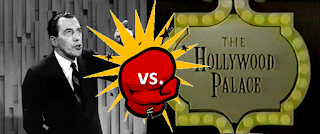
During the 60s, the Ed Sullivan Show and The Hollywood Palace were the premiere variety shows on television. Whenever they appear in TV Guide together, we'll match them up and see who has the best lineup..Hollywood Palace: Elizabeth Montgomery of "Bewitched" makes her debut as a Palace hostess and her first network appearance as a song-and-dance gal. Guests: singer Vic Damone; comics Paul Lynde and Jackie Mason; the Baja Marimba Band; Pat Anthony's tigers; and two acrobatic acts, Sensational Parker and the Three Robertes.
Sullivan: Ed's scheduled guests are Jimmy Durante; Dame Margot Fonteyn and Rudolf Nureyev, who appear in segments from the filmed version of Prokofiev's ballet "Romeo and Juliet"; comic Alan King; singer Connie Francis; Gwen Verdon and cast members from "Sweet Charity," who perform "The Big Brass Band"; ventriloquist Arthur Worsley; and the winners of the New York Harvest Moon Ball dance contest.
This is actually a pretty strong week for both shows, but Ed has, I think, just a little more class. Nureyev and Dame Margo were two of the most famous ballet dancers of the time, and their appearance - even on film - would have been a highlight for many people who wouldn't get to see them otherwise. Durante and King are always funny, and Gwen Verdon likely danced up a storm. No backing into it this week, but Sullivan's the clear winner.
You'll remember how last week I said that TV Guides of this era covered live events with a combination of up-to-the-minute and to-be-announced? Well, this week's edition demonstrates that in spades. The World Series begins Wednesday, with the runaway American League champion Baltimore Orioles taking on - who? At this point, your guess is as good as anyone's, with the Dodgers, Pirates and Giants locked in a three-way battle for the flag. The weak-hitting Dodgers, defending Series champions, are led by Sandy Koufax (in his last season) and Don Drysdale; the slugging Pirates feature future Hall of Famers Willie Stargell and Roberto Clemente; and the Giants counter with some stars of their own, namely Willie Mays, Willie McCovey and Juan Marichal. Awaiting them, the Orioles have Triple Crown-winner Frank Robinson, slugger Boog Powell, and a pitching staff featuring Dave McNally, Jim Palmer, and Stu Miller.
Because of the uncertainty surrounding the National League winner, who will also host the first two games of the Series, we don't even know what time the games start: noon CT if it's the Pirates, 2pm if the Giants win, and 3pm if the Dodgers come out on top. And it is the Dodgers, ultimately, who emerge from the logjam, besting the Giants by a game and a half and the Pirates by three. Little good it does, though: after Baltimore's Moe Drabowsky stops the Dodgers with 6.2 innings of one-hit, 11-strikeout relief, Orioles hurlers go on to record three straight shutouts (the final two by scores of 1-0), winning the Series in a four-game sweep. I remember this Series with great satisfaction; the Dodgers had beaten the Minnesota Twins the year before, and being a good Minnesotan who also hadn't learned how to be a discerning fan, I thirsted for revenge. The Orioles gave it to me with one of the most powerful pitching performances in Series history: two runs given up in the four games.
Once again, the Series tops all other sporting events for the week, such as Saturday afternoon's college football match between Missouri and UCLA. UCLA Quarterback Gary Beban, who will win the Heisman Trophy the next season, leads the Bruins to a 9-1 season, losing only to Washington (but staying home for the bowl holidays, thanks to the conference's Rose Bowl-only rule), and they take the Tigers handily, 24-15.
Sunday's NFL games are all over the map, with the Minnesota Vikings playing at home, and thus blacked out within a 75-mile radius. Channel 4, the CBS Minneapolis affiliate, offers an Eastern Division matchup between the Cleveland Browns and New York Giants; Channels 8 and 12, located in LaCrosse, Wisconsin and Mankato, Minnesota respectively, carry the Detroit Lions and the Green Bay Packers; and the two stations unaffected by the blackout, in Duluth, Minnesota and Mason City, Iowa (both Channel 3) carry the Vikings game against the Chicago Bears. It's much easier keeping track of the AFL game - the Buffalo Bills and the Kansas City Chiefs, a preview of the 1966 AFL Championship Game.
In this era before Sunday football doubleheaders, there's actually some time for other sporting events, such as the Canadian Open golf championship. This tournament used to be much bigger than it is today, and the 1966 field included the sport's best: Gene Littler, Jack Nicklaus and Billy Casper. To reinforce the event's stature, a footnote in Sunday's listing mentions that in case of a tie, CBS will provide coverage of the 18-hole playoff on Monday afternoon - a playoff format once seen in all the majors, but now only the U.S. Open.
Not exactly sports-related, but then you can't exactly leave off something on Tuesday called "The National Sports & Physical Fitness Test." It's the latest in CBS' popular series of interactive viewer tests, which have included "The National Driver's Test" and "The National Citizenship Test." I don't have a list of the questions in front of me, only the "official score card" included in the TV Guide; however, the Close-Up promises location shoots from the Air Force Academy, "where cadets eat heartily without gaining an ounce," a New York dance studio, and a California high school with an acclaimed fitness program. Also, for no apparent reason, the program includes clips of Bobby Thomson's famous 1951 home run, and Joe Louis' first-round knockout of Max Schmeling in 1938. Harry Reasoner hosts; I wonder if this had any of the success that the other tests did?
So if you don't have wall-to-wall sports on television Sunday afternoon, what the heck is on? Well, between the NFL football and Canadian Open, CBS has To Tell The Truth and Ted Mack's Original Amateur Hour; in later years the lineup would include Mister Ed. NBC featured G-E College Bowl (North Dakota State versus the winner of last week's contest between Oklahoma and the University of Scranton; the Minnesota statewide edition of TV Guide might have had an earlier go-to-print time that didn't allow them to wait until Monday), and a religion special. ABC's coverage leans more toward the affiliates; Minneapolis' Channel 9 has reruns of The Untouchables, Naked City, Thriller, Surfside 6 and The Greatest Show on Earth.
Sundays were also known as the "graveyard" for public affairs and educational programming, and that's well in evidence this week. There are the venerable Sunday morning news chat shows; ABC's Issues and Answers has a debate between the candidates for governor of California, Democratic incumbent Pat Brown* and his Republican opponent, Ronald Reagan. Brown, who'd defeated Richard Nixon in 1962, had said that he looked forward to sending Reagan back to Death Valley Days, a show he'd once hosted. Presumably this was before Reagan managed to eek out a one-million vote win, garnering a mere 58% of the vote. ABC also had an interview show called Elections 66, with Vice President Hubert Humphrey and former Republican presidential candidate Barry Goldwater as the guests, and ABC Scope, their weekly Vietnam report. Face the Nation on CBS had Senate Minority Leader Everett Dirksen; the venerable Republican senator from Illinois is quizzed on the coming midterm elections. Dirksen's Democratic counterpart from Illinois, Paul Douglass, is the guest on NBC's Meet the Press (he's not listed in the TV Guide, but a quick Google search gives us the answer).
There's a heavy concentration of news this particular Sunday, and per the cover story, much of it has to do with Vietnam. In addition to ABC's weekly Scope, NBC has Vietnam Weekly Review, and later that afternoon The Frank McGee Report, which often presented breaking Vietnam news. NBC also has a special report late Sunday afternoon, "The Agony of Two Cities," looking at racial conflict in Chicago and Cleveland.
*Father of the past and current governor, Jerry.
Channel 11, the Twin Cities' independent station, presents the long-lost standby of the local channel, matinee movies, which in this case is a prime choice indeed: the Academy Award-winning Casablanca, followed by Basil Rathbone's Sherlock Holmes in The Voice of Terror. Reruns of Laramie and Sea Hunt and a religion show round out the afternoon.
I talked a little a couple of weeks ago about the frustrations that writers had working with the Production Code, that arbiter of content that governed how certain moral issues should be presented. Well, that was in 1965, and now one year later TV Guide takes on the question of what should be done to produce a movie code that "makes sense in view of contemporary standards." The Editors' conclusion: "It isn't easy."
For starters, it's becoming increasingly clear that movies and television present separate challenges. As the editorial puts it, "while you can forbid youngsters to enter a theater, you can't keep all of them from seeing an 'adult' movie on TV." And yet you can't allow the needs of television to control what paying customers in movie theaters can see. And speaking of that audience, while there's been a relaxation of moral restrictions lately, "puritan standards still control the thinking, if not the actions, of most Americans."*
*A fact that must drive Gene Roddenberry and Sterling Silliphant to drink.
And then there's the foreign audience to think about. Nudity and bedroom scenes are as commonplace in European movies as violence is in American ones, and "Europeans aren't exactly titillated by a sheepish Rock Hudson trying, unsuccessfully, to hold hands in a crowded restaurant with a well-corseted Doris Day."*
*From what we know now, neither, apparently, was Rock.
The answer, according to the Editors, is that the movie code shouldn't worry about television and concentrate on theaters only. Most movies, they point out, can be adapted to run on television*, and the ones that can't will probably recoup any advertising losses through European distribution. "The important thing is that such a code, run by administrators empowered to interpret its provisions, will make it possible for creative men to treat any subject tastefully."
*Which in itself was the source of no little controversy.
Is that what we wound up with? My suspicion is that the code Hollywood wound up with included the Ratings System that, with subsequent changes, we've come to know and love (or hate). Television, itself under increasing pressure from the government, came up with its own ratings system, not to mention the V-Chip. But whether it be movies or television, I'm not sure that the word "tasteful" is the first that would come to mind... TV
October 3, 2013
Around the dial
We're running a little behind this week, but I did want to take time to highlight a couple of interesting pieces from the week.
At the Onion A/V Club, Dennis Perkins asks whether specialty networks are beyond redemption. I can remember when channels such as History, HGTV, A&E and other "niche" networks started up. There was something dependable about them - the idea that you could turn to them at any time and not only know what you were getting, but have a pretty good chance of really liking what you were seeing. (I never minded the Hitler documentaries that The History Channel had., but their series of "As It Happened" replays of original television news coverage was outstanding.) I suppose it was inevitable that they'd run out of material (after all, how many biographies are there really worth watching?), but to look at what's happened to Bravo, Sci-Fi (or Syfy, for the stupid out there), and MTV, or to see how general cable networks like TBS and USA have turned into clearinghouses for binge police procedural watching - well, they're living and breathing advertisements for cutting the cord, aren't they?
Comfort TV takes a look at how TV shows of the past portrayed the future. I think this is always entertaining, as these old shows never seem to get it quite right - they either dramatically overestimate or grossly underestimate the leaps and bounds that technology makes, often within the same series. Take Star Trek for example - cheesy digital control board combined with warp speed and transporters. It's probably a testament to the greatness of human creativity that technological advances multiply and morph exponentially, at a far greater clip than the mind can even comprehend.
Sorry for the brevity this week - sometimes it happens! I'll make up for it on Saturday with a brand new TV Guide! TV
At the Onion A/V Club, Dennis Perkins asks whether specialty networks are beyond redemption. I can remember when channels such as History, HGTV, A&E and other "niche" networks started up. There was something dependable about them - the idea that you could turn to them at any time and not only know what you were getting, but have a pretty good chance of really liking what you were seeing. (I never minded the Hitler documentaries that The History Channel had., but their series of "As It Happened" replays of original television news coverage was outstanding.) I suppose it was inevitable that they'd run out of material (after all, how many biographies are there really worth watching?), but to look at what's happened to Bravo, Sci-Fi (or Syfy, for the stupid out there), and MTV, or to see how general cable networks like TBS and USA have turned into clearinghouses for binge police procedural watching - well, they're living and breathing advertisements for cutting the cord, aren't they?
Comfort TV takes a look at how TV shows of the past portrayed the future. I think this is always entertaining, as these old shows never seem to get it quite right - they either dramatically overestimate or grossly underestimate the leaps and bounds that technology makes, often within the same series. Take Star Trek for example - cheesy digital control board combined with warp speed and transporters. It's probably a testament to the greatness of human creativity that technological advances multiply and morph exponentially, at a far greater clip than the mind can even comprehend.
Sorry for the brevity this week - sometimes it happens! I'll make up for it on Saturday with a brand new TV Guide! TV
October 1, 2013
Mitchell's Top Ten, #5: The Prisoner
This is another of those stories that can’t be properly explained without drifting back to my misbegotten youth. It began late one summer when I was in high school in the World’s Worst Town™. For the past few weeks I’d noticed a listing on Channel 8, the PBS station*, for a late Sunday night program called The Prisoner. Since it kept appearing, it had to be a series; and it had these bizarre descriptions in which nobody had a name, only a number. It was summer; there was no reason to get up early on Monday morning; thus emboldened, I decided to stay up late one Sunday night and see what this strange show was all about.
*Yes, even though we only had one commercial station (KCMT, Channel 7, about which I’ve written frequently), we did have a PBS affiliate, which was based in Appleton. It’s thanks to them that I first started watching Sesame Street, even though I was probably out of their demographic; that’s how bad the programming on Channel 7 was.
And when that episode was over, all I could think of was what the hell was that?
Things haven’t been quite the same since.
I don’t know where, in the 17-episode run of The Prisoner, I came in; it was in the second half, for sure, because the final episode ran on the Sunday prior to the first Monday after school resumed, so I probably only saw the final five episodes or so. I remember this because that final episode (which I was determined to see, despite having to get up early the next day) was so bizarre, so utterly unlike anything I’d ever seen before, that it agitated me to the point that I couldn’t go to sleep for a couple of hours afterward.
But it wasn’t only me; The Prisoner wasn’t quite like anything that had ever been on television before. It was another British import which had originally appeared in this country as the summer replacement for Jackie Gleason, and two more different programs couldn’t be imagined. The Prisoner changed the way I looked at a lot of things. I suppose it did that to a lot of impressionable youth. It captured the sense of the rebel against the system, which is what all of us were when we were in school, especially if the school’s system was repressive, inane, or both.*
*My high school certainly qualified on that account.
The Prisoner has a timelessness about it, though, that means you don’t have to be a young rebel to watch or appreciate it, and no matter how many times you see it you’re always picking up something new.
However, in order to truly appreciate The Prisoner, I think you have to go back even further in TV history, back to a modest half-hour espionage series called Danger Man.
![]() |
| Number 6 (Patrick McGoohan) with the best Number 2, Leo McKern |
*In the United States the show was aired under the title Secret Agent, using Johnny Rivers’ hit single “Secret Agent Man” as its theme.
This new incarnation of Danger Man ran an additional three seasons, and ended only when McGoohan announced his plans to start a new series which he would produce, write, and star in, called The Prisoner.
One of the favorite occupations of Prisoner fans is to debate whether or not Number 6, McGoohan’s hero in The Prisoner, is the same character as John Drake. They are, after all, played by the same actor, and Number 6 is introduced to us as a secret agent who has resigned from the service. McGoohan always denied that the two were the same, possibly because he didn’t own the rights to "John Drake," and therefore couldn’t safely use the character in his new series.
I prefer to think that the two are one and the same (although I won’t go to the mat over it), because it makes so much sense to watch the three series one after the other: the two versions of Danger Man followed by The Prisoner. Drake and Number 6 do in fact share a lot of characteristics, including an unshakable integrity and a quirky cynicism, both of which can at times work to undercut his devotion to his job. Obviously you can watch and enjoy The Prisoner without the Danger Man prologue, but I think you find yourself with a much deeper appreciation of Number 6's character if you accept the earlier series as backstory.
The other controversy surrounding The Prisoner deals, of course, with the ending. The first time I saw it I was dumbfounded. I mean, I got what he was trying to say (SPOILER ALERT: Number 6 is Number 1), but I just couldn’t see how that could be. I was too literal-minded to fully understand the concept of allegory, and I’d never encountered that kind of hallucinatory abstractness. It was by far the most sophisticated level of storytelling I’d ever seen before, and it deeply influenced my artistic outlook.
If The Prisoner
![]() |
| McGoohan strikes one of several Messianic-type poses during the series |
*I briefly considered ranking it #6, but my great respect for it prevented me from making a joke at its expense.
Perhaps three years ago I watched The Prisoner all the way through for the first time in several years, as a way of topping off my then-recent purchase of the Danger Man box set. I was surprised, and I suppose I shouldn’t have been, to find that the series was as fresh as ever. I’d forgotten the outcomes of some of the stories; others, while I remembered them well, caused delight in their twists and turns. It was a thoroughly satisfying experience.
It’s true that The Prisoner isn’t for everyone; its lack of a clear-cut ending, combined with its ambiguous and challenging themes, mean you really have to be in the mood for it, and you have to commit to staying with it for the long haul. And if it does win you over, you’re invariably going to wind up comparing other shows to it, often unfavorably. But on the upside, watching The Prisoner can make you not only cynical, but paranoid, and those are two qualities that can come in pretty handy nowadays. TV
Perhaps three years ago I watched The Prisoner all the way through for the first time in several years, as a way of topping off my then-recent purchase of the Danger Man box set. I was surprised, and I suppose I shouldn’t have been, to find that the series was as fresh as ever. I’d forgotten the outcomes of some of the stories; others, while I remembered them well, caused delight in their twists and turns. It was a thoroughly satisfying experience.
It’s true that The Prisoner isn’t for everyone; its lack of a clear-cut ending, combined with its ambiguous and challenging themes, mean you really have to be in the mood for it, and you have to commit to staying with it for the long haul. And if it does win you over, you’re invariably going to wind up comparing other shows to it, often unfavorably. But on the upside, watching The Prisoner can make you not only cynical, but paranoid, and those are two qualities that can come in pretty handy nowadays. TV
Subscribe to:
Posts (Atom)


