August 12, 2014

Robin Williams, R.I.P.

He was a prodigious talent, no doubt about it, but his appeal - unlike that of his hero, Jonathan Winters - largely escaped me.  I grew up outside the range of Mork and Mindy*, so I missed Williams at his peak; his movie work, that which I saw of it, generally made on me a negative impression, if anything at all.  People like Patch Adams and Adrian Cronauer (the fictional ones, that is) are generally the kind that, in a perfect world, would receive a punch in the nose.

*Literally, thanks once again to the world's worst town.

And yet there were two performances of his which I would not hesitate to label as extraordinary - dramatic turns in Insomnia and Dead Again - that convinced me Williams could really act, if he put his mind to the right role.*  In that way, too, he mirrored Jonathan Winters, who turned in a memorable dramatic performance in an episode of The Twilight Zone that made one wonder what else he might have been capable of.

*I know: the old canard, which I largely agree with, that comedy is more difficult than drama.  True, likely, but not necessarily more satisfying.

There was, of course, the other trait he shared with Winters, and with many other entertainers, and that was depression.  Listening this morning to some of the details of Williams' life, we heard about how he was an unpopular, overweight child, and resorted to comedy and voice talents to create an alternate world in which he could be more comfortable.  He had later, well-publicized battles with addiction, and in retrospect one is tempted to look back at his body of work and see a latent sadness in it, an attempt to wring humor out of a world that was inherently hostile.  Again, the link between comedy and tragedy, separated by such a thin line.

In his obit of Williams this morning, NRO writer Michael Potemra used blogosphere language to describe depression; not unlike an internet troll, it is "an equally malevolent, anonymous force, trying to break someone’s spirit — only he actually lives inside that person, has the person’s own intelligence, and therefore knows that person’s faults with infinite specificity and can use them to destroy him."

That's about as good a description of depression as I've read, and as one who's suffered from it myself, I can testify to its debilitating qualities.  It is a tragedy wrapped in a tragedy, and it is why the Catholic Church has come to understand that suicide does not automatically condemn one to Hell, for it often renders that person incapable of thinking in a clear or straight manner; they literally become incapable of making a prudential judgment.  As Christians we know the deadliness of the sin of despair, and when one becomes so enveloped in depression that one cannot even recognize despair as anything but a way of life, it calls for - and, we can only hope and trust, will receive - a level of mercy that far surpasses the disease.

I started out with the suggestion that I was not a fan of Robin Williams; even in death I don't resort to hagiography.  But I know well that a great many people were and are, and his death affects them in a special way.  They'd come to know him, to feel that he was a part of their lives, one that gave them simple pleasures, perhaps even pulling them out of their own depression.  That's an essential element of our humanity, the ability to bring light into the life of someone else; a commendable one, and one which, again, we trust will carry with it its own merits and rewards.  Thus is the life of Robin Williams, its tragedy and ultimately its triumph.  To Thee do we commend his eternal soul.

August 9, 2014

This week in TV Guide: August 7, 1965

It's back to the '60s for a week after last week's preliminary incursion into the '80s. If you liked last week, though, don't worry; we'll be back there before you know it.

***

Regular readers are familiar with my affection for Gene Barry's detective series Burke's Law.  It was a stylish mix of humor and police drama, all done with tongue-in-cheek and twinkle-in-eye.  But Burke's Law, as we know it, is now done.  Starting this fall, the show's jumping on the secret agent bandwagon popularized by The Man From U.N.C.L.E.  Amos Burke, Secret Agent retains Barry's suave style (and Rolls Royce) amidst a bevy of beauties, but the supporting cast that did so much to make Burke fun - Gary Conway, Regis Toomey, Leon Lontac and Eileen O'Neill - is long gone, never to be seen again.*   And Amos Burke, Secret Agent will be gone before long itself - the reboot lasts a mere 17 episodes before the series bites the dust.

*Except for a cameo appearance by O'Neill as one of Burke's "secret agent" operatives.  Though she doesn't play the Sergeant Ames character, I think it's significant that she's one of the few female operatives working with Burke who doesn't get killed.

According to the article by Peter Bogdanovich (!), network executives feel the Burke's Law format was getting stale, "running 'out of gas'."  And despite the protestations of Tom McDermott, president of Four Star Productions that Amos Burke will not be a carbon copy of U.N.C.L.E. - "The last time I saw U.N.C.L.E., they looked like they were doing Burke's Law" - there's no doubt that the spy spoof has played a big role in the retool of Burke.   It's a James Bond world now, and we're all just living in it.

Barry himself professes to be excited about the new format.  "We made TV history," he says of the cameo-laden, sly humor of Burke - "and now the time is ripe to enlarge the format of the show."  And to its credit, Amos Burke doesn't try to deny its past.  As the season progresses, there are several references to Burke's previous career as the head of the L.A. homicide department, and Burke continues to drive his Rolls.  In fact, Barry's sophistication, which everyone agrees was the major selling point of Burke, should have been tailor-made for a globe-trotting secret agent.  But without the supporting cast of the previous two years, the spark just isn't there anymore.  The shows are pleasant, but nowhere near as entertaining.  Which once again proves that if it ain't broke, don't fix it.

Besides Amos Burke, Secret Agent, the 1965-66 television season also sees the premieres of I Spy, The Wild Wild West, and Get Smart.  They all go on to longer, more successful runs than Amos Burke.  And when Gene Barry reprises the role of Amos Burke in 1994, it will be under the moniker of Burke's Law.  As it should be.

***
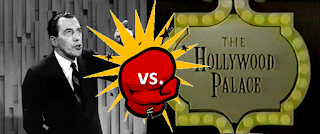
During the 60s, the Ed Sullivan Show and The Hollywood Palace were the premiere variety shows on television. Whenever they appear in TV Guide together, we'll match them up and see who has the best lineup..

Palace: Host Steve Lawrence inroduces Mickey Rooney and Bobby Van in a spoof of the movie "Bridge on the River Kwai"; opoeratic soprano Jean Fenn; the Backporch Majority, folk singers; choreographer-dancer Jack Cole; comic Gene Baylos; plate spinners Alberta and Rosita; the Gimma Brothers, novelty act; and 4-year-old drummer Poogie Bell.

Sullivan:  Ed welcomes Steve Lawrence, Victor Borge, the rock 'n' rolling Dave Clark Five, comics Rowan and Martin, the Israeli Ballet, puppet Topo Gigio, the tap dancing Mattison Trio and John, a balancer.

Well.  As I typed the listings, I was thinking to myself that I really wanted go go with Palace this week because I like Steve Lawrence, but beyond Rooney and Van the lineup's pretty weak.  And then I come over to Sullivan and who do I see?  Steve Lawrence!  As far as I remember, this is the first time we've had an act appear on both Palace and Sullivan the same week.  Of course, it helps when both shows are in reruns.  But Ed has more than Steve - try the very funny Borge, the occasionally funny Rowan and Martin, and the stylish Dave Clark Five.  And if that isn't enough, you've got a puppet and a ballet company!  No more calls, ladies and gentlemen, we have a winner.  Sullivan takes it in a song.

***

Football?  This early in August?  Of course.  The sporting landscape changes dramatically this week, with our usual summer fare of baseball, golf and bowling being joined on Sunday by the return of the American Football League as the Buffalo Bills and Boston Patriots face off in a pre-season tilt from Boston.  This is the first year of the AFL's new television contract with NBC, which gives the AFL the necessary finances to launch the bidding war that ultimately results in the league's merger with the NFL.

Not to be outdone, CBS presents an NFL game opposite the AFL, but we're really talking apples and oranges here.  The CBS offering is the Baltimore Colts inter-squad game, taped the previous night.  The focus is on Baltimore's preparation for the regular season, in which they'll be out to avenge their 24-0 loss to the Cleveland Browns in the previous year's NFL championship game.  In fact, it's Cleveland, not Baltimore, that makes it back to the title game - where they're waxed by my favorite team of the era, the Green Bay Packers, 23-12.  Better that you should tune in a day earlier and catch their broadcast of the Washington Redskins* and Philadelphia Eagles from Hershey, PA.**

*This being a retro TV site, we have no problem using the "R" word.
**Where, a couple of years earlier, Wilt Chamberlain had his famed 100-point basketball game.


***

On Monday, You Don't Say! begins a one-week stint by celebrity panelists Dr. Joyce Brothers and Dr. Frank Baxter.  "Who's Frank Baxter?" my wife sensibly asks, and though I kind of knew the answer, the always-reliable Wikipedia provides the rest of the story.

Born in Newbold, New Jersey, Baxter is best remembered for his appearances from 1956–1962 as "Dr. Research" in The Bell Laboratory Science Series of television specials. These films became a staple in American classrooms from the 1960s through the 1980s. The Bell series combined scientific footage, live actors and animation to convey scientific concepts and history in a lively, entertaining way; and the bald, bespectacled and affable Baxter served as narrator, lecturer and host. These films made Baxter (who was not a scientist) something of a scientific icon among baby boomers. Several of Baxter's science films have been released on DVD.

Baxter also appeared (as himself) in a prologue to the 1956 film The Mole People, in which he gave a brief history of theories of life beneath the surface of the earth.

In 1966, Baxter hosted a popular TV series called The Four Winds to Adventure, featuring filmmakers exploring little-known areas of the world, whether across continents, oceans, or local people and animals in a particular region.

Baxter died at age 85 in Pasadena, California. His body was cremated, but his ashes were scattered in Colorado, NOT placed in a vault in California, as some sources maintain.

What I love about this is that only in television of the '50s and '60s could a man become a cult celebrity, a guest on game shows in fact, by appearing in science specials.  Fat lot of good chance of that happening today, unless your name is Neil Degrasse Tyson.

You might not remember the name, but I'll bet you'd recognize him if you saw him.  To give that a test, here he is (along with Eddie Albert!  Directed by Frank Capra!) in the acclaimed Our Mr. Sun.


***

Kellam de Forest is my kind of guy.  His research company regularly vetts scripts for accuracy and liability, and is on call to answer questions that producers and scriptwriters might have about, say, how to peel a pearl (The Richard Boone Show) or what day December 30, 2022 falls on (The Twilight Zone).  And while some of these items may seem like they're not such a big deal - after all, anyone with an internet connection can tell you that 12/30/22 is a Thursday - others can be very important, not only for the show's accuracy, but its financial well-being.

For one thing, de Forest conducts a vigorous background check into character names that appear in scripts.  This service would have been particularly advantageous had the producers of Dr. Kildare taken advantage of it.  They're currently in the midst of a $5 million lawsuit because of a recent episode in which a fictional doctor stands accused of covering up a medical mistake that resulted in the death of a young child.  Seems that there's a real doctor out there with the same last name, who didn't take kindly to having that name besmirched, whether the TV doc was fictional or not.  Sending the script de Forest's way could have saved the producers a lot of grief, for a fraction of the cost.

I first read about de Forest many years ago, in Marc Scott Zicree's Twilight Zone Companion, in which de Forest applied his trade to the 1963 episode "In Praise of Pip."  Rod Serling's original script contained a reference to American military action in Laos, with Jack Klugman's son Pip dying in a place where "There isn't even a war there," but de Forest came back with the following recommendation:

The Geneva Treaty on the neutrality of Laos stipulated that all foreign troops be removed.  At present the only U.S. military in Laos is a small mission with the Embassy.  There are officially no combat or special forces in Laos.  The implication that the U.S. has troops fighting in Laos (even in The Twilight Zone) could be an embarrassment and might cause repercussions.  U.S. Special Forces are fighting ("in an advisory capacity") in South Vietnam.  Suggest South Vietnam.

There was also a suggestion as to the wording in the script:  "In South Vietnam it is common knowledge that there is a Civil War, but U.S. troops are not supposed to be fighting there.  Suggest 'There isn't even supposed to be a war there.'"

It's a fascinating line of work, at least to me.  De Forest sits in his office, surrounded by a library of over 5,000 books "run[ning] the gamut from "The History of Orgies" to Dr. Spock's 'Common Sense Book of Baby and Child Care.'"  A script comes in, from an episode of Profiles in Courage set in the late 1800's.  Among 54 research points, de Forest issues recommendations regarding the phrases "Little old bird dog, that's me" ("the term 'bird dog,' referring to one who hunts and finds objects, didn't come into use until circa 1930") and "to take in a water cooler around the bend in the corridor" ("the modern cooler was invented about 1910, though there were can-top coolers earlier").  Another Profiles script called for a scene of "great shouting and commotion" at the 1924 Democratic National Convention.  De Forest, on his own, added "The 'official' record indicates specific cries of 'soak it to them, boys, soak it to them.'"

I don't have a Kellam de Forest Research Services at hand for my use, although the resources of the internet probably provide me with more data than de Forest could have dreamt of.  It's knowing how to use the research that counts.  And when it comes to storytelling, it's the details - putting a war in South Vietnam instead of Laos, or taking care to avoid historical anachronisms - that can make all the difference.

***

Some quick programming hits for the week:

SOURCE: HADLEY TV GUIDE COLLECTION
Saturday, as we noted, is the return of exhibition football on CBS.  That night, Al Hirt, summer replacement for Jackie Gleason (and beneficiary of a feature article elsewhere in this issue), features a pretty good middlebrow lineup, with satirist Stan Freberg (one of the funniest men in radio or television), Met Opera soprano Anna Moffo , ballet dancers Edward Villella and Patricia McBride, pop singer Dionne Warwick, rockers Chad and Jeremy, harpist Robert Maxwell and jazz pianist Willie Smith.  And then, of course, there's Al's trumpet.  Pretty good lineup - to be honest, it might top Ed and Palace this week.

On Sunday ABC's public affairs program ABC Scope commemorates the 20th anniversary of the bombing of Hiroshima.  We hear about this on an almost annual basis around this time of year, but in 1965 it was still pretty fresh in people's minds.  Correspondent Lou Cioffi (incorrectly identified as Gioffi in this issue) reports on how the city has changed since then; I wonder how much discussion concerned the use of the bomb in the first place?  I'm always interested in intense conversations about this today, conducted mostly by people who weren't alive then and have little feeling for the context and climate in which the decision was made.

Monday's rerun of Andy Williams features an odd pairing of guests: Roy Rogers and Dale Evans, and Jonathan Winters.  "In a circus spot, Roy demonstrates his marksmanship and Jonathan portrays a lion tamer."  On the other hand, NBC's The Man From U.N.C.L.E., which is coming to camp mode by this time, has a story about "a strange disease [that] killed the entire population of a small English coastal village - by afflicting the inhabitants with old age." With a couple of tweaks, that could almost be The Andromeda Strain, couldn't it?

Tuesday - we're seeing the summer season wind down, and with it the shows that won't be returning in the fall.  NBC has a pair - Moment of Fear, which is showing an episode that originally came from G.E. Theater in 1959, and Cloak of Mystery, which shows a failed pilot episode.  Hullabaloo, also on NBC, will be back next summer, but it ends this year's run with a show hosted by Frankie Avalon.

Wednesday: It's CBS' Our Private World, the first prime-time program spun off from a daytime soap, in this case As the World Turns.  It airs twice weekly, on Wednesdays and Fridays, and stars the legendary soap actress Eileen Fulton in her ATWT role of Lisa Miller Hughes.  It would have been interesting had this show taken, to have a bifurcated story universe running in both daytime and nightime - that is, even though the shows (and storylines) are separate, the participants inhabit the same universe.  Alas, the show, which started in May, only makes it through to September and the beginning of the fall season.

On Thursday, the Minnesota Twins and New York Yankees wrap up a series at Yankee Stadium, broadcast on WTCN, Channel 11.  It's an informal changing of the guard; the Twins, who were mostly miserable as the Washington Senators, are headed for the American League pennant in 1965, as part of a run that includes a second-place finish in 1967 and West Division titles in 1969 and 1970.  For the Yankees, on the other hand, it's the Twilight of the Gods: American League champions for the last five years and 22 of the last 29, the Yanks are headed for a sixth-place finish in 1965, followed by a total collapse into the cellar in 1966.  They won't make it back to the World Series for another decade.

SOURCE: HADLEY TV GUIDE COLLECTION
Finally, what would Friday be without a beauty pageant, or "Beauty Spectacular," as the listings put it?  It's the 14th annual International Beauty Pageant, live from Long Beach, California.  John Forsythe is the host, with an all-star panel (well, kind of) of judges including actress Virginia Mayo, illustrator Alberto Vargas (yes, that Vargas), and Tom Kelley, the fashion photographer, who took a very famous photo of Marilyn Monroe against a red background which we probably, ah, shouldn't link to here.

Interestingly enough, this lesser-known pageant is still around, and is one of the few that doesn't judge solely on looks.  Its "contestants are expected to serve as 'Ambassadors of Peace and Beauty', demonstrating tenderness, benevolence, friendship, beauty, intelligence, ability to take action, and, most importantly, a great international sensibility. The ultimate goal of the Miss International beauty pageant is to promote world peace, goodwill, and understanding."

In other words, just like this blog, right? TV  

August 7, 2014

Around the dial

Some of you may think I take the easy way out by devoting Thursdays to links.  Au contraire!  What it really does is give me a chance to read some terrific pieces at other blogs, and steer them your way.  Let's get started, shall we?

Cult TV Blog has been concentrating on allegory in The Prisoner, and you can check out the latest excellent entry here.  But I want to draw your attention to his analysis of the 1998 film version of The Avengers, viewed in light of the original series.  I never saw the movie; first of all, it was before I became such a fan of the series, and second, it seemed to have gotten some pretty poor reviews.  But you might think kinder of it after reading this piece.

Classic Film and TV Cafe takes a look this week at one of my favorites, Fred Astaire - specifically, the 1961 movie The Pleasure of His Company.  The funny thing about this is that I really don't like musicals; my favorite, 1776, holds the distinction of having the longest stretch without music of any Broadway musical.  I don't even like the stories of many of Fred's movies - but I always like him.  That man has style just standing and breathing.  And he made three very good television specials, as well.

All Things Kevyn is all sitcoms in this post, where he shares with us some of his favorites in the genre.  Like me, his first memories of many of these shows comes from watching them after coming home from school.  I mean, I don't think I ever saw an episode of Gilligan's Island in prime time; it was always in that period between 4 and 6 pm.  Ah, yes - before the afternoons became all about bad talk shows and bad local news.

We haven't checked in on I Love Dino Martin lately, but this is a good week to do so - as our gracious host links to a terrific piece that speculates on celebrities who should have been guest villains on Batman.  And yes, I can absolutely see Dino as Two-Face.  It's almost painful that we won't ever get a chance to see how that would have gone.

Thanks to my friend Andrew Lee Fielding at The Lucky Strike Papers (and by the way, if you haven't bought his book yet, why not?) for this link to some very interesting looking titles by Bear Manor Press, many of them concerning our favorite classic television shows and stars.  I'm intrigued by this Nat Segaloff bio of Sterling Silliphant - I've taken some jabs at Silliphant in the past for being able to turn any script into a pulpit for his social beliefs, but his story sounds like a very interesting one.

Seems like some of the bloggers out there are on vacation, or at least slowing down for the month.  Why can't I do that?  Who knows.  I guess it's just the lure of attention, that I have to keep on writing.  That and I enjoy what I'm writing about.  See what I mean on Saturday, when I'm back with another TV Guide blast from the past! TV  

August 5, 2014

Summer rerun: What does TV do to you?

Some years ago, Ben Berger put up a provocative article on National Review Online entitled "Tocqueville and the Tube," and since this deals with both television and culture, I suppose I ought to have a few thoughts on it. And, of course, I do.

In parsing an article like this, one needs to avoid two assumptions. The first, on the part of the writer, is that television is all-bad, or at least a necessary evil to be watched as little as possible. The other, on the part of the reader, is to assume that every serious article written about television is going to bash it.*

*Which reminds me of an old Peanuts cartoon - Lucy is reading an article about television, and asks Linus if he agrees with the premise that TV can be harmful to your health. His reply: "I don't know - I've never had one fall on me."

Berger's start is not promissing on either level.  He begins with a flat declaration: "Television makes us fat, lazy, inattentive, unsociable, mistrustful, materialistic — and unhappy about all of that. It cheapens political discourse, weakens family ties, prevents face-to-face socializing, and exposes kids to sex and inures them to violence." I notice he didn't include the national debt, the bad weather in the South, or the rise of Bin Laden - but perhaps I wasn't reading closely enough.

OK, so I'm being a little flip there. Truth is, I agree with much of what Berger says in that paragraph - with reservations.  Like most things, television itself is neither good nor evil, but neutral. The same goes for watching television. Yes, you can watch too much, in the same way that you can eat too much chocolate, or spend too much time in the sun. The effects aren't going to be good for you.

Television is best used not as replacement, but as an augmentation, for human interaction, if you allow the exchange of information that one gets from television to become an interpersonal, interactive activity. I've often argued that I learned more from watching Alistair Cooke's brilliant television series America than I did from the high school classes I was taking at the same time. A smart teacher (of which there weren't many in the high school I attended) might have found out a way to integrate that program into the classroom, to use it as a springboard for learning and discussion about topics that Cooke didn't cover.

Berger does not deny that the quality of television you watch can make a difference, acknowledging that "moderate viewing is not so bad" (and that "[h]igh-quality programs may enrich us,") - but the problem is that we do not watch in moderation. "According to the Nielsen Company, in 2009 the average American watched more TV per day (over five hours) than ever before." But was not thus always the case? The March 18, 1961 issue of TV Guide notes that according to a Nielsen survey in January 1961, "people in the average home put in six hours a day in front of their TV sets. This is the highest level in three years, just short of the all-time peak of six hours, six minutes which was hit two months in a row in 1958."

Now, I suppose there are subtleties embedded in these statistics. For example, we seem to work longer hours that we did in the 50s and 60s, and more women have jobs today than they did then, which means we may be spending a larger percentage of our disposable time in front of the tube. And there's no denying that families don't watch TV together the way they used to, which when added to the likelihood that every room in the home has a television leads one to suspect that our six hours a day are in fact spent alone, or at least with fewer people around us than there used to be. The DVR, and the introduction of "on demand" viewing, makes the shared experience of television one step further removed.

Hmm. Suddenly, I seem to have talked my way into agreeing with Berger, or at least part of his premise. And from there, of course, things get more complicated.

Berger moves on to Neil Postman's comment that television has "an inherent bias toward the shallow," and it's hard to argue that television isn't what it used to be, at least when one considers the overall quality of what passes for programming today. While it's true that not everything on during The Golden Age of Television was golden, a lot of it was pretty good. Even as the 50s transition into the 60s, however, the pressure of ratings - the rise of "lowest-common denominator programming that produces Postman's "shallow" bias - becomes more noticable, as I pointed out in this piece considering the fall of The Voice of Firestone in the early 60s

Berger scores points by underscoring the relationship between television and behavior - for example, the idea that violent programs, if they don't actually cause violent behavior, can desenitize viewers to it. (I would not, however, include things like Bugs Bunny cartoons in that category, as many TV-bashers do.) And he argues that television can encourage other forms of behavior, such as materialism and sensuality, not only through the content of the actual program but also through the advertising that accompanies it. And to me that seems a hard argument to deny, as some commentators attempt. The very purpose of advertising is to influence behavior, after all, so why should the program itself be any different?

In discussing the physical and mental effects of television, Berger offers one of the most striking paragraphs in the entire article, pointing to the overstimulation which modern television provides. "The average shot length of American movies stood at 27.9 seconds in 1953, just after TV began its ascent, fell to 7.3 seconds in 1986 as MTV gradually took hold, and was 2.5 seconds in 2007." That seems astounding, until you actually start to think about it. The other night I caught the last few minutes of the new Hawaii Five-O while I was waiting for the local news (had to catch up on the latest weather bulletins, you know).

The scene invoived - not a car chase, I think, but rather a car travelling quickly from one point to another. There was a shot of the car, a change in angles, a focus on the hubcaps moving rapidly, a cut to inside the car, another change of angle, an overhead view - none of these images lasted more that two or three seconds. It was ridiculous. We tend to ignore this kind of editing when we can, our mind streamlining things for us and simply conveying the basic message that the car is travelling at a high rate of speed. (The mind is a beautiful thing.)

But if you take a minute to really pay attention to what you're seeing, you're likely to have some kind of seizure from all the rapid cuts. (Perhaps the reason more people don't have this reaction is that they're only half-paying attention, anyway.) Setting aside the sociological implications of this, I think this is just bad television: lazy, time-wasting, a substitute for actually writing a scene. Most of all, it's self-indulgent - someone once said that the best movie music (and I think this goes for television as well) is that which doesn't call attention to itself. In other words, it enhances while never overshadowing. What we see now in the editing process, too often, is "art" run amok, begging to be realized as clever when in fact it has nothing to do with storytelling. If your editing screams "look at me!" it's probably because you're afraid your story is too weak to keep the viewer's attention. On the other hand, maybe I'm just being old-fashioned in saying this. Nonetheless, it's probably difficult to dispute the idea that such programming can make people hyperactive.*

*Although, in my case, it's mostly in exercising my thumb through repeated clicks on the remote.

Berger makes many familiar arguments against television - that it cuts down on physical and mental activity, leading to overweight bodies and underweight minds, and while I think the second is open to debate, I'm not about to argue with the first (although I would suggest there are other sociological factors, such as the breakup of the nuclear family, that play a role as well). However, the most interesting part of his discussion is that which centers around the premise of the title.

Tocqueville and his most famous book
Tocqueville, of course, knew nothing about television. And yet he did forsee its effects, in a way. In his extensive writing about democracy, Tocqueville sought to understand it as a form of technology. As Berger notes, "Democracy extends citizens’ movement beyond their previous boundaries in feudal and aristocratic hierarchies, enabling them to do pretty much what they like. In that sense it constitutes a technology of freedom. But Tocqueville worried that citizens might use the new technology in ways that undermined their prospects for maintaining freedom." In other words, as our freedom gives us access to new and different experiences, "[t]he soul cleaves to them; it dwells on them every day and in great detail; in the end they shut out the rest of the world and sometimes come between the soul and God."

Heady stuff, and you really need to read over this a couple of times to understand the implications. But Tocqueville saw in this the ultimate threat: that the freedom eventually could "isolate men from each other.”

Is this what television has done? Can you give it that much credit? Well, if you consider how much of TV has become niche programming, designed to appeal to a specific demographic or interest group, then it means we have less incentive to become well-rounded people of eclectic tastes. If you look at the chattering heads on news programs calculated to appeal to like-minded thinkers, then we have less desire to understand the other points of view. If you enjoy the ease of "on-demand" viewing, then you have less opportunity to discuss what you saw on television last night with a co-worker who may not yet have seen it. Instead, you'll go to the on-line message boards.*

*Realizing, of course, that in the virtual workplace your co-worker may be an on-line one anyway.

If it seems that I came to praise - or at least defend - TV, only to wind up damning it, then you understand the inherently complex relationship between humans and television. Television is an amazing piece of technology, one at which I've never really stopped marvelling. The advancements - from black and white to color, to big screen, and now to HD and 3D, all of which I've lived through - are astonishing, and admirable.

Make no mistake - I enjoy watching television. It's a simple pleasure, one which I think has enhanced my life and brought pleasure to it. It has given me the chance to read and write about it, for which I am grateful. And there are too many people who make easy hay out of attacking it, for TV is an easy target.

But that's not to say that all the attacks are justified. If Berger sometimes falls into the TV-bashing trap, he also makes some salient points, ones that deserve consideration, and - if you disagree with them - a serious, thoughtful analysis. (One which I'm not at all sure I've provided here.) The end result, whatever your viewpoint, is a confirmation of my main argument, which is that television is the chief cultural shaper of the last seven decades.

But what do you think? Whether you agree or disagree your comments, as always, are welcome.


Originally posted June 1, 2011

August 2, 2014

This week in TV Guide: August 1, 1981

It is as testimony to the high regard in which I hold you, my readers, that I present today's issue.  Having found myself in a lull when it comes to TV Guides covering the next few months, I invested in a supply of issues from the early 1980's, which will be making their way onto the site over the next few weeks.  This, despite the fact that, television-wise, the '80s rank far behind the late '50s-early '70s era of issues in which I'm most interested.  I could have let the project lay for the next few months, or I could have dipped into the archives and presented reruns or additional information - but no.  Instead I torture myself by going through issues that frequently are of no concern to me.  Suffering for the sake of art?  Or simply readership?  You be the judge.

***

So, what will pay-TV take away from free TV?  That was one of the major concerns from the late '60s on, as TV Guide became aware of the growing potential that lie in cable TV.  At first designed merely to bring a clear picture to outlying country towns unable to get conventional signals, it soon became apparent that cable TV could be used for much more, and that entire channels might someday spring forth.  That day is now.

Today, reports Neil Hickey (today being 1981), more than 10 million American homes have some type of pay-TV.  That's 12% of the possible number, and in another ten years that number's expected to triple. And while cable continues to climb in popularity, there's an even bigger prospect on the horizon - pay-per-view.

What is the attraction of pay-TV?  An Arbitron study asked a large sample of subscribers that question, and the answers really come as no surprise:


It's movies, and as Hickey notes, "families know they'll spend more going out to a single movie than a whole month's worth of pay-TV might cost them."  You'll notice that neither sports nor original programming appear on that list.  And yet, according to Hickey, "It's inevitable that most major sports ... someday will wind up on pay-TV because that's where the big money will be: promoters can sell "tickets" directly to the public and cut out the middleman, namely the advertiser."  Clearly, Hickey is thinking of PPV here, and in fact for as far back as I can remember, the talk has always been about how events like the World Series and the Super Bowl would sometime wind up on PPV.  In fact, that hasn't happened and isn't likely to - for one thing, although it would have seemed preposterous in the early '80s, the commercials are now for many the most interesting thing about the Super Bowl.

In fact, with the exception of niche sports like boxing, wrestling and MMA, PPV has never made a big dent in the sports scene.  Conventional cable, however, has.  The Rose Bowl and all major college bowl games, the Final Four, Wimbledon, the British Open, the Stanley Cup finals, NASCAR, the NBA playoffs, Monday Night Football and so many other major events, are now seen in part or in whole on cable, and baseball's Game of the Week has become irrelevant for most fans.

And while there's no doubt that movies remain a prime attraction of cable (and PPV), it's original programming that's now driving the momentum.  From The Sopranos to Breaking Bad, Mad Men, Game of Thrones, True Detective and all the rest, there's a consensus that quality adult drama may well be the greatest selling point for today's cable TV.

But even in 1981, the networks are worried.  Had they known what the future would bring, they might have worried even more.

***

We've looked at articles the past few weeks from figures as varied as Arnold Toynbee and Malcolm Muggeridge, writing about everything from the unfulfilled promise of television to why TV should focus on what it does best.  This week, we hear from one of the heavyweights of television news: Fred Friendly.

Fred Friendly, dean of TV news
I'll assume most classic TV buffs know who Friendly was, but brief bio: collaborator with Edward R. Murrow, president of CBS News, TV host, professor of journalism, member of the Ford Foundation.  In short, television legend.  In this interview, Friendly is asked for his opinions on a number of news-related subjects, and his answers hold about as true for today as they did back in 1981.  To wit:

On local news:  "I think most local news would horrify [Murrow].  Speaking for myself - it makes me vomit.  Some local reporters actually are pretty good, and yet when those local shows go on at 6 o'clock and 11 o'clock, it's putrid.  There's a sort of giddiness to their news.  It's laughing, joking, reporters talking about their personal lives.  And sometimes they're laughing about things that aren't laughing matters.*

*I agree with this all, by the way.  Just watch any commercial for a local news organization, and you'll see the kind of chuckle-thon Friendly references.  I don't want the people who read the news to be my pals.  I'm not going to take them more seriously if they all act like they're friends who get together to have a few on the weekends.  I don't want people trying to make a difference.  I want the damn news.

On the media's sensitivity to criticism:  "If you say to a broadcast person or a newspaper person, 'You didn't report that story on productivity very well,' they're offended.  Suddenly, you're fighting the First Amendment.  Well, the First Amendment includes the right to tell a broadcaster that he's doing a lousy job.  If Spiro Agnew had been smarter, if he had done his homework better, if he hadn't been such a bully about it all, it would have been clear that everything he was saying about the press wasn't wrong."*

*Friendly's doubtlessly referring to Agnew's famous September 11, 1970 "Nattering nabobs of negativism" speech, in which he went on to attack the media for forming "their own 4-H Club - the "hopeless, hysterical hypochondriacs of history."  The speech was written by William Safire.

On journalists' salaries:  The journalist who deserves to make a million dollars a year hasn't been invented.*  There's something obscene about that. . . When journalists become a part of the upper class, something has happened to the news business.  It's malevolent because it's taking away money from the news budget.  You could hire 10 or 20 camera crews for that."

*Of Barbara Walters, the original million-dollar-journalist, he said, "She's a fine person and a good journalist, but she's not worth a million dollars; nobody in journalism is."

On the future of cable TV:  Ted Turner is ahead of his time [in founding CNN]. . . There just aren't enough people out there on the cable - yet.  It's an idea whose time will come."  Friendly goes on to paint a very interesting portrait of what the future looks like: "There will be a CBS-1, CBS-2, CBS-3, CBS-4 and so forth.  CBS-1 will be the kind of popcorn television we now have, a billion-dollar penny arcade. Let it be.  Then there'll be CBS-2 (as well as ABC-2 and NBC-2), which will be all-news.  Then there'll be CBS-3, which will be performing arts; CBS-4, which will be all-sports; CBS-5, which will be something we can't even figure out yet."

For the most part, that prediction has come to pass.  ESPN, for example, is really ABC-4 (or perhaps ABC is ESPN-2), and Fox (which wasn't even around back then) already has Fox sports, Fox news, Fox business and Fox movies, as well as the "popcorn television" main network.  Both CBS and NBC have significant chunks of other networks, from USA to Bravo.  I think that what Friendly did not foresee - indeed, nobody in the TV Guides of this era does - is that the niche networks, as we now call them, would succumb to the same pressure for ratings and homogeneity.  Arts networks (and any other low-performing niche network) are gone, and just about any non-specialty station left is nothing more than a collection of the same endless network reruns, syndicated programming, and infomercials.  I mean, I defy anyone to identify the difference between TBS, WGN, USA, TNT, Bravo, Hallmark, Lifetime and the rest.  They all may have one or two areas in which they specialize (the soapy movie on Hallmark and Lifetime, for example), but as to the rest of it there's virtually no difference.  And that makes me feel about the way Fred Friendly felt about local news.

***

ABC's In Concert is long gone by now, but when I saw the listings (on multiple channels) for Solid Gold, I thought I might have something I could match up to NBC's The Midnight Special on Friday night - but the clock's struck 12 for Special.  In its place is one of the great shows of the '80s, SCTV.

At this point in time it's called SCTV Network 90, to distinguish it from the syndicated reruns of SCTV Television Network that still air, and a good chunk of the network version is still comprised of bits from that syndicated series.  But the long-form spoofs that became the hallmark of SCTV are coming to the fore now, and this week's show features one of the show's funniest bits: a takeoff on Chinatown called Polynesiantown, which contains one of the great running jokes ever on TV.  You probably ought to track down the entire episode, but here's the memorable ending, including that crane shot that would come back to haunt Johnny LaRue for years to come.


***

If you look through this issue and get the feeling something's missing, you're right.  Baseball.  Where have all the players gone?

On strike, that's where.  No, this isn't the one that wiped out the World Series; that wouldn't happen for over a decade.  This is a different strike; it started on June 12, and before it ended it would force cancellation of nearly 40% of the season.  There are rumors, however, that the strike may be ending soon, and in anticipation of that possibility TV Guide has included a handy schedule at the front of the issue, with the games that might be seen this week.  Such was not the case, however; the strike is settled on July 31 (after the press date of this issue), and play resumes on August 9 with the All-Star Game in Cleveland.*

*A byproduct of the strike is that the season was split into two halves, with the division winners from each half advancing to the playoffs.  The unintended consequence of this was that the two teams with the best overall records in baseball, the Cincinnati Reds and St. Louis Cardinals, each failed to make the postseason because neither had been in first at the right time of the year.

In the meantime, Superstation WTBS, the home of the Atlanta Braves, is reduced to showing minor league baseball featuring the Braves' AAA affiliate in Richmond.  In the meantime, NBC replaces its Saturday afternoon Game of the Week with something called "NBC Sports' Summer Season," and if that sounds suspiciously like a show thrown together at the last minute, you're probably right.  This week's show features women's college tennis*, the Royal Horse Show, taped at Wembley, a pair of karate world championship bouts, and a NASCAR race taped in July.  Yes, these were the days before every race was carried live - and that should tell you how sports coverage has changed since then.

*This was so long ago, the NCAA hadn't yet become the orverriding governing body for women's college sports; the tourney is instead sponsored by the AIAW, the Association of Intercollegiate Athletics for Women, which will be superseded by the NCAA the following year.

***

Same song, different tune: yet again, a blurb in TV Update tells us that CBS and NBC are pushing for hour-long newscasts within the year.  This is one of the two drumbeats constantly played in TV Guide over the years, the other being the possibility that one of the networks will move its evening news into prime time rather than the dinner hour.  The affiliates are resisting the move, of course, because it will come out of their time.  The networks have countered with a proposal to get rid of that half-hour Prime-Time Access Rule that was supposed to give viewers local public affairs programming and instead saddled them with syndicated game shows and imported trash like Police Surgeon.  

It doesn't happen, of course.  As is the case with the push for prime-time news, it never happens.  To this day the networks maintain a 30-minute dinnertime newscast (and seem hard-pressed to fill even that little amount, given the number of features that would seem to fit in more with Oprah Winfrey's network).  The affiliates still maintain the half-hour before prime-time, and the programming hasn't gotten any better.  

There is one notable mention in this piece, though, and that's the emergence of ABC as the number one news program in the ratings - the first time ever for the network.  There are mitigating circumstances, of course; Dan Rather has just taken over for Walter Cronkite, and after the curiosity bump in ratings that usually accompanies these kinds of moves (see: Couric, Katie), CBS has fallen behind ABC.  There's more to it than just that, though; it's a measure of the impact of Roone Arledge as head of ABC News.  ABC's World News Tonight features not just one but three anchors - Frank Reynolds in Washington, Max Robinson in Chicago, and Peter Jennings in London, with Barbara Walters providing interviews from New York.  I always thought it was a terrific newscast, and it would stay on top even after Reynolds' death in 1983, when Jennings would take over and embark on his own long run as television's elder statesman of the news.  Ironic, given that in his first stint as ABC anchor, he had been the youngest anchor ever, at 27.  He was a pro, through and through.

***

I've studiously ignored the cover story of this week's issue until here, at the end.  Yes, the Muppets are big TV stars now, thanks to the syndicated Muppet Show, and none bigger than Miss Piggy.  I remarked a few weeks ago of my fondness for Rowlf, who had appeared with Jimmy Dean on his ABC series, and as much as I liked Rowlf, that's how much I hated Piggy.  I don't know if it was the annoying voice, the irritating self-centeredness, the way she bullied Kermit, or what.  Yes, I know it was all supposed to be an act, and this was how we were supposed to see the character, but I never thought that bit was funny.  I still don't think it's funny.

I looked for a clip of the above, but couldn't find one, so you'll just have to be content with words.  It's from the Academy Awards telecast of 1980.  She's been complaining about not being nominated for an Oscar for The Muppet Movie.

Miss Piggy: Jonathan, you saw "The Muppet Movie." Can you stand there, in your rented tuxedo, and tell me that I am not Oscar material?
Carson: Oscar Mayer, maybe!

Even Johnny wasn't able to keep a straight face for that one.  Piggy wasn't amused, but I sure was. TV  


It's About TV is now on Facebook!  Please like us and follow for additional content and teasers to upcoming posts!