This week Super Bowl IV takes top honors on television. Nowhere in this issue is it called that, by the way; it's only referred to as the "Super Bowl" even though the Roman numerals had already been implemented by then. Of course, we all know how much the Super Bowl has changed since its earliest days --
-- But wait. Maybe we
don't all know that. After all, if you're under, say, 40, you've probably never known any other Super Bowl than what we have today. And if that's the case, then this one TV Guide is going to tell you everything about what the Super Bowl
is by showing you what it
was, and what it
wasn't.
What it
wasn't, first of all, was a ratings monster. How do we know that? Easy: the game started at 2:30 p.m. CT on CBS, with only a half-hour pregame show. It's true that nothing was scheduled against it*; local movies and syndicated series (
The Rifleman, 77 Sunset Strip, The Man from U.N.C.L.E.), but in the days before saturation sports on TV, that wasn't all that unusual in the first place.
*
In 1970 CBS broacast the NHL as well as the NFL, and the Rangers-Canadiens game began at 11:30 a.m. - it was about the only time CBS could televise it. In 1971, when NBC carries the Super Bowl, CBS schedules its NHL game directly opposite it.
It
was about the game, not the commercials. It was the final matchup between the American and National Football Leagues, a rivalry as bitter as anything in sports. With the victory by the Kansas City Chiefs over the Minnesota Vikings, the final Super Bowl tally between the two leagues was 2-2. People watched it for what happened on the field, not during the commercial breaks. Besides, the game's only allocated three-and-a-half hours of airtime, and you have to figure that last half hour is reserved for the trophy presentation. When the commercials* are the most important thing about the broadcast, I can promise the game and the trophy presentation aren't going to get done in that amount of time.
*
And the halftime "concert." In perhaps the first example of a Super Bowl halftime extravaganza, Al Hirt was the headliner of a Marti Gras celebration.
And about the two teams - there was no week off after the league championship games to allow the Super Hype to build up; therefore, at press time TV Guide didn't even know who the teams were. The best they could do was to give the rosters for the four teams playing to get into the game: the Kansas City Chiefs and Oakland Raiders in the AFL, and the Minnesota Vikings and Cleveland Browns in the NFL. Two of these teams will compete for the trophy; tune in Sunday to see who they are.
There's no special section in TV Guide, by the way, dealing with the game. No sidebar on "memorable moments" (such as last year's shocking upset win by the New York Jets over the Baltimore Colts), no "gameday recipes" for your Super Bowl party. Just a two-page article by TV Guide's resident sports expert Melvin Durslag, writing about the general surprise that this year's game was being played in New Orleans instead of making Miami the permanent home (as many had expected), and wondering about how long football would continue to remain America's top sport (looks like he was ahead of his time, doesn't it?).
There's no question that in January 1970 the Super Bowl is a big game. It's one of the biggest sporting events of the year. But that's all it was, and sometimes it helps to have a reminder of when, unlike today, that was the case.
◊ ◊ ◊
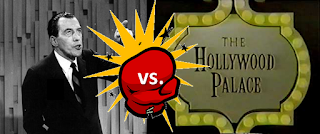 During the 60s, the
Ed Sullivan Show
and The Hollywood Palace
were the premiere variety shows on television. Whenever they appear in TV Guide together, we'll match them up and see who has the best lineup..
Sullivan: Tiny Tim and his bride Miss Vicki are the headliners, offering a medly of love songs through the ages. Scheduled guests: Flip Wilson, Peter Gennaro, Stiller and Meara, country singer Sonny James and songstress Karen Wyman
Palace: Bacharach tunes predominate as hosts Burt Bacharach and his wife Angie Dickinson present jockey Bill Shoemaker (singing and dancing in his show business debut), comie Scoey Mitchell, and singers Dusty Springfield and Sam and Dave.
This is a strange week, isn't it? I know that Tiny Tim was big stuff back then; I even remember watching
his marriage to Miss Vicki on Carson's show. But if
they're headlining Sullivan, it doesn't speak well for the rest of the show, does it? I'd love to know what Ed thought of Tim personally - he was a shrewd judge of talent, but I can't help thinking that he looked at this as being something he had to do to keep the show on the air. Burt Bacharach is scheduled to do several of his own songs tonight, with the Ray Charles singers (not
that Ray Charles), and while he's not a very good singer, he's written some wonderful songs that should make for a very good show, especially when someone else like Dusty Springfield is singing those songs. Angie could probably just stand there and look good, and it wouldn't hurt the show one bit. Tonight,
Palace sits at the top of the heap.
◊ ◊ ◊
 Throughout the 60s and early 70s, TV Guide's reviews were written by the witty and acerbic Cleveland Amory. Whenever we get the chance, we'll look at Cleve's latest take on the series of the era.
Jim Nabors is one of those rarities in show business. He left a hit series,
Gomer Pyle, USMC, at the height of its popularity, in order to star in his own variety show. According to Cleveland Amory, Nabors prefers his new series because (1) he likes to sing, and (2) the hours on this show are better. There's only one problem with this, says Amory: "a lot of us are learning, the hard way, the rigors of listening to Mr. Nabors sing. It's not that he's a bad singer - he's not. But he's just not a singer. He's a comedian." And what that means, for viewers of
The Jim Nabors Hour, is that "every time he sings a serious song we (1) can't get out of our head that
album of the New York Mets singing and (2) have an almost uncontrollable urge to grab Mr. Nabors, say 'Terrific game, Jim,' pour champagne on his head and push him into the showers."
Singing is one component of the three-legged variety show formula. The second leg is dancing, and Nabors is no dancer either. That leaves only the third leg, comedy. "And here let us say it does pass muster. Not only is Mr. Nabors a fairly funny fellow to begin with, he has a very funny way of making even unfunny stories come off funny." It helps that his former
Pyle sidekick Frank Sutton is a regular on the show, and also that his guest stars, such as Carol Burnett, have been given very funny sketches to work in.
But then it comes back to singing, such as the duet he did with Kate Smith in which "Mr. Nabors deferred to Miss Smith so much that it was hardly a duet at all." Fortunately, this too was saved by what Amory refers to as "one of their typical unfunny funnies," to which Amory confesses, "well - OK. We laughed." A lot of people did when they were watching Jim Nabors, and plenty of people
did like his singing, even if Cleve wasn't one of them.
The Jim Nabors Hour survived on CBS for two seasons, and with its good ratings would probably have lasted longer were it not for the network's rural purge. Jim Nabors popularity, however, never waned.
◊ ◊ ◊
The Jim Nabors Hour airs Thursday night at 7:00 on CBS, and this week's guest is singer Barbara McNair, which I guess means that the travel medley that Jim and Barbara are doing is going to be only so-so, while the comedy bits will be pretty good. Guess we don't need to watch now, do we?
In fact, there are quite a few variety shows on this week. On
Saturday (6:30 p.m., NBC), Andy Williams welcomes Cass Elliott, Arte Johnson, and Ray Stevens, with cameos by Lorne Greene and Sam Jaffe (who's playing his
Ben Casey character of Dr. Zorba in a sketch). At the same time on CBS, Jackie Gleason's guests are Milton Berle, Jackie Gayle, Irwin C. Watson, and Allan Drake. Meanwhile,
Sunday at 8:00 p.m. on CBS, Glen Campbell has Roger Miller, Caterina Valente, and Henry Gibson.
Monday ABC's failed 45-minute experiment
Music Scene (6:30 p.m.), with host David Steinberg,
departs the scene with appearances from Bo Diddley, John Sebastian, Buffy Sainte-Marie and Randy Marr.* Carol Burnett is nowhere near failing, though, and her guests tonight are Nancy Wilson and Nanette Fabray. (CBS, 9:00 p.m.)
Tuesday evening belongs to Red Skelton (7:30, CBS) with an excellent lineup featuring Duke Ellington and his orchestera, and comedianne Pat Carroll.
*
ABC's other 45-minute series, The New People
, also says farewell on Monday. The shows are replaced by It Takes a Thief
and the Monday Night Movie
.
I'm no country fan, but even I know that
Hee Haw is famous for its big-name guest stars, and this
Wednesday (6:30 p.m., CBS) is no exception, with Lynn Anderson, Hank Thompson, and Buck Owens' son Buddy Allen. NBC counters with a variety special at 7:00 p.m., "The Wonderful World of Girls," hosted by Gene Kelly, with Barbara Feldon, Ruth Buzzi, Kay Medford, Barbara Heller, Chanin Hale and Diane Davis, along with members of the Las Vegas Folles Bergere
(right). At 9:00, Rowan and Martin are back - not as part of
Laugh-In, but as hosts of a "satirical swipe at TV" with Carol Burnett, the Smothers Brothers, Sammy Davis Jr., and cameos by suprise stars.
Thursday also sees the final Christmas special of the year, 90 minutes of highlights from Bob Hope's 15-day tour of Vietnam, Germany, Italy, Turkey, Thailand, Taiwan and Guam. (NBC, 7:30 p.m.) He's brought along Connie Stevens, Suzanne Charney, Miss World Eva Reubar-Staier, the Golddiggers, Romy Schneider (in Germany only), comic jugglers the Pieros, and Teresa Graves. Following Bob, Dean Martin takes his turn (9:00 p.m., NBC), with Sammy Davis Jr., Andy Griffith, Paul Lynde, and comic-singer Glenn Ash. Meantime, over at ABC, Tom Jones is the man at 8:00 p.m., with George Gobel, Shani Wallis, Spanish singer Rafael, and the Rascals.
Finally,
Friday rounds out the week with the final episode of
Jimmy Durante Presents the Lennon Sisters, and their guests Ed Ames, David Frye, and Ferrante and Teicher. Jimmy and the Lennons sing "Try to Remember," and I wonder if that's the epitaph on their show?
◊ ◊ ◊
Buried in The Doan Report this week is a very interesting quote, another of those that convinces us there's nothing new under the sun. The debate is whether or not network commentary should be labeled as "editorial opinion." It's an issue that's been raised by Vice President Agnew, who cites unlabeled commentaries as evidence of a liberal network bias. One major station-ownership group, Storer Broadcasting, is threating to put their
own superimpositions on screen, even if NBC and CBS refuse to do so. (ABC is currently the only network to clearly label commentary as such.)
Richard S. Salant, president of CBS News, is uncomfortable with the whole thing. "What a can of worms
that opens up!" he says of the Storer threat. "The trouble these days is, everything somebody agrees with is fact, and anything they don't agree with is opinion. I wish I knew how they're going to define what is 'editorial'." Now, substitute "news" and "fake news" for "fact" and "opinion", and try that one on for size. With the proliferation of the internet and social media, I'd argue that things are worse today than they were in Salant's time - but it hardly began with Trump and Clinton.
◊ ◊ ◊
Finally, names.
There are plenty of them this week. On Sunday, ABC's movie is
The House on Green Apple Road, which was the pilot for the
Dan August series. Burt Reynolds plays police lieutenant Dan August when the series debuts in September 1970, but in this movie the role is played by Christopher George. The guest cast is Janet Leigh, Julie Harris, Tim O'Connor, Walter Pidgeon, Barry Sullivan, Keenan Wynn, Mark Richman, William Windom, Joanne Linville, Burr DeBenning, and Lynda Day. (She and Christopher George would be married in May 1970.)
The Friday night movie on CBS is
Robin and the 7 Hoods, which has if anything an even better cast: Frank Sinatra, Dean Martin, Sammy Davis Jr., Bing Crosby, Edward G. Robinson, Peter Falk, Barbara Rush, VIctor Buono, Hank Henry, and Allan Jenkins. It makes the rest of the night - Lee Meriwether, Yvonne DeCarlo, and cameos by Rudy Vallee, Edward Everett Horton, and Estelle Winwood on
The Name of the Game (NBC, 7:30 p.m.), Bill Mumy, Harold Gould, and Larry Linville on
Here Come the Brides (ABC, 8:00 p.m.) and Don Rickles on a rerun of
Run For Your Life (WTCN, 8:30 p.m.) look shallow by comparison.
And then there's this ad touting Rosemary Prinz's debut on ABC's
All My Children. The ad runs every day this week, giving you an idea of what a big deal this is. Prinz was famous for playing Penny Hughes on
As the World Turns from 1956-68. She and her on-screen husband Jeff Baker were, according to
the always-reliable Wikipedia, daytime television's first supercouple, although I might have suggested Mike and Sara Karr from
The Edge of Night, but I digress.
Prinz was part of
All My Children for six months, during which her name ran above the title, and she was the only cast member to have her picture in the opening credits. It was the first month for
All My Children - not a bad way to make a splash, hmm?
TV


