Where should we start today? How about at Drunk TV, where Paul takes a look at the first season of the syndicated series Ripcord, of which I have fond memories from back in the day. I don't remember the stories so much, but the idea of guys jumping out of planes with parachutes was tremendously appealing. Remember the toy plastic skydivers they used to make with the flimsy parachutes attached to them? They never worked for me, either.
And then there's the sitcom Julia, which I remember but seldom ever watched. There's no question that it was a significant program in the television history of the 1960s, although, as Terence points out at A Shroud of Thoughts, it would be seen as fairly innocuous today. Still, it was, appropriately enough, a groundbreaking series.
At The Lucky Strike Papers, Andrew shares a heartfelt tribute to his father, who died on New Year's Day at the age of 100. For anyone who's read Andrew's book on his mother, the elegance of his writing will come as no surprise.
In that nostalgic mood? Over at The Hits Just Keep on Comin', JB looks back to February 15, 2003—what was in the news back then, and how it all looks in retrospect today. As with Andrew, there is a strong sense of remembering the warm embrace of the past, and I don't think it's coincidental. Aren't we all feeling a little bit—or maybe a bit more than a little—that way right now? Yup, back to the grind.
Once upon a time, and maybe once again in the near future, it was a big deal when a television show went to the Soviet Union. At Comfort TV, David recalls the Head of the Class episode "Mission to Moscow," which was just such an event when it aired in 1988.
At Cult TV Blog, John continues to look at orphaned episodes with 1964's comedy The Diary of a Nobody, a quasi-silent program (with only narration), directed by none other than Ken Russell. I always enjoy these links.
It's time again for Love That Bob!, and at The Horn Section, Hal reviews the 1957 episode "Chuck at College," wherein we see Chuck (Dwayne Hickman) heading off to school, where he's expected to live up to (or is it down to?) the reputation of his famous Uncle Bob (Bob Cummings).
And finally, I'm back on Eventually Supertrain this week, where Dan and I have another pleasant chat on Search. And look at that who's on the cover of the TV Guide that Dan shares—why, it's none other than our intrepid heroes from World Sercurities! TV
There isn't anything very Valentine-y about it, but I did hold out a couple of items from Saturday for use today. First, on Today has a very interesting pairing of guests: the young actress Lynn Redgrave, riding a high from Georgy Girl and now appearing on Broadway, and John T. Scopes. And if that name sounds kind of familiar, it should, as in the Monkey Trial. That's right: John T. Scopes was the schoolteacher who was hauled into court in Tennessee in 1925 for teaching the theory of evolution. His defense attorney was Clarence Darrow. Assisting the prosecution was William Jennings Bryan. And here Scopes is, the man at the center of it all, on television. Think about how remarkable that is.* Talk about history coming to life.
*Scopes also appeared on To Tell the Truthin 1960, as a tie-in for the movie release Inherit the Wind. He was probably on Today promoting his memoirs, which would come out later in 1967.
Later, on The Mike Douglas Show (4:00 p.m., WCCO), one of the guests is Joseph Pilates. And that name ought to sound familiar as well; he only created the exercise regime that bears his name. Who could have guessed?
A couple of other interesting items in this Minnesota State Edition: the Pillsbury Bake-Off, live from Los Angeles and hosted by Art Linkletter; and Hall of Kings, a documentary look at 900-year-old Westminster Abbey, hosted by James Mason. And who's one of the actresses also appearing on the show? Why, it's none other than Lynn Redgrave.
On Sunday February 12 (11:30 a.m. CT), NBC's Meet the Press presents a special one-hour edition with William Manchester, author of the controversial book The Death of a President, the authorized account of the assassination and funeral of John F. Kennedy. Manchester is to be quizzed by Alistair Cooke, whom we'll get to know better as host of Masterpiece Theatre but at this point is the American correspondent for The Guardian; Chuck Roberts, White House correspondent for Newsweek, who was in Dallas and flew back on Air Force One with President Johnson; Robert MacNeil of NBC, the network's man in Dallas who covered the assassination; and Meet the Press producer Lawrence Spivak. Edwin Newman is the moderator.
To understand why Manchester's book is so controversial, one has to step back in time to shortly after the funeral. The Kennedy family realized that books about the assassination would come out; they worried about how both the event itself and the family would be depicted. In an effort to control the story, they had commissioned Manchester, who had earlier written a flattering article about JFK, to write the book, and have exclusive access to family, friends, and political allies of the late president.
Once the manuscript had been produced, however, the family began to have second thoughts. There were concerns that Manchester had revealed too many personal glimpses into the family's life, that Manchester's prose was "overwrought," and that his unfavorable portrayal of Lyndon Johnson could prove troubling to Robert F. Kennedy's political ambitions. Jacqueline Kennedy had spoken frankly and personally with Manchester, but now feared the thought of those revelations in print.* Bobby Kennedy, who was fanatically loyal to Jackie, got into the middle of the dispute. An agreement for a four-part serialization in Look magazine was, RFK charged, a breach of the agreement that "the final text" was not to be published until approved by the two Kennedys. Manchester countered that Bobby had been in agreement that the book should be published as soon as it was finished, to avoid playing a part in the 1968 elections and also to counter the Warren Report critics, and that in fact Look was Kennedy's preferred magazine of choice. Lawyers were called, negotiations were conducted, Manchester himself almost suffered a nervous breakdown over the interference by the Kennedys and their Boston cronies. When Jackie went to court, Manchester went to Meet the Press to tell his side of the story.
*Mrs. Kennedy later admitted that she never actually thought the public would read the book, but that it “would be bound in black and put away on dark library shelves.
In the end, things were settled. As the family saw their popularity take a dive in the polls (people suspected the worst about their efforts to control the story, and that doesn't even take into account the conspiracy buffs already in full swing), Bobby decided he'd had enough; a drop in the polls is never welcome news for a politician. As Spivak says on Meet the Press, everyone involved "has been hurt or somehow damaged—you, Mrs. Kennedy, Senator Robert Kennedy, President Johnson and the book itself." The two parties settled out of court, with Manchester removing 1,600 words from the Look serialization and seven pages from the book—"less than one percent," according to Manchester. Look hits the newsstands at the end of January and immediately sells out; the book, published in April, becomes an instant bestseller. But, as Alistair Cooke would later note, "the dispute is already more famous than the book."
I've not been able to find any video of the program, but if you're interested, you can read the transcript of the sometimes-contentious interview here. And you don't even have to send ten cents to Merkle Press to do it.
lll
During the 60s, the Ed Sullivan Show and The Hollywood Palace were the premiere variety shows on television. Whenever they appear in TV Guide together, we'll match them up and see who has the best lineup.
Palace: Host Sammy Davis Jr. welcomes Mickey Rooney, Liberace, singer Kaye Stevens, comic Lee Tully, the acrobatic Mascots, and Mr. and Mrs. Bob Top, English high-pole roller skaters.
Sullivan: Scheduled guests: comic-actor Jack Gilford, who appears in a sketch with comedienne Nancy Walker; comics Joey Adams, Joan Rivers and Richard Pryor; singers Sally Ann Howes, Jerry Vale and Lola Falana; the rock 'n' rolling Young Rascals; dancer Peter Gennaro; and teh roller-skating team of Ravic and Babs.
Short and sweet. Sammy Davis Jr. If there hadn't been anyone else on the show, Palace still would have won. As it is, include Mickey Rooney and Liberace, and you've got it made. Palacedances to this week's title.
lll
Throughout the 60s and early 70s, TV Guide's weekly reviews were written by the witty and acerbic Cleveland Amory. Whenever we get the chance, we'll look at Cleve's latest take on the shows of the era.
"Well, you can look if you want to," Cleveland Amory begins in his review of CBS's new sitcom Mr. Terrific, "but do me a favor, will you? Don't expect, along the [air] waves, any raves. For the fact is, Mr. Terrific, like its Siamese twin, Captain Nice, is not only not terrific, it's pretty terrible."
Mr. Terrific, for those of you unfamiliar with the title, is a superhero spoof starring Stephen Strimpell as Stanley Beamish, a mild-mannered gas station attendant who, with the help of a special pill, gains superhuman strength and the ability to fly, which he uses to help fight crime. The problem, according to Amory, is that despite his new superpowers, "he still remains basically the same stumblebum he always was." And since the pill apparently only works on him, the government has to make do with its imperfect hero. There wouldn't be much of a show otherwise, would there?
Speaking of strength, the show is not without its own, chief among them the "peerless performance" of John McGiver as the head of the government agency for which Stanley moonlights as Mr. Terrific; I'd expect no less from a pro like McGiver; there is, as Amory says, only one of him. But—and here we'll let Cleve's comments on the second episode serve for the entire series, "the individual shortcomings of the script, the acting and the directing were matched only by the innate tastelessness of the whole idea." In fact, the whole thing can be summed up by an acknowledgement from Harley, another government agent. "Stanley is accident prone. Even when he does something right, it's an accident." Concludes Amory, "The same might be said, at almost any moment, of this show."
lll
I don't think we've ever had the chance to look at dueling ice shows, have we?
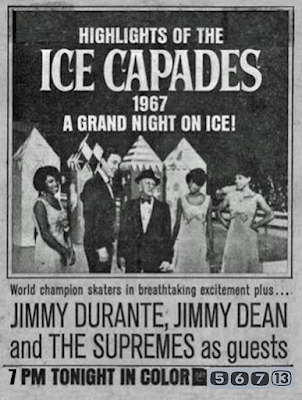
First up, on Monday, is your 1967 Ice Capades (7:00 p.m., NBC), hosted by Jimmy Durante and featuring Jimmy Dean and the Supremes. The Ice Capades first appeared on NBC in 1965, and their annual show ran through 1970, with various hosts such as Arthur Godfrey, Lorne Greene and Florence Henderson. (These ice shows are something of a regular occurrence on NBC; later in the year, Ed Ames hosts a similar presentation of the Ice Follies.)
Not to be outdone, Milton Berle hosts Holiday on Ice (one of the Ice Follies' bitter competitors) Thursday night (9:00 p.m., ABC). Perhaps a little more glamour here; whereas Capades show was taped in Rochester, New York, Holiday on Ice comes to you from Paris. Berle ought to be a good MC for this; it's much like his hosting jobs on his other variety shows, and there are probably plenty of pretty girls in skimpy outfits for him to leer at.
Interestingly enough, the Ice Capades went out of business in the mid-90s, while in 1979 the Ice Follies merged with Holiday on Ice. There's no limit to themed ice shows out there even today, though.
lll
And now a brief pause for some culture, and I'm not talking about what you'd find in a petri dish, either.
On Monday, Gilligan's Island and the aforementioned Mr. Terrific are preempted for a musical rendition of Pinocchio by New York's Prince Street Players (6:30 p.m., CBS). This is just one of a number of productions of classic family stories that Prince Street Players did for CBS between 1965 and 1970, including Jack and the Beanstalk, The Emperor's New Clothes, and Aladdin. Fortunately, several of them exist on YouTube—including Pinocchio!
Wednesday, KTCA, the public broadcasting station, has An Age of Kings (7:00 p.m.), a continuing series of the Bard's historical plays. You'll see this pop up throughout the '60s, especially the early part of the decade—it was made by the BBC in 1960. Later the same evening, WTCN has The Wars of the Roses (8:30 p.m.), another BBC production of Shakespeare's first series of historical plays, made in 1965. I find it interesting that this was being shown on commercial, rather than public, television; possibly it was some kind of syndicated package similar to when Edward the King was broadcast in America in the mid-70s.
Friday night, NET Opera Theatre (7:00 p.m., WDSE) presents Jack Beeson's opera Lizzie Borden, based on the ax murderess of the same name. The production is from the acclaimed world premiere staged by the New York City Opera in 1965, adapted for the television stage. The music is modern and at times atonal, and Beeson has taken liberties with the story for dramatic effect, but it makes for compelling viewing both as an opera and a television production. The broadcast is a prime example of the advantage to staging an opera in a television studio (as opposed to simply bringing in cameras to cover a live performance, as is done with the Metropolitan Opera's HD broadcasts), giving viewers camera angles and views that would be impossible to replicate in a live theater broadcast. Following the opera, there's a half-hour profile of composer Beeson, looking at his work methods and motivations.
lll
Some other selections from the week:
The Golden Globes are broadcast Wednesday at 9:00 p.m. on NBC, hosted by Andy Williams. You remember the Golden Globes, don't you? I know they've only been off television for one year, but memories are short, nowadays. Anyway, I wrote a while back about the Golden Globes and their colorful history; for a few years the awards were actually presented on Andy's variety show, but this year they get their own place in the sun. It's a short spotlight, though; the show still runs for only an hour, but that's plenty of time to give out a handful of awards, most of them to the movie A Man for All Seasons. You'll recall that this would have been during the period of time when winners were actually tipped off in advance that they were bringing home the award; it was often the only way to get them to attend the show. Today, the problems faced by the Hollywood Foreign Press Assocation, presenter of the Globes, are not so much because of being colorful, but colorless, shall we say.
One of the great Star Trek episodes of all time airs on Thursday (7:30 p.m., NBC)—"Space Seed." It introduces us to a ruthless dictator played by Ricardo Montalban, and without it we'd never have gotten this immortal scene.
OK, maybe it didn't last that long. . .
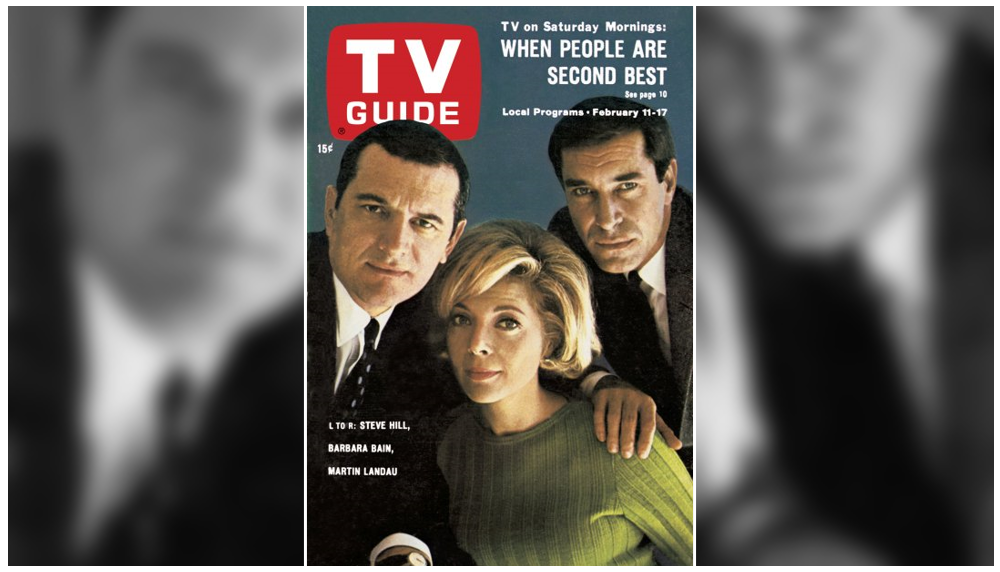
The cover story this week, by Leslie Raddatz, is on Steven Hill, the original head of the Mission: Impossible team. After decades of reruns with Peter Graves as Jim Phelps*, it can be a little surprising to remember that for the first season of Mission: Impossible, it was Hill's Dan Briggs who listened to the recordings at the beginning of each show and pulled the same pictures out of the dossier each time.
*Who is not a traitor to his country, no matter what Brian DePalma thinks.
Hill is very good in the role, with just the right amount of menace to suggest that, if things were to get tough, Dan Briggs could get even tougher. It doesn't work out, though, and the reasons are clear in the article. Hill is an observant Orthodox Jew who leaves the set on Fridays in order to get home before sundown, and does not work on Jewish holy days, and while his beliefs are respected, there's no doubt that it puts a crimp in shooting a complicated television series. Many times Briggs' visible role is limited to the beginning and end of the story, and there's at least one episode in which he isn't seen at all. His level of involvement in each week's mission is seldom as large as it becomes for Jim Phelps in future seasons. So it's one year and out for Steven Hill, but don't worry too much—Law & Order will be by in a couple of decades, and he'll get ten seasons out of that.
Our starlet of the week is "comely" Pat Moore, who is moving from a $60 per hour model to a bit player in television (a semi-regular on Hullabaloo and Perry Como, but with no speaking lines) and commercials (where, as is usual in commercials, her voice is dubbed). For her, the big time is simple: being able to talk.
In the TV Teletype, we're told that Batman producer Howie Horwitz is "looking for a Batgirl to 'fight evil' next fall. Batman won't know her real life identity and vice versa." Thanks to retrovision, we do know the identity of Batgirl, though—the lissome Yvonne Craig, who packs quite a kick.
And speaking of Batman. . .
lll
Dwight Whitney spends some quality time with Adam West, learning about what it's like being the star of the hottest television show around. His portrait of West paints a restless man who has already been married and divorced twice, an ambitious man who gave up a successful radio show in Honolulu (and his second wife) when Hollywood called, an actor who wants to be thought of in the same company with Marcello Mastroianni. Batman, Adam West says, "will make it possible for me to do what I want to do the way I want to do it." And that is? "Like be a big fat star."
Lest this sound too serious though, there's a wonderful bit at the beginning of the article that is pure West, speaking in that stiff, breathless staccato full of odd pauses, as campy and self-deprecating as we've come to see him in the years since Batman. The scene: West's dressing room trailer as he prepares for the day's shooting.
"It's hero time," says Adam West lightly, tugging the top of the tights up over the flat of his stomach and starting on the skintight tunic. "In a moment I will step from this humble dwelling and, to the plaudits of the crowd, plummet from a platform fully three and a half feet high."
The chant "We want Batman!" rises in shrill crescendo. "Ah, the adulation!" he continues, undulating like a Girl Scout in a tight girdle. "Oh, I love it, basking in the sincere warm smiles of the little children. What! You say Chief O'Hara isn't working today? Oh, I miss the Chief. The family's disintegrating—Robin off to college, Aunt Harriet drafted and being shipped to Vietnam. Oh, the heartbreak of it all. Here, give me that!"
His dresser hands him the tiny gray skullcap worn beneath the Batman helmet. West places it with exaggerated care. "I wonder if I should go out and bless the crowd? No, perhaps not." He jams the fiberglass-and-nylon helmet down over his ears. "Marvelous bit of haberdashery," he mumbles. "It's hot. The sound bounces. Can't hear. My nose pinches and gives me a cleft palate. Can't see. And I owe it all to that peerless Prince of Trivia, our producer Bill—'Bull'—Dozier, who refuses to supply me with a seeing-eye dog. Now off to give another Academy Award-winning performance."
[...]
"Sign my autograph, Batman, please!"
"Later, kids," says the Caped Crusader coolly. "Got to rescue Alfred from the clutches of that infernal scoundrel, The Archer."
"Aw, Batman, you couldn't hurt a flea!" says one.
"Yeah," replies Adam West amiably. "Disillusioning, isn't it?"
And that, my friends, makes this whole blog worth it.
TV
I've often written about sports announcers who were what I called "big-game announcers," and since there's apparently a big game this weekend, it's appropriate to start with Bryan Curtis's profile at The Ringer of one of the last big-game announcers around: Al Michaels. Not only is it an interesting look at Michaels, it's a very good reminder of just what it is that makes announcers like him worthy of the title.
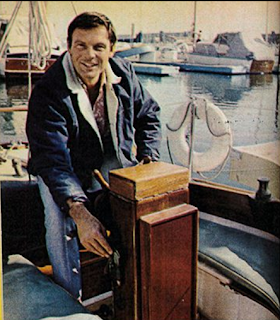
Richard Long is a familiar face to any classic television viewer: Bourbon Street Beat, 77 Sunset Strip, The Big Valley, and Nanny and the Professor roll off the tongue, and he did guest appearances on just about every show of the 1960s, which makes Rick's "Seven Things to Know" feature about Long at Classic Film & TV Cafe particularly fun.
"See the Monkey Dance"--a title like that tells me that this story isn't going to turn out well. It's the name of Lewis Davidson's first teleplay for The Alfred Hitchcock Hour, and it's Jack's first look at him in this Hitchcock Project entry at bare-bones e-zine.
At Cult TV Blog, John continues his look at "orphaned episodes" with "The Facts of Life," an episode of the 1960s series Our Man at St. Mark's. Like the American series of the same name, "The Facts of Life" is a comedy, but the similarities end there. John also has a couple of requests for those who might be able to help.
At A Shroud of Thoughts, Terence commemorates the truly impressive career of special effects genius Douglas Trumbull, who died this week, aged 79. Trumbull played a pivotal role in the design of 2001: A Space Odyssey, directed the movie Silent Running, worked on all kinds of films (including Close Encounters and Blade Runner), and animated the beloved opening graphics for ABC's Movie of the Week.
Martin Grams has a very interesting story on the 1976 British anthology series Plays for Britain, which he refers to as "the British Playhouse 90." It's available on DVD now, and while not every episode is a home run, he feels it's well worth checking out. Have you heard of this, John?
From the email inbox, Brendan Somers poses this question: "After coming from England and hitch hiking from the East Coast I somehow got on Dick Martin's new game show Mindreaders on the 15th August 1979 and would love to have a copy of that show. Sadly nearly all that series shows were destroyed except about 4 of which one was mine. Whilst Youtube has a video of this show purporting to be a "full" episode there's no footage of the men (of whom I was one) being questioned etc, but only the women. I wonder if you can help me in any way to get the footage of me. Rowan and Martin's Laugh-In was a favourite show of mine and I'd love to get a record of my meeting with him and the show." Brendan, I think it's a longshot, but I'll throw this out for anyone to comment on. Thanks! TV