September 8, 2023

Live from the Mid-Atlantic Nostalgia Convention


HUNT VALLEY, MD — One of the advantages to being retired (and there are many) is that, for perhaps the first time in my life, my time is my own. And so, rather than making a hectic, cramped flight to Baltimore followed by a long drive to the hotel, we made the longer (nine hours) but much more relaxing drive to Hunt Valley, home of the Mid Atlantic Nostalgia Convention.  And, thanks to being able to bring far more in the car than one is able to cram into a couple of suitcases and carry-ons, I'm able to report to you for the first time live, more or less, on location, rather than waiting until a few days later.

As I'm writing this, it's the morning of day two of the convention, which started Thursday and wraps up tomorrow; it's been several years since we last attended MANC, but everything feels pretty much the same; the hotel is still inadequate and the air conditioning is only partly functional in the vendor rooms, which isn't all that welcome when the temperatures outside are hovering in the high 90s. (Thankfully, the convention will be moving to a new venue next year, with this hotel seeing the bulldozers). And even though our friends from past years aren't here this time (Carol, Jodie, Kevin: I'm counting on you to be here next year), it's like old-home week being back.

As proof of our attendance, I submit the following, never-before seen on this website:

Hal Linden (L) and Max Gail (R)

Tim Matheson

Diane Baker

We all know these people are actors, and used to dealing with the public. They're still just people, though, like you and me, and I don't think they ever get tired of people complimenting them on how much pleasure they've given you over the years. They were very nice and generous with their time, and each one had a few specific things to say based on whatever comments you'd made to them; for instance, Diane Baker appeared in the final episode of The Fugitive as the woman whom Dr. Richard Kimble presumably settles down with; I joked that we felt he was now in safe hands, and she went on to talk about what a good actor David Janssen was, what a nice man he was to work with, and how intelligent he was—check out some of his interviews on YouTube, she said, and see how articulate he is talking about various subjects. Hal Linden talked about how fortunate he'd been to work with Danny Arnold, who created Barney Miller, and how, as an independent producer, Arnold hadn't had to satisfy all the network suits during the development process. When Max Gail found out we'd driven nine hours to get here, he wished us a safe trip home. And Tim Matheson talked about how much fun it had been working on Animal House, and how smart it had been for the producers to set it as a period piece to make the humor all the more subversive. 

Bond girls Kristina Wayborn (L) and Mary Stavin (R)
from
Octopussy, prior to a showing of the movie

It's wonderful being in a place where you can go back in time for awhile without having to worry about what's going on outside, where you're hanging out with people who are interested in the same things you are and appreciate what you think; one of the vendors I spoke with said he'd had a customer who'd mentioned my presentation from a few years ago when I'd talked about TV Guide; he'd gotten into collecting them because of my talk. I wasn't presenting this year; we're here strictly as spectators, which is really the way to go because you get to see the celebrities, listen to the seminars and presentations, and hobnob with the vendors (and shell out some money while doing so, I might add). I'm hoping to be back doing something here in the next couple of years in conjunction with the book I'm finishing up, now, but in any event we'll be back, enjoying the benefits of retirement.

The convention continues through Saturday, so stop by if you're in the neighborhood. In the meantime, you'll excuse me, but there's a panel on What's My Line? to catch. . .

UPDATE: A look at some of the loot:

We went to MANC and got a lot more than a (not) lousy T-shirt!

Yes, we will see more TV Guides on the site next year!

The item on the right is a Rocky Soaky to go along with my Bullwinkle at home

And it's autographed, too!

 TV  

September 6, 2023

How to watch TV


I imagine the answer to this must be self-evident to most of you; after all, you wouldn't be here unless you already knew how to watch TV, right? (It certainly can't be for my sparkling, rapier-like wit and charm.) 

But when you think about it—and, believe me, I have—there are different ways to watch TV, depending on the type of show you're watching. Sometimes, of course, all you need is some white noise, some background chatter to keep you from being distracted by doing something more important. (Like reading this esasy, for instance.) There are other times, though, when you find yourself drawn in by the storytelling, invited into a universe inhabited by the characters you see on screen. This is storytelling at its best. It causes you to think—not in the sense that you're attending a class or listening to a lecture, but because you become an active participant, either in confronting the challenges faced by the characters, or dealing with the issues raised in the story.

For example, let's look at a question raised in a recent episode of Sam Benedict, the legal drama I've been watching: should an attorney leave himself open to severe discipline, perhaps even disbarrment, for failing to provide an adequate defense for a man he knew was guilty? His secretary thinks not: she knows her boss as a good and decent man, and argues that he shouldn't be forced to put his own career on the line for a man who was clearly guilty. (The jury came in with a guilty verdict and death sentence in forty minutes.) Even if an appeal is upheld, the defendant will just be retried, convicted again, and executed anyway; why sacrifice yourself when you're not going to change anything? 

For Sam Benedict, the issue is that everyone, regardless of their guilt or innocence, is entitled to a fair trial, and this man—regardless of his guilt or innocence—didn't receive one. His Sixth Amendment rights were violated because he didn't have an adequate defense. And now, hours from the scheduled execution, the attorney has no choice; he is duty-bound to act in the best interests of his client.

So what do you think? I know people who'd agree with the secretary, who'd say that there's no sense in giving up your own career over defending a man who was guilty anyway. People are funny that way; they're the same ones who are always saying that "if you're innocent, you don't have anything to fear." But we all know, or should know by now, that this ain't necessarily so. Sure, crime offends us, especially when the victim is a child or a senior citizen, innocent or defenseless. It's the same rationale used by cops who plant evidence on a suspect in order to guarantee a conviction. He's guilty anyway, they say to themselves and others; this is just to ensure nothing funny happens, whether you get a slick lawyer or a lenient judge or jury nullification. It's an easy call when guilt is obvious, right? Well, it is easy to be favor of justice for everyone in the abstract, but what happens when push comes to shove? 

This is an example of a story that forces you to think about the questions being raised. You might wonder what you'd do in the same situation, but more likely you're finding that the episode may be challenging your beliefs, questioning your ideas; it might even force you to change your mind.

Then, there's a show like Combat!, where you find yourself in the middle of the action, with bombs bursting around you and bullets whizzing past your head. I don't know about you, but I find it impossible not to put myself in the battlefield, wondering what I'd do if it were me in that trench, seeing death and destruction everywhere—and being grateful that I was never in such a situation. Does it make you consider your opinion toward war and peace? You understand that you're being manipulated; after all, every storyteller tries to control the reaction that story produces, and the producers of Combat! made no bones about it being an anti-war drama, though not in a political sense.

But what happens when a storyline forces you to consider the wounded German soldier, perhaps the very one who was shooting at you just a few minutes ago, as a fellow human being? Is it still a situation of kill-or-be-killed, or do you look at him as a creation of God, deserving of being treated with dignity? You might argue that things are different in wartime, but Christ was well aware of war, yet He still admonished His followers to love their enemies. And again, you find yourself being asked: What would you do? Can you expect the Germans to live up to the Geneva Convention regarding prisoners of war if you're not prepared to do the same? 

Granted, with shows like these, it's easy to sit back on your couch and declare your certainty that you'd do the right thing if it came to that, but in truth we can't know for sure; things are different when people are shooting at you, or if it's your daughter's killer on trial. One thing is for sure: it's an excellent way for you to come face-to-face with some uncomfortable truths.

Finally, there are those series that invite you to speculate on what Paul Harvey used to call the rest of the story. Hogan's Heroes is a perfect example of this kind of show; lacking a final episode, it's become something of a cottage industry for people to speculate on what happened after the series ended; I engaged in a bit of that myself, in one of the more popular pieces I've written here. But when people come to feel that they know and love the characters they see on screen, it becomes natural to speculate on what happens next. 

One series that seems to be ripe for this kind of treatment is another World War II drama, Garrison's Gorillas. Unlike Combat!, Garrison's Gorillas is a more conventional action-adventure program, in which a team of convicts, each with a particular talent, is assembled into a fighting unit designed to carry out particularly difficult missions requiring the kinds of skills which Garrison's men possess. In return for taking part in these missions, the men are promised their freedom—six months after the war ends. But since the show was cancelled after a single season, we never know what the rest of the story is. Do they make it all the way through, or are some of them killed along the way? And does the government hold up their part of the bargain in the end?

After one particular mission, I had the disturbing thought that, in real life, things would not have gone so well for our heroes after the war. Remember, for instance, the pains to which Allen Dulles and the wartime spy machine took to ensure the secrecy of Operation Paperclip, the project that utlized German scientists, some of them war criminals, in the American rocket program. Would Dulles have been sanguine about the American public—or, even worse, American lawmakers—finding out that the U.S. military had recruited convicts, some of them perhaps dangerous, some of them perhaps security risks, to take part in missions that might well have involved documents that, after the war, could have been sold to the highest bidder? And that, as part of the deal, these convicts had been promised their freedom in return? 

I wonder. Dulles was a devious type, likely part of the cabal to which Taylor Caldwell referred in last week's piece, and I think he would have wanted to keep this operation as secret as possible. Given the nature of criminals, I doubt he would have trusted them either to behave themselves or to keep quite. Therefore, the logical solution would be to have them all killed in the last days of the war. When I expressed this opinion to my wife, she sensibly pointed out that Garrison himself would never stand for such a thing. She's right, of course, which is why Garrision would also have to die. It probably would have been some kind of plane crash on the way back from a final mission, the kind of crash that often occurs to those whom the government views as a liability. A dark conclusion to the story, perhaps, but no less logical than many fan fictions that people write.

And when it comes to it, that's what this is all about. Fan fiction, like any other involvement in the characters and storylines of a television series, is nothing to be ridiculed. Whether or not the stories are logical and well-written or elementary pieces of tripe doesn't matter—what does is that people have engaged in these stories in a way that demonstrates how these programs made them think, rather than sit dully in front of a flickering screen doing their best impressions of someone in a vegetative state. People who say they don't want to be challenged by television shows, that they don't want to be made to think, are missing the whole point. (Remember a few weeks ago I wrote about how even game shows like Supermarket Sweep required the viewer to have a "detailed knowledge of market prices plus the ability to make arithmetical calculations, involving fractions, at high speed."

This isn't to say that every television show is a college-level ethics class masquerading as entertainment; there's enough evidence to the contrary to disabuse anyone of that notion. But a viewer shouldn't be intimidated by the idea of a television show causing those little gray cells to work. That, I think, is the way to watch television. And who knows—they might even find they like it. TV  

September 4, 2023

What's on TV? Wednesday, September 5, 1973


Happy Labor Day to one and all out there. I've always found it interesting that Labor Day is a day that should, one would think, be dedicated to the common laborer, the union member, the guy whose sweat makes our life better. And yet it seems to me that the those who benefit from it most are government and white-collar workers, who get to go shopping and take advantage of all those people who don't get the day off. Oh well; when I was working, I never turned down the chance to have a holiday. At any rate, I considered looking at this issue's Labor Day, what with the Jerry Lewis Telethon and all, but that would have been too easy; it would have wiped out most of a day's programming for two stations. What's the fun in that? So here's our average, ordinary day in TV land, courtesy of the Central California edition. Don't work too hard reading it!

September 2, 2023

This week in TV Guide: September 1, 1973


Growing up, there were certain things that were simply part of the American fabric, events you noticed whether you were interested in them or not. The Miss America Pageant was one of those events. It seemed as if everyone watched Miss America, even though we know that wasn't the case, and while a particular contestant would occasionally capture the hearts of everyone (usually with a winning smile and a particularly spectacular talent presentation), most of the time people tuned in to see if their state's entrant would win. (There were always headlines in the papers on Monday if Miss Minnesota won, which she did three times; the pageant usually ended too late for it to make the Sunday paper.)

The pageant isn't until next week, but this week J. Robert Conroy has an article about his uncle, Ed Corcoran, who took over the pageant in 1935. At that point the pageant had endured a colorful, if checkered, early history; if you ever wondered, for instance, why some of the pageants included contestants identified as Miss Chicago and Miss New York City, or that Miss Toronto and Miss Winnipeg once competed to become Miss America, the answer is that the pageant was founded on the idea of increasing tourism in Atlantic City, which is approximately 100 percent dependant on the tourist trade, so if having a Miss Chicago or a Miss Toronto meant more tourists, "that was just dandy with Atlantic City." (In fact, Miss America 1925 was Norma Smallwood, Miss Tulsa. Also landing in the top 15 was Miss Dallas, Rosebud Blondell, better known today as Joan.) 

Conroy is frank in stating that his Uncle Ed "ran a leg show, and that was it, period. There wasn't a baton-twirler in the bunch. He wouldn't even let the girls talk, let alone answer cute questions on stage to demonstrate whatever it is that part of the program is supposed to demonstrate." It wasn't that they didn't have talent, "he just believed that things would be better if they kept it to themselves." Contestants would go through a tortuous evening of turning to the left, turning to the right, walking back and forth across the stage, and then turning left and right again, while the judges bickered amongst themselves, plugging for their personal favorites. It took hours; "As often as not, the crowning of the new queen dragged on well beyond midnight into the small hours of Sunday morning, much too late to make any of the Sunday papers, whose representatives had long since fallen asleep in their chairs."
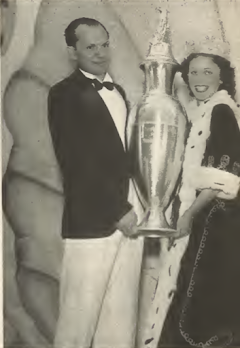
     Ed Corcoran with Miss America 1935,
Henrietta Leaver
The modern Miss America Pageant began to emerge when Leonra Slaughter took the reins following Corcoran's death; whereas Corcoran built it into a successful tourist event, "an obviously successful device to get the Atlantic City name in print as a place very much alive after Labor Day as well as before," Slaughter took it further, tailoring it for a television audience, and building up sponsors who would provide the money for the pageant's scholarship fund. She also worked with the Junior Chamber of Commerce to take over sponsoring local contests—movie houses had been the primary sponsors prior to that. 

Conroy, who became a press agent and whose connection with the pageant had continued after his uncle's death, recounts his own involvement with the Jaycees in their first running of the Miss Chicago pageant. Before the night was over, he found himself serving as the one and only judge of the contest. "So, I picked this long-legged blonde stunner and wrote a rave letter back to Lenora that my beauty was going to win all the marbles. She didn't, but she did make the semifinals. Maybe you can imagine the pride I felt when I saw Cloris Leachman walk on a stage once again, earlier this year —to accept her Emmy."

Conroy notes that "They don't make Miss America Pageants any more the way they used to," and this was back in 1973. Through the years, the pageant suffered the backlash from the woman's lib movement, sex scandals, and more, and cratered during the disastrous tenure of Gretchen Carlson (the last Miss Minnesota to become Miss America) as head of the organization. The pageant moved from Atlantic City to a casino arena in Connecticut, and was dropped from network television. In fact, looking at the information online, the date and location for this year's pageant haven't even been decided yet. It's too bad, but not surprising, Times change, as I'm always saying, and there's no reason to think that Miss America wouldn't be part of the changes. It's just one more event that's disappeared from our common American experience.

l  l  l

It's always nice to get the Soviet perspective on things, and Richard K. Doan reports that the Russians are accusing Sesame Street of being an "imperialist plot," designed to foster concepts such as "private enterprise and the importance of money." Even though Doan says American shows such as Mighty Mouse, Lassie, and Daktari have been seen on Russian TV (not to mention The Rifleman), the Soviets fear that Sesame Street's "cultural imperialism" could infiltrate Soviet homes when global satellite networks come into being. The Children's Television Workshop points out that Sesame Street already airs in 50 countries, and predicts that someday the show will be shown in the USSR. Close; after the fall of the Soviet Union in 1993, Ulitsa Sezam premieres.

Over at the Tiffany Network, CBS is recoving from a recent double-battering of controversy, starting with the presentation of the movie ◀ Sticks and Bones on August 17. The movie skewered the facade of the "ideal Amerian family," telling the story of a blind and embittered Vietnam veteran named David, his brother Rick, and his parents Ozzie and Harriet. A touchy topic to be sure, but even so the response from the network's affiliates is surprising: 94 of the 186 stations refused to carry Sticks and Bones, although in eight cities it was carried by non-CBS affiliates. One CBS insider, who said that the show was "not even good drama," guessed that "the tune-out in the first half hour must have been astronomical." 

As if the network hadn't already bought enough trouble, there was also the repeat of the two-part "Maude's Dilemma" story on the popular sitcom, in which Bea Arthur's character has an abortion. The show had been somewhat controversial when it was originally aired in November 1972, but by the time the network decided to repeat the story in August, a campaign had been organized against the network; this time, 39 affiliates chose not to air the episodes (only two had done so on first showing), and CBS received more than 17,000 letters of protest, twice as many as they'd gotten back in November. (I wonder what kind of overlap there was on affiliates who chose not to carry either show?) One can understand why CBS chose to burn the shows in August, before the start of the new season.

Oh, and as if that weren't bad enough, the first ratings are in for the new CBS Morning News with Hughes Rudd and Sally Quinn. "Nielsen reported New Yorkers switched heavily to the [Rudd-Quinn] newscast the first week—then returned in large numbers to the Today show."

l  l  l

This week's TV Teletype gives us a look at some coming attractions, including a made-for-TV remake of the classic Miracle on 34th Street, starring Jane Alexander, David Hartman, and Sebasian Cabot, which can be seen December 14 on CBS. This movie has its fans, but I'm not one of them; when you have an original like Miracle, what can you possibly add that would make it worthwhile? Oh, and I particularly appreciate the shots of all those lush, non-evergreen trees in full leaf; I understand how telemovies with short production times have to shoot in summertime, but it still makes it look as if you're not even trying.

ABC's working on a morning show of its own, to compete against Today and the CBS Morning News. The network is hoping to have its yet-unnamed show on the air by January 1; Steve Mills, the VP heading up the project, says it "will probably have a team of personalities, a host and/or hostess, sports elements and a variety of specialists." Sounds like every other morning show, doesn't it? In the event, the show, AM America, doesn't premiere until January 6, 1975, and never finds a footing; it's replaced that November by Good Morning America, hosted by the aforementioned David Hartman.

We're also told that Jerry Lewis has a big lineup in-store for his annual Labor Day Telethon, airing this weekend. Stars include Rowan and Martin, Dionne Warwicke, Buddy Hackett, Johnny Cash, Tony Curtis, Merv Griffin, Connie Stevens, Peter Falk, and Bobby Darin. And speaking of stars, the latest trend features sports stars in acting roles; boxer Jerry Quarry is playing a bouncer on The Magician, former baseball player Maury Wills is appearing on Adam's Rib, and O.J. Simpson guests on Here's Lucy. There's apparently no truth to the rumor that Simpson had originally been considered for a remake of Run for Your Life.

l  l  l

But enough of industry news; what's actually on the tube this week? It's the last week before the beginning of the new fall season (the highly-anticipated Fall Preview comes out next week; I reviewed it here), but there are still things that merit your attention.

The highlight is Wednesday night's special presentation on NBC, the television premiere of 1966's Best Picture winner A Man for All Seasons (Wednesday, 8:30 p.m. PT), starring Oscar winner Paul Scofield as Sir Thomas More, who was martyred by the psychotic Henry VIII for refusing to recognize the king's divorce from Catherine of Aragon. The movie won six Oscars in total; Judith Crist calls it "a thinking man's spectacular," "a gripping human drama in which the passions and turbulence are underplayed, a probing study of conscience whose complexities and subtleties are indicated with brilliant clarity and whose contemporary significance is forcefully presented by implication alone." Interestingly, NBC plans to repeat the movie the following Sunday afternoon as part of NBC Week. I think I've mentioned this before, but this is a movie that took a long time to grow on me; I finally made the commitment a few years ago, and now it's part of my library; it is, indeed, a great movie.

Among the movie repeats are a couple of successful pilots: Toma (Wednesday, 8:30 p.m., ABC), starring Tony Musante as the detective who's a master of disguise, and The Six Million Dollar Man (Tuesday, 8:30 p.m., ABC), with Lee Majors as the man-machine. Crist likes the first, but finds the second "somehow wholly unappetizing." Musante leaves Toma after one season, with the series then morphing into Baretta, while The Six Million Dollar Man thrives for five successful seasons, even generating the Bionic Woman spin-off. 

My earlier mention of the Jerry Lewis Telethon (Sunday, 7:30 p.m., KFSN in Fresno; 8:30 p.m., KERO in Bakersfield) reminds me that it's Labor Day weekend, with the attendant sports highlights. CBS presents coverage of the first weekend of the U.S. Open tennis championships (Saturday at 1:00 p.m., Sunday at 12:00 p.m.), while on Labor Day itself, it's the world's richest horse race, the All-American Futurity, from Ruidoso Downs, New Mexico (4:30 p.m., syndicated). The third jewel of the quarter-horse triple crown pays the winner $330,000, while the runner up makes $138,000—nearly as much as first prize in the Kentucky Derby. It's still run every Labor Day, televised on the Cowboy Channel, and though it's not the world's richest race, the winner takes home over $1 million, making it the richest race of any kind for two-year olds. I used to watch this every year; it was a nice wind-down from the Telethon. 

On Tuesday, NBC devotes its entire prime-time to a three-hour NBC Reports special on the Energy Crisis (8:00 p.m.), which is also the subject of a Neil Hickey piece asking "Will the Lights Go Out All Over the World?" The report's three major segments focus on coal (cheap and safe, it's 7"our most abundant and inexpensive source of energy"), nuclear power ("the risk is small—but we don't know how small"), and oil ("Wells are pumping at full force, yet more and more filling stations are running dry"). Fifty years later, the successful intertwining of energy with climate change means coal is out of the question, nuclear energy is too dangerous, and oil is killing the planet. What it all means, other than that the eco-warriors have a very good public relations machine, is anybody's guess.

William Conrad does a Cannon double-dip on Wednesday, first playing the portly detective in a sketch on The Sonny and Cher Comedy Hour (8:00 p.m., CBS), where he "searches for baddies at Sonny's pizza parlor"; as himself, Conrad also sings "The Men in My Little Girl's Life." (Rick Springfield is the musicial guest, by the way, singing "What Would the Children Think?") Later, on his own show (10:00 p.m., CBS), Cannon tries to save attorney Jessica Walter from someone who wants her off her latest case.

Thursday night offers sports and music; at 6:00 p.m. on CBS, it's an NFL practice—I mean, "exhibition"—game between the last two Super Bowl champions, as the Miami Dolphins take on the Dallas Cowboys. In truth, though, exhibition games were much different back then, as the starters often played at least half the game, playing themselves into shape. Over at ABC, Tony Bennett and Lena Horne join forces for an hour of music—"and no variety-show small talk." (9:00 p.m.) Fourteen songs are on the menu, with another 24 covered in a medley saluting composer Harold Arlen (including "Over the Rainbow," "Stormy Weather," and "Come Rain or Come Shine.")

Friday
night ABC and NBC air primetime specials touting their new Saturday morning lineups. ABC's Saturday Morning Sneak Peak (8:00 p.m.) is hosted by Jack Burns and Avery Schreiber, with Rick Springfield (Mission: Magic!), Lassie (Lassie's Rescue Rangers), and new offerings from Batman and Superman (Super Friends), Yogi Bear (Yogi's Gang), and Goober (Goober and the Ghost Chasers). Meanwhile, NBC Starship Rescue (8:30 p.m.) touts the new animated Star Trek, Butch Cassidy and the Sundance Kids, Go!, and appearances by Kevin Tighe and Randolph Mantooth (Emergency +4) and Johnny Whitaker, Scott Kolden, and Billy Barty (Sigmund and the Sea Monsters). CBS, not to be left out, has a repeat of Weird Harold, one of Bill Cosby's creations, featuring Fat Albert and more of his friends. I was pretty much over the Saturday morning scene by then, but these shows just sound painful to me. 

l  l  l

Well, we've just about made it through another summer, with its usual share of reruns, buried documentaries, and the like. Next week comes the Fall Preview, but not the one advertised in the pages of this week's issue. Instead, we'll be looking at the 1965-66 edition, with all the hits the new season has to offer, including magic in a bottle, fun in a POW camp, a honey of a detective, and a program that sets the standards for dumb ideas on TV.  You'll want to run for your lives to see it! TV  

September 1, 2023

Around the dial


Just the other week, we were looking yet again at the popularity of movies on television, and how the introduction of more recently-made movies was a real game changer; we see evidence of this in an ad from the Broadcasting Archives. Pal Joey, the movie being promoted in the ad, is a Sinatra movie from 1957; the implication is that because WBEN shows newer movies, they're the station to beat in Buffalo.

David's journey through 1970s TV continues at Comfort TV; in case you've forgotten, he's on a quest to see at least one episode from every series of the decade. This week, he turns to Friday nights in 1972, It's a fascinating schedule, including shows like Sanford and Son, The Brady Bunch, The Partridge Family, Sonny and Cher, and The Odd Couple. Not bad at all.

At Cult TV, John is watching the classic British comedy Ripping Yarns, with Michael Palin and Terry Jones. Unlike many of John's entries, I've actually seen and enjoyed this series on PBS, even though the "boy's own" genre isn't something native to me. This week, he's looking at "The Curse of the Claw," and if you're inclined to a Pythonesque type of humor, I think you'll get it.

At Those Were the Days, there's a series of posts on the two TV-movies Elizabeth Montgomery did in the mid-1990s that were based on the autobiography of the famed crime reporter Edna Buchanan. 1995's Deadline for Murder, the second in the series, was Montgomery's final performance before her death later that year; I wonder if there were more movies in the series planned?

We haven't had an Avengers review yet this week, so let's go to The View from the Junkyard, where Roger and Mike dissect "Honey for the Prince," a Steed-and-Peel episode at the end of the black-and-white era. Their views diverge on this one, and I'm not going to tell you which one I agree with; you'll have to guess that on your own.

And finally, since last we did this, Bob Barker died, 99 years old. It's probable that he was on television before most of us here were born, and it seemed he'd always be around: Truth or Consequences, The Price is Right, the Miss Universe Pageant, the Tournament of Roses Parade. He had what in sports I've called the "big-game voice," the idea that if you heard him on television, you could be pretty sure that whatever he was doing was credible, or at least not a complete waste of time. At A Shroud of Thoughts, Terence has more on the life and career of a television institution.

If you're going to be on the road for this holiday weekend, have a safe time, and I'll see you back here later. And remember, I'll be at the Mid Atlantic Nostalgia Convention next week; let me know if you'll be there too! TV