September 16, 2023

This week in TV Guide: September 17, 1955


Let's start the week off right with a look at two legends and their relationship to TV, beginning with Judy Garland and her television debut on next Saturday's 90-minute Ford Star Jubilee. It will be telecast live and in color (on the East Coast, anyway), with special guest David Wayne, playing the Fred Astaire role in a song from Easter Parade.

Garland is only 33 and without the gaunt look that we'd see a decade later—in fact, don't you think she looks like daughter Liza in the picture on that album cover below? And even though she cancelled the remainder of her national tour in order to do the special, she's nervous all the same. "I’ll probably come out on the stage, take one look at those three-eyed TV monsters and faint dead away," she says. "And then where am I going to find another medium to make my comeback?" 

Still, it's a time of excitement, and she's not going to worry about it. "I’ll just work my head off, get good and sick 30 minutes before air time, and by Sunday morning we’ll know whether or not I’ve laid an egg." The writer is confident that she won't. And I don't think she did, either; included in the show is the only video performance of "Over the Rainbow" while wearing the famous tramp outfit that she so often wore in concert. As a matter of fact, you can see most of the show here and decide for yourself. As I frequently say, we're fortunate we have this much of our television history still intact.

l  l  l

From one legend to another: Frank Sinatra says he has no interest in doing television on a regular basis—it's "too tough," he says—but the networks keep coming after him, and he's not above doing the occasional special, such as this Monday's now-famous Producers' Showcase presentation of Thornton Wilder's "Our Town" (7:00 p.m. CT, NBC) in which Sinatra plays the Stage Manager and introduces the song "Love and Marriage."* The cast includes Paul Newman and Eva Marie Saint, the two teenagers at the heart of the story, plus Shelley Fabares and well-known character actors Paul Hartman, Ernest Truex, Sylvia Field, and Peg Hillias. 

*It's also the first of a long collaboration between songwritesr Sammy Cahn and Jimmy Van Heusen. 

But back to The Chairman; he's happy with "Our Town" ("a great script"), but he says he doesn't have any TV plans for the future. "I like movies better," he tells Dan Jenkins, although he makes fun of an early effort, 1948's The Miracle of the Bells, now popular on The Late, Late Show, in which he plays a priest, "walking through the role with all the grace and animation of a wooden Indian" according to Jenkins ("Pretty awful, wasn't it?" Sinatra acknowledges.) A man can afford to do that when he has an Academy Award on the mantlepiece, which Sinatra won five years later for From Here to Eternity. "Takes a guy that long to learn how to act," he says. "You gotta keep watching all the other guys and pretty soon you absorb enough of it or it just rubs off on you or something. Anyway, you learn." He learns pretty good; later in the year he'll star in The Man with the Golden Arm, for which he'll receive another Oscar nomination the following year. And despite his protestations to the contrary, he's got one more TV series up his sleeve, a 1957 effort for ABC that was to combine dramatic efforts with occasional music specials.

That series fails (as did an earlier CBS effort in 1950), but no matter; he remains a powerhouse in records and movies, and his frequent singing specials are always ratings hits. This must be our lucky week, though; "Our Town" is available on YouTube as well, and you can see it here.

l  l  l

Another week, another story about CBS's struggle to field a competitive morning show to go against Today. It seems as if this has been the case ever since television started, but that's an exaggeration; it's only been several decades. Anyway, we've already seen Walter Cronkite and Jack Paar try, and fail, to make a dent in NBC's dominance of the two-hour timeslot, but according to the New York TV Teletype, the network has a radical new idea: "Bill Leonard, local New York CBS commentator, will do feature stories; Charles Collingwood will continue with the news, and Bob Keeshan, original 'Clarabell' on Howdy Doody, will do a kid show, Captain Kangaroo."

Now, isn't that something? CBS does, in fact, cut The Morning Show down to an hour, and giving the second hour to The Captain. Paar actually stays with the show until the following year, when CBS moves him to a late-morning program of his own. Paar's replaced by Will Rogers, Jr.; that format lasts 14 months before Rogers is replaced in turn by country singer Jimmy Dean; that show runs for 45 minutes, with a 15-minute morning news program leading into Captain Kangaroo; the whole shebang lasts another nine months, after which CBS gives up altogether until The CBS Morning News debuts in 1963.

Meanwhile, Captain Kangaroo continues weekdays until 1982, when it's moved to the weekend in order to make room for an expanded CBS Morning News, hosted by Bill Kurtis and Diane Sawyer, which actually worked for while—before failing again. 

l  l  l

Let's stay with the industry news for a bit longer. Dan Jenkins takes a not-so-fond look back at the summer season just ended; "If 'good riddance' is too strong a term, and it probably is, let it be said that it was a 'normal' summer. As such, it in no way measured up to the exciting promises voiced by the networks." Only one program, The $64,000 Question, emerged from the season to become a hit, and while Jenkins questions its cultural value, rest assured that it's going to become a symbol of television culture—cough, scandal—before long. 

Johnny Carson debuted his variety program on CBS*; the "bright young comic" is still in the launching stage, but when he takes off, it'll be quite a flight. Julius La Rosa, standing in for Perry Como, was "pleasant, if not inspiring." His old boss, Arthur Godfrey, turned the reins over to Frankie Laine, "who poses no immediate threat." Many of the "spectaculars" promised for the summer were less than special, including "One Touch of Venus," which I mentioned just a few weeks ago. Jenkins wastes fewer words than I did in describing it; it was "a bore." 

*You can find this on DVD, and while I think the makers would like you to mistake this for The Tonight Show, it's worth it anyway, to see his legendary career in its embryonic stage. 

I don't want to give the impression that everything was bad, though. Jenkins liked Ethel and Albert, the Peg Lynch-created crossover from radio, writing that it was "one of the few intelligently written husband-and-wife situation comedies extant and should be jealously preserved for the benefit of the American sanity." He also liked The Dunninger Show, starring the famed mentalist (you can read about the TV Guide profile here), calling him a pheonmenon, and adding that "there aren't many phenomenons on TV." Then or now, if you ask me. And the anthologies that continued throughout the summer, such as Studio One, were satisfying. 

All in all, says Jenkins, good television "is somewhat akin to the weather. Everybody talks about it, nobody does anything about it—yet occasionally, as though all by itself, along comes that rare day in June. It’s the waiting that can kill you."

l  l  l

John Cameron Swayze, anchor of NBC's Camel News Caravan, is the latest to weigh in on the effect television has on children, and surprise: he believes they'll profit from it. 

While acknowledging that "a few programs are not what they should be," Swayze points out that "our youngsters' TV experiences are in no way limited to specifically designed 'children's programs,' either good or bad; their interest isn't limited to programs tailor-made for their particular age group." Because of its visual impact and sense of immediacy, "televisison has captured the child's imagination and boosted interst in areas of thought and activity often considered outside his own sphere." 

In support of his contention, Swayze points to his own experience with News Caravan; more than 35 percent of the mail he gets is from children between six and 16, a "tremendous response" from a demographic that's not the target market. In one week, he received letters from an entire New Jersey elementary class commenting on world problems; had a letter from a 14-year-old in Arkansas asking about use of the H-bomb for defense; heard from a 15-year-old with her views on the power struggle in the Kremlin; and had a 10-year-old write asking for ideas on the president's foreign policy." Many colleagues, he reports, have received similar kinds of mail from young viewers; among other things, he concludes, "we parents are slow to realize how much youngsters are interested in what’s going on in the world beyond their own particular family and school realm."

The lesson, he says, is that parents should "take advantage of this painless, entertaining 'schoolroom,' i.e., the TV set," and understand that children "are quite capable of interest in good adult programming." It's not enough to make sure they see they monitor children's programs; "a little effort should be put to surveying personally the type and quality of the many TV programs available and scanning daily schedules for shows overlooked that could spark their child’s interest." It might surprise them, as it surprised Swayze, to find out "they have been selling young folks a bit short when it comes to enjoying and profiting from the better type of so-called grown-up TV fare."

l  l  l

We'll wrap things up for the week with a look at more programming highlights, beginning with the debut of Perry Como's one-hour primetime show (Saturday, 7:00 p.m., NBC). Perry's guests are an all-star lineup including Frankie Laine, Rosemary Clooney, Marion Lorne, Leo DeLyon, and Dave Barry. Como had hosted the three-times-weekly Chesterfield Supper Club since 1948, and his hour-long show is an instant hit, becoming the Kraft Music Hall in 1959, and remaining on the air until 1963, when Como decides to cut back to several specials per year.

On Sunday, it's the premiere of Famous Film Festival (6:30 p.m., ABC), notable for being the first primetime movie series on network television, featuring nearly three dozen recent movies from Britain. Tonight's premiere is Carol Reed's grim 1947 thriller Odd Man Out, starring James Mason in one of his greatest performances, supported by Robert Newton and Kathleen Ryan. If you're looking for something a little more lighthearted, Dean Martin and Jerry Lewis are back to kick off the new season of the Colgate Variety Hour. (7:00 p.m., NBC) Included in tonight's features a satire on the recent differences of opinion between the two stars; Less than a year later, the partnership is dissolved. I wonder if the "differences" referred to here are what precipitated the break, or if it's something else. They're going up against Ed Sullivan's Toast of the Town (7:00 p.m., CBS), tonight spotlighting the U.S. Navy's World Wide Talent Contest, with the finalists coming from all over the world. Julius La Rosa and the Marquis Chimps are also part of the fun. 

Besides "Our Town," Monday also features opera star Roberta Peters on Voice of Firestone (7:30 p.m., ABC), where in addition to the classics, she sings pieces by Noel Coward and Richard Rodgers. And later, on WTMJ in Milwaukee, Orson Welles' brings film noir to Shakespeare in his 1948 black-and-white adaptation of Macbeth, with Jeanette Nolan in her film debut as the murderous Lady Macbeth. (Midnight)

A pair of premieres are on tap for Tuesday, starting with Cheyenne (6:30 p.m., ABC), one of the three rotating elements of Warner Brothers Presents, and the only one to survive to a second season. Cheyenne is not only the first hour-long Western, it's the first hour-long show with continuing characters to survive beyond one season. Meantime, at 7:30 p.m. on CBS it's the inaugural episode of You'll Never Get Rich, later to be known as The Phil Silvers Show, starring Silvers in his most famous role as Master Sergeant Ernie Bilko. 

Wednesday
, Arthur Godfrey and Friends begins the night for CBS (7:00 p.m.), which leads us to one of the week's cover stories, part two of Godfrey's feud with the press. The star himself shrugs off any significance to what's written about him; "I learned a long time ago to read as little as possible about myself," he told one interviewer. "First they build you up; then they tear you down." And such is the case with Godfrey; for years he enjoyed laudatory writeups from the press, but the tide began to turn with the firing of Julius La Rosa, when his role suddenly switched "from hero to villain, from crusader to bully." Says Ben Gross of the New York Daily News, "to see the Great Man requires the eating of more humble pie than trying to interview the Queen of England. He is the master of the brush-off, with a generally contemptuous manner toward newspapermen." Godfrey's vow to even the score in his upcoming autobiography doesn't help things any, and despite his best efforts he never regains the popularity he once enjoyed.

Thursday belongs to guest stars, with Nina Foch and Vincent Price starring on Climax! (7:30 p.m., CBS); naturally, Price is the heavy, and meets an untimely ending. Ida Lupino, one of the four stars of Four Star Playhouse, stars in "With All My Heart" (8:30 p.m., CBS), while Brian Donlevy and Bobby Van are the leads in "The Policy of Joe Aladdin" on Ford Theatre (8:30 p.m., NBC) And WTMJ's midnight movie is The Lie, with Lee Bowman as a man who wakes up to find a dead body in his room. How many times has this happened to you?

Throughout the week, the merchants of the modern Park Forest Plaza in Park Forest, Illinois ("60 modern stories! Parking for 3500 cars!") have been celebrating the "Park Forest-TV Guide Jamboree," and Friday features a musical-variety hour with local celebrities, headlined by a non-local celebrity: Sammy Davis Jr., who also crowns the queen of the festival. (3:00 p.m., WGN) In case you were curious, the Park Forest Plaza is no more, but it's not a victim of the recent downturn in retail malls; it came to an end in 1996. Later, on Edward R. Murrow's Person to Person (9:30 p.m., CBS), it's a great doubleheader: first Ed interviews conductor and composer Leonard Bernstein and his wife, Felicia Montealegre; then his guest is Olympic legend Jesse Owens. Not a bad way to end the week, right? TV  

September 15, 2023

Around the dial


Well, we're back this week after last week's special report from—where was I again? Oh yeah, the Mid-Atlantic Nostalgia Convention. (By the way, I'll have a final entry on that next Wednesday.) As is always the case when this feature takes a week off, we've got a full batch of links, so let's get right to it!

We'll start off with my latest appearance on the Dan Schneider Video Interview. This week, we look at the history of special event news coverage, from the death of Stalin to the Gulf War. There's a lot more to this than you might think, and I'd be interested to see what you all think. You can see the entire episode here.

John takes another break from his excellent series at Cult TV Blog on The X-Files and the American Dream for a look at The Avengers, and the early episode "Box of Tricks," a rare Steed-Venus Smith story. I like it not only because he mentions yours truly (thanks, John!) but because he goes deeper into an episode which has received valid criticism but still entertains. 

At Classic Film & TV Café, Rick reviews the 1964 version of Ernest Hemingway's short story The Killers, starring Lee Marvin and Clu Gulager. Most of you probably know it was originally slated to be the first TV movie, but wound up in the theaters due to its violence; like Rick, I quite like this movie. He also reviews Tenebrae, Dario Argent's 1982 giallo thriller, which might be worth a look.

The latest entry in the Hitchcock Project is Allan Gordon's "The Man Who Found the Money," from Hitchcock season six. Jack takes a deep look at this very nasty episode, starring Arthur Hill and Rod Cameron, at bare-bones e-zine.

Much of the appeal to classic television lies in its uncanny ability to revive happy memories of the past, and David demonstrates this at Comfort TV with his fond review of the superb PBS children's show The Electric Company, featuring Bill Cosby, Rita Moreno, Morgan Freeman, and Irene Cara. It's proof that educational television doesn't have to be boring at the same time.

Cult TV Lounge pulls up a blast from the past—an episode of the 1950-51 Dick Tracy TV series, included as a bonus in the box set of Dick Tracy serials. It's an excellent look at the challenges involved in doing a half-hour drama series, and how the writers have to really know what they're doing.

Collider has an interesting article on how the excellent neo-noir movie Experiment in Terror may have influenced David Lynch, especially in the making of Twin Peaks and Blue Velvet. Now, the article doesn't actually quote Lynch as acknowledging this, though I wouldn't doubt it; still, I'm in a kind of prove-it mindset. Nevertheless, it seems hard to refute! 

Not long ago, I posted a review of the 1970s miniseries Captains and the Kings, looking primarily at the striking coincidences between the story's Armagh family and the real-life Kennedys, and author Taylor Caldwell's political message. If you're interested in the ins and outs of the series itself, Paul has an excellent extended look at Drunk TV. 

At Travalanche, it's a nostalgic look back at the Labor Day tradition that was the Jerry Lewis Telethon, an annual tradition for so many of us around here. Labor Day just isn't the same anymore, sad to say, but that doesn't make it unique.

A View from the Junkyard takes a look at what must be one of the most famous non-cartoonish animated shows, Star Trek: The Animated Series. It really was quite something at the time: a cancelled primetime show making a comback as a Saturday-morning show, feauring the voices of the original cast members; as Mike says, it's essentially season four of the series.

At A Shroud of Thoughts, Terence dips way back into the memory files for NBC Follies, the network's 1973 attempt to revive the variety show genre. The fact that NBC Follies is, as Terence says, "largely forgotten except by television historians and fans of Sammy Davis Jr. and Mickey Rooney," tells you what you need to know about its success. Of course, since he's describing me, I had to link to it. TV  

September 13, 2023

NBC Week, 1965


Here's something I thought might be a fun follow-up to Saturday's 1965-66 Fall Preview edition of TV Guide. It's an eight-page insert from that issue, advertising NBC's new fall lineup, which premieres during NBC Week, September 12 through 19. 

For those of you who don't remember, the networks used to roll out their fall lineups over the course of a week-long extravaganza. You'd get your first glimpse at new shows, the return of old favorites, and probably some blockbuster movies along the way. It was a great way to do business, and NBC Week ("NBC: The Full Color Network!") was one of the best of the promotions. 

The illustrations in this advertisement are by the legendary MAD magazine artist Jack Davis, and they appeared in the program section in individual ads for each night as well as in this section. I think you'll enjoy it!


As an added bonus, here is a half-hour special promoting NBC's new season, hosted by Don Adams, star of the new series Get Smart!. Will it be a hit? We'll see! TV  


September 11, 2023

What's on TV? Wednesday, September 15, 1965


Art Linkletter's guest on House Party, "physical culturist" Verne Gagne, was better known to me (and millions in the Midwest) as the American Wrestling Association's world heavyweight wrestling champion, and one of the great "good guys" in wrestling history. He was a native of Minnesota, having played college football at the U of M (where he was all-Big Ten), before turning to wrestling, and was a dynamic personality on television. He was an old-school wrestler; there was nothing flamboyant about him, no outrageous costume or over-the-top persona—just good, clean wrestling (his submission hold was "The Sleeper") and a warmth that endeared him to fans. According to the always-reliable Wikipedia, he's one of only seven men inducted into each of the WWE, WCW and Professional Wrestling halls of fame. Too bad this issue isn't from Minneapolis-St. Paul; the programs come from the Northern California edition.

September 9, 2023

This week in TV Guide: September 11, 1965


It's always a good idea to know what you're in for, and in this special issue previewing the new season, the Editors let you know right away: it should be an amusng season. "It won't be packed with entertainment innovations or impressive drama or cultural uplift, but by and large it should be amusing." (That's encouraging, I guess.) They go on; "The trial and error of past seasons apparently has proved to the networks that nighttime hours are most profitably filled with a week-in, week-out schedule of pure escape—comedy and games and vaudeville and adventure and soap opera. As a result, 97 of the new season’s 100 nighttime network programs are escapist; the other three are informational." (Perhaps they meant "weak-in, weak-out.") 

All is not lost, however; we can still look forward to programs that exhibit "high standards of quality and a semblance of balance" to our viewing. Those programs are called "specials," and one wonders if there is some wishful thinking involved in saying that they will "frequently" pre-empt the regular schedules. As always, however, "television will be most satisfying to those who use the on-off knob most discreetly." 

And with that as an introduction, let's dive right in. Just don't say you weren't warned. 

l  l  l

The Editors, as you could probably tell, weren't exactly, shall we say, enthusiastic about the season's new shows, yet I think you'll agree that several of them have since attained, if not iconic status, a prized place in the classic TV pantheon. (It could, on the other hand, be that we've simply lowered our standards.) I won't say too much about any of them; I think you're probably pretty familiar with them. 

The weekend alone sees the debuts of Get Smart! and I Dream of Jeannie (both Saturdays on NBC) and The FBI (Sundays, ABC). Get Smart! is described as "a cluck-and-dagger series" (was this written by Cleveland Amory?), with deadpan comedian Don Adams as "the compleat secret agent" except for one thing: he's an idiot. Barbara Feldon is part of the group bailing him out. I Dream of Jeannie, meanwhile, stars Barbara Eden as a "dish" of a genie and Larry Hagman as a "poor sap" of an astronaut; since Jeannie "wears the latest in harem fashions, she’s bound to enchant at least part of the audience." Oh, I think she enchanted more than just a part of the audience, and she still does, 58 years later.

The FBI  "applies the melodramatic touch of Quinn Martin" to actual cases from the files of the Bureau, with Efrem Zimbalist Jr. playing stolid G-Man Lewis Erskine. There's also mention of "a running romance—and an accompanying conflict" because Lew Erskine's daughter (Lynn Loring) is in love with Erskine's partner (Steven Brooks), but Erskine doesn't want her marrying an FBI agent. That subplot lasted about nine episodes before everyone figured out love and justice didn't mix. The lack of attention paid to the private lives of the agents is one of the big things that helped this series last for nine seasons. 

Monday sees the debut of Run for Your Life (NBC), with Ben Gazzara as the man suffering from a terminal illness, trying to "cram a full lifetime into a day—or a minute." Tuesday, the standout is ABC's cavalry sitcome F Troop, which only runs two seasons but takes hold in the hearts of many a viewer, including our friend Hal Horn; its stars include Larry Storch and Forrest Tucker as frontier versions of Bilko, and Ken Berry as the helpless commander. Wednesday gives us a quartet of solid hits: The Big Valley (ABC), starring Barbara Stanwyck as the matriarch of a sprawling family; Lost in Space (also CBS), about "an average American family pioneering the frontiers of the future"; Green Acres (CBS), the latest member of the Hooterville universe, with Eddie Albert and Eva Gabor as the farm transplants; and I Spy (NBC), with Robert Culp and Bill Cosby as globe-trotting spies.

On Thursday, CBS premieres their first movie series, the Thursday Night Movies, which promises 30 big-time features throughout the season. (If this week's selection is any indication, they're more than living up to the hype, but you'll find that out below.) If you want to catch the movie, though, you're going to have to pass up the other sterling debut of the night, The Dean Martin Show (NBC), which Dean describes as "the kind of show where a man can take his wife and kids, his father and mother—and sit around a bar and watch." The blurb promotes big name guest stars but "no sketches"; of course, we know that the sketches, with Dean valiantly trying to keep a straight face, become one of the show's highlights. 

Watch Honey West on a new Magnavox; $498.50    
Friday won't be left out in the cold, beginning with CBS's The Wild Wild West; it would be called a "steampunk"  Western today, but back then it was just a lot of fun, with Robert Conrad and Ross Martin. The preview sees Martin as more of a sidekick, a "Gabby Hayes" to Conrad's leading man, but we know that Martin more than held his own throughout four successful seasons. There's also Hogan's Heroes (CBS), "escapist entertainment in more ways than one," with Bob Crane leading his merry bunch of POWs through six seasons. And then there's "television's slinkiest sleuth," Anne Francis as Honey West (ABC); it lasts only one season, but maintains a popular cult following, and goes into the history books as the first American television action series to feature a female lead.

There are a few other shows that merit mention, even though they weren't big hits: The Loner (Saturday, CBS) is a Rod Serling-helmed Western starring Lloyd Bridges; although it too runs for just a single season, it's admired by many today simply because of Serling's reputation. Since it came out on DVD, people have also found out it's pretty good. Trials of O'Brien (Saturday, CBS) is known today as Peter Falk's favorite series of all those he worked on; to my mind, the combination of courtroom drama and domestic humor doesn't really work, but I'll admit I could be wrong about that. Gidget (Wednesday, ABC), stars Sally Field and Don Porter, and just most people agree it just wasn't very good. And then, there's—well, there's My Mother the Car (Tuesday, NBC), which stars Jerry Van Dyke and the voice of Ann Sothern, and remains one of the dumbest ideas ever for a television show. I won't say any more.

So as we look back on everything, there are some pretty successful series debuting this season, shows that to this day have loyal and loving audiences, and have guaranteed their spots in pop culture history. I counted thirteen, not including the honorable mentions; most of them have since come out on DVD, and you can find many of them on YouTube or the Internet Archive as well. I'd think that over the last 40 years or so, networks would have given a lot to have had a season introducing as many popular shows as this.

Of course, there are the also-rans as well, series such as The Wackiest Ship in the Army, The Legend of Jesse James, The John Forsythe Show, A Man Called Shenandoah, The Steve Lawrence Show, Please Don't Eat the Daisies, O.K. Crackerby!, The Long, Hot Summer, Laredo, Mona McCluskey, Tammy, Camp Runamuck, The Smothers Brothers Show (the sitcom, not the variety show), Hank, Mr. Roberts, and Convoy. All of them have their fans, none of them had the ratings to last more than a season or—in the case of Laredo and Daisies—two.

l  l  l

First Lady Johnson tours D.C.    
on Thanksgiving (ABC)   
Since the Editors made a point of praising the many specials on tap for the season, I guess I ought to spend a couple of paragraphs on these as well. And they're good, too: Julie Andrews and Gene Kelly team up for a special on NBC; Harry Belafonte does one for CBS, and A Charlie Brown Christmas makes its premiere in December on CBS. Carol Channing (CBS), and Sammy Davis (ABC) host variety hours; Jack Benny, Danny Thomas, Perry Como, and Bob Hope have their regular specials on NBC; Mary Martin returns with Peter Pan, also on NBC; and Andy Griffith hangs out with Jim Nabors and Don Knotts in a CBS special

On the cultural front, Sir John Gielgud performes selections from Shakespeare on Ages of Man for CBS; NBC Children's Theatre presents "Stuart Little" (narriated by Johnny Carson) and others; the United Nations series (Carol for Another Christmas, The Poppy is Also a Flower) returns with two more ponderous dramas on ABC; and Hallmark Hall of Fame boasts six programs for NBC. Peter Ustinov plays the voice of Michelangelo in a two-part special narrated by Jose Ferrer (NBC), and Dick Van Dyke hosts the late Stan Laurel on CBS. 

We're also promised space shots and news specials on all three networks, parades on Thanksgiving and New Year's Day, the Ringling Bros. Circus on NBC, awards shows, and beauty pageants. On the sports front, NBC televises football from the colleges and the AFL, plus the World Series; CBS has the NFL, the Masters golf tournament, and the Triple Crown horse races; ABC has the U.S. Open and PGA golf championships, plus games of the week for major league baseball and the NBA. They all sound special to my way of thinking.

And by the way, if you enjoy these highlights of the fall season, you'll want to tune in again on Wednesday, when I'll have a special insert from this week's issue!

l  l  l

Meanwhile, time and tide and television wait for no one, so while we're talking about what's upcoming, let's not forget to watch what's on right now.

I'm blowing off the usual "Sullivan vs. The Palace" feature this week for two reasons: first, The Hollywood Palace is a rerun, with Roy Rogers and Dale Evans hosting, and we already looked at that episode here. More important, however, is the headliner for Ed's 18th season opener: The Beatles.


It is the fifth and final "live" performance by the Fab Four on Sullivan, although it was taped on August 14 for airing on this date;* hence, the precise details on their playlist. Interestingly, the Beatles don't kick off the show; they're the fourth act on the bill, following Soupy Sales, Cilla Black, and Fantasio. They perform "I Feel Fine", "I'm Down", and "Act Naturally" in their first set, and then close the show with "Ticket to Ride", "Yesterday", and "Help!"   

*The Beatles were in New York for their legendary Shea Stadium concert on August 15, so their apperance was worked around this schedule. The Sullivan show was usually aired live; I've read contradictory accounts as to whether this particular show was taped in its entirety on August 14, or only the Beatles segment, which was then integrated into the live broadcast. A close look at the way Ed's pocket handkerchief is folded suggests it could have been the former, but maybe Ed just left his hanky in the suit for a month. You can watch the entire show here and make up your own mind.

The show garners Ed a 60 share of the audience. It's also the last black-and-white episode; from  next week on, the show will be broadcast in color. Too bad the studio wasn't ready for that in August.

l  l  l

Barbra Streisand with her Emmy    
for "My Name is Barbra." It was   
close, though: she won by a nose.   
Sunday turns out to be a big start to the new season; following Sullivan and the Beatles, it's the 17th annual Emmy Awards (10:00 p.m., ABC on tape delay), hosted by Sammy Davis Jr. at the Hilton Hotel in New York, and Danny Thomas at the Hollywood Palladium. This year, the Academy is rolling out a new format for the show; "the categories have been boiled down to four, and the word 'excellence' has replaced 'best,' so that more than one nominee in each category—or none—may get the Academy's nod. The categories: Outstanding Program Achievements in Entertainment; Outstanding Individual Achievements in Entertainment; Outstanding Program Achievements in News, Documentaries, Information and Sports; and Outstanding Individual Achievements in News, Documentaries, Information and Sports." 

In the event, only eleven awards are handed out, covering just five different programs. The big winner is NBC's Hallmark Hall of Fame, with three wins for "The Magnificent Yankee" (not Babe Ruth or Mickey Mantle, but United States Supreme Court Justice Oliver Wendell Holmes), including "Outstanding Program Achievements—" ah, hell, I'm still calling it "Best Show"—along with Alfred Lunt as Best Actor, and Lynn Fontanne as Best Actress. This new format is used only this year; next year's Emmys go back to the old way, which has been used ever since. 

By the way, NBC led with 21 nominations, followed by CBS with 14. ABC garners exactly two.

l  l  l

Merv Griffin was never one to shy away from controversy (as CBS finds to its dismay during his brief tenure with the network), and on Friday, his syndicated show welcomes one of the most controversial literary figures in the country, poet and playwright LeRoi Jones. (11:20 p.m., KSBW in Salinas) You can see a clip from the interview here

Jones, one of the leaders of the black liberation movement. Jones, who will later change his name to Amiri Baraka, is one of the leaders of the black liberation movement, has spoken out against Dr. Martin Luther King's anti-violence campaign, and has been accused of, variously, anti-Semitism, anti-white racism, armed resistance, and advocating rape; if that doesn't quality as controversial, I'm not sure what does. Merv's other guests include musical-comedy performer David Burns, Boston columnist George Frazier, comic George Carlin, and singers Fleury D‘Antonakis and Johnny Desmond, and that's about as eclectic a combination of guests as you can get. If I'm not mistaken, in the clip you'll see Frazier sitting behind the desk with Merv; he had been an influential jazz columnist for the Boston Herald, while Jones, in 1963, had written Blues People: Negro Music in White America. Meanwhile, Carlin was one of the best-known countercultural comedians in the business. so there's some synergy in the guest lineup; I would have enjoyed seeing them all sitting on the couch together. 

l  l  l
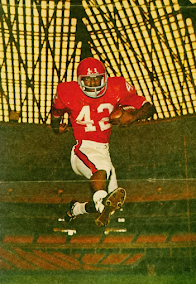
    Warren McVea in the Astrodome
The rest of the week's fun begins Saturday with the season kickoff of NBC's college football Game of the Week (10:45 a.m. PT), as Tulsa takes on Houston in the historic first football game ever played in Houston's "Harris County Domed Stadium," known to one and all as the Astrodome.* Although the listing doesn't mention this, the game is significant for one additional reason; Houston's Warren McVea becomes the first black player in the university's history. He'll be with them next season as well, when Houston plays Washington State in the first football game ever played on artificial turf. TV Guide refers to previous games between the two teams as being "high-scoring," but Tulsa comes out on top in this one, 14-0.

*Not the first indoor college football game, though, nor even the first one televised, as we saw here.

Sunday, like Saturday, starts off with sports: the American Football League opens its sixth season (and first on NBC) with the New York Jets visiting the Oilers in Houston (11:00 a.m.) Note that this game is not played in the Astrodome, but at Rice Stadium; the Oilers wouldn't move into the Dome until the following season. Meanwhile, the U.S. National Tennis Championships finish up at Forest Hills, New York (2:00 p.m., ABC), with Spain's Manuel Santana defeating Cliff Drysdale of South Africa to win the men's championship; Margaret Smith beats Billie Jean Moffitt to win the women's title. It's not called the U.S. Open yet, since professional players aren't allowed to compete.  

Monday, the new-look 12 O'clock High debuts, as Paul Burke takes over the lead from Robert Lansing when General Savage's plane is shot down. (7:30 p.m., ABC) Don't get me wrong; I like Paul Burke a lot, and he was excellent in Naked City, but Quinn Martin never should have replaced Robert Lansing. Elsewhere, the new season of Hullabaloo opens with Sammy Davis Jr., fresh from the Emmys, hosting; the guests are Sonny and Cher, The Supremes, the Lovin' Spoonful, and the Strangeloves. (7:30 p.m., NBC)

Speaking of format changes, it's not just 12 O'clock High; the fourth-season opener of McHale's Navy (Tuesday, 8:30 p.m., ABC) sees McHale and his entire crew (including Fuji) transfered to southern Italy, along with Binghamton and Carpenter. I've never been sure just how plausible this would have been, and besides: I thought the Americans wanted to win in Europe. But maybe I'm overthinking this; perhaps I should learn how to watch TV. For a more realistic view of warfare, the Korean War drama The Bridges at Toki-Ri, starring William Holden and Grace Kelly, makes its television debut on NBC's Tuesday Night at the Movies. (9:00 p.m.)

Among Wednesday's debuts, The Adventures of Ozzie and Harriet begins its 14th season, and its first in color. (7:30 p.m., ABC) Compared to them, returning hits like The Beverly Hillbillies (fourth season), The Virginian (also fourth), and The Dick Van Dyke Show (fifth season) look like pikers. And here's another series that found out a format change doesn't necessarily mean an improvement, either in quality or ratings: Burke's Law is now Amos Burke, Secret Agent. (10:00 p.m., ABC) No Detective Tilson. No Detective Hart. No Henry, the chauffeur. No charm. No fourth season.

Here's a change that worked! My Three Sons starts its sixth season on a new network, CBS, after five seasons on ABC. (Thursday, 8:30 p.m.) It will remain on CBS for seven seasons, until it goes off the air in 1972 after a run of 12 years. And just to show that the Tiffany Network is serious about making tonight special, My Three Sons is followed by the debut of the CBS Thursday Night Movie and the TV debut of one of the greatest political thrillers ever: The Manchurian Candidate. (9:00 p.m.) Frank Sinatra stars, in what I think is his finest role, along with Angela Lansbury, Laurence Harvey, Janet Leigh, and James Gregory. 

On Friday, it's The Man from U.N.C.L.E.'s turn to turn to color. as Rip Torn stars in part one of the second-season opener "The Alexander the Greater Affair." (10:00 p.m., NBC) This is, I think, U.N.C.L.E.'s best season, but its successful first season, with its cheeky combination of spy thriller and satire, has already influenced other shows—including, unfortunately, Burke's Law. And on the late night schedule, it's the 1959 movie The Wasp Woman (11:20 p.m., KSBW). "Janice Starlin’s beauty treatments are made up of wasp enzymes—but they have unexpected effects." Susan Cabot and Anthony Eisley star, and if this movie sounds like it belongs on MST3K, you're almost right: it was riffed on Cinematic Titanic, Joel Hodgson's successor to MST3K, which featured many of the show's original performers. And speaking of MST3K. . . 
 
l  l  l

MST3K alert: It Conquered the World
(1956) A scientist discovers that one of his associates is helping some beings from outer space to conquer the Earth. Peter Graves, Beverly Garland, Lee Van Cleef. (Saturday, 5:30 p.m., KSBW). "He learned almost too late that man is a feeling creature… and, because of it, the greatest in the universe. He learned too late for himself that men have to find their own way, to make their own mistakes. There can't be any gift of perfection from outside ourselves. And when men seek such perfection… they find only death… fire… loss… disillusionment… the end of everything that's gone forward. Men have always sought an end to the toil and misery, but it can't be given, it has to be achieved. There is hope, but it has to come from inside — from man himself." TV