Showing posts with label Descent into Hell. Show all posts

November 8, 2023

The Descent into Hell: "The Horn Blows at Midnight" (1953)


This is the way the world ends
Not with a bang but a whimper.
T.S. Eliot, The Hollow Men

TThere's a thin line between comedy and tragedy; it's why the symbols of the theater are the laughing mask and the crying mask, Thalia and Melpomene: always together, two sides of the same coin.

It's true, though, that you'd be hard-pressed to find much comedy in these stories, although the absurdity of what we've allowed ourselves to be subjected to would be laughable if it weren't so tragic. So perhaps it's well that this final story—the only one to deal with the actual end of the world—is a comedy. One with strings attached, however, because it ends with mankind being given another chance—a last chance.

I

The Chief of the Department of Small Planet Management in Heaven (Lester Matthews) has just received a directive from the Front Office regarding Planet 33974. For too long, that "nasty little globe," a place where power and plunder has become more important than gentleness and humanity, has been the source of nothing but headache. They've been warned enough—war every 20 years, two million crimes per annum, greed, intolerance, and persecution. The order is simple and to the point: Planet 33974 must be destroyed. The Chief's assistant, Elizabeth (Dorothy Malone) hands him the file on Planet 33974: Earth.

The destruction of the planet will be simple enough: an angel must travel to Earth—the top floor of the Waldorf Biltmore Hotel in New York City, to be precise—at exactly 12:00 midnight, blow five notes on a special trumpet, and voila! no more Earth. Elizabeth suggests her boyfriend Athaneal for the job, but The Chief groans; he considers Athaniel to be a nincompoop who's failed in every assignment, but Elizabeth insists he can do it—after all, he's a trumpet player in the Heavenly orchestra ("The Sweetest Music the Other Side of Heaven.")

When the call comes, Athaneal (Jack Benny), Angel Junior Grade, 3rd Phalanx, 15th Cohort, is in the process of being thrown out of the orchestra by Beethoven, who is tired of Athaneal always botching the opening measure to his Fifth Symphony. Upon being told of the assignment, Athaneal pauses—Earth is his home planet, where he died 300 years ago—but he assures The Chief that he can carry out the mission. The Chief hands him the precious trumpet, and reminds him that it must be blown exactly at midnight: 11:59 p.m. won't do, 12:01 a.m. won't do. If Athaneal is successful, The Chief promises him a promotion to Angel Senior Grade.

Upon arriving in New York City, Athaneal overhears a young couple quarreling. Danny is a young trumpet player in a radio orchestra. His girlfriend Helen wants him to give it up for a real job so they can get married, but Danny refuses: being a musician is "what I know, it's what I do." This touches Athaneal, as it mirrors a conversation he and Elizabeth had before he left for earth. He urges the couple to set aside their differences and enjoy their time together, but Danny storms off, taking Athaneal's trumpet case by mistake.

After realizing what has happened, Athaneal hails a cab and races to the Waldorf, where Danny's orchestra plays. On the way there, he listens as the driver recites the world's various woes. I've already gone through one war, he tells Athaneal, and my kid went through another. "Einstein says the next war will be fought with atomic bombs, and then the next war after that will be fought with rocks."
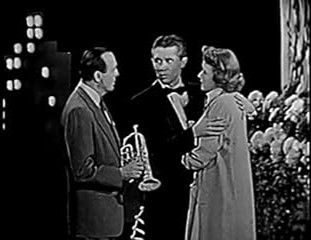
As the midnight hour approaches, Athaneal, Danny, and Helen all converge at the rooftop garden of the Waldorf. After retrieving his trumpet from Danny, Athaneal reveals to them his true identity, and that in four minutes he will blow his trumpet and destroy the Earth. "You only have four minutes to live. Are you going to spend those four minutes just fighting with each other?" They finally get the idea. Danny is skeptical, but Helen tells him that with the world as it is, anything could happen at any minute. "Suppose we did have only four more minutes to live," she asks him. "We've wasted all our precious time." If only they knew in advance when the world would end, they could make every second a happy one. "Holding each other close would be the most important in all the world." Realizing the truth of what Athaneal has said, they return inside arm-in-arm, leaving the angel alone in the garden, holding his trumpet as the minute hand moves toward midnight. And here he pauses.

At every act of kindness he has encountered, Athaneal's doubts about his mission have increased, leaving him to wonder if The Chief realizes the true nature of the situation. Now, speaking directly to him, Athaneal pleads for the lives of those on Earth. Take Danny and Helen—"They're not bad people, and they're so much in love—how can they be bad? They shouldn't be destroyed." He thinks back to the others he's met along the way: two young shoeshine boys he met upon his arrival, who were so nice to him; the friendly news dealer who helped him find Danny; the little old lady he sat next to in the hotel lobby, planning a trip around the world after winning a contest. There are millions like them all over the world, just looking for a little happiness; don't they all deserve another chance? Moved by Athaneal's plea, The Chief relents, giving the planet and its people that one—final?—chance.
II

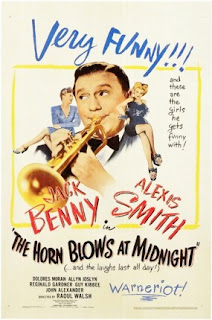
One of Jack Benny's greatest running gags (along with his stinginess and being eternally 39) was the movie The Horn Blows at Midnight. It had not been particularly successful in its theater run in 1945, underperforming at the box office and receiving lukewarm reviews by the press. Several reasons were proffered for its failure: President Roosevelt had died just eight days before the film's release, and the Rodgers and Hammerstein musical Carousel, which dealt much more successfully with the theme of the spirit world, had just opened on Broadway. Mostly, though, it just didn't quite have it; as New York Post critic Winston Archer wrote, "the comic fantasy doesn't come off as planned. The big build-up remains an architectural and overworked effort."

The movie had one great post hoc promoter, though: Jack Benny. Benny quickly made "The Horn Blows at Midnight" a continuing joke that would run through the remainder of his career. (One of my favorite Benny bits comes from a 1957 episode of his TV show: Benny is driving to 20th Century Fox to discuss a movie based on his life. At the front gate, he casually asks the guard (played by Benny regular Mel Blanc) if he ever saw the movie. "Saw it?", cried Blanc. "I directed it!") His jokes, of course, gave the movie far more publicity than it would have gotten otherwise, burnishing Benny's reputation for self-deprecating humor, and helping the movie recoup its investment. Although it was Benny's final starring role in a movie—"When the horn blew at midnight," he once said, "it blew taps for my movie career"—it also became one of his best-known, even for people who never saw it.

A radio version of The Horn Blows at Midnight was produced for Ford Theater on March 4, 1949 with Benny starring once again as Athaneal. It wasn't quite the same version of the story as that seen in the movie theaters, though; the movie had a running time of 78 minutes, while Ford Theater had a one-hour (minus commercials) timeslot; obviously, cuts to the story would have to be made. Those cuts, however, produced a subtle but marked difference, not only in the telling and the tone of the story, but in the conclusions to be drawn from it.

The first and most obvious change was the dropping of a framing device with which the movie began and ended. It presented Benny as a musician named Athaneal, a trumpet player in a studio orchestra performing for a radio program. Athaneal falls asleep during a commercial for the show's sponsor, Paradise Coffee (the coffee "that makes you sleep"), and dreams that he is an angel, playing the trumpet for the Heavenly Orchestra, who is then selected by The Chief (God? St. Peter? Edward Platt?) to bring down the curtain on Earth by blowing his trumpet at midnight.

The story then proceeds apace, leading to the movie's climax, but this too is different: after several false starts and misadventures, Athaneal finally has the trumpet in his hands, but in the process of warding off those trying to stop him from blowing the fatal notes, he falls off the roof of the building and wakes up to discover that it was all just a dream. As dreams go, it doesn't quite rise to the level of Pam finding Bobby in the shower; after all, thanks to the framing device, we already knew that this was just a dream. (Also, The Chief is a poor substitute for Victoria Principal.) This knowledge means that the movie essentially acts as its own spoiler, ruining whatever suspense might have existed and turning everything into a whimsical warning to the world to shape up or risk blowing it all (up).

This revision, plus the toning down of some of the movie's comedic set pieces, adds a level of genuine poignancy to the story, not to mention providing us with a threat we can actually identify with. And when the story makes its way to television four years later, it is this version, not the one seen in theaters, that forms the basis for the teleplay, broadcast live on CBS's Sunday afternoon cultural variety show Omnibus and introduced by host Alistair Cooke, three days after Thanksgiving, 1953.

That's not to say "The Horn Blows at Midnight" has become a straight drama; to the contrary, there are several funny moments, most of them centered around Benny's reputation for stinginess. For instance, while waiting in the lobby of the Waldorf for Danny to appear, a bellboy walks through the lobby "paging Jack Benny." The old woman sitting next to Athaneal comments that she always watches Benny's show (this is television after all, rather than radio) and adds that he must be "the sweetest, kindest, most generous man in the whole world." Athaneal also turns out to be a big tipper, giving the two shoeshine boys (one of them played by Harry Shearer!) a dollar each; "It's such a wonderful feeling to give money away," Benny says, with his trademark pause as he looks at the audience. And then there's the scene when a little girl at the Waldorf asks Athaneal how old he is; 357, he replies, but adds "I tell everybody up there that I'm 339," a play on Benny's perennially being 39.

These scenes ensure that "The Horn Blows at Midnight" maintains a lightheartedness that keeps it from ever becoming preachy, and makes maximum use of Benny's comedic talent. But the slapstick and the broad comedy of the movie have now been replaced with a humor that is at once both gentle and very human, underlining man's foibles while at the same time looking at him with a patient affection.

It also makes possible the story's most dramatic moment, the one that provides its moral center: Athaneal's plea for mercy on behalf of the people of Earth.

III

The eighteenth chapter of Genesis consists entirely of a conversation between God and Abraham, during which God expresses his anger toward the cities of Sodom and Gomorrah. "The outcry against Sodom and Gomorrah is so great and their sin so grievous that I will go down and see if what they have done is as bad as the outcry that has reached me," He tells Abraham. "If not, I will know."

Abraham's response, demonstrating the closeness of his relationship with God, is revealing. “Will you sweep away the righteous with the wicked?" he asks. "What if there are fifty righteous people in the city? Will you really sweep it away and not spare the place for the sake of the fifty righteous people in it? Far be it from you to do such a thing—to kill the righteous with the wicked, treating the righteous and the wicked alike. Far be it from you!"

In the face of this plea, God relents. "If I find fifty righteous people in the city of Sodom," He tells Abraham, "I will spare the whole place for their sake."

But Abraham doesn't stop there; "Now that I have been so bold as to speak wo the Lord, though I am nothing but dust and ashes, what if the number of the righteous is five less than fifty? Will you destroy the whole city for lack of five people?"

Again, God relents; if He finds forty-five, he will not destroy the city.

And so it goes, with Abraham continuing to bargain, reducing the number of the righteous first to forty, then thirty, then twenty; each time, God agrees to Abraham's pleas. Finally, Abraham dares to ask, "What if only ten can be found there?"

And God replies, "For the sake of ten, I will not destroy it."

The parallel between Abraham's imploration on behalf of Sodom and Gomorrah and Athaneal's appeal for the residents of Earth is obvious, and striking. Central to each is the plea on behalf of the innocent; just as Abraham asks if God intends to punish the righteous as well as the wicked, Athaneal looks at the suffering residents of Earth, many of whom bear no responsibility for the atrocities of the global war, and confronts the implicit moral dilemma as to whether they should pay this price without even having had a chance to build a world of their own.

He tells The Chief of the good, decent people he's met—not just Danny and Helen, but all the others: the shoeshine boys, the news dealer, the little old lady. "There are millions of others just like them, just hoping and praying for a better world," Athaneal pleads. "If you'd just give them a little more time. You've waited so long, thousands and thousands of years, suppose you wait just a little while longer, and then maybe everything can straighten itself out and be exactly the way you want it to be." At each invocation, a rumble of thunder greets Athaneal in reply, a sign of The Chief's determination to carry out the plan, but as the angel continues, the rumbles begin to diminish in intensity.

Finally, reflecting on his conversation with the taxi driver about the next war, Athanael plays his trump card. "If there's another war, the whole world would destroy itself and then there'd be no more Earth." He then appeals to The Chief's sense of justice, as well as his practicality: "Remember Chief, if that happened, then the responsibility wouldn't be yours. You wouldn't be to blame." Won over by Athaneal's argument, The Chief agrees to stay his hand—for now. Relieved that The Chief has granted his plea for mercy, Athaneal tells him, "I'd like to come home now."
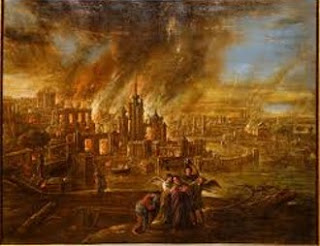
Before we get too comfortable with this bucolic scene, however, we should consider the warning implicit within, for it promises only the potential for a long-term happy ending. The implication is that the Earth is being given one final chance Give them one more chance, Athaneal pleads, allowing for the possibility that the Earth will even blow itself up and relieve The Chief from having to do it himself.—after all, in the very next chapter of Genesis, God's angels carry out the promised visit to Sodom and, after finding not even ten righteous men, warn Lot and his family to leave the town at once, after which the cities are laid waste, with "dense smoke rising from the land, like smoke from a furnace."

IV

The television programs we've looked at in this series have portrayed a world that might well have been thought unthinkable to viewers when they watched them; we know from contemporary reviews that more than a few critics thought them improbable, unrealistic, heavy-handed. And in a dramatic sense that may well have been true. But what about in a prophetic sense? The writers of these stories were clearly providing us with warnings, For some, as in "Dialogues of the Carmelites" or "Murder in the Cathedral," it was using the past not merely as a historical detail but as a reminder that the unthinkable was once all-too possible. In other cases—"The Year of the Sex Olympics," "They," "A Sound of Different Drummers"—it was a logical extension of a future that had already been glimpsed, a preview of what could happen if events continued in that progression without being altered. In fact, in one way or another, to one degree or another, they all seem to have come to pass.

The signature themes we've seen throughout these stories are, for the most part, missing or in altered form in "The Horn Blows at Midnight." The New York in which Athaneal finds himself is not one of oppression or totalitarianism, and people are not being called upon to sacrifice their lives—consciously, that is. The only outward fear we encounter is a generalized sense, based on the experiences of the war and the Bomb, of man's inhumanity to man, but we don't see any dramatic examples of it. We didn't need to—everyone was already familiar with it. The world portrayed here is neither futuristic nor an echo of the distant past; for those watching it in real time, it was their world, a world they not only had experienced, but were experiencing even as they watched the show. That threat of nuclear war, voiced by the cab driver on Athaneal's frantic ride to the hotel, was something that was very real. And in that way it makes it a world more disturbing, more frightening, than any other that we've experienced.

We've seen, throughout this series, examples of sacrifice, of courage, of nobility and sacrificial love. But in "The Horn Blows at Midnight" we see something different, something overwhelming and essential: a deeply felt expression of compassion. Not sympathy, not pity, but compassion. Someone once described compassion as love put into action, and it's hard to find a better description for the feeling Athaneal comes to have for these humans and their planet.

Ever since receiving his assignment, Athaneal has been warned about the "nasty little globe" he's about to help obliterate. Upon his arrival on Earth, he sees the headlines of Investigations, wars, murders—even smog! But during this brief time, he also learns a great deal about its residents, observes them in various situations, listens to them as they shared their thoughts and fears, their hopes and dreams for the future. And he begins to have doubts, to even wonder if The Chief knows what he's doing.
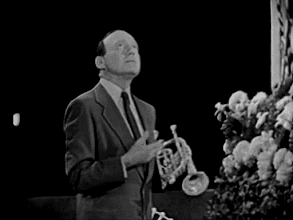
It is that compassion that emboldens him to speak so frankly with The Chief, to intercede with him on behalf of all those who will die without even having had a chance to build a world of their own. This ending—quite unlike that of the original movie—is what gives "The Horn Blows at Midnight" its gravitas, its moral weight. Having once seen it, it becomes more and more difficult to imagine the story without it, and perhaps that's one reason why the movie doesn't fare so well.

It is also that compassion that seems to be in such short supply nowadays. We've become a world in which it's one strike and you're out, leaving no room for forgiveness, for understanding, for rehabilitation and reclamation—for humanity. The world seems to be caught in the grasp of a sickness today, one greater than that which existed in the time of "The Horn Blows at Midnight." Depending on the day, we have the potential to look at the news and read of some new moral depravity, something that might have been thought unthinkable a few years ago, but now has become accepted as the new normal. We see screaming mobs consumed by hatred—hatred for others, which ultimately traces its roots back to hatred for themselves. One need only to look at reactions to the Israel-Hamas war to see this, but in reality it has been growing steadily in the past few years, and if the growth now seems to be exponential, I'm sure there's a mathematical explanation for that.

In our headlong rush toward iconoclasm and nihilism—creating a world that only tangentially bears resemblance to the world that many of us have known, tearing down beliefs and codes that have sustained our existence for millennia, creating alternative realities that render reality itself to be nothing more than an objective observation, denying biology itself--we seem, quite literally, hell bent on self-destruction. And so, we should be hoping that The Chief shows as much patience with us as he did in 1953. Either that, or we have someone as eloquent as Jack Benny pleading our case for us. Meanwhile, night falls, and the clock continues to go tick, tick, tick . . .  TV  

October 4, 2023

The Descent into Hell: "A Sound of Different Drummers" (1957)


"Books are the treasured wealth of the world and the fit inheritance of generations and nations." 
―Henry David Thoreau, Walden

I

In the future, people live in a high-tech world of domed cities, governed by a World Union, where crime has been eliminated and lifespans lengthened, and computer analysts and tranquilizers to take care of any concerns you might have. Books have been banned in this future world, as independent thought is seen as a source of trouble. “Readers,” those found possessing books, are considered guilty of treason and executed by teams of "Bookmen," who then take the confiscated books to the "library," where technical and instructional books are catalogued and all others are destroyed.

Gordon Miller (Sterling Hayden), one of the Bookmen, finds himself attracted to the new librarian, a young woman named Susan (Diana Lynn). Gordon tries to flirt with her; her response is polite but cautious. He accidentally discovers Susan hiding a book in her clothes, a capital offense—but there is something about her that fascinates him; he has never met anyone like her, and despite his revulsion at her crime, he beings to see her whenever he can.

Gordon's partner and best friend Ben (John Ireland) disapproves of Gordon’s relationship with a Reader. "I don’t want you to make a mistake," Ben tells him. When Gordon challenges Ben on his beliefs, asking him if he ever thinks about anything, Ben replies, "What is there to think about? I don’t want to think. I hate Readers."

Occasionally, Gordon talks with his "analyst," a computerized voice meant to serve as an escape valve; computers replaced human analysts when it was discovered people censored their thoughts on the couch. Gordon tells the analyst (voice of Paul Lambert) about his relationship with Susan, and when he mentions that Susan is a Reader, the analyst repeats over and over that "Readers commit crimes of treason to be punished by death." When Gordon asks him why reading is a crime, the analyst replies that "My answers are scientifically accurate. There is no deviation from the truth."

Despite this, and with Ben growing more suspicious, Gordon continues to see Susan and reads everybook he can lay his hands on. He is torn about the conflict between what he has been taught as a Bookman, and what he learns from being around Susan, and warns her that it is dangerous to be involved with a Bookman; she says life would be worse without him, and he realizes that he loves her. They make plans to marry as soon as their application is approved by the Department of Genetics.

Finally, Susan finally brings him to a secret meeting of Readers. There, he meets their leader, Howard Ellis (David Opatoshu). They talk about the importance of books, and how extraordinary individualism is. When Gordon asks Ellis how things got the way they did, Ellis can only say that it’s complicated, but that they’ve wound up with a society where the individual is the criminal. He then quotes a passage from Walden, by Henry David Thoreau: "If a man does not keep pace with his companions, perhaps it is because he hears a different drummer. Let him step to the music which he hears, however measured or far away." We are not criminals, he tells Gordon, just people who hear different drummers. Susan knew this when she brought him here, but she knew he’d say the right thing at the right time. Gordon wonders how this ruthlessness makes them any different from the Union.

Later, we see Ellis reviewing a plan for Gordon and Susan to escape to one of the free colonies in South America. Things are getting too dangerous for them to remain here; look at how long it’s taken for the Department of Genetics to act on their application. Ellis and the others won’t be accompanying them in the escape, though—he explains that to get out is to give up the fight, and their movement won’t continue to grow.

   Sterling Hayden and Diana Lynn
Meanwhile, Ben complains that Gordon misses regular appointments and doesn’t go on Bookman calls anymore; instead, he talks about thoughts and ideas. He warns Gordon that things are getting too dangerous, and that he should give it up before it is too late. When another call comes in for them, Ben forces Gordon to accompany him. Arriving at the scene, Gordon is horrified to find that the accused are George and Mildred, his surrogate parents. He refuses to take part in their execution, and instead flees the scene, vowing to kill Ben for what he has done.

Gordon goes to get Susan so they can flee, but it’s too late; her apartment is surrounded by Bookmen, led by Ben. Gordon fights them to give Susan time to escape, and kills two of them before he’s seized and taken away.

In court, Gordon is charged with treason and murder. The prosecutor (Paul Lambert) tells him that his life has been spared in hopes that he will cooperate in uncovering what is obviously a widespread plot to the subvert and overthrow the Union, and asks him to provide the names of the others in the plot and the details of how he was to escape. In return, he will be free to live a normal life, doing less sensitive work. Gordon refuses to respond, and is returned to his cell.

For three weeks Gordon undergoes further interrogation. When he refuses to talk, the Bookmen can only conclude that he must be sick. His analyst tells him that he's denying the most basic instinct in man—survival; when Gordon says he’d then be left alone, the analyst assures him that "I am your friend. I am the only one who loves you."

Finally, Ellis himself visits. He assures Gordon that Susan is safe, but tells him that the court still wants to know the names. He even suggests that Gordon give them the names; twelve more deaths won’t make any more difference. When Gordon again refuses, Ellis tells him what he really wants: Gordon’s martyrdom. The death of a Bookman will strike a great blow for the movement. It will expose a crack, a fissure, in the Union that will continue to grow. It could, in fact, bring down the State altogether.

Gordon spurns this role as well, refusing to serve as their martyr. It’s not that he’s changed his mind; he’ll die before he gives up the names of the others. But it will be for his reasons, not theirs. And his reason is a simple one: he can’t stomach the killing any longer. He’s killed too many people already, for no good reason, and he refuses to take responsibility for one more death. It’s as simple as that.

As a defeated Ellis leaves, another prisoner is thrown in the cell with him—Ben. Gordon expresses shock, but Ben tells him, "Those books. When you were caught, I didn’t want you to know more than me. I read them, Gordon. I read them, I read them! I understand now, Gordon. I understand!"

Vowing that the Union will eventually lose, Gordon finally accepts his martyrdom, as he and Ben are executed.

II

"A Sound of Different Drummers" aired October, 3, 1957, on Playhouse 90, CBS’s prestige dramatic anthology series. The listing in TV Guide read, "In a totalitarian state of the future, Gordon Miller is a young officer who has the task of suppressing illegal international activity," a curious (not to say somewhat deceptive) description to say the least.

If you go through the Internet searching for "A Sound of Different Drummers," I can promise you that 9 times out of 10—no, make that 999 times out of 1,000—it'll be in regard to Ray Bradbury's plagiarism lawsuit against Robert Alan Aurthur for borrowing too heavily from Bradbury’s Fahrenheit 451*. Let this be the thousandth, then: a look at the episode itself. For regardless of whether or not Aurther plagiarized Bradbury’s story, "A Sound of Different Drummers" tells a disturbing story of a nightmare world where everything is perfect—as long as you don’t rock the boat.

*If you want to read about that aspect of the story, you can start with Stephen Bowie's excellent writeup here

This isn’t the first time we’ve seen Robert Alan Aurthur’s name here; he was also responsible for the 1955 Producers' Showcase adaptation of Arthur Koestler’s "Darkness at Noon." In fact, looking at the body of Aurthur’s work, many of his stories deal with injustice of various kinds, particularly race relations (A Man is Ten Feet Tall and The Lost Man, both starring Sidney Poitier, and Shadows, directed by John Cassavetes), so it’s easy to understand how stories such as "Darkness at Noon"" and "A Sound of Different Drummers" appealed to him.

Starring as the conflicted Bookman Gordon Miller was Sterling Hayden, who gives a performance so intense and yet repressed that he appears capable of bursting at any moment. Diana Lynn, a frequent star on Playhouse 90, plays Gordon’s love interest Susan, and John Ireland is properly menacing as Gordon’s partner Ben Hammond. Playing the leader of the Readers (and the secret trial judge) is David Opatoshu, who’s something of a regular in this series; we last saw him in the Outer Limits episode "A Feasibility Study," and before that he appeared in Star Trek’s "A Taste of Armageddon." Rounding out a compelling cast is Paul Lambert in an intriguing dual role, as both the prosecutor and the voice of the analyst.* The evocative, melancholy incidental music was by the prolific Fred Steiner (Perry Mason, The Bullwinkle Show).

*A side thought: Charlton Heston tells the story of how, in the movie The Ten Commandments, he convinced director Cecil B. DeMille that he should also play the voice of God in the scene with Moses and the burning bush, using the rationale that "any man hears the voice of God from inside himself." Is there something similar at work here, with the Union assuming the role of man’s analyst—his confidante, his only friend, his God?

At the helm for the broadcast was the young (27) John Frankenheimer, considered the premier director of live television; between 1954 and 1960, he directed 152 live dramas, an average of about one every two weeks, and he was responsible for directing 27 of the 133 episodes of Playhouse 90, the most of any director. He’d go on to direct such political thrillers as The Manchurian Candidate and Seven Days in May.

John Frankenheimer
Through the years, Frankenheimer had become known for his dynamic and creative style, both of which can be seen here. As an example, the sets for "Different Drummers" are open, without back walls [(nothing to keep the Union out?) and shrouded in darkness; in a particularly effective touch, images from the videophone calls are projected against the darkness, appearing to float in midair. And as for Frankenheimer’s dynamic directing style, Hayden, the newcomer to live television, freely admitted to being scared. "Frankenheimer loved to move the camera so fast. . . I went into one set to do a scene and there were no cameras! Then around the corner, like an old San Francisco fire truck, comes the camera on a dolly. And a guy comes along, puts up a light, and BANG, we go."

"A Sound of Different Drummers" received generally favorable reviews from both critics and viewers (excepting Ray Bradbury, of course). Hayden received what he described as "among my first good notices," while The New York Times TV critic Jack Gould called it "the boldest and most stimulating" play of the season, an "intellectually compelling narrative", and "a powerful drama protesting the disease of conformity"; and the Hackensack Record found it "a stimulating plea for intellectual freedom." A dissenting view came from Mary Wood, the radio and television critic for the Cincinnati Post, who found the play "engrossing, if far-fetched," and added that Aurthur might have made more of an impact had he "made his imaginary society more believable." However, a viewer in Buckingham, Pennsylvania, writing to the Philadelphia Inquirer, countered that "We are in that rut NOW! Anyone with different ideas is frowned upon and made to feel like a pariah. All we need to make it complete is to dress in uniforms and live under a glass dome, like waxed flowers."

What I find interesting in perusing these contemporary reviews is the use of words like "intellectual" and "intellectual freedom," as if we’re talking about some specialized type of freedom, separate from and distinguishable from other types of freedom. And I think this is part of the point that Aurthur is trying to make. As one character asks of the Readers early on, "Why do you want to change things? We have everything so perfect." Early on, Gordon asks Susan rhetorically, "Who am I to tear up perfection? Look, we have World Union. There’s not a man living who remembers war. We have no crime: no crimes of passion because tranquilizers and analysts have wiped them out; no crimes for gain because everyone over there has what he wants or needs materially."

But, Susan corrects him, "There is one crime."

"There should be one crime," Gordon replies, "because the only people who can shake this world we live in are sick people with sick ideas. Now where do they get these ideas? They get them from books. Can you imagine what kind of world this would be if everyone read books? Why, we’d end up with a bunch of psychotics running around with destructive, non-conformist ideas." It isn’t that he wants to kill them, but "If a few psychotics have to die for the common good, then I have to do it in spite of the fact that I don’t like it."

In other words, Susan, says, the end justifies the means.

Yes, Gordon replies. "That’s a good phrase. I’ll have to remember it."

You might think we’d wizened up since then, but have we? After all, we embraced the Patriot Act because it promised us safety from terrorists, and what’s a little inconvenience in comparison to that? And when businesses were shut down during the Covid scare, when people were ordered to mask up and those in hospitals and care facilities were isolated from their friends and loved ones, we were reminded that it was only a little disruption, and it was for the common good, and what’s a little discomfort like wearing a mask when it comes to saving lives? Except when it comes to the loss of freedom, nothing is insignificant.

So was Mary Wood being short-sighted in calling Aurthur’s world "far-fetched"? Such critiques were common when it came to stories presenting such gloomy dystopian futures. Possibly she was speaking for the many Americans for whom the prospect of such a totalitarian state was unthinkable.

Perhaps, then, it’s not an issue of being short-sighted so much as it is an indication of how much and how quickly things have changed in the past decade or so.

III

The 1950s dramas that we’ve looked at are, without exception, products of Cold War thinking. A few of them, such as "Darkness at Noon" and "1984," are identifiably set during the Cold War, but all of them, no matter when they take place, are influenced by it.

Another thing: none of them actually feature any fighting to speak of; the war, if there was one, has already been fought and lost. Totalitarianism is no longer a threat but a reality, and so these stories, as well as being excellent vehicles for drama, are cautionary tales, warnings about the future that could happen if we’re not careful.

The San Bernardino County Sun called   
"Different Drummers" "strange and thrilling"   
Don’t assume that they’re all part of some great right-wing propaganda effort, though, for there’s another Cold War theme running through many of these stories: a theme that, although it’s seldom voiced in the scripts, must be acknowledged in order to fully appreciate the context in which a story such as "A Sound of Different Drummers" was written: McCarthyism, what Aurthur referred to as the "dark days of democracy," days in which "nobody spoke up because his head could come off for this kind of talk." An era in which people were questioned about every association they’ve ever had, every organization they’ve ever belonged to, every person they’ve ever talked to, until the questioners could find a flaw in the façade, a weapon which they could use against the accused like a battering ram, until their reputation lies in tatters on the ground, and with it any semblance of whether or not the accusations were actually true.

Think of the questioning Gordon undergoes in front of the court, and later with Ellis. They make it all sound so reasonable. All he has to do is give them the names of the others in the cell. His own guilt will be wiped away—expunged from the record—and he and Susan will be free to go, with no ramifications. (Set aside the implausibility in this offer; I don’t think Gordon believes it for one second.) I’m positive anyone watching this at the time of broadcast would have instantly recognized this tactic from McCarthy and his House Un-American Activities Committee hearings. They might also have remembered the fate of the so-called Hollywood Ten: movie producers, directors, and screenwriters who appeared before HUAC, refused to answer questions or name names, and wound up serving time for contempt of Congress, after which they were blacklisted.

Just tell us the names of your fellow Readers. They would have called it being a "Friendly Witness."

Interestingly, and I wonder how much of this made it into his performance, Sterling Hayden had appeared before the House Un-American Activities Committee in 1951, owing to his brief membership in the Communist Party following the war, and became a Friendly Witness himself. It was a decision that Hayden regretted for the rest of his life. "If I have any excuse, and it's not a good reason," he told journalist Gerald Perry, "the FBI made it clear to me that if I became an 'Unfriendly Witness' I could damn well forget the custody of my children. I didn't want to go to jail, that was the other thing. The FBI office promised that my testimony was confidential. And they were very pleasant. So I spilled my guts out, and the months went by, and I was on some shit-ass picture, and I got a subpoena. The next thing I knew I was flying to Washington to testify. The worst day of my life. They knew it already, and there is the savage irony.” He was one of the most prominent namers of names in the industry; in his 1963 autobiography, he wrote, "I don't think you have the foggiest notion of the contempt I have had for myself since the day I did that thing."

During a 1958 round-table discussion on television drama, Aurthur cited "the collaboration between writers and actors" as an essential part of what makes for good television writing. "[A] great deal of changing goes on, and it is vitally important, because the whole intent of a production is to extend the original meaning of the script. . . It means simply taking the meaning and bringing it to life." It seems inconceivable, at least to me, that Hayden didn’t influence how that scene played out, beyond acting out the lines on the screen, as if it were a do-over for him. As, maybe, it was.

IV

The Smith Act of 1940 made it a crime to belong to an organization that advocated violent overthrow of the United States government. It was a law, that in the words of historian Larry Tye, outlawed "the advocacy of ideas rather than the commission of misdeeds." He cites the case of Junius Scales, an Army veteran who became a leader of the American Communist Party and was sentenced to six years in federal prison in 1954, not for his involvement in any plot but simply for being a member of an organization which advocated violence. (A description that would apply to several organizations in this day and age.) He was, writes Tye, "the only American ever imprisoned for merely belong to the Communist Party as opposed to participating in a violent or subversive activity"; it was, in fact, a longer sentence than anyone had ever received for actually committing an act of political violence or subversion. Later, the FBI would confirm that Scales’ real crime had been his refusal to name names of other former or present party members.

So much of what happens in "Different Drummers" sounds as if it could have been taken from today’s headlines; the lines spoken are too familiar to us. And has been the case so, so many times, it is driven by the fear which the ruling elite have for anyone who dares to think differently, to challenge authority, to question the status quo. And that, along with everything we’ve seen so far, got me to thinking.

My college logic is a little worn, but I think I recall enough of it to propose the following: if the McCarthy era was the obvious source for the background atmosphere through which these stories are to be understood, and if we are finding them applicable to our day and time, then it would be reasonable to conclude that we are entering, have entered, a second McCarthy era, where one lives in fear from the ramifications of anything he or she might have said, might be saying, or might be thinking of saying. In short, you can’t say what you want. You’ll be labeled a racist, a Nazi, a hater; you’ll be accused of using the wrong pronouns. And then you’ll be shunned by polite society, and anything of merit that you might have said or done in the past will simply be forgotten. You’ll find yourself removed from the picture, just as the Soviets used to do in the case of party functionaries who’d fallen into disgrace or disfavor. Only now it's even easier than it was then; you don’t require any special photograph editing skills, only a finger to press a button on a computer, and it’s all over.

Anyone who doubts the existence of a new McCarthy era has only to look at the number of people who’ve been cancelled in the last few years: shamed in their professions, ostracized by their colleagues, fired by their employer, canceled by their bank, silenced by social media, dropped by their friends.

Back then, it was called "Blacklisting." Today, it’s called "Cancel Culture." Back then, the dreaded word was "Communist." Today, it’s "homophobe," "climate denier," "anti-vaxxer," "Christian."

V

So in addition to banning books and blacklisting, what else is on the agenda for Aurthur’s far-fetched government of tomorrow?

At one point Gordon marvels at how Susan is like nobody he’s ever known. For instance, at their first meeting, he mentions how his partner had told him about her beautiful smile. "People don’t smile much, do they?" he says. "That’s a dangerous statement," she replies. When he asks her what makes it dangerous, she answers, "If you say that people don’t smile, you might conclude that people aren’t happy." And that simply wouldn’t do in a prefect society, would it?

Later, while enjoying a picnic outside the domed city (nature itself being a revelation to Gordon), Susan notes how they have such different ways of looking at things. Gordon views the domed city as perfect, safe, secure. To Susan, however, it’s a prison, where the people are kept in ignorance. "In the old days people were afraid of the dark, she says. Nowadays we live in darkness so we’re afraid of the light."

How, he wonders, did she come to be like this, to have these thoughts that are so different, so unlike any he’s ever heard before? She begins to tell him about her childhood, an unusual one it that she spent it with her parents, something that is strictly forbidden today. "The Union didn’t catch up with us until I was eight."

"No wonder you’re different," Gordon says, mirroring the accepted attitude. "That’s a pretty unhealthy start. Before the Union took over the raising of infants all neuroses in children were caused by parents. It’s a scientific fact. A child raised by parents has to grow up disturbed."

But, she asks, didn’t he ever want to know who his parents were? At first, he dismisses such thoughts as idle curiosity, but then he corrects himself. "I would like to find them. But that comes under the heading Treasonous Thoughts." He thinks back to the old couple he killed for being Readers. "They could have been my mother and father. Every time I go on a raid, I could kill them and not know it. I look in the faces of people and wonder. Are these my parents? Do I have siblings? Do they think about me, do they love me? I’ve killed over 100 people. Could have been my parents, my sister, my brother? It’s like killing myself."

I suppose that’s a pretty far-fetched idea, that the Union should raise all infants. And yet today we see increasing arguments about the role that parents should play in the lives of their children. Liberal activists accuse parents of spreading hate and ignorance, teaching their children the "wrong" ideas, of preventing them from getting a “complete education.” In some states, minor children might be able to get an abortion without telling their parents. School districts seek to block parents from knowing "whether their child identifies as a different gender in the classroom," and organizations provide schools with training and materials on how to secretly transition students. Teachers’ unions fight to prevent parents from having input in the school curriculum; the late educator John Goodlad once said that "Parents do not own their children. They have no ‘natural right’ to control their education fully." The President claims that “school children don’t belong to parents 'when they’re in the classroom.'" Meanwhile, federal agencies move to remove words like "mother" and "father" from childcare laws. 

As we saw in "The Children’s Story," there’s a thin line between educating and brainwashing, one that seems to get more and more faint every day. The Native American activist Wilma Mankiller said "Whoever controls the education of our children controls the future." Don’t think that the government and the education industry doesn’t know that. And as for those parents old-fashioned enough to think that they, and not the schools, know what’s best for their children, "If the older generation cannot get accustomed to us, we shall take their children away from them and rear them as needful."

That last quote came from Hitler, by the way.

VI

"I hardly know an intellectual man, even, who is so broad and truly liberal that you can think aloud in his society." 
―Henry David Thoreau

One of the things about revolutionaries is that you; can seldom trust them to remain true to their ideals once they’ve achieved their goals. To underline this, Gordon quotes Friedrich Nietzsche in one scene, that "Liberal institutions straightaway cease from being liberal the moment they are soundly established. Once this is obtained, no more grievous and more thorough enemy of freedom exists than liberal institutions."*

*The actual quote, from Twilight of the Idols, reads, "Liberal institutions cease to be liberal as soon as they are attained: later on, there are no worse and no more thorough injurers of freedom than liberal institutions." Nietzsche continues, "One knows, indeed, what their ways bring: they undermine the will to power; they level mountain and valley, and call that morality; they make men small, cowardly, and hedonistic—every time it is the herd animal that triumphs with them. Liberalism: in other words, herd-animalization."

Gordon discovers the truth of this in his initial meeting with the other members of the Readers cell. After Ellis explains the group’s philosophy, talking about how extraordinary individualism is, he tells Gordon, "We think of ourselves not as criminals, but simply as people who hear different drummers. We’d like you to be with us, Gordon."

"Then there’d be no turning back," Gordon replies.

"Can you turn back now?" Ellis asks.

After Gordon tells Ellis he’s with them, Ellis then reveals that, had Gordon said no, Ellis would have had to have Gordon shot. "We have to be a little ruthless too, Gordon."

"How does that make you any different from them?" Gordon asks.

"That’s one of those vast complications we’ll discuss later," Ellis says.

From a purely tactical viewpoint, this makes perfect sense. In wartime, maintaining the integrity of such an organization’s security is paramount; the success of its mission and the very lives of its members depends on it. For Gordon, however, it exposes another side of the Readers: a willingness to use tactics similar to those of the State.

Ellis’s "complications" become yet more complicated after Ellis has been revealed as chief judge of the court. Yes, Ellis tells Gordon, Susan is safe—but the court still wants those names. "Gordon, they’re very frightened men, don’t you understand that? A society so rigid that when it goes, it goes smash. You confound them, Gordon, you confuse them. Tiny cracks. They must let you talk or kill you."

Despondent and worn out, Gordon bluntly asks Ellis what he should do. Ellis gives him one option: you can answer their questions. Gordon is shocked by Ellis’s attitude, but Ellis provides him with a rationalization: "If you talk, twelve people will die, but they would eventually die anyway. What would they be? Victims of cruelty, certainly not the first and maybe not the last." And when Gordon wearily points out that as a Bookman he’s already killed over a hundred people, Ellis replies, "Twelve more. What difference would it make?"

Has Ellis been a wolf in sheep’s clothing all along, trying to trick Gordon by giving him “permission” to name names? Or does he have something else in mind? Having presented Gordon with an option he must have known Gordon would never accept, could never accept, he offers an alternative: accepting death. But not just any death—his death will be an act of martyrdom, a death that means something. "Your death will widen the crack maybe just enough that it will smash it. And when it falls, I will be there. Susan will be there. The twelve you don’t name will be there. If not us our children. Gordon, if you die silent, you will be the first the people will hear. I promise you that. They’ll hear of the bookman reader who died for his ideals."

But, as Gordon knows, it’s much easier to talk up the nobility of martyrdom when you’re not the one doing the dying. Yes, he’ll remain silent, ensuring his death. "But not for your reasons. Not because of hope or because of faith. I just can’t kill anymore. I can’t be responsible for twelve more people dying," he tells Ellis. "You want me to believe my death will be something normal, You talk about ideals. You talk about people knowing. You want it to seem big and normal that I’d die for ideals. Howard, there’s nothing big and noble about a man dying. I’ve seen over a hundred people die. A man dies alone, in the dark." It’s as simple as that; I just can’t kill any more.

Not, however, before Gordon asks Ellis one final question. "You used the word ruthless," he says, thinking back to when Ellis was prepared to have him killed if he hadn’t joined the Readers. "What does happen, Howard, when you are soundly established?"

"I don’t know, Gordon," Ellis replies quietly. 

VII

So what, exactly, was Ellis’s game there? Is he hero or villain, freedom fighter or strongman-in-waiting? I suppose it doesn’t matter in the end, at least not in "A Sound of Different Drummers." Gordon’s story ends, with his and Ben’s executions, and our story ends with them.

One could, however, speculate that Ellis intentionally set up Gordon: studied his records and found where he was vulnerable, made sure Ben introduced him to Susan, had him recruited into the Readers, arranged for his arrest, made himself chief judge at the trial, manipulated Gordon into being the martyr that the movement desperately needed in order to grow. That’s Machiavellian to the nth degree, and I'm almost ashamed I could think of something that cynical, but it’s undeniable that Gordon was more useful to him dead than alive. Yes, it’s true that Ellis put together an escape plan for Gordon and Susan, and that could have been his way of warning Gordon that he was in trouble without blowing his own cover, but I wonder if Ellis was ever sincere about anything, including the entire Reader movement in the first place. For all we know, Ellis is just another politician, the flip side of the very coin minted by the World Union.

In a way, though, that uncertainty itself is the real weapon—the infiltration of organizations by officials of the government, the next-door neighbors and co-workers who may be on the spymaster’s payroll, question of who you can trust. That kind of mutual mistrust prevents people from getting together, from comparing notes, from taking action. As Gordon says, "They've broken us down so that alone we're afraid. Alone we’re helpless. You know, I hope we can exist because we’re always in groups, we're never alone. The great crimes of history can only have been committed by groups. Whether they're people hiding under hoods or with swastikas on the arms or wearing Bookmen’s uniforms."

Or governments isolating us from our loved ones, ordering us to hide our identities behind masks, making us suspect those standing next to us, living next door, people we though were our friends?

You might remember, for instance, the story from a while back about the FBI supposedly attempting to infiltrate traditional Catholic organizations under the pretense of them being extremist groups? Or the Covid-snitches who ratted out those who violated the lockdown rules, who might—horrors—have invited some friends over without having them separated by the proper distance. "Get vaccinated for others," they said; "It’s for the common good."

I keep coming back to Mary Wood’s review in the Cincinnati Post and her comments about Aurthur’s "far-fetched" world, a world in which ;so many things have come true. Would she have found my theory about Ellis a far-fetched one? Would anyone, viewing "A Sound of Different Drummers" back in 1957, have attributed to him such devious motives? 

I’ll allow as to how I can be pretty cynical when it comes to that, but I can’t imagine that this would be any more implausible than, say, undermining the stability of a country for personal and political gain. Let’s suppose—just for the sake of argument, you understand—that a candidate for high office started a movement, one that eventually came to comprise millions of his followers, so popular that it was known just by its initials.

Now, suppose he were to find his poll numbers down, his fundraising running low, his leadership challenged by others in the party: wouldn’t it be in his best interests to suggest that he and his followers were so dangerous to the establishment that they were being targeted? It would help if some of those followers were arrested, too; that way they’d become the perfect martyrs, much more valuable than if they were mere voters. Even if he was indicted himself, he’d gain publicity, he’d galvanize his supporters, he could even raise money off it. If I were him, I’d make damn sure that’s what happened. Even if I had to make it happen myself.

Just my imagination, of course. And as I said, I’m cynical. But then, admit it—so are you.

And if we’ve become that much more cynical since 1957, if circumstances have manipulated us to feel that way—well, really, whose fault is that? TV   

July 19, 2023

The Descent into Hell: "A Feasibility Study" (1964)


It is hard enough to find anyone who will die on behalf of a just man, although perhaps there may be those who will face death for a good man. —Romans 5:7

At the outset, the opening narration from the Control Voice tells us of the planet Luminos, a planet in a distant system. Earth scientists have concluded that the planet is too close to its sun to support life, but life exists there nonetheless, a strange and suffering form of life that now searches the galaxy for a planet with a healthy population—one that can be enslaved.

Meanwhile, a man prepares to drive to the office, while his wife lovingly chides him about spending too much time at work. Next door, another man, breaking off a continuing argument with his wife, seeks refuge at church, but finds his car will not start. Outside a mist has settled over the neighborhood—is it radioactive? Such are the mundane features of an everyday Sunday morning on Midgard Drive in Beverly Hills, USA, Earth, a neighborhood that is about to become the subject of a most unusual experiment—a feasibility study.

I

Ralph Cashman (David Opatoshu), a driven businessman, prepares to go to the office on Sunday morning—he has a "success compulsion," according to his wife Rhea (Joyce Van Patten), who wants him to at least have breakfast first.

Outside, he meets his neighbor, Dr. Simon Holm (Sam Wanamaker). Simon’s car won’t start, so Ralph offers to give him a lift to church. Simon’s wife Andrea (Phyllis Love) appears in the doorway; they hadn’t said good-bye, and she’ll be gone by the time he gets back. On the way, Simon confides to Ralph that he and Andrea are separating. They’ve only been married a year and a week, but Simon says it’s been "long enough to find out we made an honest mistake."

    David Opatoshu
After dropping Simon off at church, Ralph continues on his way to work. He drives into a heavy, cloud-like fog in front of him (always a mistake in these kinds of stories), so thick that it’s impossible to continue; when he stops the car to investigate, what looks like some kind of monstrous hand presses against the front windshield. He gets out of the car and finds himself in a rocky landscape, with three shadowy figures coming toward him. Running from them, he sees another hand, held up as if to stop him.

Back in the neighborhood, Simon returns to find Andrea still home; she couldn’t call a taxi because the phone is out of order. It is obvious that Simon doesn’t want Andrea to leave, and he renews his plea to her to stay, but she is adamant. She won’t stay if Simon won’t let her have "some part of my life to live my own way." If you really love someone, you should be able to "understand another person’s heartbeat, even if the rhythm is different from yours." "I can’t live with you if life has to be lived according to your prescriptions," she tells Simon. "I can’t! No matter how benevolent or secure you’d make it, it’s slavery!" Simon replies that he’s not trying to run her life; "I just don’t want you wandering around the world with your camera and your typewriter worrying about everybody else, when I need you here, always, at home."

Their argument is interrupted by a scream from Rhea. Someone is walking up the sidewalk to her front door. When the figure collapses, Simon sees that it’s Ralph, his face and hands covered by grotesque skin eruptions, similar to those on the beings that surrounded Ralph’s car. Ralph warns Rhea, in a ghostly voice, that she must not touch him, and adds, "We’re not on Earth." His body then vanishes.

They next see a figure going into the garage. Rhea is sure it must be Ralph, but Andrea tells her it wasn’t even a man. He goes to the door, but a voice from inside the garage warns him not to come in. Simon tells Andrea to get the car in case they need to take whoever it is to the hospital; then, talking through the door, asks if he needs help or is hurt. The voice replies that he’s not hurt physically, just afraid. "I came through the shield," the voice says. "I’ll be punished if I spoil the experiment." He’s only 16, the voice says, "I’m almost an old man." He says he’ll go back, but they can’t see him. Simon tells Rhea to go back indoors. Meantime, Andrea waits in the car she was going to use to drive Ralph to the hospital. When the being emerges, he heads for the car and tells Andrea to take him back, "or I’ll touch you." Andrea speeds into the cloud, and Simon runs after her, disappearing from sight.

Emerging on the other side, Simon finds himself in the same unearthly setting that Ralph entered earlier, surrounded by the same creatures—ponderous figures, bodies encased in the same kind of rocky terrain as the planet’s surface, almost becoming part of the background. Simon sees Andrea suspended in a tube-like cylinder, before he is led in front of some kind of council. One of them, referred to in the credits as The Authority (voice of Ben Wright, physically played by Robert H. Justman), tells him that their entire neighborhood, six square blocks, has been teleported to the planet Luminos.

The Authority explains that the Luminoid race has virtually no physical mobility. They are not born that way, but at a particular age, because of an organism in their genes, the skin eruptions begin, and their bodies begin to turn to stone, leaving them "doomed, immobile, unable to do anything but think," and requiring able-bodied beings to perform their work. This used to be done by Luminoid youth, but they have now rebelled, necessitating the need for another source of labor; the Earthlings are now part of an experiment, to test the feasibility of bringing the entire population of Earth to Luminous as slave labor. They have nothing to fear; they will be happy, their lives comfortable and secure. The Authority tells Simon that Andrea will be returned to their home presently, and that he should "tell your neighbors to fear no fears and dream no dreams of escape—for there is no escape."

II

There’s an interesting footnote to this, as writer Ted Rypel observes: the fact that the Luminoid children have apparently rebelled, necessitating the Luminoids’ mission to abduct and enslave the Earthlings. Does this imply that the desire for freedom isn’t the sole province of humans, that it’s somehow inherent in all sentient beings? Or does the appearance of the Luminoid youth, curious to see what exists outside the foggy barrier, suggest that the young are alike all over, rebelling against their parents and against the system, nothing more than a Luminoid Rebel Without a Cause?

III

   Sam Wanamaker and Phyllis Love
Returning to their home, Simon finds Andrea there; she explains that the Luminoids used a sterilizing gas on her; even though the boy didn’t touch her, they breathed the same air and the Luminoids used the gas as a precaution. They realize now that they never stopped loving each other, and each asks forgiveness for having tried to change the other. "I didn’t want to leave you," Andrea says, and Simon replies, "I gave you no choice." The truth of her earlier words must have occurred to him: No matter how benevolent or secure you’d make it, it’s slavery!

"That’s the whole bright mystique of life, choice," Simon tells her. "Maybe that’s what the soul is. Choice."

"Can we live with the loss of it?" Andrea asks.

"Perhaps," Simon replies. "But I think it would be better to die trying to win it back."

Simon decides they must alert the rest of their neighbors to what has happened, and set up a meeting in the church, to discuss what they must do. Andrea tells Simon she’ll meet him there, and after he leaves, she looks at herself in the mirror, at the first sign of eruption that’s started to break out on her shoulder.

As everyone gathers in the church, Simon looks for Andrea, but the priest, Father Fontana, assures him that she will show up. To the group, Simon now explains what the Luminoids plan for them. As Father Fontana recites The Lord's Prayer, someone starts pounding at the door. Simon, thinking it is Andrea, implores the two men guarding the door to let her in; when they refuse, Father Fontana approaches them and raises his hand, palm facing the doors as if in the form of a blessing, and the men part. Outside is Ralph, fully enveloped in the disease. The priest moves to take Ralph in his arms, but is held back by Simon; the rest shrink back in fear and horror.

Ralph stands in the doorway: alone, weeping, utterly desolate. Rhea runs to him, but Ralph will not let her touch him. We see that Andrea is also there, standing behind Ralph. She now admits to Simon that she, too, has been infected, just from the time she spent in the car with the boy, breathing the same air.

Simon then turns back to the rest, and bluntly tells them there is no way of escape, no way back to Earth. Their future is as slave labor. They don’t have to suffer the same fate as Ralph, not as long as they remain in their homes and don’t travel more than six blocks in any direction; even if some, like Andrea, catch the disease through the air, enough of them will survive to make the experiment feasible. And then the Luminoids will teleport the entire population of Earth to the planet to be enslaved. "We will live in labor camps," he says, "we will toil and sweat and die in controlled areas."

But we have a choice, he reminds them. Human choice. They can let the Luminoids know that they will not simply stand by while the entire human race is enslaved. They can choose to voluntarily expose themselves to the disease, to become what the Luminoids are. "My wife has already been infected," he tells them. "I’m going to take her hand. Will someone take mine?"

After a moment’s hesitation, Andrea stretches out her hand, which is taken by Simon. Rhea then takes Simon’s other hand; her free hand, in turn, is grasped by Father Fontana, and in turn the others, one by one, form a human chain, hand in hand. A chain forged by love, and a resolution to thwart the Luminoid plan.

A final image shows the crater that marks where the Midgard neighborhood once stood. An official sign has been posted telling people not to enter the area due to threat of possible radioactive dirt or rocks, and asks anyone with knowledge concerning the disappearance to contact the police. The Control Voice advises us that the Luminoid feasibility study has concluded. "Abduction of human race: infeasible."

IV

Watching the first half of "A Feasibility Study," a viewer might reasonably wonder why I’ve chosen to include it in this series. It unfolds as a mystery, a domestic drama, a science fiction story complete with alien monsters. A horror story to be sure, but not the same kind of horror that we’ve witnessed here.

That is the way it is, the way events sneak up on you until, before you know it, you find yourself in the middle of it.

Of course, what "A Feasibility Study" is really about is slavery, among other things, but a unique and most seductive kind of slavery, that of the velvet fist. As the Authority tells Simon, "You will be happy. Your lives here will be comfortable and secure, and you will be free to worship and love and think as haphazardly as usual." Kind of like You will own nothing, and you will be happy, don’t you think? I can’t remember who said that, but I’m sure you know what I mean.

The power of Joseph Stefano’s script is that the horror of slavery is never seen. There are no scenes of tortures, of beatings, of vengeful masters whipping helpless slaves trying to escape. These masters are literate, even eloquent, not the monsters of "1984" and "Darkness at Noon." And talk about accommodating—or at least practical, for as Simon tells his fellow humans, we are no good to them dead. No, I think Stefano trusts us to understand this; he never even bothers to explain what type of work the slaves are to carry out, and in truth it makes no difference, for the kind of slavery he’s talking about doesn’t require work; it merely requires people to let themselves be led around like sheep—unthinking, uncaring, unfeeling.

Where "A Feasibility Study" makes its point is in presenting the alternative to slavery, what David Schow, co-author of The Outer Limits: The Official Companion, describes as "vivid sketches of the human spirit." It is what the Luminoids, for all their advanced knowledge, could not anticipate: the power of caring, of loving, of sacrifice; of overcoming fear and uncertainty; most of all, the power of choice. For Stefano, human beings by definition cannot be sheep, are incapable of being sheep, as long as they have free will and an intellect, as long as they are capable of choice. Of course, if one chooses to be a sheep, there is nothing stopping them.

(Incidentally, about the name of the street everyone lives on, Midgard Drive: According to Norse legend, Midgard describes "the world inhabited by men," and J.R.R. Tolkien derived from it the term Middle-earth. Midgard was also said to be surrounded by Jotunheim: the world of the hostile giants.)

"A Feasibility Study" was the ninth episode in the production cycle, wrapping up in August 1964, but it would not air until eight months later, on April 13, 1965, as the series’ 29th episode. The delay was unwelcome, but not exactly unexpected; "There was enough thinking going on in The Outer Limits to worry people," recalled the show’s creator, Leslie Stevens, and approval from the network’s Standards and Practices department was unusually slow in coming. ABC was particularly nervous about the ending, which network censor Dorothy Brown read as condoning mass suicide. "She saw the act of martyrdom as a negative gesture rather than a noble one," Stefano said. "But I probably proved my point when ABC saw the finished film, with everyone joining hands. It was very moving and inspirational, and that’s when they approved it."

A few words about the performances of the principals in the cast. Sam Wanamaker and Phyllis Love as Simon and Andrea Holm, display a quiet vulnerability that, once they reunite, turns to strength and courage. David Opatoshu* and Joyce Van Patten, as Ralph and Rhea Cashman, inject their brief scenes together with the comfortable affection borne of a successful marriage; Opatoshu’s reappearance as the infected Ralph is simply heartbreaking, and Van Patten’s response is both touching and inspiring. Ben Wright, providing the voice of The Authority, is appropriately superior and distainful; Frank Puglia, in the small but not unimportant role of Father Fontana, projects a quiet power and spirituality, particularly in the closing scene.

*You’ll remember him from the earlier essay on the Star Trek episode "A Taste of Armageddon," where he played a considerably less honorable character.

The unsettling atmosphere of the planet Luminos, its oppressive fog and darkness contrasting with the everyday normality of the human neighborhood to create a growing sense of impending doom, is portrayed in stunning, glorious black and white by cinematographer John Nickolaus; the poignancy of the episode’s final scene, as the humans commit to their heroic sacrifice, is enhanced by the lovely, heartrending music of Dominic Frontiere—and, surprisingly, it wasn’t even composed specifically for the episode, instead consisting of musical cues composed for other Outer Limits episodes.

While critics were divided on the merits of the story, "A Feasibility Study" struck a note in viewers that made it one of the most-remembered episodes of the series, a profoundly moving meditation with a singularly memorable ending. If there isn’t a moment in it that causes you to think about your life and the lives of your family and loved ones—well, there’s something about you that just isn’t human.

V

There can be no return, Simon tells his fellow slaves. No escape, no way back to Earth and their former lives. It does not, however, mean that there is no alternative. "We can choose to make their enslavement of our Earth infeasible. We can choose not to escape infection. We can deliberately become what they are."

The climactic scene of "A Feasibility Study" takes place, appropriately, in a church. It is there that we see the symbols of religion most clearly: the candles, the statues, the Rosary beads. And at the heart of it, looming ever-present in the darkness as Simon makes his impassioned plea, the symbol of the ultimate sacrifice, the Crucifix.

This is not the first time we’ve discussed an act of self-sacrifice here; "Dialogues of the Carmelites," "Murder in the Cathedral," and "The Obsolete Man" all end with the protagonists accepting their deaths with courage, defiance, and faith—a reminder that death is not the end of life.

But even if we were in a studio stripped bare of any decoration, we wouldn’t be able to overlook the religious aspect of this drama, and I can’t help but wonder if this caused any of ABC’s discomfort, because it leads to some uncomfortable questions, the biggest of which being the nature of free will.

Free will is one of the greatest mysteries of life. Why do we have it? The standard answer is that we were given it in order that we might choose good over evil, right over wrong, things you probably learned in Sunday School.

Joyce Van Patten  
That leads to a whole other series of questions, of course. We wonder about those who choose evil, who use their free will to commit acts that we recognize as bad or immoral, often with consequences for the innocent. Why does God allow bad things to happen to good people? Where is the justice in that? On the flip side, though, one asks if an act can be truly good if it is not freely chosen? Would a good deed be praiseworthy if it was done without choosing, without considering the ramifications, if it were as automatic as breathing?

Whether we like it or not, free will is a gift to us, one that asks of us that we exercise it thoughtfully. It tests our mettle, shows what we’re made of, appeals to both the best and the worst in us. Most of all, it asks us to choose. "That’s the whole bright mystique of life, isn’t it?" Simon muses. "Choice. Maybe that’s what the soul is: choice." Those people I mentioned above all had something in common: they were given a choice, and their choices were driven by their faith.

For the Carmelites, they chose to offer their lives as martyrdom, moved by a faith that, by being persecuted for their beliefs, the fire of hatred that inflamed the revolution would become uncontrollable and would wind up consuming itself and burning out, leading to divine graces for the people and for France. And especially for Blanche, the young sister who had fled in order to save her life and then had returned so that she could give it up, the knowledge that she would no longer be ruled by fear.

For Thomas Becket, the Archbishop of Canterbury locked in a struggle with King Henry II, he has only to submit to the authority of the king to avoid death; but having returned to England from France, and the protection of King Louis VII, he chose to remain in an unlocked Canterbury Cathedral despite the pleadings of his monks to either flee or barricade himself inside, and instead faced the knights he knew would assassinate him.

For Romney Wordsworth, the obsolete man, his choice was to accept death as an act of resistance, echoing the words of St. Paul, "Death, where is thy sting?" And, as he sat in his room reading from his banned Bible and honoring a faith he refused to renounce, he might have hoped that the people would realize that the emperor had no clothes, that the Chancellor was driven by fear just like they were; and that therefore, they could defeat him, bring down the State, and show that no man is obsolete.

All of them faced execution as punishment for their choice. By contrast, the deal offered to the humans on Luminos seems to be a pretty good one. The Luminoids "don’t intend to harm us," as Simon points out. "They want us strong and well. They need our strength." True, you could die just from breathing the same air, but we can chalk that up to the same risks we face every day; after all, getting out of bed in the morning is a risk, we often remind ourselves. Whatever it is that they have to do as slaves to the Luminoids, one could envision living a good life, or at least a tolerable one. Get up in the morning, go off to work, come back in the evening, have dinner, catch up with the wife and kiddies, and go to bed. You can even go to church on Sunday! And anyway, aren’t we all just wage slaves already, working for The Man every night and day?

But the Carmelites, Becket, Wordsworth, the Luminoid slaves: they’re all human beings. And, as Simon tells them, we can choose.

We can choose.

In a way Dorothy Brown was correct; without that faith, and without that freedom to choose, there is no sacrifice: it simply amounts to mass suicide.

VI

I’ve written about fear many times in this series; it’s a theme that runs through most of these stories. Fear is the greatest destructive power on Earth, one of the most fearsome human emotions, for those who know how to use it. Fear of authority, fear of reprisal, fear of being a non-conformist; fear of the unknown, fear of the future. The totalitarian state is constructed on fear; it is what the overlords count on—what they depend on—to remain in power. It is also what drives them; fear of the loss of power.

For fear to be overcome, it first has to be acknowledged, recognized for what it is. The phrase "Be not afraid," or variations thereof, appears more often in the Bible than any other admonition. The great entertainer Sammy Davis Jr. once said that "reality is fear of the unknown waiting around the bend." In the British science fiction series Doctor Who, the title character accepts death as the price for overcoming fear; "I had to face my fear," he says. "That was more important than just going on living."

In "A Feasibility Study," the Luminoids are banking on the human fear of death, and the willingness to do anything to avoid that death. The Authority astutely sized up the Earthling as "vain fleshmen who love their bodies above all else that nature has given to them," and concludes that, "you will obey. At the threat of our touch, you will obey." And in truth, it’s hard to blame them for coming to that conclusion. After all, look at what the human race did in the name of a virus that had a survival rate in the upper 90s. They subjected themselves to an untested "vaccine" without regard to the possible side effects, closed down society and business, demonized anyone who "questioned the science."

But that’s not all. Over the last few decades, humans have become so sensitive to any kind of risk that it’s almost pathological. From food allergies to antibacterial soap, fear and disease lurks around every corner. Understand that this isn’t to demean or diminish those who actually suffer from such maladies, but one has to wonder sometimes if the preventative actions we take aren’t, in fact, responsible for the ailments in the first place; a basic exposure to germs, for example, is necessary to the development of a functioning immune system.

No, for all the bluster about how savage humans are at heart (a theme of many a science-fiction story, including ones seen on The Outer Limits), we’re actually quite timid when it comes to it, so risk-averse that one wonders what value there is to a life that doesn’t allow for taking chances. I’m fond of quoting Harry Reasoner, the legendary television newsman, who wrote that "The idea of trying to outguess life, to avoid everything that might conceivably injury your life, is a particularly dangerous one. Pretty soon you are existing in a morass of fear." Life asks a great deal of man in exchange for what it provides, but "if life asks him to cringe in front of all reasonable indulgence, he may at the end say life is not worth it. Because for the cringing he may get one day extra or none; he never gets eternity."

So the Luminoids could hardly be blamed for believing that their human captives would accept slavery rather than suffer the consequences. They would have looked at this as manna from heaven, absolute proof that they could exploit that fear into creating a slave race.

But there is one thing that can overcome fear, and that is love. It is the equalizer, the great healing power, because without love there can be no sacrifice, not really. And a very interesting thing about "A Feasibility Study" is that it is about love as much as it is fear. The first half of the story highlights the absence of love, or at least the relegation of love to a lesser status. Despite their words, it’s obvious that Simon and Andrea love each other, but they won’t let that love breathe through layers of ambition and disappointment and cynicism. It’s only when they’re confronted by something that is bigger than either of them that they realize how only by coming together can they face it.

And if the first part of the story is about the absence of love, then the conclusion shows us what happens when love is allowed to overcome fear. It’s what happens when Simon and Andrea support each other and, in doing so, gain the strength to defeat it. It’s what happens when Father Fontana approaches the church doors and, with a simple gesture, is able to move aside the two men barring entrance to the church, reminding them that the church closes its doors to no one. It’s what happens when, in one of the most moving scenes in the drama, the weeping David is comforted by his wife Rhea, who is not afraid to go to him.

Another thing that occurs to me: you might have noticed than when Father Fontana opens the door and finds the infected David standing there, his first instinct is to reach out to him until he is restrained by Simon. I don’t know if Joseph Stefano or anyone involved in makeup for the show had this in mind, but the effect of David’s appearance there evoked, at least in me, an image of someone infected by leprosy—a disease which, similarly, caused people to recoil in horror for fear of contamination. And I thought of Fr. Damien, the Catholic priest who treated the lepers of Molokai and eventually was infected himself; it is said that in his first sermon after the diagnosis, instead of his usual greeting of "My fellow believers," he began, "My fellow lepers." A small moment, perhaps.

Perhaps the most inhuman thing the human race did during the virus scare was to intentionally isolate themselves from each other, to cut off the most vulnerable from human companionship and contact. How many times we heard of those not allowed to see their loved ones in a hospital or nursing home, not able to furnish them with companionship, not able to be with them in their last hours of life. They not only reacted out of fear—fear that had been imposed on them—they themselves stoked that fear, added to it until it became hysteria.

That contact, the human touch and the love that comes with it—so simple, and yet we deliberately, willingly removed it from use. There was a lot of talk thrown around at the time about caring for others, about this isolation being an act of love. In some specific cases, there may well have been a medical justification for it. But make no mistake—this was no act of love. There was no love involved in it.

VII

Death does not mean that life has ended, but merely changed.

There is a tendency, in all allegorical stories, to view them as something of a commentary on current affairs, a way to offer a thought-provoking or unpopular take on something that’s part of the zeitgeist. In this case, one would be forced to look at the threat of communism or the fight for civil rights as inspirations for "A Feasibility Study." (Ironic, considering that proponents of civil rights were often accused of being part of the communist threat. And certainly that possibility can’t be ignored.

However, the issues that Joseph Stefano explores—freedom, choice, love, fear—go far what would have been necessary to make a simple plea for tolerance. For that reason, I’m convinced that Stefano did not want the episode to be seen purely through the lens of contemporary events. For him, the idea of martyrdom, the voluntary sacrificing of life in order preserve the human race, seems to have been his main interest, and there’s no way to fully understand and appreciate that aspect without looking at everything else. And those are timeless themes, applicable to any era.

When I rewatched "A Feasibility Study" episode for this essay, I couldn’t help thinking about the passengers of United Airlines Flight 93, the flight that crashed in Stonycreek Township, Pennsylvania on September 11, 2001. You remember: the passengers, having learned from their phones of the attacks on the World Trade Center and the Pentagon, fought back against their hijackers, forcing the plane to crash well short of its intended target. Like the humans held captive by the Luminoids, they understood that they could not escape, that there would be no return to their former lives, their friends and loved ones.

But those passengers understood—their actions indicate they must have understood—that even though the fact of their deaths could not change, the meaning of their deaths could, and would. They would die at the hands of their captors, or they would sacrifice their lives to prevent their captors from accomplishing their goal, and taking yet more innocent lives. Either way, they would be dead—but nothing else would be the same. One can choose to die as a slave, or to die as a free man.

We can choose.

There is one major difference in these sacrifices. The whole world would know soon enough about what happened on Flight 93, and that their rebellion, directly or indirectly, would lead to the crash of the plane, the failure of its mission. The sacrificial act made on Luminos, on the other hand, will go unknown by the billions on Earth, including many who may not have merited it. They will supply no encouragement; they will raise no standard under which others can choose to fight back, there will be no shrine constructed in their honor. In fact, were you to ask Simon, he might tell you that this is the way it had to be, for it would mean that their rebellion had succeeded, that the continued teleportation of Earthlings had been found to be unfeasible, that no one on Earth would ever know about it.

And while those on Earth might remain ignorant of what happened, we can observe that there is a lesson to be taken from it all, which is that freedom is something intrinsic in the human spirit. It may lie submerged, deep in the recesses of the psyche, perhaps for generations at a time; nevertheless, it exists, waiting for the moment when it will be called on, when a spark will bring it to life.

"It is for freedom that Christ has set us free," St. Paul writes to the Galatians. "Stand firm, then, and do not let yourselves be burdened again by a yoke of slavery." The apostle was writing about the slavery of sin, but there is more than one kind of slavery, just as there is more than one kind of freedom. The Luminoids did not understand that, but we do, because humans have always had to fight for their freedom.

We can choose.

Some people look at the ending as sad, depressing, but that’s not how I see it, not really; in fact, I’m rather encouraged by it, because it suggests the indominable spirit of the human being, the desire for freedom, and the ability to love. Even in these times, the times in which we live today, it’s comforting to think that this spirit is ingrained in us, even when we doubt its existence. I think it’s natural to wonder if, when put to the test, we’ll really respond the way we hope we would, we’ll make the right choice.

The Luminoids would have accused their would-be slaves of having chosen death, but in reality they chose freedom. They chose life. Possibly—just possibly—we will, too.  TV