Showing posts with label Jimmy Dean. Show all posts

November 27, 2024

The Jimmy Dean Show, Thanksgiving, 1964


I mentioned on Monday that there'd be something extra from this week's TV Guide, and here it is: the Thanksgiving night episode of The Jimmy Dean Show as seen on Thursday, November 26 at 9:00 p.m. CT. Jimmy's guests are comedian Norm Crosby, singer Johnny Cash, pianist Floyd Cramer and singer Molly Bee. (Plus his Muppet sidekick, Rowlf; you'll see him as well.)

Jimmy's variety show was always entertaining; although he was primarily a Country singer with strong crossover appeal, he had guests from accross the entertainment spectrum, all of which he seemed to know personally. As a host, he projected a warmth and genuine likeability that viewers picked up on, something especially appropriate on a holiday like Thanksgiving. All in all, I can't think of a better way to wind down from a big meal on a big day than to spend an hour with Jimmy and the gang.


It's always nice to find and share the shows you run across in TV Guide, and holiday episodes are doubly enjoyable. Hopefully, you'll enjoy it sometime in the next couple of days. Happy Thanksgiving everyone! TV  

July 20, 2024

This week in TV Guide: July 24, 1965


It's one thing to know you're old, to be aware of the chronological truth. I freely admit it in my own case; longtime readers know I make no bones about it. It's another thing, though, to be reminded, by your own actions, that you're old. Take this week's issue of TV Guide. I've had this issue for at least three years, given that I purchased it back when I lived in Minnesota. I recognize its cover, I've read its articles, I'm familiar with its programs. It's highlighted on the very complicated spreadsheet that I use to track the issues I own. All this would suggest to me that I wrote it up at some time in the past 

And yet, I don't see it anywhere on the blog. I don't remember having made any pithy comment about it. I've searched the blog using various terms from articles I would have written, had I written them. In other words, I've owned this issue for at least three years, and whenever July would roll around, I skipped over it because I thought I'd already done it. I feel as if Perry Mason is convicting me with his stare. 

At this point, if I were really losing it, I'd probably figure I was done and end things right here. (Either that, or I'd run for office.) But, perhaps fortunately for you, I've retained enough of my wits to forge ahead, and there's no better place to begin than with the aforementioned Raymond Burr, about to embark on what will be the ninth and final season of Perry Mason. He speaks candidly about it with Dwight Whitney, admitting that he didn't expect to still be doing the series. "I wanted to do a show called The Power," he explains. "In it I played the governor of a state, and it had some of the same things going for it that Perry did. It was the best damn thing I ever read, the best new show presentation anybody in this business had ever seen." So what happened? Well, "the heads of CBS decided that with another year of Perry in the offing they didn't want to convert [to another series] at that point. I went along. I'm a paid actor. Once having signed a contract, I had a certain obligation. Last year I still felt it. So we made an eighth season of Perry Mason." And in the meantime another political drama, Slattery's People (starring Richard Crenna) came along. And there went The Power. As a consolation, however, Burr is paid "what may be the highest straight salary ever offered any TV actor."

Not that he didn't have concerns about Perry Mason, particularly the just-completed eighth season. "This year was a bad year," he tells Whitney. "Sometimes the plots got so involved even I couldn't understand them. But next year can be a great one." (Spoiler: it isn't.) That isn't the only reason he came back, though; "My actors were hurting," he says. "I couldn't let go. I was concerned." He had suddenly become, Whitney says, "God's gift to intransigent actors, tender to men's troubles, father of the world." 

Thanks to Mason, Burr has been one busy man: making regular trips abroad to entertain the troops (four to Vietnam alone), speaking to various bar associations (58 since the show started), and serving on the boards of various foundations and organizations. Next year, he says, he'll be visiting a dozen countries around the world, making speeches to universities. "I speak for world peace through law," he says. "I'm a kind of one-man lobby for the legal profession. I believe that the world will either destroy itself or learn how to settle things by law. So it becomes the world's most important profession." He's grateful for the non-monetary things the show has given him; "It's not very often that a person is given the opportunity to use his personal image to do so much good in the world. That's tough to give up regardless."

I've written about Raymond Burr many times in the past; he's appeared on the cover of TV Guide many times in the past. His secret life with its created backstory is always intriguing, but his public life as a mensch has always been impressive, and genuine. As he and Whitney part, the weary Burr—he leaves on another trip to Vietnam early the next morning—says that he does what he has to do. "What is right for me. What I have done may not have brought absolute happiness. But for me it has brought some measure of satisfaction. IF that makes me a fool, my friend, then that is what I am."

Rather than ending on that somewhat somber note, I prefer to think that I've saved the best for last. It comes from a paragraph earlier in the article, after Burr tells Whitney he wants Perry Mason to go out with a great year. "I could visualize Burr waiting for that 'great year' to go out on until Perry Mason was defending cases from a wheel chair." It sounds like a great role for Robert Ironside, doesn't it?

l  l  l

During the 60s, the Ed Sullivan Show and The Hollywood Palace were the premiere variety shows on television. Whenever they appear in TV Guide together, we'll match them up and see who has the best lineup..

Sullivan: Ed welcomes Maurice Chevalier, the San Francisco Ballet, comic Soupy Sales, singer Felicia Sanders, rock ‘n’ rollers Gerry and the Pacemakers, middleweight boxing champion José Torres, comedian London Lee, Stephenson’s Dogs, and Jorgen and Conny, a perch act.

Palace: Host Tony Martin and his wife, actress-dancer Cyd Charisse, introduce comedian Jack E, Leonard; veteran song-and-dance man Ted Lewis; Johnny Puleo and his Harmonica Gang; a vocal-instrumental trio composed of Dean Martin Jr., Desi Arnaz IV and Billy Hinsche; ventriloquist Fred Roby; and the Half Brothers, jugglers.

There's no question that Cyd Charisse is always worth watching, whether she's with Fred Astaire or not. Now, having said that, I'm forced to add that Gerry and the Pacemakers have the edge over Deano, Desi, and Billy, and while Ted Lewis certainly had a legendary career, I have to give the nod to Maurice Chevalier. Meanwhile, there's no comparison for the San Francisco Ballet. Based on all this, I give the win to Sullivan by a José Torres knockout

l  l  l

Throughout the 60s and early 70s, TV Guide's weekly reviews were written by the witty and acerbic Cleveland Amory. Whenever we get the chance, we'll look at Cleve's latest take on the shows of the era. 

It seems as if it was only two or three weeks ago that we were last talking about Jimmy Dean, and here he is again, this time as the subject of Cleveland Amory's review. We learned back then that the network suits were doing their very best to make Jimmy into something he wasn't, something that Cleve rightly judged to be "unwise," because the truth is that "if there’s one thing certain in this changing world, it is that you can’t make Jimmy Dean into anything but Jimmy Dean."

Is that a backhanded compliment? Maybe; it depends on what you think of Dean's style, his schtick, his brand of contemporary country music. But as Amory points out, credit where credit is due: "taken for what he is, and what the show is, Jimmy is good." Take, for instance, his interaction with his Muppet sidekick Rowlf, manned by the team of Jim Henson and Frank Oz, and voiced by Henson. Their bits, such as a recent one which involved a trained flea, "may not sound funny, but with Rowlf and Jimmy looking at an imaginary trained flea, it was a funny scene." Considering that many of their interactions are ad-libbed, it speaks to Dean's quickness with the comeback lines. His interactions with his guests are equally believable; whether it's Rex Allen, Molly Bee, Jack Jones, Eddy Arnold, or Roy Clark, he's fulsome with his praise, and deservedly so. "For country singing or folk singing—and even for city folks who like the country—this show has many virtues."

In fact, if the show has any flaws at all, it's from the constant plugs for his guests' latest albums. It's one thing, says Amory, for it to happen on a talk show, but on a variety show where the guests get paid— well, "Ah want you to know, Jimmy, whan you air a-doin' thet, we dang near burn up." But if that's the biggest complaint that Cleveland Amory has to offer about your show, you're doing all right, son.

l  l  l

Raymond Burr isn't the only star getting the in-depth profile treatment this week, as Arnold Hano takes a look at the up-and-down life of Jackie Coogan, currently undergoing a career renaissance as Uncle Fester on ABC's The Addams Family

Once upon a time, Jackie Coogan was one of the biggest stars in Hollywood. At the age of six, he appeared as The Kid in the Charlie Chaplin film of the same name. As a ten-year-old, he met the Pope, received an ovation from the delegates at the League of Nations, received the highest honor from the Greek government, and was mobbed by a crowd of 50,000 in Paris. He made $4 million in the movies, and another $4 million in outside earnings. And when he reached the age of 23, he found out that his mother and stepfather had squandered it all. He filed suit against them but was told he had no claim. He joined such distinguished company as Lou Gehrig in having a dubious namesake, in this case the Jackie Coogan Act, which required at least half of a child actor's earnings to be kept in a trust for him until he came of age. He married and divorced Betty Grable; "My success did not match hers," he comments. Two more marriages and divorces would follow, before the fourth one took.

He joined the Army (long before Pearl Harbor) and piloted a glider in Europe during World War II. "Nothing you've ever done before in life really counts," his commanding officer told the pilots the night before their mission. "Tonight you'll find out if you have a soul." Returning from the war, he discovered the acting roles were nowhere to be found. He took odd bits in nightclubs, parodying The Kid on his knees. 

The role that changed his life, he says, came on October 4, 1956. It was "Forbidden Area," the premiere episode of CBS's Playhouse 90, a tense Cold War drama written by Rod Serling, directed by John Frankenheimer, and starring Charlton Heston and Vincent Price. There was one comic role in the play, that of the Cook. Coogan was cast in the part, won critical acclaim, and was nominated for an Emmy. The offers came rolling in after that.

He was asked to audition for The Addams Family; ABC's Harve Bennett took one look at him in Fester's black robes and said, "He's perfect!" He enjoys his work on the show, but can't help looking at the child actors playing the two Addams children, Lisa Loring and Ken Weatherwax. "Kids can't get proper experience today," he says. "No vaudeville." He works on his autobiography (a book that seems not to have been published), and tells Hano, "I've never enjoyed life more than today." After The Addams Family ends, he continues to do guest appearances on television until his death in 1984. Maybe Hollywood can still produce happy endings, after all.

l  l  l

Not much on the menu this week other than reruns, but in these pre-DVR days, there are certainly some of them you'll want to catch if you missed them the first time. 

One piece of original programming, however, leads off the week. It's the Miss Universe Beauty Pageant (Saturday, 9:00 p.m., CBS), live from Miami Beach. Jack Linkletter, Art's son, is the emcee, while John Daly and Sally Ann Howes are the commentators for the television audience. Meanwhile, Pat Boone presides over the crowning of the new Miss Universe, who happens to be Thailand's Apasra Hongsakula, the first Southeast Asian to win the crown.

The hour-long version of The Twilight Zone has always been considered something of a hit-or-miss season, as the format didn't really fit the tight stories that had become the hallmark of the show's first three seasons. (One of the few instances where the network executives knew best: Rod Serling had originally conceived TZ as an hour-long program, but was convinced by the suits to change it to 30 minutes. They were right.) Sunday's episode, however, is an exception: "The Incredible World of Horace Ford" (8:00 p.m, CBS), a touching story of a man trying to recapture his lost youth, with Pat Hingle outstanding in the title role. The story, written by Reginald Rose, originally appeared on Studio One ten years previously, with Art Carney; the story's downbeat ending was modified for TZ, and that was fine with Rose—as he pointed out, he'd already had it done his way the first time.

One of the week's most watchable repeats is Monday's The Winging World of Jonathan Winters (8:00 p.m, NBC), first shown in May. Winters is at his best in this "freewheeling" hour, which features Steve Allen, Leo Durocher, Stiller and Meara, and a taped tribute from Jack Paar (who featured Winters on his show many times). Alexander Scourby narrates the hour, produced and directed by Greg Garrison, who will go on to helm The Dean Martin Show.

On Tuesday, George Hamilton hosts Hullabaloo (9:00 p.m., NBC), with his musical guests Brenda Lee, Noel Harrision, Linda Bennett, the Hollies, the Impression, the Womenfolk, the Ronettes, and the Wayne—I mean, Wayne Fontana and the Mind Benders. (Sorry, got carried away there for a moment.) Hamilton, who'd starred in the Hank Williams biopic Your Cheatin Heart the previous year (probably when this episode was first shown), sings the song of the same name with Brenda; Harrison, who'd yet to record the Oscar-winning "The Windmills of Your Mind," sings the ballad "Barbara Allen." Perhaps the show's ratings would have been better had the host been George Harrison. 

You'll recall that last week I highlighted a couple of programs that were representations of a socio-culture that's long-since disappeared, and this week offers something of the same: Key to the City (Wednesday, 8:00 p.m., NBC), a 1950 comedy set at a mayors' convention in San Francisco, starring Loretta Young as "a prim and serious lady mayor" who's mistaken for a night-club dancer; Clark Gable co-stars as the man who makes the initial misidentification; romance follows! Would we see something like that on network TV today? Somehow, I doubt it. (By the way, Raymond Burr appears as the heavy!)

Thursday night is highlighted by one of the best, and best-known, episodes of Kraft Suspense Theatre, "The Jack is High" (9:00 p.m., NBC), a heist caper with a very, very gruesome twist at the end. Edd Byrnes, Henry Jones, William Bramley, and Larry Storch are the gang trying to pull off their getaway hidden inside a gasoline tank truck, while Pat O'Brien plays the dogged detective on their trail. Ralph Senensky directed; you can read his thoughts about it here. (For good measure, you can see the complete episode here.)

We started our look at the week with an original program, and we'll end it the same way, as Sally Ann Howes returns from Miami Beach to participate in a mini-Rat Pack reunion on The Tonight Show. (Friday, 10:30 p.m., NBC) Joey Bishop is the guest host (completing his second week subbing for Johnny!), and in addition to Sally, his guests are Frank Sinatra and Sammy Davis, Jr. I'd stay up late for that.

l  l  l

Another Raymond Burr note, of sorts; Ray Collins, who played Lieutenant Arthur Tragg for so many seasons on Perry Mason, died of emphysema on July 11 at age 75. As "For the Record" reports, his career spanned 60 years on stage, in the movies, and on television; "If they've written it," he used to say, "I've played it." He'd been in failing health for some years, with his last appearance on Mason coming on January 16, 1964 (filmed in October of 1963). Raymond Burr, ever the mensch, insisted that Collins be kept in the show's credits until he died, not only to help keep his spirits up (he watched the show every week), but to allow him to continue to receive health coverage from the Screen Actors Guild.

 l  l  l

MST3K alert: Robot Monster
(1953) Deadly robots descent upon the earth. Their mission: to destroy civilization with supersonic death rays. George Nader, Claudia Barrett. (Thursday, 10:30 a.m. as part of a double feature, WTCN) This description actually flatters a movie that is widely considered to be one of the worst ever made. The "robots" are dressed in gorilla suits, the premier special effect is a bubble machine, and the best thing about it, by a long shot, is the score, composed by the before-he-was-famous Elmer Bernstein. Fortunately, we have not one, but two episodes of Radar Men from the Moon to soften the blow. TV  

June 29, 2024

This week in TV Guide: July 3, 1965


I always enjoyed watching The Jimmy Dean Show when I was a kid. I didn't know anything about country music, or the demographics that would doom shows from Hee Haw and Green Acres to The Beverly Hillbillies and Petticoat Junction. If Jimmy Dean's sausage had been available back then, I wouldn't even have known about that. All I knew was that I liked Jimmy Dean, and I liked his sidekick, Rowlf.

Rowlf was the first Muppet I remember having seen; I don't think I'd even seen Kermit at that point. There was something about this dopey puppet that I thought was hilarious, and as I write this I suspect that maybe I liked Rowlf even more than I did Jimmy. The banter between the two was easy; Jimmy always called Rowlf  (or, as he pronounced it, "Ralph") "my ol' buddy," and Rowlf in turn displayed the typical Muppet humor that would endear him, and them, to so many over the years.

In fact, according to Richard Gehman's profile of Dean in this week's issue, Rowlf's popularity has at times threatened to overshadow that of the boss. During a location shoot, delighted crowds swarmed over Jim Henson to the point that Dean was overheard muttering, not entirely approvingly, "Next thing you know, they'll be calling the dog the star of this here ol' show." If it happens, though, it will only be through Dean's suffrage, because Jimmy Dean is in fact the boss of his show. He knows his audience, he knows himself, he knows what the viewers would buy. In the show's first season, when the network had tried to pass him off as urbane and sophisticated, the show teetered on the edge of cancellation until Dean put his foot down. "Lemme do it mah way," he told the suits, and the ratings took off.

Though he is undeniably in charge, there is an easy camaraderie between Dean and the crew, and his producer acknowledges that nine times out of ten Dean's suggestions for changes wind up improving the finished product. Unlike, say, Andy Griffith's character in A Face in the Crowd, the Dean you see in front of the camera is in essence the same as the one off-camera. Sure, the accent is maybe a bit put-on. (His wife acknowledges that in real life he "really doesn't have much of an accent.") And for all the down-home cornpone humor, he's quite a bit more sophisticated than that.

Behind that aw-shucks country boy was a shrewd businessman who know exactly what he was doing. The Dean show ends in 1966, and three years later Jimmy Dean sausage hits the shelves. And, of course, Rowlf goes on to be a fixture on many Muppet presentations over the years (not to mention a few business films), and of course The Muppet Show. The ol' country boy and his dog didn't do too badly, did they?

l  l  l

During the 60s, the Ed Sullivan Show and The Hollywood Palace were the premiere variety shows on television. Whenever they appear in TV Guide together, we'll match them up and see who has the best lineup..

Sullivan: In this first rerun of the season, Ed welcomes singer-dancer Juliet Prowse, singer Connie Francis, comics Allen and Rossi, French pop singer Jean Paul Vignon, the Harlem Globetrotters, comedienne Jean Carroll, Country and Western singer Roy Orbison, and the Youngs, a teeterboard act.

Palace: Bette Davis hosts this rerun from February, with guests Bert Lahr; singer Julius LaRosa; comedian Jan Murray; dancer Barrie Chase; the Nerveless Nocks, acrobats; Australian comic juggler Rob Murray; and Les Cinci, a Parisian couple.

Well, what do we have this week? On the Palace side, Bette Davis is a legend, but is she also a host? She has some star power helping her out: Bert Lahr, a talented man; Barrie Chase, both talented and a babe; Jan Murray a very funny comedian; and Julius LaRosa a pretty fair singer. Ed has Juliet Prowse, who's not quite in the same league as Chase; Jean Carroll, who's not quite as funny as Murray, and Connie Francis, who—well, OK, she might win that matchup with LaRosa. But can acrobats and jugglers keep pace with the Harlem Globetrotters, who can acrobat and juggle with the best of them? Allen and Rossi are favorites of Ed's. And then there's Roy Orbison, who's pretty much of a legend himself.  As much as I'd like to pick one or the other (and, at one time, I might have chosen one or the other), the only way I see out of this week is to call it a Push.

l  l  l

You can't really ignore a quote as incendiary as the one on this week's cover, "I've seen pig pens better run," and Edith Efron chats this week with the author of those choice words, FCC commissioner Lee Loevinger. Loevinger, a former justice on the Minnesota State Supreme Court, is something of a libertarian when it comes to Federal control over the airwaves, setting him apart from his colleagues on the Commission; for instance, Loevinger believes that the separation of church and state (which, we all know, never appears in the Constitution) would seem to render moot the FCC's authority to mandate religious programming on local broadcasters.

Lee Loevinger
For that matter, Loevinger seems skeptical that the FCC has much of any authority over broadcasters (making him a curious choice to serve on the Commission), saying that the Commission's charter requiring stations to operate "in the public interest," combined with the FCC's authority to determine just what that public interest is, amounts to an infringement on the First Amendment rights of broadcasters. Loevinger cites the relevant section of the Communications Act, which explicitly states that "nothing in the statues 'shall be understood or construed to give the Commission the power of censorship over broadcasting.'" According to Loevinger's reading of the First Amendment, "The plain truth is that we have no damn business getting involved in programming at all." 

His strongly-held beliefs lead him to oppose the Fairness Doctrine that requires equal time be offered to any controversial issue, and extends as far as the realm of dramatic programming, about which he says that "[y]ou can't constitutionally compel people to read good books, or watch good plays, even on the assumption that you know what good art is, and that is a perilous assumption." Of former chairman Newton "Vast Wasteland" Minow, he says, "The Minow view, that it is the FCC's duty to elevate the level and quality of broadcasting, is legally and morally wrong," and uses words like "ill-considered . . . illogical . . . silliness . . . nonsense . . . contradictions . . . essential error" to describe Minow's famous speech.

One wonders what exactly Loevinger thinks the FCC ought to be doing. Mostly, he says, granting broadcast licenses, which is what the Commission was created to do in the first place. But it was that license-granting authority which originally gave the FCC the foothold into regulation of programming, and the problem of how to separate the two—how the FCC can still grant licenses without making subjective judgments regarding the merits of the applicants and their proposed programming. There are no standards for judging, Loevinger complains, which makes the separation between licensure and regulation almost impossible to maintain.

It's no surprise that Loevinger has few friends on the Commission, and most experts remain puzzled as to why the late President Kennedy appointed him to take Minow's place (although students of JFK's style know how he enjoyed appointments that "rocked the boat"). He'll remain at the FCC until 1968, fighting the lonely fight, his most lasting accomplishment being to encourage AT&T to establish a uniform emergency phone number: 911.

l  l  l

The Famous Adventures of Mr. Magoo
(Saturday, 8:30 p.m. PT, NBC) was inspired by the success of Mr. Magoo's Christmas Carol; the premise has Magoo starring each week in adaptations of famous literary classics such as Robin Hood and Moby Dick. As was the case in Christmas Carol, Magoo plays the roles straight without the jokes about his nearsightedness, but tonight's episode, "Don Quixote de la Mancha," would have been a perfect opportunity to explain why Don Quixote was able to mistake windmills for attacking knights. Marvin Miller, from The Millionaire, plays the Don's sidekick Sancho Panza.

Sunday marks the first network broadcast of the final round of the U.S. Women's Open Golf Championship, from the Atlantic City Country Club in Northfield, New Jersey (1:00 p.m., NBC). As is par for the course (har har!), only the final three holes are covered in the one-hour telecast*; future Hall of Famer Carol Mann shoots an even par 72, including a birdie on the final hole, to win by two strokes over Kathy Cornelius.

*The Women's Open is followed at 2:00 p.m. by the final round of the Western Open, one of the longest-standing tournaments on the men's tour; coverage of this limited to the final three holes as well.

Sunday is also the Fourth of July, which, as we've noted in the past has never been a particularly notable day for TV specials. However, ABC's Issues and Answers (1:30 p.m.) does display something of a wry humor, interviewing Sir Patrick Dean, Great Britain's ambassador to the United States, on the 189th anniversary of the Declaration of Independence. On the local scene, KXTV in Sacramento has the movie Stars and Stripes Forever, starring Clifton Webb as John Philip Sousa; later on, it's James Cagney in his Oscar-winning role as George M. Cohan in Yankee Doodle Dandy (11:35 p.m., KPIX in San Francisco).

Monday is the start of another week of celebrity appearances on afternoon game shows: Buddy Greco and Molly Bee on NBC's What's This Song? (9:30 a.m.); Rita Moreno and Les Crane on the same network's Call My Bluff (11:00 a.m.); Ann Jeffries and Alan Young on Password (1:00 p.m., CBS)followed by Peggy Cass, Orson Bean, Tom Poston and Kitty Carlisle on To Tell the Truth (1:30 p.m., CBS); and a pair of NBC shows rounding out the day, Dwayne Hickman and Emmaline Henry on You Don't Say! (2:00 p.m.), and Gisele MacKenzie and Bobby Vinton on The Match Game (2:30 p.m.). Dwayne Hickman was, of course, the star of The Many Loves of Dobie Gillis; coincidentally, the movie appearing opposite Password is none other than 1953's The Affairs of Dobie Gillis (2:00 p.m., KTVU in San Francisco), with singer/dancer Bobby Van as Dobie. Fun fact: Bobby Van also appeared as a contestant on Password, in 1974 with his wife, Elaine Joyce.

Moment of Fear
is one of those summer dramatic anthology series comprised of episodes from other dramatic anthologies, something that wasn't particularly unusual in the 1960s; Tuesday's episode, though, is really dipping back into the past. It's "The Secret Darkness" (8:30 p.m., NBC), starring Vincent Price and Bethel Leslie, and it first appeared on Studio 57 in 1957, eight years ago—you could only do this back in the days when there were still black-and-white programs in prime time. By comparison, the anthology series that follows, Cloak of Mystery (9:00 p.m., NBC), has a story that's virtually brand new: "Mr.. Lucifer," with Fred Astaire and Elizabeth Montgomery, which ran on Astaire's Alcoa Premiere series only three years ago, back in 1962.

Wednesday's highlight relies on cameo appearances by Rudy Vallee and Hedda Hopper as themselves in "Lucy Takes a Cruise to Havana" on The Lucy-Desi Comedy Hour (10:00 p.m., CBS). Besides the Mertzes, the guest cast includes Ann Sothern, Cesar Romero, and Frank Nelson. In case there's anyone out there who doesn't know this, legendary gossip columnist Hedda Hopper is the mother of William Hopper, who plays Paul Drake in Perry Mason.

Robert Goulet makes his American TV dramatic debut in the Kraft Suspense Theatre episode "Operation Greif" (Thursday, 10:00 p.m. NBC), in a story about the real-life German plot to infiltrate American lines with saboteurs and terrorists wearing American uniforms. Goulet is known for his singing and musical-comedy performances, but his success in this dramatic role might be the impetus for his casting in the 1966 World War II drama series Blue Light, where he plays an American double agent working in Germany during the war. Kind of a counter-Operation Greif.

Rounding out the week is a program that manages to be both dated and timely: it's "Is Democracy Too Expensive This Year?", an episode of the political drama series Slattery's People, starring Richard Crenna (Friday, 10:00 p.m., CBS). The plot has Slattery and a party fundraiser visiting a potential Congressional candidate who needs money to run a viable campaign; Slattery wants to help raise the money, but the fundraiser doesn't want to waste it on a candidate who doesn't have a chance. It's timely in that it shows how money makes politics go around; dated in that it shows how much more money candidates need today.

l  l  l

I'm not quite sure how to break it to James Gilgour, of Wynnewood, Pennsylvania, but his Letter to the Editor marks him as a trusting soul who needs to be let down easy, and that's what the editor does in response to his missive regarding a recent profile of Gunsmoke's Doc, Milburn Stone. "You use the expression—'Miss Kitty’s questionable character'," notes Gilgour. During all the years of watching Gunsmoke, I never once saw or heard anything which made me question Miss Kitty’s character. In what way can you justify the statement? 

The editorial response, delicately phrased, is that "Histories of the West bear out, we think, that dance-hall girls of the era were, more often than not, of "questionable character." Less delicately put, many of them were prostitutes, the upstairs of the Long Branch was a brothel, and Miss Kitty herself, according to no less an authority than Amanda Blake, was the madame, having started out as a "working girl" before becoming half-owner of the Long Branch. Now, it's true that the radio version of Gunsmoke was a little more explicit about this than the television series, but I think that in this case we can rest assured as to what the rest of the story really is. Sorry to have to be the one to tell you, Jim, but that's the way it is. If it's any consolation, though, she does have a heart of gold.

l  l  l

Finally, remember that "Six Degrees of Separation" game we played the other week? Well, I'll go you one better here. On this week's nighttime version of Password (Thursday, 9:00 p.m., CBS), the celebrity panelists are Woody Allen and Nancy Sinatra. The following year Nancy's father, Frank, will marry Mia Farrow. That marriage won't last, but eventually Farrow hooks up with—Woody Allen. Apparently the connection between Frank and Mia wasn't entirely dead though, based on her suggestion that son Ronan might belong to Frank. The password is. . .

l  l  l

MST3K alert: Teenagers from Outer Space 
(1959) Three aliens decide that the earth is the perfect spot to graze their man-eating monsters. David Love, Dawn Anderson, Bryan Grant. (Thursday, 3:00 p.m., KRON in San Francisco) There's no particular reason for the titular alien in this movie to be a teen—unless it's meant to serve as a warning to parents out there. See what can happen to your kids if you're not careful? They'll be blasting the skin off humans! I guess kids are the same all over, aren't they? TV  

July 5, 2014

This week in TV Guide: July 3, 1965

I loved watching The Jimmy Dean Show when I was a kid.  I didn't know anything about country music, or the demographics that would doom shows from Hee Haw and Green Acres to The Beverly Hillbillies and Petticoat Junction.  If Jimmy Dean's sausage had been available back then, I wouldn't even have known about that.  All I knew was that I liked Jimmy Dean, and I liked his sidekick, Rowlf.

Rowlf was the first Muppet I remember seeing; I don't think I'd ever seen Kermit at that point.  There was something about this dopey puppet that I thought was hilarious, and as I write this I suspect that maybe I liked Rowlf even more than I did Jimmy.  The banter between the two was easy; Jimmy always called Rowlf "my old buddy," and Rowlf in turn displayed the typical Muppet humor that would endear them to so many people over the years.

In fact, according to Richard Gehman's profile of Dean in this week's issue, Rowlf's popularity has at times threatened to overshadow that of the boss.  During a location shoot, delighted crowds swarmed over Jim Henson to the point that Dean was overheard muttering, not entirely approvingly, "Next thing you know, they'll be calling the dog the star of this here ol' show."  If it happens, though, it will only be through Dean's sufferage, because Jimmy Dean is in fact the boss of his show.  He knows his audience, he knows himself, he knows what the viewers would buy.  In the show's first season, when the network had tried to pass him off as urbane and sophisticated, the show teetered on the edge of cancellation until Dean put his foot down.  "Lemme do it mah way," he told the suits, and the ratings took off.

Though he is undeniably in charge, there is an easy camaraderie between Dean and the crew, and his producer acknowledges that nine times out of ten Dean's suggestions for changes wind up improving the finished product.  Unlike, say, Andy Griffith's character in A Face in the Crowd, the Dean you see in front of the camera is in essence the same as the one off-camera.  Sure, the accent is maybe a bit put on (his wife acknowledges that in real life he "really doesn't have much of an accent."  And for all the down-home cornpone humor, he's quite a bit more sophisticated than that.  If you have any doubts, check out this clip from his just-cancelled daytime series that aired in 1959:


Believe me, behind that aw-shucks country boy was a shrewd businessman who know exactly what he was doing.  The Dean show ends in 1966, and three years later Jimmy Dean sausage hits the shelves.  The old country boy didn't do too badly, did he?

Here's a clip of Jimmy and Rowlf doing a typical bit, the only part of each week's show that would be precisely scripted - everything else was pretty much seat-of-Jimmy's-pants.


***
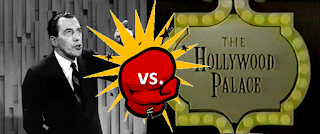
During the 60s, the Ed Sullivan Show and The Hollywood Palace were the premiere variety shows on television. Whenever they appear in TV Guide together, we'll match them up and see who has the best lineup..

Palace:  Bette Davis hosts this rerun from February, with guests Bert Lahr; singer Julius LaRosa; comedian Jan Murray; dancer Barrie Chase; the Nerveless Nocks, acrobats; Australian comic juggler Rob Murray; and Les Cinci, a Parisian couple.

Sullivan:  In this first rerun of the season, Ed welcomes singer-dancer Juliet Prowse, singer Connie Francis, comics Allen and Rossi, French pop singer Jean Paul Vignon, the Harlem Globetrotters, comedianne Jean Carroll, Country and Western singer Roy Orbison, and the Youngs, a teeterboard act.

Off the top of my head, I don't think I've reviewed either of these shows before, which saves me the possible embarrassment of recommending a show that I'd trashed earlier.  So what do we have here?  A couple of pretty strong lineups, but in the end I think the Palace earns the nod.  Bette Davis is a legend, Bert Lahr a talented man, Barrie Chase both talented and a babe, Jan Murray a very funny comedian, and Julius LaRosa a pretty fair singer.  Ed has Juliet Prowse, who's not quite in the same league as Chase, Jean Carroll, who's not nearly as funny as Murray, and Connie Francis, who's not quite as good a singer as Julius LaRosa.  Only the legendary Roy Orbison could elevate Ed, but it's too much for just one man.  The Palace earns the decision this week.

***

Throughout the '60s TV Guide prided itself on its serious coverage of the business of television.  This week, Edith Efron chats with FCC commissioner Lee Loevinger, author of the choice words that appear on the cover.  Loevinger, a former justice on the Minnesota State Supreme Court, is something of a libertarian when it comes to Federal control over the airwaves, setting him apart from his colleagues on the Commission.  For instance, Loevinger believes that the separation of church and state (which, we know, never appears in the Constitution) would seem to render moot the FCC's authority to mandate religious programming on local broadcasters.

Lee Loevinger
For that matter, Loevinger seems skeptical that the FCC has much of any authority over broadcasters, saying that the Commission's charter requiring stations to operate "in the public interest," combined with the FCC's authority to determine just what that public interest is, amounts to an infringement on the First Amendment rights of broadcasters.  Loevinger cites the relevant section of the Communications Act, which explicitly states that "nothing in the statues 'shall be understood or construed to give the Commission the power of censorship over broadcasting.'"  According to Loevinger's reading of the First Amendment, "The plain truth is that we have no damn business getting involved in programming at all."  His strongly-held beliefs lead him to oppose the Fairness Doctrine that requires equal time be offered to any controversial issue, and extends as far as the realm of dramatic programming, about which he says that "You can't constitutionally compel people to read good books, or watch good plays, even on the assumption that you know what good art is, and that is a perilous assumption."  Of former chairman Newton "Vast Wasteland" Minow, he says, "The Minow view, that it is the FCC's duty to elevate the level and quality of broadcasting, is legally and morally wrong," and uses words such as "ill-considered ... illogical ... silliness ... nopnsense ... contradictions ... essential error" to describe Minow's famous speech.

One wonders what exactly Loevinger thinks the FCC ought to be doing.  Mostly, he says, granting broadcast licenses, which is what the Commission was created to do in the first place.  But it was that license-granting authority which originally gave the FCC the foothold into regulation of programming, and the problem of how to separate the two - how the FCC can still grant licenses without making subjective judgments regarding the merits of the applicants and their proposed programming.  There are no standards for judging, Loevinger complains, which makes the separation between licensure and regulation almost impossible to maintain.

It's no surprise that Loevinger has few friends on the Commission, and most experts remain puzzled as to why the late President Kennedy appointed him to take Minow's place on the Commission.  He remains at the FCC until 1968, fighting the lonely fight, his most lasting accomplishment being to encourage AT&T to establish a uniform emergency phone number - 911.

***

Seeing as how we're only a couple of weeks removed from Michelle Wie's victory at the U.S. Women's Open golf championship, it's probably appropriate to mention that Sunday, July 4 marks the first time the Women's Open has ever been telecast on network television.  NBC's cameras are present at the Atlantic City Country Club to cover the challenging last three holes of the tournament's final round, as future Hall of Famer Carol Mann shoots an even par 72 to win by two strokes over Kathy Cornelius.

Across the aisle at CBS, it's the final round of the Western Open from Tam O'Shanter Country Club in Chicago.  The Western Open the third oldest tournament on the PGA tour, trailing only the U.S. and British Opens, and in 1965 it's still one of the most prestigious, tournaments on the tour, dating back to 1899.  Billy Casper wins the first of two consecutive Western Opens, joining a list of winners that includes Arnold Palmer, Jack Nicklaus, Chi Chi Rodriguez, Ben Hogan, Sam Snead, Byron Nelson and Walter Hagen.   It's now called the BMW Championship, it's no longer played every year in Chicago, and it's played in the fall rather than the summer, a victim to the World Golf Championship tournaments that have mostly served to make golfers richer and more selective in the tournaments they play.

In baseball, the Twins are on over the weekend (versus the Kansas City Athletics)  and Friday (against the New York Yankees in a rare home broadcast, one of three or so that Channel 11 would do each season).  The Twins, of course, will take the American League pennant in 1965.  Saturday's ABC Game of the Week gives us the Yankees and Red Sox in Boston, which goes to show that even back then, the networks never passed up an opportunity to show the Yanks and Sox, and the network also presents a rare Monday matinee between the Yankees and Tigers from Detroit, which makes perfect sense when you figure that most people would have had the day off - after all, the 4th of July was on a Sunday.

And if you're interested in the cinematic treatment of sports, NBC's Wednesday Night at the Movies presents Fear Strikes Out, the (mostly) true story of baseball player Jimmy Piersall (Anthony Perkins, right) and his struggle with mental illness, while the Thursday matinee on Channel 4 is The All American, the story of a college football player (Tony Curtis) who gives up the game after his parents are killed in an accident while travelling to see him play.  Sounds a little soapy to me.

***

Random notes to round out the week:

Fourth of July!  There's not much in the way of special programming (aside from the baseball game tomorrow), but two fairly interesting programs airing against each other Sunday afternoon at 12:30pm.  First, on Duluth's KDAL, Ronald Reagan narriates a documentary studying the effects of Communist brain-washing on American POW's.  I sense a patriotic motive here.  Opposite it, ABC's Issues and Answers, displaying something of a sadistic humor, presents an interview with Great Britain's ambassador to the United States, on the 189th anniversary of the Declaration of Independence.

Pretentious alert: On CBS' Look Up and Live that same morning, William Stringfellow documents his four years living in Harlem and working for the civil rights movement, and through the use of photographs telling the story of a white attorney defending the black ghetto.  "To illustrate the dehumanizing experience of ghetto life, members of the Open Theatre Workshop read excerpts from the poetry of Bertolt Brecht, Federica Garcia Lorca and Richard Wright.  I should add here that Look Up and Live was part of the network's block of religious and cultural programming on Sundays (seldom ever seen on Channel 4 in Minneapolis, where the accent was on Bowery Boys movies), and as such it was probably of a pretty high quality.  Which means it still could have been pretentious.

Celebrity watch:  This week's game shows are chock full of celebrities: Buddy Greco and Molly Bee on NBC's What's This Song?; Rita Moreno and Les Crane on the same network's Call My Bluff; Ann Jeffries and Alan Young on CBS' Password, followed by Peggy Cass, Orson Bean, Tom Poston and Kitty Carlisle on To Tell the Truth; and a pair of NBC shows rounding out the day, Dwayne Hickman and Emmaline Henry on You Don't Say!, and Gisele MacKenzie and Bobby Vinton* on The Match Game.  And don't forget Steve Lawrence on Sunday night's What's My Line?, joining the stage with regulars Arlene Francis, Bennett Cerf and Dorothy Kilgallen.

*Bobby Vinton was a well-known and loved Polish-American singer, perhaps the most famous Polish-American of the time, and I remember Johnny Carson joking about the election of Pope John Paul II, saying that everyone knew something was up when the smoke coming out of the Sistine Chapel spelled out "Bobby Vinton."  Polish jokes really died out not long after JPII became pope.

Perhaps more interesting, or at least unique: on the nighttime version of Password Thursday night, the guests are Woody Allen and Nancy Sinatra.  The following year Nancy's father, Frank, would marry Mia Farrow.  That marriage wouldn't last, but eventually Farrow would hook up with - Woody Allen.  Apparently the connection between Frank and Mia wasn't entirely dead though, based on her suggestion that son Ronan might belong to Frank.  It's enough to make the head spin.

And that kind of tidbit is why I keep reading old TV Guides. TV