Showing posts with label Raymond Burr. Show all posts

July 20, 2024

This week in TV Guide: July 24, 1965


It's one thing to know you're old, to be aware of the chronological truth. I freely admit it in my own case; longtime readers know I make no bones about it. It's another thing, though, to be reminded, by your own actions, that you're old. Take this week's issue of TV Guide. I've had this issue for at least three years, given that I purchased it back when I lived in Minnesota. I recognize its cover, I've read its articles, I'm familiar with its programs. It's highlighted on the very complicated spreadsheet that I use to track the issues I own. All this would suggest to me that I wrote it up at some time in the past 

And yet, I don't see it anywhere on the blog. I don't remember having made any pithy comment about it. I've searched the blog using various terms from articles I would have written, had I written them. In other words, I've owned this issue for at least three years, and whenever July would roll around, I skipped over it because I thought I'd already done it. I feel as if Perry Mason is convicting me with his stare. 

At this point, if I were really losing it, I'd probably figure I was done and end things right here. (Either that, or I'd run for office.) But, perhaps fortunately for you, I've retained enough of my wits to forge ahead, and there's no better place to begin than with the aforementioned Raymond Burr, about to embark on what will be the ninth and final season of Perry Mason. He speaks candidly about it with Dwight Whitney, admitting that he didn't expect to still be doing the series. "I wanted to do a show called The Power," he explains. "In it I played the governor of a state, and it had some of the same things going for it that Perry did. It was the best damn thing I ever read, the best new show presentation anybody in this business had ever seen." So what happened? Well, "the heads of CBS decided that with another year of Perry in the offing they didn't want to convert [to another series] at that point. I went along. I'm a paid actor. Once having signed a contract, I had a certain obligation. Last year I still felt it. So we made an eighth season of Perry Mason." And in the meantime another political drama, Slattery's People (starring Richard Crenna) came along. And there went The Power. As a consolation, however, Burr is paid "what may be the highest straight salary ever offered any TV actor."

Not that he didn't have concerns about Perry Mason, particularly the just-completed eighth season. "This year was a bad year," he tells Whitney. "Sometimes the plots got so involved even I couldn't understand them. But next year can be a great one." (Spoiler: it isn't.) That isn't the only reason he came back, though; "My actors were hurting," he says. "I couldn't let go. I was concerned." He had suddenly become, Whitney says, "God's gift to intransigent actors, tender to men's troubles, father of the world." 

Thanks to Mason, Burr has been one busy man: making regular trips abroad to entertain the troops (four to Vietnam alone), speaking to various bar associations (58 since the show started), and serving on the boards of various foundations and organizations. Next year, he says, he'll be visiting a dozen countries around the world, making speeches to universities. "I speak for world peace through law," he says. "I'm a kind of one-man lobby for the legal profession. I believe that the world will either destroy itself or learn how to settle things by law. So it becomes the world's most important profession." He's grateful for the non-monetary things the show has given him; "It's not very often that a person is given the opportunity to use his personal image to do so much good in the world. That's tough to give up regardless."

I've written about Raymond Burr many times in the past; he's appeared on the cover of TV Guide many times in the past. His secret life with its created backstory is always intriguing, but his public life as a mensch has always been impressive, and genuine. As he and Whitney part, the weary Burr—he leaves on another trip to Vietnam early the next morning—says that he does what he has to do. "What is right for me. What I have done may not have brought absolute happiness. But for me it has brought some measure of satisfaction. IF that makes me a fool, my friend, then that is what I am."
Rather than ending on that somewhat somber note, I prefer to think that I've saved the best for last. It comes from a paragraph earlier in the article, after Burr tells Whitney he wants Perry Mason to go out with a great year. "I could visualize Burr waiting for that 'great year' to go out on until Perry Mason was defending cases from a wheel chair." It sounds like a great role for Robert Ironside, doesn't it?

l  l  l

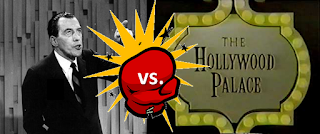
During the 60s, the Ed Sullivan Show and The Hollywood Palace were the premiere variety shows on television. Whenever they appear in TV Guide together, we'll match them up and see who has the best lineup..

Sullivan: Ed welcomes Maurice Chevalier, the San Francisco Ballet, comic Soupy Sales, singer Felicia Sanders, rock ‘n’ rollers Gerry and the Pacemakers, middleweight boxing champion José Torres, comedian London Lee, Stephenson’s Dogs, and Jorgen and Conny, a perch act.
Palace: Host Tony Martin and his wife, actress-dancer Cyd Charisse, introduce comedian Jack E, Leonard; veteran song-and-dance man Ted Lewis; Johnny Puleo and his Harmonica Gang; a vocal-instrumental trio composed of Dean Martin Jr., Desi Arnaz IV and Billy Hinsche; ventriloquist Fred Roby; and the Half Brothers, jugglers.

There's no question that Cyd Charisse is always worth watching, whether she's with Fred Astaire or not. Now, having said that, I'm forced to add that Gerry and the Pacemakers have the edge over Deano, Desi, and Billy, and while Ted Lewis certainly had a legendary career, I have to give the nod to Maurice Chevalier. Meanwhile, there's no comparison for the San Francisco Ballet. Based on all this, I give the win to Sullivan by a José Torres knockout

l  l  l

Throughout the 60s and early 70s, TV Guide's weekly reviews were written by the witty and acerbic Cleveland Amory. Whenever we get the chance, we'll look at Cleve's latest take on the shows of the era. 

It seems as if it was only two or three weeks ago that we were last talking about Jimmy Dean, and here he is again, this time as the subject of Cleveland Amory's review. We learned back then that the network suits were doing their very best to make Jimmy into something he wasn't, something that Cleve rightly judged to be "unwise," because the truth is that "if there’s one thing certain in this changing world, it is that you can’t make Jimmy Dean into anything but Jimmy Dean."

Is that a backhanded compliment? Maybe; it depends on what you think of Dean's style, his schtick, his brand of contemporary country music. But as Amory points out, credit where credit is due: "taken for what he is, and what the show is, Jimmy is good." Take, for instance, his interaction with his Muppet sidekick Rowlf, manned by the team of Jim Henson and Frank Oz, and voiced by Henson. Their bits, such as a recent one which involved a trained flea, "may not sound funny, but with Rowlf and Jimmy looking at an imaginary trained flea, it was a funny scene." Considering that many of their interactions are ad-libbed, it speaks to Dean's quickness with the comeback lines. His interactions with his guests are equally believable; whether it's Rex Allen, Molly Bee, Jack Jones, Eddy Arnold, or Roy Clark, he's fulsome with his praise, and deservedly so. "For country singing or folk singing—and even for city folks who like the country—this show has many virtues."

In fact, if the show has any flaws at all, it's from the constant plugs for his guests' latest albums. It's one thing, says Amory, for it to happen on a talk show, but on a variety show where the guests get paid— well, "Ah want you to know, Jimmy, whan you air a-doin' thet, we dang near burn up." But if that's the biggest complaint that Cleveland Amory has to offer about your show, you're doing all right, son.

l  l  l

Raymond Burr isn't the only star getting the in-depth profile treatment this week, as Arnold Hano takes a look at the up-and-down life of Jackie Coogan, currently undergoing a career renaissance as Uncle Fester on ABC's The Addams Family. 

Once upon a time, Jackie Coogan was one of the biggest stars in Hollywood. At the age of six, he appeared as The Kid in the Charlie Chaplin film of the same name. As a ten-year-old, he met the Pope, received an ovation from the delegates at the League of Nations, received the highest honor from the Greek government, and was mobbed by a crowd of 50,000 in Paris. He made $4 million in the movies, and another $4 million in outside earnings. And when he reached the age of 23, he found out that his mother and stepfather had squandered it all. He filed suit against them but was told he had no claim. He joined such distinguished company as Lou Gehrig in having a dubious namesake, in this case the Jackie Coogan Act, which required at least half of a child actor's earnings to be kept in a trust for him until he came of age. He married and divorced Betty Grable; "My success did not match hers," he comments. Two more marriages and divorces would follow, before the fourth one took.

He joined the Army (long before Pearl Harbor) and piloted a glider in Europe during World War II. "Nothing you've ever done before in life really counts," his commanding officer told the pilots the night before their mission. "Tonight you'll find out if you have a soul." Returning from the war, he discovered the acting roles were nowhere to be found. He took odd bits in nightclubs, parodying The Kid on his knees. 

The role that changed his life, he says, came on October 4, 1956. It was "Forbidden Area," the premiere episode of CBS's Playhouse 90, a tense Cold War drama written by Rod Serling, directed by John Frankenheimer, and starring Charlton Heston and Vincent Price. There was one comic role in the play, that of the Cook. Coogan was cast in the part, won critical acclaim, and was nominated for an Emmy. The offers came rolling in after that.

He was asked to audition for The Addams Family; ABC's Harve Bennett took one look at him in Fester's black robes and said, "He's perfect!" He enjoys his work on the show, but can't help looking at the child actors playing the two Addams children, Lisa Loring and Ken Weatherwax. "Kids can't get proper experience today," he says. "No vaudeville." He works on his autobiography (a book that seems not to have been published), and tells Hano, "I've never enjoyed life more than today." After The Addams Family ends, he continues to do guest appearances on television until his death in 1984. Maybe Hollywood can still produce happy endings, after all.

l  l  l

Not much on the menu this week other than reruns, but in these pre-DVR days, there are certainly some of them you'll want to catch if you missed them the first time. 

One piece of original programming, however, leads off the week. It's the Miss Universe Beauty Pageant (Saturday, 9:00 p.m., CBS), live from Miami Beach. Jack Linkletter, Art's son, is the emcee, while John Daly and Sally Ann Howes are the commentators for the television audience. Meanwhile, Pat Boone presides over the crowning of the new Miss Universe, who happens to be Thailand's Apasra Hongsakula, the first Southeast Asian to win the crown.

The hour-long version of The Twilight Zone has always been considered something of a hit-or-miss season, as the format didn't really fit the tight stories that had become the hallmark of the show's first three seasons. (One of the few instances where the network executives knew best: Rod Serling had originally conceived TZ as an hour-long program, but was convinced by the suits to change it to 30 minutes. They were right.) Sunday's episode, however, is an exception: "The Incredible World of Horace Ford" (8:00 p.m, CBS), a touching story of a man trying to recapture his lost youth, with Pat Hingle outstanding in the title role. The story, written by Reginald Rose, originally appeared on Studio One ten years previously, with Art Carney; the story's downbeat ending was modified for TZ, and that was fine with Rose—as he pointed out, he'd already had it done his way the first time.

One of the week's most watchable repeats is Monday's The Winging World of Jonathan Winters (8:00 p.m, NBC), first shown in May. Winters is at his best in this "freewheeling" hour, which features Steve Allen, Leo Durocher, Stiller and Meara, and a taped tribute from Jack Paar (who featured Winters on his show many times). Alexander Scourby narrates the hour, produced and directed by Greg Garrison, who will go on to helm The Dean Martin Show.

On Tuesday, George Hamilton hosts Hullabaloo (9:00 p.m., NBC), with his musical guests Brenda Lee, Noel Harrision, Linda Bennett, the Hollies, the Impression, the Womenfolk, the Ronettes, and the Wayne—I mean, Wayne Fontana and the Mind Benders. (Sorry, got carried away there for a moment.) Hamilton, who'd starred in the Hank Williams biopic Your Cheatin Heart the previous year (probably when this episode was first shown), sings the song of the same name with Brenda; Harrison, who'd yet to record the Oscar-winning "The Windmills of Your Mind," sings the ballad "Barbara Allen." Perhaps the show's ratings would have been better had the host been George Harrison. 

You'll recall that last week I highlighted a couple of programs that were representations of a socio-culture that's long-since disappeared, and this week offers something of the same: Key to the City (Wednesday, 8:00 p.m., NBC), a 1950 comedy set at a mayors' convention in San Francisco, starring Loretta Young as "a prim and serious lady mayor" who's mistaken for a night-club dancer; Clark Gable co-stars as the man who makes the initial misidentification; romance follows! Would we see something like that on network TV today? Somehow, I doubt it. (By the way, Raymond Burr appears as the heavy!)

Thursday night is highlighted by one of the best, and best-known, episodes of Kraft Suspense Theatre, "The Jack is High" (9:00 p.m., NBC), a heist caper with a very, very gruesome twist at the end. Edd Byrnes, Henry Jones, William Bramley, and Larry Storch are the gang trying to pull off their getaway hidden inside a gasoline tank truck, while Pat O'Brien plays the dogged detective on their trail. Ralph Senensky directed; you can read his thoughts about it here. (For good measure, you can see the complete episode here.)

We started our look at the week with an original program, and we'll end it the same way, as Sally Ann Howes returns from Miami Beach to participate in a mini-Rat Pack reunion on The Tonight Show. (Friday, 10:30 p.m., NBC) Joey Bishop is the guest host (completing his second week subbing for Johnny!), and in addition to Sally, his guests are Frank Sinatra and Sammy Davis, Jr. I'd stay up late for that.

l  l  l

Another Raymond Burr note, of sorts; Ray Collins, who played Lieutenant Arthur Tragg for so many seasons on Perry Mason, died of emphysema on July 11 at age 75. As "For the Record" reports, his career spanned 60 years on stage, in the movies, and on television; "If they've written it," he used to say, "I've played it." He'd been in failing health for some years, with his last appearance on Mason coming on January 16, 1964 (filmed in October of 1963). Raymond Burr, ever the mensch, insisted that Collins be kept in the show's credits until he died, not only to help keep his spirits up (he watched the show every week), but to allow him to continue to receive health coverage from the Screen Actors Guild.

 l  l  l

MST3K alert: Robot Monster
(1953) Deadly robots descent upon the earth. Their mission: to destroy civilization with supersonic death rays. George Nader, Claudia Barrett. (Thursday, 10:30 a.m. as part of a double feature, WTCN) This description actually flatters a movie that is widely considered to be one of the worst ever made. The "robots" are dressed in gorilla suits, the premier special effect is a bubble machine, and the best thing about it, by a long shot, is the score, composed by the before-he-was-famous Elmer Bernstein. Fortunately, we have not one, but two episodes of Radar Men from the Moon to soften the blow. TV  

February 24, 2024

This week in TV Guide: February 22, 1969


I think most of us are aware of the secret life of Raymond Burr, how he constructed a life's story that was almost entirely false, not out of any particular malice, but in order to keep his private life private. His homosexuality, to be sure, but I think the creation of his alternate life's story went far beyond what was necessary to simply keep quiet that part of his life. For years, until after his death, this story was accepted almost without question by so many news sources, but in part two of a two-part profile of Burr, Edith Efron takes a very close look at the actor, and finds some things that hint at the mystery of the man, and how not everything is what it appears.

There's her conversation with Linda Galloway, wife of Ironside co-star Don, who offers this view of him: "Ray is the most variable, individual man I know. He changes from minute to minute. He is like a lot of different men. Sometimes he is sharp, sometimes he is dull. He can say the same words on different days and they'll mean a hundred different things. Sometimes they'll be a caress, at other times an insult or a snub. He is so... complicated!" Like a lot of different men—isn't that an interesting description?

Burr, one of America's most popular actors, has often come across, Efron says, as "a combination of Falstaff and St. Francis of Assisi," a mixture of jollity and benevolence. But, she says, these are "scarcely the essence of Raymond Burr. They are his disguise." Underneath that disguise, he is solitary, remote, a man of "both massive strengths and massive weaknesses," an "unstable, darkly tense man who constantly reveals signs of inner torment." His many compulsions range from eating to tidying, working, and do-gooding. Most are, she says, more subtle; "He is locked up in repressive defenses and finds it virtually impossible to open up emotionally." Disguises, repressive defenses. "His own complex identity weighs heavily on Burr’s mind—he is often in an introverted, brooding state of selfinspection. But mainly he attempts to escape his inner anxiety." And most of his escapes, she says, are "creative." That may come across as a lot of psychobabble, but it also kind of strikes close to home, don't you think?

Efron notes his apparent disconnection during a dinner given by civic leaders to acknowledge his humanitarianism. He frankly admits his boredom with such events. But, he acknowledges, "The fun isn't there for them if you’re not a little available. So you go through with it. But it’s a terrible drain, a terrible drag." He's left tolerating people, but, he says, "Behind the social façade, I'm remote." There's that word façade. 

     Looking over his shoulder?
Why the inner conflicts? One friend says he feels Burr, a man of strong emotions, values, and convictions, "doesn't feel he should express them openly. He seems to feel there is something wrong about it. Almost as if it's guilt." Another calls him "a violently self-=assertive man who thinks self-assertion is wrong. . . Now he feels he should crucify himself for the world. But he doesn't want to. He's really greedy for life. He’s spent his life submissively climbing onto crosses, hating it, and hating himself for hating it." The result is a man who "exists in a state of virtually nonstop tension, alienation and self-condemnation," a man "with a brilliant capacity for life who can’t permit himself to live it."

It's all very interesting, but at the end, are we really any closer to understanding why Burr chose to create a fake life to tell the world? Perhaps not, although the hints of shame, guilt and and self-abnegation that pepper these snippets might give us a tantalizing clue. He names Socrates, Gandhi and Schweitzer as his moral ideals; perhaps he couldn't stand to have had a life that was, by comparison, so ordinary. In the end, though, I think it might just be that Raymond Burr couldn't have done it any other way, that his desire to create barriers and shields made it imperative, inevitable, that he would have done it. And maybe, in some odd way, he had something of a last laugh after all; maybe all this, too, was an illusion, one that allowed him to live a life that nobody knew about. Perhaps not, but maybe.
 
l  l  l

During the 60s, the Ed Sullivan Show and The Hollywood Palace were the premiere variety shows on television. Whenever they appear in TV Guide together, we'll match them up and see who has the best lineup.

Sullivan: Broadway takes a bow as Ed presents stars and other cast members from three current musical hits: Fiddler on the Roof, Cabaret, and Zorba. Also: the 5th Dimension, Glenn Yarbrough, Michele Lee, comedians Myron Cohen and Dickie Henderson, and Hugh Forgie’s Novelty act.

Palace: An all-comedy potpourri is hosted by Laugh-In’s Dan Rowan and Dick Martin, who offer their own brand of enlightenment about old songs and charades. Sharing the spotlight are fellow farceurs Ron Gaylord and Burt Holiday; banjo-playing pantomimist Gene Sheldon; double-talking Simmy Bow; telephone gossip Betty Walker; and stand-up comics Jackie Gayle and Irwin C. Watson. 

The Broadway stars appearing with Ed tonight aren't necessarily the names people associate from the original casts or the movie adaptations—Harry Goz is Tevye in Fiddler, Anita Gillette and Martin Ross in Cabaret—it's still a star-studded lineup, more than enough to overcome the all-comedy presentation on Palace. This week Sullivan takes the bows, and that's no laughing matter.

l  l  l

Throughout the 60s and early 70s, TV Guide's weekly reviews were written by the witty and acerbic Cleveland Amory. Whenever we get the chance, we'll look at Cleve's latest take on the shows of the era. 

Every once in awhile you run across one of those shows that simply leaves no impression, like the smallest of kittens walking across a bedspread. It could just as easily have been from the 1950s or the 1990s for all you know; it doesn't even ring a bell from having been in TV Guide. It's the opposite of total recall; there's no recall at all. Such a series, at least for me, is My Friend Tony. Had I not run across it on YouTube a few years back, I would have been like the man at his high school reunion who has no idea who his friend Tony is. There must be a good reason for this, so we turn to Cleveland Amory for encouragement that we didn't miss some hidden gem. As usual, he doesn't let us down.

My Friend Tony is, says Cleve, "one more show which starts out-with high promise and reasonable premise and promptly falls flat on its console." NBC has had too many of these "fallen soufflés," he continues; "It's time they either got a new chef in charge of locking at what's cooking or else a new Vice President in Charge of Believability." Sheldon Leonard, the producer who's developed much better series than this, terms the show a "mystery-comedy," which leaves something to be desired; "Mystery loves comedy all right these days, but whether or not they should get married is, judging by this show, an entirely different matter." Tony, the eponymous friend in question, is a young Italian (played by Enzo Cerusico) serving as the "fun-loving legman" for John Woodruff (James Whitmore), one of those professor/detectives (James Whitmore) that populate TV. John met Tony (a "street urchin") in Italy during the war, and later on Tony became one of his students. 

The mysteries, such as they are, are contrived and overly complicated; in one episode, Brooke Bundy plays a young woman who is, incredibly, not only the good girl, but the girlfriend of the crooked crime commissioner, and the sister of a murderer who kills someone she fingers, before he's killed himself. Not only that, she manages to fall for Tony, for whom the feeling is mutual. As Tony leaves, she says, ""Most girls cry at a time like this.' We couldn't have agreed more, except for one thing—she was almost at the end of the script and should have been happy as a clam." Cerusico is actually both good and likable in the role; what he isn't is believable. Whitmore is another example of what we've seen too many times this season, "a fine actor in a phony part." Perhaps Tony has the last laugh, after all. One of the reasons he has such a good time is because his English isn't very good, "and in a show like this, that's a big advantage."

l  l  l

Looking through these issues of the late 1960s and early 1970s, it's impossible to overstate how traumatized news organizations were by the experience of Chicago, 1968. No matter how hard I might want to avoid it, it just keeps coming up, even though we're now almost six months after the fact. 

This week we lead off with the third of a four-part series by Neil Hickey entitled "How the Networks Stubbed Their Toes," which examines aspects of how the media covered the Democratic National Convention in Chicago, and suggests that, just maybe, things weren't quite as bad as people made it out to be. The popular conception—certainly the one I've always read—is that the coverage was one-sided, "a straight-out contest of good versus evil: the good dissenters (both inside and outside the hall) versus the bad Establishment." But Hickey finds that there was, from the very beginning, an attempt by journalists to set a balance between the demonstrators and Mayor Richard Daley's police. 

Roger Mudd of CBS, for instance, took a harsh view of those delegates who favored the Vietnam peace plank that was defeated on the floor. "It occurs to me that we're suffering at this convention from a massive case of political bad manners," he said, "and the special goat became Mayor Daley." Did the dissidents, he continued, really think the convention could have been conducted without security? As far as his observations on what came to be called the "police riot" conducted against demonstrators in Grant Park, "I talked to reporters last night who were there who said that the police were right. I don't know that we're absolutely correct in calling it unprovoked." Hickey cites several similar comments by ABC's Howard K. Smith and NBC's Chet Huntley, calling out demonstrators for "being quite purposeful in their baiting of the police." 

According to William Wood professor at the Columbia School of Journalism, the strong feelings which many have regarding the events in Chicago may color their perceptions of how the story was handled. Nonetheless, he acknowledged that the reporters occasionally let their private feelings come through, when they're supposed to be "absolutely impervious" to such lapses. He also believed that at times the networks latched on to more sensational stories, ones lacking in substance, while saying to themselves, consciously or unconsciously, "Let's keep this thing going." He urges the FCC to be judicious with any demands they make of the networks to defend their coverage, but overall stresses a need for "quiet self-examination" by the news departments. Penn Kimball, a professor at the Columbia School, thinks that there might have been a benefit for reporters to have done "an old-fashioned news-gathering job on foot," feeding the information to the anchors, rather than reporting from the scene with cameras and microphones. 

One story that swept the convention was a rumor that Massachusetts Senator Edward Kennedy might make himself available as a last-minute compromise candidate. The rumor swept through the convention hall like wildfire, but there's never been any real evidence that such a rumor was true. Says Kimball, "There was indeed something to the story, but the boom was never real, and TV—and everybody else inflated it." CBS's Eric Sevareid wondered aloud if the rumors "were not, at least, in part, the creation of TV reporters looking for an intriguing story."

Demonstrators aren't fools; they know that reporters and cameramen are watching them, and they know how to stage events for their benefit. Kurt Lang, a sociology professor at SUNY Stony Brook, says that the journalists on the scene "inadvertently contributed to the uproar in their search for interesting interludes." That's not, however, the same thing as slanting the news, he stresses. He adds that the problem wasn't too much coverage, but not enough of the right kind of coverage. Television had an ideal opportunity to look at "what these demonstrations and these young people really meant," he says. "Who were they? Where did they all come from? Why, in fact, did they come to Chicago at all? What does it say about our institutions? Why should young Americans walk around waving a Vietcong flag? What moves them to shout, 'I want to destroy the whole Establishment and see it come tumbling down'?"

I've commented in the past that I see a lot of disturbing parallels between 1968 and what we're experiencing today, and while I think the experts in this article made some excellent points, the larger question still remains. The demonstrators in Chicago and elsewhere, protesting the war and the establishment—they're not much different from the young people of today, protesting on campuses and in the streets, with their anti-American slogans and chants. I don't suggest that they're representative of all young people, or all Americans; I'm just suggesting that those questions Lang mentions, the ones that weren't being asked in Chicago, aren't being asked today, either. The media may or may not be biased, but are they doing a good job covering the story? More important, are they even letting the public know there is a story? Lang concludes by saying, "Nobody I know in TV has attempted seriously to answer these questions. The networks were covering the violence, all right, but not what it means to all of us for now and the future.” Hickey adds, and I agree, that this is the better story.

l  l  l

It's kind of a lean week, TV-wise, but here's a program that caught my eye: "The Experiment," an episode of CBS Playhouse, a kind of attempt to resurrect the old Playhouse 90 quality-drama idea (Tuesday, 9:30 p.m.) It distills almost every issue of the 1960s into one story: youth rebelling against the establishment, premarital sex, racial conflict. About the only thing missing, as far as I can tell without actually watching it, is drug use, but that might have been worked in there as well.

What's really notable about this is the casting. M.K. Douglas stars as Wilson Evans, the young scientist who sells his soul to corporate America in order to further his studies, while Tisha Sterling is Tess Hayes, a student activist and M.K.'s lover, who agrees to pose as his wife in order to further his career. M.K. Douglas, complete with scraggly beard, is, as we might have guessed, Michael Douglas (and a note in the listing helpfully identifies him as Kirk Douglas's son), while Tisha Sterling is the daughter of Ann Sothern and Robert Sterling. Was this stunt casting, especially playing up the generation gap? I don't think so; Sterling had a very capable career, particularly in the movies, while we all know the success that Douglas has achieved over the years. They're surrounded by a very strong supporting cast, including John Astin, Barry Sullivan, and Susan Strasberg. Ellen Violett talks here about her experience writing the teleplay.

l  l  l

With De Gaulle in Paris
The networks are paying a lot of attention to President Nixon's trip to Europe this week; understandable, given that this is the first European trip by an American president since John F. Kennedy in 1963 (the famed "Ich bin ein Berliner" speech). Planned stops include Brussels, London, Bonn, Berlin, and Paris; considering that it's only been a month since the inauguration, one can appreciate the importance to which Nixon himself must have attached this visit. Networks plan coverage of the President's departure from Washington on Sunday, as well as mid-morning and late-evening reports and expanded news coverage. In addition, CBS has prime-time specials on Thursday (8:00 p.m.) and Friday (7:30 p.m.). I mention this partly to show how extensively television covered the news back then, and partly to show how, well, indifferent we've become to overseas travel through the years. It sometimes seems as if the president flies over to Europe every six weeks or so for something or other, and if I exaggerate on that, my point is that it's become so routine, so common, that we hardly consider it an event anymore—and technology, especially things like air travel and television, has made the world much, much smaller. And it could have felt even smaller; original plans called for the Apollo 9 launch on Friday morning, but colds for all three astronauts pushed the mission start back to March 3.

l  l  l

Good news if you're a fan of CBS; according to the latest from Richard K. Doan, the network has such a comfortable lead in the ratings race that, with only scattered exceptions, they'll be sticking with their current lineup. At present, only The Jonathan Winters Show, Gomer Pyle, U.S.M.C.*, and The Queen and I appear to be definite cancellations; while it's possible that Hawaii Five-0 and The Wild Wild West could be in trouble "as too action-oriented in the present antiviolence climate," but only if "something hot comes up." Whether they're referring to something hot being a hot news event or a hot potential show isn't clear, but in the event, while Five-0 will survive and thrive until 1980, the network gives West its cancellation notice by the time this issue hits the newsstands; producer Bruce Lansbury will call the show "a sacrificial lamb … It went off with a 32 or 33 share which in those days was virtually break-even but it always won its time period."

*Gomer Pyle was, in fact, number two in the ratings, behind only Laugh-In, but left the air in favor of Jim Nabors' variety program.

Elsewhere in the industry, Rod Serling remains in the spotlight, despite his comments a few months ago in which he "swore off writing for TV presumably forever." Not only has he been working on a proposed new ABC series, The New People, he's "engaged also in writing a two-hour World Premiere movie for NBC in which he'll appear as a plot-explaining host." The premise: three "slightly related" suspense tales, with a different star in each. The movie's referred to as "Night Gallery," with Joan Crawford, Roddy McDowall and Sam Jaffe among those scheduled.

l  l  l

MST3K alert: The Eye Creatures
(1945) The strange inhabitants from a flying saucer terrify a lovers' lane. John Ashley, Cynthia Hull, Warren Hammack, Chet Davis, Bill Peck. (Saturday, 11:30 p.m., KCRA in Sacramento) As you can see from the picture at the left, the original title was rendered in a stylized logo. When the movie was re-released as Attack of the Eye Creatures, whoever was in charge of graphic embellishments inexplicably added "Attack of the" to the title, meaning that it reads literally as, well, Attack of the The Eye Creatures. No fan of MST3K would ever refer to it any other way. And I think that tells you just about everything you need to know about this movie.  TV  

June 22, 2022

Over the Transom: Ironside


by Stephen Taylor

We were not an Ironside household as I grew up. I never saw a single episode of the show as a child, and grew up knowing only that it involved a cop in a wheelchair; that was the extent of both my knowledge and my interest in the show. I’m much older now, and I have time to watch old television shows, and I thought I’d give Ironside a try. I’ve always enjoyed Raymond Burr, and thought the show might be fun to watch. I’ve watched the first three seasons, and thought I’d offer a few comments.

The premise is this: Robert T. Ironside (Raymond Burr) is the Chief of Detectives for the San Francisco Police Department. He survives an attempt on his life, but suffers an injury which leaves him a paraplegic. Forced to retire, he returns to the SAPD as a consultant; he forms a special unit comprised of Detective Sergeant Ed Brown (Don Galloway), Officer Eve Whitfield (Barbara Anderson) and assistant Mark Sanger (Don Mitchell). He reports to Police Commissioner Dennis Randall (Gene Lyons). The special unit handles almost every sort of crime, from con artists to car thieves to murder to property theft to security for dignitaries and more. Sometimes they’re directed by the Commissioner to handle certain crimes, but they mostly spring into action unbidden. It’s a standard police drama centered around Burr, except that he’s in a wheelchair.

The two-hour pilot aired in March of 1967. It was pretty good; it introduced Ironside and his team to the audience, and explained how Ironside came to be in that wheelchair. There is a lengthy list of suspects, as Ironside was not popular with quite a few people. The ending was fairly suspenseful; the murderer was not who you might think it was, and the pilot made a basic attempt to show how Ironside assembled his team. Sgt Brown and Officer Whitfield he wanted because “they’re good cops!” Mark Sanger was a different story. Ironside had already sent Sanger to jail twice. Hearing that Sanger was downstairs in booking and making threats about “getting” the Chief, Ironside had Mark brought to his office, where he offered Sanger a proposition: come to work for him or go back to jail. Push the wheelchair, assist Ironside in getting around, perform odd jobs, other duties as assigned. All for the princely sum of $20 a week. Sanger accepts, but he’s an angry black man. Very angry. Angry, but not stupid, and knowing that he’s entered an important fork in his road, he accepts. His hiring set up some of the only conflict between characters the show ever had.

Raymond Burr was an excellent actor. He’d been a supporting player in movies since the Forties, and could play a variety of parts. He committed a murder in Rear Window, and starred as a psychopathic gangster in a movie called Raw Deal* in 1948. He already had a lengthy track record on television; he’d starred in Perry Mason as the titular character in the long-running series about a defense attorney. America knew Raymond Burr, and they liked him. Never a father figure, he was the gruff but avuncular uncle who always knows how to be stern with an adult but kind to a child; understanding always, but insistent on a moral code based on honesty and integrity. The part of Chief Ironside called for this character, and it fit Raymond Burr to a T; he’d been playing a variation on that character for the last 10 years. For his part, Chief Ironside had been a cop for at least twenty years. It’s mentioned that he’d been in the Navy, presumably in WW II. He’d risen through the ranks to Chief of Detectives, where he stayed until the attempted murder. Even as a consultant he’s still called “Chief” by his subordinates and others. There are exceptions; those exceptions being his aunt; who calls him Robert, and Commissioner Randall, who, along with all his old flames, and there were many old flames, calls him Bob. 

He’s gruff and something of a tyrant, yet capable of acts of astonishing kindness and generosity. He takes no guff from anyone. He demands respect and gets it; even professional criminals respect him, as they know he’s fair and will never give them a raw deal or go back on his word. He has a keen sense for when something’s not quite right, a sharp eye for detail, and a knack for interrogation. He inspires an almost slavish loyalty from his team, and sometimes abuses that loyalty; he also has a short temper and isn’t above raising his voice if something displeases him. The show was centered around Chief Ironside, and it’s fair to say that Raymond Burr carried the show. Burr, in this part being confined to a wheelchair, has to rely on his face to convey mood and emotion, and he’s gifted in doing so. He could convey anger, happiness, deep suspicion, exasperation and many other emotions with his expressions or the way he held his jaw. He’s quite good.

Sergeant Brown (Don Galloway) is a detective sergeant who landed on the team simply because Ironside approved of his work as a detective. Although portrayed as a bit of a bumbler in the early episodes, he soon demonstrates that he is fast on his feet, good with interrogation and even better at anticipating the Chief's next request/demand. He seems to have been born suspicious; his eyes squint when he smells a rat, and they squint a lot. He doesn’t seem to have any sort of personal life. And Don Galloway is woefully miscast in this part. I don’t know much about Galloway. I don’t remember seeing him either before or after Ironside. He makes no strong impression. Brown’s a detective sergeant, meaning that he’s a veteran who’s seen every side of the human condition, including a great many things civilians can only imagine. There are many ways to die, and he’s seen all of them. Yet none of it registers on his face. There are no lines or wrinkles; nothing to indicate that his experiences have changed him. He’s just an anonymous guy wearing a suit who happens to carry a badge. He has no gravitas. No bearing. He’s simply not believable. Galloway reminds me of Dick Sargent, not a detective in a large city. He’s simply too clean-cut to believably play the part. He’s not objectionable, and he does sort of grow on the viewer, but he never really makes an impression. And he’s not given a lot to do.

Only one episode, “Girl in the Night” from the first season, really centers on Brown; he meets a troubled nightclub singer (Susan St. James) and becomes attracted to her. Sparks should have flown, but they didn’t. He just isn’t believable as the sort of guy who might meet a nightclub singer and have a brief fling. Susan St. James lit up the room, but it was as though she was talking to a wall for all the good it did her. His casting was a loss to the series. It will be interesting to see if he’s given more to do in later seasons, but Brown was horribly miscast. Journeyman director Ralph Senesky directed “Girl In The Night”. On his website**, Senesky discusses the production of this episode, as well as his general opinion of Universal Television, which wasn’t favorable. He did think that “Girl In the Night” turned out well, however. 

Oh, my. I spoke too soon. I wrote the above after watching all but the last episode of the third season. After an entire season of indifferent writing and acting, would the last episode be the one to break the pattern? Yes. A very strong yes. Don Galloway, please forgive me. 

Don Galloway finally gets a chance to shine in an episode at the end of the third season; “Tom Dayton Is Loose Among Us” shows us that despite being miscast, Galloway could act, and the episode answers some questions the audience has about Sgt. Ed Brown. Bill Bixby plays a sociopath named Tom Dayton, with William Smithers being cast as defense attorney Ross Farley. Dayton tends to react violently to women in positions of authority. During one such act of violence, he causes the death of Brown’s fiancée. Finally, we get some backstory. Finally. Told in flashback, Brown, a rookie patrolman at this point, becomes obsessed with catching Dayton, and gets in the way of Ironside’s investigation into her death. Ironside isn’t happy, and he lets Brown know it, but he also senses the makings of a good cop in Ed Brown, and invites him to join the investigation. Brown comports himself well, and Ironside makes a mental note for the future. But it isn’t over. Not yet. 

Seven years later, Dayton is paroled. Brown, a Detective Sergeant by this time, is convinced that Payton will strike again. His old obsession with Payton returns; he’s angry and in danger of losing his objectivity regarding Payton; it gets to the point that Ironside has to tell Brown to stand down. And Payton does strike again. Ironside, to show his trust in Sergeant Brown, allows him to conduct the initial interrogation after Payton surrenders in the company of attorney Farley. Bill Bixby puts on an acting clinic in the entire episode but especially this scene, proving once again what a superb actor he really was; this is a juicy part and he makes the best of it. But Don Galloway, bless his heart, reaches deep within himself and finds acting talent he probably didn’t even know he had; he matches Bixby stroke for stroke during the interrogation. Sgt Brown begins by trying to build some rapport with Dayton, and he’s successful. He then pushes, pokes, prods and goads Dayton to answer, as one man to another, some questions about the most recent assault he’s committed. And as Brown continues to push, Dayton begins to lose control. Brown pushes even more, and Dayton cracks wide open. 

Defense attorney Farley can’t do anything but give himself a facepalm; he’s never seen an interrogation go off the rails like this, and it gets worse. After Brown finally goads him into losing his last vestige of self-restraint, Dayton concludes by giving a full confession; he’s proud of himself, and with rapport established, is convinced that Sgt. Brown surely understands why he assaults the women who show him disrespect. And, while conducting the interrogation, an entire range of emotion plays across Brown’s face; he’s alternately amused, understanding, angry, misbelieving and repulsed, all within the span of just a few minutes. It’s an excellent scene, with tour de force acting by Bixby forcing Galloway to up his game; he doesn’t want Bixby to show him up, and that certainly doesn’t happen here. More of this from Don Galloway, please. Give us more.

Barbara Anderson portrayed Officer Eve Whitfield. The Chief selected her at the same time he selected Sgt. Brown, because “they’re both good cops”. Barbara Anderson certainly wasn’t miscast. She could act (Lenore Karidian, call your office….) and she’s given a backstory. Eve was a young socialite with a strong sense that there might be more to life than fashion shows. The episode “Reprise” had a badly injured Whitfield recalling how she met each of her teammates. Ironside, who had an absolute gift for sensing human potential, sized her up as a potential police officer, but he had to reel her in, and the early scenes between the Chief and the civilian Whitfield were excellent. She’s a snappy dresser (Barbara Anderson was beautiful) and does a lot of undercover work on the show. 

She’s also unafraid of danger. While leaving a movie theater, she quite literally walks into the middle of a jewelry store robbery, and comports herself well in the ensuing gunfight. This was one of the best episodes of the first season; it’s called “All In a Day’s Work”, and it’s good. Eve shoots down one of the robbers, and is horrified to find that she’s just killed a teenager. She becomes afraid of her pistol, “forgetting” to put the pistol in her purse when she leaves the office and performing abysmally at the gun range. Ironside grows exasperated with her and essentially tells her to put on her big girl pants and be a cop. Which she does. The others were horrified at his attitude, but his little lecture is just what she needed. The ending is a little pat, as almost all the endings were, but this episode was a cut above the rest, due mainly to her acting and the writing by Ed McBain (Evan Hunter). I had no idea that Evan Hunter had done any writing for TV, but he did indeed, especially in his salad days in the 50’s and 60’s. You can tell it in this episode; the writing is a little sharper and the characterizations a little more vivid. And it includes one of the best scenes in the series.

Ironside is talking to the mother of the dead boy; she’s played by Jeanette Nolan, one of the best character actresses I’ve ever seen. Raymond Burr was one of those actors who could draw a better performance out of another actor simply by being in the same scene, but Nolan needed little prodding. The scene lasts about three minutes, but it’s very emotional. She doesn’t want to help Ironside find the Fagin who was running the robbery ring, and Ironside has to convince her otherwise. A lot of emotion and feelings rubbed raw here, and the final moment when Nolan relents and gives Ironside the information he needs is just excellent. It’s always a joy to watch two fine actors work together, and this is a fine example of just how well Raymond Burr could act, especially with actors who were his equal.

Don Mitchell played Mark Sanger. Mark Sanger had to be easy to write for, as Sanger was an interesting character. Mark Sanger grew up on the mean streets of the city, probably in Fillmore. It was a challenging life for a boy with no father and Mark began to drift into crime. As an adult, he’d been sent to jail multiple times by Chief Ironside, and Mark didn’t appreciate that one bit. He was angry, not just at Ironside, but at everything. He was an angry black man, and meat for multiple scripts which explored his upbringing and his relationship with Ironside. He respected Ironside, and ultimately came to care for him very much. In return, Chief Ironside was proud enough of Mark that he paid for Mark’s education, which ultimately led to his becoming a lawyer.

But in the beginning there were fireworks. In “Memory Of An Ice Cream Stick” from the first season, Mark goes to visit an adult figure from his childhood named Sam Noble; Noble has just been released from prison. Mark has pleasant childhood memories of the ex-con; Noble treated Mark decently and gave him a sort of father figure to look up to. Ironside warns him against being involved with Noble, as he suspects Noble is involved in a gangland murder. Mark declines Ironside’s request, and forcefully explains to Chief Ironside that he doesn’t need or want his advice, that he is a grown man, and that the Chief simply does not understand how Mark grew up or the role that Sam Noble played in Mark’s life. He is tired of the Chief’s advice and admonishments in general, as well as his patronizing attitude. The Chief is taken aback, and, for both the first and last time in the first three seasons, apologizes. He takes Mark’s request to heart, and Mark learns a valuable lesson about childhood memories when he finds that Noble is indeed involved in the murder, and that he’s not at all the man Mark remembers. As the series progresses Mark begins to loosen up; he works well with the other members of the team, and begins doing more and more police work. 

My overall impression of the series is that it’s a routine police procedural with some nice touches. The writing and direction was routine, and the acting routine as well. In his discussion of the two episodes he helmed for Ironside, director Ralph Senensky refers to Universal as a factory; he stated further that, and I’m paraphrasing, that simply driving through the Universal gate seemed to drain all the creativity out of him. It’s tempting to say that Ironside was routine, and to simply leave it at that. Except that that’s not really fair to Universal Television. NBC, Universal and Harbour Productions signed a contract guaranteeing NBC 26 episodes of a crime drama; each episode was to be about 52 minutes long, and each episode was budgeted at between $150,000 and $200,000 apiece, and each episode had a shooting schedule of either six or seven days. It was right to say that Universal was a factory; they really were making a product, and their customer was NBC. Consistent excellence simply wasn’t possible under these conditions. And quite a bit depended on the mix of producers, writers and directors. Some dramas, such as The Fugitive, simply had a better mix of the three and were able to turn out consistently better episodes. Ironside did not. As a result of all these factors, there were many episodes of Ironside that were simply routine at best and nearly unwatchable at worst. This was never the intent, but it’s just how it played out.

Having said all this, sometimes the factory turned out some excellent television. And the best was an episode called “Price Tag: Death”. It starred Ralph Meeker as a homeless former cop, and ◀ Clu Gulager as a petty thief who lives in the bottle. During a burglary, the thief accidentally kills a homeless man, who was a friend of the fallen cop. Meeker asks Ironside for help. Jack Brody, the thief played by Gulager, is a pathetic figure. He’s a boozer. He’s lost his wife and family. He sits and smokes and drinks all day. He writes bad checks to generate an income; he’s discovered that if you buy some groceries at a supermarket, they’ll let you write the check for some amount over the purchase amount. He dumps the groceries and lives on these small sums of cash. He’s a complete loser. He goes to see his ex-wife; she wants nothing to do with him and doesn’t want him near their children. He picks up a woman at a bar and takes her home, only to wake up the next day to find that she’s cleaned out his wallet; she even returns later in the day and steals the machine he stole during the disastrous burglary, which he uses to make the checks he cashes, meaning he no longer has an income. He wrecks his car. His pitiful little life is falling apart, and he’s almost relieved to be shot to death at the end of the episode.

What to say? Clu Gulager’s acting is outstanding. Gulager was one of those actors who was never going to carry a show, and he didn’t do character roles. He spent nearly his entire career doing Guest Star roles such as this one. He was one of those rare actors that screenwriters live for; give him some good lines and he runs away with them. His Jack Brody is vivid; the cold sweat of desperation oozes from every pore on his body. He’s trapped in this cycle of petty crime, and he doesn’t know how to escape. He’s simply a bystander who watches as his life, which wasn’t much to start with, degrades with increasing speed. Clu Gulager plays this role very, very well, and is completely believable as the alcoholic loser who isn’t even a very good thief. Kudos also to director Richard Colla and writers Collier Young and Robert Earll, who wrote the lines which Clu Gulager used so effectively to define Jack Brody. This is the best episode yet in the first three seasons, and perhaps one of the best episodes of series television I’ve ever seen.


Ironside
is worth watching. It’s not great television, but it is entertaining. It doesn’t enjoy the same iconic status in our culture as other shows of the period, such as Mannix and Star Trek, but it succeeds on its own merits as simple entertainment and a pleasant way to spend an hour. This set of episodes was packaged by Shout! Factory; for whatever reason they only released the first four seasons. The second set has been released by an Australian company called Via Vision, and it’s proving difficult to find; it goes in and out of stock at all American retailers. If you enjoy vintage television from a different time and place, you’ll enjoy Ironside.

* Raw Deal is a gem. It’s one of the finest film noirs ever made. Directed by Anthony Mann, with cinematography by the legendary John Alton, it really gives Raymond Burr a chance to shine as the sadistic gangster Rick Coyle. While not the main character, Burr chews the scenery, and plays evil very convincingly; he has an epic death scene which can only be envied by other actors. ClassicFlix has re-released their restoration of Raw Deal; their restoration is pristine. This movie is an excellent introduction to the world of noir, and Raymond Burr is a huge asset to a movie which also stars Dennis O’Keefe, Marsha Hunt and Claire Trevor. John Ireland plays Fantail, Coyle's psychopathic assistant. Highly recommended. This movie is without flaw.

** Ralph Senensky has made an invaluable contribution to television history with his remarkable website “Ralph’s Cinema Trek”. Senensky, who’s still with us at 99, was a journeyman director who worked in television from the Fifties into the Eighties; he directed episodes of a great many iconic television shows, including Ironside, Mannix, The FBI, The Fugitive and many others. He’ll still be known in 100 years, after all the other shows are forgotten, for directing seven episodes of Star Trek. Senensky was a competent and respected director who could solve problems on the fly, knew how to improvise, and most importantly, he knew how to put a show in the can on time and on budget. His website is packed with his memories of nearly every episode he directed; he illustrates his stories with embedded clips from each show, as well as imagery of scripts and other documents used to illustrate his memories. His stories are priceless, as they provide a up-close look into television production of that time. My favorite article talks about how he was fired from “The Tholian Web”. Be prepared to spend hours reading the articles. He helmed two episodes of Ironside, “Girl in the Night” and “Return of the Hero”. He never liked working for Universal; he makes his reasons abundantly clear in the article detailing the productions of these two episodes He describes Raymond Burr as “aloof”; he also describes some of the troubles Burr was beginning to have with Universal. Good, good stuff. His website is at senensky.com. Give it a look-see.  TV  

February 15, 2020

This week in TV Guide: February 15, 1969

This city of Chicago runs the city of Prague a close second right now as the world's least attractive tourist attraction." Now, before you get upset with me, I didn't say this; as a matter of fact, I rather like Chicago, even though it's one of the most violent and corrupt cities in the country, if not the world. No, these words come from CBS commentator Eric Sevareid, in the buildup to the 1968 Democratic Convention, and they set the tone for Neil Hickey's article, the second of four parts, on "Television in Turmoil"—in this case, the networks defending themselves against charges of bias and distortion in their coverage of the convention.

And they can use all the help they can get. As we saw a while back, the media were united as seldom before in their opposition to the violence and police abuse that they had witnessed (and, in some cases, experienced personally) during the "Battle of Chicago," only to find that the great majority of Americans were siding against them, and with Mayor Daley and his police. They're now being called upon by the FCC to answer the many letters of complaint received about their coverage, and in their defense they point out that a relatively small percentage of their overall convention coverage was devoted to the more violent moments. ABC, for example, points out that with their limited coverage (90 minutes per night), only 13 minutes and 49 seconds concerned the violence between police and demonstrators. Additionally, ABC counted William F. Buckley Jr. among their commentators, and both he and ABC newsman Howard K. Smith were strongly critical of the demonstrators. NBC had perhaps the cheekiest response, telling the FCC that many viewers simply had "forgotten instances of reporting which contradict their conclusions, while recalling only selectively or inaccurately to suit an argument." (Doubtless those same viewers probably felt the same way about the NBC,) CBS, meanwhile, criticized the limits set up by the Chicago police, "restraints upon the freedom of movement and technical resources of television . . . which have never before been imposed on the medium."

ABC's explanation may be the best: the events were so "inherently inflammatory," and "people identified so passionately with one side or the other, that no matter how these events were treated by the news media, there would inevitably have been criticism of the news coverage." However, Hickey concludes, that explanation has pleased nobody, neither "private citizen nor public official who was convinced that television behaved with partisan bad manners in Chicago last August and ought to be restrained from ever doing so again."

What's the moral of the story? For the news media, Chicago 1968 was an existential crisis, the first time they'd been confronted with the possibility they were out of touch with the views of the public, and many media people wondered if that might not in fact be the case. The question of media bias is rising, through the coverage of civil rights, Vietnam, the convention, and national protests, and it's only going to get more pointed with the outspoken speeches of Vice President Agnew. And, judging by what we read and hear today, the argument shows no signs of dissipating. Plus ça change, plus c'est la même chose.

t  t  t

During the 60s, the Ed Sullivan Show and The Hollywood Palace were the premiere variety shows on television. Whenever they appear in TV Guide together, we'll match them up and see who has the best lineup..

Sullivan: Tentatively scheduled guests: Arthur Godfrey; singers Caterina Valente and the Young Americans; the rocking Blood, Sweat and Tears; comedians Rodney Dangerfield, and Fiore and Eldridge; and juggler Eric Brenn.

Palace: Host Milton Berle welcomes Steve Allen, Jayne Meadows, Mel Tormé, singers Dana Valery and Leland Palmer, and comedian Jerry Collins.

This matchup could go either way. I think Sullivan has a deeper lineup, but I like the way Palace starts out strong with Steverino, Jayne, and the Velvet Fog. And anyway, this isn't about which lineup is better, it's about which one I like the best, and I think this week I prefer Hollywood over New York. Palace wins the week.

t  t  t


Throughout the 60s and early 70s, TV Guide's weekly reviews were written by the witty and acerbic Cleveland Amory. Whenever we get the chance, we'll look at Cleve's latest take on the series of the era. 

Before Brian Lamb and Booknotes on C-SPAN, there was a program on NET, a much-loved program called Book Beat, hosted by Chicago Tribune columnist Bob Cromie, in which Cromie interviews an author about his latest book. Now, there's nothing particularly new about authors being interviewed about their books, though rarely for a half hour. Johnny and Merv and Joey do it all the time. And this doesn't always make for the best television since, as Cleveland Amory points out, authors make for difficult interviewees: "All too often he exhibits that one unpardonable combination—nervousness and ego together. A man becomes an author, Somerset Maugham once said, because he is the kind of man who things of what he should have said on the way home from the party. We have often thought of that line as we watched some interview program and saw some author mumbling along."

(As an author myself, I'm probably not the best one to talk about the accuracy of this statement. It is true, I will admit, that many of my best retorts come post facto, when I become hilarious and erudite in the eyes of an audience of one. In my defense, however, as well as the defense of authors everywhere, I should note that the only important thing about coming up with the right thing to say is being able to remember it long enough to write it down. This I am usually able to do.)

What makes Bob Cromie, and Book Beat, different is this: not only does Cromie read every book that he discusses on the show, he proceeds from the assumption that his viewers are as interested in these books as he is. This makes a big difference. It also helps that Cromie knows his role on the show. For instance, notes Cleve, a recent program with Marc Connelly (Voices off Stage) required him to do little more than provide the punctuation for Connelly's nonstop stories. On the other hand, when interviewing Norman Mailer (Miami and the Streets of Chicago), Cromie's job was to "grin and bear it" in the face of Mailer's relentless negativity, and he did it so well that, Amory says, "at the end Mr. Mailer was actually likable."

Most memorable, perhaps, was an interview with Elie Wiesel (Legends of Our Time), in which Cromie's simple question, "You are, I believe, a survivor of Auschwitz?" was enough to "open the floodgates of one of the most memorable interviews we have ever heard." So memorable was it that Cleve dispenses with his clever bon mots and puns, in favor of quoting Wiesel's poignant words about the Holocaust. When asked how many of his family died in Auschwitz, Wiesel replies, "Dozens. Dozens and dozens and dozens. In each of my books I give life to one member of my family. In one book my father, in another my grandfather, in another my little sister. I try to bring them in and give them some kind of monument. In words, not stone—there is no stone." That, I think, is what it means to be an author, and also what it means to be interviewed by a pro.

t  t  t

The Americanization of Emily is generally considered one of James Garner's best movies; with a script by Paddy Chayefsky, it combines the easygoing charm of Garner and co-star Julie Andrews with the savage satire and biting wit of Chayefsky's other hits, including The Hospital and Network. (In fact, both Garner and Andrews considered it their personal favorite of all the movies they acted in.) Its anti-war message was controversial in its time, however, and we get a hint of that in Judith Crist's review (Thursday, 9:00 p.m. ET, CBS). "[This week's] pretension is in The Americanization of Emily, an "almost" movie in that it almost gets where it thinks it's going before it changes its mind  and gets nowhere. Blame the fuzzy-minded and phrase-gimmicked screenplay extolling cowardice because heroics and heroism immorally support and encourage war. James Garner is simply unbelievable as the antihero and Julie Andrews is charming, but Emily barely gets her first papers.

If you think that's a bad review, though, wait until you get to her take on The Carpetbaggers (Sunday, 9:00 p.m., ABC). "Five years ago this screen version of Harold Robbins' foray into poor man's pornography was noteworthy for its being dull and dreary soap opera decked out with near-incest, nymphomania, alcoholism, prostitution, blackmail, big-business dirty-dealing and some antique theorizing about hereditary insanity. Since these are now the everyday stuff of entertainment, we're left only with the dull and dreary. The movie grossed millions because people paid to see if it was as smutty as the book. It wasn't." Ouch!

Lest you think all is negative, there's "one of Hollywood's best movie musicals," Seven Brides for Seven Brothers (Friday, 9:00 p.m., CBS), directed by Stanley Donen and choreographed by Michael Kidd, and staring Howard Keel and Jane Powell. "The fresh humor of the plotting is irresistible and the dancing—particularly a barn-raising and rough-house sequence—still stands beyond compare." I know it's one of my wife's favorites, but I can't help but think about this version.

t  t  t

College basketball is the big winner in this week's sports scene, highlighted by the famous Palestra doubleheaders that have been such a big part of the Philadelphia basketball scene for so many years. On Wednesday night it's Seton Hall vs. St. Joseph's, followed by Duquesne vs. LaSalle; Friday it's Brown vs. Penn and Detroit vs. LaSalle. Both nights begin at 7:00 p.m. on WPHL. While some of these colleges may be obscure in the big-time scene nowadays, Eastern basketball was big-time back in the 1950s and 1960s, when the NCAA tournament had maybe 22 teams and each conference could only send one team.

There's also golf this week; the PGA Tour event is the Phoenix Open (5:00 p.m. Sunday, ABC), and the made-for-TV shows include the CBS Golf Classic (4:00 p.m. Saturday) and Shell's Wonderful World of Golf (Saturday, 5:00 p.m., NBC). With their big names and color footage of some of the world's greatest golf courses, I think these shows had more to do with the growth of golf than the actual tournaments. The NHL Game of the Week gives us the Boston Bruins against the Black Hawks at Chicago (Sunday, 2:30 p.m., CBS), and the Flyers are on local TV, taking on the Blues in St. Louis Wednesday at 9:00 on WKBS.

Also on Wednesday, it's the second annual Academy of Professional Sports Awards, live from Hollywood (10:00 p.m., NBC). Last year, the host was Johnny Carson; this year, the honors go to Perry Como. I haven't been able to find out too much about these awards; I know there were several awards of this type around this time (the Victor Awards, for example), but I don't see any evidence of this outfit beyond this year.

And if none of these float your boat, there's ABC's Pro Bowlers Tour Saturday at 3:00 p.m., followed by Wide World of Sports, featuring figure skating and the World Figure-Eight Stock Car Championships at Islip, New York—always a favorite. Remember these?


t  t  t

Raymond Burr has moved out of the courtroom and into a wheelchair, as the star of Ironside. In fact, I don't think it's an exaggeration to say that, despite the supporting cast, Burr, virtually through an act of will, is the show. And in this interview with Edith Efron, he shows how similar the character is to the man.

Efron begins by looking back, to Burr's portrayal of Perry Mason, to find how the actor inhabits a role—or, more accurately, how he creates it. Speaking of Mason, Burr says he wasn't given much to work with: "Erle Stanley Gardner did not create a character with spiritual qualities." But Mason, like Robert Ironside, "is something like doing a Greek tragedy. You already know what the end will be. Because the action is schematized and predictable, the whole concentration must be on qualities of character. I had to project these qualities, these values, from the inside."

So what, Efron asks, does it take for an actor to portray a hero? "It's harder to play a hero than a heavy. It requires the ability to project honesty and truth, to project great moral purity. A certain subtle quality of evil can prevent an actor from conveying the purity required for a heroic lead." When Efron asks if, then, Burr lacks that quality of evil and has that purity, he replies "I didn't say that." Even though, implicitly, he did.

Because of the values he projects, Efron says, Burr "has gotten more than respect. He is the object of moral adulation by an incredible legion of human beings in 71 countries—where the Perry Mason show is breaking international records for inspiring devotion, as it did for so long in this country." He inspires awe in fellow actors, and even fear. Says an old friend, "Those eyes—they seem to go right through you to the core. He looks—and you've had it. He affects a lot of people that way."

Raymond Burr is something of a contradiction. He's an intensely private person, and yet to a great degree the man you see on the screen, regardless of the role, is Raymond Burr. He tells Efron a curious thing: "I never lie. I don't say all there is to say about myself. But I never lie. And I hate being lied to." Well, we know that he has lied, about his life and his background, though there's no evidence that it was ever done for personal gain, but simply to help create that barrier around him. (And in fairness, a number of the "lies" are simply conclusions drawn by others based on things he's said.)

This isn't the first article TV Guide has done on Burr, and it won't be the last. But no matter how many times we read about him, he continues to be more and more fascinating, even as we find we never get any closer to knowing him.

t  t  t

I don't really know what to make of the show I'm about to mention. It's a special called Children's Letters to God (Sunday, 8:30 p.m. ET, NBC), hosted by Gene Kelly and by our old favorite, Dr. Frank Buxton, and based on the best-seller by Stuart Hample and Eric Marshall. From the description, I think it's supposed to be a humorous half-hour, kind of like those bits that Johnny Carson used to do where he'd read Thanksgiving recipes from children. ("Put the turkey in the oven at 1,000 degrees for 10 minutes.") The letters were written by kids in Sunday school, and put to animation by Bill Melendez Associates, the folks responsible for the Peanuts specials.*

*Of which there just happens to be one this week, He's Your Dog, Charlie Brown, Thursday at 7:30 p.m. on CBS.

Some of these letters are pretty funny: "Dear God, Why did you make worms and things? I know you must have had a reason, but I hope it was a good one," reads an unsigned one, while Frank writes, "Dear God, I saw St. Patrick Church last week when we went to New York. You live in a nice house." The program description notes that a child may write about "anything—slum conditions, a show-business career or a distaste for [as we saw] crawly creatures." The letters are described as whimsical and touching, and there's something quite poignant about how these children share with God so freely and openly, about whatever happens to be on their mind, as if they were talking with a friend or parent—and that's the way it should be.

At the same time, I get the feeling there's something far more existential buried in this idea, especially considering when this show was made. I'm drawn back to that memorable 1968 Mister Rogers episode in which Daniel Striped-Tiger asks about assassination. Was there a letter from a child asking, "Dear God, Why do bad people kill good people? Or are they not really bad?" What about a letter like, "Dear God, Why did you make things like War? And why did my daddy die?" And, of course, we're right in the middle of the counterculture revolution; I wonder if anyone would have written, "Dear God, My older sister says you're dead. Is that true?" Maybe a Jewish child would have asked a question about the Holocaust, like Elie Wiesel. I realize that this all sounds terribly depressing, or at the very least like something that The Onion would have come up with. But there was great desperation taking hold of America at the end of the Sixties, and no wonder: war, race, poverty, sex, drugs, divorce. Children must have been frightened by it all, it also seems quite natural that this would have been a deeper, more reflective program than it is.

And then there's how a show like this looks from today's perspective. I know that these kinds of programs are still done by people like Steve Harvey, and books like this one are still written. (The original authors themselves wrote additional volumes.) But there's a segment of the population out there, the people who despise any kind of religion, and they probably equate Sunday school with some form of child abuse, or scoff at the naivety of these children that they actually believe in something as foolish as God. Certainly the East and West Coasts are far too sophisticated for this kind of sentimental claptrap. Seriously, could you air a program like this today? It seems to be a relic not just from another era, but another world.

That's why I say that I'm not quite sure what to make of this program. I look at the title and I see something that's probably completely different from what the program actually was. I look at the books with their brightly colored covers, and read the earnest letters written in a kid's handwriting, and I understand what they're going for. Then I look back at the title again: Children's Letters to God. There is something so very stark about that, don't you think? "Dear God, Please get me and my family out of this place." "Dear God, I pray every night. Do you hear me?" Maybe one like "Dear God, Thank you for the food we have every day," or "Dear God, Thanks for bringing my mom home from the hospital." Were there letters like those too? Why is there suffering? Why did my dog have to die? Kids ask these kinds of questions, and I think the answers would have been quite moving, as well as inspiring.

I know, I know; reading too much into something again. Still, a version of this program on Lamp Unto My Feet or Look Up and Live might have been interesting; Fred Rogers would certainly know how to do it. As the world seemed to crumble before our very eyes, it would have reminded us just Who holds it all together. TV