


Until now, when he sits down with Edith Efron to gives readers a rare and intimate look inside the creative process that produces what you see on television and in nightclubs. "Art," Winters says, "is a way of hiding." Speaking of comedians, he says that "we express ourselves indirectly through art," and that, in his case, behind the laughter, his vast array of characters are saying something serious that Winters himself has been reluctant to voice.
 As an example, he speaks of his most famous character, Maude Frickert, whom he describes as grass-roots, "the Plymouth Rock, 'The Star-Spangled Banner,' Valley Forge—she's American history." "She's a fighter," he adds. "In a way, she's putting down a weaker generation. She's saying, 'Let's shape up.' She hates to miss out on anything, but she draws the line at the 'living-it-up' attitude: the acid, the grass. She's against that." In essence, she's saying to people, "What’s happening here? What's happened to the spirit of 76?"
 And then there's Howard Ganglinger, who represents "a combination of Kiwanis, Masonic, Lions—all organizations wrapped into one." Winters does not have the same respect for him as he does for Granny and Suggins; "Basically he's a weak man. He's a conformist" who has given up on America. "This guy believes it's the fall of the Roman Empire. . .He feels that America has been sold out. That's it in a nutshell. He’s bitter and it shows. He’s constantly telling people what's wrong with the country." Maynard Tetlinger, another of his characters, is "just as much Americana as Suggins and Frickert and Ganglinger," "the type of guy that still gets up—as old as he is—at a baseball or a football game and sings 'The Star-Spangled Banner.' There’s still something that goes through him when the band passes on the Fourth of July."
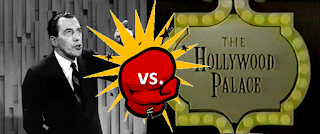 During the 60s, the Ed Sullivan Show and The Hollywood Palace were the premiere variety shows on television. Whenever they appear in TV Guide together, we'll match them up and see who has the best lineup..
Sullivan: Tentatively scheduled guests: Carol Lawrence, comedian Norm Crosby, Greg Morris of Mission: Impossible, singer Jeannie C. Riley, the Association (singing "Goodby Columbus"), the American Legion drill team, and the novelty act of Valenti and Valento. (Actual lineup also includes Creedence Clearwater Revival, Mickey Mantle, and impressionist.)
 From 1963 to 1976, TV Guide's weekly reviews were written by the witty and acerbic Cleveland Amory. Whenever they appear, we'll look at Cleve's latest take on the shows of the era.
 Here's one of those conundrums that must seem almost incomprehensible to modern sensibilities (not to mention modern sports fans). The NCAA Basketball Tournament—it hadn't yet been branded "March Madness"—gets underway on Saturday with a first-round doubleheader (11:00 a.m. PT, NBC). Later in the day, we have a pair of regular-season games, with San Francisco taking on Pacific (12:30 p.m., KGO and KHSL) and Oregon State facing Oregon (2:30 p.m., KTVU, KXTV, and KHSL). In other words, the tournament starts before the regular season is even over. How can this be?
 It's another big week for big-screen movies, starting on Saturday with the second showing of Alfred Hitchcock's horror classic The Birds (9:00 p.m., NBC), starring Rod Taylor (as character named "Mitch"? Gotta love that!) and Tippi Hedren, looking dazzling with one of the most cosmopolitan wardrobes in modern movie history. Judith Crist calls it "dull and plotless" except for the terrifying titular characters, but when you have them as your hook, what more do you need?
 We return to the local scene on Wednesday, with Joseph L. Mankiewicz's acclaimed 1953 adaptation of Shakespeare's Julius Caesar (9:00 p.m., KOVR in Sacramento), with Marlon Brando in a surprisingly effectve, Oscar-nominated performance as Mark Antony, James Mason as Brutus, John Gielgud as Cassius, and Louis Calhern as Caesar. Oh, and Edmond O'Brien, Greer Garson, and Deborah Kerr are part of the cast as well.
 Throughout this week's issue are notices of possible programming pre-emptions due to the flight of Apollo 9, which launched on March 3 and is scheduled for splashdown on Thursday. Coming after the dramatic Apollo 8 trip around the moon last December, Apollo 9 represents the first test of the Lunar Module (in Earth orbit), and is essential for the success of the man-on-the-moon program. What's remarkable about this is the moon landing, on Apollo 11, comes up later this year. We've become so used to things taking a long time (which they always seem to do nowadays), it's still awesome to think that NASA could go from a first test of the LM to the actual landing in just over four months.
 "TV," Lerner says, "is a double-edged sword. It cuts you when you grasp it. But it can also cut away many of the obstacles that have impeded social advance in the past." It has broken down barriers: barries of distance, of time, of access. Although it sounds like a cliche, it truly has become a window to the world, especially for those who, until now, have lived in relative construction. This exposure is, in the abstract, a good thing. However, the flip side is that TV can also be seen as an instrument of social unrest. "By churning up the aspirations of the disinherited, TV has also increased their demands. for more equal access to the life possibilities; and when the demands have not been met, it has quickened their anger and resentment." This is not to say that television created this unrest; it was already present in society. But it is also true that it is "the visible medium by which the winds blow into every home in the Nation."
 As an example, he speaks of his most famous character, Maude Frickert, whom he describes as grass-roots, "the Plymouth Rock, 'The Star-Spangled Banner,' Valley Forge—she's American history." "She's a fighter," he adds. "In a way, she's putting down a weaker generation. She's saying, 'Let's shape up.' She hates to miss out on anything, but she draws the line at the 'living-it-up' attitude: the acid, the grass. She's against that." In essence, she's saying to people, "What’s happening here? What's happened to the spirit of 76?"
The same can be said of Elwood P. Suggins, who, Winters says, "represents some kind of fundamental common sense—you're laughing at him, but with him at the same time. He’s a square—an innocent guy—a diamond in the rough." While he's not superficially like Granny (he "hasn't got the aggression Granny has. He's much more sentimental.") he's of the same type: "He's just as American as she is. He’s grass-roots. He’s '76."

Efron notes that "under all these disguises," it is obviously Winters himself speaking, and asks him what he's trying to say. "I'm expressing a deep love for my country. I’m an American all the way. When I saw the American flag being burned in New York and in San Francisco, I wrote to my senator, for the first time. I sat down and I wrote a long letter. I said in it: 'What’s happening? Why is this being allowed?' " Coming back to a theme that his characters voice of "something being lost," he quotes Theodore Roosevelt on the importance of the man "in the arena," of knowing that "if he fails, at least fails while daring greatly, so that he’ll never be with those cold and timid souls who know neither victory nor defeat."
Asked why he hasn't come out and said these things in his own voice, preferring instead to address it obliquely through his characters, he admits that he's worried about the effect his conservative words might have on his career. "It seems to me that I am outnumbered. I find as I look around me that I'm in a minority with my views. . . I've thought it could harm me professionally to speak out." He's telling Efron these things, in part, because she's asking him questions "that very few people in the press have ever asked me." His characters, he says, had become something of a crutch, but after having spent a great deal of time thinking about it, "I've suddenly decided: I'm through running scared. I don't have to run frightened, regardless of what happens in the country." And now is the time, he feels, to speak up: I see revolutionaries . . .I see freedom under attack, free enterprise under attack . . . I see people mixed up. They're coming to a stage where they're wondering: should we accept democracy or should we accept socialism; should we accept Communism?"
This, he concludes, is the "real" Jonathan Winters. "The time has come to stand up and be counted, to get into the arena. . . .That's it. That's everything."
l l l
 During the 60s, the Ed Sullivan Show and The Hollywood Palace were the premiere variety shows on television. Whenever they appear in TV Guide together, we'll match them up and see who has the best lineup..
Sullivan: Tentatively scheduled guests: Carol Lawrence, comedian Norm Crosby, Greg Morris of Mission: Impossible, singer Jeannie C. Riley, the Association (singing "Goodby Columbus"), the American Legion drill team, and the novelty act of Valenti and Valento. (Actual lineup also includes Creedence Clearwater Revival, Mickey Mantle, and impressionist.)
Palace: Diana Ross and the Supremes introduce guests Ethel Waters, Stevie Wonder, comics Soupy Sales and Sammy Shore, dancer Donald McKayle and the comic Saddri Dancers. Diana and the Supremes perform "With a Song in My Heart," "Stranger in Paradise," "Without a Song"; and a medley including "Let's Get Away from It All," "The Lady Is a Tramp," "Day After Day," "I’m Living in Shame."
Ed had a very good lineup to start with, from Carol Lawrence to Greg Morris, and the addition of CCR and Mickey Mantle strengthens it. While the Palace lineup is good enough, I can't say that any of their guests really knock me over; as you probably know, while I don't hate the Supremes, I was never their biggest fan, and the same could be said for Stevie Wonder and Soupy Sales. What that does leave us with Mantle in the cleanup spot, and a home run for Sullivan.
l l l
 From 1963 to 1976, TV Guide's weekly reviews were written by the witty and acerbic Cleveland Amory. Whenever they appear, we'll look at Cleve's latest take on the shows of the era.
 The Undersea World of Jacques Cousteau is, according to Cleveland Amory, perhaps the best dramatic show on television, with "more drama in it than half a dozen average series shows." I suppose that could be taken as a low bar for success, but there's a lot to be said for a program that can make the life cycle of the giant sea turtle, a topic I wouldn't ordinarily be particularly interested in, nothing less than fascinating.
The Undersea World may take place below the surface, but it succeeds on many levels. The underwater photography, as one would expect, is "remarkable," and it's matched by the narration by Cousteau and Rod Serling, as well as the stories themselves. It is, says Amory, "a truly rare combination of technical and scientific know-how mixed with humane and even poetic understanding." In addition to the saga of the sea turtle, there was another episode about whales, and a third on the raising as pets of two baby fur seals. With more such episodes on the way—includng one on archaeological exploration of Lake Titicaca in South America, and another discussing how to live underwater—there seems to be no fear that the program will stagnate any time soon.
Given Amory's intense feelings regarding animal welfare, it's no surprise that such a series meets with his approval. Speaking of the show on turtles, he quotes the narration that "Only man is capable of killing without need," which still doesn't make animals more noble creatures than humans, but does make a point. It's also no surprise that he takes the opportunity to launch yet another not-so-veiled barb against one of his favorite whipping boys, ABC's The American Sportsman.* (ABC, he writes, "still has bloody hands in this field.") Comments like this generally provoke responses, both pro and con, in the letters mailbag; it'd be interesting to look two or three weeks down the road and see what readers have to say.
*Ironically, or perhaps not, Melvin Durslag writes on The American Sportsman this week, highlighting an episode in which Phil Harris goes pheasant hunting with host Curt Gowdy. "By day’s end, both Phil and the pheasant had shois in them." Regarding criticism of the show, producer Lorne Hassan says that approximately eight percent of their feedback is negative.
l l l

Well, you have to keep in mind that in 1969, there were only 25 teams in the tournament. There was no seeding involved; conference champions were automatically put in specific geographic regions (e.g. Atlantic Coast and Ivy League in the East, Big Ten and Southeastern in the Mideast, Big Eight and Southwestern in the Midwest, Pac-8 and Western Athletic in the West), and the champions from the biggest conferences received byes into the Round of 16. Furthermore, only one team from each conference made the tournament, and there were no conference tournaments (other than the Atlantic Coast). Therefore, all you had to do was plug in the appropriate namesin the right slot, and if the Big Ten and Pac-8 champions, for example, weren't going to play until next week anyway, there was no reason the tournament couldn't start before their seasons were done.
If this sounds confusing, it's partly because the tournament wasn't such a big deal back then; in fact, the National Invitation Tournament, which is virtually invisible nowadays, had a national television contract long before the NCAA tournament managed to do the same. There were no bracket pools, no saturation coverage everywhere you looked. The tournament setup did make for some awkward situations; there was no reason, for example, why the #1 and #2 teams in the nation couldn't wind up playing each other in a regional semifinal, and one of the reasons why UCLA was so dominant in the decade was that there were only five other teams in the West region. But you know what else? It was, it seems to me, a lot more interesting back then.
l l l

Another kind of "bird" features on Sunday with the network television premiere of Otto Preminger's religious epic The Cardinal (9:00 p.m., ABC), combining the grandeur (and political intrigue) of the Catholic Church with sex, reform, civil rights, and the looming war. Tom Tryon stars as the young Bostonian headed for the red hat; among the all-star cast, John Huston stands out as the crusty Cardinal Glennon, a role which earned him a richly-deserved Best Supporting Actor nomination. Crist notes that the red-clad "birds" in this movie are, by far, outacted by their malevolent counterparts on Saturday night.
Despite The Cardinal's three-and-a-half hour running time, the movie's 9:00 start allows viewers to watch, in its entirety, the eleventh annual presentation of The Wizard of Oz (Sunday, 7:00 p.m., NBC), Unlike past years, this year's showing is free of a studio host (past hosts included Red Skelton and Danny Kaye), but with an iconic cast including Judy Garland, Ray Bolger, Bert Lahr, Jack Haley, Margaraet Hamilton, and Frank Morgan (not to mention the munchkins) and a memorable musical score, you'll be pleasantly entertained nonetheless.
On Monday, the highlight is 1959's The Last Angry Man (8:00 p.m., KLOC in Modesto), with David Wayne as a television executive trying to convince a ghetto doctor (Paul Muni) to appear on a a new show profiling Americans from around the world. Muni, in his final Oscar-nominated performance, is brilliant as the irascible doctor who's dedicated his life to helping the poor and destitute, while Wayne can't see beyond the potential for ratings. It provides an interesting look at the pressure cooker of 1950s television; it's been a few years since I've seen it, and I ought to watch it again for this site.
Tuesday's movie contribution comes not from the theaters, but is a made-for-TV World Premiere. It's The Whole World Is Watching (9:00 p.m., NBC), the pilot for "The Lawyers" segment of The Bold Ones. It's given a topical pertinence via its premise, with a student activist accused of killing a university policeman during a campus demonstration; its dramatic heft comes from Burl Ives, Joseph Campanella, and James Farentino as the trio of lawyers defending him. Hal Holbrook, Carrie Snodgress, Steve Ihnat, and Stephen McNally round out a strong supporting cast.

Joanne Woodward stars as The Stripper (Thursday, 9:00 p.m., CBS), and it's disappointing to discover that a movie with as provocative a title as that turns out to be, as Crist says, a mishmash "as incredible as it is dull." You'd think you could do better than that, wouldn't you? It's a "sentimental" tale (which is a red light to begin with) of a relationship between Woodward's "down-at-her-heels dancer" and a mother-dominated teen, played by Richard Beymer. Claire Trevor is the mother, and Carol Lynley, Michael J. Pollard, Robert Webber, Louis Nye, and Gypsy Rose Lee support them.
And what would a big movie week be without something from Elvis? In this case, the something is Harum Scarum (Friday, 9:00 p.m., CBS), with The King as a singer touring the Middle East who becomes involved in a plot to assassinate a potentate. I'll bet that happens all the time nowadays, don't you? Mary Ann Mobley is the princess with whom he also becomes involved (and I wonder how many princesses you'll find like her in the Middle East today), and Philip Reed as the aforementioned king, whose country is called "Lunarkand." Or, as Crist puts it, "Never-never land."
l l l

l l l
As a bookend to the Jonathan Winters interview, it seems appropriate to conclude with syndicated political columnist Max Lerner's* essay on television as having the potential for "The greatest force for democracy," the sixth in a series of such essays in defense of television. That potential, it could be said, comes with some conditions.
*Lerner was an interesting character, a New Deal Democrat and ACLU backer who was on Nixon's Enemies List, but was also a strong supporter of Margaret Thatcher and Ronald Reagan.

Television's great power is its immediacy, its now, in the moment intimacy. "If done tolerably well it can do something to make the vast, unmanageable leviathan of society more compassable, less lonely, better-known to itself." There's a caviat, however, "the danger that as a Nation we will grow accustomed to the moment of action, and come to confuse action with truth." In other words, if we see what is happening, we may completely overlook the why.
One of the limitations of television is that, being a visual medium, it has a predilection toward action. Action, in turn, tends to arouse a greater involvement in the viewer, who "gets so involved he reacts strongly and it shapes his attitudes and his actions." It is, therefore, imperative that television exercise its freedom wisely, for "you can't have an effective TV medium without its havin gan impact on the frame of freedom in the society, on the quality of democratic living and thinking, on the nature and pace of change in the society."
Whittaker Chambers, the former Soviet spy turned anti-communist, once said something to the effect that capitalism without a moral foundation was no different from any other -ism. In his conclusion, Lerner makes a similar point. It is true, he says, that "there can be no good TV without freedom. I add that there can be no real freedom in our fragile society unless there is a cement that holds the society together. The hardest task TV can take on, even harder than fighting against restraints on its freedom, is the task of helping to strengthen the cement of the society." Television has a responsibility to exercise its freedom in a way that strengthens, rather than unravels, democracy. Absent that responsibility, we will wind up with neither democracy nor freedom. And then where will we be? TV


