Showing posts with label Judith Crist. Show all posts

July 4, 2026

This week in TV Guide: July 2, 1966


Whis is the way it is: only now, in July of 1966, is Walter Cronkite beginning to get the credit that would, in years to come, seem to be his by right, or maybe divine fiat. Today we're conditioned to view every landmark in American history through the eyes of the Most Trusted Man in America, and yet just two years before, in August 1964, he had been removed from the lead chair for CBS's coverage of the Democratic National Convention. Back then, rumors were rampant that Cronkite's job was on the line, that he'd either be replaced or teamed with someone more "glamorous." That's life for you.

As Richard Schickel notes in this week's cover story, it's taken years of struggle, but for the first time Cronkite and the CBS Evening News have started to top NBC's powerhouse Huntley-Brinkley Report. Not that he takes any satisfaction from it; for Cronkite, it's all about the news, not the ratings. "Walter is a newsman who has remained a newsman and has never tried to be a television 'personality,'" says Richard Salant, head of CBS News. Cronkite reminds people that it was only last year that he'd worked on television longer than for newspapers and wire-services, and he jealously protects his title as "Managing Editor" of the evening news. Over the years, viewers have come to recognize and trust the passion Cronkite has for the news, "that over the years he has generated a quality of believably no other broadcaster can match." In time, that will translate into becoming "the most trusted man in America."

He's a strong backer of the program's resident pundit, Eric Sevareid, whom he believes is right more often than not in his opinions; he also appreciates the freedom that Sevareid's commentaries have given him from having to interpret the news himself. He's devoted to hard news, which he thinks gives the program an advantage over "the softer Huntley-Brinkley approach." Fred Friendly, the former head of CBS News, puts it this way: "Walter and his staff are better newsmen than the opposition." The night that Luna 9, the Soviet Union's unmanned spacecraft, made the first soft landing on the moon, Cronkite led with pictures from the landing. NBC "doesn't put them on until they are 16 minutes into it."

The Cronk and his son Chip, working on a 
slot car track; a swell gift for a boy in the '60s.
I've made this point before, but it bears repeating: NBC's ratings for the assassination of John F. Kennedy in 1963 were higher than those for CBS and ABC combined. And as noted earlier, Cronkite's position was said to be in jeopardy a year later. Today, thanks to CBS's generous use of the Cronkite library—Cronkite announcing JFK's death, Cronkite overcome by the moon landing, Cronkite proclaiming that Vietnam is lost—one might think that Walter Cronkite was not just America's most trusted newsman, but America's only newsman. In light of that, it strikes me as somewhat disingenuous when Friendly, Salant, Cronkite, and the rest talk about how the ratings don't matter, that to even discuss them is to play NBC's game. On the other hand, the triumph of Cronkite's legacy, like his eventual victory in the ratings race, shows the value of playing the long game. The way it was isn't remembered; what goes in the history books is the way it is.

Which is not in any way intended to cast a shadow on that legacy. Unlike today's newsreaders, Cronkite was a newsman, and never stopped being one. He took the news seriously, and he took his obligation to the viewers seriously. Like the big-game sportscasters I've written about in the past, when you heard Walter Cronkite's voice, you stopped and listened.

In his office there is a quote from a review that Cronkite has framed and hung on the wall. "Viewers rarely recall and relish a Cronkite statement. They believe it instead." That's not a bad legacy either, one that today's television personalities might want to consider.

l  l  l

During the 60s, the Ed Sullivan Show and The Hollywood Palace were the premiere variety shows on television. Whenever they appear in TV Guide together, we'll match them up and see who has the best lineup.

Sullivan: Ed's guests are singers Tom Jones, Frankie Avalon, Annette Funicello and Mireille Mathieu; actor Ray Milland, who appears in a scene from his Broadway play Hostile Witness; comics Don Rickles, John Byner and Arthur Haynes; puppet Topo Gigio; Los Vegas, singing-instrumental group; and Elizabeth and Collins, knife-throwing act.

Palace: Host Vincent "Ben Casey" Edwards presents an all-female guest lineup: actress Bette Davis, who reads Dorothy Parker's poem "Biographies"; singer-dancers Liza Minnelli and Liliane Montevecchi; comedienne Joan Rivers; Miss Elizabeth, Swiss trapeze artist; the balancing Roggé Sisters; and performing elephants Bertha and Tina.

We're in rerun season, of course, and it's not hard to see why these two episodes were chosen. I suppose Vince Edwards was a natural for hosting an all-female Palace, given that he's displayed his innate animal magnetism for years on Ben Casey. He's got a good cast, too, particularly when Bette Davis is the lead guest. However, even with Liza (with a Z) and Joan Rivers, Palace is not about to compete with Tom Jones, Frankie and Annette, Ray Milland, and Don Rickles, and if Ed feels he still needs a few more stars, John Byner can probably impersonate them. No pretending here; Sullivan for the win.

l  l  l

From 1963 to 1976, TV Guide's weekly reviews were written by the witty and acerbic Cleveland Amory. Whenever we get the chance, we'll look at Cleve's latest take on the series of the era. 

Bad news for all you fans of The Cleve this week; our erstwhile hero-critic is on vacation. Not to fear, however, for his substitute (I don't think I can ever recall someone subbing for Amory, though I could be wrong about that) is none other than Judith Crist, movie critic for the New York Herald Tribune and film and drama critic of the Today show, and future movie reviewer for TV Guide.

For her subject this week, Crist not surprisingly looks at the state of the movie as seen on TV. Like the farmer and the rancher, she says, "movies and television have been forced into wary friendship and coexistence for economic survival." It is, however, time for "an awareness of what effect television is having not only on movie making but also on movie watching." The effect can be seen most strongly in young viewers, Crist says, those who have been conditioned to short-attention spans from television, delivered "in 12-minute doses of concentrated action zooming to a climax that is suddenly aborted" by commercial time. They don't know about subplots, the intricacies of plotting, and the subtleties of moviemaking. All they know is that they want their movies to be like their TV shows, "a series of exciting episodes and vignettes."

And it isn't just kids; many adults, according to Crist, admit that "their attention wanders after 20 of the 30 uninterrupted minutes Schaefer Award Theater allots its movies as a 'public service.'" Crist acknowledges that "it's a rare movie that can't be pared here and there," but such edits have to be judicious. Too many times, though, the end result is "out-and-out butchery." with film fans left nonplussed by bizarre jumps and stories that fall apart due to the total absence of certain scenes. What, for example, happened to the Marseillaise scene in Casablanca?

Television also needs to take its movie business more seriously. Rather than flooding the airwaves with "pop pap," Crist urges stations to seek out innovative opportunities such as airing a local film festival, or even serving as an art revival house. (An excellent idea, by the way; many PBS stations used to do this.) She suggests that movie hosts share inside information with viewers about then-unknown stars who might be appearing in tonight's flick, not unlike what Robert Osborne would do on TCM decades later. "All it takes," she writes, "is some thought and less money." Ah, we can but dream, can't we? 

l  l  l

This week's starlet is Leigh Chapman, also known as Napoleon Solo's secretary on The Man from U.N.C.L.E., and despite her cool and chic appearance, she's her own biggest critic. "I despise selling myself as an actress because I don't like my body. There are too many defects," she says. "As writers go I might be good-looking, but as actresses go—"

She's written scripts for Burke's Law, Dr. Kildare, and My Favorite Martian, among other shows, and when asked how a nice girl like her wound up behind a typewriter, she replies simply, "I like words." She wants to prove she can write as well as a man can, and in fact she prefers to take a masculine point of view "because we have a masculine-oriented society."

Looking at Leigh Chapman's later writing career, it all makes sense. She becomes known for action-adventure movies and TV shows: Dirty Mary Crazy Larry, The Octagon, The Wild Wild West, Mission: Impossible, It Takes a Thief. She wrote the pilot for Walker, Texas Ranger. "I like larger-than-life characters who do dangerous, heroic things," she said. "And that, to me, means men." She gave up acting after a disagreeable experience with Desi Arnaz, an incident she details in a fascinating interview she does with Stephen Bowie. She dies of cancer in 2014, but not before having taken up underwater photography. With that kind of talent, who needs acting?

l  l  l

Well, we've gotten this far, and we've barely touched on the week's programs. Let's see what we can do to rectify that.

Did NBC read an advance copy of Judith Crist's article? This week's Saturday Night at the Movies, Sam Peckinpah's Ride the High Country (9:00 p.m. PT), includes a feature following the movie, with Ken Murray (known for his home movies of life in Hollywood) taking a look at the careers of the movie's stars, Joel McCrea and Randolph Scott. (Pause, repeat "Randoph Scott" reverently.) Networks used to have these featurettes from time to time, when the movie didn't fill the entire two-hour timeslot. And on ABC Scope (7:00 p.m.), "War Comes to Main Street" visits
the places where violence and demonstrations aren't taking place on every street corner: "To find out how Vietnam is affecting the less vocal majority, Desmond Smith takes his camera crew to Dodge City, Kan., a prosperous community of cattle ranchers and wheat farmers."

On Sunday, ABC Sports visits close to home with coverage of the final round of the U.S. Women's Open golf championship (2:00 p.m.), from Hazeltine National Golf Club in Chaska, Minnesota, a suburb of the Twin Cities. Golf fans probably recognize Hazeltine from hosting the Ryder Cup in 2016, but its first brush with fame, or infamy if you will, was as host of the 1970 men's Open. The course, less than a decade old, had yet to mature, and was despised by most of the pros; Dave Hill famously suggested that it only needed "80 acres of corn and a few cows" to be truly complete; Minnesotans, being the proud people we are, serenaded Hill with mooing for the rest of the tournament. Sandra Spuzich, at +9, wins the Women's Open, and a first-prize of $4,000. If you're not in the mood for that, Discovery '66 (11:00 a.m., ABC) takes a look at "The World of Charles Dickens," with host Frank Buxton touring old London and looking in at the home in which Dickens wrote many of his works.

Monday is the 4th of July, which explains why NBC's on the air with the Minnesota Twins playing the Cleveland Indians (4:00 p.m.). It's been a disappointing season for the defending American League champion Twins, but the Indians have stayed near the top thanks to pitching from Luis Tiant, Sonny Siebert, and Sudden Sam McDowell—remember him? That's the only bit of holiday programming for the day, but remember that most people are out, going to parades and fireworks shows, or just enjoying the high point of summer. They probably have better things to do that stay inside watching television. I myself have no idea what I was up to.

Telly Savalas (right) and Beau Bridges guest star in Tuesday's episode of The Fugitive (10:00 p.m., ABC). Beau accidentally shoots the driver of a passing car; he wants to turn himself in, but Telly won't hear of it, leaving Dr. Kimble—who was riding in the car—as the prime suspect. I know I've mentioned things like this before, but how many times as something like this actually happened to you, let alone an innocent man on the run from the law? I wonder.

Wednesday's fun just for browsing through the night and seeing all the guest stars: Frank Gorshin as the Riddler on Batman (ABC, 7:30 p.m.), Glenn Corbett and John Doucette on The Virginian (NBC, 7:30 p.m.), James Brolin and Kim Carnes—yes, Miss "Bette Davis Eyes" herself—on The Patty Duke Show (ABC, 8:00 p.m.), Marilyn Mason in The Big Valley (ABC, 9:00 p.m.), Jack Lord, Dana Wynter, Pat O'Brien and Sheree North in "The Crime" on Bob Hope Presents the Chrysler Theatre (NBC, 9:00 p.m.), Pippa Scott on The Dick Van Dyke Show (CBS, 9:30 p.m.), and Julie London and producer Sheldon Leonard on I Spy (NBC, 10:00 p.m.). Oh, and Buddy Hackett is one of Johnny Carson's guests on The Tonight Show (NBC, 11:15 p.m.)

The highlight on Thursday is one of the most charming of movies (and star Jimmy Stewart's favorite role), Harvey, on the CBS Thursday Night Movie. (CBS, 9:00 p.m.) And in their pre-Laugh-In days, Rowan and Martin continue as summer subs for Dean Martin. (NBC, 10:00 p.m.)

Decisions, decisions: on Friday's Donna Reed rerun (ABC, noon), "Alex wants a new set of golf clubs, but Donna says that the family needs a new washing machine." Things were different in 1966, we know; still, you'd think that a doctor would be able to afford both. No wonder Carl Betz was so excited to play Clinton Judd—it probably meant a raise in pay. And on Court-Martial (ABC, 10:00 p.m.), Bradford Dilman discovers that his client is innocent of the crime for which he's charged, but guilty of another crime. Why didn't things like this ever happen to Perry Mason?

l  l  l

MST3K alert: I Was a Teenage Werewolf
(1957) A psychiatrist's drugs turn a youth into a monster. Michael Landon, Whit Bissell, Yvonne Lime, Tony Marshall. (Friday, 5:00 p.m., KGO in San Francisco) "You are not drinking a piña colada at Trader Vic’s, young man, you’re just not old enough." Michael Landon was two years away from Bonanza when he starred in Werewolf, and he remained a fan of the movie for the rest of his life. "I think it's a good movie. I like it. My kids like it. They better like it, their dad's in it."

l  l  l

That's it for this America 250 Fourth of July, 2026. Not quite like the Bicentennial year was, is it? Here's a hope for happier times ahead, and never forget what this day is all about. TV
If you enjoy the content here and want to support my broader creative work, please consider leaving a tip at my Ko-fi page. Any amount you contribute helps me continue writing, researching, and sharing these articles and projects. Thank you!

July 23, 2022

This week in TV Guide: July 23, 1966


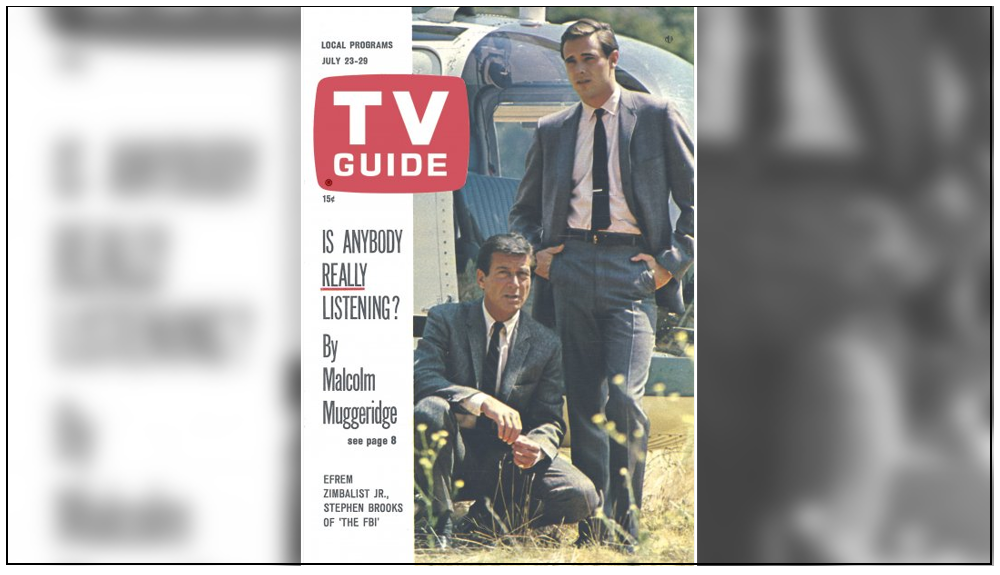
This week’s lead story is written by British humorist and critic Malcolm Muggeridge, the sixth in a series of articles "assessing television's effect on our society." Muggeridge wrote for TV Guide several times over the years (I think this was my favorite); he was one of many distinguished writers appearing in TV Guide through the ‘60s and ‘70s, a period when the magazine was capable of a particularly high intellectual content. (Unlike today.) As interesting a writer as Muggeridge was, he was an even more interesting individual: a leading journalist, social critic and television personality in Britain, a soldier and spy during World War II, a left-winger who eventually because staunchly anti-Communist, an editor with Punch magazine, an interviewer with the BBC, a stinging satirist who became a harsh critic of ’60s permissiveness, eventually converted to Christianity, and was widely credited with bringing Mother Teresa to popular consciousness in the West. Incredible.

In this issue, many of his talents are on display. He freely acknowledges the influence of television— "what [children] see on it more than anything else, governs their present hopes and future aspirations"—and that the medium has become a major shaper of opinion: "If Nixon had been better made up, without that devastating afternoon-shadow, for his encounters with the late President Kennedy, it is perhaps he who would have gone to the White House."

He acknowledges that television is often of dubious artistic merit ("The old music hall, as I remember it in my childhood, was, by comparison, a feast of reason and a flow of wit."), and that the quality "declines visibly year by year."  However, he also cautions against throwing the baby out with the bath water, as it were:

Let it be remembered, however, that, on the same line of reasoning, the invention of printing might be as summarily dismissed. After all, far more type is dedicated to Peyton Place and Playboy magazine than to “Paradise Lost” or “La Recherche du Temps Perdu.” . . . How tragic if, because men could be debauched by “Fanny Hill” and the works of the Marquis de Sade, they had been deprived of the solace of the New Testament and Shakespeare’s plays, which also come to them largely through the printed word!

To critics who charge that television numbs the mind and turns people into what we today would call "couch potatoes," Muggeridge replies, "Nor is it true that, before television, those who now spend their evenings viewing sat at home doing embroidery or listening to 'The Mill on the Floss' read aloud. They were much more likely to be out at the pub studying tomorrow’s racing lineup or swapping dirty stories." He adds that television may indeed be "a cultural wasteland, but what about what they replaced? Was that a well-tended garden?"

The fact is, according to Muggeridge, there has been little serious art produced in any media—there has been far more "wealth, talent, skills and endeavor" spent in the last half-century of cinema than produced the Italian Renaissance, but the yield in terms of "enduring worth and interest" is "virtually nil."  Garbo, the Marx Brothers, Chaplin: "these are not the equivalent of even a minor work or art." A bit harsh perhaps, but not without merit. Rather than being constantly disappointed by television’s output, he suggests lowering expectations—"We do not expect tabloid newspapers to serialize Kierkegaard, or women’s magazines to run extracts from Thomas a Kempis. . . Why, then, should television be expected to manifest its seriousness and concern for culture by every now and again putting on a half-fisted production of 'King Lear' or mounting a boring lecture on the French Impressionists?" Far better that TV concentrate on what it does best: news, sports, comedy, soap operas.*

*He had some definite thoughts on those who appeared on television as well, as was shown in a memorable confrontation with Monty Python's John Cleese and Michael Palin on a BBC show in 1979. Maybe we'll talk about that someday.

This is Muggeridge as he came to be known in the late ’60s and ‘70s: an acerbic wit who nonetheless could not disguise an increasing seriousness creeping into his works. And it’s in that spirit that he leaves us with this optimistic note: for as many times that people have stopped him and mentioned how they’ve seen him on television, "not one has ever so much as mentioned, let alone quoted, anything I have said."  If that same "blissful ignorance" applies to all who air their views on the tube, "how splendid!"

l  l  l

During the 60s, the Ed Sullivan Show and The Hollywood Palace were the premiere variety shows on television. Whenever they appear in TV Guide together, we'll match them up and see who has the best lineup.

Sullivan:  Satirist Allan Sherman; the Supremes and the Dave Clark Five, rock ‘n’ roll groups; Richard Kiley and Joan Diener, appearing in a scene from “Man of La Mancha”; actor Menasha Skulnik; golf champion Ken Venturi; comics Stiller and Meara; and juggler Ugo Garrido.

Palace: Host Bing Crosby and son Gary, comedian Henny Youngman; singer Rosemary Clooney; Edgar Bergen and Charlie McCarthy, dancer-choreographer Hugh Lambert, comedy xylophonist Roger Ray, and the Band of the Fiji Military Forces.

"Those are both pretty good," my wife said when I read this week’s lineups to her. "I think you have to give a very slight edge to the Palace. They’ve got Bing Crosby, even with that talentless Gary, and besides, it seems like the Supremes were on with Sullivan every other week." Hard to argue with that, not if you want to have a successful marriage. Besides, with Bing and Rosie you’ve got a White Christmas reunion, and Bergen and Charlie are always funny. Maybe if it had been the Stones instead of the Supremes—but, alas, we’ll never know. The winner: Palace, by the slimmest of bouffant hairdos.

l  l  l

With Cleveland Amory taking the summer off, we're fortunate to have TV Guide's movie critic, Judith Crist, filling in. And we're particularly fortunate that this week, the subject of Crist's review is none other than ABC's blockbuster prime time soap, Peyton Place.

Back in the olden days of radio, Crist says, things were simpler, and soaps often focused on a main character. But now, "the affluent society won't settle for simplicities," she writes. "We'll take our emotional calories in assorted nuts, by the handful." And as Peyton Place "snail-paces along toward its third season," the storylines seem, if anything, to be getting more complicated: "It was possible to keep track of things in the early days but more and more outlanders are drifting into the precinct. Blink an eye and there are three more mysteries on hand, with half-forgotten characters to go with them." Crist admits to harboring a secret desire that Martin Peyton will turn out to be his own grandfather. 

Indeed, Peyton Place seems to be a miserable place to live, a place where "people face life, hunching over the ghastly sins and secrets that have taken place off-screen and long ago, and reveling in all the sorrows and suspicions and soul searching they produce on screen and in perpetuity." And the show always seems to be on the verge of some monumental reveal, some dark secret that threatens to boil over; Crist thinks it will be that "somewhere in Peyton Place there's somebody whose parents were a properly married unadulterous pair, whose birth was therefore legitimate and who has reached his 20th year without having had a nervous breakdown, committed mayhem or even murder or, hope among hopes, stumbled upon the secret of his neighbor's sins!" Well, one can always hope.

Not that there aren't some positives connected to PP: the show has shifted to color, the production values are first-class, and some of the cast members provide a dignity that can produce the illusion that this show, compared to the daytime soaps, is of a "higher class"; and Mia Farrow, caricatured above, has "eternity in [her] wide, wide eyes." But then there's the "near-camp dreariness" of the dialog, the pace that makes it clear the program was "designed for sporadic viewing," and those complicated plots. Watching Peyton Place, Crist concludes, "is getting a big much—and lower-calorie diets are healthier in the long, long run."

l  l  l

Since the death of Dorothy Kilgallen the previous November, the What’s My Line? crew from Goodson-Todman has been engaged in "The Great Woman Hunt," a furious search for a permanent replacement for Kilgallen, who had been with the show since its inception in 1950. So far, the seat has remained in the possession of a rotating cast of guest stars—everyone from Kitty Carlisle (a stalwart of Goodson-Todman’s To Tell the Truth) to Dr. Joyce Brothers, with magazine publisher Helen Gurley Brown, TV Guide critic Judith Crist, columnist Sheilah Graham, and actresses Joanna Barnes, Joan Fontaine and Dina Merrill thrown in. Even Muriel Davidson, the author of this article, has been considered for the list. It’s a tough gig, though, coming into a long-running show with a veteran cast; as host John Daly puts it, "If she doesn’t fit into our family, we’ll just freeze her out."

At press time there are three clear contenders for the seat. There’s Phyllis Newman, another veteran of To Tell the Truth, married to legendary Broadway composer Adolph Green; charming, bubbly and very girlish (and I mean that as a compliment), always having to tilt her head upward slightly during the Mystery Guest segment so her mask wouldn’t fall off. Sue Oakland is a surprise finalist; married to TV producer Ted Cott (David Susskind’s cousin), she’s got both beauty and brains: "Besides being breath-takingly beautiful and gowned, she is a near-genius, with a Master's degree in political science from Columbia University and with one lovely leg up on a Ph.D.*

*Her Master’s was in the inside workings of the United Nations; her Doctoral dissertation was "The Function of Television on the Presidential Election Campaign of 1968."

And then there’s society columnist Suzy Knickerbocker, whose nameplate will eventually simply read "Suzy" rather than the letter-crunching "Miss Knickerbocker."  Her real name is Aileen Mehle and passing mention in the article is made of her having a 22-year-old son. (That son, Roger, is an Annapolis graduate and naval officer, and on the Christmas episode of WML, on which his mother is a panelist, he appears as the Mystery Guest.)

The tongue-in-cheek question remains: "Can a girl be found who can win the hearts of a great, established family, still grieving the loss of one of its most beloved members? . . . Or will her struggle for acceptance bring about the destruction of the entire, proud, 16-year dynasty?" In the end, despite the producers’ vows, none of the ladies above, or anyone else, for that matter, wind up filling Dorothy’s seat. WML is starting to show its age, "developing creaks of the Nielsen in its venerable beams," and it will leave the air in September 1967, with a run of 17½ seasons—at the time the fourth-longest-running non-news series of all time, trailing only The Ed Sullivan Show, The Original Amateur Hour and Lamp Unto My Feet. Whether the right fit was never found, or time just wound up running out, that fourth seat on the panel will continue to be filled with rotating female guests until the very end.*

*Or almost the very end; the final show features a panel of Arlene Francis, long-time guest Martin Gabel (Arlene’s husband), former regular Steve Allen, and Bennett Cerf.  Host John Daly himself plays the final Mystery Guest.

l  l  l

I've mentioned before that it can be a challenge finding noteworthy shows during the summer, but I think we've done quite well for ourselves this week. As always, though, you can be the judge.

NBC’s Saturday Night at the Movies has the Kirk Douglas classic Ace in the Hole, which is airing under its alternate title, The Big Carnival. (8:00 p.m. CT) It's a cynical, cynical story of a newspaperman trying for a comeback with the story of a man trapped in a cave. But it's only a story if he stays trapped long enough for a dramatic rescue. Not to disparage any of my friends in the media, and I do have them, but this kind of news manipulation could never happen today, right? Right?

Sunday, the sports world focuses on the final round of the PGA Championship, from the famed Firestone Country Club in Akron, Ohio. (3:00 p.m., ABC) It’s an early appearance for golf’s final major championship of the year, which is usually played in August. It’s also an unplanned location for the tourney; originally it was supposed to take place at Columbine Country Club in Columbine, Colorado, but severe storms in 1965 had damaged the course, forcing the PGA to swap sites—Firestone had been scheduled to host in 1967, but traded with Columbine. After 54-year-old Sam Snead turns back the clock by leading the first two rounds, the young Al Geiberger comes on during the weekend to finish at even par, good enough for a four-shot win over Dudley Wysong.

*A footnote: that night, a few hours after the tournament, 1964 British Open champion Tony Lema and his wife are among those killed in the crash of a small plane flying Lema to Illinois to compete in a Monday event. The 32-year-old “Champagne Tony,” one of the best and most charismatic players on tour, had finished 34th in what turned out to be his last tournament. Had he not died, I think a lot more people would know who he is today.

Burgess Meredith is on prime-time three out of five nights this week, all on ABC, which is pretty good for both him and the network and a treat for us viewers. His first appearance is Monday night on 12 O'clock High (6:30 p.m.), where he plays a scientist who's developed an airborne radar that allows bombers to zero in on targets even when they're obscured by clouds. Trouble comes when the Germans figure out how to zero in on the radar. According to the Close-Up describing the episode, during one scene, "Meredith received a rare accolade: spontaneous applause from the other actors on the set." Also appearing in a semi-regular role is Robert Dornan, before he gives up acting and runs for Congress; MST3K fans will remember him from The Starfighters.

Jack Hawkins, who was so good as Quintus Arrius in Ben-Hur, is also on multiple nights; later in the week, he appears as a prim and insensitive Englishman on Bob Hope's Chrysler Theatre (in a story for which Shelley Winters would be nominated for an Emmy), but on Tuesday night he's on Dr. Kildare (7:30 p.m., NBC), as an atheist whose heart attack may have been Divine Punishment. Or not.

Burgess Meredith is back Wednesday in the first of two consecutive nights on Batman (6:30 p.m. tonight and tomorrow, ABC); this week, Alfred, the butler of millionaire Bruce Wayne, is kidnapped by "that piscatorial pirate of plunder." No window cameo, alas; although Jerry Lewis had appeared in the first one earlier in the season, it didn't become a semi-regular feature until the second season.

Thursday night Eve Arden stars on an episode of Bewitched (8:00 p.m., ABC) in which Endora shows Darren what Samantha's baby will look like in 25 years. Arden plays a nurse at the hospital, while the episode also marks the first appearance of Elizabeth Montgomery in her dual role as Samantha and her Cousin Serena. Meanwhile, Rowan and Martin continue in their summer replacement series that eventually leads to Laugh-In; this week, their guests are singer Barbara McNair and comedian Jackie Vernon. (9:00 p.m., NBC)

On Friday, a delightful rerun of Sing Along with Mitch (7:30 p.m., NBC) features Shirley Temple as the special guest, performing the songs she made famous as such an adorable child star. And at 9:00 p.m. on CBS, the Canadian comedians Wayne and Shuster conclude their documentary series Wayne and Shuster Take an Affectionate Look at... with a review of the career of W.C. Fields. Unless you're in Minneapolis, that is, where WCCO pre-empts the show for a double-feature of Marshal Dillon.

l  l  l

Ah, this is the kind of thing I always appreciate finding: a 1966 CBC documentary hosted by—Alex Trebek! Yes, the same Alex Trebek who hosted Jeopardy since who-knows-when and became a beloved American icon! And what makes this even better is that the original Jeopardy, with host Art Fleming, is still on NBC’s daytime schedule! Who could possibly have looked at this issue and thought to themselves that nearly 60 years later Jeopardy would still be on, and it would have been hosted for 37 by this obscure Canadian appearing on a CBC documentary being broadcast by NET?

The show itself is, I think, striking: a look at "The Cultural Explosion" of the 1960s. "More people go to concerts, museums and theaters than ever before—but are we on the threshold of a new Renaissance?" What, exactly, does this tell us about today?  It’s very intriguing; after all, we hear constantly about how the arts must appeal to young people, who are increasingly turned off by the arts, and yet when it comes to the ‘60s, we tend to assume that the young dominated the tenor of the decade.

So: were older people driving this cultural boom? If so, why? Was it merely a measure of the post-war disposable income that drove the growth of the consumer society of the ‘50s? Or did they have more influence over popular culture than we might think?

Their offspring, who today represent the demographic most interested in culture (i.e. grey-haired) must have had some of that rub off on them. If so, why haven’t they been able to do the same thing with their descendants? We know that schools played a greater role in art and music back then than they do now – is that the difference? Were they already interested in culture in the ‘60s as well, or did that interest come to them later in life?

If the latter is the case, does it suggest that today’s youth, for whom culture is dead, might yet come around when they get older?  Or is it that things have changed so dramatically over the last 60 years that they must be reached earlier, or be lost forever?

Obviously you could write a whole book about this. And yet, when those of us with an interest in the arts read daily about the difficulties faced by classical music organizations, theaters, museums, and more, there’s something depressing about this program, so full of optimism for the future, talking about a culture "explosion" and the possibility of a new age. Who would have imagined that the arts would survive the tumultuous ‘60s, only to run aground on the shoals of the new millennium? TV  

May 22, 2021

This week in TV Guide: May 25, 1974


The Indianapolis 500, "auto racing's premiere event," takes center stage in the sporting world this Memorial Day weekend, so that's where we'll start.

The race is at a crossroads, following one of its most controversial runnings ever, in 1973. That year two drivers were killed in crashes (one during practice), and a mechanic in the pits died after being hit by a fire truck racing to the scene of one of the fatal accidents. The race itself took three days to run, rain interrupting both the first and second tries, and eventually ended after less than 350 miles when yet more rain finally brought it to a merciful end. The crowd, which had numbered more than 350,000 on day one, was less than 50,000 by the conclusion.

The problems are many, according to Hal Higdon's article, but center around the fact that technological advances have made the cars too fast, with neither the speedway nor the cars themselves prepared to handle the risks from increased speeds (over 30 mph in less than three years). The speedway has taken steps, firing the chief steward, widening the pit lane, and raising walls and pushing seating back (several spectators had been injured in driver Swede Savage's fiery fatal crash in 1973). The cars have also undergone changes, with fuel tanks cut almost in half, and aerodynamic adjustments designed to lower speeds by as much as 15 mph. Despite the changes, Higdon writes, the race still faces challenges: the speedway and the governing body "allowed speeds to soar dangerously past 200 mph with little more than talk," and he warns that "if unnecessary deaths continue, the so-called greatest spectacle in auto racing may not survive."

For several reasons, this article represents a moment frozen in time. Today, as speeds top 230 mph, we might wonder what all the fuss was about. Auto racing was infinitely more dangerous in the early 70s than it is today, even has it had become safer than it was in, say, the 1950s. Safety features have been introduced to both speedways and automotive structure, helping to absorb impacts and providing greater protection for the driver.

Incredibly, Salt Walther survived this crash during the first
attempt to start the 1973 Indianapolis 500 
Earlier this month the 27th anniversary of the death of the great Formula 1 champion Ayrton Senna was observed. Senna and driver Roland Ratzenberger were killed in separate accidents on one of the grimmest weekends in motor racing history* Similar concerns were raised over racing's future. And yet, to date only one other driver, Jules Bianchi, has died in a Formula 1 race. Dale Earnhardt and Dan Wheldon have died in accidents in recent years, but their deaths, too, are the last of their respective series. The fact remains that while motor sports are still dangerous, they are nowhere near as deadly as they were.

*A third accident nearly killed young driver Rubens Barrichello, and several spectators and track officials were also injured over the course of the San Marino Grand Prix weekend.

And yet the Indianapolis 500 is no longer the "greatest spectacle in racing," all of IndyCar having been surpassed by NASCAR in terms of popularity and talent. A divisive split in the Indy racing community created competing series, with neither having either the talent or the financial support to thrive. Indianapolis, caught in the middle, is still trying to recover, with empty seats and low television ratings out there for all to see.

The irony is that the bleak future forecast in the article has, in many ways, come to pass - but for entirely different reasons.

t  t  t

With live television of the 500 still a decade away, the race is being shown on Sunday night on a tape-delay basis. It's the first time in the history of the race that it is being held on Sunday; previously, the race had been held on Memorial Day itself*, but after the fiasco of 1973 it's thought that a Sunday race will allow people to attend on Monday should rain intervene again.

*Prior to 1970, Memorial Day was on May 30, as was the race. When Memorial Day fell on a Sunday, the race was moved to Monday. In 1970 Memorial Day itself became a Monday holiday; the first two 500s were held on Saturday, with the 1973 race being the first to run on the new Memorial Day. All races since then have been scheduled for Sunday.

As I mentioned earlier, the 500 isn't what it used to be. However, if you're looking for its great competitor, the Coca-Cola 600, you're going to have to travel to Charlotte to see it; the race, then known as the World 600, is not on live TV. Instead, we've got a nice assortment of minor sports to fill out Sunday, including the Family Circle Cup women's tennis final on NBC, the final round of the Danny Thomas Memphis Classic on an independent feed (I'm guessing Hughes Sports Network), diving and horse jumping on CBS Sports Spectacular. No baseball, which means the Twins must be at home.


t  t  t

Throughout the 60s and early 70s, TV Guide's weekly reviews were written by the witty and acerbic Cleveland Amory. Whenever we get the chance, we'll look at Cleve's latest take on the shows of the era. 


As we come to the end of yet another television season, it's time once again for our favorite critic to look back at the past year and offer second thoughts on what he got wrong, and where the networks might have erred. In particular, four series—Dirty Sally, The Six Million Dollar Man, Happy Days, and The Magician—appear to have generated enough viewer response for Cleve to give them a rewatch, and a re-review.

Many readers thought Amory was too hard on The Magician, which he says is not the case; he likes both Bill Bixby and the willingness of the show not to rely on violence, so he apologizes if he gave the impression he didn't like it. As for Happy Days, he says, happiness "is in the eyes of the beholder. And what we've re-beheld here convinced us that either we've gone around the bend or our letter writers have. Certainly the show has." And this long before it jumped the shark! His opinion of The Six Million Dollar Man hasn't improved either; "Lee Majors' fans are legion. Maye, in his next show, we can join them." And Dirty Sally, the short-lived Jeanette Nolan spinoff from Gunsmoke, one letter writer asked him if he "prefers sex, rape, murder, violence, dope, crime and whathaveyou," to which he replies, "Just the whathaveyou." So, if you're keeping score at home, he was wrong about both Happy Days and The Six Million Dollar Man (big hits), right about Dirty Sally (single season), and wrong about The Magician (also single season).

Among Amory's other observations: the networks still don't "get" The Waltons ("you don't have to have bang-banbs or laff-laffs or even a million dollars to have a show of value"), praises both Kojak and Police Story, and sees War and Peace and Upstairs, Downstairs, both from Masterpiece Theatre as two of the finest examples of television today. But Cleve saves his highest honors for the NBC movie The Execution of Private Slovik; "Martin Sheen was superb and so was everything else about it." It was, he says, television at its best. And you can never have too much of that.

t  t  t

The breakthrough summer hit of the year is the House of Representatives hearing into the impeachment of President Nixon. It's a spin-off from the earlier joint House-Senate select committee hearings, which made minor stars out of lesser political hacks such as North Carolina Senator Sam Ervin, Tennessee Senator Howard Baker, judge John Sirica*, stoolie John Dean, and featured an appearance by future TV and movie star—and U.S. Senator—Fred Thompson as the minority council.

*Who probably would have gotten The People's Court if it had existed back then.

This week's schedule calls for Tuesday, Wednesday and Thursday hearings, with either live or taped coverage. I haven't checked to see what might actually have aired, but I remember from the earlier go-around that the networks rotated coverage to assuage those who either weren't interested or couldn't do without their daytime stories.

The drama continues to playout until August, when Nixon resigns in the final episode. A reboot of the series is attempted in 1998-99 and again in 2020-21, but both times fails to attract an audience.

t  t  t

Let's see, what else might you be interested in this week? There are a lot of reruns kicking in, so we'll try to find something else. Dick Clark's at the beach in ABC's Action '74 on Saturday at noon. Bill Withers and the Staple Singers are the guests. NBC offers an Emmy Awards doubleheader on Tuesday, with the inaugural Daytime Emmys being presented at 11:00 a.m. CT, followed by the traditional Primetime Emmys at 8:00 p.m. Barbara Walters and Peter Marshall do the honors in the Daytime show, telecast from New York, while Johnny Carson hosts the nighttime extravaganza in Hollywood.*

*An interesting but perhaps ill-advised feature of these Emmys is that in addition to the genre awards (Best Comedy Series, Best Drama Series, etc.), there are "Outstanding Performance" awards for "Actor of the Year," "Actress of the Year," etc., featuring the winners in the individual genre categories. Thus, Alan Alda in M*A*S*H faces off against Hal Holbrook in the special Pueblo, William Holden in the limited series The Blue Knight, and Telly Savalas in the drama Kojak.

"Upstairs, Downstairs" is the feature on PBS' Masterpiece Theater, as it was apt to be at any given time. ABC News Closeup does a show on stolen art at 7:00 p.m. on Thursday, while NBC News Presents counters at 9:00 p.m. with "The Pursuit of Youth." And then Let's Make a Deal's Monty Hall hosts a Sea World special on ABC Friday night; an hour later the same network has a Jacques Cousteau special on the octopus. Must have been a theme night.

t  t  t

An interesting bit of contentiousness in the Letters to the Editor section, as Stanley Borucinski of Riverside, NJ writes in to criticize a recent TV Guide editorial lamenting press censorship when it comes to covering crime. The editorial had referred to the recent example of a voluntary 90 day news blackout on vandalism in Webster City, Iowa. Proponents of the blackout felt that news coverage gave unwarranted publicity to the vandals, which would then result in increased vandalism.* The editor (in fact, probably Merrill Panitt) pointed out that during the period of the news blackout, vandalism in Webster City increased 36.5 per cent compared to the same month the previous year.

*Similar to the idea of not showing a drunk fan racing across the field during a football game; if you give him face time on television, you'll just encourage others to do the same.

Mr. Borucinski argues that what the media is really interested in is making money, and they know that crime coverage "sells better than good news," which means "the press exaggerates and sometimes even invents news." Panitt (we'll assume it was him) counters with a lengthy rebuttal of his own, in which he states that the increase in crime "seems to have been caused by a censored press," and concludes that "When facts are hidden or covered up, nothing improves as things usually get worse."

You might recall that in a 1976 TV Guide, the editors argued strongly that media exposure of the CIA's clandestine activities was harmful to American foreign policy, and concluded that while the public had the right to know how their government operated, "must we know everything about everything?" I think that's a fair point, and ultimately what the editors are saying is that the media has to exercise responsible restraint in how much of a story they tell, while still ensuring that the story itself is told. Not an easy task, but one would assume that teaching this kind of responsibility is what you should get in journalism school.

And if you thought that, you'd probably be wrong.

t  t  t

Judith Crist has one of her vintage rip jobs in her movie review section. Her first target is the family comedy Hello Down There, which she describes as an "Ivan Tors production apparently designed to give fans of his Flipper more—just a little more—of the same. It features

Tony Randall and Janet Leigh as the alleged adults in this travesty of a "family" film involving idiot parents (papa is a crazy inventor of an underwater house and mama gets her way by depriving him of you-know-what), moronic children (one suspects this is essentially a propaganda film for birth control), assorted television sub-personalities and a pair of dolphins. The dolphins get all the lines. A pity then didn't write them. Those who are willing to settle for insults to their intelligence in the guise of situation comedy are welcome to it—but why foist it on the young?

She also tears into The Christmas Tree, with William Holden as the rich father of a dying 10-year-old son, who contracted radiation poisoning from an accident involving a military jet off the coast of Corsica while the two were camping there.
The movie is obviously against nuclear contamination of the air and doom of kiddies. But beyond somehow suspecting that dear old dad is making his millions out of defense contracts, one needn't even comment on the vulgarity of dealing with so serious a subject on this level or the stupidity and tastelessness of the plotting. The film's ultimate message basically is that if you've got to die young, it's good to be rich to enjoy it. Depending on your taste threshold, of course, there may not be a dry eye—or a full stomach—in the house.
No wonder she'd described the week as consisting of movies with "the slickery and banality that too many of us tolerate in our search for nonviolent non-sordid entertainment. It's an argument you saw often back then, and still see today—the idea that if you take sex and violence out of a movie, you're perforce left with little more than pablum. It doesn't have to be that way, and it shouldn't be. There is still a way to make tasteful, serious adult dramas—the question is, are there any adults left out there to enjoy them?

t  t  t

Finally, we close with the devastating news that, for the first time in its 21-year history, TV Guide is forced to increase the cover price of a single issue. Ever since the first issue on April 3, 1953, the price has remained 15 cents, but starting next week, it will climb to 20 cents. The annual subscription rate will go up as well, to $9.50.

Today, a single issue on the newsstands costs you $4.99, although a new subscriber rate runs $20 for 26 issues (every other week), and no local listings. That's what I call paying a whole lot more for a whole lot less. TV  

July 4, 2020

This week in TV Guide: July 2, 1966

This is the way it is: only now, in July of 1966, is Walter Cronkite beginning to get the credit that would, in years to come, seem to be his by right, or maybe divine fiat. Today we're conditioned to view every landmark in American history through the eyes of the Most Trusted Man in America, and yet just two years before, in August 1964, he had been removed from the lead chair for CBS's coverage of the Democratic National Convention. Back then, rumors were rampant that Cronkite's job was on the line, that he'd either be replaced or teamed with someone more "glamorous." That's life for you.

As Richard Schickel notes in this week's cover story, it's taken years of struggle, but for the first time Cronkite and the CBS Evening News have started to top NBC's powerhouse Huntley-Brinkley Report. Not that he takes any satisfaction from it; for Cronkite, it's all about the news, not the ratings. "Walter is a newsman who has remained a newsman and has never tried to be a television 'personality,'" says Richard Salant, head of CBS News. Cronkite reminds people that it was only last year that he'd worked on television longer than for newspapers and wire-services, and he jealously protects his title as "Managing Editor" of the evening news. Over the years, viewers have come to recognize and trust the passion Cronkite has for the news, "that over the years he has generated a quality of believably no other broadcaster can match." In time, that will translate into becoming "the most trusted man in America."

He's a strong backer of the program's resident pundit, Eric Sevareid, whom he believes is right more often than not in his opinions; he also appreciates the freedom that Sevareid's commentaries have given him from having to interpret the news himself. He's devoted to hard news, which he thinks gives the program an advantage over "the softer Huntley-Brinkley approach." Fred Friendly, the former head of CBS News, puts it this way: "Walter and his staff are better newsmen than the opposition." The night that Luna 9, the Soviet Union's unmanned spacecraft, made the first soft landing on the moon, Cronkite led with pictures from the landing. NBC "doesn't put them on until they are 16 minutes into it."

The Cronk and his son Chip, working on a slot-car
track - a swell gift for a boy in the 1960s.
I've made this point before, but it bears repeating: NBC's ratings for the assassination of John F. Kennedy in 1963 were higher than those for CBS and ABC combined. And as noted earlier, Cronkite's position was said to be in jeopardy a year later. Today, thanks to CBS's generous use of the Cronkite library—Cronkite announcing JFK's death, Cronkite overcome by the moon landing, Cronkite proclaiming that Vietnam is lost—one might think that Walter Cronkite was not just America's most trusted newsman, but America's only newsman. In light of that, it strikes me as somewhat disingenuous when Friendly, Salant, Cronkite, and the rest talk about how the ratings don't matter, that to even discuss them is to play NBC's game. On the other hand, the triumph of Cronkite's legacy, like his eventual victory in the ratings race, shows the value of playing the long game. The way it was isn't remembered; what goes in the history books is the way it is.

Which is not in any way intended to cast a shadow on that legacy. Unlike today's newsreaders, Cronkite was a newsman, and never stopped being one. He took the news seriously, and he took his obligation to the viewers seriously. Like the big-game sportscasters I've written about in the past, when you heard Walter Cronkite's voice, you stopped and listened.

In his office there is a quote from a review that Cronkite has framed and hung on the wall. "Viewers rarely recall and relish a Cronkite statement. They believe it instead." That's not a bad legacy either, one that today's television personalities might want to consider.

t  t  t

During the 60s, the Ed Sullivan Show and The Hollywood Palace were the premiere variety shows on television. Whenever they appear in TV Guide together, we'll match them up and see who has the best lineup..

Ed Sullivan: Ed's guests are singers Tom Jones, Frankie Avalon, Annette Funicello and Mireille Mathieu; actor Ray Milland, who appears in a scene from his Broadway play Hostile Witness; comics Don Rickles, John Byner and Arthur Haynes; puppet Topo Gigio; Los Vegas, singing-instrumental group; and Elizabeth and Collins, knife-throwing act.

Palace: Host Vincent "Ben Casey" Edwards presents an all-female guest lineup: actress Bette Davis, who reads Dorothy Parker's poem "Biographies"; singer-dancers Liza Minnelli and Liliane Montevecchi; comedienne Joan Rivers; Miss Elizabeth, Swiss trapeze artist; the balancing RoggĂ© Sisters; and performing elephants Bertha and Tina.

We're in rerun season, of course, and it's not hard to see why these two episodes were chosen. I suppose Vince Edwards was a natural for hosting an all-female Palace, given that he's displayed his innate animal magnetism for years on Ben Casey. He's got a good cast, too, particularly when Bette Davis is the lead guest. However, even with Liza (with a Z) and Joan Rivers, Palace is not about to compete with Tom Jones, Frankie and Annette, Ray Milland, and Don Rickles, and if Ed feels he still needs a few more stars, John Byner can probably impersonate them. No pretending here; Sullivan for the win.

t  t  t


Throughout the 60s and early 70s, TV Guide's weekly reviews were written by the witty and acerbic Cleveland Amory. Whenever we get the chance, we'll look at Cleve's latest take on the series of the era. 

Bad news for all you fans of The Cleve this week; our erstwhile hero-critic is on vacation. Not to fear, however, for his substitute (I don't think I can ever recall someone subbing for Amory, though I could be wrong about that) is none other than Judith Crist, movie critic for the New York Herald Tribune and film and drama critic of the Today show, and future movie reviewer for TV Guide.

For her subject this week, Crist not surprisingly looks at the state of the movie as seen on TV. Like the farmer and the rancher, she says, "movies and television have been forced into wary friendship and coexistence for economic survival." It is, however, time for "an awareness of what effect television is having not only on movie making but also on movie watching." The effect can be seen most strongly in young viewers, Crist says, those who have been conditioned to short-attention spans from television, delivered "in 12-minute doses of concentrated action zooming to a climax that is suddenly aborted" by commercial time. They don't know about subplots, the intricacies of plotting, and the subtleties of moviemaking. All they know is that they want their movies to be like their TV shows, "a series of exciting episodes and vignettes."

And it isn't just kids; many adults, according to Crist, admit that "their attention wanders after 20 of the 30 uninterrupted minutes Schaefer Award Theater allots its movies as a 'public service.'" Crist acknowledges that "it's a rare movie that can't be pared here and there," but such edits have to be judicious. Too many times, though, the end result is "out-and-out butchery." with film fans left nonplussed by bizarre jumps and stories that fall apart due to the total absence of certain scenes. What, for example, happened to the Marseillaise scene in Casablanca?

Television also needs to take its movie business more seriously. Rather than flooding the airwaves with "pop pap," Crist urges stations to seek out innovative opportunities such as airing a local film festival, or even serving as an art revival house. (An excellent idea, by the way; our PBS station KTCA had moments like that in the late '70s and early '80s.) She suggests that movie hosts share inside information with viewers about then-unknown stars who might be appearing in tonight's flick, not unlike what Robert Osborne would do on TCM decades later. "All it takes," she writes, "is some thought and less money." Ah, we can but dream, can't we?

t  t  t

This week's starlet is Leigh Chapman, also known as Napoleon Solo's secretary on The Man from U.N.C.L.E., and despite her cool and chic appearance, she's her own biggest critic. "I despise selling myself as an actress because I don't like my body. There are too many defects," she says. "As writers go I might be good-looking, but as actresses go—"

She's written scripts for Burke's Law, Dr. Kildare, and My Favorite Martian, among other shows, and when asked how a nice girl like her wound up behind a typewriter, she replies simply, "I like words." She wants to prove she can write as well as a man can, and in fact she prefers to take a masculine point of view "because we have a masculine-oriented society."

Looking at Leigh Chapman's later writing career, it all makes sense. She becomes known for action-adventure movies and TV shows: Dirty Mary Crazy Larry, The Octagon, The Wild Wild West, Mission: Impossible, It Takes a Thief. She wrote the pilot for Walker, Texas Ranger. "I like larger-than-life characters who do dangerous, heroic things," she said. "And that, to me, means men." She gave up acting after a disagreeable experience with Desi Arnaz, an incident she details in a fascinating interview she does with Stephen Bowie. She dies of cancer in 2014, but not before having taken up underwater photography. With that kind of talent, who needs acting?

t  t  t

Well, we've gotten this far, and we've barely touched on the week's programs. Let's see what we can do to rectify that.

Did NBC read an advance copy of Judith Crist's article? This week's Saturday Night at the Movies, Sam Peckinpah's Ride the High Country (9:00 p.m. ET), includes a feature following the movie, with Ken Murray (known for his home movies of life in Hollywood) taking a look at the careers of the movie's stars, Joel McCrea and Randolph Scott. (Pause, repeat "Randoph Scott" reverently.) Networks used to have these featurettes from time to time, when the movie didn't fill the entire two-hour timeslot.

On Sunday, ABC Sports visits close to home with coverage of the final round of the U.S. Women's Open golf championship (2:00 p.m.), from Hazeltine National Golf Club in Chaska, Minnesota, a suburb of the Twin Cities. Golf fans probably recognize Hazeltine from hosting the Ryder Cup in 2016, but its first brush with fame, or infamy if you will, was as host of the 1970 men's Open. The course, less than a decade old, had yet to mature, and was despised by most of the pros; Dave Hill famously suggested that it only needed "80 acres of corn and a few cows" to be truly complete; Minnesotans, being the proud people we are, serenaded Hill with mooing for the rest of the tournament. Sandra Spuzich, at +9, wins the Women's Open, and a first-prize of $4,000.

Monday is the 4th of July, which explains why NBC's on the air with the Minnesota Twins playing the Cleveland Indians (4:00 p.m.). It's been a disappointing season for the defending American League champion Twins, but the Indians have stayed near the top thanks to pitching from Luis Tiant, Sonny Siebert, and Sudden Sam McDowell—remember him? That's the only bit of holiday programming for the day, but remember that most people are out, going to parades and fireworks shows, or just enjoying the high point of summer. They probably have better things to do that stay inside watching television. I myself have no idea what I was up to.

Telly Savalas (right) and Beau Bridges guest star in Tuesday's episode of The Fugitive (10:00 p.m., ABC). Beau accidentally shoots the driver of a passing car; he wants to turn himself in, but Telly won't hear of it, leaving Dr. Kimble—who was riding in the car—as the prime suspect. I know I've mentioned things like this before, but how many times as something like this actually happened to you, let alone an innocent man on the run from the law? I wonder.

Wednesday's fun just for browsing through the night and seeing all the guest stars: Frank Gorshin as the Riddler on Batman (ABC, 7:30 p.m.), Glenn Corbett and John Doucette on The Virginian (NBC, 7:30 p.m.), James Brolin and Kim Carnes—yes, Miss "Bette Davis Eyes" herself—on The Patty Duke Show (ABC, 8:00 p.m.), Arthur Hill reading the poems of William Carlos Williams on U.S.A. (NET, 8:30 p.m.), Marilyn Mason in The Big Valley (ABC, 9:00 p.m.), Jack Lord, Dana Wynter, Pat O'Brien and Sheree North in "The Crime" on Bob Hope Presents the Chrysler Theatre (NBC, 9:00 p.m.), Pippa Scott on The Dick Van Dyke Show (CBS, 9:30 p.m.), and Julie London and producer Sheldon Leonard on I Spy (NBC, 10:00 p.m.). Oh, and Buddy Hackett is one of Johnny Carson's guests on The Tonight Show (NBC, 11:15 p.m.)

The highlight on Thursday is one of the most charming of movies (and star Jimmy Stewart's favorite role), Harvey, on the CBS Thursday Night Movie. (CBS, 9:00 p.m.) And in their pre-Laugh-In days, Rowan and Martin continue as summer subs for Dean Martin. (NBC, 10:00 p.m.)

Decisions, decisions: on Friday's Donna Reed rerun (ABC, noon), "Alex wants a new set of golf clubs, but Donna says that the family needs a new washing machine." Things were different in 1966, we know; still, you'd think that a doctor would be able to afford both. No wonder Carl Betz was so excited to play Clinton Judd—it probably meant a raise in pay. And on Court-Martial (ABC, 10:00 p.m.), Bradford Dilman discovers that his client is innocent of the crime for which he's charged, but guilty of another crime. Why didn't things like this ever happen to Perry Mason?

t  t  t

That's it for this very unusual Fourth of July, 2020. Returning to the present for a moment, here's a hope for happier times ahead, and never forget what this day is all about.  TV