Showing posts with label Malcolm Muggeridge. Show all posts

May 23, 2026

This week in TV Guide: May 22, 1965


From time to time, TV Guide has presented an occasional series of articles called "If I had a network, in which prominent personages from various walks of life are asked the simple question, "What would you do if you were in complete charge of a network?" This week, the respondent is one of the magazine's most distinguished occasional essayists, British humorist and critic Malcolm Muggeridge. Now, that name should be familiar to you as a regular reader of this website, because I almost always feature Muggeridge's pieces when they appear. They're invariably shrewd, erudite, and witty, not to mention extremely perceptive. So what does Mr. M have to say about running an American television network?

For starters, his first step would be "a furious, sustained and lethally well-documented assault on Nielsen ratings, with a view to undermining their acceptance," to be replaced by what he calls a "system of enquiry into viewing, both qualitative and quantitative, undertaken by, say, the sociology department of Columbia University." Such a study would, he believes, provide a far more accurate analysis of American viewing habits, although it would meet with stiff opposition from advertising agencies, "who naturally prefer existing arrangements, in the same sort of way that African witch doctors prefer toads and newts to logarithms." 

Thus empowered, what would he have appear on our screens? Surprisingly enough, he says, "the word 'culture' would play no part in my plans." A television network, he goes on to say, "should be thought of not in terms of a theater or music hall; not, certainly, of a lecture hall or classroom, but of what was known, in the lower-middle-class homes I frequented when I was young, as an evening 'social,'" consisting of games, discussions, an analysis of the news, perhaps a reading—a salon of sorts, you might say. 

Part of that would be comedy; in the first half-century of cinema, "only in the genre of comedy was anything of enduring interest achieved." And it would be comedy of a higher sort than one often sees on the home screens today; rather than old, warmed-over jokes from tired gag writers, he would feature "warm, rich, authentic comedy, derived from life rather than from the dreary standard techniques of entertainment." He then goes on to make a remarkable statement, one that rings richly true today, and serves as a sad indictment of our modern culture: "It is to me always an extraordinary circumstance that Americans, who in their private capacity love to laugh more perhaps than any other people, in their public capacity so easily become preternaturally solemn." For suggestions, advice, and (hopefully) performances, he would instruct his secretary to immediately reach out to the one and only Zero Mostel, and would aim for comedy that comes from the fortunes and misfortunes of daily life, its joys and delights, in much the same way he did in Fiddler on the Roof or the way it's done on the British sitcom Steptoe and Son (which, indeed, did work in this country, as Sanford and Son). 

Next, he'd take Fred Friendly and put him in complete and total charge of the news and public affairs department, with the lure that all his programs would be shown in prime time. He would have only two directives: "firstly, to go for comment, the harder and the more vehement the better; and, secondly, to leave news stories as such to the news agencies, as sensible newspapers do, devoting all available camera resources to elucidating the meaning or significance of what is happening in the world." In other words, don't go for the stories all the other networks are covering; go where they aren't. As he says, "After 40 years of journalism I propound this truth—the news is never where it is but always where it isn’t."

As far as the commentary that he mentioned, here he makes another prescient observation that applies one hundred percent to our time: "do Americans, I often wonder, realize how completely their television reflects (to use the latest jargon-word) a consensus rather than the tangle of individual, rasping, conflicting views which characterize a truly free and open society?" What television is particularly good at is presenting what he calls "the false sense of unanimity," whereas he wants to see a diversity of opinion—not the free-for-all shoutfest that news networks give us today, but different voices, with different opinions. Wouldn't that be nice?

Finally, "I should try to make my network intensely American." He knows this sounds funny coming from a foreigner, but he also notes that in all the years he's come and gone to America, "I have been haunted by a sense that in the public presentation of the people, and the country, both at home and abroad, something quite delightful, and to me intensely sympathetic, gets left out." It is, he writes, "Something joyous, innocent, humorous; exactly contrary to the gangster violence, the sick sex obsessions, the portentous moralizing, which so often, alas, pass for being American." For example, why not serialize Huckleberry Finn or Tom Sawyer, rather than Peyton Place? The American culture, he seems to say, the American persona, is a unique thing that deserves to be celebrated, not ignored. 

To this, I should think, we could all say, "Amen." 

l  l  l

During the 60s, The Ed Sullivan Show and The Hollywood Palace were the premier variety shows on television. Whenever they appear in TV Guide together, we'll match them up and see who comes out on top.

Sullivan:  Scheduled guests: Pernell Roberts of Bonanza; Liza Minnelli, currently starring in Broadway’s "Flora the Red Menace"; Guy Lombardo and his Royal Canadians; singer Kathy Kirby; comedian Bob King; juggler Eric Badicton; comics Stiller and Meara; the Bachelors, Irish folk singers; and the Feredianis, acrobats. (According to the episode guide, ballet stars Rudolf Nureyev & Margot Fonteyn appeared as well.)

Palace:  Host Tennessee Ernie Ford introduces singer/dancer Ann Miller, who dances on stage with a partner for the first time (Dante de Paulo); songstress Edie Adams; comedian Jack Carter; Santos, Portuguese acrobat who performs somersaults on the low wire; the O'Keefe comedy divers from England, one of whom dives 90 feet into six and one-half feet of water; and the Gus Augspurg Monkeys.

To be perfectly honest, this is a bit of a struggle. I'm not really all that into listening to Pernell Roberts sing cowboy ballads, and both shows have their share of acrobats. Ed has Stiller and Meara, the Palace has Jack Carter. Ed has Liza, Z or not; the Palace has Edie Adams. But there's Tennessee Ernie and Ann Miller, a powerhouse duo, and based on that, I'm giving a slight edge to the Palace.

l  l  l

From 1963 to 1976, TV Guide's weekly reviews were written by the witty and acerbic Cleveland Amory. Whenever they appear, we'll look at Cleve's latest take on the shows of the era.

This week, Cleveland Amory ventures into the world of the celebrity game show with a show entitled, appropriately enough, The Celebrity Game. It is, someone once wrote, a kind of precursor to The Hollywood Squares, in that we have a panel of celebrities, and three contestants who try to predict how the celebrities answered various questions. The answers are, of course, simply excuses for various comic riffs and punchlines: for example, "Do you agree that the first thing most men notice about women is their eyes? When women talk, do men really listen? Does a woman worry more about being single than a man? Is it possible to predict what kind of wife a woman will make? Is it wise for a man to try to win every argument with his wife?" If, Cleve opines, "for some unaccountable reason you want to know the answers to the above questions and furthermore want to have humorous answers delivered by celebrities," then this is your cup of tea—or, perhaps, something a little stronger, which you'll need just to sit down and watch. 

Host of The Celebrity Game is Carl Reiner, who says that it's a challenge to get many of these celebrities, many of whom "are really shy and retiring by nature," to open up and participate. Were this truly so, Amory observes, "either Mr. Reiner has entirely confined himself to the outgoing type or he is the greatest master of ceremonies since Louis XIV. If his celebrities participated any more, there would be no need for Mr. Reiner at all." The celebrities run the typical gamut, with George Jessel, Della Reese, Phyllis Diller, Morey Amsterdam, Frankie Avalon, and "several Gabors." Whether the celebrities are giving spontaneous answers to these questions or are depending on their writers, Amory doesn't venture an opinion. However, it remains true that the humor is uneven at best, and sometimes downright unfunny. 

Speaking of those questions, you'll notice that most of them have to do with the war between the sexes, which was already tiresome long before 1965. However, given that Dr. Joyce Brothers is billed as a consultant, you can also count on questions of a medical nature, such as "Are we becoming a nation of hypochondriacs by watching too many hospital shows on television?" (The 2026 version of this question would undoubtedly substitute pharmaceutical commercials for doctor shows.) The best answer he can remember, Cleve says, was also the most appropriate, coming from Tommy Sands, who prefaced his answer with "I’m not going to try to be cute or funny, because I’m not cute or funny." And that, Amory says, is that.

l  l  l

To be perfectly honest, I've never thought of Max Baer as the next Angry Young Man, but according to this unbylined profile, there's "a lot of hostility" that's built up inside him, and that comes out on the set occasionally. Not aimed at others, it should be noted; Baer is far too self-aware to consider himself a big enough star to be temperamental. His demands for perfection are aimed mostly at himself, and his frustrations at being trapped in a role that clearly doesn't align with who Max Baer—son of the former world heavyweight boxing champion, well-read graduate of the University of Santa Clara (major in commerce, minor in philosophy), who enjoys discussing Kant and Spinoza and Schopenhauer
—really is.

 "What really bugs me is I'm out in public and some guy looks me over and says, 'So you're Jethro, huh? Well, you’re not so big.' They’re the same kind of people who used to say, 'So you’re Max Baer’s kid, huh? Well, you don’t look so tough.' I'm playing a caricature—a mental midget—and I’m no more like Jethro than the man in the moon." 

Ah, the price of fame.

Acting came naturally to Baer; his father had wanted to be an actor, but was pushed into the fight game by his father, who had wanted to be a boxer himself. "I wanted to be an engineer or lawyer and got sidetracked," Max Jr, says. "But, as I tell my mother, someday I'll make good in the work that Dad really wanted to do." And though he may bristle about playing Jethro, he's also refreshingly realistic. "I’m not complaining. Sure, Hillbillies isn’t my type of humor, personally. I’d like to move on to bigger things. But I go for this good Hollywood life. The money’s good, the dames are good, even if all the older dames in town want to mother me." And he can be seen taking a real interest in the behind-the-scenes side of Hollywood, studying directors, taking notes, watching the editors in the process of cutting the film. And he hasn't given up on moving on to more challenging work, plays such as "A Streetcar Named Desire." Maybe in another four or five years, he says. Richard Whorf, who directed the first two seasons of Hillbillies, is a believer. "This is a boy who improved 900 percent in two years—and he’s all unschooled, natural ability. Don’t be surprised if Max turns into a very big star."

In fact, that kind of stardom eludes Baer. Unsurprisingly, the many seasons as Jethro left him typecast, and he moved into the production side that he'd taken such an interest in earlier, producing and directing the movies Macon County Line and Ode to Billy Joe, before retiring from the business in 1979. Still and all, Max Baer Jr. lives on as the last surviving member of one of the most successful sitcoms of all time, one for which he'll always be remembered, and there are worse things in life than that.

l  l  l

In looking through the week's movies, we land immediately on KTVU's Unchained (Saturday, 10:30 a.m.), which stars former football star Elroy Hirsch and current Della Street Barbara Hale in the story of Chino State Prison, the "prison without walls." But you don't care about any of that, and you might only be tangentially interested that jazz great Dexter Gordon has an uncredited role in the movie as a saxophone player in the prison jazz band—he was at the time serving a sentence for heroin possession. No, what you're interested in, and what Unchained is primarily known for, is "Unchained Melody," written by Alex North and Hy Zaret, made famous by the Righteous Brothers, and one of the rare B-movie themes to earn an Oscar nomination for Best Song. (It lost to "Love Is a Many-Splendored Thing," which later spawned a soap opera of the same name, but that's another story.)

A couple of Western-themed programs highlight Sunday, beginning with The Saga of Western Man's "Custer to the Little Big Horn" (4:00 p.m., ABC), and the title pretty much tells it all in this story of one of the most controversial figures in American history. I don't know for sure at this point in time if we still considered Custer a hero or a villain, and that's a question that probably never will get a definitive answer. Later that night, it's director John Huston's modern-day Western, The Misfits (9:00 p.m.), with Clark Gable and Marilyn Monroe each making their last film appearances, and Monroe's then-husband, playwright Arthur Miller, writing his only screenplay. 

Hugh Downs and the Today crew are in Greece this week (Monday through Friday, 7:00 a.m., NBC), with a look at the ancient and mysterious country; on today's show, they're joined by art and architecture correspondent Ailne Saarinen in looking at the "Golden Age," with a focus on the Acropolis, Parthenon, and Theatre of Dionysus. I wonder if they'll find the version of The Odyssey that Christopher Nolan should have used while they're there. Later, CBS premieres the first of their famous "test" programs, the "National Drivers Test." (10:00 p.m.) It's a timely broadcast, coming four days before Memorial Day; Walter Cronkite and Mike Wallace quiz viewers and respondents in four categories: Judgment, Knowledge, Perception, and Special Situations.

On Tuesday, "Boy Under Glass," a repeat episode of Mr. Novak, spotlights an issue that isn't so much of an issue anymore: the school's star pitcher has a chance to show off for major league scouts in a playoff game, but first the has to remain academically eligible. (7:30 p.m., NBC) You remember academics, don't you? Before lawsuits and image-and-likeness payments and pro days for the cream of the crop, there was actually this quaint notion that young people were students first, and athletes second. Leo Durocher has a cameo appearance as himself. It would be interesting to look at this episode through today's sensibilities and ask a test audience if they actually understood the principles involved.

A Group W Special, Paintings in the White House: A Close-Up (Wednesday, 8:00 p.m., KPIX), highlights the history of art in the White House, including the famous paintings that currently reside in the Mansion. First Lady Lady Bird Johnson introduces the program, which is narrated by Fredric March and Florence Eldridge, and will spawn a companion coffee-table volume. It preempts My Living Doll with Julie Newmar, and you can decide for yourself whether or not that's a good thing. And there's a nice casting touch in The Virginian (7:30 p.m., NBC), a flashback story that explains how Trampas came to the Shiloh Ranch after his father was killed by Judge Garth in self-defense: Sonny Tufts, who played Doug McClure's character in the 1946 movie of the same name, plays his father in this episode.

Back in the day, which in this case is 61 years ago, Memorial Day was celebrated on May 30, no matter what day of the week that happened to fall on. And the Indianapolis 500 was run on Memorial Day, no matter what day of the week it was. On Thursday night, announcer Sid Collins ("The Voice of the 500") narrates The Greatest Spectacle (10:00 p.m., Channel 10), an hour-long documentary tracing the history of the great race, including interviews with Ray Harroun, the first winner of the 500; legendary war hero Eddie Rickenbacker, who once owned the Speedway; and current president Tony Hulman, known as the man who saved the 500.

"Controlled Experiment," a Friday repeat of The Outer Limits (7:30 p.m., KTVY) is the series' only comedy episode, featuring Barry Morse and Carroll O'Connor as two Martians come to earth to investigate our "quaint custom of murder." As if they wouldn't do the same thing; ask Roddy McDowall in "People Are Alike All Over"! Later, the KXTV movie at 10:00 p.m. is David and Goliath, an Italian movie from 1960 starring Orson Welles, in one of those films I suspect he made for the money to finance a project of his. No truth to the rumor that he plays both title roles. 
 

l  l  l

MST3K alert:
The Sword and the Dragon (Russian; 1960) Bay Area TV Debut. With a magic sword a legendary Russian hero sets out to rescue his wife from barbarians. Boris Andreyev, Andrei Abrikosov, Natalia Medvedeva. (Monday, 5:00 p.m., KGO in San Francisco) The movie itself is nothing to write home about, but the interstitials include what is probably the greatest-ever Ingmar Bergman joke. Granted, that may not be a huge category, but even so, it's a classic.
 TV
If you enjoy the content here and want to support my broader creative work, please consider leaving a tip at my Ko-fi page. Any amount you contribute helps me continue writing, researching, and sharing these articles and projects. Thank you!

July 23, 2022

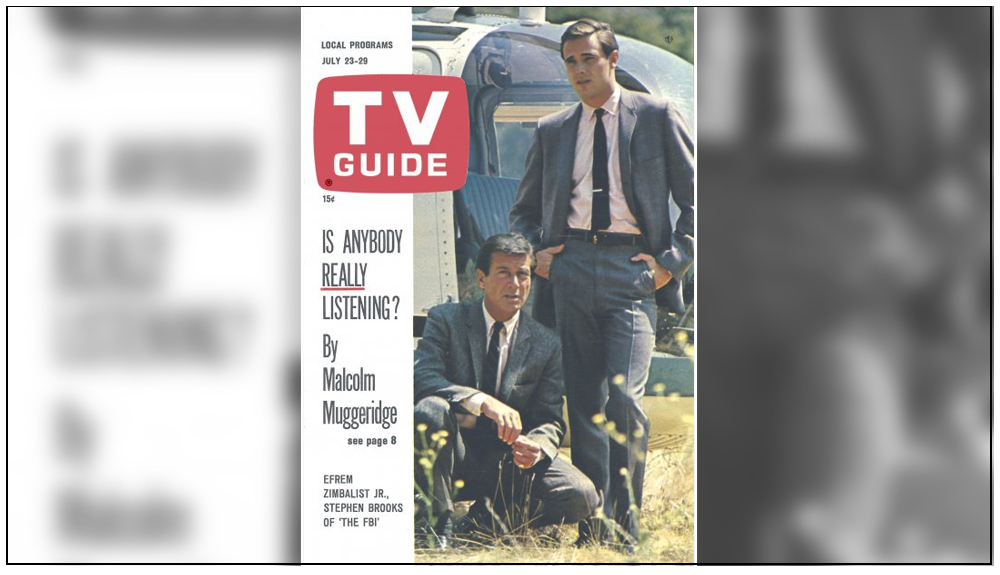
This week in TV Guide: July 23, 1966


This week’s lead story is written by British humorist and critic Malcolm Muggeridge, the sixth in a series of articles "assessing television's effect on our society." Muggeridge wrote for TV Guide several times over the years (I think this was my favorite); he was one of many distinguished writers appearing in TV Guide through the ‘60s and ‘70s, a period when the magazine was capable of a particularly high intellectual content. (Unlike today.) As interesting a writer as Muggeridge was, he was an even more interesting individual: a leading journalist, social critic and television personality in Britain, a soldier and spy during World War II, a left-winger who eventually because staunchly anti-Communist, an editor with Punch magazine, an interviewer with the BBC, a stinging satirist who became a harsh critic of ’60s permissiveness, eventually converted to Christianity, and was widely credited with bringing Mother Teresa to popular consciousness in the West. Incredible.

In this issue, many of his talents are on display. He freely acknowledges the influence of television— "what [children] see on it more than anything else, governs their present hopes and future aspirations"—and that the medium has become a major shaper of opinion: "If Nixon had been better made up, without that devastating afternoon-shadow, for his encounters with the late President Kennedy, it is perhaps he who would have gone to the White House."

He acknowledges that television is often of dubious artistic merit ("The old music hall, as I remember it in my childhood, was, by comparison, a feast of reason and a flow of wit."), and that the quality "declines visibly year by year."  However, he also cautions against throwing the baby out with the bath water, as it were:

Let it be remembered, however, that, on the same line of reasoning, the invention of printing might be as summarily dismissed. After all, far more type is dedicated to Peyton Place and Playboy magazine than to “Paradise Lost” or “La Recherche du Temps Perdu.” . . . How tragic if, because men could be debauched by “Fanny Hill” and the works of the Marquis de Sade, they had been deprived of the solace of the New Testament and Shakespeare’s plays, which also come to them largely through the printed word!

To critics who charge that television numbs the mind and turns people into what we today would call "couch potatoes," Muggeridge replies, "Nor is it true that, before television, those who now spend their evenings viewing sat at home doing embroidery or listening to 'The Mill on the Floss' read aloud. They were much more likely to be out at the pub studying tomorrow’s racing lineup or swapping dirty stories." He adds that television may indeed be "a cultural wasteland, but what about what they replaced? Was that a well-tended garden?"

The fact is, according to Muggeridge, there has been little serious art produced in any media—there has been far more "wealth, talent, skills and endeavor" spent in the last half-century of cinema than produced the Italian Renaissance, but the yield in terms of "enduring worth and interest" is "virtually nil."  Garbo, the Marx Brothers, Chaplin: "these are not the equivalent of even a minor work or art." A bit harsh perhaps, but not without merit. Rather than being constantly disappointed by television’s output, he suggests lowering expectations—"We do not expect tabloid newspapers to serialize Kierkegaard, or women’s magazines to run extracts from Thomas a Kempis. . . Why, then, should television be expected to manifest its seriousness and concern for culture by every now and again putting on a half-fisted production of 'King Lear' or mounting a boring lecture on the French Impressionists?" Far better that TV concentrate on what it does best: news, sports, comedy, soap operas.*

*He had some definite thoughts on those who appeared on television as well, as was shown in a memorable confrontation with Monty Python's John Cleese and Michael Palin on a BBC show in 1979. Maybe we'll talk about that someday.

This is Muggeridge as he came to be known in the late ’60s and ‘70s: an acerbic wit who nonetheless could not disguise an increasing seriousness creeping into his works. And it’s in that spirit that he leaves us with this optimistic note: for as many times that people have stopped him and mentioned how they’ve seen him on television, "not one has ever so much as mentioned, let alone quoted, anything I have said."  If that same "blissful ignorance" applies to all who air their views on the tube, "how splendid!"

l  l  l

During the 60s, the Ed Sullivan Show and The Hollywood Palace were the premiere variety shows on television. Whenever they appear in TV Guide together, we'll match them up and see who has the best lineup.

Sullivan:  Satirist Allan Sherman; the Supremes and the Dave Clark Five, rock ‘n’ roll groups; Richard Kiley and Joan Diener, appearing in a scene from “Man of La Mancha”; actor Menasha Skulnik; golf champion Ken Venturi; comics Stiller and Meara; and juggler Ugo Garrido.

Palace: Host Bing Crosby and son Gary, comedian Henny Youngman; singer Rosemary Clooney; Edgar Bergen and Charlie McCarthy, dancer-choreographer Hugh Lambert, comedy xylophonist Roger Ray, and the Band of the Fiji Military Forces.

"Those are both pretty good," my wife said when I read this week’s lineups to her. "I think you have to give a very slight edge to the Palace. They’ve got Bing Crosby, even with that talentless Gary, and besides, it seems like the Supremes were on with Sullivan every other week." Hard to argue with that, not if you want to have a successful marriage. Besides, with Bing and Rosie you’ve got a White Christmas reunion, and Bergen and Charlie are always funny. Maybe if it had been the Stones instead of the Supremes—but, alas, we’ll never know. The winner: Palace, by the slimmest of bouffant hairdos.

l  l  l

With Cleveland Amory taking the summer off, we're fortunate to have TV Guide's movie critic, Judith Crist, filling in. And we're particularly fortunate that this week, the subject of Crist's review is none other than ABC's blockbuster prime time soap, Peyton Place.

Back in the olden days of radio, Crist says, things were simpler, and soaps often focused on a main character. But now, "the affluent society won't settle for simplicities," she writes. "We'll take our emotional calories in assorted nuts, by the handful." And as Peyton Place "snail-paces along toward its third season," the storylines seem, if anything, to be getting more complicated: "It was possible to keep track of things in the early days but more and more outlanders are drifting into the precinct. Blink an eye and there are three more mysteries on hand, with half-forgotten characters to go with them." Crist admits to harboring a secret desire that Martin Peyton will turn out to be his own grandfather. 

Indeed, Peyton Place seems to be a miserable place to live, a place where "people face life, hunching over the ghastly sins and secrets that have taken place off-screen and long ago, and reveling in all the sorrows and suspicions and soul searching they produce on screen and in perpetuity." And the show always seems to be on the verge of some monumental reveal, some dark secret that threatens to boil over; Crist thinks it will be that "somewhere in Peyton Place there's somebody whose parents were a properly married unadulterous pair, whose birth was therefore legitimate and who has reached his 20th year without having had a nervous breakdown, committed mayhem or even murder or, hope among hopes, stumbled upon the secret of his neighbor's sins!" Well, one can always hope.

Not that there aren't some positives connected to PP: the show has shifted to color, the production values are first-class, and some of the cast members provide a dignity that can produce the illusion that this show, compared to the daytime soaps, is of a "higher class"; and Mia Farrow, caricatured above, has "eternity in [her] wide, wide eyes." But then there's the "near-camp dreariness" of the dialog, the pace that makes it clear the program was "designed for sporadic viewing," and those complicated plots. Watching Peyton Place, Crist concludes, "is getting a big much—and lower-calorie diets are healthier in the long, long run."

l  l  l

Since the death of Dorothy Kilgallen the previous November, the What’s My Line? crew from Goodson-Todman has been engaged in "The Great Woman Hunt," a furious search for a permanent replacement for Kilgallen, who had been with the show since its inception in 1950. So far, the seat has remained in the possession of a rotating cast of guest stars—everyone from Kitty Carlisle (a stalwart of Goodson-Todman’s To Tell the Truth) to Dr. Joyce Brothers, with magazine publisher Helen Gurley Brown, TV Guide critic Judith Crist, columnist Sheilah Graham, and actresses Joanna Barnes, Joan Fontaine and Dina Merrill thrown in. Even Muriel Davidson, the author of this article, has been considered for the list. It’s a tough gig, though, coming into a long-running show with a veteran cast; as host John Daly puts it, "If she doesn’t fit into our family, we’ll just freeze her out."

At press time there are three clear contenders for the seat. There’s Phyllis Newman, another veteran of To Tell the Truth, married to legendary Broadway composer Adolph Green; charming, bubbly and very girlish (and I mean that as a compliment), always having to tilt her head upward slightly during the Mystery Guest segment so her mask wouldn’t fall off. Sue Oakland is a surprise finalist; married to TV producer Ted Cott (David Susskind’s cousin), she’s got both beauty and brains: "Besides being breath-takingly beautiful and gowned, she is a near-genius, with a Master's degree in political science from Columbia University and with one lovely leg up on a Ph.D.*

*Her Master’s was in the inside workings of the United Nations; her Doctoral dissertation was "The Function of Television on the Presidential Election Campaign of 1968."

And then there’s society columnist Suzy Knickerbocker, whose nameplate will eventually simply read "Suzy" rather than the letter-crunching "Miss Knickerbocker."  Her real name is Aileen Mehle and passing mention in the article is made of her having a 22-year-old son. (That son, Roger, is an Annapolis graduate and naval officer, and on the Christmas episode of WML, on which his mother is a panelist, he appears as the Mystery Guest.)

The tongue-in-cheek question remains: "Can a girl be found who can win the hearts of a great, established family, still grieving the loss of one of its most beloved members? . . . Or will her struggle for acceptance bring about the destruction of the entire, proud, 16-year dynasty?" In the end, despite the producers’ vows, none of the ladies above, or anyone else, for that matter, wind up filling Dorothy’s seat. WML is starting to show its age, "developing creaks of the Nielsen in its venerable beams," and it will leave the air in September 1967, with a run of 17½ seasons—at the time the fourth-longest-running non-news series of all time, trailing only The Ed Sullivan Show, The Original Amateur Hour and Lamp Unto My Feet. Whether the right fit was never found, or time just wound up running out, that fourth seat on the panel will continue to be filled with rotating female guests until the very end.*

*Or almost the very end; the final show features a panel of Arlene Francis, long-time guest Martin Gabel (Arlene’s husband), former regular Steve Allen, and Bennett Cerf.  Host John Daly himself plays the final Mystery Guest.

l  l  l

I've mentioned before that it can be a challenge finding noteworthy shows during the summer, but I think we've done quite well for ourselves this week. As always, though, you can be the judge.

NBC’s Saturday Night at the Movies has the Kirk Douglas classic Ace in the Hole, which is airing under its alternate title, The Big Carnival. (8:00 p.m. CT) It's a cynical, cynical story of a newspaperman trying for a comeback with the story of a man trapped in a cave. But it's only a story if he stays trapped long enough for a dramatic rescue. Not to disparage any of my friends in the media, and I do have them, but this kind of news manipulation could never happen today, right? Right?

Sunday, the sports world focuses on the final round of the PGA Championship, from the famed Firestone Country Club in Akron, Ohio. (3:00 p.m., ABC) It’s an early appearance for golf’s final major championship of the year, which is usually played in August. It’s also an unplanned location for the tourney; originally it was supposed to take place at Columbine Country Club in Columbine, Colorado, but severe storms in 1965 had damaged the course, forcing the PGA to swap sites—Firestone had been scheduled to host in 1967, but traded with Columbine. After 54-year-old Sam Snead turns back the clock by leading the first two rounds, the young Al Geiberger comes on during the weekend to finish at even par, good enough for a four-shot win over Dudley Wysong.

*A footnote: that night, a few hours after the tournament, 1964 British Open champion Tony Lema and his wife are among those killed in the crash of a small plane flying Lema to Illinois to compete in a Monday event. The 32-year-old “Champagne Tony,” one of the best and most charismatic players on tour, had finished 34th in what turned out to be his last tournament. Had he not died, I think a lot more people would know who he is today.

Burgess Meredith is on prime-time three out of five nights this week, all on ABC, which is pretty good for both him and the network and a treat for us viewers. His first appearance is Monday night on 12 O'clock High (6:30 p.m.), where he plays a scientist who's developed an airborne radar that allows bombers to zero in on targets even when they're obscured by clouds. Trouble comes when the Germans figure out how to zero in on the radar. According to the Close-Up describing the episode, during one scene, "Meredith received a rare accolade: spontaneous applause from the other actors on the set." Also appearing in a semi-regular role is Robert Dornan, before he gives up acting and runs for Congress; MST3K fans will remember him from The Starfighters.

Jack Hawkins, who was so good as Quintus Arrius in Ben-Hur, is also on multiple nights; later in the week, he appears as a prim and insensitive Englishman on Bob Hope's Chrysler Theatre (in a story for which Shelley Winters would be nominated for an Emmy), but on Tuesday night he's on Dr. Kildare (7:30 p.m., NBC), as an atheist whose heart attack may have been Divine Punishment. Or not.

Burgess Meredith is back Wednesday in the first of two consecutive nights on Batman (6:30 p.m. tonight and tomorrow, ABC); this week, Alfred, the butler of millionaire Bruce Wayne, is kidnapped by "that piscatorial pirate of plunder." No window cameo, alas; although Jerry Lewis had appeared in the first one earlier in the season, it didn't become a semi-regular feature until the second season.

Thursday night Eve Arden stars on an episode of Bewitched (8:00 p.m., ABC) in which Endora shows Darren what Samantha's baby will look like in 25 years. Arden plays a nurse at the hospital, while the episode also marks the first appearance of Elizabeth Montgomery in her dual role as Samantha and her Cousin Serena. Meanwhile, Rowan and Martin continue in their summer replacement series that eventually leads to Laugh-In; this week, their guests are singer Barbara McNair and comedian Jackie Vernon. (9:00 p.m., NBC)

On Friday, a delightful rerun of Sing Along with Mitch (7:30 p.m., NBC) features Shirley Temple as the special guest, performing the songs she made famous as such an adorable child star. And at 9:00 p.m. on CBS, the Canadian comedians Wayne and Shuster conclude their documentary series Wayne and Shuster Take an Affectionate Look at... with a review of the career of W.C. Fields. Unless you're in Minneapolis, that is, where WCCO pre-empts the show for a double-feature of Marshal Dillon.

l  l  l

Ah, this is the kind of thing I always appreciate finding: a 1966 CBC documentary hosted by—Alex Trebek! Yes, the same Alex Trebek who hosted Jeopardy since who-knows-when and became a beloved American icon! And what makes this even better is that the original Jeopardy, with host Art Fleming, is still on NBC’s daytime schedule! Who could possibly have looked at this issue and thought to themselves that nearly 60 years later Jeopardy would still be on, and it would have been hosted for 37 by this obscure Canadian appearing on a CBC documentary being broadcast by NET?

The show itself is, I think, striking: a look at "The Cultural Explosion" of the 1960s. "More people go to concerts, museums and theaters than ever before—but are we on the threshold of a new Renaissance?" What, exactly, does this tell us about today?  It’s very intriguing; after all, we hear constantly about how the arts must appeal to young people, who are increasingly turned off by the arts, and yet when it comes to the ‘60s, we tend to assume that the young dominated the tenor of the decade.

So: were older people driving this cultural boom? If so, why? Was it merely a measure of the post-war disposable income that drove the growth of the consumer society of the ‘50s? Or did they have more influence over popular culture than we might think?

Their offspring, who today represent the demographic most interested in culture (i.e. grey-haired) must have had some of that rub off on them. If so, why haven’t they been able to do the same thing with their descendants? We know that schools played a greater role in art and music back then than they do now – is that the difference? Were they already interested in culture in the ‘60s as well, or did that interest come to them later in life?

If the latter is the case, does it suggest that today’s youth, for whom culture is dead, might yet come around when they get older?  Or is it that things have changed so dramatically over the last 60 years that they must be reached earlier, or be lost forever?

Obviously you could write a whole book about this. And yet, when those of us with an interest in the arts read daily about the difficulties faced by classical music organizations, theaters, museums, and more, there’s something depressing about this program, so full of optimism for the future, talking about a culture "explosion" and the possibility of a new age. Who would have imagined that the arts would survive the tumultuous ‘60s, only to run aground on the shoals of the new millennium? TV  

July 15, 2015

Summer rerun: How The Beverly Hillbillies explains your salvation

A while back I’d made an offhand comment that 1965 might well be the year that defined the decade of the 60s; prior to that, much of the 60s still depended on the 50s for its definition; after that, the 60s devolved into the disintegration of everything familiar, an era that continued well into the 70s.

And so perhaps it’s appropriate that we take a closer look at the Malcom Muggeridge article I mentioned at the end of this week’s TV Guide review (March 6, 1965), because I think there’s more to this piece than we can get into in the regular “This Week” format.

Muggeridge, although he once claimed to have no sense of humor, was widely known as a wicked satirist; the New York Times referred to him as a “caustic social critic.” He’d been the editor of the British humor magazine Punch, and he was rarely at a loss for words – or targets of that caustic criticism. He wasn’t afraid of being outrageous; witness his 1957 Saturday Evening Post article “Does England Really Need a Queen?” which, needless to say, created something of a stir back home.

However, there was always a serious subtext behind Muggeridge’s humor, and this side became more pronounced as the 1960s evolved. He became an outspoken critic of the counterculture, especially the drug and sexual revolutions. By the time of his 1966 book Tread Softly for You Tread on My Jokes this more serious side was much in evidence, so despite the TV Guide cover’s promotion of Muggeridge’s article as “a renowned critic’s witty report on the British passion for American TV” (and in fact the dry Muggeridge wit is certainly visible), I think it fair to assume that Muggeridge was really talking about something much more profound, especially regarding the spiritual evolution (or devolution) of British and American society.

The premise of this article is an analysis of why The Beverly Hillbillies has become the most popular program on British television. This is due in large part, according to Muggeridge, “precisely because they are so tremendously American.

The fact is that we Europeans, whatever we may say to the contrary, are crazy about everything American. Indeed, I sometimes think that the more anti-American we purport to be in attitude, the more Americanized we tend to become in our tastes, our speech and our attire.

OK, so that’s easy enough to follow. There’s long been a school of thought that anti-American attitudes are born of jealous as much as anything. (Whether this is still the case, or that in the intervening 50 years American culture has earned that antipathy on its own is another question.) But just what is it about the Hillbillies’ American-ness that makes such an impression on Brits – or fellow Americans, for that matter?

Muggeridge suggests that there is an innocence about the Hillbillies that appeals to a cynical populace. “We, too, yearn after wealth which does not corrupt; after an innocence which triumphantly survives the possession of riches.” Jed may have hit the jackpot with that oil strike, but it hasn’t fundamentally changed either he or his family, “constantly on the edge of succumbing to the lures of luxurious living, but always at the last moment pulling back and resuming their old, virtuous ways.” There is an irony to this, though, in that our cynical selves would rather admire the virtuous than emulate them: “In accordance with the principles of an Affluent Society as laid down by Professor Galbraith, we have rejected the outmoded Christian notion that the poor are blessed, but we should still like to be convinced that it is possible to be rich and blessed.”* By watching the success of the Hillbillies each week, we are reassured that we can have our cake and eat it too.

*Muggeridge was in large part responsible for bringing Mother Teresa to popular light through his book Something Beautiful for God. I suspect therefore that the phrase “outmoded Christian notion” is meant as brittle sarcasm.

And this success bodes well not only for the here and now, but for the hereafter as well. “Week by week [the Hilbillies] demonstrate that, though possessed of great wealth, they can still just get through the needle’s eye into the kingdom of heaven.” Muggeridge expands on this spiritual aspect, for it is one that is crucial to understanding the role of television in modern culture – it “is largely dedicated to providing reassurance on precisely this score.”

The early Christians, in order to secure themselves against indulgence in sensuality and cupidity, persuaded themselves that their fleshly appetites were vicious and great possessions a handicap to virtuous living. The writings of the fathers and the saints are full of denunciations of sex and riches. Now, when we have created a way of life in which sex is our chief relaxation and riches our main pursuit, traditional Christian teaching in this respect would seem to require revision. We cannot accept the drastic notion of ourselves as sinners. Nor can we in decency just repudiate the fathers and the saints.*

*Almost 50 years hence, has anything really changed?

The answer, therefore, is to demonstrate that the two can coexist, “that, like the Hillbillies, we can be rich and still successfully repel the assaults of the Evil One.”

It is not only tempting to draw parallels between the 60s that Muggeridge describes and our own time, it is virtually impossible not to do so. Many of us dream of what we would do with sudden wealth, should our Powerball number finally come up. We may quit our jobs, buy homes for our loved ones, establish scholarships, fund charities, buy a fancy sports car. One thing is for sure, though: our sudden wealth will not change who we are. We not only say this, we not only believe it will be so, we have a desperate need to believe it.

The role of television in all this cannot be minimized. As I’ve so often suggested, television does not create so much as it reflects, and the truth reflected by the success of the Hillbillies is one that dates back to the Victorians. “[O]bsessed as they were with the lusts of the flesh, [the Victorians] were always trying to demonstrate in their popular art that chastity could survive in the poor and the simple despite all the lures and stratagems of accomplished seducers. We, obsessed with money, seek in our popular art to reinforce the conclusion that the poor remain blessed even when they become rich.” Television, therefore, simply takes its place in a long line of visual media as reinforcing this belief.

What saddens me and, I think, would sadden (though perhaps not surprise) Muggeridge as well, is how we’ve seen this attitude change in the last few years. You hear much talk about the utility of morality, especially in terms of religion, and especially in terms of the American Founding Fathers. It is said, and it is a debatable point, that most of the Founders were Deists. However, it is undeniable that most of them understood the need for a civic religion, even if they themselves didn’t believe in its truths. Franklin, for instance, felt that organized religion was necessary to keep men good to their fellow men, writing Thomas Paine that members of society “have need of the motives of religion to restrain them from vice, to support their virtue, and retain them in the practice of it till it becomes habitual, which is the great point for its security.”

This attitude is mostly a given in Muggeridge’s article. Even if we strive to make wealth coexist with virtue, we do not deny the merits of virtue. We know that being blessed is a desirable state to be in, and we understand, even if only subconsciously, that the desire for wealth and power and sex somehow diminishes that state of virtue – else why should we attempt to reconcile it all?

Today, however, I don’t think anyone would be sure of that. Rather than aspiring to a virtue that, though it may be unattainable, is still recognized as being worthy, we now deride virtual altogether. Not only are there fewer and fewer standards which a majority can agree on, there is disagreement as to whether or not standards are even necessary. Viewers in the 60s may have looked at the Hillbillies as quaint, but they felt good about the idea that they could be both “rich and blessed.” Today, the blessed part isn’t important – we’d rather be rich and sated.

Not the Beverly Hillbillies
As evidence of the universality of the fairy tale epitomized by the Hillbillies, Muggeridge had cited, interestingly enough, The Beatles – a group he loathes, calling them “four moronic and unpleasing youths with long hair and little talent.” Nonetheless, a great deal of their appeal in 1965 came from the perception that they remained “unspoilt” by their wealth and fame. “[T]hey are still the same simplehearted, inarticulate Liverpudlians that they always were.” The Beatles are, in essence, Britain’s own Hillbillies.

Now, by the end of the 60s, I’m not sure anyone would have considered The Beatles “unspoilt”- by this time they’d encountered drugs, experimental music, and the Maharishi Mahesh Yogi. In a way this exposes the fallacy of the fairy tale that so many longed to believe in. There’s an old saying that “when you lie down with dogs, you get fleas.” Likewise, wealth, power and sex create their own burdens, and by separating these from virtue, we soon succumb to their collective weight.

Muggeridge concludes his article with the observation that, thanks to television, “more people in the world today know The Beverly Hillbillies, it is safe to assert, than know President Johnson or even the Pope. Backward or undeveloped nations are shown by means of television the way of life toward which they so ardently aspire.” The global reach of television leads us into uncharted waters; “Such a thing has never happened before. No need to take on trust the rewards of toil and struggle; it is there, visible, on the television screen.” No matter who he is, no matter where he is, a citizen of the world “sees with his own eyes all he may enjoy and become”.

It’s quite interesting that an article with so many layers would be published in a “popular” publication like TV Guide, but the times were different, and serious content often landed in the magazine’s pages. By the way, if this all sounds a little dry and scholarly to you, it’s not meant to. Muggeridge’s article is in fact quite readable, and frequently slyly humorous. On the face of it Muggeridge is being his outrageous old self, satirizing the desire television has to be seen as Important. But behind his mock seriousness lies a true appraisal of the culture of the 60s and where it was leading, and I’ve no doubt that Muggeridge was deadly serious in his appraisal of what the popularity of The Beverly Hillbillies says about ourselves and our time. As Muggeridge might have said, “I’m surprised that you’re taking this seriously. But I’m even more surprised that you aren’t.”

Originally published March 2, 2013

July 26, 2014

This week in TV Guide: July 23, 1966

There are times, as you’re probably aware, when it’s particularly challenging finding interesting material from the summer issues of TV Guide.  Most programs are either reruns (some of which we’ve already covered here) or summer replacements, and the news isn’t always particularly noteworthy.  It’s as if everyone’s just marking time until the start of the new season in September.  As a matter of fact, the first issue I selected for this week’s coverage was so inconsequential I wound up throwing it back in the pile, replacing it with the one you’re about to discover for yourselves.  Thankfully, this issue has more than enough to interest the cultural archaeologist - so much that I can't even get around to cover boy Stephen Brooks, co-star of one of my favorite series, The FBI.  So let’s get right to it.

***

Since the death of Dorothy Kilgallen the previous November, the What’s My Line? crew from Goodson-Todman has been engaged in “The Great Woman Hunt,” a furious search for a permanent replacement for Kilgallen, who had been with the show since its inception in 1950.  So far the seat has remained in the possession of a rotating cast of guest stars – everyone from Kitty Carlisle (a stalwart of Goodson-Todman’s To Tell the Truth) to Dr. Joyce Brothers, with magazine publisher Helen Gurley Brown, TV Guide critic Judith Crist, columnist Sheilah Graham, and actresses Joanna Barnes, Joan Fontaine and Dina Merrill thrown in.  Even Muriel Davidson, the author of this article, has been considered for the list.  It’s a tough gig, though, coming into a long-running show with a veteran cast – as host John Daly puts it, “If she doesn’t fit into our family, we’ll just freeze her out.”

At press time there are three clear contenders for the seat.  There’s Phyllis Newman, another veteran of To Tell the Truth, married to legendary Broadway composer Adolph Green; charming, bubbly and very girlish (and I mean that as a compliment), always having to tilt her head upward slightly during the Mystery Guest segment so her mask wouldn’t fall off.  Sue Oakland is a surprise finalist; married to TV producer Ted Cott (David Susskind’s cousin), she’s got both beauty and brains: “Besides being breath-takingly beautiful and gowned, she is a near-genius, with a Master’s degree in political science from Columbia University and with one lovely leg up on a Ph.D.*

*Her Master’s was in the inside workings of the United Nations; her Doctoral dissertation was “The Function of Television on the Presidential Election Campaign of 1968.

And then there’s society columnist Suzy Knickerbocker, whose nameplate will eventually simply read “Suzy” rather than the letter-crunching “Miss Knickerbocker.”  Her real name is Aileen Mehle, and passing mention in the article is made of her having a 22-year-old son.  (That son, Roger, is an Annapolis graduate and naval officer, and on the Christmas episode of WML, on which his mother is a panelist, he appears as the Mystery Guest.)

The tongue-in-cheek question remains: “Can a girl be found who can win the hearts of a great, established family, still grieving the loss of one of its most beloved members? . . . Or will her struggle for acceptance bring about the destruction of the entire, proud, 16-year dynasty?”  In the end, despite the producers’ vows, none of the ladies above – or anyone else, for that matter – wind up filling Dorothy’s seat.  WML is starting to show its age, “developing creaks of the Nielsen in its venerable beams,” and it will leave the air in September 1967, with a run of 17 ½ seasons – at the time the fourth-longest-running non-news series of all time, trailing only The Ed Sullivan Show, The Original Amateur Hour and Lamp Unto My Feet.  Whether the right fit was never found, or time just wound up running out, that fourth seat on the panel will continue to be filled with rotating female guests until the very end.*

*Or almost the very end; the final show features a panel of Arlene Francis, long-time guest Martin Gabel (Arlene’s husband), former regular Steve Allen, and Bennett Cerf.  Host John Daly himself plays the Mystery Guest.
***

During the 60s, the Ed Sullivan Show and The Hollywood Palace were the premiere variety shows on television. Whenever they appear in TV Guide together, we'll match them up and see who has the best lineup..

Palace: Host Bing Crosby and son Gary, comedian Henny Youngman; singer Rosemary Clooney; Edgar Bergen and Charlie McCarthy, dancer-choreographer Hugh Lambert, comedy xylophonist Roger Ray, and the Band of the Fiji Military Forces.

Sullivan:  Satirist Allan Sherman; the Supremes and the Dave Clark Five, rock ‘n’ roll groups; Richard Kiley and Joan Diener, appearing in a scene from “Man of La Mancha”; actor Menasha Skulnik; golf champion Ken Venturi; comics Stiller and Meara; and juggler Ugo Garrido.

“Those are both pretty good,” my wife said when I read this week’s lineups to her.  “I think you have to give a very slight edge to the Palace.  They’ve got Bing Crosby, even with that talentless Gary, and besides, it seems like the Supremes were on with Sullivan every other week.”  Hard to argue with that, not if you want to have a successful marriage.  Besides, with Bing and Rosie you’ve got a White Christmas reunion, and Bergen and Charlie are always funny.  Maybe if it had been the Stones instead of the Supremes – but, alas, we’ll never know.  The winner: Palace, by the slimmest of bouffant hairdos.

***

This week’s lead story is written by British humorist and critic Malcolm Muggeridge, the latest in a succession of distinguished writers that TV Guide employed through the ‘60s and ‘70s in an effort to raise the intellectual image of the magazine.  Muggeridge, a leading journalist, social critic and television personality in Britain, is a remarkable individual – a soldier and spy during World War II, a left-winger who eventually because staunchly anti-Communist, an editor with Punch magazine, an interviewer with the BBC, a stinging satirist who became a harsh critic of ’60s permissiveness, eventually converted to Christianity, and was widely credited with bringing Mother Teresa to popular consciousness in the West.  Incredible.

In this issue, many of his talents are on display.  He freely acknowledges the influence  of television – “what [children] see on it more than anything else, governs their present hopes and future aspirations,” and that the medium has become a major shaper of opinion:  “If Nixon had been better made up, without that devastating afternoon-shadow, for his encounters with the late President Kennedy, it is perhaps he who would have gone to the White House.”

He acknowledges that television is often of dubious artistic merit (“The old music hall, as I remember it in my childhood, was, by comparison, a feast of reason and a flow of wit.”), and that the quality “declines visibly year by year.”  However, he also cautions against throwing the baby out with the bath water, as it were:

Let it be remembered, however, that, on the same line of reasoning, the invention of printing might be as summarily dismissed.  After all, far more type is dedicated to Peyton Place and Playboy magazine than to “Paradise Lost” or “La Recherche du Temps Perdu.” . . . How tragic if, because men could be debauched by “Fanny Hill” and the works of the Marquis de Sade, they had been deprived of the solace of the New Testament and Shakespeare’s plays, which also come to them largely through the printed word!

To critics who charge that television numbs the mind and turns people into what we today would call “couch potatoes,” Muggeridge replies, “Nor is it true that, before television, those who now spend their evenings viewing sat at home doing embroidery or listening to ‘The Mill on the Floss’ read aloud.  They were much more likely to be out at the pub studying tomorrow’s racing lineup or swapping dirty stories.”  He adds that television may indeed be “a “cultural wasteland, but what about what they replaced?  Was that a well-tended garden?”

The fact is, according to Muggeridge, there has been little serious art produced in any media – there has been far more “wealth, talent, skills and endeavor” spent in the last half-century of cinema than produced the Italian Resaissance, but the yield in terms of “enduring worth and interest” is “virtually nil.”  Garbo, the Marx Brothers, Chaplin – “these are not the equivalent of even a minor work or art.”  A bit harsh perhaps, but not without merit.  Rather than being constantly disappointed by television’s output, he suggests lowering expectations – “We do not expect tabloid newspapers to serialize Kierkegaard, or women’s magazines to run extracts from Thomas a Kempis. . . Why, then, should television be expected to manifest its seriousness and concern for culture by every now and again putting on a half-fisted production of “King Lear” or mounting a boring lecture on the French Impressionists?”  Far better that TV concentrate on what it does best – news, sports, comedy, soap operas.*

*He had some definite thoughts on those who appeared on television as well, as was shown in a memorable confrontation with Monty Python's John Cleese and Michael Palin on a BBC show in 1979.  Maybe we'll talk about that someday.

This is Muggeridge as he came to be known in the late ’60s and ‘70s – an acerbic wit who nonetheless could not disguise an increasing seriousness creeping into his works.  And it’s in that spirit that he leaves us with this optimistic note: for as many times that people have stopped him and mentioned how they’ve seen him on television, “not one has ever so much as mentioned, let alone quoted, anything I have said.”  If that same “blissful ignorance” applies to all who air their views on the tube, “how splendid!”

***

I’ve mentioned before how many movies networks and local stations used to run.  Today we mostly see made-for-TV flicks on broadcast stations, with theatrical features are relegated to specialty networks or pay cable, but they were all over the dial back in the ‘60s.  I don’t think, however, we’ve ever spent a lot of time on the kinds of movies being shown – let’s take a quick look, shall we?  Remember, this is just a sample.

WCCO, Channel 4, has a double-feature on Saturday afternoon (since they have no network sports).  At 1pm it’s Souls for Sale, which sounds for all the world like one of those American International films*, with Vincent Price starring in the story, based on Thomas De Quincey’s “Confessions of an Opium Eater”, of a man arriving in San Francisco “determined to help an old friend fight the slave trade.”  That’s followed at 2:30pm by Curse of the Demon, in which “A girl believes her uncle has been murdered by supernatural means for defying a devil cult.”  Dana Andrews, what on earth are you doing in this movie?

*Just checked, and surprise! It’s not.  According to the always-reliable Wikipedia, it was produced and directed by Albert Zugsmith, who as a producer put out three classics of their kind: The Incredible Shrinking Man, Orson Welles' Touch of Evil, and Douglas Sirk's Written on the Wind.

NBC’s Saturday Night at the Movies has the Kirk Douglas classic Ace in the Hole, which is airing under its alternate title, The Big Carnival.  On Saturday night, Channel 4 is back with Magnificent Obsession, starring Rock Hudson and Jane Wyman, while KCMT, Channel 7 has The Mummy’s Curse, with Lon Chaney.

Late night Sunday, WTCN, Channel 11, has a Hitchcock thriller, Shadow of a Doubt, with Joseph Cotton and Teresa Wright.   On Monday it’s the Cary Grant/Franchot Tone comedy Every Girl Should Be Married on WEAU, Channel 13, coupled with Burt Lancaster’s adventurous The Crimson Pirate on WDAL, Channel 3.  Tuesday it’s a choice between Loretta Young’s Mother Was a Freshman on KGLO or the WW2 drama Decision Before Dawn, with Richard Basehart heading a large cast, on Channel 9.

Wednesday I’d choose the noir classic The Big Heat on Channel 11, with Glenn Ford, Gloria Grahame and Lee Marvin, in “the story of a policeman who resigns from the force to find the murderers of his wife.”  I’m betting on Ford as the former cop and Marvin as one of the killers.

Thursday night CBS has a so-so adaptation of the Broadway hit Mary Mary, which sounds right out of the ‘50s: “The hectic life of recently divorced publisher Bob Kellaway, who has problems with alimony, taxes, the wealthy girl he wants to marry – and his ex-wife.”  Where are Rock Hudson and Doris Day when you need them?  Probably better to opt for KMSP, Channel 9, and their late-night feature This Woman Is Dangerous, starring Joan Crawford (who is), or another Glenn Ford movie, Plunder of the Sun, on WDAL, Channel 3.

On Friday afternoon Channel 11 has what sounds like an interesting speculative sci-fi picture, The Creeping Unknown, with Brian Donlevy and Jack Warner.  “A new rocket is sent hurtling into space with three men on board.  When it crash lands in England, there is only one man left on board.”  That night Channel 11 is back with another Hitchcock mystery, Saboteur, with Bob Cummings as a man trying to clear himself of starting a fire in a military aircraft plant.  And Channel 4 winds down the broadcast week with Charlie Chan at Treasure Island, which stars Sidney Toler and Cesar Romero – but, alas, no Captain Hook.

***

Quick sports note – the bulk of the week is taken up with baseball (Tigers vs. Indians on NBC’s Saturday Game of the Week, and Twins games against Boston, New York and Baltimore), but the biggest event of the week is in golf - the PGA Championship, from the famed Firestone Country Club in Akron, Ohio.  It’s an early appearance for golf’s final major championship of the year, which is usually played in August.  It’s also an unplanned location for the tourney – originally it was supposed to take place at Columbine Country Club in Columbine, Colorado*, but severe storms in 1965 had damaged the course, forcing the PGA to swap sites – Firestone had been scheduled to host in 1967, but traded with Columbine.  After 54 year old Sam Snead had turned back the clock by leading the first two rounds, the young Al Geiberger comes on during the weekend to finish at even par, good enough for a four-shot win over Dudley Wysong.

*Yes, that Columbine.

A footnote: that night, a few hours after the tournament, former British Open champion Tony Lema and his wife are among those killed in the crash of a small plane flying Lema to Illinois to compete in a Monday event.  The 32-year-old “Champagne Tony,” one of the best and most charismatic players on tour, had finished 34th in what turned out to be his last tournament.  Had he not died, I think a lot more people would know who he is today.

***

Ah, this is the kind of thing I always appreciate finding – a 1966 CBC documentary hosted by – Alex Trebek!  Yes, the same Alex Trebek who’s hosted Jeopardy since who-knows-when!  And what makes this even better is that the original Jeopardy, with host Art Fleming, is still on NBC’s daytime schedule!  Who could possibly have looked at this issue and thought to themselves that nearly 50 years later Jeopardy would still be on, and it would have been hosted for over three decades by this obscure Canadian appearing on a CBC documentary being broadcast by NET?

The show itself is, I think, striking – a look at “The Cultural Explosion” of the 1960s.  “More people go to concerts, museums and theaters than ever before – but are we on the threshold of a new Renaissance?”  What, exactly, does this tell us about today?  It’s very intriguing – after all, we hear constantly about how the arts must appeal to young people, who are increasingly turned off by the arts, and yet when it comes to the ‘60s, we tend to assume that the young dominated the tenor of the decade.

So: were older people driving this cultural boom?  If so, why?  Was it merely a measure of the post-war disposable income that drove the growth of the consumer society of the ‘50s?  Or did they have more influence over popular culture than we might think?

Their offspring, who today represent the demographic most interested in culture (i.e. grey-haired) must have had some of that rub off on them.  If so, why haven’t they been able to do the same thing with their descendants?  We know that schools played a greater role in art and music back then than they do now – is that the difference?  Were they already interested in culture in the ‘60s as well, or did that interest come to them later in life?

If the latter is the case, does it suggest that today’s youth, for whom culture is dead, might yet come around when they get older?  Or is it that things have changed so dramatically over the last 50 years that they must be reached earlier, or be lost forever?

Obviously you could write a whole book about this – and yet, when those of us with an interest in the arts read daily about the difficulties faced by classical music organizations, theaters, museums, and more, there’s something depressing about this program, so full of optimism for the future, talking about a culture “explosion” and the possibility of a new age.  Who would have imagined that the arts would survive the tumultuous ‘60s, only to run aground on the shoals of the new millennium? TV  


It's About TV is now on Facebook!  Please like us and follow for additional content and teasers to upcoming posts!