Showing posts with label Lawrence Welk. Show all posts

May 3, 2024

Around the dial


Xt bare-bones e-zine, Jack's Hitchcock Project continues with the second te,leplay from the team of Albert E. Lewin and Burt Styler, "Craig's Will," a rare Hitchcock comedy, with a fitting cast including Dick Van Dyke and Stella Stevens. 

If you've been reading along, you know that David's been going through prime-timebib television of the 1970s at Comfort TV, to see "if it's possible to watch at least one episode" from every series. Well, you can cross off another series, with the discovery of an episode from The Chicago Teddy Bears. Remember that series?

At Realweegiemidget, Gill looks at that rare breed of TV-movie that acts as an anthology, with separate segments (think Trilogy of Terror for example). Rex Harrison Presents Stories of Love was a pilot for an unsold TV series, with a cast including Agnes Moorehead, Bill Bixby, Leonard Nimoy, and Juliet Mills.

John returns to the British anthology series Armchair Theatre (I always enjoy typing that name), and the offbeat "A Bit of a Lift," deeply flawed but still worth watching (isn't that the way with most TV, though?), and including casual sex, rape, thoughts of suicide, and more. What else do you need?

Combine the words "retro" and "TV," and you're likely to get my attention. That's what happens at Silver Scenes, where the Metzingers report on the new FAST channel PBS Retro, featuring 1970s, 80s, and 90s shows, mostly from the network's inventory of children's programming.

I've long-ago given up on the new version of Doctor Who, but I'm still a fan of the original. (Why else would I have shelled out big bucks recently for personally autographed pictures of Tom Baker and Sylvester McCoy?), So you'll want to read Mike's review at A View from the Junkyard, aof the new colorized version of "The Daleks."

As good as Alex Trebek was, Art Fleming has always been my host of Jeopardy!, and if that makes me old, bite me! On this 100th anniversary of Fleming's birth, Travanche looks back on Fleming's career, and how it lead to the Jeopardy! podium.

One of these days I'll get back to watching Maverick (I've only made it through season one so far), but at Television's New Frontier: The 1960s, we're up to 1962, the fifth and final season of the show, with Jack Kelly carrying on as the sole Maverick brother.

Martin Grams has an interesting little article on the "lost" Batman episode featuring the villain Two-Face, which was written by Harlan Ellison and would have been part of the show's third season until it was cancelled; reportedly, Two-Face would have been played by Clint Eastwood. 

I've written about Lawrence Welk several times, including just a couple of years ago, and that's also Paul's subject at Drunk TV. Paul calls himself "a born-again Welk-oholic," and looks at how the show offers a glimpse into a long-gone past.

I've had some really interesting comments the last week or two, and if you've left one of them and you're hoping I'm not ignoring you, I'm not—it's just that between a busy schedule and a bout of lethargy, I've fallen behind again. Hang on, I'll get to you! TV  

April 20, 2024

This week in TV Guide: April 19, 1969


You may recall the sensation that was The Beatles: Get Back, the eight-hour documentary directed by Peter Jackson that ran on Disney+ over three consecutive nights beginning on Thanksgiving Day, 2021. It seemed, at least to this non-Beatles fan, that everyone was either watching it, talking about it, or both; it aired to great reviews and great ratings. In addition, a feature film was made of the famous rooftop concert that features in the documentary.

I bring all this up because in this week's TV Guide, we have a pictorial featuring the Fab Four, performing on that rooftop, as part of Michael Lindsay-Hogg's documentary Let It Be, being made in support of the album of the same name. "The reason for making an album is obvious. The reason for filming the session is to let the world—all over which the Beatles hope to sell the documentary in a few months— know just how the Beatles go about their work." And part of that work is the recording session on the roof of the Apple Corps building, located in London's Savile Row. Needless to say, the impromptu session attracted quite a number of passersby, who proceeded to gather on the streets and sidewalks below, prompting calls from neighboring shops to the Metropolitan Police demanding that they "quell the noise." But, as TV Guide notes, "Even bobbies couldn't do that."  

The original documentary came out in 1970, by which time it served as something of an epitaph for the group, which was in the process of a highly publicized breakup. As was noted at the time, a good portion of Jackson's documentary was comprised of footage shot by Lindsay-Hogg, which Jackson proceeded to restore and enhance; Jackson himself referred to it as "a documentary about a documentary," a supplement to, rather than a replacement of, the original. It also presented a revisionist account of the making of the Let It Be album, presenting a far more upbeat atmosphere than had been previously thought.


As you know, we're always searching for relevancy here at It's About TV!, and it seems to me that nothing could be more relevant that a pictorial in support of a documentary that would come out the following year and then would be reprised more than fifty years later to become another TV sensation. Who knew?

l  l  l

During the 60s, the Ed Sullivan Show and The Hollywood Palace were the premiere variety shows on television. Whenever they appear in TV Guide together, we'll match them up and see who has the best lineup.

Sullivan: Ed's scheduled guests: Norm Crosby; Ken Berry of Mayberry R.F.D.; dancer Peter Gennaro; comic Pat Cooper; and singers Julie Budd, Grace Markay, and the Chambers Brothers.

Palace: Host Steve Lawrence presents Phyllis Diller, Broadway songstress Florence Henderson and Bill Dana (as skydiving instructor Jose Jimenez). Also: the singing Fuller Brothers; ventriloquist Russ Lewis; the Rhodins, aerialists; and Pat Anthony’s wild-animal act. 

To be perfectly honest, neither lineup overwhelms this week, but since I copped out with a push last week, I'm forced to make a choice, so let's bear down and get to it. I've always enjoyed Steve Lawrence, a versatile performer, and although it isn't fashionable anymore, Bill Dana's Jose Jiminez act was very funny. And who can really vote against Mrs. Brady? I liked Norm Crosby on Palace last week, so I have to like him on Sullivan this week, but while there's nothing wrong with Ed's show, I'll give the nod to Palace this week.

l  l  l

Throughout the 60s and early 70s, TV Guide's weekly reviews were written by the witty and acerbic Cleveland Amory. Whenever we get the chance, we'll look at Cleve's latest take on the shows of the era. 

That Show isn't, as you might think, one of those epaulets that people use when they're talking about something they might have found slightly distasteful, as in, "Did you see that show last night?" It is, in fact, the title of Joan Rivers' new talk show, syndicated five-times-a-week to stations around the country, and as Cleveland Amory says, it really is different from the run-of-the-mill talkfest. For one thing, Rivers attempts to engage her audience during her opening monologue. It might be a little too much for some viewers, with Rivers "[j]umping and bouncing around, weaving, waving, punching and gyrating," and trying (sometimes successfully, sometimes not) to provoke a reaction. In one show, she emerged to great applause from the audience, except for one man who stubbornly refused to clap. Rivers, who honed her talent on the nightclub circuit, naturally picked him out; "You have guts, mister," she said.

Rivers really works the audience, "and make no mistake— she works hard." When a joke fails to get a response she doubles down, building on it until something happens. After a string of cracks about her supposed lack of talent at housekeeping failed to elicit much reaction, she finally got some applause for proclaiming that she had a nice, clean garden. "'Now, you're applauding,' she said, smiling. "I like your applause, you know. I’m a mother—and a working mother."

Perhaps the most novel aspect of That Show—and it is novel—is how Rivers mixes her guests, matching the typical talk show celebrity with a non-celebrity who has an unusual or interesting job or hobby, "which becomes the basis for a discussion with both Miss Rivers and the celebrity. Most of the time the celebrity has only two choices—either play second fiddle or just burn." The match-ups are meant to be incongruous, or at least humorous; one show, for example, paired an etiquette writer and former middleweight boxing champion Rocky Graziano; another featured a psychotherapist who'd authored a book on marital fights, along with James Earl Jones, star of The Great White Hope. Naturally, Rivers and Jones staged a pretend fight for the doctor to critique, at one point moaning, "Where did we lose the magic?" I've never been a fan of Rivers, though I didn't have the animosity toward her that some did, and I have a feeling I'd have asked the same question about That Show.

l  l  l

Some interesting specials highlight the best of the week, starting on Sunday night with the 23rd presentation of the Tony Awards (10:00 p.m., CBS), hosted by Diahann Carroll and Alan King. It's hard to know how relevant the Tonys have ever been to the public at large; I know that Broadway is a tourist trap, and people planning a trip to the city may depend on the Tonys to give them some idea of what's hot, but I can't help thinking that in 1969, Broadway was much more relevant to the entertainment industry, considering how many stars had roots in the legitimate theater. Just look at some of this year's nominees: Art Carney, James Earl Jones, Brenda Vaccaro, Charlotte Rae, Herschel Bernardi, Jack Cassidy, Angela Lansbury, Joel Grey, Jerry Orbach, and Donald Pleasence. Nowadays, when a big name appears on stage, it's seen as a bid to attract a mainstream audience; back then, it was called making a living.

Monday features an uninterrupted evening of specials, ranging from animation to concerts to dramatic poetry readings, starting with the Babar the Elephant (7:30 p.m., NBC), narrated and voiced charmingly by Peter Ustinov, and based on the first three Babar books. That's followed by the latest Singer Presents musical special starring Don Ho (previous specials have included the legendary Elvis comeback, Sinatra's "A Man and His Music," and Tony Bennett); the theme is "Hawaii-HO!" (I wonder where they got that idea, hmm?), with Don leading viewers on a musical tour of Hawaii (8:00 p.m., NBC; no video, but you can listen to the soundtrack here.) Speaking of Sinatra, you can see him in a repeat of Francis Albert Sinatra Does His Thing (9:00 p.m., CBS), in which Frank is joined by Diahann Carroll and the 5th Dimension for music that's "swinging, soul, spiritual and psychedilic." Sinatra was famous for an aversion to doing multiple takes, and tonight's program is the dress rehearsal tape—Sinatra liked it and decided not to do a final taping. The poetry comes from Spoon River (10:00 p.m., CBS), a one-hour adaptation of Edger Lee Masters' free-verse Spoon River Anthology. Charles Aidman, who stars along with Jason Robards, Joyce Van Patten, and Jennifer West, wrote and directs the play, which he adapted from his own 1963 Broadway version; Hal Lynch and Naomi Caryl Hirshhorn perform the folk songs that accompany Masters' poems. I'm not sure I can imagine anything like this on American television today, not even on PBS.

Things turn more serious on Tuesday's NBC White Paper "Ordeal of the American City" (7:30 p.m.), a 90-minute look at "how urban ills are reflected on campus," with a focus on student unrest, teacher strikes, minority-group protests, and international conflicts. If this sounds a lot like what's going on in the world of education today, I suspect it's no coincidence; this should have been called "a look at how urban ills are caused and exacerbated by what's taught on campus." 

On Wednesday, Barry Sullivan and E.G. Marshall star in "This Town Will Never Be the Same," the latest presentation of Prudential's On Stage series of dramatic stories relating to today's issues (9:00 p.m., NBC). Sullivan plays a newspaper editor facing a dual crisis: his paper is on the verge of collapse, and his son has been implicated as a drug dealer. Vincent Gardenia and Roy Scheider headline a distinguished supporting cast.

Thursday, NBC's acclaimed Project 20 series turns its eye on the father of the country in "Meet George Washington" (7:30 p.m.), the story of "the best-known unknown in our history." In Susan Ludel's background article on the show, producer/director Donald Hyatt explains why Washington should be relevant to the "Now" generation, young people more interested in "new" revolutionaries than old ones: "Most people don't know what George Washington stood for; they don’t know why he was great. People are vague about the principles of the American Revolution, and many of them are unclear about the basic ideas behind the Declaration of Independence. Americans today are." (He could be talking about millennials, couldn't he?) He rejects the idea that history has no bearing on our lives today, and says that "knowledge of the past is a prerequisite to dealing successfully with the present"; "It is ideas that make history and that make the present intelligible. It is from ideas that all movements spring. To say that history doesn’t matter is to say that ideas don’t matter. But they do." Perhaps someone should dust this program off and show it today.

Finally, The Wild Wild West isn't a special, but Friday's episode is special in a way, with Pat Paulson making a surprisingly effective dramatic acting debut as a greenhorn agent assigned to assist West in "The Night of the Camera" (7:30 p.m., CBS). Incidentally, this episode is notable in that Ross Martin's character, Aretemus Gordon, does not appear; Martin suffered a heart attack in August 1968, necessitating guest appearances by several actors filling in for him during his absence. Martin's place in this story is taken by none other than Charles Aidman, who appeared in four episodes; other actors included William Schallert and Alan Hale, Jr. (who is also quite effective, by the way; showing some acting chops he didn't get to display in Gilligan's Island.

l  l  l

You'll notice I didn't mention Saturday up there, but that doesn't mean I've forgotten it completely—otherwise, we wouldn't have that groovy illustration of him on this week's cover. (And by the way, that just doesn't seem right, does it? A psychedelic Lawrence Welk? You'd have had an easier time selling me the idea of Ronald Reagan as the Democratic nominee for president.) But if you're looking for an entertainer trying to successfully bridge the Generation Gap, who better to turn to than the maestro?

"I think young," Welk tells a somewhat apprehensive Digby Diehl. "I listen to KHJ [a middle-of-the-road rock station in Los Angeles], to the Top 40, in my car and at home, and so I know what goes on. If I hear a song I like, my associates and I analyze it and perhaps try it out at the Hollywood Palladium before considering it for the show." Welk explains the need for a careful, cautious approach; "We've had the mothers and fathers so long, we don’t want to do anything to displease them. We want them to depend upon the fact that we’re not going to use any swear words or do anything that would be inappropriate, in the moral sense, to carry into the home. If there’s a double meaning, we don’t play it on television." He freely admits he doesn't understand much of the new stuff; for instance, a few years back he had a hit with "Puff, the Magic Dragon," and was later horrified to discover the song's possible link to the drug culture. "One of my musicians once told me a couple of years ago, 'Lawrence, I didn’t think there were still people in the world as naïve as you!'"

He carefully considers the meaning behind the Generation Gap. "I think that there are some forces working to disturb us," he says. "If you bring me a song, and I and a group of other people can't understand it, then you're talking about something that's pretty far out. Good music, sensible music, will bring about good thoughts, good living, good common sense. Music out of this world that you can’t understand will bring about confusion." He adds, however, that "if we have an open mind towards this younger generation, we can learn many good things from them."

If it's true, as Diehl asserts, that Welk really doesn't understand what's happening in the world of contemporary pop music, it's also true that it doesn't really matter. Welk has already outlasted Glenn Miller, Benny Goodman, and Harry James; the way things are going, he may go beyond the Beatles and Elvis as well. "I'm dedicated to entertaining people. I'm more interested in that than in creating art. If people pay a dollar to hear us, then we ought to give them a dollar and a half's entertainment. If we just do something for ourselves that's 'Art,' we've cheated them. Well, here we are, 55 years later, and The Lawrence Welk Show is still going strong with reruns on many PBS stations. And this is after running on the network and in syndication until 1982—indeed, long after the Beatles (see above) and Elvis fled the scene. That's not to say the others aren't still popular, but so is Welk. The maestro, it would seem, knew what he was talking about after all.

l  l  l

There's a rare full-page editorial on the cancellation of The Smothers Brothers Comedy Hour by CBS. As the editors note, "This publication has in the past wholeheartedly defended the right of even the Smothers Brothers to have their say on the issues of the day." They continue, "We are in full accord, however, with the Columbia Broadcasting System in its wise, determined and wholly justified insistence on meeting its responsibilities by retaining the right to preview what it will telecast over its facilities." And the Smothers made that impossible by delaying the delivery of their finished shows to the network for review, as was their contractual obligation. It's their right to do so; after all, it's CBS that "is open to censure from the public for its telecasts; it therefore should have some control of what is said. And the Smothers Brothers have been saying plenty to arouse a substantial part of America." 

To those who claim CBS's decision stomps on free speech, the Editors respond that "Freedom of speech is not, the issue. The issue is taste. And responsibility. And honesty. And perspective. And a proper respect for the views of others." They continue, "Shall entertainers using a mass medium for all the people be allowed to amuse a few by satirizing religion while offending the substantial majority?. . . Shall a network be required to provide time for a Joan Baez to pay tribute to her draft-evading husband while hundreds of thousands of viewers in the households of men fighting and dying in Vietnam look on in shocked resentment?" These are good questions, ones not easily answered, possibly because we've lived in a culture that reveres egalitarianism so much that we casually brush off the idea of anything being sacred. And yet, this was not always the case.

"For all the Smothers Brothers’ pseudo-intellectualism, it seems doubtful that they have ever encountered George Bernard Shaw’s statement that 'Liberty means responsibility.'" The editors agree with CBS's decision, based on a policy "that is determined not to insult the general mores of the country." They also applaud the judgment shown by NBC and ABC in not picking up the Brothers. "Tom Smothers has been quoted recently as saying, “We don’t want to offend anyone out there. But if you get offended, that’s the way the cookie crumbles.” The last person who made a social pronouncement in terms of pastry was Marie Antoinette. And look what happened to her."

l  l  l

What else? Well, Liz Trotta, one of the best television reporters and war correspondents, talks about her experiences in Vietnam. I would have written about this, except I'm afraid you might be getting Vietnam fatigue. Nonetheless, I didn't want to pass up the opportunity to link to this article I wrote a few years ago about Trotta and her two books, including Fighting for Air: In the Trenches with Television News, a wonderful memoir of her career, including her time in Vietnam. If you're interested, I'd suggest reading the book rather than her brief TV Guide article; it will give you much, much more.

And there's an article by Merle Miller on his hometown of Marshalltown, Iowa, a town where people just don't watch much TV. I have no idea whether or not that is still the case, having never visited Marshalltown despite spending most of my life in a neighboring state that was only a good afternoon's drive away. But let's be honest here; this is a website about television. Do we really want to read about people who don't watch television, even though they may be far more well-rounded and mentally adjusted than we are?

l  l  l

MST3K alert: Cat Women of the Moon
 
(1954) A rocket ship from the Earth lands on the moon, where its crew discovers a civilization of cat women. Sonny Tufts, Marie Windsor, Victor Jory. (Saturday, 8:00 a.m., KCRA in Sacramento) This is another Rifftrax feature, which, as you know, is close enough for us, if not for government work. Appropriately enough, our riffers are Mary Jo Pehl, who played Pearl Forrester on MST3K, and Bridget Nelson, the better half of Michael J. Nelson. Marie Windsor is campily evil, and Victor Jory appropriately heroic. All this, and Sonny Tufts too! TV  

July 1, 2023

This week in TV Guide: July 2, 1955


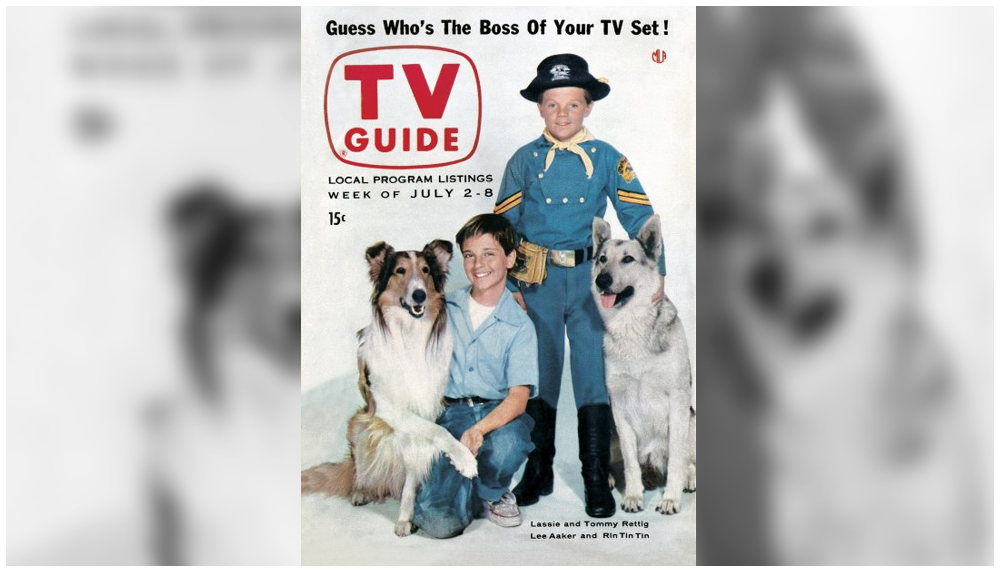
Now, I know what you're thinking: you've seen the cover of this week's issue, and you're waiting for me to make some remark about television going to the dogs. Well, that would be too easy, and as you know, we don't do anything easy around here. 

Instead, we learn that these two canines, Lassie and Rin Tin Tin (Lassie Jr. and Rin Tin Tin IV, for those keeping count), are each earning about $100,000 for their owners. And no wonder: in their first seasons on television, Rin Tin Tin is pulling a rating of 37.6 (a cumulative rating for two shows a week), while Lassie is at 30.3 for it's single broadcast. If you need more evidence of their popularity, look at their fan mail: Lassie gets an average of 2,000 letters a week (the rest of the cast combined get about 3,000 a week), and a recent contest to name one of Rinty's puppies, the show received 700,000 entries.  

These dogs work hard for their money. Rin Tin Tin is often involved in scenes that include Cavalry horses, which means a potentially life-threatening situation every time they film such a scene. Both dogs' trainers get worked up over suggestions that stunt dogs are frequently used. Rudd Weatherwax insists that Lassie appears in 98 percent of the shots, and that his brother is used only when a previous scene has been so strenuous that Lassie needs to rest; likewise, Lee Duncan says Rinty's stand-in is used only "where absolutely necessary," although his voice is often dubbed in—the stand-in "is considered a superior growler and snarler."

Directors say the dogs are easy to work with, and they get less "back talk" than they do from live actors. That's not to say that there are no egos involved, though; according to the author of this unbylined piece, "it took several weeks of delicate negotiations before both camps would agree to let the two dogs pose together" for the cover picture. (During the shoot, the dogs remained calmer than everyone else in the studio.) And nobody's allowed to play with the dogs between takes except for the two boys who act with them, Tommy Rettig with Lassie and Lee Aaker with Rinty; it's important that the dogs and their boys have good chemistry.

Of the two shows, Lassie has probably had the lasting impact, even though Rin Tin Tin remains famous. I always think of the latter's show as falling into the era of the pre-adult Western, whereas Lassie ran for 19 seasons with a variety of co-stars. In their day, though, they each thrilled millions of children, and each of them has their star on the Hollywood Walk of Fame.

l  l  l

Edie Adams is, to my way of thinking, either the luckiest woman in the world, or the most put-upon. As you probably know, she's married to one comedian, the incomparable Ernie Kovacs. However, she's currently working with another, the up-and-coming young Jack Paar; for several months she was part of his ensemble cast on CBS's Morning Show, and now she's made the move to Paar's half-hour daily variety show, which debuts Monday at 1:00 p.m. ET, also on CBS. 

Wisely, the former "Miss Television 1950" avoids any direct comparisons between her husband and her employer. They both smoke cigars, as you can see above. And they're both funny. "They think alike. They're both satirists, see humor in commonplace things. I don't know when something is funny. But with Ernie and Jack around, who has to be a comedian? I play it straight." 

In fact, Edie considers herself more a singer than a comedianne. She attended Juillard and studied opera in five languages, and it was as a singer that she "lost miserably" on Arthur Godfrey's Talent Scouts. On the other hand, she received nine job offers as a result of her Godfrey appearance, so let that be a lesson to those of you who have a fear of failure. She received critical acclaim for her Broadway performance in 1953's Wonderful Town, and her future includes a Tony Award for Li'l Abner. 

In fact, she quite comes into her own in the years after this article, earning Emmy nominations while working with Ernie, and another for her own show, Here's Edie, which ran in 1963, after Kovacs' death. She'll go on to found two successful businesses of her own, and for 20 years is the commercial face of Murial Cigars. She had been in deep debt after Kovacs's death in 1962 (Kovacs was as free with his finances as he was with his comedy), but by 1989 she was a millionaire. She also rescued many of Kovacs's videotapes at a time when much of television history was being dumped into New York Bay. No matter how you look at it, Edie Adams is quite a star, and that makes us the lucky ones. 

l  l  l

A moment ago, I mentioned Jack Paar's new show premiering on Monday, and this week appears to be the start of the Summer Season on television, with more than one show deserving some attention.

Saturday
leads off with a big one: the debut of The Lawrence Welk Show (9:00 p.m., ABC). You might remember I wrote about Welk's enduring popularity last Wednesday; well, this is what got me thinking about it. The Maestro started his show on KTLA in 1951, and tonight marks his national premiere; he'll remain on ABC until 1971, and then in first-run syndication until 1982. At this point the show is known as The Dodge Dancing Party, and the listing in this week's issue promises "60 minutes of music and comedy." Sixty minutes, and 27 years.

Also on Saturday, NBC presents Steve Allen in Movieland! (9:00 p.m.), a 90-minute spectacular featuring movies and stars from Universal-International. Allen himself is in Hollywood to star in The Benny Goodman Story, and Goodman joins the show with drummer Gene Krupa and pianist Teddy Wilson; Tony Curtis, Jeff Chandler, Audie Murphy, and Piper Laurie are among the other stars appearing. So which show would you choose?

Sunday gives you another choice to make: on NBC, the Colgate Variety Hour (8:00 p.m.) stars Guy Lombardo and His Royal Canadians, performing from Lombardo's restaurant in Freeport, Long Island. The hour also features highlights from "Arabian Nights," the Lombardo-produced musical being performed at Jones Beach, New York; and a film clip from We're No Angels, the upcoming movie starring Humphrey Bogart, Peter Ustinov, and Aldo Ray. That's opposite Toast of the Town (8:00 p.m., CBS), with the show coming from the aircraft carrier U.S.S. Antietam, currently moored in the Hudson River. No big names on tonight's show, so I'm afraid I'm going to have to give the edge to Guy, even though it isn't New Year's Eve.

On Monday, it's the national debut of The Soupy Sales Show (7:00 p.m., ABC). Like Lawrence Welk, Sales started out on local television, in his case, Detroit; like Welk, he's destined for a long and successful career. That's followed at 7:15 by John Daly and the News, ABC's evening news program. Reliable sources (OK, Wikipedia) have this starting in 1953, so my assumption is that this is the local debut. At 8:00 p.m. on NBC, it's another newcomer, as comedian Phil Foster begins his run as summer replacement for Sid Caesar; joining Phil are singer (and future soap opera star) Bill Hayes, actress Barbara Nichols, comedians Cliff Norton and Sid Gould, and tonight's guest star, singr Martha Wright. And to celebrate July 4th, Tonight (11:30 p.m., NBC; coming to you from California, where, as we know, Steve's doing that Benny Goodman movie) does a remote highlighting a fireworks show.

WPTZ, Channel 3 in Philadelphia, boasts "Top Stars in Hollywood's Best" every afternoon at 1:00 p.m., and they're doing a pretty good job on Tuesday, with the noir classic D.O.A., starring Edmond O'Brien as the man who knows he's been poisoned, and only has a few hours to solve his own murder. In primetime, singer Patti Page debuts her twice-weekly 15-minute music program (7:45 p.m., CBS); you can also catch it Thursdays at the same time. 

Wednesday, The United States Steel Hour makes its CBS premiere (10:00 p.m.); for its first couple of seasons, it aired on ABC before switching networks, and it would continue on an alternating basis (with Armstrong Circle Theatre) until 1963, when it became the last of the live dramas from the Golden Age to leave television. Tonight's episode is "The Meanest Man in the World," starring Wally Cox, and my guess is it's a bit more lighthearted than most. And in a preview of the future, young Floyd Patterson, who next year will become Heavyweight Champion of the World, takes on Archie McBride from Madison Square Garden in New York. (10:00 p.m, ABC)

Not a new show, but a new star; I've previously mentioned Star Tonight (Thursday, 9:00 p.m., ABC), a half-hour anthology that features rising young stars in leading roles, paired with more established actors and actresses in supporting roles. As is always the case, some young stars go on to great things, others not so much. Tonight's new star is one of the former, Theodore Bikel, who goes on to a long and successful career as a respected stage and screen actor and folk singer.
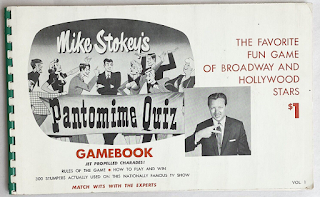
Play the home version!
On Friday, it's the return of Pantomime Quiz (8:00 p.m, CBS), one of television's most enduring summer replacement shows, as well as one of the few to air on all four networks—ABC, NBC, CBS, and DuMont. As was the case with Lawrence Welk, Pantomime Quiz got its start on KTLA before moving to national television; its broadcast history deserves a paragraph of its own, if for no other reason than to demonstrate that it was either a great idea for a show (two celebrity teams playing charades), or an example of how desperate networks were for programming:
  • KTLA: November 1947 - June 1949
  • CBS: October 1949 - August 1951
  • NBC: January - March 1952
  • CBS: July - August 1952
  • DuMont: October 1953 - April 1054
  • CBS: July - August 1954
  • ABC: January - March 1955
  • CBS: summers, 1955 - 1957
  • ABC: April - September 1958 (as well as daytime May 1958 - October 1959)
  • CBS: September 1962 - September 1963 (from hereon, known as Stump the Stars)
  • Syndicated: February - September 1964
  • Syndicated: September 1969 - September 1970
That's quite a run, isn't it? For all but four months of the 1962 edition, the host was Mike Stokey, who also produced several television series. Pantomine Quiz was a winner at the first Emmy Awards show, taking the prize for "Most Popular Television Program." If there was an award for shows ping-ponging between networks, I'm sure it would have wone that as well. If you're interested, you can see an episode here.

One more show that deserves mention this week: Five Minutes More, which airs Monday through Friday at 11:25 p.m. on Philadelphia's WCAU, and stars Ed McMahon. I've mentioned many times how, in these early days, local television served as something of a feeder system for the networks, and here's another example; Ed started with WCAU in 1949, appearing as a clown on Big Top, the nephew on the cooking show Aunt Molly’s Den, and host of Cold Cash, Million Dollar Movies, and Five Minutes More, in which he presented commentary. 

l  l  l

Speaking as we are of Philadelphia, here are the May viewing numbers, as measured by the American Research Bureau (which later became Arbitron):


So, I wondered, keeping in mind how different parts of the country view television differently, how does this compare to the national ratings? I Love Lucy, #4 here, was #1 for the season nationally, followed by The Jackie Gleason Show and Dragnet (neither of which show up in Philadelphia). Other discrepencies: Stage Show (#5 locally / not rated nationally), This Is Your Life (#6 / #12), Person to Person (#7 / not rated), The Jack Benny Program (#8 / #7), Your Hit Parade (#9 / #15), What's My Line? (tied for #10 / not rated), and Arthur Godfrey's Talent Scouts (tied for #10 / #18). Other national hits that didn't make the local scene: Disneyland (#6), The George Gobel Show (#8), Ford Theatre (#9), and December Bride (#10). 

Naturally, this isn't an apples-to-apples comparison, since we're looking at only one month locally as opposed to the entire season nationally. Still, it's interesting to look at our local market and see what's hot in Philadelphia.

l  l  l

Monday is Independence Day (as alluded to earlier), and you'd expect to find some appropriate programming in the cradle of independence. Actually, however, much of the holiday red, white and blue airs on Sunday, beginning at 3:00 p.m. on WFIL with Day of Deliverance, a short film by Freedoms Foundation, from Independence Hall; Howard K. Smith narrates. That's followed by American Forum of the Air (3:30 p.m., NBC), with four United States Senators (John Butler, Clifford Case, Hubert Humphrey, and Karl Mundt) debating the question, "Is American Freedom in Danger?"

At 4:00 p.m., CBS's You Are There takes us to "The Signing of the Declaration of Independence," as we see the tense, and seemingly irreconcilable, differences of opinion between the delegates to the Continental Congress. Walter Cronkite hosts. (Personally, if today's media had been covering this, we'd probably still be singing "God Save the King.") And on Let's Take a Trip (5:30 p.m., CBS), host Sonny Fox takes us on a tour of Independence Hall, the Liberty Bell, and other historical items.

On July 4, Voice of Firestone (8:30 p.m., ABC) presents a program of patriotic music including "God Bless America," "America the Beautiful," and a medly by George M. Cohan. WCAU hosts a July 4 party from Fairmount Park in Philadelphia. Finally, in a story that may be more of a parable for today, Robert Montgomery Presents (9:30 p.m., NBC), has an episode called "Fourth of July," about a corrupt American politician hoping to rebuild his reputation by moving to a South American country and changing his name. 

l  l  l

I think I've told this story before, but it's worth repeating: the first time I ever saw It's a Wonderful Life it was nowhere near Christmastime; it was in the middle of the night and I was up waiting to watch an early space shuttle launch. There was a long delay in the countdown, during which Channel 5 put the movie on while everyone was waiting to return to live coverage. (They did, and so the movie was cut off somewhere around the time George loses his hearing.) 

I was reminded of that this week, seeing that WPTZ's Saturday Night Playhouse is showing the Alistair Sim version of A Christmas Carol. (11:30 p.m.) Now, it's true that this version had only been out for a year, so it was probably part of a package of newish English movies that had just been imported for American television. Nonetheless, let's be real: unless you're Hallmark and it's Christmas in July, this just doesn't feel right, does it? TV  

June 28, 2023

The enduring popularity of Lawrence Welk


Here’s a question for you, how does Lawrence Welk do it? How does he remain popular when, according to popular thought, his audience should have died off a long time ago?

When I was a kid, my grandparents watched Lawrence Welk. I saw enough of it that I knew who all the key players were (Myron Floren, Bobby & Cissy, Norma Zimmer, et al) but I didn’t really pay much attention to it, and for a good reason: it wasn’t my kind of music. Lawrence Welk was for old people and squares; everyone said so.

Fast forward to today. After being cancelled by ABC, Welk continued in first-run syndication until 1982, and in 1987 reruns began showing on PBS; many PBS stations still carry it today. We are now the age that our parents and grandparents were when they watched Welk. And yet the Welk show obviously remains popular. My first question, because there’s going to be more than one, is this: where did that audience come from?

If they’re the children and grandchildren of the show’s original audience, that means more of them actually watched Lawrence Welk than was thought at the time, and they watch it today either because they enjoyed it then, or because it brings back happy memories of the past. On the other hand, if Lawrence Welk really is for old people, does that mean we have some kind of genetic predisposition, that when we reach a certain age a genome kicks in and we suddenly start craving champagne music played on an accordion? (Just look at Weird Al.)

The reason I ask this first question is because some traditional forms of entertainment—classical music and opera, live theater, black-and-white television shows and movies—are said to suffer from an ageing audience, one that isn’t regenerating itself. Those involved in the arts, for example, are often wringing their hands wondering how to attract younger audiences; and the production of classic television on DVD has slowed to a trickle because, we are told, the audience for such shows is dying out.

This leads to my second question: how does Lawrence Welk manage not only to retain his audience, but to perennially rebuild it, especially among viewers who aren’t supposed to find Welk and his music appealing? The man has, after all, been dead since 1992, so it’s not as if he’s suddenly become hip like Betty White. Not only that, we’re coming up on a generation of viewers who may not have the same memories of watching the original show with their family. Which means you’ve got a whole lot of kids who were weaned listening to the Stones singing “Satisfaction” who now seem to find their own satisfaction when Norma Zimmer and Jimmy Roberts sing “Drifting and Dreaming,” a song that was written in 1925, almost 40 years before the Stones even formed.

Which brings me to my third question: if Welk was (and is) able to do it, why aren’t any of these others able to do it? Certainly there must have been kids who grew up with their mom or dad listening to the Metropolitan Opera on the radio. Why didn’t this get passed down the same way Lawrence Welk was? And as far as those old TV shows, there are plenty of fans who became fans because they watched reruns on TV years and years after they were originally broadcast. Why does this audience not keep replicating itself?

    Myron Floren
As I was typing this, I started thinking of possible answers to my own questions. Welk was always considered family entertainment, and the almost-universal breakdown of the family might suggest that Welk is over-represented, that he continues to exist precisely because those who like him come from families that remained intact and kept passing him down from generation to generation. It’s just a theory, mind you, but whenever you watch one of those concerts shown during PBS pledge drives, you notice that audience is almost always made up of the same people who watched these acts when they were a going concern. Could it be that these groups aren’t genetically inherited by future generations in the same way that Lawrence Welk is? It could even be that fans of those groups didn’t have children, or didn’t have as many, meaning that the possibility for future growth via genetics was limited from the very start.

It’s easy to look at all of this tongue-in-cheek, of course, and the idea of there being a genetic predisposition to watching Lawrence Welk at a certain age is, I suppose, as absurd as anything Samuel Beckett would come up with. But there’s a dimension to this story about which I’m quite serious, and I’m still looking for answers. Why does Lawrence Welk continue to be popular, generation after generation, when so few other cultural icons do? What did he do right that these arts organizations do wrong? Is it all in the marketing, is there a demographic component to it, or is there something about champagne music that is inherent in people, that we search for whether we realize it or not—the Comfort TV that my friend David Hofstede writes about?

If you’re looking to me to provide the answer, I can’t. It’s entirely possible that I’ve made such a hash out of explaining this that nobody could conceivably answer it. And the fact is that I never was much of a fan of Welk and his style of music. But I do watch his Christmas shows every December, and maybe, since that’s the time of year that most lends itself to sentimentality, I have my own memories that I’m looking to relive. One thing’s for sure, though, and that’s that I would hate to live in a world in which there wasn’t room for Lawrence Welk and his brand of entertainment. The day that happens, there really won’t be much left to look back at. TV  

January 7, 2023

This week in TV Guide: January 4, 1958


Well, here we are at the start of another year of TV Guides, and if you'd told me I'd still be paging through these old issues after all these years, I'd have said you were crazy. Wait, no—I'd have said I'd be crazy to be doing this for so long. Now, that's a conclusion I'm sure many of you reached long ago, but there's a lot to be said for self-awareness, and the fact one knows they have a problem means they're not too far gone.  

In the meantime, though, since any such treatment will prove to be time-consuming, we'll continue with this week's issue, and since controversy is always a rich topic, we'll start with the latest wave of censorship scourging the airwaves: cartoons. Woody Woodpecker cartoons, to be specific. It seems that ABC, in preparing its late-afternoon Woody Woodpecker Show, had to make at least 25 edits to the 52 cartoons included in the package—even though all of them had passed through the restrictive Breen and Johnston Offices and had received the Purity Seal to play in movie theaters, which they have been doing for years "with nary a critical comment." Says Walter Lantz, Woody's creator, "I was quite surprised when TV censorship was applied. I thought we were safe." 

The culprit, as always, is the sponsor, in this case the Kellogg cereal company. Wally Ruggles, from the Leo Burnett Company advertising agency, explains that "If there was a question at all on a scene, our feeling was why do it? It might cause some group or other to bring pressure, and Kellogg doesn't want to make any enemies." The cartoons reviewed included not only Woody, but other characters like Andy Panda and Oswald Rabbit, and some musical cartoons. Among the scenes that endured the censor's snips:

  • All cartoons with black characters. There were eight such cartoons, but, says Lantz, "we never offended or degraded the colored race, and they were all top musical cartoons, too." Oddly enough, a cartoon with African Pygmies was "found acceptable."
  • All drinking scenes, including one in which a horse drinks cider from a bucket and then drunkenly tries to walk a tightrope. (Don't ask.) "On TV you'll still see the tipsy horse on the tightrope but, since we cut out the scene showing his drinking the cider, you won't understand why he's groggy."
  • The "Abu Ben Boogie" cartoon was rejected entirely due to "a little harem girl wiggling her hips." 
  • Any kissing scenes in which cartoon animals kiss cartoon human beings. Cartoon animals are allowed to kiss other cartoon animals. Imagine what would have happened if these standards had been applied to Bugs Bunny.
  • Physical or mental disabilities, including a scene in which Woody's antics cause him to have a nervous breakdown, and he's hauled away by two other woodpeckers wearing white coats. There's also a scene in which "Three Blind Mice" are changed to "Three Lazy Mice," and they're shown to be only pretending to be blind.

Lantz concedes that some of the changes were a good idea; a mouse putting his mouth over a gas jet and floating around like a balloon was cut, and he concurs, "because it's visual and a two-year-old might try to imitate what he saw without understanding the consequences." Although the Woody cartoons have considerable action and violence, Lantz points out that nobody really gets hurt. "A character may be run over by a steam roller but in the very next scene we see that he's perfectly well and ready for more adventure." 

The final word goes to Thomas Kersey, manager of ABC continuity acceptance. He took the edited cartoons without making a single change, but notes that "in television, there are 50 million continuity acceptance editors. You can't please everybody. The best I can do is try to use common sense."

l  l  l

I have to be honest; when I saw the combination of Lawrence Welk and censorship on the cover, I was hoping that it might have something to do with Welk's former "Champaign Lady," Alice Lon, and how the Maestro sacked her for "showing too much knee." Sometimes you get lucky, sometimes you don't. Alas, in this case the cover story is about Welk's formula for success. "If I had to analyze our music in one word," he says, "the word would be 'melody.' Second in importance is a good beat. At least I think we have a good beat. I know we play the melody."

Welk bases his success on "what 26 years' worth of constant experience tells me the great majority of the audience wants to hear." He constantly talks with his live audiences and insists on reading critical letters first. He recalls the time a new arranger advised him to "quit playing this ricky-tick, cornball music and get into something a little more modern." So he tried it at his usual live haunt, the Aragon Ballroom, and found the audience holding back. He asked them why. "They thought I had changed. They didn't like my music any more. So the arranger left and his arrangements left with him."

His early influencers included Guy Lombardo, Glenn Miller, and Tommy Dorsey, and from there he developed his own style. He admits that he doesn't understand progressive musicians like Stan Kenton and Dave Brubeck; "I think it is much complicated for the average person to understand." His own personal tastes, which he thinks it would be unfair to impose exclusively on his band and audience, include "Claire de Lune," "Stranger in Paradise," and "Moon Love," and he admires the music of Montevani and Paul Weston, although he thinks that Andre Kostelanetz tends to "overarrange."

I've often thought of the irony that Lawrence Welk and his music tend to skew to an older audience; he's still popular with that older audience, only now it's comprised of a couple of generations who made fun of their own parents and grandparents for liking Welk. Personally, I think when you reach a certain age, a switch goes off in your DNA, and the next week you find yourself tapping your toe to the champagne music. But, as of 1958, Lawrence Welk had a gross income that approached $4 million a year. Who are we to argue with that?

l  l  l

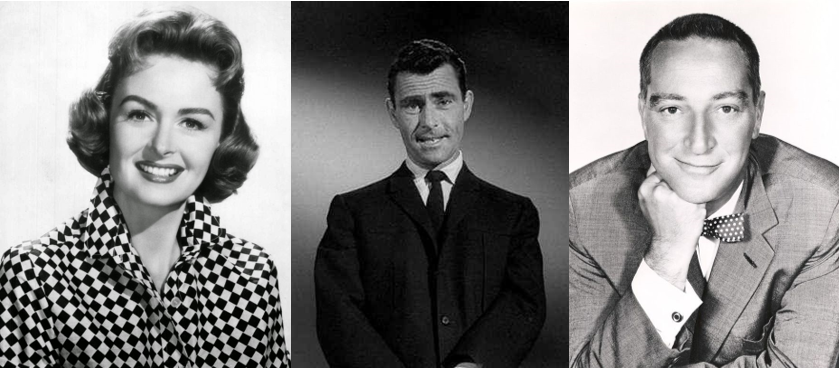
The TV Teletype crystal ball is working well this week. In Hollywood, Dan Jenkins reports that "NBC will continue to go along with the new Rowan and Martin comedy team, has scheduled them for six major guest appearances for this year." NBC will continue to stick with them—eight years later, they're the summer replacement for Dean Martin, and the following year they graduate to their very own series, Laugh-In. It runs until 1973. Also: "ABC has a situation-comedy format in mind for Donna Reed." Yup, that's The Donna Reed Show, which debuts in September 1958 and runs for eight successful seasons, until 1966.

There's more: "CBS is talking seriously to Rod Serling, wants him to produce as well as write an hour-long series next season dealing in fantasy and science fiction." That, of course, is The Twilight Zone, which ran from 1959 to 1964. From what I've read, it was Serling who originally wanted an hour-long series, but the network prevailed upon him to do a half-hour, and in time he came to see that it fit the format for TZ perfectly, so much so that he was not happy with CBS when they did expand the show to an hour. 

Things are looking up for them in the coming year.

Not to be ignored, at "Late and Exclusive," Burt Boyar says that "Garry Moore's desire [is] to emcee a variety show every week." Garry gets his wish; he's currently hosting I've Got a Secret in primetime and The Garry Moore Show Monday through Friday mornings, but in September of 1958 he'll end his morning show in favor of that hour-long variety show, which runs until 1964.

Not everything we see is a hit, though. Jenkins correctly reports that Johnny Desmond "is the leading candidate for the permanent love-interest in Joan Caulfield's Sally series." And Desmond does indeed get the role of Jim Kendall—for what it's worth. NBC's already considering cancellation of the series, which premiered in September 1957, as it's being devoured in the ratings by Maverick and The Jack Benny Program. Desmond's appearance as a regular is part of a retooling of the show's concept, but things don't improve; Sally is cancelled in March, meaning Johnny Desmond got to play his new role for all of seven episodes.

l  l  l

Starting in 1954, Steve Allen helmed his own NBC variety show which, at the beginning, aired opposite that of Ed Sullivan. It didn't run as long as Ed's, of course, but then Allen said his goal was never to conquer Ed, just to coexist with him, which he did for several seasons. Let's see who gets the best of the contest this week. 

Sullivan: Fredric March and Florence Eldridge are seen in an extended excerpt from "A Long Day's Journey into Night," by Eugene O' Neill. Other guests include Johnnie Ray, vocalist; the Everly Brothers, vocal due; Bambi Linn and Rod Alexander, dancers; the Vienna on Parade Orchestra": The Amandis, teeter-board act; Tex Barton and his horse, novelty act; Clifford Guest, ventriloquist. 

Allen (color): Steve's guests tonight include: Ward Bond and Robert Horton, of TV's Wagon Train; Xavier Cugat and his orchestra with songstress Abbe Lane; and Singer Sam Cooke and comedian Johnny Haymer. Tom Poston, Louis Nye.

I've mentioned before that Sullivan and Allen are really two different kinds of programs; while Ed's show is built around his guests, with him usually just the emcee, Steve is an active participant in a show that's maybe closer to Dean Martin or Carol Burnett, with sketch humor and regulars in addition to a smaller number of guests. So you ask yourself which of the two is likely to retain your interest for the whole show? One thing Ed could do, with his proximity to and influence with Broadway, is bring in top stars to perform scenes from their latest plays and musicals, and that's what we have with tonight's excerpt from "A Long Day's Journey into Night," which brings Broadway into the homes of people who may never visit New York. On the other hand, I'm not sure teeter boards, horses and ventriloquists are going to hold me for the rest of the hour. Steverino's got a pretty good lineup, so based on depth, I'll give Allen the advantage

However, I'll put in a good word as well for the show that follows Allen on Sunday: The Chevy Show (9:00 p.m., NBC), with comic actor Tom Ewell, dancer Shirley MacLaine, musical-comedy star John Raitt, and singing actress Anna Maria Alberghetti. If you just keep your dial tuned to NBC after Steve, you've got a pretty good couple of hours going. 

l  l  l

Let's see, what else is on this week?

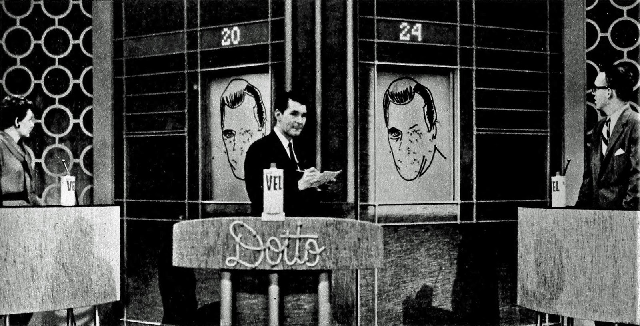
On Monday, it's the debut of the daytime quiz show Dotto (11:30 a.m., CBS), hosted by Jack Narz, in which questions are answered to connect the dots on a drawing; the first contestant to identify what the drawing is wins, and gets to continue against a new opponent. Now, you ought to recognize Dotto for a couple of reasons: first, while CBS continues to air the show in daytime, NBC will simultaneously begin broadcasting a weekly nighttime version beginning in July. You don't see one show on two different networks at the same time too often. Nor do you see a successful show—Dotto had become one of the most popular shows on television*—cancelled so abruptly, when both the daytime and nighttime versions are axed in August. The reason: a little thing about the results being fixed. No matter where we are in 1957 and 1958, we can't seem to keep from running into signs of the brewing scandal.

*According to the always-reliable Wikipedia, "On NBC's July 29 episode, a contestant on the show, actress and model Connie Hines had a telegram read on air with Columbia Pictures stating interest in her as an actress. Hines later became famous as Carol Post on the popular comedy Mister Ed."

I always enjoy nights when we see big stars appearing on the small screen, and Monday also has some fine ones: Bob Hope is on The Danny Thomas Show (9:00 p.m., CBS). He's Danny's guest star at a benefit charity show, and Danny begins to worry that Bob might overshadow him. (That's on opposite CBS's Twenty-One, and there's that scandal connection again!) Then, on Goodyear Theater (9:30 p.m., CBS), Jack Lemmon is the star of the story "The Victim," as a man who realizes he's being followed by two men shortly after the death of his wife. 

As an aficionado of MST3K, you can understand why Tuesday's Red Skelton Show (9:30 p.m., CBS) holds so much appeal for me. "Guests Lon Chaney, John Carradine, and Vici Raaf join Red in a 'mad scientist' sketch tonight. Henpecked George Appleby is thrown out of the house and ordered by his wife to get a job as a laboratory assistant to a pair of experimenting scientists (Chaney, Carradine). The two scientists are attempting the transplant of animal brains to human beings." If you've seen any of these movies, you know what's coming next.

I'm assuming most of you know who Parley Baer is, but maybe not? Sure, you've probably seen him as the mayor in The Andy Griffith Show, and you've probably heard him as Chester in the radio version of Gunsmoke (and you've probably eaten his cookies; he was the voice of Ernie the Elf in the Keebler commercials), but I think he might have been on literally every television and radio show ever made. (If you're ever listening to an old-time radio program and one of the actors sounds familiar, it's probably either William Conrad, Parley Baer, or Virginia Gregg.) Anyway, he's Darby, the Nelsons' neighbor, in Wednesday's episode of The Adventures of Ozzie and Harriet (Wednesday, 9:00 p.m., ABC). 


On Thursday, Jack Benny hosts the latest Shower of Stars (8:30 p.m., CBS), with guests Tommy Sands, Ed Wynn, Jo Stafford and Paul Weston, and the dance team of Chiquita and Johnson. (You've got to love those caricatures of Benny and Wynn by Hirschfeld.) If you're looking for something more substantial, check out Aaron Spelling's play "The Last Man" on Playhouse 90 (9:30 p.m., CBS), starring Sterling Hayden and Spelling's wife, Carolyn Jones. It's the story of a man whose wife dies in childbirth because a storekeeper delays in selling him the medicine that could save her life. Now he's settled down in the area, while planning his revenge. It's later made into the movie One Foot in Hell, which is probably a better description for the story.

Friday's Zane Grey Theater (8:30 p.m., CBS) features what could be called a Western version of Twelve Angry Men, but with a twist: the jury is deadlocked in the murder trial of a gunslinger, with eleven voting guilty and one innocent. But as the lone holdout tries to convince his fellow jurors, the gunman escapes. It's a strong cast, with Robert Ryan, David Janssen, and Harold J. Stone. That's followed by The Frank Sinatra Show (9:00 p.m., ABC), with Frank's guest Robert Mitchum. After that, Robert Taylor and George Murphy are the guest stars on The Thin Man (9:30 p.m,. NBC), with Peter Lawford and Phyllis Kirk as Nick and Nora Charles.

l  l  l

Finally—well, I don't know. Can you call Carol Channing a starlet in 1958? She's already been nominated for a Tony, appeared on the cover of both Life and Time, and spent several years working with George Burns. She's been in Gentlemen Prefer Blondes and Wonderful Town, and is a regular on television. But she hasn't been in Hello, Dolly! yet, the role that brings her international and everlasting fame. So maybe we'll put her somewhere in-between.

So let's end with Sheree North. Or, rather, Sheree North's diet. She's already become well-known as one of Marilyn Monroe's potential successors, and one of the reasons she's been able to succeed at such a wide variety of roles is the health food diet that allows her to vary her weight to between 102 and 148. It includes "nothing but unprocessed, unpreserved and unchemically-treated foods available at any health-food store." She augments it with supplements such as cashew-nut butter, almond paste, and malts. Dinner, for example, might consist of raw chopped vegetables, cooked vegetables, and a broiled steak or lamp chop, with molasses and lemon juice or cider vinegar and honey for refreshment. You'll notice that you don't see recipes for these kinds of things in TV Guide. Then again, there's nothing wrong with a good steak, as long as it comes with a loaded baked potato and a salad. We won't even discuss dessert. TV