Showing posts with label Local Stations. Show all posts

September 13, 2025

This week in TV Guide: September 16, 1978


This week TV Guide assembles its panel of experts to assess the chances of success for the 21 new shows on the Fall schedule. Those experts are four advertising executives heavily involved in steering sponsorship money to the new season's programs: Lou Dorkin of Dancer-Fitzgerald-Sample, Joel Segal of Ted Bates & Co., Inc., Michael Lepiner of Benton & Bowles Inc., and Paul Schulman of Gardner Advertising Companies. Collectively, they're responsible for committing "tens of millions of their clients' money to the new season's programs."

As usual, when I look at lists like this, I start at the bottom and work my way up, and as I looked at the bottom three (#21, People;  #20, The Paper Chase*; #19, Lifeline), I thought the critics had sized things up pretty well: People, a TV version of the magazine hosted by Phyllis George, made it through eight episodes; while Lifeline, a real-life documentary series focusing on a hospital ER, survived for 18 episodes spread over two seasons; meanwhile, The Paper Chase was an overrated series that was cancelled by CBS after one season and lasted for three additional seasons on PBS. So far, so good—or so bad, in this case.

*To its credit, Paper Chase, a show I always considered outrageously overrated, was admired by the panelists as "a quality effort" and a "touch of class." Of course, as anyone in the business can tell you, it's better to be popular than admired; while the series did make it through four seasons (including three on PBS), the praise given it amounts to little more than the Miss Congeniality award of the year.

But as I wound my way up the list, I began to wonder if those critics had really been as perceptive as I'd originally thought. There was Apple Pie at #18, The American Girls at #17, The Waverly Wonders* at #15, W.E.B. at #13, The Eddie Capra Mysteries at #11. None of these series scored higher than a one from any member of the panel, and given that one point meant "a marginal show that could survive but probably won't" (several of them received zeros, meaning "a natural-born loser"), I started to understand the unvarnished truth: the great majority of the new shows were, quite simply, bad. Continuing, there was Sword of Justice at #10, In the Beginning at #8, Mary at #5—was there no hope for this season?

*Supposedly, Larry Hagman was offered the choice between The Waverly Wonders, a sitcom in which he'd be the lead, and a prime-time drama where he would play an "unscrupulous and ruthless" character. He chose the latter, which was called Dallas, and attained television immortality. The lead in Waverly went to Joe Namath, who went on to demonstrate, over the course of four episodes, why he made the Hall of Fame as a football player.

There was a faint glimmer of light in Mork & Mindy, the #7 show, which runs for four seasons, the longest of any show outside the top four. That it didn't finish higher is understandable; three of the four panelists gave it a zero, and Dorkin calls it "strictly kid-stuff" and a "one-note gag." However, it also indicates that the panel either misjudged or didn't appreciate the magnetism of Robin Williams, which is perhaps understandable; a personality of his magnitude doesn't come along very often. To his credit, though, Schulman sees this as "the sleeper of the year." Dorkin was more positive about the #4 series, WKRP in Cincinnati; he ranks it "the comedy breakthrough of the season," and likes its chances even against NBC's Little House on the Prairie

Taxi
, at #3 on our list, is perhaps the most successful of all the season's new shows; it runs for five seasons over two different networks, and leaves with 18 Emmy Awards (including three for Best Comedy Series), along with a host of beloved characters. It doesn't hurt that it airs on ABC between Three's Company and Starsky & Hutch. There's no missing #2, though: Battlestar Galactica, which scores 11 out of a possible 12 points, not to mention a spot on this week's cover. It is, the panel agrees, the only new series that "is in any sense innovative," and it's been given a desirable spot on Sunday night, the most heavily-viewed night of the week. "It's bound to attract by the zillions kids and young adults who are famished for more Star Wars thrills and intergalactic derring-do." And it did, indeed, go on to become a multi-season success, although in order to do so it would have to wait 25 years to be rebooted on a cable network that didn't even exist in 1978. 

This brings us to the #1 show, one that is considered an absolutely, positively, guaranteed success. Each of our four critics gave the series a score of three points, which meant "a show that's a sure winner [that] is destined to be a front runner in the ratings." That show happens to be Vega$, starring Robert Urich, and while it was a solid success, running for three seasons and remains fondly remembered by many (not least because of Audrey Davis and Judy Landers), it's not quite the unqualified, long-running hit that one might have expected, particularly considering the prime scheduling slot it's been given, immediately following Charlie's Angels. However, given the shows we've seen in this list, it qualifies as an unqualified success.

If you're somewhat underwhelmed by what you've seen here, you're not alone. ABC's schedule, for example, is decried as "junk," "kiddy-porn," and "bubble-gum banality," yet it's also agreed that the network—and its highly successful programming—is now considered "the model for the other two networks who are transparently attempting to duplicate its success." It doesn't take long for the results to show; several of the new series are gone by November, including Mary Tyler Moore's Mary, which is pulled after four episodes at Mary's request. In case you're thinking that hope lies around the corner with the mid-season replacements, guess again: those replacements include Hello, Larry, Supertrain, Sweepstakes, and David Cassidy–Man Undercover, and The Stockard Channing Show. To be fair, though, it also includes The Dukes of Hazard and Diff'rent Strokes. But if you're thinking that this new season was pretty underwhelming, you're absolutely right. And to their credit, the panelists were pretty accurate in their predictions. But then, how could they not be, when most of what they had to choose from were bombs? 

l  l  l

Among those looking at the new season is our erstwhile critic, Robert MacKenzie. He's not offering any reviews, not yet anyway; too early for that, and some of these shows won't be on long enough to be reviewed anyway. Curiously, though, he sees a number of the 21 shows as "unusually promising"—on paper, at least. He likes the idea of Lifeline, and the rise of nonfiction television in general, although I suspect he might have had second thoughts had he seen these quasi-documentaries morph into unscripted "reality" television that, in reality, was anything but. He praises NBC's Fred Silverman for his commitment to "More prime-time news specials and documentaries," although perhaps their most interesting documentary would have been one explaining how a program like Supertrain gets greenlighted for the second season. 

He's also encouraged that television has finally come to realize that shows can be set in cities other than New York or Los Angeles, as evidenced by The Paper Chase (somewhere in the Northeast), Vega$ (Las Vegas), WKRP in Cincinnati (Cincinnati), and Battlestar Galactica (outer space). Just for good measure, he throws in W.E.B., a show that "threatens to take us inside the world of network broadcasting." (At five episodes, I wonder if he got a chance to review it?) Well, he does warn us that "This will not be a comedy, unless unintentionally."

As for what he terms "the Beach Blanket Bounce-off," those shows featuring girls dressed (or undressed) in bikinis, towels, and nighties, "The critic, no sexist he, will judge these series on their merits, with only proper attention to their charms."

Rest assured, though, that MacKenzie, as is the case with any good critic, is "free to draw the useful and happy distinction between good ratings and good television." It's not necessarily the case that never the twain shall meet, but, borrowing the royal "we" from our hero Cleve, "We plan to keep an open mind, a condition that is best maintained in a horizontal position," with the eyes closed and the feet up.

l  l  l

Back in the days when networks actually aired movies, one of the treats of the new season was seeing some of these blockbusters make their television premieres. And in an effort to get the maximum impact from these premieres, the networks are quite apt to do one of two things: add additional footage to expand the running time so the movies can be turned into two-parters; or remove footage so the movies can be shown on TV in the first place.

An example of the latter is The Bad News Bears (Friday, 9:00 p.m., ABC), which Judith Crist calls "one of the best kids' movies of recent years." Until, that is, the movie was "bowdlerized" by ABC. One of the movie's strengths, in addition to "top-notch" performances from Walter Matthau, Tatum O'Neal, and Jackie Earle Haley, was that "for once screen kids talked the way human kids do." Unfortunately, "the salty speech has been sugared for TV, even though 10 million kids will know the three little words that are missing from that tag line." More evidence, in case we needed it, that the kids are often a lot more advanced than the adults, which, in fact, would answer quite a few of the questions regarding how kids are brought up nowadays.

At the other end of the scale, we have two cases in which movies that were perhaps already too long are being made even longer, thanks to the addition of "additional" footage that was, mostly, culled from the cutting room floor. The wisdom of the film editors can easily be seen in Airport '77 (Tuesday and Wednesday, 9:00 p.m. each night, NBC), in which 70, count 'em 70, minutes have been added, 67 of them being outtakes, to, as Crist says, "pad out scenes." It doesn't add anything to a movie that has completely abandoned the airport premise of the first two films; "Not to worry, disaster and/or cliche lovers," Crist assures us; "all goes unsmoothly and there are some exciting air-sea rescue operations after the plan winds up at the bottom of the ocean in, no less, the Bermuda Triangle."

The other premiere to get the stretch treatment is the 1976 remake of King Kong (Saturday and Sunday, 9:00 p.m. each night, NBC), which has 65 minutes being added to the 134 minutes of the theatrical release, all of it outtakes. Alas, the new footage can't hide the reality: the charm of the original 1933 classic "is lost amid all the hydraulic manipulations and plastic. For those who don't know the original film, the new version can be a foolish entertainment. For those who do, it's a travesty."

One might think we'll fare better with movies that make it to the small screen more or less intact, but such is not the case of 1976's The Shootist (Tuesday, 9:00 p.m., CBS), with John Wayne, Jimmy Stewart, Lauren Bacall, and Ron Howard "wasted" in "a tediously pretentious and vapid melodrama about the last days of a 'legendary' killer." Wayne and Bacall emerge from the movie as "anachronistic antiques," in Crist's words. I happen to like The Shootist myself, but I'm willing to allow as to how this may be an example of a movie that ages well; part of its power, I think, comes from it being the Duke's last movie, and seen in the light of a dying actor in his final movie playing a dying gunman in his last hurrah, it takes on a resonance and emotional charge that it might not necessarily have had during its original viewing. Put another way, if Wayne had gone on to make five or six movies after The Shootist, would we remember it as fondly as we do?

Even old reliables aren't necessarily a guarantee of success; take Lassie: The New Beginning, another two-parter (this one a telemovie, so the padding is all intentional), airing Sunday at 7:00 p.m. on ABC, with the conclusion being shown next Sunday at the same time. It is, says Crist, "probably the worst of the nine theatrical films and innumerable TV-series episodes" since the original 1943 Lassie Come Home, and considering its plot—two kids faced, in part one alone, with "grandma's illness, a trek from Arizona to California to be dumped on an uncle who dislikes them, grandma's death, separation from Lassie, threats of an orphanage"—well, says Crist, "If I were a collie, I'd sue."

l  l  l

On weeks when we can, we'll match up two of the biggest rock shows of the era, NBC's The Midnight Special and the syndicated Don Kirshner's Rock Concert, and see who's better, who's best.

Kirshner: Harry Chapin, Tom Chapin, and Steve Chapin (all brothers) are joined by comic Gary Mule Deer and comedy group the New Untouchables. Music: "Taxi."

Special: Performances by R.E.O. Speedwagon, Little River Band, A Taste of Honey, Atlanta Rhythm Section, Climax Blues Band, and the Ozark Mountain Daredevils. Highlights include "Keep Pushin" (Speedwagon), "Reminiscing" (Little River Band", "Boogie Oogie Oogie" (Honey).

I don't suppose you'd call the Chapin brothers a "group," but this is a week of groups nonetheless. And when it comes to groups, Special has the best of the offerings. If you don't believe, me, just check out this performance of "Time for Me to Fly" by Speedwagon, and "Boogie Oogie Oogie" by A Taste of Honey. If that doesn't convince you that Special wins the day, nothing will.

l  l  l

What else is on this week? Well, we've already visited some of the biggest blockbusters of the week, those big-screen movies stretched over into two-part spectaculars, even if their increased running time doesn't justify their increased running time. However, hope remains.

Saturday sees the special one-hour sixth-season premiere of Good Times (8:00 p.m. ET, CBS), the first of a three-part story arc that features the return of Esther Rolle as Florida, the moral foundation of the series. To watch it, you'll have to pass up the second-season premiere of CHiPS (same time, NBC), which remains at an hour but offers up the tantalizing possibility that Jon and Ponch will leave the CHP for a future selling cars. Given that there's nothing in the promo material about the series changing its name, I think we can guess how this turns out. Brianne Leary joins the cast, and the special guest stars are a blast from the past, Troy Donahue and Kaye Stevens. Meanwhile, Captain Stubing finds himself marooned on a desert island after a three-hour cruise—that is, a two-hour season opener that includes the typical cast of stars, but really misses out on the opportunity for a Gilligan's Island reunion. 


We know all about Sunday, with part one of Lassie and part two of King Kong, but we've also got the three-hour premiere of Battlestar Galactica (8:00 p.m., ABC). I don't recall having watched this when it was on, although I could have: I was celebrating my second weekend in the Twin Cities after returning from exile in the World's Worst Town™. Amidst outer space and giant apes, though, there's another contender: the 30th Emmy Awards (8:30 p.m., CBS), hosted by Alan Alda; I know you're excited to find out the big winners, and so I won't keep you in suspense: All in the Family and the NBC miniseries Holocaust were the big winners, taking home six awards each, while The Rockford Files takes home the Best Drama award; however, the biggest award might go to the trio of Carter, Begin, and Sadat, who interrupted the broadcast for 30 minutes to announce the signing of the Camp David agreement.

Then as now, Mondays in the fall can mean only one thing, and that's Monday Night Football. For the season's third week, Frank, Howard and Dandy Don travel to Foxboro, Massachusetts, for the game between the Baltimore Colts, a bad team that used to be good, taking on the New England Patriots, a formerly bad team on the way to being good. (9:00 p.m., ABC) The Colts gallop to a 34-27 victory, but whether or not that's good is up to you. 

With Tuesday dominated by movies (Airport '77 on NBC, The Shootist on CBS), the burden for the night's variety falls on ABC. On Happy Days, a two-part story set in Colorado concludes with Fonzie entering a bull-riding contest to bail out a dude ranch. (8:00 p.m.) If Fonzie hadn't already jumped the shark, I suppose you could have said he's throwing the bull around; either way, it's a long way from the show's origins. Laverne & Shirley follows (8:30 p.m.), with a knock on the head turning Shirley into a stripper named Roxy. Happens all the time, in my experience. Janet and Chrissy take part in a liberation protest at a nude beach on Three's Company (9:00 p.m.); dare we suggest that they were—busted? On Taxi (9:30 p.m.), Tony gets a chance to match wits with a boxing champion, played by world welterweight champion Carlos Palomino. Does Tony get punchy over the encounter? And on Starsky & Hutch (10:00 p.m.), Starsky tries to track down Hutch before he succumbs to a deadly strain of botulism, a plot that leaves me wondering whether this is the most realistic storyline of the evening, or the least.
 
One of the tropes you can almost always count on at the beginning of a new season is the return of an old favorite to a show on which they were once a regular, and such is the case on Wednesday's Charlie's Angels (9:00 p.m., ABC), in which Farrah Fawcett-Majors reprises her role of Jill Munroe, who's somehow involved in trying to prevent the sabotage of a new racing car. We get a special guest star thrown in as part of the bargain, with former world driving champion Jackie Stewart appearing as himself. Call me crazy, but that's what makes this episode worth watching. We're also treated to the first of McLean Stevenson's two failed series this season, In the Beginning (8:30 p.m., CBS), in which he plays the stereotypical conservative priest confronted with a stereotypical liberal nun (Pricilla Lopez) for predictably stereotypical hijinks, which somehow manage to hang on for five, count 'em five, episodes.

Thursday opens with the seventh-season premiere of The Waltons (8:00 p.m., CBS), a special two-hour episode that works in a tribute to the memory of Will Geer (Grandpa), who died in April. It's also the opening of the seventh season for Barnaby Jones (10:00 p.m., CBS), as Buddy Ebsen tries to protect a murder witness targeted for extinction by the bad guys. Gretchen Corbett takes some time off from The Rockford Files to play the damsel in distress. And it's the second-season starter for Family (10:00 p.m., ABC), wtih Quinn Cummings, nominated for an Oscar for The Goodbye Girl, joining the cast.

It's the fourth-season opener for Donny & Marie (Friday, 8:00 p.m., ABC), which also introduces a new weekly disco segment. K.C. and the Sunshine Band help kick off the festivities, along with Olivia Newton-John and Bob Hope, who—I swear—never met a guest spot on a variety show that he didn't like. Still, it's preferable to the debut of The Waverly Wonders, the show which Larry Hagman passed up—remember?—in favor of Dallas. (8:00 p.m., NBC) In honor of Joe Namath's football background, the show airs for four episodes.

l  l  l

Finally, in the TV Update, Sally Bedell reports that the Fred Silverman era at NBC may be getting off to a rocky start. Over the last two years, ABC, flush with ratings success, has mounted a concerted effort to win over CBS and NBC affiliates. It was popularly thought that these efforts would be on hold for the time being while the affiliates measured Silverman's impact on the Peacock Network. However, less than three months into his term, the network was rocked by the departure of Minneapolis-St. Paul station KSTP, which announced it would be moving to ABC after 30 years as an NBC affiliate. Despite Silverman's plea to give him six months to turn things around, KSTP's owner, Stanley E. Hubbard, was adamant: "ABC's long-range potential for continuing [its] leadership was the deciding factor. We feel ABC is the strongest management team in broadcasting today."

For KSTP, the move means being able to take advantage of a powerhouse primetime lineup from the nation's number one network; for ABC, it hopes to double the audience of its evening news program, thanks to KSTP's top-rated news programs. For other affiliates considering a change, a network source is quoted as saying, "There is no question that the move will have a psychological impact." Hubbard added that while he didn't doubt that NBC's ratings would go up under Silverman, he didn't think it would happen in six months. Guess again; Silverman never does turn things around at the number three network, and he himself will be gone by 1981, setting up his own successful production company.

Living in the Twin Cities at the time, I remember when all this went down. It was indeed a shock to see KSTP, one of the original NBC affiliates, make the switch, and the surprises didn't end there; it was widely expected that NBC would, in turn, go to KMSP, the now-spurned ABC affiliate, but no—they instead chose WTCN, one of the nation's leading independent stations, leaving KMSP as the odd station out. In the end, they turned out all right; after a successful independent run themselves, they're now a Fox affiliate, with all the rights and privileges included (read: NFL football). Yes, as Carroll O'Connor and Jean Stapleton would say, those were, indeed, the days. TV


If you enjoy the content here and want to support my broader creative work, please consider making a donation at my Ko-fi page. Any amount you contribute helps me continue writing, researching, and sharing these articles and projects. Thank you!

October 26, 2024

This week in TV Guide: October 30, 1954


Robert Montgomery is a man of many talents: noted film actor, producer and director (including two nominations for Best Actor), Tony Award-winning director, twice president of the Screen Actors Guild, host and occasional star of Robert Montgomery Presents, one of the longest-running and most prestigeous of the early drama anthologies, and if that weren't enough, father of Elizabeth Montgomery. And now, add to that: presidential advisor. 

Late last year, Montgomery was invited by old friend Jim Hagerty—who also happens to be President Eisenhower's press secretary—to breakfast at the White House with Ike and a half-dozen other Republican operatives. They discussed effective communication on television; after breakfast, the meeting moved to the Oval Office. At the end, he was offered the position as a staff consultant to the president. The position includes an executive office in the White House, along with a secretary; he spends a couple of days a week at the job. 

Montgomery stresses that he is not, as he has been referred to in the press, Eisenhower's "coach." He hasn't tried to change or "glamorize" the president, or to change his gestures or mannerisms. "Mr. Eisenhower," he says, "is a public figure, not an actor. He has a right—and an obligation—to appear to the public as he is; not as someone else wants him to appear." His job, he says, is to "help project Mr. Eisenhower’s own personality and thoughts in as natural a manner as possible."

Montgomery spent three months studying the president's habits off-camera. "All right, these are the methods he, as an individual, ordinarily uses to convey what he wants to say." Montgomery's job is to incorporate those methods to television, to not worry about what he's been told to do, but to do what he finds easiest and most comfortable. When Eisenhower voiced concern about inconveniencing cameramen, Montgomery told him, "Whatever you want to do, Mr. President, do. It’s the technicians’ obligation to make you comfortable."

   The student and the teacher
Over the past year, Montgomery has worked to raise the lecturn when Eisenhower addresses Congress, so that Ike didn't have to bend over, and to give the television audience a better look at his face. He changed the president's glasses from heavy, horn-rimmed to a more flattering shape and lighter rims. When Montgomery noticed that Eisenhower frequently paced back and forth behind his desk and occasionally wen to the front to sit on the edge, he suggested that he do the same when making informal talks on TV. He had a layer of felt placed over the president's polished desktop to keep lights from reflecting into his eyes, and he coordinates the president's wardrobe to make sure it stands out from the backdrop from wherever he's speaking. He checks camera and light locations, does sound checks, and makes sure that stand-by cameras and audio are ready. He also recommend that Eisenhower use a teleprompter, but only on certain occasions; ideally, he uses a cue sheet with only about 40 words in his notes for a 30-minute speech. 

For all this, Montgomery accepts no salary or expenses. He considers working with the president to be "his most exciting assignment and the high point of his career." Mr. Eisenhower, he says, is a man of wisdom, ability, integrity, and modesty; "It’s important that these qualities be projected to the people who have elected ohim." He concludes, "If you believe so thoroughly in a man and his program, how much better can you do in point of service?" I think there are more than a few candidates out there who could benefit from Montgomery's council. 

l  l  l

Let's stay in the political arena; Tuesday is election day, and even though it's a mid-term election, with the presidency not at stake, all three networks plan to cover the vote-counting at least until control of both houses of Congress has been decied. 

Cronkite and crew during 1952 coverage 
On CBS (beginning at 9:00 p.m. ET), Walter Cronkite heads a team of veterans from the 1952 election, including Edward R. Murrow, Douglas Edwards, Charles Collingwood, Eric Sevaried, Ron Cochran, and others. Included is the Univac computer, "the electronic brain that calculates and projects the trends," first introduced with "some success" in 1952. The network plans cutaways to New York, Chicago, Los Angeles, and Washington D.C. 

Over at NBC (9:30 p.m.), Dave Garroway, "who can be counted on to remain cool amidst the most hectic proceedings," will anchor the coverage, aided by John Cameron Swayze, Roy Neal, David Brinkley, Joseph McCaffrey, Ray Scherer, and others. They'll have remotes from Republican and Democratic national headquarters. Both CBS and NBC will break for local updates for the last five minutes of each half-hour.

And then there's ABC. While WFIL, the ABC/DuMont affiliate in Philadelphia, plans to break into local programming to cover the results in the East, the network plans to deliver "complete nationwide returns" beginning at midnight, with John Daly anchoring from ABC's New York studios. It's ironic: even though ABC's news division was widely derided for most of its existence (at least up until the late 1970s), their mode of limited coverage of events such as political conventions and elections has become the norm for networks nowadays. Of course, that's not what they intended at the time . . . 

l  l  l

It's remarkable just how much you can talk about Barry Nelson without actually talking about Barry Nelson. What do I mean about that? Point #1: Nelson is on the cover of this week's issue, along with Joan Caulfield, with whom he co-stars Saturday nights on CBS in the sitcom My Favorite Husband. Now, if that show sounds familar to you, it's probably because My Favorite Husband was a radio comedy, airing from 1948 through 1951, starring Lucille Ball as a "slightly zany housewife" married to bank executive Richard Denning, and that series eventually evolved into I Love Lucy. While both the network and sponsor Jell-O wanted Denning to continue on the show when it moved to TV in 1951, Lucy insisted on casting Desi Arnaz as her on-screen husband. The show lost Jell-O as a sponsor, but gained television immortality, which I would figure as a pretty good trade-off. The actual My Favorite Husband, with the original radio premise, finally made it to TV in 1953 with Nelson and Caulfield, running for two-and-a-half seasons. That's a good-sized paragraph about Barry Nelson that actually has very little to do with him.

Point #2: Nine days prior to this issue—that is, October 21—Nelson starred in the third episode of the mystery anthology series Climax!, "Casino Royale," co-starring Peter Lorre and Linda Christian. If that sounds familiar to you, it should: it's based on the novel of the same name, written in 1953 by Ian Fleming, and Nelson plays Fleming's hero, James Bond. Yes, that James Bond. In this version, Bond is an American agent, working with a British contact named Clarence Leiter, to subdue arch villain Le Chiffre, played by Lorre. Nelson thereby became the first actor, of any nationality, to play Bond, and if he seems somewhat miscast in the role, I don't think he can be held to blame. (But you can watch it here and decide for yourself.) No adaptation that features "Jimmy Bond" is going to capture the essense of the Bond we've all come to know and love. Despite its proximity to the Climax broadcast, the TV Guide article doesn't even mention "Casino Royale." Granted, the Bond stories didn't really become popular in the United States until JFK mentioned how much he enjoyed them, but it's still funny to think of it flying so far under the radar.  That's two paragraphs about Barry Nelson, and still we haven't really talked about him.

So: we're told that Barry Nelson looks a lot like "an aging Tom Sawyer," but doesn't act like one. He's "actively intelligent," devoted to acting as a profession in which "he knows he is competent, hopes to improve, and works constantly toward bigger and better things." Following his discharge from the Army, he made his mark on the stage, culminating with three years on Broadway in "The Moon Is Blue." But "An actor can't afford to stay very long on Broadway," he says. "In order to become known, he must appear on the mass media—on television or in pictures." With that in mind, he made the move to TV and My Favorite Husband. He finds live television "too much of a grind" and calls the process "a dull, tedious business, but he says this without rancor or complaint—it is, for a professional actor, simply a fact.

Nelson maintained an active and varied career throughout his life: returning to Broadway as both actor and director (including a Tony nomination), was one of the regular panelists on To Tell the Truth, served as a host on NBC Radio's Monitor in the mid-60s, acted in several movies (including Airport and The Shining), and was a guest star on many television series, with his last coming in an episode of Murder, She Wrote in 1989. He died in 2007, shortly before his 90th birthday, with a pretty good career to his name. 

l  l  l

Speaking of television as we were—which is not surprising since this is a television website, after all—Frank De Blois is complaining that Hollywood movie studios are taking away too much talent from TV: female talent, to be specific. It's not surprising in a historical context, given that television in its early days was, by-and-large, populated either by former movie stars who'd maxed out their stardom, or up-and-coming talent looking to make it big in the movies. (There's also a select group of visionaries who, seeing television's potential, got into it early on, from the production side as well as acting. But since that doesn't fit into this story, we'll just pretend they don't exist.)

MGM, Paramount, RKO, and Columbia have already made off with "choice properties" who made their start on TV: Grace Kelly, Anne Francis, Rosemary Clooney, and Betsy Palmer, to name a few. For example, just two years ago, the future Princess of Monaco was one of the "bright stars" on television, having made her mark on Studio One, Suspense, and TV Playhouse. She then headed for Hollywood, promising to return to TV "after a picture or two." Since then, she's made High Noon, Mogambo, Dial M for Murder, and Rear Window, and she'll win a Best Actress Oscar for the about-to-be-released The Country Girl. I wouldn't look for her to return to television any time soon.

In retrospect, though, I'm not sure that Grace wasn't the exception, rather than the rule. Anne Francis had a hit in Forbidden Planet, but a diet of low-budget movies saw her return to television, which I think really suited her better. (Honey West, anyone?) Rosemary Clooney started out with Arthur Godfrey and Ed Sullivan, and had a smash with White Christmas, but that was it; her greatest success came as a recording star, with a few guest spots on TV. Likewise, Betsy Palmer is far better known as a regular on I've Got a Secret and The Today Show and for her appearances on stage; there is, of course, Friday the 13th, but that's a ways in the future. Other names, such as Rita Gam and Joanne Jordan, never achieved megaton stardom, and Eva Marie Saint (who'd win an Oscar for On the Waterfront and would win hearts in North by Northwest) never planned on a long-term film career; she preferred "a voice in her own future as an actress." Still, there's plenty of talent out there, and as long as they continue to succeed, Hollywood will continue to come calling.

l  l  l

It's a quiet week on the old tube, with election coverage being the dominant feature, but there's always something worth mentioning. For instance, on Saturday, the college football game of the week features a matchup from a time when the Ivy League was still relevant in major college football: Penn State at Penn, from Franklin Field in Philadelphia. (2:00 p.m., ABC) Penn State was well on its way to becoming the dominant team in the East, while Penn played a schedule that included teams like Army, Navy, Duke, and Notre Dame. Not a surprise that the Quakers would finish the season 0-9, losing to Penn State 35-13 in one of their better outings.

Sunday, Hallmark Hall of Fame (5:00 p.m., NBC) presents a story we'd probably never see today: "The Path to Peace," newspaper editor Horace "Go West, Young Man" Greeley's drive to have former Confederate President Jefferson Davis freed from federal prison. You'll notice that title again: reconcilation is always a path to peace, but unfortunately, too many people today seem to think that reconcilation only goes one way—theirs. Coincidentally, tonight's You Are There (6:30 p.m., CBS) tells the story of Abraham Lincoln's selection as the Republican candidate for president in 1860. 

Speaking of Robert Montgomery as we were, it would be wrong to neglect this Monday's Robert Montgomery Presents, "The Gentleman" (9:30 p.m., NBC), the story of "A man . . . obsessed with the way things used to be. Rather than accepting and appreciating the present, he sadly retreats to living his life in the past." It sounds like the story of this blog, doesn't it? Otherwise, Benny Goodman and his quintet have the joint jumping on (Sid) Caesar's Hour (8:00 p.m., NBC), with regulars Carl Reiner and Howard Morris.

Tuesday provides us with a final bit of politicking, albeit in a non-partisan vein; The Morning Show (7:00 a.m., CBS) presents a filmed message from President Eisenhower urging people to get out and vote, regardless of which party they support. For those of you too young to remember, there was a time when everyone voted on the same day unless they could demonstrate they'd be out of town on Election Day, in which case they got an absentee ballot. I kind of miss those days. . . Later, on The Garry Moore Show (10:00 a.m., CBS), Garry interviews his congressman, played by Durward Kirby.

On Wednesday, it's the second-ever episode of Disneyland (7:30 p.m., ABC), and Walt has a treat in store: the television premiere of Alice in Wonderland, the 1951 animated feature film with a wonderful list of voice talent, including Ed Wynn as the Mad Hatter, Sterling Holloway as the Cheshire Cat, Jerry Colonna as the March Hare, and J. Pat O'Malley as Tweedledum and Tweedlede. Sure, it's abridged, and it's shown in black-and-white, but it's probably still the best show on TV tonight.

Thursday's highlight can be seen on Climax!, the show that gave us "Casino Royale" a couple of weeks ago. This time, it's an adaptation of Lucille Fletcher's1943 radio thriller Sorry, Wrong Number (8:30 p.m., CBS), starring Shelley Winters in the role played by Agnes Moorhead in the original broadcast and, perhaps more famously, Barbara Stanwyck in the 1948 movie adaptation (for which Stanwyck was nominated for Best Actress). Fletcher, who also wrote the movie screenplay, did the television adaptation as well, so I have great confidence the quality remained high. (Orson Welles called the original "the greatest single radio script ever written.") Fun fact: the music for the TV version was composed by Fletcher's former husband, Bernard Herrmann.

We'll stick with radio—kind of—to end the week: on Friday's Today Show (7:00 a.m., NBC), Dave Garroway's guest is "the father of radio," Lee DeForest. It's said that they'll be discussing DeForest's lastest invention; now, I haven't found any info as to what that might have been, but I can imagine Garroway enjoying the interview immensely. Besides the fact he started on radio, he would have been fascinated by the science and technology of radio, not to mention the other areas in which DeForest worked.

l  l  l

At some point along the way we apparently decided to become a completely homogeneous culture. There are exceptions, of course, some natural resources and local landmarks unique to a given area, but for the most part we seem determined to make every city in every region of the country look identical—and identically bland—to every other city in every other region: the same chain stores in the same strip malls designed in the same architectural style.

Television, in its role as a mirror of culture, is no different. Thanks (?) to some of our streaming providers, it's now easy to check out local newscasts from various parts of the country, and I defy anyone to find substantial differences in the broadcasts: they use the same fonts, the same color schemes, the same types of intro music, the same style of logo, the same backdrop showing their respective city skylines (themselves becoming less and less distinctive). The anchors have the same, vaguley nondescript accents, they wear the same clothes (female anchors even share cute outfits online), and they read from virtually identical scripts. 

Of all the things that used to give a station its unique identity, the station-identification slide was one of the most distinctive. This week, TV Guide shares some of those slides from around the country, as stations show off their mascots, local landmarks, regional color, and more. 


Even after the artistic renditions became more sophisticated, station IDs maintained their distinctiveness. There were specialized versions for various holidays, photographs capturing seasonal representations of local landscapes, skylines, and the like. I don't even know if there are station ID slides anymore other than at the start of the local news; it seems as if we just go from one program to another, and heaven forbid we should take any time away from commercial opportunities. There's no use crying over spilt station logos; still, it does seem as if we've lost something, doesn't it? TV  

January 3, 2024

WCCO's Miracle on 9th Street, 1974 - local programming the way it should be


When I was growing up, and for many years thereafter, WCCO, the CBS affiliate in Minneapolis-St. Paul, was considered one of the best hard news stations in the United States, and one that took seriously the admonition to provide meaningful public affairs programming to the community. Over the years, the station won five Peabody awards for local programming, and produced documentaries on Vietnam, Northern Ireland, and other heavyweight topics, always looking at the Minnesota angle to the story.

They were also one of the few stations to use the Prime Time Access Rule for the purpose for which it was originally intended, at least for one night a week. Moore on Sunday, a kind of local 60 Minutes, featured in-depth providing the kind of in-depth reporting and commentary that we often say we want from our local stations yet seldom watch; the show ran for two decades and itself won a Peabody. The host of Moore on Sunday was Dave Moore, the legendary anchorman for WCCO from 1957 to 1991, a man who could project the gravitas that is missing so often in local news today.

And yet, that was In addition to being a newsman, Moore was also an amateur actor, occasionally appearing in local theaters. He usually expressed his natural haminess through The Bedtime Nooz, his satirical news spoof that ran late Saturday nights during the '60s and early '70s. However, on December 22, 1974, Moore on Sunday presented something quite extraordinary for a local public-affairs program: an original comedy-drama entitled Miracle on 9th Street.

Miracle on 9th Street (named after the then-location of WCCO's studios) displays the satire typical of The Bedtime Nooz, criticizing the commercialism of Christmas (including the station's own role in it), with wonderful over-the-top performances by weatherman Bud Kraehling as the evil toy manufacturer, Ron Meshbesher, one of the Twin Cities' most prominent attorneys, playing himself as Kris Kringle's defense attorney, and real-life members of WCCO's news team (reporter Rod Challenger, commentator Al Austin, and station manager Sherm Headley). It's filled with inside jokes aimed at Minnesotans of the era, but the gist of the story is as timeless as the movie it spoofs, Miracle on 34th Street. Most of all, it's Moore's portrayal of Kris Kringle, a mix of off-the-wall comedy and poignant warmth, that carries the day.

The story, in a nutshell: Kris Kringle is an elderly man (with white hair and beard), stranded in the Twin Cities when his Amtrak train is forced to layover due to budget cuts. Meanwhile, at the studios of WCCO, the director of a local kids' show is forced to scramble when the announcer scheduled to play Santa (John Gallos) is injured after a picture of Laurel and Hardy falls on his head, knocking him out.* Seeing Kris passing by the studio, the director begs him to substitute for the injured Gallos and play Santa. All he has to do is give each child in the studio audience a toy from the Tuffy Toy Company. 

*The video showing Gallos being hit by the picture is real, having happened while Gallos was hosting the weekly Laurel & Hardy show. It was one of the Twin Cities' most well-known bloopers.

Everything proceeds according to plan until, while giving one of the children a toy robot, Kris notices how poorly made and potentially dangerous the toy is, and calls out Tuffy Toys on the air. The owner of the company, Hiram Blye (Kraehling), is outraged by Kris's criticism of his company, and promptly files a $1 million slander suit against WCCO and Kris, a case that is due to go to trial just before Christmas.

Much as the original Miracle on 34th Street, Miracle on 9th Street functions on multiple levels, eschewing sentimentality in favor of a comedic/satiric parody. In the case of 9th Street, the satire is mostly expressed inwardly, as a spoof of the television business: the director consulting a notebook to make sure he uses the right technical jargon, the banal questions asked by reporters, and most of all the kowtowing to station sponsors. Moore and Kraehling do double-duty, playing themselves during the WCCO newscast as well as their characters in the story, in scenes that are shot on tape, using WCCO's actual news set and graphics. (Imagine today's local anchors deigning to do the same.) In one memorable scene that could have come straight out of The Bedtime Nooz, WCCO reporter Rod Challenger is doing his standup in front of the Hennepin County Government Center when a beautiful young woman walks past him. The cameraman ignores Challenger entirely, following the woman as she continues walking, returning to Challenger only when the annoyed reporter stops talking.

One of my favorite moments occurs later in the report, when Challenger interviews Kringle as part of his story:

Voiceover: During an interview, we asked Kringle what he thought his chances were of being acquitted in the million-dollar libel action scheduled to begin tomorrow in Hennepin County District Court.

Challenger: Mr. Kringle, what do you think your chances are of being acquitted in the million-dollar libel action scheduled to begin tomorrow in Hennepin County District Court?

Kringle: Oh, not bad.

Later, Challenger notes how, with three days to go until Christmas, defense attorney Meshbesher requests a delay in the proceedings "so that his client could attend to some important prior commitments," business that Kringle was reluctant to discuss it in open court "for fear people would laugh." The judge invites Kringle to approach the bench to explain it in confidence; Kringle does so, but "the judge laughed and denied the motion." As Challenger does the voiceover, the report is accompanied by sketches from a courtroom artist (cameras in the courtroom being decades away).

Al Austin, WCCO's editorial journalist and investigative reporter, also has fun spoofing his well-known liberal views, attacking the "powerful Toy Lobby in Washington" in an almost word-for-word parody of his frequent gun control commentaries, simply replacing the word "guns" with "toys." Austin slams dangerous toys as "cheap Saturday morning specials," and concludes with his call that "all toys should be registered." We then see Blye, who has just viewed Austin's editorial, calling the station's editorial feedback line, identifying himself as an "average" viewer and going on to refer to Austin as "a no-good, filthy, pinko, radical idiot." Such satire is the equal of anything in Miracle on 34th Street, all the more amazing because it's being done by the very industry and personalities it targets. 

*Pretty much the same thing my mother called him every time he delivered one of his editorials.

I enjoy this for so many reasons: the multi-leveled satire, the attention to detail in the faux news reports, the in-jokes that Minnesotans would get but that aren't necessary in order to appreciate the show. Most of all, I marvel at the idea of a half-hour comedy being done by a local station, using the station's own personnel, on a public affairs program produced by that same local station. It shows the kind of commitment to the community that the FCC valued so highly back in the day, and which is so lacking now—just like the kids' shows, local movie hosts, and variety shows that have almost entirely bitten the dust. And it isn't even the only time WCCO did something like this; among others, there was One Who Stole at Christmas in 1982 and The Gift of the Magi in 1984.

At a time when informercials and syndicated garbage take up non-network hours and some local stations are shuttering their news operations, it's good to take a look back at the way stations used to operate. Will we ever see anything ljke it again? TV  

February 5, 2022

This week in TV Guide: February 7, 1981

Xere's Jane Seymour, looking not at all like the future Dr. Quinn, but with a bit of a slutty, come-hither appearance to her, quite consistent with the role she's playing in ABC's three-part miniseries, East of Eden (starting Sunday, 7:00 p.m.)And for those who think we don't need another version of John Steinbeck's classic, especially when we have one with James Dean in it, TV Guide assures us that we do—this one is "more faithful to Steinbeck," and Seymour, as the "Satanic siren" Cathy Ames, is a major attraction.

In Bill Davidson's profile, Seymour (real name: Joyce Penelope Wilhelmina Frankenberg) confesses she likes "evil parts," as did Barbara Stanwyck, Bette Davis and Joan Crawford. She's just now coming into her own as an actress; despite her appearance as a Bond Girl in Roger Moore's 007 debut Live and Let Die, her most recent fame comes from her Emmy-nominated turn in Captains and the Kings, followed by another miniseries, Seventh Avenue. With East of Eden, she's ready to cement her status as "Queen of the Miniseries." And this is before appearing in War and Remembrance.

Perhaps her fame today rests on her ability to sell jewelry, but Jane Seymour has come a long way from being mistaken for one of Henry VIII's wives.

l  l  l

There's another movie on this week, CBS's A Gun in the House (Wednesday, 8:00 p.m.), starring Sally Struthers, and that's the subject of this week's editorial. As one might imagine from the title, there's a gun involved in the story, and it's the violence surrounding the gun that's attracted TV Guide's "anger and disgust." "Television drama," Merrill Panitt writes, "had gone too far again, in pursuit of a Serious Issue." Surprisingly, given the movie's title and TV Guide's political leanings, the Issue is not gun control, at least as far as this editorial goes.

In the movie Struthers plays a woman terrorized by two robber-rapists who resorts to a gun "only when she has good reason to believe it is her only chance to avoid being raped and possibly murdered." So far, so good. "But the script establishes this by offering scenes of prime-time soft-core sadism that go considerably beyond the artistic requirements of showing a woman who fears for her life." To cite one extreme example, "Was it really necessary for the would-be rapist to pour pear brandy over the head of his intended victim? Two glasses of pear brandy? (What is this, 9½ Weeks?) And then force her to wipe the floor with her body?" Ooh, kinky. Too bad Jane Seymour wasn't available for the role.

But I get what Panitt is saying here. It sounds campy today (and even he described it as blackly humorous), but over thirty years ago, something like this quite possibly would have earned a theatrical release an R rating. And, in fact, what does it have to do with the main story? Are the writers trying to establish the rapist as a sadistic, possibly psychotic, criminal? It is, as Panitt says, "an excuse for scenes of gratuitous nastiness."

The point, the editorial concludes, is that scenes like this aren't necessary. "For lessons on how to create terror without sleaze, they should see any movie of Hitchcock's."* But in this case, it was business as usual for the writers, who simply followed the maxim of "hasty TV writing" that "tastelessness is a shortcut to powerful effects."

*Notwithstanding that Hitch received much of the same criticism for a movie called Psycho.

It isn't just Panitt feeling that way, though. Judith Crist's review calls it a "simple-minded" movie that winds up "exploiting sex and violence," is more interested in "sadistic perversions," and "loses all its credibility with the introduction of a near-manic district attorney and Struthers' being left to solve her own case." Says Crist, "It's true that social-issue movies need juicing-up to hold the viewer, but lascivious drool isn't the lubricant."

l  l  l

And now a local note: I've had occasion in these reviews to allude to the Great Affiliate Switch of 1979, in which three of the Twin Cities' four commercial stations changed their affiliation, with KSTP switching from NBC to ABC; WTCN teaming with NBC instead of being an independent; and KMSP, the former ABC affiliate, winding up with the short end of the stick, becoming the new independent.

Or maybe things didn't turn out so bad after all.


l  l  l

As I said a couple of weeks ago, I'm not going to take up space with another of my gratuitous shots at what's become of the Hallmark Hall of Fame—I mean, it's like catching fish in a barrel, isn't it? Instead, I'm just going to concentrate on this week's presentation, the one-man show Mister Lincoln (Monday, 9:00 p.m., PBS), starring Roy Dotrice and taped at Ford's Theatre in Washington, D.C.

The broadcast is one of three that appear this season on PBS*, the other two being Casey Stengel, another one-man show with Charles Durning, and Dear Liar, a two-person play with Jane Alexander and Edward Herrmann. It's one of the Hall of Fame's most interesting recent seasons, the only one since 1979 in which the presentations were staged as plays rather than movies. As for Mister Lincoln, I recall having seen this when it was first broadcast. Dotrice, an English actor known as a man of many faces, is a most convincing Abraham Lincoln, and TV Guide's description of his "stirring reading of the Gettysburg Address" is no exaggeration. This is one of the few instances in which Hall of Fame was done before a live audience, and at the end of that reading the audience burst into spontaneous applause. But here—see for yourself. The Address comes about an hour and 10 minutes in.


*Somewhat disingenuously, back when PBS still pretended to be commercial-free, these presentations were simply called the Hall of Fame, with Hallmark providing the grant.  Today, using the full title would hardly be an issue. 

There's also a nice article by Herbert Mitgang, author of the play, putting Lincoln's life in context and debunking many of the myths that have grown up around him, such as his being a hick lawyer, and that he opposed racial equality. TV Guide would do this from time to time under the label "Background," with an article, often by an outside expert, providing added information regarding one of the more significant programs being shown during the week.

l  l  l

A warning, though—if you want to see Mister Lincoln, you're going to have to pass up part two of East of Eden (8:00 p.m., ABC), and the remake of the Doris Day movie Midnight Lace (8:00 p.m., NBC), starring Mary Francis Crosby in Dodo's role. Capitalizing on the whole Dallas angle, the teaser proclaims, "She Shot J.R. Now Who's Trying To Kill Her?"

That's the way of it during Sweeps Weeks of course, and February has long been known for the networks packing as much star power into their programming as possible. East of Eden has it particularly hard; not only does it go up against Midnight Lace on Monday and A Gun in the House on Wednesday, its Sunday night premiere has to face NBC's three-hour docudrama Kent State (7:00 p.m.), which Crist calls a "stunning film [that] allows us our individual judgment but, more important, does not allow us to forget."

And that's not all. Both Kent State and East of Eden have some real competition with the week's other blockbuster movie, Burt Reynolds' Hooper (7:00 p.m., CBS), co-starring Sally Field and Jan-Michael Vincent. It was one of the big box-office hits of 1978, and Crist's favorable review describes it as "wonderfully rowdy, funny and on occasion touching."

On the other hand, all this week Family Feud features competition between Miss USA and Miss Universe. I don't suppose that has anything to do with Sweeps, do you?

l  l  l

What else is on this week?

With Howard Hesseman's death last week, there's only one choice for Saturday: a special one-hour edition of WKRP in Cincinnati (7:00 p.m., CBS) in which Johnny Fever moonlights as a TV disco host. 

On Sunday night, it's part 6 of one of the most popular Masterpiece Theatre stories of the '80s, Danger UXB (8:00 p.m., PBS), the story of a bomb disposal unit during World War II. I must admit I never saw an episode of it, but I hear it was a blast.

With all the sensationalism on Monday's shows, it's nice to know you can depend on a wholesome family drama like The White Shadow (7:00 p.m., CBS). Tonight: "Falahey's girl friend is young, pretty, and pregnant!" Never mind.

TV Update reports that Fred Silverman's job as programming boss at NBC is in jeopardy, and we might have a glimpse into why by looking at the network's Tuesday night lineup. Whereas top-rated ABC has Happy Days, Laverne & Shirley, Three's Company, Too Close for Comfort, and Hart to Hart, NBC counters with Lobo, BJ and the Bear, and Flamingo Road. Maybe that's it, or maybe it's something else?

Wednesday
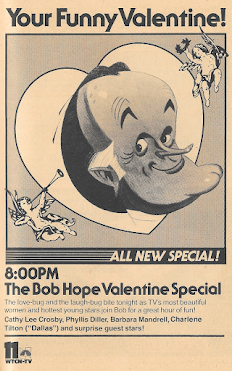
, NBC presents The Bob Hope Valentine Special (8:00 p.m.), with the usual lineup of beauties: Cathy Lee Crosby, Barbara Mandrell, Charlene Tilton, and, of course, Phyllis Diller—plus "surprise guest stars!" The listing mentions Dr. Joyce Brothers, but I can't believe that's all, can you?

Thursday NBC rolls out a brand-new series, The Gangster Chronicles, starring Joe Penny, Michael Nouri, and Brian Benben, with a three-hour premiere. This was later repackaged into movie form as Gangster Wars. The series itself runs for 13 episodes, after which it's edited down into a 121-minute VHS presentation also called Gangster Wars. Confused? So am I.

I'm also a bit confused by Friday's movie Inmates: A Love Story (8:00 p.m., ABC), starring Perry King (Joe Penny's old running mate from the series Riptide) and Kate Jackson as residents of an experimental co-ed prison (!) who fall in love. Gee, who could have seen that coming? Fortunately, Judith Crist reports that it wasn't made available for preview.

l  l  l

As I was running through those blockbuster Sweeps matchups, I wondered how much any of this would mean to younger viewers, those who've grown up with DVRs and streaming video. I mean, when you can record a half-dozen or shows at once, or go to your computer and watch a show any time you want, what difference does it make if there are two or three good ones simultaneously?

Remember, though, that this particular electronic age is in its infancy right now. I was reminded by an ad that appeared just before the programming section. It was for Audio King, an electronics chain that was big in the Twin Cities at the time. It asks you to imagine the absolute wonder of being able to play a television program over again and again.

But be forewarned: this technical marvel will cost you. The top-of-the-line MGA HS300U features infrared remote control, speed search, slow motion and a 7-day timer, all for $1,450. If that's a little too rich for you, there's the Hitachi—it's compact and easily programmable, and only sets you back $1,250. And for those of you on a budget, JVC has a two-speed model that still offers remote control, still-frame and slow motion for $950.

These are all in the VHS format, but don't forget there's another player in the field. An ad for Video Images offers you your favorite movies and television shows on either VHS or Beta! And when you buy three, you'll get a fourth title free! What a deal! And free with your order, you'll get their giant video catalog with "over 400 all-time favorite TV shows, feature films, cartoons, etc!" (That should just about cover it all.) The cost?  Well, each Beta is $39.95, while VHS runs you $42.95. And to think - today you can get a movie on DVD, a far-superior format, out of the bin at Walmart for a buck.*

*And you can download to your laptop or the cloud and not even have to have it physically in your possession. How far we've come.

With prices like that, it's no wonder people are still complaining that they always put all the good shows on at the same time. TV  

October 8, 2021

Around the dial


At bare-bones e-zine, Jack's Hitchcock Project continues to look at the work of Joel Murcott; this week, it's the third-season episode "Death Sentence," a nasty little piece of work starring James Best, Steve Brodie, and Katharine Warren. 

John returns to the 1970s action series The Professionals at Cult TV Blog, taking us all the way back to "Long Shot," the series' second episode to be filmed (although it aired later in the season), and along the way he wonders just how "real" the show is supposed to be. Good question.

Fire-Breathing Dimetroden Time has been surveying the tenth season of the new Doctor Who, and this week comes up to "The Doctor Falls," featuring the always-reliable Cybermen. I have to admit I've long-since given up on the new version; Peter Capaldi's Doctor, whom we see here, is as far as I'll go.

At A Shroud of Thoughts, Terence takes a look at Desi Arnaz and his work on I Love Lucy. We always talk about Lucy, but Desi was a true trailblazer: the first Latino to star in an American sitcom, and thus the first mixed marriage to be shown on American TV.

At The Hits Just Keep on Comin', JB takes a wonderful look back at the marvels of local television, from Chicago's The Prize Movie With Ione to kids' shows to Dialing for Dollars. As the world has become more homogeneous, so has TV—and we lose these lovely little things.

Television Obscurities commemorates the 75th anniversary of Faraway Hill, the first prime time soap opera on network TV, and laments that, as is so often the case with early television, we know so little about a series that presaged so much.

Speaking of which, in a very good review of the career of the Ink Sports, Gary at Soulride drops a couple of fascinating classic TV tidbits: that the Ink Spots first appeared on TV on November 6, 1936, making them the first performers (of any color) to appear on live TV; and that in the same program, Eddie Albert appeared in a drama he wrote called “The Love Nest”, the first original drama to ever be presented on live television. The program in question was an NBC/RCA TV Demonstration: the first live TV demonstration in history. TV