Showing posts with label Olympics. Show all posts

February 27, 2026

Around the dial


Remember the sitcom Angie? I do, although I'd have to be prompted for it; it's not the kind of show I'd think about casually. But David remembers it, and at Comfort TV, he gives us five reasons the show didn't last longer, despite having a lot going for it.

At Cult TV Blog, the Tony Wright Season continues, with John looking at the 1968 Avengers episode "Whoever Shot Poor George Oblique Stroke XR40?" I just saw this episode a couple of weeks ago, in fact; it has some very funny lines about treating a computer like a human.

At RealWeegieMidget Reviews, Gill remembers Catherine O'Hara and Bud Cort with a pair of "cautionary tales with a twist," with O'Hara in "I'll Die Loving," from Really Weird Tales; and Cort in the Twilight Zone revival episode "The Trunk." 

Now, this isn't television related, but you don't think I'm going to pass up a post titled, "Everybody was Kung Fu Fighting...Vampires!" do you? That's the brilliant header for Rick's post on The Legend of the 7 Golden Vampires, aka The Seven Brothers Meet Dracula, at Classic Film & TV Cafe.

Roger continues his look at The A-Team at The View from the Junkyard, with "Trouble on Wheels," which finds our heroes dealing with a stolen car parts ring that quickly escalates into kidnapping, torture, and more. 

Another of our beloved figures from the past has passed on: Lauren Chapin, Kitten from Father Knows Best, who died of cancer aged 80. At A Shroud of Thoughts, Terence looks back at a career that may have been short, but also made her a lot of fans.

Martin Grams looks at the comic book series Sergeant Preston of the Yukon, based on the radio series, which itself wound up moving to television. Ah, for the days of simple adventures like this on television!

The Winter Olympics may be over for another four years, but they're not forgotten: Garry Berman gives us a brief history of the winter games on American television, starting with 1960 and the broadcasts from Squaw Valley. I don't watch them anymore, but back in the day, they were great fun, especially on ABC. TV


If you enjoy the content here and want to support my broader creative work, please consider making a donation at my Ko-fi page. Any amount you contribute helps me continue writing, researching, and sharing these articles and projects. Thank you!

August 16, 2025

This week in TV Guide: August 19, 1972


When last we visited Miami Beach, the Sun and Fun Capital of the World, it was for the most entertaining stretch of television since Jackie Gleason and the June Taylor Dancers were in town. I speak, of course, of last month's Democratic National Convention, otherwise known as the Circular Firing Squad, otherwise known as the convention where their nominee for president gave his acceptance speech at 3:00 a.m. Eastern time. "They blew that terribly," Walter Cronkite tells Richard K. Doan and Neil Hickey in this week's story previewing this week's Republican Convention, to be held in the same city. "I think it must have hurt them a great deal."

The Republicans take their turn in Miami Beach determined not to repeat the Democrats' mistakes of 1968 and 1972. Their solution: what may be the first purely made-for-TV convention. One Republican strategist puts it succinctly: "It's be short and sweet and to the point. And it'll be a whole new kind of TV show, different even from our own conventions of the past." After all, they only have two things to accomplish: "to nominate Richard Nixon in prime time, and to get those delegates in bed each night before midnight." As David Brinkley says, "This one will be even more difficult for us than the Democrats' because there will be fewer surprises, less suspense, and less to talk about." 

The differences will be noticeable even before the gavel drops; unlike most modern-day conventions, this one is scheduled for three days rather than four. The convention floor itself will be less cramped, with the Republicans having only 1,348 delegates as opposed to 3,016 for the Democrats. The platform and credentials procedures are scheduled for afternoon sessions, rather than in prime time. To liven things up, three giant video screens have been installed around the convention hall to provide slide shows and films for viewers, including three short films by documentarian David L. Wolper. And because ABC is once again forsaking gavel-to-gavel coverage, major speeches won't be scheduled until after 9:30 p.m., to make sure they appear on all three networks. Says Fred Rheinstein, who oversees the party's television and radio arrangements, "If the convention has a good look and is visually effective and interesting without seeming manipulated—which it will not be—then I've succeeded."
   
The convention itself kicks off Monday night with a speech by temporary convention chairman, Ronald Reagan, thought to be a kind of consolation prize since he was obviously finished as a presidential hopeful; followed by a speech from GOP Chairman Bob Dole (who was old even then). Tuesday night Nixon's name is placed in nomination by another old adversary, New York Governor Nelson Rockefeller. And then on Wednesday night Vice President Spiro Agnew delivers his acceptance speech, leading into Nixon's own speech. Everything ends by 11:00 p.m., or close to it, and everyone goes home happy. In November, Nixon wins 49 out of 50 states, garnering nearly 61 percent of the popular vote. Less than two years later, he'll be out of politics. Such are the vagaries of politics, after all.

l  l  l

I should have warned you that this was going to be a political issue; in the first of three parts, Edith Efron takes a look at the state of blacks in broadcasting. Namely, why are there so few, and what's being done about it. 

Considering we're only going to get one-third of the story this week, a top-level overview is probably the best way to take it. Examination of the problem begins with the Congressional Black Causus; their investigation sugggests that the black community is "grossly excluded, distorted, mishandled and exploited by the white-controlled news media," and that "black people are systematically excluded from employment at most levels in newspapers, radio and television stations, though token nubers are to be found." Furthermore, the white media have "failed miserably" at honest reporting in the day-to-day news from the black community. In other words, Efron summarizes, "the hiring-promotion-and firing proces is racist, and that news coverage is racist."

Somewhat interestingly, Efron decides to investigate rather than simply take the words of black groups that the discrimination is intentional and racially motivated. The people she talks to at the station level, mostly heads of network-owned and operated stations, offer various perspectives on increasing black representation in the newsroom. Robert Hocking, at WCBS, says that it's difficult to train people in these "complex jobs"; thus, they tend to rely on those who've already received training. They're also moving to increase hiring in the sales area, since "most stations get management people through sales." Across the board, they agree that although the numbers are still low, major strides are being made.

Howard University professor Samuel Yette, the "self-appointed" spokesman for the black journalists, contends that the increase in hiring is largely "pacification, not unlike other pacification measures aimed at blacks during the last decade." To which a white editor replies, "Do you realize what he's saying? He's saying we're racists if we don't hire blacks—and that we're racists if we do hire blacks." One top decision-maker explains the complexities involved. The bottom line is "protecting the station license," and everything is measured against that. If you hire too many blacks, you face the public calling you "the black station." If you hire too many inexperienced blacks, "the work begins to sink." If you put too many in the sales department, "those people in the ad agencies [may] take their business elsewhere." Most important for the credibility of the station, "How many blacks without real managerial experience can you put in decision-making jobs before they bankrupt you." At the same time, he acknowledges a double-standard. "Our staff is loaded with white mediocrities. Every staff is loaded with white mediocrities. But we're used to white mediocrity. When it's a black mediocrity, it feels as if somebody forced him down your craw. I grant you, it's racism."

The bottom line, Efron says in the conclusion to part one of the story, is that Yette's analysis, "couched in 'master-slave' language, is seeing the situation from the 'outside.'" Station managers and executives look at the same problem from the "inside." What does it add up to? Black unpreparedness due to historical racism is a reality; but contemporary efforts to fix the situation are also a reality; but continuing racism in the industry is also a reality. Which is the dominant one? What they all agree on is that there is a problem. 

l  l  l

Surely there must be something available for anyone not in the political frame of mind. And even with the Convention taking up three nights, there's a little something for everyone.

Football season will be here before you know it, and on Saturday, NBC airs a prime-time pre-season matchup between the Raiders and Rams from Los Angeles. (8:00 p.m.) For those of you trying to keep track of these things, this pits a team that would move from Oakland to Los Angeles and then back to Oakland and finally to Las Vegas, against a team that had moved to Los Angeles from Cleveland and would eventually move to St. Louis, and then back to Los Angeles. At one point both teams played in Los Angeles at the same time. After all that, who cares who wins?

Sunday
includes what's sure to be a controversial episode of William F. Buckley Jr.'s Firing Line (PBS, 7:00 p.m.), as Buckley welcomes the controversil psychologist ◄ B.F. Skinner, discussing his book Beyond Freedom and Dignity. (You can see it here.) Among other things, Skinner advocaters that "man be controlled and conditioned to serve group interests." I'm not entirely sure about this, but I think Skinner might have wound up as head of the Centers for Disease Control; he certainly sounds like it. Either that, or he's a distant relative of Anthony Fauci. And speaking of programs with a modern theme, Darren McGavin stars as the defendant on "The Lawyers" segement of The Bold Ones (9:00 p.m., NBC). He admits causing $50,000 worth of damage to a private investigating firm: but it turns out the firm had complied a secret dossier on him that cost him his job, his marriage, and his reputation. The script, which won an Emmy following the original broadcast, was entered in the Congressional Record. Today, the firm that compiled the dossier would probably get a government contract. (According to IMDb, the information they gathered was erroneous, which guarantees they'd get the contract.)

With convention coverage starting on Monday, our pickings are going to begin getting a little slim, unless you're a political junkie as I was when I was that age. Rowan and Martin's Laugh-In (6:30 p.m., NBC) has an all-sports rerun, featuring Rams quarterback Roman Gabriel, whom you might have seen in the game Saturday, and cameos from Vida Blue, Andy Granatelli, Sugar Ray Robinson, Bill Russell, Doug Sanders, Vin Scully and Willie Shoemaker. Nice show. For those of a musical vein, the 1971 Montreaux Jazz Festival is featured on PBS (7:00 p.m.), and ABC—making good use of their extra 90 minutes before joining the convention in progress—repeats the pilot for the upcoming series The Rookies (7:00 p.m.), with Darren McGavin as Sergeant Ryker, a role that will be played in the fall by Gerald S. O'Loughlin, and Jennifer Billingsley as Danko, who will be played by Kate Jackson in the series.

It's the annual NBC telecast of the Ice Follies on Tuesday (6:30 p.m.), and this year Snoopy and his creator, Charles M. Schulz, are the headliners. On a repeat of The Mod Squad (6:30 p.m., ABC) has Andy Griffith as a man facing death threats after his testimony puts away a killer. And on Marcus Welby, M.D. (7:30 p.m., ABC), Gary Collins plays a hard-nosed father whose tough discipline is making things worse for his son; I'd bet on Dr. Welby against any bully. The GOP Convention wraps up on Wednesday, as does Steve Allen's stint as guest host (along with wife Jayne Meadows) on The Dick Cavett Show (11:30 p.m., ABC). Different time, same situation: Joey Bishop is guest host on The Tonight Show (10:30 p.m., NBC). Unlike the Democratic Convention, which saw sessions running until 6:00 a.m., the talk shows are in no danger of being pre-empted by the GOP. 

Thursday is a night of specials on ABC, topped off by a series' "best show of the season." It starts at 7:00 p.m. with Kid Power, a prime-time preview of a new Rankin-Bass Saturday morning animated series that begins next month. It's based on the "Wee Pals" comic strip, focusing on a multicultural group of youngsters sharing thougths on "prejudice, teamwork and responsiblity." A total of 17 episodes are made. That's followed at 7:30 by a "fast-paced" concert starring Three Dog Night with special guest Roberta Flack, and it had better be fast-paced since they're going to fit six songs into a half-hour (minus commercials). But I know; songs were shorter back then, and why not? At 8:00, it's a cinéma-vérité look at Julie Andrews, who just happens to have an ABC variety series starting next month, directed by Blake Edwards, who just happens to be married to Julie. And at 9:00, Owen Marshall, Counselor at Law presents "Victim in Shadow," a charged episode dealing with rape. Stefanie Powers is the victim, and Rick Nelson is the rapist.

The Summer Olympics start tomorrow in Munich with the Opening Ceremonies, and on Friday (7:00 p.m.) ABC presents a two-hour preview of what is already being referred to as the "Peaceful Olympics," meant to erase the bad memories of Hitler and the 1936 Berlin games. The network is planning a record 61½ hours of coverage (which is a drop in the bucket compared to what NBC does today, but times were different back then), and tonight's special gives us a look at the favorites, along with some memorable moments from the past. Next week's TV Guide will have an extensive look at the Games, but it's worth a look at an excerpt from that article, describing the atmosphere likely to prevail:


The atmosphere surrounding the Games should be thick with Bavarian Gemutlichkeit [friendliness]. A German Olympic official has promised, "We know only too well that crimes have been committed in the German name, and how many people have suffered . . . These Olympics will be what they are supposed to be: the great meeting of the youth of the world; of the new, hopefully enlightened generation; and thus a small contribution to world peace."

Ironic, isn't it?

l  l  l

The last word, though, belongs to our cover star, Chad Everett. Everett was riding high on the success of Medical Center in 1972, and Jeanie Kasindorf's profile highlights some of Everett's, shall we say, controversial viewpoints, such as referring to his wife as "the most beautiful animal I own." (Did I mention already that this was a heavily political issue?) That remark, on the Dick Cavett show, caused guest Lily Tomlin to walk off, and for that reason alone we probably ought to thank Everett for performing a public service.

Everett was something of a chauvinist, albeit a benign one, who professed that he'd never heard of Gloria Steinem. But his comments suggest something more: an insight into the the very nature of gender roles, and the cultural controversy that exists today about the definition of masculinity and what it means to be a man in the 21st Century: "Please, women, don't take all of my roles as a protector away. Let me open doors and take care of you. If you want to come out and compete in the business world, I'm still gonna give you my seat on the bus."

(I'll interject here a juxtaposition with another article in this week's issue, a profile of soap opera star Marie Masters, who plays Susan Stewart on As the World Turns. In Ross Drake's story, she talks about the need for "a more balanced relationship" between men and women. "There is no reason why a man should be a prince, while everybod else in his home is a slave." Maybe this just interests me, but when Kasindorf asks Everett about John Lennon and Yoko Ono calling women "slaves," Everett—who "bristles" at Lennon and Ono's description—indirectly responds to Masters as well: "It's ridiculous. A woman shares in the income of her man by giving a cleaning service. It's honorable work. Wives aren't slaves or prisoners." As I say, maybe I'm the only one interested in this, but it's almost as if these two articles were posited against each other. Coincidental, I suppose. And this is probably the longest parenthetical digression I've ever engaged in.)

Everett, a political conservative (in case you hadn't guessed), sees Communism trying to "destroy morals and break down the family unit." And also makes what I find a curious comment, and I find myself wondering if it had anything to do with him being involved in a medical show, since I don't think this was something on the radar of the average American in 1972: "For us, day care centers and test tube babies are things that are unthinkable. I know I would rather not have children if the only type of woman who was available to me was one who wanted to get pregnant, transfer her embryo to another woman's body, then receive the baby back from the hospital and stick it in a child care center." 

You might wonder how his wife, the actress Shelby Grant, felt about all this. Well, she differed from him on some points, but on the whole her thoughts align with his. "Chad's never changed a diaper, and a lot of women don't like that attitude. But I don't think, as long as he's making the money, he should have to. I've seen a lot of pussyfoot men at the laundromat and the supermarket each week. In our house Chad doesn't waer my clothes and I don't wear his." (Masters thinks that it's "unfair" for any woman who can't afford a housekeeper to have to do all the work herself. But I'm digressing again.) And when she died in 2011, she and Chad had been married for 45 years. Not bad for a piece of property. TV  

February 8, 2025

This week in TV Guide: February 5, 1972


We begin this week with a personal memory, if you'll permit. I realize that for most people, NBC has been the network of the Olympics for many years, but if you're my age, you can remember when the Olympics meant ABC, Jim McKay, and "Up Close and Personal" coverage. The history of the Olympics on American TV only goes back to 1960, when CBS provided minimal coverage of both the Summer and Winter Olympics. ABC made its first appearance with the 1964 Winter Games, while NBC carried the Summer Games. My first experience with the Olympics was in 1968, and both of them were on ABC, so by 1972 I'd come to expect to find them there. 

However, this year's Winter Olympics, from Sapporo, Japan, are on NBC, and with the network planning extensive live coverage, the fourteen-hour time difference between Japan and New York has necessitated a most unusual broadcasting schedule. The network has divided its weekday lineup into three segments, starting with a 30-minute broadcast at 8:30 a.m. ET, preempting the last half-hour of Today. Primetime shows (which include live coverage of skiing and speed skating) are on Monday and Tuesday nights for an hour each, and a two-hour broadcast on Thursday.* Daily coverage concludes with 90-minute broadcasts at 11:30 p.m., preempting The Tonight Show. Things are somewhat more expansive on the weekend, with four-and-a-half hours on Saturday and three hours on Sunday.

*In case you're wondering what programs were so important that they couldn't be preempted on Wednesday or Friday, they were Columbo and Night Gallery (Wednesday) and Friday Night at the Movies on Friday. (Two Mules for Sister Sara, FYI.) Even in the middle of the Olympics, a network has to have its priorities in order.


In total, the network presents 36 hours of coverage across the 12 days of competition; by contrast, the NBC family of networks provided close to 3,000 hours of coverage of the 2022 Winter Olympics in Beijing, across 19 days. For absolutists, I'm sure today's broadcasts provide a bonanza. I'm a meat-and-potatoes, just-the-facts kind of guy, though, and back when I watched the Olympics, I was only interested in seeing medal-winning performances, not all the preliminaries or various features; I think that the advent of saturation coverage was when I started to lose interest in the Olympics; I haven't watched them since, I'd guess, the 1990s, and I don't have any plans to take them up again any time soon. Maybe NBC could offer a "skinny package" of coverage on one of their streaming platforms, but even then I don't think I could be convinced to tune in to some of the newer "sports."

There's a closing irony about this though, as there is about almost everything. The theme to NBC's Olympic coverage, written by John Denver, Bill Danoff, and Taffy Nivert, was called "Victory Is Peace." It only took eight months, until the Summer Olympics in Munich, for that to come crashing down.

l  l  l

From 1963 to 1976, TV Guide's weekly reviews were written by the witty and acerbic Cleveland Amory. Whenever they appear, we'll look at Cleve's latest take on the shows of the era

Of the many tough lessons learned in the process of being Cleveland Amory, TV critic, one stands out this week: "[B]eware of any show which is titled Somebody's Something. It's inclined not to be anybody's anything." Case in point is Rod Serling's Night Gallery. And if you don't see where he's going with this review, he continues: "Most episodes contain three separate stories, so if you don't like the first, you can always look forward to the next two. On the other hand, if you don't like either the first or the second, you can always look forward to the third. By the same token, if you don't like the first or the second or the third—well, look at it this way, it's over."

The problems with Night Gallery are legion: the stories are often either overwritten, or overacted, or overproduced—and, on occasion, all three. Most of the episodes are based on overworked gimmicks, and on the rare occasions when the show threatens to succeed, something gets in the way. Two episodes come to mind, both written by Serling: one in which a man from the future sents his deformed son to anothet planet in accordance with "The Federal Conformity Act of 1993." (The story Cleve's referring to "The Different Ones," according to IMDb.) "It could have been touching," Amory says, "but, being in this show, it wasn't." The other story he references is undoubtedly "Green Fingers," with Elsa Lanchester as a woman who refuses to sell her cottage to a developer. "Again, it had its points—aside from the fact that, like so many stories here, it didn't really have an end." It's important, Cleve says, that stories like this have an end; it's not good enough that they are ending.

What this show really strives for, Amory believes, is the sort of sensation one got from Alfred Hitchcock Presents, "And it really is infurating, 50 years after Hitchcock, to have something not anywhere near as good." It's particularly puzzling that "such drivel" manages to attract name stars. We know from Serling's own comments that he had major problems with Night Gallery, and became frustrated with elements such as the comic blackout sketches, which he felt distorted the entire program. Several of his scripts were rejected, and when NBC ruled out any Twilight Zone-type philosophical stories, Serling commented that "These people are taking what could have been a good series and they're so commercializing it it's not going to be commercial." For better or worse, Serling knew what he wanted Night Gallery to be, and I'm not at all sure he wouldn't have agreed with Cleveland Amory on the results."

l  l  l

Elizabeth Baur is, as Dick Adler relates in this week's cover story, the new face on Ironside, and I can remember, during one of my occasional forays into viewership, wondering what had happened to the blonde I'd seen before. Was it the same actress, with a new hair color? (Well, you can't always expect sophisticated analysis at that age.)

It's true that there had previously been a blonde, Emmy-winning Barbara Anderson, for the previous four seasons. But she'd left the show, rather surprisingly, to get married and try her luck with movies, and so Baur, who had previously been on the Western series Lancer, was selected from a large group of contenders. You'd be forgiven for thinking she hadn't made much of an impression at first, though; the first three episodes of the season had already been written for Anderson when Baur came on-board, so neither she nor the writers had much of an opportunity to establish her character. That has since changed, and she's flourishing as part of the ensemble cast. 

At the same time she'd tried out for Ironside, producer Cy Chermak told her that she wasn't really what they had in mind for the role, but that he wanted her to come back and read for him. After that second meeting, he again told her that she wasn't the type they were thinking of, but would she come back and do a screen test? She did, along with seven other actresses, and she was the unanimous choice. Not taking any chances, however, she also auditioned for a role in the daytime soap Bright Promise, which she got. The next day she was offered the role for Ironside, and sent Bright Promise her regrets. 

It's all interesting, and her impression of Raymond Burr ("he was very sweet and charming") pretty much lines up with everything else we read about him from people who've worked with him. What I find most interesting, though, is not the Ironside story, but her experience on Lancer. That series ran for two seasons, from 1968 to 1970, placing it in the midst of television's latest anti-violence period, and her comments on how the "silly business" of "violence points" on the show were handled are quite illuminating. "We had a limit of a certain number of points per show—like 10. You got maybe three points for a slap, four points for hitting somebody with a fist. It got to be pretty foolish. I mean, Westerns are supposed to have action in them, and when you take that away the shows getvery talky." And, she might have added, bland. So when you're watching television from this era and wonder why the bad guys never seem to get shot, just ask yourself how many points that might have been worth.

l  l  l

Would you care to take a guess at how many times, over the years, I've written disparagingly about the contemporary version of Hallmark Hall of Fame, comparing it unfavorably to its classic presentations? Anyone? Buehler? I'm not sure myself, but I'd have to guess it happens at least a half-dozen tims a year. And I don't believe any of you fine connoisseurs of television out there would disagree with me in those criticisms. Well, this week I get to take aim at a presentation from this more distinguished era. It's called "Love! Love! Love!" (Tuesday, 7:30 p.m., NBC), and it's part of Hallmark's advertising blitz for Valentine's Day. By the way, if you have any doubts about that point, take a look at the Hallmark ads appearing in this issue alone:


Three ads, three mentions of "Love," and a story called "Love! Love! Love!" Get it?

Anyway, this musical "tribute to young love" features Robert Wagner playing the emcee at The Troubadour in Los Angeles, where he introduces performances by Mac Davis, Helen Reddy, and Bread. As they sing, "a series of montages shows six young couples enjoying the pleasure of each other's company." It's not quite a musical, not quite a variety show, not quite a drama, and—as far as I'm concerned—not quite interesting enough for me. The idea itself is a creative departure for Hall of Fame, and I think it could have worked with a different selection of artists; as it is, the only one I can halfway listen to is Mac Davis. I know they were all big stars, but—and this is the kind of comment I might have reserved for Sullivan v. Palace—I don't know why. According to the Hall of Fame website, the next presentation will be Harvey, with Jimmy Stewart reprising his famous role, and that's more like it.

l  l  l

Once again, one of the highlights of the viewing week comes to us courtesy of the big screen, so let's start with the television premiere of Tennessee Williams' A Streetcar Named Desire (Thursday, 9:00 p.m., CBS), with Oscar-winning performances by Vivian Leigh, Kim Hunter, and Karl Malden; Marlon Brando's iconic, much-parodied role as Stanley Kowalski lost out to Humphrey Bogart in The African Queen, but, as Judith Crist says, his performance here is "nothing short of brilliant," as he "furthered the style that innumerable young actors were to ape and established his reputation for greatness." 

Be that as it may, I'm opting for Akira Kurasawa's masterpiece The Seven Samurai (Friday, 8:30 p.m., PBS), one of the greatest movies of all time (featuring a star-making turn from Toshiro Mifune), and the basis for the American Western The Magnificent Seven, a pretty good movie in its own right. When it was released for American theaters, it was edited from 200 minutes to 160, but PBS promises that it will be showing the original; though it has inspired many a Western in both America and Italy, it is, as Crist says, "a meaningful film, concerned with individuals rather than stock characters, and [Kurasawa's] artistry raises his work to classic stature."

Down a notch or two perhaps, but still eminently watchable, is the two-part showing of Ice Station Zebra (Sunday and Monday, 9:00 p.m. both nights, ABC), an action-adventure adaptation of Alistair MacLean's Cold War thriller, with an all-star cast including Rock Hudson, Ernest Borgnine, Patrick McGoohan, Jim Brown, and Lloyd Nolan. It received mixed reviews in its release, but as Crist says, "With Cdr. Rock Hudson in charge—who's to worry?" 

What else? Victor Borge presens a lesson in his famous phonetic punctuation on The Electric Company (Saturday, noon, WGBH in Boston). I must have been younger than this the first time I saw Borge do this, and it was as funny then as it is today. On American Bandstand (1:00 p.m., ABC), it's a "Salute to the Fifties" with Little Richard and Flash Cadillac and the Continental Kids. We still do these tributes today, but in 1972 the 1950s weren't that long ago.

Sunday is Glenn Ford night on CBS. First, it's a repeat of The Brotherhood of the Bell (7:30 p.m.), a darkly sinister story of a secret society with its members in all the right places of power; you may recall me writing about it here, in my "Descent into Hell" series. That's followed at 9:30 p.m. by Ford's underrated modern Western, Cade's County, in which Ford plays a tough Southwestern sheriff, the kind of role he plays best. Tonight's episode is part two of a drama in which Cade seeks to clear a man charged with murder.

On Monday, Bill Bixby and Brandon Cruz, stars of The Courtship of Eddie's Father, star in ABC's Monday Night Special, "Bill Bixby and Brandon Cruz at the Budapest Circus" (8:00 p.m.). Bill and Brandon not only introduce the acts, they perform with some of them! Hollywood Television Theatre presents a repeat of an adaptation of John Dos Passos's monumental trilogy "U.S.A." (8:00 p.m., PBS), telling the story of American life from pre-World War I to the Depression; Peter Bonerz, John Davidson, James Farentino, Joan Hackett, Shirley Knight, and Michele Lee play all the roles, while Edward G. Robinson reads the prologue.

It's easy to forget that the Sunday Mystery Movie used to be on Wednesday (when it was called, for no other reason, the Wednesday Mystery Movie), and that's why Columbo is bumping out the Winter Olympics tonight; the episode is Blueprint for Murder" (8:30 p.m., NBC), with Patrick O'Neal as the killer, and Peter Falk himself as the director. If you're not a Columbo fan, and I can't imagine why that would be the case, you're perhaps watching the week's second dose of Bill Bixby and Brandon Cruz, this time on their own show (8:00 p.m., ABC), with tonight's special guest, Sammy Davis Jr. 

In honor of Lincoln's Birthday on February 12, CBS presents a repeat of the David L. Wolper documentary They've Killed President Lincoln! (Thursday, 8:00 p.m.), an excellent "You Are There"-type look at the events leading up to the assassination. Civil War historian Bruce Catton supervised the production; Richard Basehart narrates. Meanwhile, over on PBS, NET Playhouse airs "Abraham Lincoln" (8:30 p.m.), D.W. Griffith's first talkie, with Walter Huston as Honest Abe and Una Merkel as his first love, Ann Rutledge. And that's not all; next week, PBS's NET Opera Theater carries the world premiere of Thomas Pasatieri's one-act opera "The Trial of Mary Lincoln," covering the firmer First Lady's insanity trial. There was no particular Lincoln commemoration in 1972, at least as far as I know; it's interesting that he's getting so much attention this year. 

Friday's highlights come from late-night, unless you're in the mood for some heavyweight boxing, with Floyd Patterson taking on Oscar Bonavena from Madison Square Garden in New York. (10:00 p.m., WSMW in Worcester). At 11:25 p.m., part one of the WTIC (Hartford) double feature is Alfred Hitchcock's shocker The Birds, with Rod Taylor and Tippi Hedren, and at 11:30, Dick Cavett's guests include Liza Minnelli, promoting her new movie, Cabaret (opening next week), Pete Seeger, Robert Klein, and Gale Sayers.

l  l  l

No MST3K movie this week, so we'll look at a recipe. "Cooking with wine adds something very special to a dish, making chicken superb, veal delicate and transforming beef stew into beef bourguignon." I'll take their word for it, but here's a nifty recipe for Chicken Marengo. Bon appetit!


TV  

January 27, 2024

This week in TV Guide: January 26, 1980


Having started the year with issues from the 1950s, 1960s, and 1970s, it seems only appropriate that this week we look at the 1980s. I don't think you should count on this trend continuing with the 1990s next week, though. I'm only willing to take this kind of thing so far.  And if you're thinking this is too bad because the Nineties were your favorite television decade, I can only offer this by way of consolation: Life isn't fair.

We begin, however, with a question that's as relevant today as it was forty-four years ago, and by relevant I mean a question that we find ourselves right smack-dab in the middle of: should television bring war coverage live to your living room? 

Tom Wolzien, a producer for NBC Nightly News, is the one asking the question. You may think of it as one that's been asked and answered already. Vietnam, after all, was "the living-room war," the first war brought into the intimacy of our homes. But, as Wolzien points out, there was a difference back then: "[D]uring Vietnam there was a large gap between an event and the time it was seen in the states—sometimes 24 hours or more. And then the pictures were in the murky, subdued colors of film processed in the Far East." Now, imagine the vivid colors of modern television, combined with the minicams that can go anywhere, and the ability to broadcast live.

The example Wolzien uses is one that cuts particularly close at the moment: that of an Israeli invasion of southern Lebanon to crush a PLO training camp. Government-run Israeli television transmits live pictures showing heavy fighting around the camp. "At the same time, PLO cameras are showing live pictures of the Israelis attacking the camp. But from the PLO cameras, the place looks more like a refugee camp than a guerrilla base." Each side wants to present its own version of events; who do you believe? Furthermore, the pictures, whether accurate or not, have to be considered propaganda since they're being produced by government organizations. Do U.S. TV networks want to be accused of airing propaganda? Not just that, but what if the live coverage captures images of soldiers being shot and killed as it happens, for everyone (including family and loved ones) to see instantaneously. Bad taste? Images that could be used to manipulate the public to either favor or oppose the war? 

What Wolzien imagines is, I think, a little different from the coverage that embedded reporters provided during the Gulf Wars. I don't recall, during either of those conflicts, an interview being conducted with an officer while his battalion was involved in active battle. But would that happen if U.S. forces were involved in, say, Ukraine or China? Would the government impose some type of control over satellite transmissions and try to block those that put the war in a bad light, and would that turn into a more general censorship of all negative war news? 

On the other hand, such a question probably wouldn't be limited to television; in all likelihood we'd be talking about coverage on social media, and we all know how many faked images and old photographs purporting to show some wartime atrocity or other have popped up online. AI just makes things more complicated, the truth more elusive. Perhaps live coverage is the answer after all, provided we can guarantee the coverage is live, and not manufactured. As if there weren't enough ethical questions regarding war to begin with, now we have to consider how the war is covered. 

Wolzen warns that the technology is coming; well, it's long since been here. "But in the end, there are only two real questions: Is it ethical to show a war live on television? Is it moral not to?" There is no conclusion to this conversation, other than to say that there are no easy answers.

l  l  l

I've probably done Robert MacKenzie an injustice over the years; for all of the Cleveland Amory reviews I've looked at, I seldom have anything to say about MacKenzie's, which tell us just as much about the TV landscape of the times. I figure this seems to be a good time to rectify that injustice, so for our mutual edification, we look at—The Misadventures of Sheriff Lobo

Lobo, a spinoff from NBC's BJ and the Bear, is a flagrant practitioner of what Mac calls "bun shots," that is, shots that "contrive to have a girl in shorts or tight pants on some errand that heads her away from the camera." (Of course, nowadays she'd be doing that strut without the shorts or tight pants, but that's progress for you.) Lobo makes a practice of using these shots with frequency; not only that, the camera "invariably zooms in for a tight frame of the featured position." And MacKenzie admits to being a little embarrassed by these shots. "I mean, a man might well wish to let his eye rove over a lady and pause at a likely curve. But a zoom-in bun shot makes a blatant voyeur out of the viewer. There's no way he can pretend to be checking out the actress's hairdo." But then, as he points out, Lobo does not pretend to be a masterclass in subtlety. 

Lobo
has a two-season run, producing 38 episodes, and if MacKenzie is embarrassed by the bun shots, I'm a little embarrassed on behalf of the network that they let the show run for that long. Lobo is played by Claude Akins, a man with "a face like an abused prune" (beat that description, Cleve!), was the heavy in BJ, but here he's called to be "convincingly treacherous and decent at the same time," and whether it's Akins' abilities or the scripts he has to work with, he can't pull it off. When he does the right thing, it just seems contrived; "he smells fraudulent, like a perfumed outhouse." Some actors weren't meant to be good guys, and I've always thought that of Akins, who often plays men who seem dedicated to making you want to punch them in the face. Miles Watson, who plays Lobo's corrupt Deputy Perkins, does the slapstick well (especially when prompted by Brian Kerwin's naïve Deputy Hawkins), but "the car chases and destruction gags frequently fall a bit flat (because there’s no laughtrack? I'd hate to think so)." 

The most damning statement comes at the end, when MacKenzie returns to the show's most notable feature: "breaking a woman down into parts is a low male-chauvinist trick. Those zooms implicate me in the director's piggism, and I resent it—even when I secretly enjoy it." Guilty pleasures like that are often an indication that perhaps you shouldn't be enjoying it in the first place.

l  l  l

On weeks when we can, we'll match up two of the biggest rock shows of the era, NBC's The Midnight Special and the syndicated Don Kirshner's Rock Concert, and see who's better, who's best.

Kirshner: Performers include Ashford & Simpson, Kansas, Michael Jackson, Brooklyn Dreams, Stephanie Mills and comic Garry Shandling. Music: "People of the South Wind."

Special: Part 2 of the seventh-anniversary show features Captain & Tennille (hosts), Crystal Gayle, the Commodores, Olivia Newton-John, the Village People, Dolly Parton, Willie Nelson, Andy Kaufman, the Outraged and Outrageous players. The Captain & Tennille sing "Do That to Me One More Time," and the Commodores sing "Still" and "Sail On."

There's a sports term called "backing in to the playoffs," referring to a team that clinches a playoff spot even though they've lost, because their closest competitor has also lost and now can no longer catch them in the standings. Well, that might be what we have this week. Of the Special's guests, I can only vouch for Olivia and Dolly, while Kirshner's class rests with Kansas, Michael, and Garry Shandling. Should a comic be the deciding vote when comparing two music shows? I don't know, but this week, Kirshner gets the last laugh.

l  l  l

It's coming up on sweeps time, and while things won't really hit their stride until next week, we've got a good number of specials and new shows being hyped this week. I'll spare you most of the ads, but you can be the judge as to whether or not any of these shows are truly special.

Saturday features one of those episodes that you see so often during sweeps: Barbi Benton on Fantasy Island (10:00 p.m. ET, ABC), as a former centerfold (really stretching her acting range, isn't she?) who wants a chance to treat men like sex objects. I assume there was a long line of men at the Island offering to help out with this one, don't you?

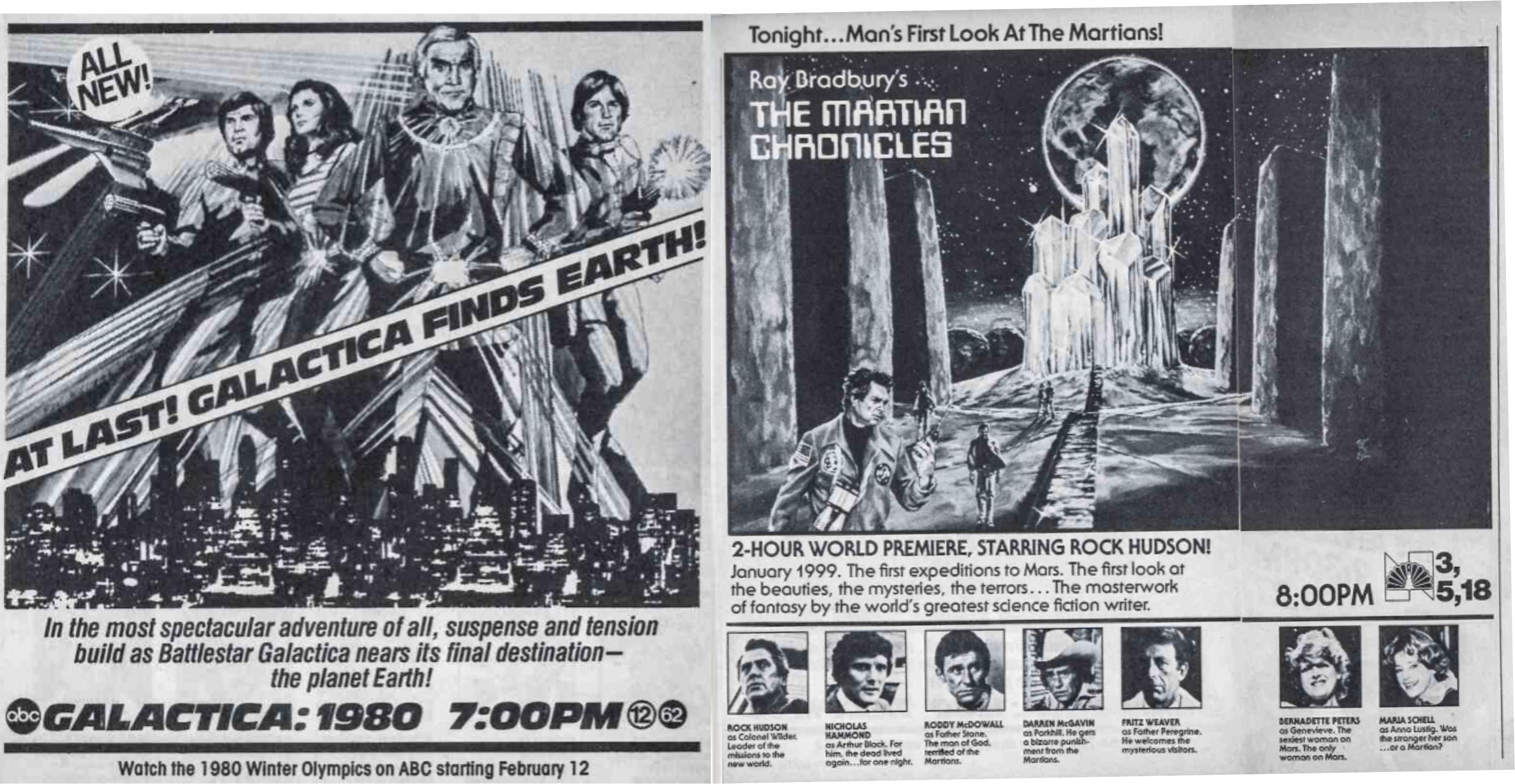
If you're looking for science fiction, then Sunday's the night for you! It starts with Galactica 1980 (7:00 p.m., ABC), the low-rent sequel to the late Battlestar Galactica, with Lorne Greene reprising his role as Adama, leader of the space wanderers. In tonight's episode, the first of a three-part story, Galactica has finally found Earth—now what do they do? Guest stars include Kent McCord, Barry Van Dyke, Robyn Douglass, and Robert Reed. Though I never watched it, I think you're better off with Sci-Fi's reboot of the series in 2003. 


Or, you can just wait an hour for part one of the six-hour miniseries The Martian Chronicles (8:00 p.m., NBC), based on the Ray Bradbury classic. Chronicles boasts an even bigger-name cast, led by Rock Hudson, with Nicholas Hammond, Roddy McDowall, Darren McGavin, Fritz Weaver, Bernadette Peters*, and Maria Schell. Parts two and three air Monday and Tuesday nights at the same time, and Ray Bradbury would probably prefer that you skip it; Bradbury bluntly told Fred Silverman that the miniseries was "boring," which is, to my way of thinking, even worse than being bad, and told friends that sitting through it was "his idea of hell."

*That ad does Bernadette Peters a real injustice: "The sexiest woman on Mars," it reads. "The only woman on Mars." I think she could stand up to any competition.

Sci-fi aside, ABC follows Galactica with the special two-hour premiere of Tenspeed and Brown Shoe (8:00 p.m.), starring Ben Vereen and Jeff Goldblum in, according to the late Tom Shales of the Washington Post, "One of the most dazzling, dizzying, exhilarating debuts an action series has ever made on television." I can understand why this series might have been greenlighted; odd couple-buddy movies are often good fodder for comedy/action concepts, and it was heavily promoted both before and during the network's coverage of the Winter Olympics, but after a promising start, the ratings fall dramatically, and the show is cancelled after 14 episodes.

Following Tenspeed, it's Donna Summer in her first TV special! Honest, that's what it says in the ad. The special (10:00 p.m., ABC) wisely avoids most of the variety special tropes, concentrating on Summer in concert at the Hollywood Bowl, augmented by staged numbers taped in-studio. Except for a campy version of "Bad Girls" that features Donna's "backup trio" of Twiggy, Debralee Scott, and Pat Ast, it's pretty much all music, all Donna.

Tenspeed and Brown Shoe isn't the only series that must have seemed like a good idea at the time; on Monday, Dennis Weaver stars in Stone (9:00 p.m., ABC), playing a police detective who writes best-selling novels on the side. (Sound familiar?) Like Tenspeed, Stone was produced by Stephen J. Cannell, who also created the series with Richard Levinson and William Link. Weaver's an established star with a pedigree as a cop, so you'd think this would have done well, but perhaps viewers missed the cowboy hat; only nine episodes were produced, seven of which were aired before the show was cancelled in March.

On Tuesday, ABC brings out "The comedy that's the new hit of the 80's!" (Again, that's what it says.) Goodtime Girls (8:30 p.m.) stars Annie Potts, Lorna Patterson, Georgia Engel, and Francine Tacker as four woman sharing an apartment in Washington, D.C. during World War II. It's a joint effort of Paramount and Garry Marshall's production company, and they must have hoped they had the next Laverne & Shirley on their hands, but it was more like the next Stone; twelve of the thirteen episodes make it to the air before the show meets its demise. 

And now we find ourselves on the horns of a dilemma.  NBC boasts that Wednesday is "The Funniest Night of the Week!" and looks to back it up with Real People at 8:00 p.m., Diff'rent Strokes at 9:00, Hello, Larry at 9:30, and The Best of Saturday Night Live at 10:00. However, that comes in direct conflict with Thursday, which ABC calls "TV's Funniest Night!" To bolster their claim, ABC points to Mork & Mindy at 8:00 p.m., Benson at 8:30, Barney Miller at 9:00, and Soap at 9:30. (I'm not sure how the producers of 20/20, which airs at 10:00, feel about it.) I think history will record ABC as having the more accurate pronouncement.

Speaking of Soap, though, this week's cover story profiles Richard Mulligan, who plays the goofy Burt Campbell. Mulligan has a long career of playing dramatic roles on stage and in the movies, and is a serious man (he discusses Montaigne and Gnosticism easily), but when he auditioned for the role of Burt, he bowled over producer Susan Harris, who now says that "I can't remember my original concept because when I think of Burt I think of Richard and when I think of Richard I think of Burt."

I've always enjoyed Mulligan's work; in his previous sitcom, 1966's The Hero, he played an actor who was a heroic cowboy type on a TV Western but in his personal life was, as The New York Times described him, "a good-natured family man with 10 thumbs and a fear of horses." In other words, a quirky character not completely unlike Burt Campbell. I also thought he was hilarious in the Blake Edwards movie S.O.B., where he plays a suicidal movie producer trying to salvage his latest movie, a bomb starring his wife (Julie Andrews). No matter what he was in, he was never the biggest name in the cast—but when he was on-screen, he was the one you noticed. -He wins an Emmy for Soap in 1981, and a few years later he'll win another one (and a Golden Globe) or the sitcom Empty Nest.

On Friday, it's the network TV debut of An Unmarried Woman (9:00 p.m., ABC), with Jill Clayburgh in her Oscar-nominated role of a woman trying to cope with life after marriage. Judith Crist calls it a "feminist milestone-movie," with Clayburgh brilliant as the woman forced to start over after her husband leaves her, and fine supporting work from Michael Murphy and Alan Bates. 

l  l  l

I alluded to the Winter Olympics earlier; ABC's coverage of the Games, being held this year in Lake Placid, New York, begins on February 12. But it's the Summer Olympics getting our attention this week. In the face of a possible boycott of the Games by the United States, Rick Cohen reports that NBC is moving ahead with their broadcast plans, but acknowledges that they do have "contingency plans" in case the Games are cancelled or boycotted by the U.S. That boycott is the topic of this week's "As We See It," a rare full-page editorial entitled "Moscow Is No Place For the Olympic Games." 

"The argument that the Games are above international politics is idealistic but fallacious," the editorial states at the outset. Comparing the situation to that faced in 1936, when the Summer Olympics were held in Nazi Berlin, the editorial acknowledges that the four gold medals won by Jesse Owens did, "somewhat," tarnish Hitler's triumph, but goes on to say that, "in hindsight it was a mistake. We should have taken the opportunity to show the German people that the United States, at least, refused to countenance the barbaric cruelty of the German government." Referring to the Soviet Union's occupation of Afghanistan and Cambodia, and its proxy wars being conducted in Angola and Ethiopia, the editors ask, "How can we think of clean competition and sportsmanship on the playing fields in Moscow"? The Soviet veto of a UN resolution calling for economic sanctions against Iran because of the hostage crisis simply underscores "not only the Soviet enmity toward this country but their determination to undermine the West and force their political system upon the world by whatever means."

Yes, it's true that boycotting the Summer Olympics would be a great disappointment for American athletes who, through no fault of their own, would lose perhaps the only chance they'd ever have to compete in the Games—not to mention the millions of Americans who enjoy the Games on television and look forward to the international spectacle every four years. Despite this, the editorial concludes, "it would be in the best interest of our country—and the world—if we were to tell the Soviet people in unmistakable terms that we are not hypocrites, that we cannot send our athletes to compete in a country whose government flouts basic human rights, bullies small countries, and poses a constant threat to world peace." 

I wonder what the editors would have had to say about the recent Summer and Winter Games in Beijing? From where I sit, red is red whether the shade is Soviet or Chinese. TV  

June 24, 2023

This week in TV Guide: June 21, 1980


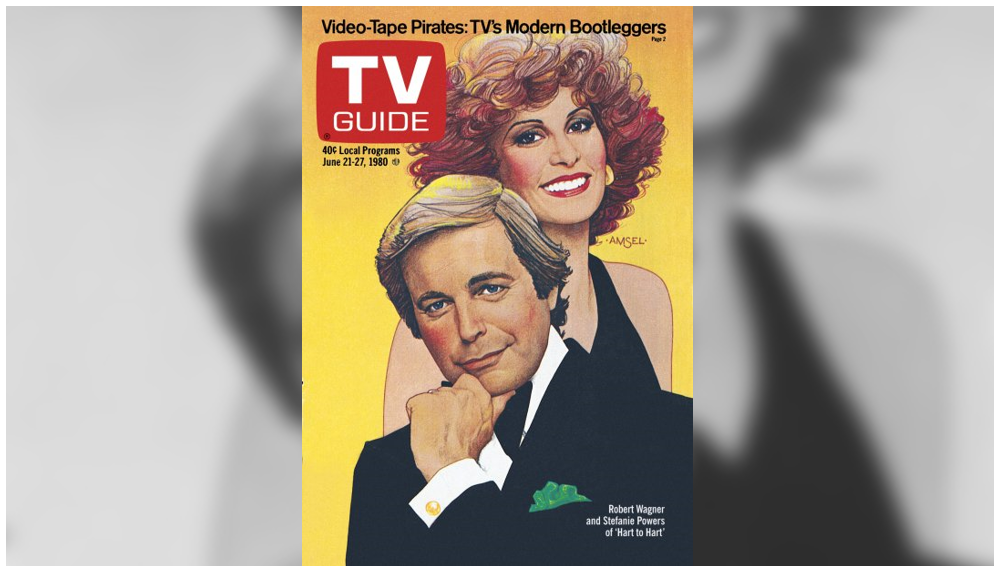
Some things never change, it seems. If you've watched a DVD any time in the last—well, however long it's been that DVDs have been around—you've seen that warning from the Federal Bureal of Investigation that piracy is a crime. I'm not sure that it's much of a deterrent, but it's there. Before there were DVDs, there were video tapes, and while there are many differences between the two, there's one thing they've always had in common: piracy. And if you don't believe me, believe Neil Hickey, who opens his article with a story of 400 FBI agents descending "like Visigoths" on 30 businesses in ten states last February 14. (And Happy Valentine's Day to you, too!) It was the result of two and a half years of undercover work penetrating organized crime's entrance into the piracy business. (I wonder if they ever pirated copies of The Untouchables?)

The fact that the Mob is now formally involved in the video business shows how lucrative video piracy has become, and how much of a threat it is to the movie business. The Motion Picture Association of America estimates that "hundreds of millions of dollars a year" are siphoned off from movie companies by video pirates, whether crime kingpins or small-time freelancers. At one New York City location, "lawmen found 22 video-tape machines grinding out copies of Kramer vs. Kramer around the clock." Well, no accounting for taste. But other bootlegging hits include Apocalypse Now, The Deer Hunter, Star Wars, Superman, Pincchio, and Bambi. Anyone with a VCR can copy and duplicate movies that run uncut on networks such as HBO. Investigations into video piracy have now involved more than 80 countries, with the FBI, Interpol, and Scotland Yard all playing their roles. Perhaps most galling of all, no less than Fidel Castro boasts that he sees pirated tapes "at the same time they open in U.S. theaters." Saudi Arabia, where movie theaters are banned by law, is a particularly fertile ground for pirate-video sales.

So then, as now, video piracy is a problem. It often involves several crimes, in fact, from copyright law to mail fraud, falsifying export documents, income-tax evasion, and interstate transportation of stolen property. But people are willing to engage in it because they have the means to do it, and the demand from consumers provides them with the motive.It costs plenty to prosecute, but the industry is willing to do it because of its "tremendous concern" about piracy cutting into its profits. The solution, if it truly exists, is a drastic one: releasing all future movies to the home-video market at the same time they're released to theaters. "It would mean that new movies would be available for home use, legally and at reasonable prices, the same day they hit the movie houses." It might well succeed in driving the Mob out of the piracy business, but it would also overturn "the whole economic base on which the movie business was founded more than 75 years ago—namely, that movies are for exhibition to audiences, not for sale to individuals."  20th Century-Fox says that in the next couple of years, it plans to do exactly that. 

Well, as far as I know, that didn't happen (except for the virus period when Warner Bros. released their movies simultaneously on HBO Max).  But now that the time between movie release and home appearance (whether on physical media or streaming) is so short, one wonders about the motives of today's pirates. Part of it is availability: movies and television series that haven't been commercially released or are out of print force those who seek them to the underground gray market, where copyright is freely violated. For some, it's probably fun, a game of "beat the man." And there's a complex relationship between piracy and the industry; the Harvard Business Review reports that piracy "can actually boost sales of some digital products by increasing word-of-mouth and overall market awareness." The biggest reason, though, is probably cost; priates may sell their product at reduced prices, or, in some cases, release it for free. And at that, we shouldn't be surprised. We're so reluctant to sacrifice for anything, to pay the price—why should this be any different?

l  l  l

On weeks when we can, we'll match up two of the biggest rock shows of the era, NBC's The Midnight Special and the syndicated Don Kirshner's Rock Concert, and see who's better, who's best.

Kirshner: Performers include Jimmy Messina, the Spinners, Michael Nesmith and comedy act the Rick & Ruby Show. Musical selections include “You Need a Man," “Do You Want to Dance?” "Nobody but You.”

Special: Ambrosia (hosts), Peter Townshend, Rocky Burnette, and film clips of Paul McCartney, the Pretenders and Gerry Rafferty. Also featured: the top-10 countdown. Highlights include "Biggest Part of Me" (Ambrosia), "Rough Boys" (Peter), "Tired of Toein' the Line" (Rocky), "Coming Up" (Paul).

Well, this week is interesting. Rather than who's better, who's best, maybe we should be looking at who's left: Pete Townshend without The Who, Jim Messina without Kenny Loggins, Mike Nesmith without The Monkees, and Paul McCartney without Wings. But even without The Who, I think any program featuring Townshend is going to automatically start with an advantage, and even though McCartney, the Pretenders, and Rafferty are on film, I think they're more than enough to edge out Kirshner. This week, Special takes the price.

l  l  l

In last Saturday's issue (June 18, 1966), I highlighted a couple of specials that were, in my opinion, really specials—one-woman shows by Peggy Lee and Lena Horne. There was nothing fancy about them, just an hour of hits each, by two great singers showcasing their talents. This Monday, we have a special that demonstrates everything that's wrong about the genre in the 1970s and 1980s, and why the descriptions sound as if they were parodies from SCTV. It's Debby Boone in, of course, her "very first knock-'em-out variety special," The Same Old Brand New Me (9:00 p.m., NBC), with special guest stars Bob Hope, Gene Kelly, Greg Evigan, and Jose Ferrer. The first problem is that it is a "variety" show, which means you're going to have those painful comedy sketches that really aren't very funny. Also, there's no synergy in the guest lineup; it's all paint-by-numbers casting—Greg Evigan as the obligatory NBC star appearing on an NBC show, Jose Ferrer because Debby's his daughter-in-law; and Bob Hope because, well, he'll appear on anything these days. (I haven't quite figured out where Gene Kelly fits in.) But do the pieces really mesh

Understand that this isn't meant to be a slam on Debby Boone, who might be the nicest person in God's creation. But at this point she's had one hit, 1977's "You Light Up My Life," and by this time she's moved to the country music genre. It's quite conceivable that she just doesn't have a body of work strong enough to support a one-hour special. And if that's the case, then this isn't really all that special, is it? It's more like an opportunity for a few celebrities to pick up some extra cash and get a little screen time. And when your show sounds like an SCTV bit but isn't, then you're in trouble. (By the way, I've got Andrea Martin as Debby, Dave Thomas as Hope, John Candy as Ferrer, Rick Moranis as Evigan, and Joe Flaherty as Kelly. But there has to be a cameo somewhere by Bobby Bittman.)
l  l  l

Ah, it's always good to air out the spleen a little, isn't it? But here's something else that's on NBC this Monday, one that's likely to be remembered a little longer than Debby Boone's first special. It's the debut of everyone's favorite gap-toothed comedian, David Letterman, and his late, lamented morning show. (Monday-Friday, 10:00 a.m., NBC) Being that it premiered during the summer, I was able to watch the first few months while I was off from college; it was a very funny, very creative program, not at all comparable to today's daytime chatfests. (I especially enjoyed Edwin Newman's news updates!) It was, more than anything, a throwback to Dick Cavett's late-1960s morning program on ABC, with some of Ernie Kovacs's morning show in television's earlier days. 

And like those outings, it was probably too different, too innovative, for a daytime audience; it only lasted four months before leaving the schedule. At that point, I thought NBC's best move would be to move SCTV to a regular Friday night slot (in place of The Midnight Special), and turn Saturday late night into Saturday Night Live with David Letterman; it would have been a massive upgrade over the disaster SNL had become. I still think it would have been a good idea; Letterman could have remade that show, which I haven't watched in decades, into something special. The stars that SNL has produced over those years would easily have fit in as part of Letterman's regular cast. But then, as has often been proven the case, what do I know? 

l  l  l

Your reminder that this is an election year comes on Saturday, with "It's a Great Night, America" (10:30 p.m., CBS), sponsored by the Republican National Committee, with Pat Boone (father of the aforementioned Debby) and Tanya Tucker, and featuring appearances by Ronald Reagan, George Bush, and Howard Baker. At this point, with the GOP convention next month, Reagan has long had the nomination wrapped up, so in essence this is a vice-presidential audition for two of the leading contenders, Bush and Baker. And since we were talking about Saturday Night Live just a moment ago, this week's episode is a rerun from January, with Teri Garr as an Iowa housewife being wooed by presidential candidates. The B-52's are the musical guest.

Sunday, it's the network television debut of 1968's Romeo and Juliet (9:00 p.m., ABC), with Leonard Whiting and Olivia Hussey starring, and Franco Zeffirelli directing. The movie, which was nominated for Best Picture, was in the headlines earlier this year for the wrong reasons, is a reminder that movies didn't always debut a couple of weeks after they left the theaters; in this case, it was twelve years from big screen to small.

If I've discouraged you from watching the Debby Boone special on Monday, just hang on for an hour, because it's followed by Tom Snyder's Celebrity Spotlight (10:00 p.m., NBC), and while I don't usually pay much attention to these celebrity interviews, this one could be more interesting: in addition to standard stars like Carroll O'Connor, Erik Estrada, and Priscilla Presley, Tom sits down to talk with James Cagney and his upcoming role in Ragtime—his first movie in 19 years.

One of my favorite shows is Police Squad!, so it should come as no surprise to you that one of my favorite movies is Airplane, the disaster spoof made by the same crew—Zucker, Abrahams, and Zucker. On Tuesday, Merv Griffin devotes his show to actors from the movie, including Robert Hays, Robert Stack, Lloyd Bridges, and Kareem Abdul-Jabbar. (9:00 p.m., WXIX, Cincinnati) I hope Leslie Nielsen was with them!

Wednesday, it's the drama Wilson's Reward, adapted from the short story by W. Somerset Maugham, starring Sandy Dennis, Gerald S. O'Loughlin, and Fred Morsell, and directed by Patrick O'Neal. (10:00 p.m., syndicated) Ted Morgan, author of the recently published biography Maugham, authors this week's "Background" story, providing a brief but frank look at the remarkable career of the man who became "the most popular English writer since Dickens." I really enjoyed those Background articles; they gave a program like this the context that made it that much more enjoyable, and encouraged you to read more about it, to coin a phrase.

On Thursday, the best choice remains Barney Miller (9:00 p.m., ABC), which features the case of a woman who claims that her husband has been replaced by a clone. What do you want to bet that Steve Landesberg's Dietrich gets assigned to that one? That's followed by Nobody's Perfect (8:30 p.m., ABC), in which Ron Moody plays a Scotland Yard inspector attached to the San Francisco Police Department. Ron Moody is a fine actor; he received a Best Actor nomination for Oliver! in 1968 (the same year as Romeo and Juliet!), but don't you think this "fish-out-of-water" police schtick was already old by 1980? 

Friday's recommendation is the late night movie In Cold Blood (3:15 a.m., WAVE, Louisville), based on the gripping true story (well, sort-of true) by Truman Capote. The movie features stark black-and-white cinematography, much of which was shot on location in Holcomb, Kansas (including the murder home); intense performances by the young Robert Blake and Scott Wilson; and an outstanding job by Richard Brooks, who was justifiably nominated both for Best Director and Best Adapted Screenplay. I will admit, however, that this may not be the best movie to watch if you're susceptible to hearing sounds in your house, and I mean that as a compliment. 

l  l  l

MST3K alert: Revenge of the Creature
(1955) "In this first sequel to The Creature from the Black Lagoon, the amphibious 'gill man' wreaks havoc in Florida. Clete: John Agar. Helen: Lori Nelson. Joe: John Bromfield." (Saturday, 8:00 p.m., WDRB, Louisville). One of MST3K's favorite whipping boys, John Agar (aka Mr. Shirley Temple) is out-acted by the great Ricou Browning, and Lori Nelson takes the place of Julie Adams. There's a reason why this movie, and not the original, is on MST3K. On the other hand, we're introduced to Professor Bobo and The Nanites, so how bad can it be? Or is that just a rhetorical question?

l  l  l

Finally, this week's variation on the old "if a tree falls in the forest and nobody hears it" question: if you're a member of an Olympics team and you don't go to the Olympics, does it really count?

As everyone knew by now, the United States had determined to boycott the 1980 Summer Olympics in Moscow, over the Soviet Union's invasion of Afghanistan. (Ironic, isn't it, how history keeps coming around to bite you in the behind? Ironic also that we've never bothered to boycott the Olympics in China.) So, even though our athletic heroes won't be getting the chance to compete for the gold, they're being given the full exposure this weekend with live primetime coverage of the U.S. Olympic Boxing Trials from Atlanta (Saturday, 8:00 p.m., NBC), and the track and field, yachting, road cycling, canoeing and kayaking, and pentathlon trials on Sunday afternoon (3:00 p.m,. NBC). Then, on Monday, the U.S. Olympic basketball team takes on a group of NBA stars from Indianapolis (9:00 p.m., syndicated). The U.S. hoopsters include Mark Aguirre, Sam Bowie and Isiah Thomas, while the NBA team is led by Artis Gilmore, Magic Johnson, and Bob Lanier. (The U.S. team won, by the way, 82-76.)

The ad above is almost a parody of itself. "They Trained Four Years! Now This Is Their Moment!" Their moment for, what exactly? What is the glory of being selected for an Olympic Team that isn't going to compete in the Olympics? How do you represent your country in what essentially becomes an intramural competition? I've come to have mixed feelings about this, as I have so many things in the past few years; just as I supported American involvement in Vietnam for years after the fact, I supported the Olympic boycott at the time. But did the Olympic boycott serve any real purpose; did it hurt anyone other than the athletes themselves? And talk about irony; just as we took the place of the French in Indochina, we wound up taking the place of the Soviets in Afghanistan. 

Now I find myself, in both cases, wondering what the hell good any of it did. And I'm afraid that's a question a mere television historian can't answer. TV