Showing posts with label Social Issues. Show all posts

June 23, 2023

Around the dial


We'll start this week on a self-serving note; my latest appearance on the Dan Schneider Video Interview is up. We're talking about the original Mission: Impossible: why it's a terrific show, why it's a problematic show, and why you should watch it. I hope you do check out the video (as well as the rest of Dan's interviews). Let me know what I'm doing right, and what I need to improve. 

at Cult TV Blog, where John is beginning a series of posts about The X-Files and the American Dream—specifically, how the show overlays the American Dream with "a dystopian scenario of government corruption, interference, violence, experimentation, and is largely a delusional front to what is portrayed as a controlling despotic country." Needless to say, I'm interested in this kind of thing, considering the scope of my "Descent into Hell" series, so I'll be following this closely.

From the website of the Brownstone Institute, Thomas Harrington writes about "those silly dads on TV" —a situation that's existed since virtually the beginning of the medium—and why this isn't particularly good for our culture.

At The View from the Junkyard, there's the usual Avengers post (which I'm always going to read), but also "Agenda for Murder," a fine episode of the rebooted Columbo featuring the third appearance of Patrick McGoohan as a killer, who is almost—but, of course, not quite—a match for the wiley detective.

There's a nice piece at Travalanche about Bud Collyer, whom most classic TV aficionado recognize from hosting a variety of game shows (most notably To Tell the Truth), as well as voicing Superman on the radio adventures and animated cartoons. There's more to him, as you'll see here.

At A Shroud of Thoughts, Terence notes the 75th anniversary of The Ed Sullivan Show, one of the great shows in televisison history. As you know from my Sullivan vs. Palace TV Guide feature, I'm vested in Ed's place in pop culture history, and glad those performances continue to be available for viewing. 

A good week; as I've said in the past, what we lack in quantity we make up in quality. TV  

October 26, 2022

The best of worlds, the worst of worlds

(left to right) Stephen Young, Luke Halpin, and Carl Betz


One of the things I most like about Judd, for the Defense (along with the powerful performances each week by Carl Betz) is how the scripts take on controversial issues without necessarily being polemical, demonstrating through misdirection and unexpected plot shifts that things are not always as simple as they seem. (You could argue that there's a little too much misdirection, but that's how good mysteries work.) Combine this with the occasional episode that stubbornly refuses to wrap everything up in a bow at the end, and you get a series that probably should have lasted more than two seasons. (But then, not being a network executive, what do I know?)

Something else that Judd has in common with the best shows of its era is the ability to illustrate, unironically and without the filter of contemporary mores, how society has changed over the decades—sometimes evolving, frequently devolving, but seldom remaining static. Case in point is the first-season episode "The Worst of Both Worlds," a story that's both timeless and subject to a completely different interpretation than it would have had when originally broadcast on March 8, 1968.

The Cliff Notes version of the plot: Judd and his associate, Ben Caldwell (Stephen Young) are called in to defend 17-year-old Kenny Carter, Jr., who was sentenced to 3½ years in the county juvenile home for stealing and wrecking a sports car belong to a family for which he'd done odd jobs, the wealthy and influential Merritt family. The man driving the car that Kenny hit was seriously injured in the crash. 

At first, it seems a straightforward case of injustice being done to the boy; talking to Ben at the county home, Kenny (Luke Halpin) insists that "I didn't admit anything because I didn't do anything," and that "because of the way they ask you the questions in court, if you answer 'no,' it turns out you're a liar; if you answer 'yes,' you're guilty." At the hearing, he was without benefit of counsel (a lawyer wouldn't have been available for three weeks, and upon suggestion of the judge, Kenny waived his right), and no transcript of the hearing was kept, due to cost. The juvenile officer, Frank Austin (Frank Marth, so we know he's going to be the bad guy), whose duty is to act in Kenny's best interests, maintains that the boy's rights were always kept in the forefront of the investigation. 

Convinced that the boy's rights were denied, Judd applies for a Writ of Habeas Corpus to get Kenny out of the home, and seeks a new hearing for him. Based on the circumstances, a judge agrees to both. It's then that the first complication occurs, when Austin reveals to Judd that Kenny had assaulted Mrs. Merritt prior to stealing the car. Austin's motive in acting as he did in the first hearing was to prevent this from coming out--"holding back the kind of charge that could ruin his life"; as it was, he would have been a delinquent in the juvenile home, "but you had to come along and open Pandora's Box." Kenny denies the assault, but Judd and Ben know he's holding back. After Mrs. Merritt (Pippa Scott) testifies in court and confirms that an assault happened, Kenny finally, reluctantly tells them the truth: he and Mrs. Merritt had been having an affair, she had tried to prevent him from leaving the house because he wanted to go on a date with a girl his own age, and (because she'd been drinking) she fell and hit her head, sustaining the injuries that Kenny was supposed to have inflicted. He then took the car to get a doctor for her, and wrecked it because the brakes were faulty. All this time he'd been trying to protect her, but now that she's turned on him, he has no choice. After undergoing a withering cross-examination from Judd, Mrs. Merritt finally breaks down and admits the truth, and the charges against Kenny are dismissed.

After the judge has ruled, while Kenny is being comforted by his family, Judd confronts Austin in the corridor, and we come to the plot point around which everything revolves:

Mr. Austin, you owe me an explanation. Didn't you know what was going on between Kenny and Mrs. Merritt?

She told me about their struggle. When she was still upset enough to be telling the truth. Later on, I could see she carefully did not tell her husband. So I could make a pretty good guess.

And you didn't say a thing in your official capacity?

My official capacity was to protect the kid, n ot to let him get smeared the rest of his life. Of course, I didn't know the whole story, particularly that brilliant council would take over the case.

Mr. Austin, I did nothing more than any competent lawyer would have done. The point I wish you would see is the injustice of trying so many of these kids in juvenile court without lawyers and calling that 'protection of the young.'

Well, how would you protect them? By feeding kids into the machinery of the ordinary criminal courts, where nobody cares what happens to them? Look, do you really think you did this kid any favors by getting him off scot-free? Without any disciplinary correction? 

He's not legally guilty of anything.

He was carrying on with a married woman. He lost his head, he took a car he couldn't handle properly, and he caused a very serious crash. Now, let me ask you this, Mr. Judd. How would you feel about seeing some other lawyer get him off, if you were the man he ran into?

Judd wins again—or does he?
This is how the episode ends, with Judd left to ponder how the legal system works, and us to ponder what it all means. As I mentioned, us viewers have been conditioned over the years to connect Frank Marth with the heavy, so we're only too willing to accept Judd's version of justice as the correct one. And yet, likely with this in mind, writers Paul Monash (series creator) and Norman Borisoff take pains to suggest that Austin did have the boy's interests in mind. Perhaps he didn't handle it correctly, but he's not a one-dimensional pantomime villain. In the end, though, you still have to think he's wrong—flat wrong, about Kenny, and about the legal system in which he acts as an officer. 

If one were to air this episode, unchanged, on a contemporary program, we'd probably be shocked. First of all, Mrs. Merritt, having seduced a minor, would be considered a sexual predator, and even if she didn't do any jail time, she'd go into the sex offender registry for sure. (What would that have done to a socially prominent family?) Kenny would be seen as a victim, not someone carrying on an affair with a married woman. His name would be kept confidential; even though word would spread in a small town like the one in which the story occurs, it's not going to follow him around on his record. Far from recommending "disciplinary correction," a judge would probably order counseling for him; as for taking the car, under the circumstances he acted not out of malice or criminal intent, but as a confused and abused boy who didn't know what else to do. In short, he's not a delinquent, but a boy taken advantage of by an older woman who should have known better. Austin likely would have been sacked had he proceeded the way in which he did and would have left both himself and the city wide open to civil charges. The entire denouement would have flipped, and Judd would have had an even stronger case for demanding that the legal system do more to protect juveniles from adult predators. 

That's the way it is. That's not the way it was. At the risk of identifying myself once again as old, I can say that when I was in high school, none of us boys would have considered Kenny a "victim"—we'd have called him lucky, and each one of us were probably hoping the same thing would happen to us—minus the accident, of course; it's never any fun doing something you aren't supposed to be doing unless you get away with it. And we wouldn't have seen him as having been taken advantage of, he scored. Of course, that's what happens when you think with your hormones instead of your head, and that's why teenagers (or those who've never matured beyond their teens) shouldn't be running the world.  

I'm certainly not suggesting that things were better back then, nor am I saying we're wrong to view things differently today. It probably suggests we should look at situations like this on a case-by-case basis. But "The Worst of Both Worlds" functions not only as entertainment, but as that time capsule I'm always talking about, presenting us with a look at how society was—not in retrospect, not seen through 21st century-tinted glasses, but the way it actually was at the time. If you want to study societal evolution, you can certainly do worse than this. TV  

April 23, 2022

This week in TV Guide: April 26, 1980


If you're looking for television that's reflecting the social climate of 1980—or is it 2022?—boy, have you come to the right place this week.

It's hard to know where to begin, so we might as well start with this week's cover story on NBC's new anti-sitcom, United States, starring Beau Bridges and Helen Shaver. It is, according to Alison Lurie, a series for "[t]hose of us who are tired of laugh tracks, and of pretty people with cute problems." It's Larry Gelbart's creation, and he's set out to show America a married couple where the woman sometimes has the advantage, where the husband is always a step behind, and the show itself lacks both a laugh track and background music. There are children, but they're only occasionally "too damned cute for comfort." One of the most striking elements of the show is Gelbart's creation of an entire two-story interior for the set, giving them "real space to move around in." 

Gelbart has created this show not for "the sugar-added baby-food audience; he wants to attract adult gourmets." It is, Lurie says, "a native sequel to Ingmar Bergman's, a kind of 'Scenes from an American Marriage." It is as far away from Father Knows Best, Donna Reed, and even All in the Family as one can get; a bold move, particularly for a medium that has yet to experience what we would today call "prestige drama" "One thing is sure, however:" Lurie concludes grimly. "if United States does not attract an audience, it will not be around for very long." It is around for exactly nine episodes (with four more unaired) Our go-to resource, Brooks and Marsh's Complete Directory to Prime Time Network and Cable TV Shows, called it "tedious, boring and didactic" It would appear that the viewers of the United States have spoken.

l  l  l

Next up is the Hallmark Hall of Fame's presentation of Gideon's Trumpet (Wednesday, 9:00 p.m. PT, CBS)based on Anthony Lewis's book of the same name about the landmark 1963 Supreme Court case Gideon v. Wainwright (the book was required reading in my pre-law classes in college), and starring Henry Fonda. If you're up on your Constitutional law, you'll remember that Gideon is the case in which the Court ruled (using the "incorporation doctrine") that the Sixth Amendment right to an attorney applied to the states as well as the Federal government, through the Due Process Clause of the Fourteenth Amendment. And yes, I knew that without looking it up.

Gideon's Trumpet presents Fonda in a role that's as different from what we're used to as was his performance in Once Upon a Time in the West. If you're expecting him to portray Abe Fortas, the heroic lawyer (and future Supreme Court justice) who takes Gideon's case all the way to Washington, D.C., you'd be wrong—that honor goes to Jose Ferrer, in a brilliant piece of casting. No, Fonda plays Clarence Gideon, a "semiliterate drifter" charged with breaking and entering, who's forced to defend himself in court because he can't afford a lawyer, and winds up being convicted and sentenced to five years in prison. The 75-year-old Fonda is, in Judith Crist's words, "simply superb" in this "forthright and fascinating drama" that goes to show that, at its best, "truth emerges as more suspenseful and engrossing than any fiction." And those first ten amendments to the Constitution are debated just as much today as they were back in 1980, not to mention 1963.

l  l  l

Another legal dilemma—the right to privacy—is the subject of an ABC News Closeup (Tuesday, 10:00 p.m.). Specifically, as reporter Paul Altmeyer points out, the increasing use of surveillance by businesses and local police forces against private individuals. In one segment, Altmeyer surprises a phone-company secretary with tapes made by security personnel who tapped her phone for two weeks in 1978. Says a former investigator with the company, "We could check on anybody. We had absolute power." 

And so it goes. TWA supervisors eavesdrop on their reservation clerks, even when they aren't taking calls. Companies using polygraphs and voice-stress analyzers on current or potential employees. Undercover police infiltrating citizens groups that were seeking to open police files on private citizens. Even WLS, the ABC-owned station in Chicago, where the former general manager is being sued by directors who claim he electronically eavesdropped on them.

Now, here we are, 42 years later, and we're still dealing with the same problems, only worse. Silicon Valley tech companies, federal and state governments, financial agencies, police departments: using technology to monitor people: what we say, where we go, the political causes we support. Social credit systems that could be used to decide who can work, who can bank, who can buy groceries. Privacy? What's that?

l  l  l

That's just one of two documentaries this week touching on issues that are just as explosive today as they were back in 1980, if not more so. It's the CBS Reports look at "Gay Power, Gay Politics." (Saturday, 10:00 p.m.) The focus is on San Francisco, where homosexuals make up 12 to 25 percent of the population, and are seen as the city's new "power brokers," especially the "night of gay rage" in the wake of Dan White's manslaughter conviction for the murder of mayor George Moscone and gay leader Harvey Milk (above).

While there are interviews with homosexual men and woman as well as insights into their lives and the gay lifestyle, the accent is on politics—for instance, the key support they provided in the election of Dianne Feinstein as the city's new mayor. According to producer George Crile, Feinstein "gave them all they had asked for," including a promise to appoint them to city government positions in proportion to their numbers. Their growing power is also evident in proposals to "'demystify' homosexuality for school children," and the impact it's all having on "traditional values." I'd swear I read this very story just yesterday. Why anyone should be surprised by any of this is beyond me.

l  l  l

Whenever when we can, we'll match up two of the biggest rock shows of the era, NBC's The Midnight Special and the syndicated Don Kirshner's Rock Concert, and see who's better, who's best.

Kirshner: Performers Cheap Trick, Lena Lovich, Rick Derringer and Le Roux.

Special: It's part two of the seventh-anniversary show, with Captain and Tenille (hosts), Dolly Parton, Olivia Newton-John, the Commodores, the Village People, Willie Nelson, Crystal Gayle and Andy Kaufman. Also: a comedy segment with Bruce Vilanch. 

OK, I'll admit this probably isn't a fair match this week, since The Midnight Special has a loaded, clip-driven all-star lineup. (Still, who doesn't like a good set from Cheap Trick?) But, fair or not, Special is a perfect example of what top-40 radio used to sound like, and when every act is a hit, you can't deny that this week Special is special.

l  l  l

The sports news this week is bad, at least for NBC; according to Frank Swertlow's TV Update, the network has "unofficially" ruled out televising the 1980 Moscow Summer Olympics in light of the U.S. decision to boycott the Games. Now begins the process of reimbursing the advertisers who've paid for the sold-out commercial time, as well as filing an insurance claim with Lloyds of London and other carriers for the $87 million they paid for the television rights. A prescient decision, that, considering that boycott rumors had begun as early as two years ago. In light of how political sports has become over the decades, I wonder if insurance coverage like this is standard nowadays?

I recall how the boycott fever that year prompted so many people to think of the Brits as traitors, not only for refusing to participate in the boycott, but carrying TV coverage on BBC. Or a few years later, when the French pissed us off over something or other (but then, when aren't they?) and we wound up with "Freedom Fries"? It's easy to get fervent about causes like this, isn't it? You're either for us or you're against us. I also find it interesting how, over 40 years later, Russia is still the center of world political attention. What do I always say, the more things change. . . 

l  l  l

Some other highlights of the week: 

Let's keep with sports this weekend, starting with playoff action in the NHL (Saturday, 5:00 p.m., KTSF) and the NBA (Sunday, 10:00 a.m., CBS). Sunday also showcases the golf tournament that gave birth to golf's Senior Tour, the Liberty Mutual Legends of Golf, from Austin, Texas (11:30 a.m., ABC). The Senior Tour hadn't been formalized at the time, so this is a unique event, giving "the sport's old-timers a chance to cash in on today's hefty purses." Some of the tour's great names of the past, including Roberto de Vicenzo, Julius Boros, Tommy Bolt and Art Wall, play in two-man teams for a share of the $400,000 purse, and this year Arnold Palmer makes his debut in the event. Soon, these "old-timers" will be rivaling the regular tour for popularity. 

Also on Sunday, Diana Ross makes her movie debut in Lady Sings the Blues (8:00 p.m., ABC), "based recognizably" on the life of the great Billie Holiday. Judith Crist sees Ross's performance as "brilliant as both actress and singer," and she's joined by Billy Dee Williams, telling the "rags-to-riches tale of a singer done in by the wrong man, with drugs or drink the recourse.)" As for Monday night's movie, All God's Children (9:00 p.m., ABC) is a story of "a town torn apart" by court-ordered busing to achieve racial segregation. Richard Widmark, Ned Beatty, Ossie Davis and Ruby Dee star, and considering the racial tensions in this country today, I probably should have included it above. I was just too tired, though.

Tuesday
night, John Williams makes his debut as conductor of the Boston Pops in a special two-hour Evening at Pops (7:00 p.m., PBS). Williams is facing a tall order replacing the legendary conductor Arthur Fiedler, who died the previous July, but he's helped out with a glittering lineup that includes violinist Isaac Stern and actor Burgess Meredith, who narrates a 14-minute adaptation of William Faulkner's The Reivers, to a score written by Williams for the 1969 film version. Williams also conducts two selections from his score for the upcoming Star Wars sequel, The Empire Strikes Back

Here's a great idea for a new feature: I'll describe the show, and you tell me if it's real or an SCTV parody! In this corner, we have The Jimmy McNichol Special, with Conrad Bain, Jeff Conaway, Magic Johnson, Donna Pescow, Kurt Thomas, Ricky Schroder, and Kristy McNichol. Meanwhile, in the opposing corner, a movie adaptation of Agatha Christie's mystery Death Takes No Holiday. If you had Jimmy McNichol to win, you're about to cash in; "The face on every newsstand comes home, for his first all-star TV special." (Wednesday, 8:00 p.m., CBS) I can't help it; this ad makes it sound as if everyone's entitled to an all-star TV special sooner or later. This one was Jimmy McNichol's first, and unless I'm mistaken, also his last. By the way, Death Takes No Holiday airs Sunday morning on Second City Television (1:00 a.m., KRON). 'Tis a far, far better thing to switch to PBS at the same hour for a broadcast of Gian Carlo Menotti's magnificent hour-long opera The Medium, a dark story about a mysterious fortune-teller, with Maureen Forrester in the title role.

Thursday it's the Academy of Country Music Awards, live from Los Angeles (Country capital of the world, right?), hosted by Loretta Lynn, Charley Pride, and Claude Akins. (9:00 p.m., NBCS) A star-studded lineup of entertainers is on hand, including Barbara Mandrell, Donna Fargo, the Oak Ridge Boys, Larry Gatlin and the Gatlin Brothers, and Eddie Rabbitt. Among the night's awards is the special Entertainer of the Decade award, given to none other than the Coal Miner's Daughter herself, Loretta Lynn.

On Friday, it's a reminder that the Kentucky Derby arrives on the first Saturday in May, as Frank Gifford and Sandy Hill host Friday Night Live at the Kentucky Derby (11:30 p.m., ABC). Unlike the many pre-Super Bowl specials, though, this concentrates on the sport itself, with a preview of the horses running tomorrow, and features on some of the more interesting stories, such as actor Jack Klugman's horse Jacklin Klugman, who'll be part of the race. The only showbiz entertainment is the premiere of Dan Fogelberg's Derby song, "Run for the Roses." Wonder if any of them mentioned Genuine Risk, who the next day becomes the first filly in 65 years to win the Derby.
 
l  l  l

Finally, I was wrong up there when I said we were done looking at socially relevant shows. Take a look at the topics on this week's People are Talking. (10:00 a.m., KPIX):
  • Monday: Sexual Slaves
  • Tuesday: U.S. Invaded by Foreigners
  • Wednesday: Terrorist Secrets Exposed!
  • Thursday: Fat Discrimination
  • Friday: Dealing with Daily Stress  
Correct me if I'm wrong—this issue was written in 1980, wasn't it? TV  

April 29, 2020

The Monsters

On March 4, 1960, "The Monsters Are Due on Maple Street," the twenty-second episode of The Twilight Zone, aired on CBS. Viewers who've watched The Twilight Zone will remember the episode vividly (it's considered one of the show's greatest stories); even those who haven't watched the series may well have heard of it.

The story, written by Rod Serling, takes place in a close-knit neighborhood on Maple Street, in an unnamed city. Strange things begin to happen (flashing lights, power outages, and the like), and the fractures develop between the once-close neighbors as, fueled by fanciful science-fiction stories, they become convinced one of them part of an alien invasion of Earth. (Remember, this is The Twilight Zone we're dealing with.) Eventually, a mob mentality takes hold of the neighborhood, there's a death, accusations fly (along with bullets and rocks), and the the neighborhood devolves into a riot.

There are no monsters, of course—or, rather, there are monsters; they just aren't playing the role we suspect. They are watching the disintegration of civilized behavior on Maple Street from a hillside where their spaceship landed. They haven't come near the street; all they've done is cause a few lights to flash and the power to go on and off, and the humans did the rest. They observe how they'll be able to colonize Earth neighborhood by neighborhood, and we'll make it possible: all they have to do is fiddle with the expected, to "take away human comforts and throw in an element of fear and humans will seek out their natural enemy: themselves." That quote comes from The Twilight Zone Vortex, and it's as good as you'll find.

Allegorical interpretations abound. Serling clearly intends this to be one of his "message" scripts; his closing narration states that "thoughts, attitudes, prejudices" are weapons found only in our minds, and that "prejudices can kill...and suspicion can destroy...and a thoughtless, frightened search for a scapegoat has a fallout all of its own—for the children and the children yet unborn." It could be a warning about racism. It could be a treatise on the Red Scare. And it's timeless: it could be about terrorism, immigration—even COVID-19.

Have you noticed how people are being urged to "snitch" on people they see violating the norms of "social distancing"? (And boy, I'll be happy to never see or hear that Newspeak term again.) We hear of cases of social media ridiculing individuals who fail to join in nightly neighborhood celebrations of health workers. And predictably, the response to the virus has divided along political and ideological lines. Liberals and conservatives, Republicans and Democrats, red states and blue, make claims, exchange accusations, and hurl invective. Those who claim to be protecting lives are called tyrants; those who claim to be protecting jobs are called traitors. If we don't close everything up, people will die. If we don't open everything up, people will die. And, as is always the case, anyone who disagrees with us is a fool. We're in this together? Give me a frigging break.

If there's one thing we've learned in the last decade or so, it's that social media presents a highly distorted view of society, and so it's possible that the nation really has attained a level of unity not seen since World War II. It's possible. But it will be interesting to see what kind of world we live in when this pandemic ends. Will the businesses forced to close ever reopen, and will the workers laid off regain their jobs? Will the public scolds keep at it, or will they go back into their dark holes? Will things get back to normal, or is this, as some people have suggested, the "new" normal? What will the future be like?

In one of his more memorable quotes, Harry Reasoner, the CBS and ABC newsman, once cautioned against a society pursuing hypersafety:

The idea of trying to outguess life, to avoid everything that might conceivably injure your life, is a peculiarly dangerous one. Pretty soon you are existing in a morass of fear. A man makes a sort of deal with life, he gives up things because they are undignified or immoral; if life asks him to cringe in front of all reasonable indulgence, he may at the end say life is not worth it. Because for the cringing he may get one day extra or none; he never gets eternity.

I think we've forgotten that; in fact, I'm not sure how many of today's generations ever even considered this. We react today to life, and to our fellow man, with fear and paranoia. But as Reasoner says, danger comes in different disguises. Some might say that, in the panic of the moment, it is too dangerous to consider the the post-virus future. If not now, though, when? The future is only one second away; if we keep putting it off, we'll only guarantee that the present remains the same. And then who will The Monsters be? TV  

May 20, 2017

This week in TV Guide: May 18, 1968

You're going to have to trust me on this: you would not see an article by someone like Dr. Karl Menninger in today's version of TV Guide. Back in 1968, however, TV Guide was more than open to great intellects engaging in serious discussions about television and its role in popular culture.

Dr. Karl Menninger was one of the most prominent American psychiatrists of the 20th Century, co-founder of the famed Menninger Clinic in Topeka, Kansas. His book The Human Mind, written in 1930, did much to introduce psychiatry to the American public, and he sought to educate Americans on the true nature of mental illness and other behavioral disorders. He was a harsh critic of the way the justice system dealt with mental illness; he once famously said that courts wasted their time with questions such as whether or not the accused knew the difference between right and wrong, when instead they should be asking, "What went wrong in this man's life that he is here instead of out on the road? How is it that he is in trouble with his people, his city, and his government? What is different about him from the rest of us? What do we do about his present predicament-and ours?" And yet he wasn't a mere apologist, either, as he pointed out in his book Whatever Became of Sin?, in which he discussed the role of sin when it came to guilt and responsibility. "The word 'sin' has almost disappeared from our vocabulary, but the sense of guilt remains in our hearts and minds," and while it would do no good for someone to try and repent of an illness, it is a different thing altogether to repent of a sin. I think you could probably make a good case that TV series such as Breaking Point and The Eleventh Hour wouldn't have been around were it not for Menninger and his ability to argue that psychiatry was a true science, and mental disorder.  a true illness.

So, you're probably asking yourselves about now, what is Karl Menninger doing writing for TV Guide?

It's the fourth installment of a series entitled "In Defense of Television," the purpose of which is "to analyze the beneficial effects television has had on our world and its citizens." Prominent figures in public and private life have been invited to share such positive aspects, "even though they may also have some negative attitudes about television and its performance." Menninger's essay is entitled "Television - The Comforting Presence," and he begins, as he does so often, with a story, or rather, a couple of anecdotes. The first tells of a man who detested air conditioning, but nevertheless had just had a unit installed in his office "because it helped to drown out the noises of the city." The second involves a young college girl who'd been given "a turtle-shaped electric appliance which had no other function than to make a whirring sound, halfway between the sound of an electric razor and an electric fan. The sound, described as extremely soothing and reassuring, was said to be a great aid to studying in a college dormitory."

From this, Menninger postulates something that I've long felt and, to the eternal frustration of my wife, practiced - "[S]ilence is not only unattainable but not necessarily desired. Sounds - and lots of them - are an inescapable part of life in the city. Peace (for people) seems to lie not in escaping from sound but in making it acceptable, comfortable, reassuring, even noncommunicative. The sound must not have a pronounced, foot-tapping rhythm nor an arresting loudness, but should produce a feeling of intimacy and companionship. No rhythm, no melody, no racket - just a presence." In other words - the sound of a television set.

For Menninger, this was the answer to an observation he had often made, that of "homes where the television was turned on while every member of the family was engaged in some activity - playing cards, reading, sewing, studying, writing, cooking, or even using the vacuum cleaner." When queried about this, people gave him similar answers: "It helps me concentrate," "It gives me a feeling of life around me," "It's sort of scary without it." And think about it - television is, as we have observed time and time again, the most intimate of media, in which we invite total strangers into our homes, to the point that we come to see them not just as invited guests, but friends. And, as my wife as observed while I'm sitting here typing on the laptop, it's not important that we may not be conversing, or engaged in the same project. It's just enough to know that I'm here, in the same room as she is. Is that not similar to what Menninger writes?

In 1967, Richard Schickel, in an article for The Urban Review, had described television "less a means of communication ('the imparting or interchange of thoughts, opinions, and information by speech, writing or signs') than it is a form of communication ('act of sharing, or holding in common; participation, association; fellowship')." Studies that indicate the average household has the TV on for five-and-a-half hours a day fail to take into consideration that the set is not necessarily being watched for all of those five-and-a-half hours. It is a presence, waiting for a time when it is needed - for a show that someone particularly wants to watch, true, but also for a space flight, an assassination, an international crisis. "These are the hours when the television set becomes a tie that unites us with people all over the Nation, even the world. For a time we are experiencing the same scenes and sounds as thousands or millions of other concerned persons."

Beyond this, Menninger takes a look at the effect television has on people, particularly children. "One current research concludes that TV appears to have little effect, either positive or negative, upon school grades; that a child's use of TV depends upon his intelligence and his relationship with his parents; that there may be a connection between viewing violence and enacting aggressive behavior; and, perhaps most important, that TV does tend to teach beliefs about the nature of the world and the motives of people around us, and set up stereotypes and 'heroes' - often of the wrong kind."

This is something I've been increasingly convinced of over the last few years, thanks to those of you who've asked the simple question: does television cause behavior or reflect it? Over this time, I've come to view television as reactive, rather than proactive; anyone who's seen the medium's painful attempts to be "hip" and "with it" in the '60s can understand how TV was far behind the curve, and the same could be said regarding every social issue from crime to abortion to divorce to homosexuality. What television is very adept at, however, is becoming an advocate once it decides on which side of the fence it stands. Recall the issue from a few weeks ago in which Edith Efron took a look at how television portrays the drug crisis. Episodes of Dragnet and Adam-12 are laughable in the way that drugs are portrayed; that's television being reactive. However, once the bit is between the teeth - well, as Efron noted, "'networks [pandered] to the leftist young, who are the primary drug consumers in white middle-class society,' by 'loading the moral decks' in the drug takers' favor." Virtually every television series today presents as normal some type of behavior which not that many years ago would have been considered unacceptable, if not immoral. But when the viewer keeps seeing the same behavior drilled into them as normal, night after night, week after week - well, what is one to think?

Menninger's conclusion as to the quality of current television is less positive; what is needed, he writes, is that "the child (and the adult, too, for that matter) should see the world and its people as clearly as possible; and that there should be less vulgarity, less soap opera and less falsification, as well as less enjoyment of other people's crimes. Television is only one of a host of influences in our society that we encourage in such vulgarization."

The role of television is complex. "For so many of the lonely it glorifies existence; for the inhibited it can enrich the imagination." Television needs to show people what goes on in the world, and how bad some parts of it are, and it can guarantee that "we can never be the same after having seen them." Ultimately, Menninger thinks television can live up to that task. The question is: has it?

◊ ◊ ◊
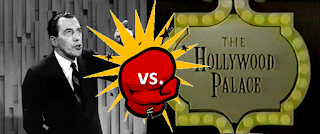
During the 60s, the Ed Sullivan Show and The Hollywood Palace were the premiere variety shows on television. Whenever they appear in TV Guide together, we'll match them up and see who has the best lineup..

Sullivan: Ed's scheduled guests include Joel Grey, star of Broadway's musical biography of George M. Cohan; the 5th Dimension; singer Jane Morgan; comedians Morey Amsterdam, London Lee and Joan Rivers; and the West Point Glee Club.

Palace: "Comedy Tonight," sung by host Milton Berle, sets the theme for guests Nanette Fabray, singer-pianist Buddy Greco, Jack Burns and Avery Schreiber, and the singing King Family. Also on hand: the Los Angeles Rams' Fearsome Foursome (Roger Brown, Deacon Jones, Lamar Lundy and Merlin Olsen) and their teammate Roosevelt Grier.

The Hollywood Palace is a rerun tonight, and I'm fairly sure I covered it the first time it was on. I don't think I was all that impressed by it back then, and I'm not much impressed by it this time, either, although it is free of the lesser-known vaudevillians that so often populate the show. Problem for The Palace is that Ed's lineup doesn't feature vaudevillians, either. Joel Grey would cop a Best Actor Tony nomination for George M!, the Broadway musical based on Cohen's life, and would recreate the role two years later for an NBC special. Morey Amsterdam, "The Human Joke Machine," is in my opinion the funniest part of The Dick Van Dyke Show. The 5th Dimension and the Glee Club provide the music, and Joan Rivers is, well, Joan Rivers. It's not decisive, but Sullivan wins the clear-cut decision.

◊ ◊ ◊

One of the things I enjoy about these TV Guides are the occasional glimpses, intentional or unintentional, they give us into our future. Such is the case this week, beginning on Monday night when WNEW (New York) and WNHC (New Haven) preempt their entire prime-time lineup for a three-hour documentary on America's racial crisis, called "One Nation, Indivisible." It's a product of the Westinghouse Broadcasting Company and airs nationally on many Group W stations, combining national segments with local panel discussions and phone-in segments. The question, according to host Rod MacLeish, is "Whether it's possible to bridge the dreadful chasm between the American races or whether ... our days as one nation indivisible are numbered." Nearly 50 years later, we're stil asking the same question.

Also on Monday night at 10:00 ET, ABC's latest installment in its Saga of Western Man casts an ominous and, frankly, depressing look at what we now recognize as the future of the church. "In the Name of God" investigates modern missionaries, "whose goals are secular as well as spiritual. They are not out to win converts, but to help people create a better standard of living - 'and let the people determine their own lives.'" What could possibly go wrong with that? Judging by the plummeting numbers of Christians throughout the world*, if these "forward-looking" missionaries were looking forward to a future bereft of faith, I'd say they did a damn good job of it.

*Not to mention the pronouncements of a Pope who bears a striking resemblance to a character from a certain book.

On Thursday night at 8:30, WNDT (New York's NET station) portrays the plight of teenagers in the ghetto in "School's Not Enough." Efforts to increase hope for these ghetto youth include job-training programs and educational opportunities. It sounds a lot like the kinds of programs my place of employment works with. Again - what's changed? The problems are still the same, the demographics are still the same, the arguments are still the same. Meanwhile, Friday at 9:00 p.m., independent station WNYC looks at another social issue, asking the question: "Can a Mother and a Housewife Also Be a Career Woman?" The guests - a marriage counselor, a psychiatrist, and a housewife and career woman - look for answers to a question we're still debating today.

Frank McGee hosts Tomorrow's World, on Friday as well (10:00 p.m.) looking at "A New Era in Medicine." Included are studies in genetics to overcome nerve problems and mental retardation; fetal treatment that would enable surgeons to operate on unborn children; mapping individual brain cells to look at various disorders; and exploration of techniques and tools that might enable doctors to treat tumors before they form. It's part Brave New World, part Watch Mr. Wizard - and, today, mostly true.

In political news, the networks look back to the aftermath of the Indiana presidential primary, and wonder if Eugene McCarthy and Robert Kennedy might debate prior to the May 14 Nebraska primary, which would not yet have taken place as this issue went to press. In the end, there is no debate in Nebraska - but there will be one in California prior to the pivotal June 4 primary, a little over two weeks from now. And then?

◊ ◊ ◊

And now a brief look at the rest of the week.

On Saturday night, NBC's Tonight Show rerun looks to have been a fascinating one, as Johnny's guests are Florence Henderson, the Temptations, and Ayn Rand. What a combination. The Emmys are Sunday night at 10:00 p.m. on NBC, hosted by Frank Sinatra in New York and Dick Van Dyke in Hollywood; among the big winners are Mission: Impossible for Best Drama, Get Smart for Best Comedy, Laugh-In for Best Variety or Musical Show, and the Hallmark Hall of Fame's "Elizabeth the Queen" for Best Dramatic Special. Wednesday's NET Festival presents highlights from the Monterey Jazz Festival, with Dizzy Gillespie, Earl "Fatha" Hines, B.B. King, Richie Havens, and the Modern Jazz Quartet among the headliners. Oh, and a note at the beginning of the program section warns us that due to the Vietnam peace talks, all shows are subject to preemption.

The sports highlight is the Preakness Stakes, live from Baltimore on Saturday afternoon. (CBS, 5:00 p.m.) Forward Pass, who was handed the Kentucky Derby when Dancer's Image was disqualified for illegal drug use, defeats Out of the Way to take the second jewel of the Triple Crown; in three weeks he'll be defeated at the Belmont by Stage Door Johnny, saving everyone from a slightly tainted Triple Crown champion.

And finally, an explanation of Mike Connors' presence on the cover. The inside story isn't really about him at all - it's just an article by the owner of a large detective agency saying how real-life detective work isn't nearly as exciting as what we see every week on Mannix, how he doesn't meet all the beautiful women and doesn't get beaten up or shot at every week like Mannix does, how when a client fires him he doesn't go on investigating the case anyway, and so on. It reminds me of a story told by the novelist D. Keith Mano, who was teaching a creative writing class and slogging through some dreadful efforts by earnest would-be writers. When one, complaining about his low grade, protested, "But this is how it was," Mano replied, "Yes, and make sure it doesn't happen again." And that's why Joe Mannix's life is more interesting than yours, Mister Private Detective. TV  

March 5, 2013

Close Up: How The Beverly Hillbillies explains your salvation

A while back I’d made an offhand comment that 1965 might well be the year that defined the decade of the 60s; prior to that, much of the 60s still depended on the 50s for its definition; after that, the 60s devolved into the disintegration of everything familiar, an era that continued well into the 70s.

And so perhaps it’s appropriate that we take a closer look at the Malcom Muggeridge article I mentioned at the end of this week’s TV Guide review (March 6, 1965), because I think there’s more to this piece than we can get into in the regular “This Week” format.

Muggeridge, although he once claimed to have no sense of humor, was widely known as a wicked satirist; the New York Times referred to him as a “caustic social critic.” He’d been the editor of the British humor magazine Punch, and he was rarely at a loss for words – or targets of that caustic criticism. He wasn’t afraid of being outrageous; witness his 1957 Saturday Evening Post article “Does England Really Need a Queen?” which, needless to say, created something of a stir back home.

However, there was always a serious subtext behind Muggeridge’s humor, and this side became more pronounced as the 1960s evolved. He became an outspoken critic of the counterculture, especially the drug and sexual revolutions. By the time of his 1966 book Tread Softly for You Tread on My Jokes this more serious side was much in evidence, so despite the TV Guide cover’s promotion of Muggeridge’s article as “a renowned critic’s witty report on the British passion for American TV” (and in fact the dry Muggeridge wit is certainly visible), I think it fair to assume that Muggeridge was really talking about something much more profound, especially regarding the spiritual evolution (or devolution) of British and American society.

The premise of this article is an analysis of why The Beverly Hillbillies has become the most popular program on British television. This is due in large part, according to Muggeridge, “precisely because they are so tremendously American.

The fact is that we Europeans, whatever we may say to the contrary, are crazy about everything American. Indeed, I sometimes think that the more anti-American we purport to be in attitude, the more Americanized we tend to become in our tastes, our speech and our attire.

OK, so that’s easy enough to follow. There’s long been a school of thought that anti-American attitudes are born of jealous as much as anything. (Whether this is still the case, or that in the intervening 50 years American culture has earned that antipathy on its own is another question.) But just what is it about the Hillbillies’ American-ness that makes such an impression on Brits – or fellow Americans, for that matter?

Muggeridge suggests that there is an innocence about the Hillbillies that appeals to a cynical populace. “We, too, yearn after wealth which does not corrupt; after an innocence which triumphantly survives the possession of riches.” Jed may have hit the jackpot with that oil strike, but it hasn’t fundamentally changed either he or his family, “constantly on the edge of succumbing to the lures of luxurious living, but always at the last moment pulling back and resuming their old, virtuous ways.” There is an irony to this, though, in that our cynical selves would rather admire the virtuous than emulate them: “In accordance with the principles of an Affluent Society as laid down by Professor Galbraith, we have rejected the outmoded Christian notion that the poor are blessed, but we should still like to be convinced that it is possible to be rich and blessed.”* By watching the success of the Hillbillies each week, we are reassured that we can have our cake and eat it too.

*Muggeridge was in large part responsible for bringing Mother Teresa to popular light through his book Something Beautiful for God. I suspect therefore that the phrase “outmoded Christian notion” is meant as brittle sarcasm.

And this success bodes well not only for the here and now, but for the hereafter as well. “Week by week [the Hilbillies] demonstrate that, though possessed of great wealth, they can still just get through the needle’s eye into the kingdom of heaven.” Muggeridge expands on this spiritual aspect, for it is one that is crucial to understanding the role of television in modern culture – it “is largely dedicated to providing reassurance on precisely this score.”

The early Christians, in order to secure themselves against indulgence in sensuality and cupidity, persuaded themselves that their fleshly appetites were vicious and great possessions a handicap to virtuous living. The writings of the fathers and the saints are full of denunciations of sex and riches. Now, when we have created a way of life in which sex is our chief relaxation and riches our main pursuit, traditional Christian teaching in this respect would seem to require revision. We cannot accept the drastic notion of ourselves as sinners. Nor can we in decency just repudiate the fathers and the saints.*

*Almost 50 years hence, has anything really changed?

The answer, therefore, is to demonstrate that the two can coexist, “that, like the Hillbillies, we can be rich and still successfully repel the assaults of the Evil One.”

It is not only tempting to draw parallels between the 60s that Muggeridge describes and our own time, it is virtually impossible not to do so. Many of us dream of what we would do with sudden wealth, should our Powerball number finally come up. We may quit our jobs, buy homes for our loved ones, establish scholarships, fund charities, buy a fancy sports car. One thing is for sure, though: our sudden wealth will not change who we are. We not only say this, we not only believe it will be so, we have a desperate need to believe it.

The role of television in all this cannot be minimized. As I’ve so often suggested, television does not create so much as it reflects, and the truth reflected by the success of the Hillbillies is one that dates back to the Victorians. “[O]bsessed as they were with the lusts of the flesh, [the Victorians] were always trying to demonstrate in their popular art that chastity could survive in the poor and the simple despite all the lures and stratagems of accomplished seducers. We, obsessed with money, seek in our popular art to reinforce the conclusion that the poor remain blessed even when they become rich.” Television, therefore, simply takes its place in a long line of visual media as reinforcing this belief.

What saddens me and, I think, would sadden (though perhaps not surprise) Muggeridge as well, is how we’ve seen this attitude change in the last few years. You hear much talk about the utility of morality, especially in terms of religion, and especially in terms of the American Founding Fathers. It is said, and it is a debatable point, that most of the Founders were Deists. However, it is undeniable that most of them understood the need for religion, even if they themselves didn’t believe in its truths. Franklin, for instance, felt that organized religion was necessary to keep men good to their fellow men, writing Thomas Paine that members of society “have need of the motives of religion to restrain them from vice, to support their virtue, and retain them in the practice of it till it becomes habitual, which is the great point for its security.”

This attitude is mostly a given in Muggeridge’s article. Even if we strive to make wealth coexist with virtue, we do not deny the merits of virtue. We know that being blessed is a desirable state to be in, and we understand, even if only subconsciously, that the desire for wealth and power and sex somehow diminishes that state of virtue – else why should we attempt to reconcile it all?

Today, however, I don’t think anyone would be sure of that. Rather than aspiring to a virtue that, though it may be unattainable, is still recognized as being worthy, we now deride virtual altogether. Not only are there fewer and fewer standards which a majority can agree on, there is disagreement as to whether or not standards are even necessary. Viewers in the 60s may have looked at the Hillbillies as quaint, but they felt good about the idea that they could be both “rich and blessed.” Today, the blessed part isn’t important – we’d rather be rich and sated.

Not the Beverly Hillbillies
As evidence of the universality of the fairy tale epitomized by the Hillbillies, Muggeridge had cited, interestingly enough, The Beatles – a group he loathes, calling them “four moronic and unpleasing youths with long hair and little talent.” Nonetheless, a great deal of their appeal in 1965 came from the perception that they remained “unspoilt” by their wealth and fame. “[T]hey are still the same simplehearted, inarticulate Liverpudlians that they always were.” The Beatles are, in essence, Britain’s own Hillbillies.

Now, by the end of the 60s, I’m not sure anyone would have considered The Beatles “unspoilt”- by this time they’d encountered drugs, experimental music, and the Maharishi Mahesh Yogi. In a way this exposes the fallacy of the fairy tale that so many longed to believe in. There’s an old saying that “when you lie down with dogs, you get fleas.” Likewise, wealth, power and sex create their own burdens, and by separating these from virtue, we soon succumb to their collective weight.

Muggeridge concludes his article with the observation that, thanks to television, “more people in the world today know The Beverly Hillbillies, it is safe to assert, than know President Johnson or even the Pope. Backward or undeveloped nations are shown by means of television the way of life toward which they so ardently aspire.” The global reach of television leads us into uncharted waters; “Such a thing has never happened before. No need to take on trust the rewards of toil and struggle; it is there, visible, on the television screen.” No matter who he is, no matter where he is, a citizen of the world “sees with his own eyes all he may enjoy and become”.

It’s quite interesting that an article with so many layers would be published in a “popular” publication like TV Guide, but the times were different, and serious content often landed in the magazine’s pages. By the way, if this all sounds a little dry and scholarly to you, it’s not meant to. Muggeridge’s article is in fact quite readable, and frequently slyly humorous. On the face of it Muggeridge is being his outrageous old self, satirizing the desire television has to be seen as Important. But behind his mock seriousness lies a true appraisal of the culture of the 60s and where it was leading, and I’ve no doubt that Muggeridge was deadly serious in his appraisal of what the popularity of The Beverly Hillbillies says about ourselves and our time. As Muggeridge might have said, “I’m surprised that you’re taking this seriously. But I’m even more surprised that you aren’t.” TV

February 23, 2013

This week in TV Guide: February 25, 1961

James Hagerty, prior to becoming head of ABC News, was President Eisenhower's press secretary - so it is with this dual authority that he offers, in this week's edition, a "Creed for Television Newsmen."    There are six points to this creed:

1. TV news reporting must be "factual, impartial, free and fearless. It cannot permit itself to be dominated or even remotely to be associated with any group or faction of special interest, any political party or any government."

2.  While analyzing and explaining news developments, "it must not confuse news reporting with personal opinion of a commentator who, after all, is expressing only his own thoughts and analysis."

3. Local, regional and national news "must never be neglected or overlooked."

4. News must be reported from "all sections" of the world, regarding a larger staff of trained reporters with expertise in foreign languages.

5. TV news cameras "must have the right to cover news wherever it happens, here at home or overseas."

6. "A good reporter does not seek to fake or exaggerate his story.  He gets the news as it happens, and reports the truth, the whole truth.  That is his job."

Politics is part of the cultural history not only of this country but of television, and so I've spent a fair amount of time on it.  I've tried, however, to keep my distance when it comes to ideological interjections, although I've got a fair number of opinions (as anyone who knows me can attest).  Having said this, I find it interesting that fully three of Hagerty's six points deal with the importance of neutral and objective reporting.  Now, without injecting any partisanship, I think we can all agree on the importance of this, and I hope we can also acknowledge that, no matter which side of the political fence you stand on, television news falls woefully short not only in this area but on all of Hagerty's points.

Hagerty served as head of
ABC News from 61-63
Obviously, this isn't a new problem; Hagerty wouldn't have made such an issue of it otherwise.  But one of the more unfortunate aspects of the fragmentation of American society over the decades is that the discerning viewer can pretty much watch whichever news program slants towards his or her point of view.  Just as music doesn't need to appeal to the masses any longer, and thus shatters into a million different niche networks, there is no incentive for any news program to offer objective, unbiased coverage.  Liberal?  Watch MSNBC or CNN.  Conservative?  Fox News.  Human interest stories?  There's always the networks, who seem to have pretty much given up on hard stuff.  And so on.

This isn't the place to debate solutions to the situation, of course, but one further point before we move on: Hagerty's first point, that the news must be kept separate from special interests, is one reason why Reuven Frank, as producer of NBC's Huntley-Brinkley Report, kept it commercial-free in its early years.  Frank understood that a news program had to avoid even the hint of a conflict of interest.  Considering the amount of influence sponsors exercised over programs in the early days of TV, it's no wonder Frank wanted to keep the news free of such entanglements.  Of course, today the bottom line in TV news is not journalism so much as the network's profit-loss statement.  So I guess none of us should be surprised.

***

CBS's Sunday documentary series The Twentieth Century casts a spotlight on French turmoil, and one can't help but see this as a forerunner of the chaos waiting around the corner in the United States.  The show promises to tell us about the "turbulent youth of France.  LEARN why they condemn conscription, defy [President] deGaulle, rebel against the Algerian war.  SEE if they are the sinners or the saviors of France."  We learn that amidst this tumult, "one dominant theme always recurs - Algeria."

Substitute "Vietnam" for "Algeria" and you've got almost a perfect match, don't you think?  Resist conscription, i.e. the draft?  Check.  Defy the President?  Check.  Sinners or saviors?  That's the question people would be asking here in a few years.  Certainly this country had problems in 1961; the civil rights movement was in full swing, and there was nothing tranquil about that.  And yet, Americans watching this show might well have thought that the French were going mad, the Republic was teetering on the brink, and the children were lunatics running the asylum.  Thank God it couldn't happen here.

***

Life magazine celebrates its 25th anniversary on Thursday night with a 90-minute star-studded extravaganza on NBC, hosted by Bob Hope.  It's truly a moment in time; for two decades the famed weekly picture magazine had chronicled our times, portraying life in all its various shapes, sizes and (eventually) colors.  And here it is being feted by the very medium that is inexorably taking its place.  Exotic images of foreign lands, the pomp and pageantry of coronations, the breathtaking drama of sporting events - all of this had made Life a staple of American households.  But now you can see all that on television, except for the color (and that's coming soon enough), and these pictures move!

Soon enough Life would be gone.  It folded in 1972, came back as a monthly in 1978, folded again in 2000, tried one further comeback as a Sunday newspaper supplement in 2004, and finally folded for good in 2007.  And the medium that took its place, television, now finds itself in the same position in relation to the internet.  Am I the only one who finds this moment ironic?

***

On the cover this week are the stars of CBS's Candid Camera.  If the smiles in the picture look somewhat forced, there's a good reason for it.


Candid Camera premiered on radio in 1947, where it was known as Candid Microphone.  It made the transition to television the next year where it remained, off and on, until 2004.  Candid Camera was an early form of reality television, but rather than the celebrity horror shows of today, I think you could describe it as being more like America's Funniest Home Videos.  For those of you unfamiliar with it, the premise was simple: an ordinary person walks into a seemingly normal situation, which rapidly becomes completely abnormal.  For example, a gas station attendant* fills the tank of a car, but no matter how long he's at it the tank never fills up.  The car is found to have a fake tank in it, but not before the surprised attendant is told, "Smile - you're on Candid Camera!"

The picture on the cover is taken from Camera's 1960-67 run on CBS.  The balding man in the background, looking as if he desperately wants to be seen, is Candid Camera creator Allen Funt.  He's being blocked by the legendary Arthur Godfrey, who at this time is co-host of the program.  The woman to the left is the singer-actress Dorothy Collins, who often appeared as the person who introduces the unsuspecting victim into the extraordinary situation (for example, she drove the car to the gas station in the prank listed above).

Candid Camera was Funt's baby through and through, but Godfrey was a known commodity to CBS and sponsors, and it might well be that the network thought he would be more likely to attract viewers than Funt alone. It was a relationship doomed from the start; Godfrey's ego demanded a large role, and he saw the program as a vehicle for his folksy humor and commentary, and yet at heart the show was nothing more than a collection of videos requiring basic introductions.

Funt, no shrinking violet himself, resisted Godfrey's efforts to put himself at the center of the show. He told a San Francisco interviewer "that Candid Camera would be much better if Godfrey didn't talk too much" and added that "if the Godfrey problem can't be solved, the Candid Camera company has another similar show in the works and ready to put on the air."  In one instance, Funt was said to have become so fed up with Godfrey that he stormed off the set during rehearsal, refusing to take part in the show's taping.  In the end, Funt won out.  Godfrey disappeared after the first season, replaced by Garry Moore's sidekick Durward Kirby (Camera had for several years been a regular feature of Moore's variety show).

***

Isn't this a terrible cartoon rendition of The Flintstones?  Fred and Wilma aren't bad, but Barney is terrible.  And who's that kid supposed to be?  It's not Bamm-Bamm.

I don't know where this came from; it's clearly not a network advertisement, although The Flintstones were in first-run on ABC.  I can only think that the ad came from WTCN, and despite what I've said about it, local ads like this are one of the charms of TV Guides of this era.  It's the opposite of the slick, packaged material we're so used to seeing in publication nowadays.  Considering ABC's status as the number-three network of the time (by a wide margin), I wouldn't be surprised if most of its affiliates were on their own when it came to this kind of advertising.

Speaking of advertising, let's close with this note, a very clever, very funny TV Guide parody by Checkboard Square, makers of Chex cereals.


It's not only an ingenious way to advertise Chex, but a brilliant, meticulously done spoof of television and TV Guide itself. The shows themselves are great (My Three Chex, starring Claude Grains; movies including A Star is Corn and King Corn), but best of all is the care with which the TV Guide layout was duplicated.  Had to have been done with the magazine's cooperation, don't you think?   I wonder how many people, gradually flipping through the pages, actually thought this was legit? TV