February 26, 2022

This week in TV Guide: February 29, 1964


From 1963 through 1969, ABC broadcast a very good series of historial documentary specials under the umbrella title The Saga of Western Man, produced by author and ABC News correspondent John Secondari and his wife, Helen Jean Rogers. The series focused on the people and events that Secondari and Rogers felt had propelled the development of Western civilization—from the birth of Christ to the life of DaVinci to Columbus and the discovery of America.*

*I've often wondered why no one has ever made a series out of Will and Ariel Durant's 11-volume work, The Story of Civilization. Maybe this is as close as they'll ever come. 

On Saturday night at 7:30 p.m. PT, the topic is "1898"—the year that "marked America's emergency as a world power." It was a significant year indeed: the Indian wars had been concluded, the age of the oil, railroad and steel barons was upon us, and immigrants were providing low-cost labor. Perhaps most significant was the emergence of a figure who was to become larger than life on the American scene: Theodore Roosevelt.* As Assistant Secretary of the Navy, Roosevelt played a key role in the construction of what would be known as the Great White Fleet, famous for their 1907 tour around the world (at the command of none other than President Theodore Roosevelt); later in the year, Roosevelt would lead his Rough Riders against Spanish troops in Cuba. If you want to argue that this was a watershed year in American history—the birth of the modern America, if you will—then I won't disagree with you.

*Actor Sidney Blackmer, who played Roosevelt a dozen times in the movies, provides T.R.'s voice in various readings.

   The destruction of the Maine, which
   led to the Spanish-American War
You wouldn't have a series like The Saga of Western Man on network television today, for a variety of reasons besides the fact that none of the commercial networks would ever run a series of historical documentaries in primetime. For one thing, it couldn't be called "Man," for reasons I hardly need to explain. You couldn't treat Western civilization as something to be celebrated, either; we all know that the West is the source and summit of everything that's wrong with the world. And you couldn't talk of the United States as a world power, because it isn't one anymore; born in 1898, one could say that it died in 2021. If this country has become a laughingstock in the world, it's only because it has fallen so far. 
I wonder what Theodore Roosevelt, who believed in what one might call "Muscular Americanism," would think of all this. For that matter, what would John Secondari think of it?

l  l  l

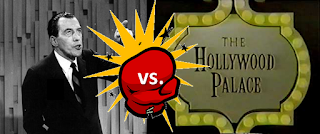
During the 60s, the Ed Sullivan Show and The Hollywood Palace were the premiere variety shows on television. Whenever they appear in TV Guide together, we'll match them up and see who has the best lineup..

Sullivan: Ed welcomes songstress Anita Bryant; comic Jack Carter; ventriliquist Rickie Layne and his little pal Velvet; and Julius Monk's "Baker's Dozen" revue.

Palace: Host Efrem Zimbalist Jr. shares some laughs with his old 77 Sunset Strip buddy Louis Quinn and introduces Kate Smith; the Great Wallendas, high-wire artists; Roy Rogers, Dale Evans, Trigger and the Sons of the Pioneers; comedian Corbett Monica of The Joey Bishop Show; and Albert Rix and his trained Russian Bears.

First things first: as far as novelty acts go, I'll take trained bears over ventriliquists any day. Now, I always thought and still think Anita Bryant had a lovely voice, and Jack Carter can be very funny at times. But let's be real: Kate Smith and Roy Rogers and Dale Evans (with or without Trigger) are quality headliners. The Flying Wallendas were and may still be the most famous high-wire act in history (and were even moreso then, when they were only two years removed from their tragic accident in Detroit). With all that, Efrem Zimbalist and  Louis Quinn (who played Roscoe on Sunset Strip and must have been there for comic relief) are just icing on the cake. It's an easy call: The Palace takes the honors.
l  l  l

Throughout the 60s and early 70s, TV Guide's weekly reviews were written by the witty and acerbic Cleveland Amory. Whenever we get the chance, we'll look at Cleve's latest take on the shows of the era. 

Bill Dana's character José Jiménez ("My name José Jiménez") debuted on The Steve Allen Show in 1959, and rode the contrails of the Mercury astronauts to stardom (he was a favorite of the flyboys, who found his astronaut skit hilarious); after appearing as a character in Make Room for Daddy, it's not a surprise that in 1963, at the height of his popularity, he was spun off into his own sitcom, which probably could have been called José Jiménez but instead carried the title The Bill Dana Show when it premiered on NBC.

As Cleveland Amory describes him, José  is "the little man fighting to better himself but convinced, due to his helpful nature, that every man was put on earth to better his fellow men." He works as a bellhop at the Park Central Hotel in New York; naturally, he is the nemesis of his boss (Jonathan Harris) and the house detective (Don Adams), and proves a frustration to his fellow bellhop Eddie (Gary Crosby), who was trying to keep José from being taken advantage of. 

Predictable, to be sure, and not terribly sophisticated, but not without its charms, according to Cleve. "[I]f slapstick is your dish," he writes, "you'll get plenty of it in this show and even if it's not, once in a while you'll get a genuinely funny splituation." Much of the humor comes from José's naivety and fractured English, such as when he decides to become a "financial typhoon" by buying stock in the hotel. During the shareholder's meeting, when the chairman rules him out of order, he replies, "No, I'm not. I had a physical last week." And when the chair finally recognizes him, José responds, "You do? I don't know you." Not everyone's cup of TV, Amory acknowledges, but how many people go to a hotel for the television anyway?

l  l  l

Some interesting notes in the margins this week, so to speak. On NBC's Sunday afternoon newsmagazine, appropriately named Sunday and hosted by Today newscaster Frank Blair (3:00 p.m. PT), drama critic William K. Zinser reviews the "controversial Broadway play" The Deputy, written by German playwright Rolf Hochhuth, and the word "controversial" is something of an understatement. To this point in history, Pope Pius XII had generally been regarded, by Christian and Jew alike, as a moral and humanitarian hero of World War II; Hochhuth, instead, presented the pope as antisemetic, indifferent to the suffering of the Jews and sympathetic to Nazi Germany, which he saw as a geopolitical balance against the Soviet Union. 

Huchhuth's portrayal of Pius as the "heartless, money-grasping pontiff "who turned a blind eye to the Holocaust has become something of a cause celebre among the jejune literati, butressed by historical slanders such as Hitler's Pope by the liberal Catholic John Cornwall. We now know, for example, that the storyline was probably a product of General Ivan Agayants, chief of the KGB's disinformation department, as part of a Soviet campaign to discredit and defame Pius—a campaign that, it must be admitted, has been largely successful in popular culture. It's only been in the last few years that the pontiff's reputation has started to be rehabilitated, with the publication of several books corroborating Pius' efforts on behalf of the Jews. But, as they say, the smear story always appears on page one, while the retraction appears in the small print on page 70. 

In case you're wondering if I've actually read The Deputy, I have a copy in my library, which I used while researching my book The Collaborator. It's unorthodox, mildly interesting, and totally slanderous.

Speaking of politics, as we tangentially have been, on Thursday night ABC News Reports previews next Tuesday's New Hampshire presidential primary (10:30 p.m.). If you'd asked experts six months ago what to expect, they'd have said that the Democratic half of the equation would be pretty quiet, with an incumbent president running unopposed, while the Republican side could present fireworks and possibly a surprise winner. Well, they were right—and yet not at all in the way they thought. 


The incumbent Democrat does indeed win, but his name is Lyndon B. Johnson instead of John F. Kennedy, and that still takes a lot of getting used to, a little over three months after the fact. Meanwhile, although Barry Goldwater and Nelson Rockefeller are the principal Republicans, the winner is a total shock: not former Vice President Richard Nixon, or Michigan Governor George Romney, or Pennsylvania Governor William Scranton, or any of the other establishment figures. Instead, first place goes to a man who didn't campaign nor set foot in the state, and who's name isn't even on the ballot: Henry Cabot Lodge Jr., current U.S. ambassador to South Vietnam, and formerly a U.S. senator from Massachusetts and Nixon's running mate in 1960. The Lodge write-in campaign, driven by four friends "looking for something exciting to do," and run out of a small office in Concord, is one of the great stories in modern politics, made even moreso by comparison to the precise, poll-driven methods of today. You can read all about this remarkable story here. 

l  l  l

On Monday, Leslie Uggams and Bob McGrath are among the soloists on Sing Along With Mitch (10:00 p.m., NBC). According to the TV Teletype, Sing Along may be headed for ABC next season, having been bumped out of its Monday night slot (in favor of The Alfred Hitchcock Hour); the network thinks it would make an ideal Saturday night companion to The Lawrence Welk Show. For whatever reason, the Miller-ABC merger never happens, and the slot following Welk winds up going to The Hollywood Palace.

KPTV, the former ABC affiliate in Portland, Oregon, is, as of March 1, an independent station (while former independent KATU is now tied to ABC). As a result of the switch, the station has a new lineup, including, on Tuesday, the British drama The Human Jungle (8:30 p.m.), starring Herbert Lom as psychiatrist Dr. Roger Corder. I've written about this series before and will again; it's an excellent, edgy series that illustrates how fragile and yet resiliant the human mind is, and anyone who knows Lom primarily from the Pink Panther movies will be in for a surprise.

The U.S.S. Thresher is very much in the news in March, 1964. The nuclear-powered submarine sank on April 10, 1963 during deep-diving tests off the Massachusetts coast, killing all 129 aboard. Wednesday, CBS Reports looks back at "The Legacy of the Thresher" (7:30 p.m.), including footage taken by the bathyscaphe Trieste shortly after the sinking. (Reports vary as to the cause of the accident; the details are in this fascinating Popular Mechanics artice.) Many years later, a secret mission, funded by the Navy and conducted by oceanographer Robert Ballard, used the submersible Alvin to gather data on the wreckage sits of the Thresher and another atomic submarine, the U.S.S. Scorpion. In return for Ballard's work, the Navy allowed him to continue to use the submersible for a project of his own, which the Navy then used as a cover story to keep the mission secret. Ballard's project: his search for the wreckage of the Titanic.

Perry Como has been a mainstay on television since 1948, and host of the Kraft Music Hall since 1959. But now, Mr. C is scaling back a bit, and beginning with this 1963-64 season, he's replaced the weekly grind with seven specials a year—arena shows set in different cities around the country. On Thursday,  Perry broadcasts from Municipal Auditorium in New Orleans, with his guests Mickey Rooney, Martha Raye, Al Hirt, and ballet dancer Jacques d'Amboise. (10:00 p.m., NBC)

Friday, it's part one of the two-part series finale of Route 66 (8:30 p.m., CBS), and Tod Stiles (Martin Milner), who's spent four years chasing girls without being caught, may have finally met his match: the eccentric members of the Tifin family are trying to marry off their niece as a condition of inheriting $5 million, and they think Tod would make the perfect groom. Their advantage: the bride-to-be is Barbara Eden. I ask you, who could pass up that opportunity?

l  l  l

Finally, the starlet who's already a star: 18-year-old Zina Bethune, who plays student nurse Gail Lucas on the CBS series The Nurses. Zina's hardly a newcomer to the entertainment scene, pursuing dual careers in acting and dancing; at 6, she was appearing off-Broadway; at 7 she was in George Ballanchine's School of American Ballet and was a lead in The Nutcracker by the time she was 10, and in a TV production of Tennessee Williams' This Property is Condemned. She's a veteran of The Guiding Light and Young Doctor Malone, Broadway plays, movies, and TV guest apperances. In fact, as Alan Gill notes in this week's cover story, "she hasn't missed much—except the experience of being young."

Shirl Conway, who plays mentor Liz Thorpe—we're in the era of shows featuring an older mentor imparting wisdom to the young student, after all, and Conway is Dr. Gillsepie to Bethune's Dr. Kildare—says, "That kid is more worried at being 18 than I was at turning 47," and adds, "Oh, I'd like to see her run in the fields." Zina herself acknowledges that "I'm at the beginning of a road —a long, lonely road. Eventually, I'll get married. I want companionship." But she takes pride in her work; Conway says that this role "hasn't shown what she's got by a hell of a long shot. The kid's an actress."

The Nurses lasts on television for three seasons, until 1965; for the last season, it's known as The Doctors and the Nurses, and brings on Michael Tolan and Joseph Campanella as the titular doctors. It then winds up as a daytime soap for a couple of years on ABC, under its original title and with the same characters, but not played by the same actresses. So although she's no stranger to daytime drama, Zina doesn't make the transition. 

She does, however, go on to make her mark in many ways; her best-known role might be opposite Harvey Keitel in Martin Scorsese’s 1967 movie Who’s That Knocking at My Door. She founds her own dance company, Bethune Theatredanse, and choreographs more than 50 works. She becomes involved in animal rights, and she does marry, to actor Sean Feeley, with whom she is still married when she dies in 2012 as the result of a hit-and-run accident. TV  


February 25, 2022

Around the dial


The news right now is very, very bad, or very depressing, or (in all likelihood) both. And some probably think that looking at old television shows is a waste of time, when there are more important things to deal with. But I like to think that, as my friend David Hofstede says, this "comfort TV" can help give us a breather, even if it's just temporary. So let's take one right now.

In fact, we'll start at Comfort TV today, where David uses Rémi Brague's book Curing Mad Truths: Medieval Wisdom for the Modern Age (which I think I'll have to get) as the basis for looking back at how the era of classic TV provides us with some essential truths about our culture. Not only thought-provoking, but spot-on.

At bare•bones e-zine, Jack's Hitchcock Project continues with the second of Lewis Davidson's scripts for the show, the tenth-season story "Misadventure," a nasty little domestic drama starring Barry Nelson, Lola Albright and George Kennedy, and filled with more twists and turns than the Nürburgring.

Speaking of Hitchcock (I love these smooth transitions, as you know), Rick at Classic Film & TV Café is on the case with another installment of the Movie Quote Game; the subject, as if you didn't already know, is quotes from Hitchcock films. How well do you know them?

The Hitchcock shows, both 30- and 60-minute versions, exist in their entirety. John's current Cult TV feature focuses on shows that have only a very few surviving episodes, and this week his eyes fall on the Saturday Night Theater episode "A.D.A.M.," and the fear of technology—a prudent fear, I'd say.

In going through old TV Guides, one finds, in the early days of public broadcasting, the children's classics Sesame Street, The Electric Company, and Mister Rogers' Neighborhood. But for a short time, there was also ZOOM, which we read about at the Broadcasting Archives.

Drunk TV takes us back to the 1970s, as Paul looks back at "a true gem," the 1979 TV-movie Breaking Up is Hard to Do, taking us behind the scenes in the world of formerly married men. Ted Bessell, Jeff Conaway, Robert Conrad, Billy Crystal, Tony Musante, and David Ogden Stiers star—you can't do much better than that.

That's it for the week; in the meantime, pray for peace. TV  

February 23, 2022

The Descent into Hell: "A Taste of Armageddon" (1967)


Someone once said that hindsight is 20/20.* Now, I don’t think that’s always true, but part of being a cultural archaeologist involves sifting through the detritus left by the past, searching for the clues that give us an idea of how the present came to be. Think of it as operating in the same way that an arson investigator goes about looking for evidence—always asking the question, What happened here? And how?

*In fact, the saying, “Most people's hindsight is 20-20" is generally attributed to humorist Richard Armour.

It’s especially true when it comes to the wreckage of a civilization. How could such a thing happen? We wonder. It’s an especially unsettling time, and try as we might to remain dispassionate, we can’t help phrasing the question in the first person, as if we’re looking in the mirror.

How did we allow this to happen?

l  l  l

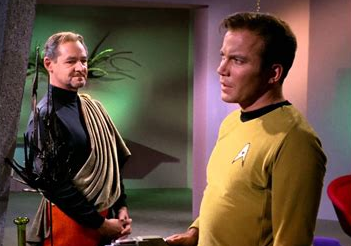
The Star Trek episode "A Taste of Armageddon" 3first aired on February 23, 1967, and it finds the crew of the Enterprise confronted with a confounding scenario: a war in which no shots are fired, but people still die. How can this be?

The planets Eminiar VII and Vendikar have been at war for five hundred years (and you thought the Hundred Year War between England and France was bad). During that time, millions of people have died, casualties of the back-and-forth attacks between the two planets. In fact, shortly after Kirk and company arrive on the surface, another fusion bomb attack occurs, with more deaths resulting. However, the crew has observed no explosions, seen no damage, witnessed no bloody and battered bodies. And then they learn the truth of the situation.

Yes, there was a real war, once upon a time, and there was death and destruction to accompany it. So much so, in fact, that the leaders of the two planets realized what Robert E. Lee had so famously said, that "It is well that war is so terrible, otherwise we should grow too fond of it." But whereas the American Civil War ended thanks to the determination of Lee's adversary, Ulysses S. Grant, that the best way to end a war is to win it, the war between Eminiar VII and Vendikar took an entirely different tack.* Realizing that neither society can continue to absorb the material destruction caused by the conflict, and apparently resigned to the irreconcilability of their dispute, they opt to make things cleaner, more sanitary, more socially acceptable, by replacing actual battle with a computer simulation, one in which "Attacks are launched in concept [and] casualties established through statistical adjustment." 

*Probably because the woke teachers of the future, having cancelled Lee out of American history, never passed on his prescient observation to future generations.

Kirk takes matters into his own hands, again.
But there's a deadly twist to all this: once the statistical fatalities have been determined, those presumed to have been killed in the attack have 24 hours to show up at a disintegrator chamber to fulfill the terms of the agreement between the combatants. If either side reneges, the other is free to launch an actual attack, complete with all the horror that the leaders have decided is too messy. And there's a deadlier twist, one that provides the impetus for the story's resolution: Kirk and his landing party, as well as the Enterprise and her crew, have been counted among the fatalities, and are told to report to the disintegrator chamber to be killed.

The story, coming as it does in the midst of the Vietnam War, is obviously intended to serve as an allegory on how man has to find a way to settle conflicts peacefully. Therefore, it creates a pair of apparent absurdities: 1) what will the authorities do if you don't show up to be disintegrated? Kill you? and 2) wouldn't it just be easier to find a solution that both sides can live with, especially since they were apparently able to negotiate this crazy computer scheme?*

*Pete Seeger might have written a song called "Waste Deep in the Big Disintegrator" if he'd been in this future.

The answer to the second question is the moral of the story, that as Churchill once said, "Meeting jaw to jaw is better than war."* But what about that first point, that there seems to be little in the way of incentive to voluntarily give yourself up to death? What can the authorities do?

*Since Churchill was a dead white European male, his lesson was obviously never passed on to future generations, either.

Well, they can remind you that disintegration is a hell of a lot less painful than being shot with a phaser, and I think that's a point to this story that's underappreciated, that there is a risk-averse aspect to this future life, one that mirrors our current obsession with avoiding suffering at any cost. Isn't that what euthanasia is about, after all? Far better to simply slip away with a pill or an injection than to experience the pain of a cruel death.

Fortunately, Captain Kirk has always understood this kind of thing; several times throughout the series and subsequent movies, he's stressed the importance of pain and suffering, as well as the need to confront fear and uncertainty, as essential to the human experience. (He makes the point in the very next episode, "This Side of Paradise.") Besides, there's no way he and his crew are going to be subjected to this absurdity. Casting aside the Prime Directive, as he so often does, he and Spock destroy the Eminiar war computer, forcing the two sides to the bargaining table in order to avoid catastrophic bloodshed. Since there's no sequel, presumably the Federation-supplied negotiator, Ambassador Fox, is able to achieve such an agreement, enabling both sides to live happily ever after.

l  l  l

How did we allow this to happen?

Anon 7, leader of Eminiar VII:
he knows better than you
Some people think there's an element of betrayal in that question, that we have somehow been betrayed by those in charge of preventing "this" from happening. And I'd agree with that. Those people in charge—and we're talking about authority figures, whether they're accountants, ministers, teachers, government leaders, even the president—they're put in a position of trust. We trust them to do the right thing by us, to protect our interests, to do what is best for the common welfare. We trust that the barber or the beautician is going to treat our hair in such a way that small children aren't going to run screaming when they see us coming. And when they don't—when the accountant embezzles from our retirement plan, when our children come home from school unable to read, what have you—then we feel betrayed by them. We trusted you, we say, and you didn't do what you were supposed to do. Not only do we say it, but in this day and age we say it loudly, and we say it publicly. 

But—and there's always a but. . .

Even the most trusted servant isn't given free reign over the household. You check up on him or her, make sure the bank account makes sense, count the silverware once in a while. It's nothing personal, but it's just something you do. You have an obligation to do it. And if that servant takes advantage of you because you didn't keep proper tabs—well, there's a segment of the population, and maybe there's a part of you as well, that's thinking, "You asked for it." Remember the saying, "Fool me once, fie on you. Fool me twice, fie on me." 

How did we allow this to happen?

Those trusted authority figures I mentioned—well, they are servants of a sort. They work for us. And therefore, they require some kind of oversight. From us. And if we allow them to run free, if we refuse to follow through on our obligation, then some of that blame falls on us. 

That can be an uncomfortable truth. It requires us to look in the mirror, and to study what we see. A lot of people would rather not do that. They'd prefer to pass the buck, to put the blame squarely on those authority figures, to say they're one hundred percent responsible for letting it happen. 

After all, How did they let it happen is a much easier question to ask than How did we let it happen.

l  l  l

There is, though, something more to this story, more than the much-desired happy ending, something that allows us to come full circle to the observation that we started with. Namely, the apparent acquiescence of the people to go willingly, even unquestioningly, to their death—just because the government says so. 

How did we allow this to happen?

It can seem like a psychosis, a mass movement taking over supposedly normal people. We've even developed a word to describe them: sheeple, people who are docile, meekly submissive, easily swayed. One day things are like they've always been, and the next day they aren't. 

People are told they can't go out in public, and the sheeple go along. People are told they can't visit sick or dying relatives, and the sheeple go along. People are told to take an unproven vaccine, to violate the beliefs of their religion, and the sheelpe go along. 

Anyone who asks questions, who dares to disagree—well, they're threatened with having their bank accounts seized, their jobs lost, their children taken away, all for speaking their mind. They're mocked by others, they're beaten by police, they become targets of the last prejudice, Contrary opinions are not allowed, they're told. Resistance is unpatriotic, they're told. They're selfish, they're insurrectionists, they don't deserve to live, they're told.

People are told to go to a disintegrator chamber. And the sheeple go along.

How did we allow this to happen?

l  l  l

Someone more perceptive than I am compared this to Hans Christian Andersen's fable of the Emperor's New Clothes. You know how that works: the emperor striding through his kingdom in a suit made of material so fine that only the very smart or very competent can see it. None of his subjects wants to be thought a fool, and so they all keep their mouths shut, even though they all know how ridiculous it is, until a child blurts out that this guy's only wearing his skivvies. Well, the Good Book does say that we must have the faith of a child, and that includes the faith to state the truth.

Thing is, there's that uncomfortable truth we talked about. And that keeps some people from speaking up about the emperor.

Some people think it's easier to just ignore what's going on, and maybe it won't affect them.

Some people prefer to keep their mouths shut and not get involved, in hopes that it just goes away. 

Some people believe the emperor must be right, because he is, after all, the emperor, and he knows best.

And some people like the idea that they're part of the elite, that they possess the intellect required to see the emperor's clothes. They're better than the peasants; they're among the privileged few. They get to tell everyone else what to do.

They're the ones who know how we got to this point, how we allowed this to happen.

And unless there's a Captain Kirk out there, there's no going back. TV  

February 21, 2022

What's on TV? Tuesday, February 27, 1962


I really enjoy these issues from the first couple of years of the 1960s. The shows are modern in a way that those of the 1950s weren't always, but not quite as mod as those of the late '60s. I like the black-and-white of the dramas, but NBC's colorcast shows are vivid in their brightness. And I like the local Twin Cities characters, so many of whom I would grow up with. Good times. But I'll tell you, that Science program for 7th graders on KTCA must be a hell of a show, the way they keep returning to it.  

February 19, 2022

This week in TV Guide: February 24, 1962


Troy Donahue, this week's cover boy, is nothing if not an accidental star, at least in name. His real name is Merle Johnson, and the way he came to be Troy Donahue is more interesting than many other aspects of his life. His agent, Henry Wilson, had the name "Troy" left over when one of his clients, Jimmy Ercolani, decided to keep his own first name while taking Wilson's suggestion for a new last name—he became James Darren. The name "Donahue" came from another Wilson client, Timothy Durgin, who had his first name changed to Rory, and chose "Calhoun" over "Donahue." So just think—we could be talking about Troy Calhoun here.

Anyway, Troy Donahue is Hollywood's current glamour boy, coming off the movie A Summer Place, which made him a household heartthrob, and currently starring in ABC's detective series Surfside 6. So what kind of guy is Troy? One of his movie costars, Suzanne Pleshette, was prepared to dislike him based on the publicity, but instead found him to be "a very unusual boy—gracious and considerate." I guess so, because the two of them were married in January 1964. Of course, they divorced in less than nine months.

There's some thought that Donahue is letting the fame get to his head; he's more demanding than he used to be, more outspoken, urging colleagues to mention in interviews how lousy their director was. He's late to the set and often comes unprepared, blowing his lines more times than anyone would like to admit. He's not an actor yet, but he's still learning.

And though he's got a very well-known name, and has a fairly long career, Troy Donahue never really does achieve the fame that seems to be his for the taking. He never achieves the long-running television series that, at the time, substitutes for movie stardom, he never has the defining role that makes him a genuine star, never gets the Oscar nomination that sometimes comes to the pretty boy that turns into an actor. He's never anything other than Troy Donahue—which is still a lot more than a lot of us ever achieve.

l  l  l

After a career of ups and downs, Judy Garland is on top again. Her recent concert tours have been critical and popular successes, particularly her Carnegie Hall concert in April of 1961, which many have called "the greatest night in show business history," and resulted in a gold album and a Grammy for Album of the Year. She's been nominated for an Academy Award for her supporting role in Judgment at Nuremberg. And now she's returning to television for the first time in six years, with a deal in place for a new round of specials with CBS.

Her first, this Sunday (8:00 p.m. CT, CBS), is treated as a television event, and it isn't hurt by the appearance of Frank Sinatra and Dean Martin as co-stars, and that it's produced and directed by Norman Jewison. The show's a smash—as you might expect with that kind of star power; it's also nominated for four Emmys—and it results in a deal for Garland to return in a weekly series, with Jewison later coming in as executive producer. The show only runs for one rocky season, and Garland returns to the stage and her final sad years. For Norman Jewison, though, the future is much brighter. Although his experience with the Garland show is hardly what one would call a success (as the second of the show's three executive producers, he only works on eight episodes), Tony Curtis suggests he start directing movies, which he does, amassing a brilliant portfolio that includes The Cincinnati Kid; The Russians are Coming, The Russians are Coming; The Thomas Crown Affair; Fiddler on the Roof, and his best-known movie, the Oscar-winning Best Picture In the Heat of the Night.

So this special is the start of a great career for Jewison. A pity that it wasn't able to turn things around for Judy Garland as well.


l  l  l

Garland's Sunday special is not the only interesting programming on tap that day. In fact, Sunday might be the best TV day this week. 

In the sports world, CBS Sports Spectacular has the 1961 Formula One United States Grand Prix (1:30 p.m.), taped last October 8 at Watkins Glen, New York. That was fairly common back in the day, networks covering Formula One races weeks or even months after the fact. If race fans were really lucky, they might get to see the race only a week or two later on Wide World of Sports. (I'll admit, though, four months is a bit extreme.) Speaking of which, the U.S. Grand Prix was notable in that 1961 was the year that Phil Hill became the first and, to date, only American-born Formula 1 World Champion. Having the final Grand Prix of the year on his home turf should have been a tremendous personal as well as professional moment for him—but it wasn't. Hill had clinched the world title in the previous race, the Italian Grand Prix at Monza, when his Ferrari teammate and rival, Wolfgang von Trips, was killed in a horrible accident that also claimed the lives of 15 spectators. Out of respect for Trips, Ferrari withdrew all of their cars from the U.S. Grand Prix, including Hill. Instead of racing for the championship of his country, Hill got a drive around the circuit in a convertible. Phil Hill was a great champion (among other achievements, he won the 24 Hours of LeMans three times), and he deserved better than that. 

Meanwhile, NBC Opera Theatre is back with Italo Montemezzi's rarely performed The Love of Three Kings (2:00 p.m.), starring Phyllis Curtin and Giorgio Tozzi. (No video, but you can hear the audio of that broadcast here.) ABC's Issues and Answers (3:00 p.m.) features a face more familiar to viewers of CBS: Edward R. Murrow, appearing in his role as Director of the U.S. Information Agency, in celebration of the 20th anniversary of the Voice of America. And speaking of the Tiffany Network, Ed Sullivan comes to us tonight live from Miami Beach (7:00 p.m., CBS), with guests Lloyd Bridges; the singing and dancing Crosby Brothers; opera singer Patrice Munsel; comedian Jan Murray; singer Damita Jo; the Gimma Brothers, acrobats; and Brascia and Tybee, dance team.

l  l  l

A look at the Teletype this week gives us a snapshot of the times. First, we see that Merv Griffin and Hugh Downs are two of the guest hosts who'll be filling in on Tonight during the interregnum between the departure of Jack Paar in March and the debut of Johnny Carson when his ABC contract expires in October. ABC's reporting a flood of requests for interviews with Carson, but they're pretending not to know whether they want to talk about Carson's upcoming gig with NBC, or his current ABC show Who Do You Trust? Yes, I'm sure everyone wanted to talk about that. Paar himself is gearing up for his once-a-week prime time show on NBC, to debut in the fall.

ABC's got a World War II drama in development, Combat, which would star Rick Jason, Vic Morrow and Shecky Greene. Unlike so many of the pilots we read about in this section, Combat not only debuts on ABC in the fall of 1962, it becomes one of the most successful war dramas on television, running for five seasons before leaving in 1967. Shecky Greene only lasts for the first season, but Rick Jason and Vic Morrow alternate as episode leads throughout the show's run.

Speaking of the war, Peter Brown, one of the stars of ABC's Lawman series, is said to be testing f or the role of JFK in the upcoming big screen adaptation of PT 109, the story of Kennedy's wartime exploits in the Pacific. The movie will indeed come out in June of the following year, while Kennedy is still alive and in office, but with Cliff Robertson in the starring role.

Finally, in April, Burt Lancaster is scheduled to host At This Very Moment, a "Cancer Control Month" special on ABC. I didn't know this, but April is still Cancer Control Month by presidential proclamation. I've mentioned how, prior to the telethon years, Jerry Lewis used to host a one-hour Muscular Dystrophy special, and this seems to have been the same type of show. I checked it out on IMDB and the guest list is impressive, so much so that I wonder how they all fit into an hour-long show: Harry Belafonte, Richard Chamberlain, Bobby Darin, Jimmy Durante, Connie Francis, Greer Garson, Charlton Heston, Bob Hope, Lena Horne, Rock Hudson—well, you get the picture. The cast is listed in alphabetical order, so I've only gotten about halfway through. The special includes taped remarks by President Kennedy and Vice President Johnson, and an archival message from Eleanor Roosevelt.

l  l  l

Let's see what the rest of the week's highlights are.

Saturday:  Boxing is still prime-time box office, and ABC's got a good one this week: the lightweight championship fight between Joe Brown and Carlos Ortiz from Las Vegas (9:00 p.m.). Or at least that's what's in TV Guide, but for whatever reason—an injury, probably—the fight doesn't come off until April, when Ortiz ends Brown's five-year reign as champion. Since this was a special rather than a regularly-scheduled broadcast, I'm not sure what ABC wound up showing.

Sunday
: The Breck Golden Showcase (9:00 p.m., CBS) presents "Saturday's Children," a play written by Maxwell Anderson and produced by Leland Hayward,* and starring Ralph Bellamy, Cliff Robertson, Inger Stevens, and Lee Grant.► At the same time, an NBC White Paper takes an inside look at "Red China," which would seem to be a relevant topic today.

*In addition to being a very successful Hollywood and Broadway producer (including South Pacific and The Sound of Music), Leland Hayward was also co-founder of Southwest Airlines, and father of actress Brooke Hayward.

Monday: According to the Teletype, the police drama 87th Precinct (9:00 p.m., NBC) has been renewed for another season; unfortunately, because it was unable to find a sponsor, that second season never came off. Too bad; the series, based on Ed McBain's series of hard-hitting 87th Precinct police procedurals, was very good, with a strong cast that included Robert Lansing, Ron Harper, Gregory Walcott and Norman Fell (and occasional appearances by Gena Rowlands as Lansing's deaf-mute wife).

Tuesday: Bob Hope's on with his third special of the season (8:00 p.m., NBC), and he has an interesting collection of guest stars: Jack Paar, the current (for now) host of Tonight: Steve Allen, the original host of Tonight, Joan Collins, who's co-starring with Bing and Bob this year in The Road to Hong Kong and looks painfully young; singer Joanie Sommers; and comedians Robert Strauss and Sid Melton. Sid's one of the co-stars on Danny Thomas' show, and coincidentally there happens to be an article on Thomas in this week's issue. On the other hand, you can watch the show that precedes Bob, The World of Sophia Loren.

Wednesday: Kraft Music Hall gives Perry Como the night off for Music Hall Goes West (8:00 p.m., NBC), hosted by country singer Rex Allen, with Jaye P. Morgan, the Sons of the Pioneers, Carl Ballentine (as the Great Ballentine), and Vic Schoen and his orchestra. Music Hall would have a recurring association with country music, hosting the Country Music Association Awards and devoting several shows to country, hosted by Eddy Arnold. At 9:00 p.m., Armstrong Circle Theater (CBS) has a docudrama on "Teen-Aged Junkies," a problem that's apparently going to be with us as long as drugs are. Or, if these two shows are too exciting for you, KTCA debuts a new series at 6:00 p.m., Aspects of Supervision.

Thursday
: I've written before about how circuses are a dying breed, but that isn't the case back in 1962, when WTCN presents coverage of the opening night of the Zuhrah Shrine Circus (9:00 p.m.), taped earlier in the evening. This was a big deal when I was growing up; there were always special matinee performances for schoolchildren (the area around the Minneapolis Auditorium always looked like a used school bus lot), and it was a rare opportunity for me to see the grand Auditorium and Convention Center. Unlike Ringling Bros., though, the Zuhrah Shrine Circus continues in Minneapolis to this day, and I think that's a good thing.

Friday:  The best night of the work week is here, and it's a great night for music, with the Bell Telephone Hour presenting an hour of the songs of Irving Berlin (8:30 p.m, NBC). If that's not your cup of tea, there's a fine episode of Route 66 with guest star Ed Asner (7:30 p.m., CBS), a suspenseful episode of The Detectives Starring Robert Taylor (7:30 p.m., NBC), and an exciting episode of 77 Sunset Strip (8:00 p.m., ABC). Of course, you could always try out the return of KTCA's Efficient Reading at 6:30 p.m.

l  l  l

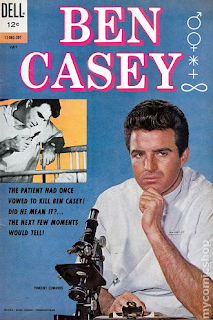
Finally, while we've yet to welcome Cleveland Amory to the scene, the very able Gilbert Seldes is on hand to provide us with a review of ABC's hit medical series, Ben Casey. And Mr. Seldes proves himself able indeed as he describes, "on my honor," the following cases that came up in a single one-hour episode of Casey (and I quote):
  1. A woman who has been coming to the clinic for years with imaginary ailments.
  2. A tough kid, supposed to have swallowed a razor blade.
  3. A rather dear old man whose family is trying to get rid of him, alleging failing memory.
  4. A woman who, so far as I could gather, was sick.
  5. A dipsomaniac.
  6. A man who got an ice pick accidentally in his heart but survived two hours on the city's transit system.
  7. A girl in a state of shock—mute.
  8. A victim of a gang war.
Remember, this all happened in 60 minutes. But, says Seldes, "the individual fragments were sharp and effective," the cases were all presented to viewers in moments, and there was interaction between the characters, As for the elements that tied the story together—well, that's another story: there were "three lectures on medical ethics, two at least on race relations, and assorted lofty epigrams on life, society and fate." And lines such as, "These hands are for healing, not for violence," and "It's the verge of midnight—it could be the verge of a new life." They're only missing exclamation points to make it complete.

Maybe the story isn't very true to life. Most certainly the dialog from the doctors and nurses isn't. But the episode was exciting, which I suppose is what's important. And a tip to the writers: if the characters "shortened their sentences and spoke like human beings we could have three more episodes as good as the eight we got—in an hour!" TV